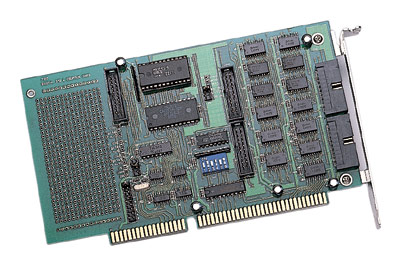
Comprehensive Product Summary: ADLINK ACL‑7122 144‑bit Digital I/O Card
### 1. Product Overview
Product Name: ACL‑7122
Model Number: ACL‑7122
Series: NuDAQ ISA Digital I/O Series
Article Number: ACL‑7122
Manufacturer: ADLINK Technology Inc.
Manufacturer Website: [www.adlink.com.tw](http://www.adlink.com.tw)
Product Type: High‑density 144‑channel Digital Input/Output (DIO) Card
Bus Interface: ISA Bus
Manual Revision: 3.42 (April 15, 2000)
The ADLINK ACL‑7122 is a high‑density parallel digital I/O expansion card designed for industrial and laboratory automation systems. It provides 144 TTL/DTL‑compatible digital I/O channels, emulating six Intel 8255 Programmable Peripheral Interface (PPI) devices operating in Mode 0. The card is part of ADLINK’s NuDAQ product line, offering robust digital interfacing capabilities for PC‑based control and monitoring applications.
### 2. Key Features
- High‑Density I/O: 144 TTL/DTL‑compatible digital input/output lines organized as six 24‑channel groups.
- 8255 Mode 0 Emulation: Fully emulates six industry‑standard 8255 PPIs, each providing three 8‑bit ports (PA, PB, PC).
- Buffered Circuit Design: Ensures higher current driving capability and signal integrity.
- OPTO‑22 Compatibility: Directly interfaces with OPTO‑22 compatible I/O modules and terminal boards.
- Programmable Interrupt Sources: Supports multiple interrupt levels (IRQ3–15) with jumper‑selectable configuration.
- Output Status Read‑Back: Allows software to verify output states.
- Hardware/Software Compatibility: Fully compatible with Advantech PCL‑722.
- Compact Form Factor: Suitable for installation in standard or compact ISA chassis.
- Software Support: Compatible with DOS, Windows 95/98/NT, and LabVIEW environments via ADLINK’s ACLS‑DLL1 and ACLS‑LVIEW libraries.
- Flexible Address Mapping: Selectable 96‑bit or 144‑bit operation modes to avoid I/O address conflicts.
- Tri‑State Interrupt Lines: Enables multiple ACL‑7122 boards to share the same IRQ line.
- Industrial‑Grade Reliability: Designed for continuous operation in industrial environments (0°C–55°C).
### 3. Technical Specifications
Digital I/O Characteristics
- Number of Channels: 144 TTL/DTL‑compatible digital I/O lines
- Configuration: Six 24‑bit ports (each emulating one 8255 PPI)
- Port Structure:
- Port A: 8‑bit
- Port B: 8‑bit
- Port C: 8‑bit (split into two 4‑bit nibbles)
Input Characteristics
- Logic High Voltage: 2.0 V (min), 5.25 V (max)
- Logic Low Voltage: 0.0 V (min), 0.8 V (max)
- Logic High Current: 22 µA @ 5 V
- Logic Low Current: –0.2 mA @ 0 V
Output Characteristics (Ports A & B)
- Logic High Voltage: ≥ 2.4 V
- Logic Low Voltage: ≤ 0.5 V
- Logic High Current (source): –2.6 mA
- Logic Low Current (sink): 24 mA
Output Characteristics (Port C)
- Logic High Voltage: ≥ 2.4 V
- Logic Low Voltage: ≤ 0.5 V
- Logic High Current (source): –15 mA
- Logic Low Current (sink): 24 mA
General Specifications
- I/O Base Address: 16 or 32 consecutive address locations (configurable)
- Interrupt Levels: IRQ 3, 5, 6, 7, 9, 10, 11, 12, 15 (jumper‑selectable)
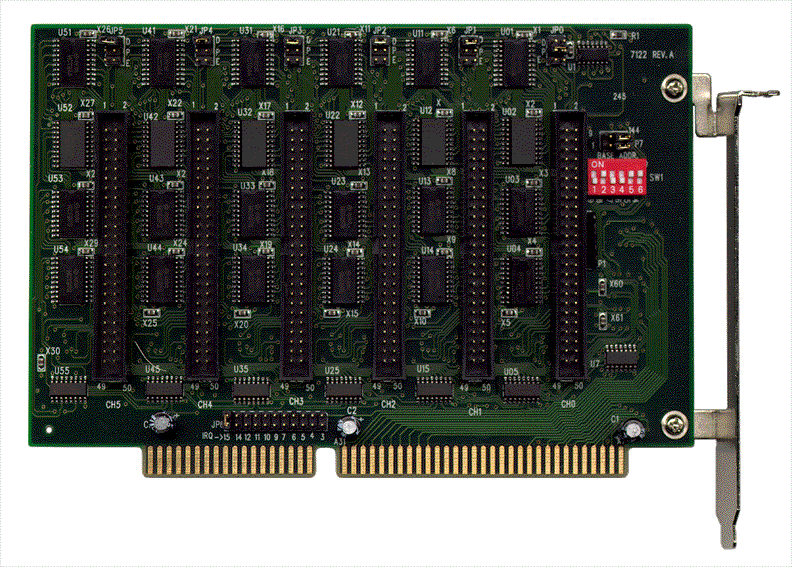
- Connectors: Six 50‑pin male ribbon cable connectors (IDC type)
- Power Consumption: +5 V @ 1.4 A typical, 1.8 A max
- Dimensions: 183 mm (L) × 119 mm (W)
- Operating Temperature: 0 °C to 55 °C
- Storage Temperature: –20 °C to 80 °C
- Humidity: 5 % to 95 %, non‑condensing
### 4. Functionality
The ACL‑7122 functions as a high‑density digital I/O interface for PC‑based control systems. It connects to the ISA bus and provides six independent 8255‑compatible I/O blocks. Each block offers three 8‑bit ports (PA, PB, PC), configurable as input or output through software control words.
Operation Modes:
- Mode 0 (Simple I/O): Each port can be independently programmed as input or output. Outputs are latched; inputs are not.
- Interrupt Handling: Two lines (PC0 and PC3) per channel can generate hardware interrupts on rising or falling edges.
Use Cases and Applications:
- Industrial process control and automation
- Machine and equipment monitoring
- Digital signal acquisition and control
- Contact closure and switch/keyboard monitoring
- Integration with OPTO‑22 relay and input modules
- Laboratory data acquisition and test systems
Compatibility:
- Fully compatible with Advantech PCL‑722 hardware and software.
- Supports DOS, Windows 95/98/NT, and LabVIEW environments.
- Works with ADLINK’s ACLS‑DLL1 (Windows DLL) and ACLS‑LVIEW (LabVIEW VI library).
### 5. Components & Accessories
Included Items:
- ACL‑7122 144‑bit Digital I/O Card
- ADLINK Product CD (includes DOS library, utilities, and documentation)
- User’s Guide (PDF or printed manual)
Optional Accessories:
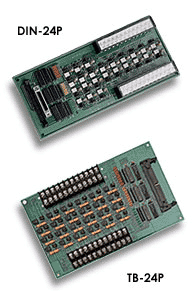
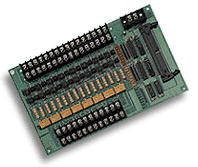
- TB‑24R / DIN‑24R: 24 Form‑C relay output terminal boards
- TB‑24P / DIN‑24P: 24 opto‑isolated digital input terminal boards
- TB‑16P8R: 16 opto‑isolated inputs and 8 relay outputs combined board
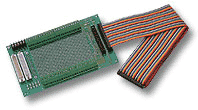
- Ribbon Cables: 50‑pin flat cables for connection to terminal boards
- Software Add‑Ons: ACLS‑DLL1 (Windows DLL library), ACLS‑LVIEW (LabVIEW interface)
Connectors:
- Six 50‑pin male IDC connectors (CN0–CN5)
- Each connector corresponds to one 8255‑emulated channel (24 I/O lines)
- OPTO‑22 compatible pin assignment for direct module interfacing
### 6. Installation & Setup
Pre‑Installation Handling:
- Handle the card on a grounded anti‑static mat.
- Use an anti‑static wrist strap.
- Inspect for shipping damage before installation.
Installation Steps:
1. Verify package contents.
2. Identify jumper and DIP switch locations on the PCB.
3. Configure base address and interrupt settings.
4. Insert the card into an available ISA slot.
5. Install the DOS or Windows software library from the ADLINK CD.
Configuration Options:
- DIO Mode Selection (SW2):
- 144‑bit mode (default): occupies 32 I/O addresses.
- 96‑bit mode: occupies 16 I/O addresses (for address conflict avoidance).
- Base Address Setting (SW1):
- Selectable within 0x200–0x3FF range.
- Default base address: 0x2C0.
- Interrupt Level (JP6):
- Selectable IRQ3, 5, 6, 7, 9, 10, 11, 12, 15 (default IRQ15).
- Interrupt Enable (JP0–JP5):
- Configurable per channel: Disabled (D), Programmable (P), or Enabled (E).
Software Installation (DOS):
1. Insert ADLINK CD.
2. Navigate to directory: `X:\NuDAQISA\7122`
3. Run `SETUP` to install DOS library and utilities to `C:\ADLINK\7122\DOS`.
Windows Programming:
- Install ACLS‑DLL1 for Windows 95/98/NT.
- Use Visual Basic, Visual C++, or Delphi for application development.
- For LabVIEW integration, install ACLS‑LVIEW.
### 7. Performance & Capabilities
Speed and Responsiveness:
- Direct ISA bus access ensures low‑latency digital I/O operations.
- Hardware buffering supports reliable high‑speed switching.
- Interrupt‑driven operation allows event‑based control.
Capacity:
- 144 digital I/O lines per card.
- Multiple cards can be installed in one system (address and IRQ configurable).
Efficiency:
- Buffered outputs reduce CPU overhead.
- Output status read‑back enables verification without additional hardware.
Limitations:
- ISA bus interface limits use to legacy or industrial PCs with ISA slots.
- Inputs are not latched; simultaneous event detection requires software polling.
- No first‑event trapping for interrupts (edge‑triggered only).
Power and Thermal Performance:
- Typical consumption: 7 W (1.4 A @ 5 V).
- Operates reliably within 0–55 °C ambient temperature.
### 8. Standards & Compliance
Electrical Interface:
- TTL/DTL logic level compatibility.
- OPTO‑22 standard pinout for external module interfacing.
Bus Interface:
- Fully compliant with ISA bus electrical and timing specifications.
Software Standards:
- Compatible with standard 8255 PPI programming model.
- Supports high‑level languages (C, BASIC, Pascal) and assembly.
- Windows DLL and LabVIEW VI libraries conform to ADLINK NuDAQ API standards.
Regulatory Compliance:
- Designed and manufactured under ADLINK’s ISO‑certified quality system.
- Meets industrial environmental and EMC design guidelines (non‑condensing humidity, extended temperature range).
### 9. Additional Information
Warranty:
- Duration: 1 year from date of purchase.
- Coverage: Defects in materials and workmanship.
- Exclusions:
- Damage from misuse, modification, or operation beyond specifications.
- Units with removed or altered serial numbers.
- Consequential damages are excluded; liability limited to purchase price.
- Service Procedure:
- Return product postage‑prepaid and securely packaged.
- Include proof of purchase for warranty validation.
Technical Support Contacts:
- Sales & Service: service@adlink.com.tw
- NuDAQ Technical Support: nudaq@adlink.com.tw
- NuDAM Support: nudam@adlink.com.tw
- NuIPC Support: nuipc@adlink.com.tw
- NuPRO Support: nupro@adlink.com.tw
- Software Support: sw@adlink.com.tw
- Address: 9F, No. 166, Jian Yi Road, Chungho City, Taipei 235, Taiwan, R.O.C.
- Telephone: +886‑2‑8226‑5877
- Fax: +886‑2‑8226‑5717
Maintenance:
- Keep connectors and contacts clean and free of dust.
- Avoid exposure to moisture or corrosive environments.
- Periodically verify jumper and DIP switch settings if reconfigurations occur.
Software Updates:
- Updated drivers and libraries available through ADLINK’s website.
- ACLS‑DLL1 and ACLS‑LVIEW updates ensure compatibility with newer Windows and LabVIEW versions.
Documentation:
- User’s Guide (Rev. 3.42) provides detailed configuration, register maps, and programming examples.
- Example C programs demonstrate initialization, I/O operations, and interrupt handling.
### Summary
The ADLINK ACL‑7122 is a robust, high‑density 144‑bit digital I/O card engineered for industrial automation, data acquisition, and control applications. Its six 8255‑compatible I/O groups provide flexible digital interfacing, while its buffered outputs and programmable interrupts enable reliable, event‑driven operation. With full OPTO‑22 compatibility, comprehensive software support, and flexible configuration options, the ACL‑7122 remains a versatile solution for legacy ISA‑based control systems requiring extensive digital I/O capacity and precise hardware control.


 SUCHEN SIE DIE PASSENDE
 A7122 Manual.PDF
Manual
A7122 Manual.PDF
Manual