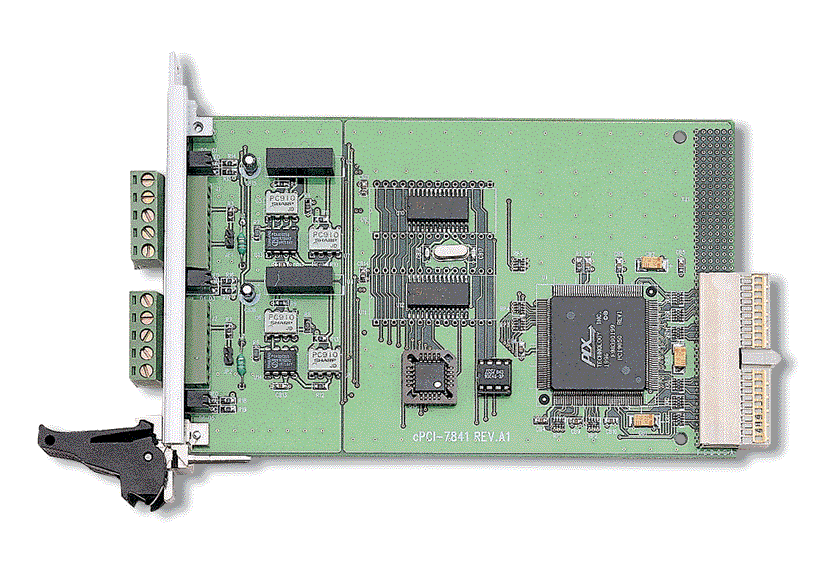
Comprehensive Product Summary: ADLINK cPCI‑7841 Dual‑Port Isolated CAN Interface Card
### 1. Product Overview
Product Name: cPCI‑7841
Model: cPCI‑7841
Series: PCI‑7841 / cPCI‑7841 / PM‑7841 CAN Interface Card Family
Article Number: cPCI‑7841
Manufacturer: ADLINK Technology Inc.
Product Type: CompactPCI Dual‑Port Isolated Controller Area Network (CAN) Interface Card
Release Information:
- First Edition: June 1, 1998
- Revision 3.00: May 28, 2000
Trademark: PCI‑7841, cPCI‑7841, and PM‑7841 are registered trademarks of ADLINK Technology Inc.
The ADLINK cPCI‑7841 is a CompactPCI‑based dual‑port isolated CAN interface card designed for industrial PC systems requiring reliable, high‑speed communication over Controller Area Network (CAN) buses. It is part of ADLINK’s 7841 series, which also includes PCI‑7841 (for standard PCI bus) and PM‑7841 (for PC‑104 bus). The cPCI‑7841 provides two independent CAN channels that can operate separately or in bridged mode, supporting CAN 2.0A and 2.0B protocols. It is engineered for industrial automation, process control, and manufacturing test environments where deterministic, noise‑immune communication is essential.
### 2. Key Features
- Dual Independent CAN Channels: Two fully isolated CAN ports capable of independent or bridged operation.
- CAN Specification Compliance: Fully compatible with Bosch CAN Specification 2.0A (11‑bit ID) and 2.0B (29‑bit ID).
- Optical Isolation: 2500 Vrms galvanic isolation between CAN channels and system bus for enhanced noise immunity and protection.
- High‑Speed Communication: Programmable transfer rates up to 1 Mbps; supports standard DeviceNet baud rates of 125 Kbps, 250 Kbps, and 500 Kbps.
- Bridge Function: Enables inter‑CAN communication or network bridging between two CAN buses.
- Direct Memory Mapping: Provides direct memory‑mapped access to CAN controllers for low‑latency data exchange.
- Integrated CAN Controller: Utilizes Philips SJA1000 CAN controller for robust bus arbitration, error detection, and automatic retransmission.
- CAN Transceiver: Employs Philips 82C250 transceivers for reliable differential signaling (CAN_H, CAN_L).
- Plug‑and‑Play Configuration: Fully compliant with CompactPCI plug‑and‑play architecture; no manual jumper configuration required.
- Software Support: Includes DOS libraries, Windows 95/98/NT drivers, and example programs.
- Application Layer Support: Provides master interface support for CANopen, DeviceNet, and Smart Distributed System (SDS) protocols.
- Industrial‑Grade Design: Wide operating temperature range (0 °C – 60 °C) and humidity tolerance (5 % – 95 % non‑condensing).
- Comprehensive Software API: Extensive function library for CAN and DeviceNet operations, including message handling, error management, and event callbacks.
### 3. Technical Specifications
Bus Interface: CompactPCI (cPCI)
Ports: 2 independent CAN channels (CAN 2.0 A/B compliant)
CAN Controller: Philips SJA1000
CAN Transceiver: Philips 82C250
Signal Lines: CAN_H, CAN_L
Isolation Voltage: 2500 Vrms (optical isolation)
Connectors: Dual male connectors (CompactPCI front panel type)
Baud Rate Support: 125 Kbps, 250 Kbps, 500 Kbps, 1 Mbps (user‑programmable)
Power Consumption:
- Typical: 400 mA @ +5 VDC
- Maximum: 900 mA @ +5 VDC (without external devices)
Dimensions: 132 mm (L) × 98 mm (H)
Operating Temperature: 0 °C – 60 °C
Storage Temperature: −20 °C – 80 °C
Relative Humidity: 5 % – 95 % (non‑condensing)
IRQ Level: Assigned automatically by Plug‑and‑Play BIOS
I/O Port Address: Assigned automatically by Plug‑and‑Play BIOS
Isolation Type: Optical isolation between CAN bus and system bus
Form Factor: CompactPCI 3U module
### 4. Functionality
The cPCI‑7841 functions as a dual‑channel CAN interface card for CompactPCI systems. Each channel operates independently, allowing simultaneous communication with two separate CAN networks or bridging between them. The onboard SJA1000 controller manages message arbitration, error detection, and retransmission, ensuring deterministic and reliable communication even in noisy industrial environments.
Typical Use Cases:
- Industrial automation and process control systems
- Factory and manufacturing automation
- Distributed control systems (DCS)
- Product testing and data acquisition
- DeviceNet and CANopen master or slave implementations
- Machine‑to‑machine communication in embedded control networks
Compatibility:
- Operating Systems: DOS, Windows 95/98/NT
- Supported Protocols: CANopen, DeviceNet, SDS
- Software Interface: ADLINK CAN library (C/C++ and Visual Basic APIs)
Communication Capabilities:
- Supports both standard (11‑bit) and extended (29‑bit) CAN identifiers.
- Provides automatic baud‑rate detection and configuration.
- Offers direct register access for low‑level control and diagnostics.
- Supports interrupt‑driven and polling modes for message handling.
### 5. Components & Accessories
Package Contents:
- cPCI‑7841 Dual‑Port CompactPCI Isolated CAN Interface Card
- ADLINK “All‑xxxxxx” CD‑ROM containing drivers, libraries, and documentation
- User’s Manual
On‑Board Components:
- Two CAN transceiver channels (82C250)
- Two SJA1000 CAN controllers
- Optical isolation circuitry (2500 Vrms)
- Dual CAN connectors (J1, J2)
- Termination jumpers (JP1, JP2) for 120 Ω resistors per port
- Status LEDs for port activity and diagnostics
Optional Accessories:
- CAN bus cables (DB‑9 or cPCI‑specific connectors)
- External termination resistors (if required for network topology)
- Software development kit (SDK) for advanced integration
### 6. Installation & Setup
Pre‑Installation Precautions:
- Handle the card on a grounded anti‑static mat.
- Wear a grounded anti‑static wrist strap.
- Inspect packaging for shipping damage before installation.
Installation Steps:
1. Power off the CompactPCI system and disconnect power.
2. Insert the cPCI‑7841 card into an available CompactPCI slot.
3. Secure the module using the front‑panel screws.
4. Connect CAN network cables to connectors J1 and J2.
5. Configure termination resistors using jumpers JP1 (Port 0) and JP2 (Port 1).
6. Power on the system; the card will be automatically detected by the BIOS.
7. Install the ADLINK driver and software library from the provided CD‑ROM.
Termination Configuration:
- Each CAN port includes a 120 Ω termination resistor.
- JP1 enables/disables termination for Port 0; JP2 for Port 1.
- Proper termination is required at both ends of the CAN bus to minimize reflections.
Software Setup:
- Install ADLINK CAN driver for DOS or Windows.
- Use provided API functions to open, configure, and operate CAN ports.
- Example programs demonstrate message transmission, reception, and error handling.
### 7. Performance & Capabilities
Communication Speed: Up to 1 Mbps per channel
Supported Baud Rates: 125 Kbps, 250 Kbps, 500 Kbps, 1 Mbps (user‑defined option available)
Isolation Protection: 2500 Vrms optical isolation between CAN and system bus
Error Handling:
- Automatic retransmission on error
- Bus arbitration and error detection per CAN 2.0 B specification
- Software functions for error code retrieval, warning limits, and error counters
Data Handling:
- Hardware FIFO buffer (64 bytes) per channel
- Software driver buffer for extended message queuing
- Supports up to 21 CAN packets in hardware FIFO
Software API Highlights:
- Initialization: `CanOpenDriver()`, `CanCloseDriver()`, `CanConfigPort()`
- I/O Operations: `CanSendMsg()`, `CanRcvMsg()`, `CanRead()`, `CanWrite()`
- Error Management: `CanGetErrorCode()`, `CanClearOverrun()`, `CanSetErrorWarningLimit()`
- Event Handling: `CanInstallCallBack()` (DOS), `CanInstallEvent()` (Windows)
- DeviceNet Functions: `SendDeviceNetPacket()`, `RcvDeviceNetPacket()`, `DNetScan()`, `DNetSetBaud()`, `DNetSetID()`
Performance Characteristics:
- Deterministic message timing with low latency
- High noise immunity suitable for industrial environments
- Efficient interrupt‑driven communication
- Supports both master and slave roles in CANopen/DeviceNet networks
Limitations:
- Designed for legacy operating systems (DOS, Windows 95/98/NT)
- Requires CompactPCI slot (not compatible with standard PCI or PC‑104 without corresponding model)
- Maximum isolation voltage limited to 2500 Vrms
### 8. Standards & Compliance
Bus Standard: CompactPCI (PICMG 2.0 compliant)
Communication Standard: CAN 2.0 A/B (Bosch specification)
Supported Protocols: CANopen, DeviceNet, SDS
Electrical Isolation: 2500 Vrms optical isolation per IEC 61010‑1 industrial safety standards
Environmental Compliance:
- Operating temperature: 0 °C – 60 °C
- Storage temperature: −20 °C – 80 °C
- Humidity: 5 % – 95 % non‑condensing
Regulatory Compliance:
- CE compliant (industrial EMC standards)
- Designed for industrial automation and control equipment per EN 61000‑6‑2/‑6‑4
### 9. Additional Information
Warranty: Standard ADLINK limited hardware warranty (typically one year; refer to manufacturer policy).
Technical Support:
- ADLINK provides driver updates, software libraries, and technical documentation via its support portal.
- Example source code and API references are included on the installation CD.
Maintenance:
- No periodic maintenance required beyond standard ESD handling.
- Ensure proper ventilation and avoid exposure to excessive humidity or vibration.
Firmware & Software Updates:
- Driver and library updates available for supported operating systems.
- Backward‑compatible with earlier PCI‑7841 and PM‑7841 software interfaces.
Developer Resources:
- Comprehensive C/C++ and Visual Basic APIs for CAN and DeviceNet operations.
- Structures such as `PORT_STRUCT`, `CAN_PACKET`, and `DEVICENET_PACKET` define communication parameters and message formats.
- Functions for configuration, message transmission, reception, error monitoring, and LED control.
Example Functional Capabilities:
- Auto Baud‑Rate Detection: `CanDetectBaudrate()` automatically determines network speed.
- Error Counters: `CanGetRxErrorCount()` and `CanGetTxErrorCount()` monitor bus health.
- LED Control: `CanGetLedStatus()` and `CanSetLedStatus()` manage onboard indicators.
- DeviceNet Management: Functions for scanning (`DNetScan()`), connection control (`DNetOpenExp()`, `DNetCloseIO()`), and parameter configuration (`DNetSetBaud()`, `DNetSetID()`).
Support for DeviceNet Object Classes:
- Identity, DeviceNet, Connection (Explicit and Poll‑IO), Assembly Input/Output, and Watchdog configuration objects are accessible through dedicated API calls.
Reliability & Safety:
- Optical isolation ensures protection against ground loops and electrical surges.
- Automatic retransmission and error correction maintain data integrity.
- Designed for continuous operation in industrial environments.
### Summary
The ADLINK cPCI‑7841 Dual‑Port Isolated CAN Interface Card is a robust, high‑performance communication interface for CompactPCI systems, enabling reliable integration of industrial PCs into CAN‑based control networks. With dual isolated channels, full CAN 2.0 A/B compliance, and comprehensive software support for DeviceNet and CANopen, it provides a flexible platform for automation, process control, and embedded communication applications. Its plug‑and‑play architecture, optical isolation, and extensive API library make it a preferred choice for developers and system integrators requiring deterministic, fault‑tolerant CAN communication in industrial environments.


 SUCHEN SIE DIE PASSENDE
 cPCI-3E10+3E12_Datasheet_en_1.pdf
PDF Catalog
cPCI-3E10+3E12_Datasheet_en_1.pdf
PDF Catalog
 PCI7841 Manual.PDF
Manual
PCI7841 Manual.PDF
Manual