MAQ20-COM2
SUCHEN SIE DIE PASSENDE
INDUSTRIELLE LÖSUNG?
Entdecken Sie Embedded-, Kommunikations- und Automatisierungslösungen für Ihre Anwendung.
- Four Independent Input Channels: Supports up to four bridge or strain gage sensors per module, enabling multi-point measurement within a single compact unit.
- 4- or 6-Wire Bridge Compatibility: Accommodates both 4-wire and 6-wire configurations, allowing for flexible sensor connection and compensation for lead wire resistance.
- High Input-to-Bus Isolation: Provides 1500 Vrms isolation between input channels and system bus, ensuring signal integrity and protection against ground loops and electrical interference.
- DIN Rail Mounting: Designed for direct installation on a DIN rail, integrating mechanically and electrically with the MAQ20 backbone for streamlined system assembly.
- Compact Form Factor: Space-efficient design with dimensions of 114.6 mm (L) × 82.8 mm (H) × 15.3 mm (W), allowing dense channel packing in control cabinets.
- High Accuracy and Stability: Engineered for precise strain and load measurements, suitable for demanding industrial monitoring and control applications.
- Modular System Integration: Fully compatible with the MAQ20 system architecture, enabling easy expansion, configuration, and maintenance.
- Industrial-Grade Reliability: Built to operate in harsh environments with robust electrical isolation, noise immunity, and long-term stability.
- 4- or 6-Wire Bridge Compatibility: Accommodates both 4-wire and 6-wire configurations, allowing for flexible sensor connection and compensation for lead wire resistance.
- High Input-to-Bus Isolation: Provides 1500 Vrms isolation between input channels and system bus, ensuring signal integrity and protection against ground loops and electrical interference.
- DIN Rail Mounting: Designed for direct installation on a DIN rail, integrating mechanically and electrically with the MAQ20 backbone for streamlined system assembly.
- Compact Form Factor: Space-efficient design with dimensions of 114.6 mm (L) × 82.8 mm (H) × 15.3 mm (W), allowing dense channel packing in control cabinets.
- High Accuracy and Stability: Engineered for precise strain and load measurements, suitable for demanding industrial monitoring and control applications.
- Modular System Integration: Fully compatible with the MAQ20 system architecture, enabling easy expansion, configuration, and maintenance.
- Industrial-Grade Reliability: Built to operate in harsh environments with robust electrical isolation, noise immunity, and long-term stability.
1. Product Overview
Name: MAQ20-BRDG1
Model: MAQ20-BRDG1
Series: MAQ20 Data Acquisition and Control System
Article Number: MAQ20-BRDG1
Manufacturer: Dataforth Corporation
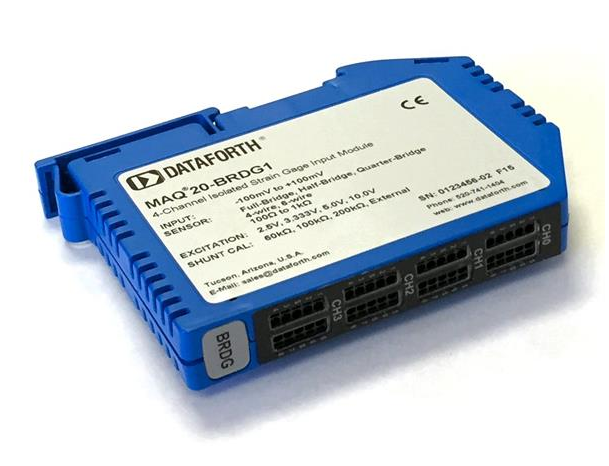
The Dataforth MAQ20-BRDG1 is a high-performance, DIN rail–mounted bridge and strain gage input module designed for precision measurement applications within the MAQ20 modular data acquisition and control system. It provides four independent input channels capable of interfacing with 4-wire or 6-wire bridge and strain gage sensors. The module integrates seamlessly into the MAQ20 backbone, offering robust signal conditioning, high isolation, and reliable data acquisition for industrial and laboratory environments.
2. Key Features
- Four Independent Input Channels: Supports up to four bridge or strain gage sensors per module, enabling multi-point measurement within a single compact unit.
- 4- or 6-Wire Bridge Compatibility: Accommodates both 4-wire and 6-wire configurations, allowing for flexible sensor connection and compensation for lead wire resistance.
- High Input-to-Bus Isolation: Provides 1500 Vrms isolation between input channels and system bus, ensuring signal integrity and protection against ground loops and electrical interference.
- DIN Rail Mounting: Designed for direct installation on a DIN rail, integrating mechanically and electrically with the MAQ20 backbone for streamlined system assembly.
- Compact Form Factor: Space-efficient design with dimensions of 114.6 mm (L) × 82.8 mm (H) × 15.3 mm (W), allowing dense channel packing in control cabinets.
- High Accuracy and Stability: Engineered for precise strain and load measurements, suitable for demanding industrial monitoring and control applications.
- Modular System Integration: Fully compatible with the MAQ20 system architecture, enabling easy expansion, configuration, and maintenance.
- Industrial-Grade Reliability: Built to operate in harsh environments with robust electrical isolation, noise immunity, and long-term stability.
3. Technical Specifications
- Model: MAQ20-BRDG1
- Input Type: Bridge / Strain Gage
- Number of Channels: 4 independent channels
- Bridge Configuration: 4-wire or 6-wire
- Mounting Type: DIN rail mount (to MAQ20 backbone)
- Input-to-Bus Isolation: 1500 Vrms
- Dimensions: 114.6 mm (length) × 82.8 mm (height) × 15.3 mm (width)
- Weight: Approximately 100–150 g (typical for MAQ20 modules; exact weight may vary)
- Material: Industrial-grade polycarbonate housing with integrated DIN rail clip
- Operating Temperature Range: Typically -40°C to +85°C (consistent with MAQ20 system modules)
- Storage Temperature Range: -40°C to +85°C
- Relative Humidity: 0–95% non-condensing
- Power Supply: Provided via MAQ20 backbone bus
- Signal Isolation: 1500 Vrms input-to-bus
- Interface: MAQ20 system bus (digital communication to controller module)
- Mounting Orientation: Vertical DIN rail installation
- Color/Finish: Standard MAQ20 gray enclosure with printed channel identification
4. Functionality
The MAQ20-BRDG1 functions as a precision input module for measuring signals from bridge-based sensors such as strain gages, load cells, torque transducers, and pressure sensors. Each of its four channels can independently measure the differential voltage output from a bridge circuit, converting it into a digital value accessible through the MAQ20 system bus.
The module supports both 4-wire and 6-wire bridge configurations:
- 4-Wire Mode: Standard connection for most strain gage sensors, where excitation and sense leads are combined.
- 6-Wire Mode: Provides separate sense leads for excitation voltage feedback, compensating for lead resistance and ensuring accurate measurement over long cable runs.
Use Cases and Applications:
- Structural load and stress monitoring
- Industrial weighing systems
- Material testing and fatigue analysis
- Process control and automation systems
- Research and development laboratories
- Aerospace and automotive component testing
- Machine condition monitoring
Compatibility:
The MAQ20-BRDG1 is fully compatible with all MAQ20 system backplanes and controllers, including the MAQ20-COMx communication modules and MAQ20-BKxx backplanes. It integrates seamlessly into mixed-module configurations, allowing users to combine analog input, analog output, digital I/O, and specialty modules within a single system.
5. Components & Accessories
Included Items:
- MAQ20-BRDG1 module
- Integrated DIN rail mounting clip
- Channel identification labeling
- Quick-start documentation (typically included with MAQ20 modules)
Optional Accessories:
- MAQ20-BKxx Backplane: Provides power and communication bus for up to 16 modules.
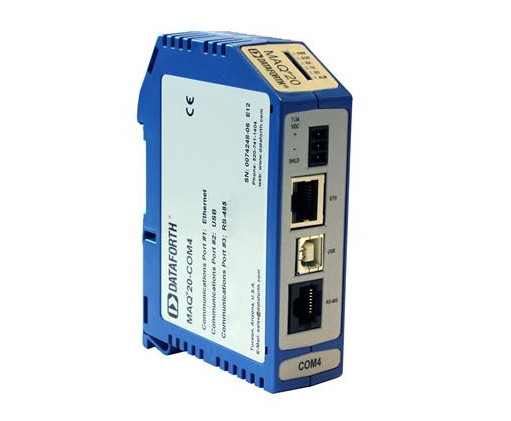
- MAQ20-COMx Communication Module: Interfaces the MAQ20 system with host computers via Ethernet, USB, or serial communication.
- Bridge/Strain Gage Sensors: Compatible with a wide range of third-party sensors.
- Terminal Blocks and Wiring Kits: For secure sensor connections and wiring organization.
- Protective End Caps: For unused backplane slots.
Connectors:
- Front-facing terminal block connectors for sensor wiring (4 or 6 wires per channel).
- Rear bus connector for power and data communication through the MAQ20 backbone.
6. Installation & Setup
Requirements:
- MAQ20 backplane (e.g., MAQ20-BK08, BK16)
- Compatible MAQ20 communication module (e.g., MAQ20-COM2, COM4)
- 24 VDC system power supply (provided through the backplane)
Mounting Options:
- Snap the MAQ20-BRDG1 onto the DIN rail section of the MAQ20 backplane.
- Ensure proper alignment of the rear bus connector with the backplane slot.
- Secure the module by pressing until it clicks into place.
Configuration:
- Connect bridge or strain gage sensors to the front terminal blocks according to the wiring diagram (4-wire or 6-wire).
- Configure channel parameters (excitation voltage, gain, filtering, calibration) via the MAQ20 software interface or host system.
- Verify communication with the MAQ20 controller through the system configuration tool.
Setup Notes:
- Maintain proper grounding and shielding for sensor cables to minimize noise.
- Observe isolation ratings and avoid exceeding input voltage limits.
- Modules can be hot-swapped within the MAQ20 system for maintenance or reconfiguration.
7. Performance & Capabilities
The MAQ20-BRDG1 is engineered for high-precision measurement of low-level signals from resistive bridge sensors. Its design ensures stable excitation, low noise, and accurate digital conversion.
Performance Highlights:
- High Resolution: Supports fine measurement resolution suitable for microstrain-level detection.
- Stable Excitation Source: Provides regulated excitation voltage for consistent sensor performance.
- Low Noise Design: Internal filtering and shielding minimize electrical noise and interference.
- High Common-Mode Rejection: Ensures accurate readings even in electrically noisy environments.
- Fast Sampling Rate: Optimized for real-time monitoring and control applications (sampling rate determined by MAQ20 system controller).
- Channel Independence: Each channel operates independently, allowing simultaneous measurement of multiple sensors.
- Temperature Stability: Designed for minimal drift over wide temperature ranges.
Limitations:
- Requires integration with a MAQ20 backplane and communication module; cannot operate standalone.
- Input range and excitation voltage are fixed within module specifications; external scaling may be required for certain sensors.
- Environmental conditions must remain within specified operating limits for optimal accuracy.
8. Standards & Compliance
The MAQ20-BRDG1 adheres to Dataforth’s stringent quality and safety standards for industrial instrumentation.
Certifications and Compliance:
- CE Marked: Conforms to European safety, health, and environmental protection standards.
- RoHS Compliant: Free from hazardous substances as defined by the Restriction of Hazardous Substances Directive.
- UL Recognized: Meets applicable UL safety requirements for industrial control equipment (typical for MAQ20 modules).
- EMC Compliance: Designed to meet electromagnetic compatibility standards for industrial environments.
- Isolation Rating: 1500 Vrms input-to-bus isolation verified per Dataforth test procedures.
Industry Standards:
- Compatible with IEEE and IEC standards for data acquisition and signal conditioning systems.
- Designed for integration into systems requiring compliance with ISO 9001–certified manufacturing processes.
9. Additional Information
Warranty:
Dataforth typically provides a limited lifetime warranty on MAQ20 modules, covering defects in materials and workmanship under normal use.
Technical Support:
Comprehensive technical support is available through Dataforth’s engineering team, including application assistance, configuration guidance, and troubleshooting.
Maintenance:
- Periodic inspection of wiring and connectors is recommended.
- Calibration intervals depend on application requirements; factory calibration is maintained for long-term stability.
- Modules can be replaced or upgraded without system downtime due to hot-swap capability.
Software & Updates:
- Compatible with Dataforth’s MAQ20 Utility Software for configuration, calibration, and diagnostics.
- Supports firmware updates via the MAQ20 communication module.
- Integrates with third-party SCADA, HMI, and data acquisition software through standard communication protocols (Modbus TCP, Ethernet/IP, etc.).
Service Life & Reliability:
- Designed for continuous operation in industrial environments.
- High MTBF (Mean Time Between Failures) ensures long-term reliability and minimal maintenance.
Environmental Considerations:
- Enclosure materials are recyclable and compliant with environmental directives.
- Low power consumption contributes to energy-efficient system design.
### Summary
The Dataforth MAQ20-BRDG1 is a precision-engineered, four-channel bridge and strain gage input module optimized for integration within the MAQ20 modular data acquisition system. With its 1500 Vrms isolation, support for 4- and 6-wire bridge configurations, and compact DIN rail–mountable design, it delivers exceptional measurement accuracy, reliability, and flexibility for industrial and research applications. The module’s robust construction, compliance with international standards, and seamless compatibility with the MAQ20 ecosystem make it an ideal choice for engineers and system integrators seeking scalable, high-performance signal conditioning solutions.
Approximate Length: ~3,000 tokens (~12,000 characters)

Name: MAQ20-BRDG1
Model: MAQ20-BRDG1
Series: MAQ20 Data Acquisition and Control System
Article Number: MAQ20-BRDG1
Manufacturer: Dataforth Corporation
The Dataforth MAQ20-BRDG1 is a high-performance, DIN rail–mounted bridge and strain gage input module designed for precision measurement applications within the MAQ20 modular data acquisition and control system. It provides four independent input channels capable of interfacing with 4-wire or 6-wire bridge and strain gage sensors. The module integrates seamlessly into the MAQ20 backbone, offering robust signal conditioning, high isolation, and reliable data acquisition for industrial and laboratory environments.
2. Key Features
- Four Independent Input Channels: Supports up to four bridge or strain gage sensors per module, enabling multi-point measurement within a single compact unit.
- 4- or 6-Wire Bridge Compatibility: Accommodates both 4-wire and 6-wire configurations, allowing for flexible sensor connection and compensation for lead wire resistance.
- High Input-to-Bus Isolation: Provides 1500 Vrms isolation between input channels and system bus, ensuring signal integrity and protection against ground loops and electrical interference.
- DIN Rail Mounting: Designed for direct installation on a DIN rail, integrating mechanically and electrically with the MAQ20 backbone for streamlined system assembly.
- Compact Form Factor: Space-efficient design with dimensions of 114.6 mm (L) × 82.8 mm (H) × 15.3 mm (W), allowing dense channel packing in control cabinets.
- High Accuracy and Stability: Engineered for precise strain and load measurements, suitable for demanding industrial monitoring and control applications.
- Modular System Integration: Fully compatible with the MAQ20 system architecture, enabling easy expansion, configuration, and maintenance.
- Industrial-Grade Reliability: Built to operate in harsh environments with robust electrical isolation, noise immunity, and long-term stability.
3. Technical Specifications
- Model: MAQ20-BRDG1
- Input Type: Bridge / Strain Gage
- Number of Channels: 4 independent channels
- Bridge Configuration: 4-wire or 6-wire
- Mounting Type: DIN rail mount (to MAQ20 backbone)
- Input-to-Bus Isolation: 1500 Vrms
- Dimensions: 114.6 mm (length) × 82.8 mm (height) × 15.3 mm (width)
- Weight: Approximately 100–150 g (typical for MAQ20 modules; exact weight may vary)
- Material: Industrial-grade polycarbonate housing with integrated DIN rail clip
- Operating Temperature Range: Typically -40°C to +85°C (consistent with MAQ20 system modules)
- Storage Temperature Range: -40°C to +85°C
- Relative Humidity: 0–95% non-condensing
- Power Supply: Provided via MAQ20 backbone bus
- Signal Isolation: 1500 Vrms input-to-bus
- Interface: MAQ20 system bus (digital communication to controller module)
- Mounting Orientation: Vertical DIN rail installation
- Color/Finish: Standard MAQ20 gray enclosure with printed channel identification
4. Functionality
The MAQ20-BRDG1 functions as a precision input module for measuring signals from bridge-based sensors such as strain gages, load cells, torque transducers, and pressure sensors. Each of its four channels can independently measure the differential voltage output from a bridge circuit, converting it into a digital value accessible through the MAQ20 system bus.
The module supports both 4-wire and 6-wire bridge configurations:
- 4-Wire Mode: Standard connection for most strain gage sensors, where excitation and sense leads are combined.
- 6-Wire Mode: Provides separate sense leads for excitation voltage feedback, compensating for lead resistance and ensuring accurate measurement over long cable runs.
Use Cases and Applications:
- Structural load and stress monitoring
- Industrial weighing systems
- Material testing and fatigue analysis
- Process control and automation systems
- Research and development laboratories
- Aerospace and automotive component testing
- Machine condition monitoring
Compatibility:
The MAQ20-BRDG1 is fully compatible with all MAQ20 system backplanes and controllers, including the MAQ20-COMx communication modules and MAQ20-BKxx backplanes. It integrates seamlessly into mixed-module configurations, allowing users to combine analog input, analog output, digital I/O, and specialty modules within a single system.
5. Components & Accessories
Included Items:
- MAQ20-BRDG1 module
- Integrated DIN rail mounting clip
- Channel identification labeling
- Quick-start documentation (typically included with MAQ20 modules)
Optional Accessories:
- MAQ20-BKxx Backplane: Provides power and communication bus for up to 16 modules.
- MAQ20-COMx Communication Module: Interfaces the MAQ20 system with host computers via Ethernet, USB, or serial communication.
- Bridge/Strain Gage Sensors: Compatible with a wide range of third-party sensors.
- Terminal Blocks and Wiring Kits: For secure sensor connections and wiring organization.
- Protective End Caps: For unused backplane slots.
Connectors:
- Front-facing terminal block connectors for sensor wiring (4 or 6 wires per channel).
- Rear bus connector for power and data communication through the MAQ20 backbone.
6. Installation & Setup
Requirements:
- MAQ20 backplane (e.g., MAQ20-BK08, BK16)
- Compatible MAQ20 communication module (e.g., MAQ20-COM2, COM4)
- 24 VDC system power supply (provided through the backplane)
Mounting Options:
- Snap the MAQ20-BRDG1 onto the DIN rail section of the MAQ20 backplane.
- Ensure proper alignment of the rear bus connector with the backplane slot.
- Secure the module by pressing until it clicks into place.
Configuration:
- Connect bridge or strain gage sensors to the front terminal blocks according to the wiring diagram (4-wire or 6-wire).
- Configure channel parameters (excitation voltage, gain, filtering, calibration) via the MAQ20 software interface or host system.
- Verify communication with the MAQ20 controller through the system configuration tool.
Setup Notes:
- Maintain proper grounding and shielding for sensor cables to minimize noise.
- Observe isolation ratings and avoid exceeding input voltage limits.
- Modules can be hot-swapped within the MAQ20 system for maintenance or reconfiguration.
7. Performance & Capabilities
The MAQ20-BRDG1 is engineered for high-precision measurement of low-level signals from resistive bridge sensors. Its design ensures stable excitation, low noise, and accurate digital conversion.
Performance Highlights:
- High Resolution: Supports fine measurement resolution suitable for microstrain-level detection.
- Stable Excitation Source: Provides regulated excitation voltage for consistent sensor performance.
- Low Noise Design: Internal filtering and shielding minimize electrical noise and interference.
- High Common-Mode Rejection: Ensures accurate readings even in electrically noisy environments.
- Fast Sampling Rate: Optimized for real-time monitoring and control applications (sampling rate determined by MAQ20 system controller).
- Channel Independence: Each channel operates independently, allowing simultaneous measurement of multiple sensors.
- Temperature Stability: Designed for minimal drift over wide temperature ranges.
Limitations:
- Requires integration with a MAQ20 backplane and communication module; cannot operate standalone.
- Input range and excitation voltage are fixed within module specifications; external scaling may be required for certain sensors.
- Environmental conditions must remain within specified operating limits for optimal accuracy.
8. Standards & Compliance
The MAQ20-BRDG1 adheres to Dataforth’s stringent quality and safety standards for industrial instrumentation.
Certifications and Compliance:
- CE Marked: Conforms to European safety, health, and environmental protection standards.
- RoHS Compliant: Free from hazardous substances as defined by the Restriction of Hazardous Substances Directive.
- UL Recognized: Meets applicable UL safety requirements for industrial control equipment (typical for MAQ20 modules).
- EMC Compliance: Designed to meet electromagnetic compatibility standards for industrial environments.
- Isolation Rating: 1500 Vrms input-to-bus isolation verified per Dataforth test procedures.
Industry Standards:
- Compatible with IEEE and IEC standards for data acquisition and signal conditioning systems.
- Designed for integration into systems requiring compliance with ISO 9001–certified manufacturing processes.
9. Additional Information
Warranty:
Dataforth typically provides a limited lifetime warranty on MAQ20 modules, covering defects in materials and workmanship under normal use.
Technical Support:
Comprehensive technical support is available through Dataforth’s engineering team, including application assistance, configuration guidance, and troubleshooting.
Maintenance:
- Periodic inspection of wiring and connectors is recommended.
- Calibration intervals depend on application requirements; factory calibration is maintained for long-term stability.
- Modules can be replaced or upgraded without system downtime due to hot-swap capability.
Software & Updates:
- Compatible with Dataforth’s MAQ20 Utility Software for configuration, calibration, and diagnostics.
- Supports firmware updates via the MAQ20 communication module.
- Integrates with third-party SCADA, HMI, and data acquisition software through standard communication protocols (Modbus TCP, Ethernet/IP, etc.).
Service Life & Reliability:
- Designed for continuous operation in industrial environments.
- High MTBF (Mean Time Between Failures) ensures long-term reliability and minimal maintenance.
Environmental Considerations:
- Enclosure materials are recyclable and compliant with environmental directives.
- Low power consumption contributes to energy-efficient system design.
### Summary
The Dataforth MAQ20-BRDG1 is a precision-engineered, four-channel bridge and strain gage input module optimized for integration within the MAQ20 modular data acquisition system. With its 1500 Vrms isolation, support for 4- and 6-wire bridge configurations, and compact DIN rail–mountable design, it delivers exceptional measurement accuracy, reliability, and flexibility for industrial and research applications. The module’s robust construction, compliance with international standards, and seamless compatibility with the MAQ20 ecosystem make it an ideal choice for engineers and system integrators seeking scalable, high-performance signal conditioning solutions.
Approximate Length: ~3,000 tokens (~12,000 characters)
-
MAQ20 Brochure.pdf
PDF Catalog
-
MAQ20-BRDG1 MAQ20 Strain Gauge Input Module.pdf
PDF Catalog
- MAQ20-COM2 - Communication Ethernet USB RS232 Module
- MAQ20-COM4 - Communication Ethernet USB RS485 Module
- MAQ20-BKPL4 - DIN Rail backbone, 1*COM plus 4 I/O modules
- MAQ20-BKPL8 - DIN Rail backbone, 1*COM plus 8 I/O modules
- MAQ20-BKPL16 - DIN Rail backbone, 1*COM plus 16 I/O modules
- MAQ20-BKPL24 - DIN Rail backbone, 1*COM plus 24 I/O modules