 SUCHEN SIE DIE PASSENDE
INDUSTRIELLE LÖSUNG?
Entdecken Sie Embedded-, Kommunikations- und Automatisierungslösungen für Ihre Anwendung.
- Integrated Vision, Control, AI, and Motion Modules: The NeuronBot combines multiple subsystems—vision sensing, motion control, and AI computation—into a single cohesive platform.
- Rapid Robotic Development: Designed as a development and demonstration kit, it supports quick prototyping and testing of robotic algorithms and applications.
- ROS/ROS 2 Compatibility: Fully supported by open-source ROS and ROS 2 libraries and packages, enabling seamless integration with existing robotic ecosystems.
- High-Performance Computing: Equipped with Intel® processors (Celeron® or Atom® x5-E3930) and optional Intel® Movidius™ Myriad™ X GPU for AI acceleration.
- Comprehensive Software Stack: Ships with Ubuntu 18.04 LTS, Neuron SDK, and Intel® OpenVINO™ toolkit for AI inference optimization.
- Integrated LIDAR Sensor: 360° RPLIDAR A1 laser distance sensor for mapping, navigation, and obstacle detection.
- Compact and Robust Design: Small form factor (260 × 270 × 260 mm) with a payload capacity of up to 3 kg, suitable for indoor research and educational environments.
- Flexible I/O and Expansion: Multiple USB, Ethernet, GPIO, and PCIe interfaces for peripheral integration and hardware expansion.
- Optional Wireless and Power Accessories: Wi-Fi module, battery pack, and mounting brackets available for enhanced mobility and connectivity.
- Rapid Robotic Development: Designed as a development and demonstration kit, it supports quick prototyping and testing of robotic algorithms and applications.
- ROS/ROS 2 Compatibility: Fully supported by open-source ROS and ROS 2 libraries and packages, enabling seamless integration with existing robotic ecosystems.
- High-Performance Computing: Equipped with Intel® processors (Celeron® or Atom® x5-E3930) and optional Intel® Movidius™ Myriad™ X GPU for AI acceleration.
- Comprehensive Software Stack: Ships with Ubuntu 18.04 LTS, Neuron SDK, and Intel® OpenVINO™ toolkit for AI inference optimization.
- Integrated LIDAR Sensor: 360° RPLIDAR A1 laser distance sensor for mapping, navigation, and obstacle detection.
- Compact and Robust Design: Small form factor (260 × 270 × 260 mm) with a payload capacity of up to 3 kg, suitable for indoor research and educational environments.
- Flexible I/O and Expansion: Multiple USB, Ethernet, GPIO, and PCIe interfaces for peripheral integration and hardware expansion.
- Optional Wireless and Power Accessories: Wi-Fi module, battery pack, and mounting brackets available for enhanced mobility and connectivity.
1. Product Overview
Product Name: NeuronBot
Model Variants: NB-SK, NB-S
Series: NeuronBOT Series
Article Number: NeuronBot
Manufacturer: ADLINK Technology, Inc.
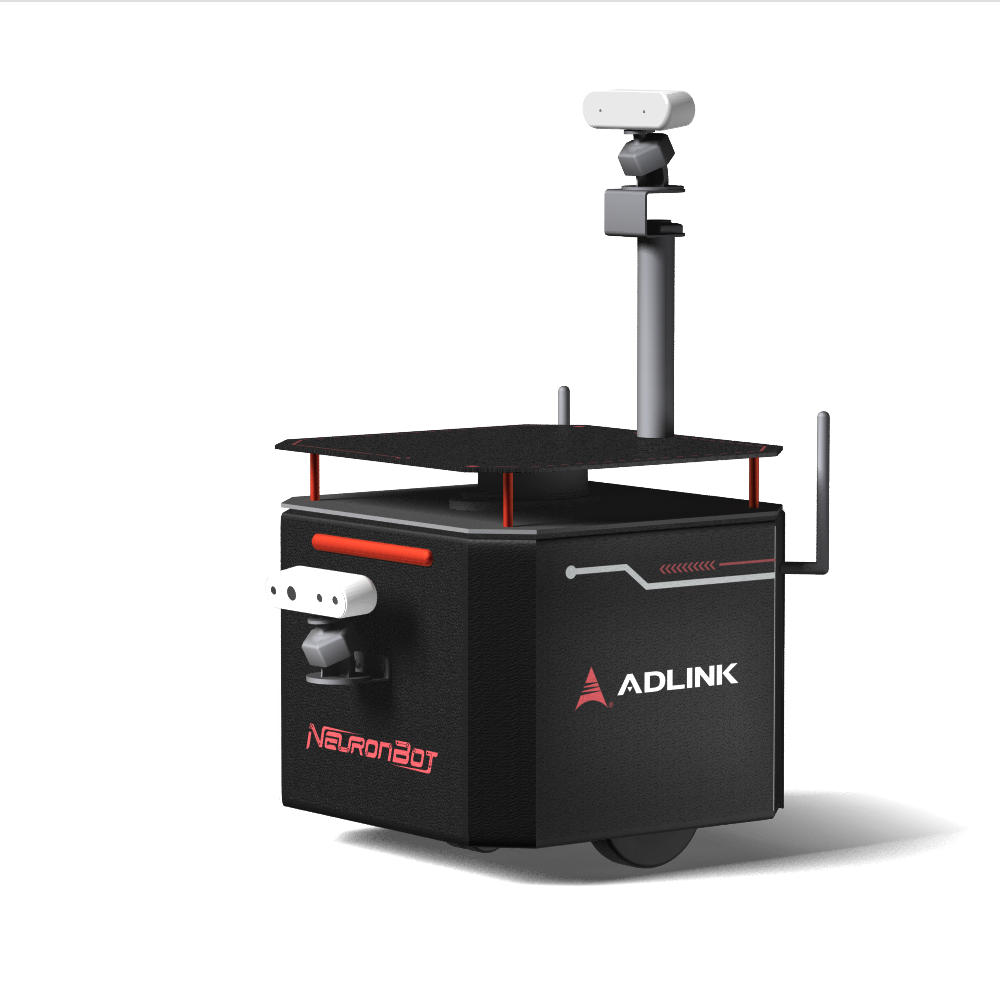
The NeuronBot is an autonomous robot platform designed for rapid robotic development, research, and educational applications. It integrates high-performance computing, motion control, and perception systems into a compact, mobile platform. Developed by ADLINK Technology, the NeuronBot series provides a ready-to-use, open-source-compatible robotic solution that leverages ROS (Robot Operating System) and ROS 2 frameworks. The platform combines hardware and software in a modular, extensible design, enabling developers, researchers, and educators to prototype and deploy robotic applications efficiently.
2. Key Features
- Integrated Vision, Control, AI, and Motion Modules: The NeuronBot combines multiple subsystems—vision sensing, motion control, and AI computation—into a single cohesive platform.
- Rapid Robotic Development: Designed as a development and demonstration kit, it supports quick prototyping and testing of robotic algorithms and applications.
- ROS/ROS 2 Compatibility: Fully supported by open-source ROS and ROS 2 libraries and packages, enabling seamless integration with existing robotic ecosystems.
- High-Performance Computing: Equipped with Intel® processors (Celeron® or Atom® x5-E3930) and optional Intel® Movidius™ Myriad™ X GPU for AI acceleration.
- Comprehensive Software Stack: Ships with Ubuntu 18.04 LTS, Neuron SDK, and Intel® OpenVINO™ toolkit for AI inference optimization.
- Integrated LIDAR Sensor: 360° RPLIDAR A1 laser distance sensor for mapping, navigation, and obstacle detection.
- Compact and Robust Design: Small form factor (260 × 270 × 260 mm) with a payload capacity of up to 3 kg, suitable for indoor research and educational environments.
- Flexible I/O and Expansion: Multiple USB, Ethernet, GPIO, and PCIe interfaces for peripheral integration and hardware expansion.
- Optional Wireless and Power Accessories: Wi-Fi module, battery pack, and mounting brackets available for enhanced mobility and connectivity.
3. Technical Specifications
Processor Options:
- NB-SK: Intel® Celeron® processor
- NB-S: Intel® Atom® x5-E3930 processor
Graphics Processing Unit (GPU):
- NB-SK: None
- NB-S: Intel® Movidius™ Myriad™ X
Memory:
- NB-SK: 4 GB DDR
- NB-S: 8 GB LPDDR4
Storage:
- 64 GB SATA SSD (NB-SK)
- 32 GB eMMC (NB-S)
- 1× microSD slot for additional storage
Microcontroller Unit (MCU): Arduino Mega
Inertial Measurement Unit (IMU): GY85 ADXL345
Encoder: 7N14P 2-channel encoder
Main Board I/O Interfaces:
- Display: 1× HDMI
- Ethernet:
- NB-SK: 2× Intel GbE
- NB-S: 1× GbE
- Serial Ports:
- NB-SK: 1× RS-232/422/485 via onboard header, 3× RS-232 via onboard headers
- NB-S: None
- USB Ports:
- NB-SK: 4× USB 3.0 (rear I/O), 2× USB 3.0 (onboard header), 1× USB 3.0 (vertical connector), 4× USB 2.0 (rear I/O)
- NB-S: 2× USB 3.0, 2× USB 2.0
- GPIO:
- NB-SK: 10× GPIO via onboard feature connector, I²C support
- NB-S: MRAA-compliant 40-pin connector (GPIO, PWM, I²C, UART)
- Mini-PCIe Slots: 2× full-size (one for CAN, one for Wi-Fi or LTE)
- Expansion Slots (NB-SK only):
- 1× PCIe x16 Gen 3
- 1× PCIe x1 Gen 2
- 1× Mini PCIe (full-size, PCIe+USB or mSATA)
- 1× Mini PCIe (half-size, PCIe+USB)
Laser Distance Sensor (LDS):
- Model: 360° RPLIDAR A1
- Height: 230 ± 10 mm
LED Indicators:
- Status LED (front): Red & Blue I/O indicators
Power Requirements:
- Main Board Power Input:
- NB-SK: 12 V DC ±5% via ATX power connector
- NB-S: 12 V DC via power jack (2 A recommended)
- Power Switch: 1× Power ON/OFF button
- Optional Battery: 11.1 V 3S 35° 2600 mAh Li-ion battery
Mechanical Specifications:
- Payload Capacity: 3 kg
- Wheel Diameter: 83 ± 2 mm
- Wheel Center Distance: 218 ± 3 mm
- Maximum Translational Velocity: 0.6 m/s
- Maximum Rotational Velocity: 0.6 m/s
- Climbing Threshold: 0 ± 1°
- Dimensions: 260 × 270 × 260 mm (10.24 × 10.63 × 10.24 in)
- Weight: 8.3 kg
Environmental Conditions:
- Operating Temperature: 0°C to 60°C (32°F to 140°F)
- Operating Humidity: 10%–90%, non-condensing
- Storage Temperature: -20°C to 80°C (-4°F to 176°F)
- EMC Compliance: CE, FCC Class B
4. Functionality
The NeuronBot functions as a fully integrated autonomous robotic platform capable of perception, navigation, and control. Its onboard computing system processes sensor data from the LIDAR and IMU to perform simultaneous localization and mapping (SLAM), path planning, and obstacle avoidance. The platform’s modular design allows developers to integrate additional sensors, cameras, or actuators through its extensive I/O and expansion interfaces.
Use Cases and Applications:
- Research and Development: Ideal for robotics research in AI, computer vision, and autonomous navigation.
- Education and Training: Provides a hands-on platform for teaching robotics, control systems, and embedded programming.
- Prototyping and Demonstration: Serves as a base for developing and testing new robotic algorithms or hardware modules.
- AI and Vision Applications: Supports Intel® OpenVINO™ for real-time inference and object recognition tasks.
Compatibility:
- Fully compatible with ROS and ROS 2 middleware, enabling integration with a wide range of open-source robotic packages.
- Supports Ubuntu 18.04 LTS operating system and Neuron SDK for software development.
- Compatible with Intel® OpenVINO™ toolkit for AI model deployment.
5. Components & Accessories
Included Components:
- NeuronBot main chassis with integrated computing module
- LIDAR sensor (RPLIDAR A1)
- IMU (GY85 ADXL345)
- Arduino Mega MCU
- Wheel and drive system
- Power and I/O interfaces
Optional Accessories:
- Wireless Module: Wi-Fi module with antenna for wireless communication
- Battery Pack: 11.1 V 3S 2600 mAh rechargeable battery for mobile operation
- Flat Panel: Optional display or mounting surface
- Front Bracket: For sensor or accessory mounting
- Stand Bracket: For stationary or elevated positioning
Connectors and Expansion:
- Multiple USB, Ethernet, GPIO, and PCIe interfaces for peripheral integration
- Mini-PCIe slots for CAN, Wi-Fi, or LTE modules
6. Installation & Setup
Requirements:
- 12 V DC power supply (2 A recommended for NB-S)
- Ubuntu 18.04 LTS environment for software configuration
- ROS/ROS 2 and Neuron SDK installation
Mounting Options:
- Flat or bracket-mounted configurations using optional front and stand brackets
- Modular design allows attachment of additional sensors or payloads up to 3 kg
Configuration Steps:
1. Connect power supply or optional battery.
2. Boot into Ubuntu 18.04 LTS environment.
3. Install and configure ROS/ROS 2 and Neuron SDK.
4. Calibrate sensors (LIDAR, IMU, encoders).
5. Deploy control and navigation packages via ROS nodes.
7. Performance & Capabilities
Mobility:
- Maximum translational velocity of 0.6 m/s and rotational velocity of 0.6 m/s provide smooth, controlled motion suitable for indoor environments.
- Wheelbase and diameter optimized for stability and maneuverability.
Payload and Expansion:
- Supports payloads up to 3 kg, allowing integration of cameras, manipulators, or additional sensors.
Computational Performance:
- Intel® Celeron® or Atom® processors deliver sufficient processing power for real-time control and perception tasks.
- Optional Intel® Movidius™ Myriad™ X GPU accelerates AI inference workloads.
Efficiency:
- Low power consumption design with optional battery operation for mobile autonomy.
- Efficient thermal management supports continuous operation within 0–60°C.
Limitations:
- Designed primarily for indoor use; limited climbing capability (0 ± 1°).
- Payload and speed optimized for research and educational applications rather than industrial heavy-duty tasks.
8. Standards & Compliance
Certifications:
- CE (Conformité Européenne)
- FCC Class B (Federal Communications Commission)
Regulatory Compliance:
- Meets electromagnetic compatibility (EMC) standards for safe operation in laboratory and educational environments.
Industry Standards:
- ROS/ROS 2 middleware compliance ensures interoperability with standard robotic frameworks.
- MRAA-compliant GPIO interface supports standardized hardware control.
9. Additional Information
Warranty:
- Standard manufacturer warranty provided by ADLINK Technology, Inc. (terms may vary by region).
Support:
- Technical documentation, SDK, and software updates available via ADLINK’s official website (www.adlinktech.com).
- Community and developer support through ROS and ADLINK forums.
Maintenance:
- Regular firmware and software updates recommended for optimal performance.
- Periodic calibration of LIDAR and IMU sensors ensures accurate navigation.
- Battery maintenance required if optional power pack is used.
Software Updates:
- Neuron SDK and ROS/ROS 2 packages are regularly updated to maintain compatibility with new Ubuntu releases and AI frameworks.
- Intel® OpenVINO™ toolkit updates enhance AI inference performance and model support.
Revision and Update Information:
- Product specifications last updated on April 14, 2020.
- All specifications subject to change without prior notice.
Summary
The ADLINK NeuronBot Series—comprising the NB-SK and NB-S models—is a compact, high-performance autonomous robot platform engineered for rapid development and educational use. It integrates advanced computing, sensing, and motion control capabilities within a robust chassis, offering full compatibility with ROS/ROS 2 and AI frameworks such as Intel® OpenVINO™. With its modular design, extensive I/O options, and optional accessories, the NeuronBot provides a flexible foundation for robotics research, AI experimentation, and prototype development.
Its combination of affordability, open-source support, and integrated hardware makes it an ideal platform for universities, research institutions, and developers seeking a reliable, extensible robotic system for innovation and learning.
Product Name: NeuronBot
Model Variants: NB-SK, NB-S
Series: NeuronBOT Series
Article Number: NeuronBot
Manufacturer: ADLINK Technology, Inc.
The NeuronBot is an autonomous robot platform designed for rapid robotic development, research, and educational applications. It integrates high-performance computing, motion control, and perception systems into a compact, mobile platform. Developed by ADLINK Technology, the NeuronBot series provides a ready-to-use, open-source-compatible robotic solution that leverages ROS (Robot Operating System) and ROS 2 frameworks. The platform combines hardware and software in a modular, extensible design, enabling developers, researchers, and educators to prototype and deploy robotic applications efficiently.
2. Key Features
- Integrated Vision, Control, AI, and Motion Modules: The NeuronBot combines multiple subsystems—vision sensing, motion control, and AI computation—into a single cohesive platform.
- Rapid Robotic Development: Designed as a development and demonstration kit, it supports quick prototyping and testing of robotic algorithms and applications.
- ROS/ROS 2 Compatibility: Fully supported by open-source ROS and ROS 2 libraries and packages, enabling seamless integration with existing robotic ecosystems.
- High-Performance Computing: Equipped with Intel® processors (Celeron® or Atom® x5-E3930) and optional Intel® Movidius™ Myriad™ X GPU for AI acceleration.
- Comprehensive Software Stack: Ships with Ubuntu 18.04 LTS, Neuron SDK, and Intel® OpenVINO™ toolkit for AI inference optimization.
- Integrated LIDAR Sensor: 360° RPLIDAR A1 laser distance sensor for mapping, navigation, and obstacle detection.
- Compact and Robust Design: Small form factor (260 × 270 × 260 mm) with a payload capacity of up to 3 kg, suitable for indoor research and educational environments.
- Flexible I/O and Expansion: Multiple USB, Ethernet, GPIO, and PCIe interfaces for peripheral integration and hardware expansion.
- Optional Wireless and Power Accessories: Wi-Fi module, battery pack, and mounting brackets available for enhanced mobility and connectivity.
3. Technical Specifications
Processor Options:
- NB-SK: Intel® Celeron® processor
- NB-S: Intel® Atom® x5-E3930 processor
Graphics Processing Unit (GPU):
- NB-SK: None
- NB-S: Intel® Movidius™ Myriad™ X
Memory:
- NB-SK: 4 GB DDR
- NB-S: 8 GB LPDDR4
Storage:
- 64 GB SATA SSD (NB-SK)
- 32 GB eMMC (NB-S)
- 1× microSD slot for additional storage
Microcontroller Unit (MCU): Arduino Mega
Inertial Measurement Unit (IMU): GY85 ADXL345
Encoder: 7N14P 2-channel encoder
Main Board I/O Interfaces:
- Display: 1× HDMI
- Ethernet:
- NB-SK: 2× Intel GbE
- NB-S: 1× GbE
- Serial Ports:
- NB-SK: 1× RS-232/422/485 via onboard header, 3× RS-232 via onboard headers
- NB-S: None
- USB Ports:
- NB-SK: 4× USB 3.0 (rear I/O), 2× USB 3.0 (onboard header), 1× USB 3.0 (vertical connector), 4× USB 2.0 (rear I/O)
- NB-S: 2× USB 3.0, 2× USB 2.0
- GPIO:
- NB-SK: 10× GPIO via onboard feature connector, I²C support
- NB-S: MRAA-compliant 40-pin connector (GPIO, PWM, I²C, UART)
- Mini-PCIe Slots: 2× full-size (one for CAN, one for Wi-Fi or LTE)
- Expansion Slots (NB-SK only):
- 1× PCIe x16 Gen 3
- 1× PCIe x1 Gen 2
- 1× Mini PCIe (full-size, PCIe+USB or mSATA)
- 1× Mini PCIe (half-size, PCIe+USB)
Laser Distance Sensor (LDS):
- Model: 360° RPLIDAR A1
- Height: 230 ± 10 mm
LED Indicators:
- Status LED (front): Red & Blue I/O indicators
Power Requirements:
- Main Board Power Input:
- NB-SK: 12 V DC ±5% via ATX power connector
- NB-S: 12 V DC via power jack (2 A recommended)
- Power Switch: 1× Power ON/OFF button
- Optional Battery: 11.1 V 3S 35° 2600 mAh Li-ion battery
Mechanical Specifications:
- Payload Capacity: 3 kg
- Wheel Diameter: 83 ± 2 mm
- Wheel Center Distance: 218 ± 3 mm
- Maximum Translational Velocity: 0.6 m/s
- Maximum Rotational Velocity: 0.6 m/s
- Climbing Threshold: 0 ± 1°
- Dimensions: 260 × 270 × 260 mm (10.24 × 10.63 × 10.24 in)
- Weight: 8.3 kg
Environmental Conditions:
- Operating Temperature: 0°C to 60°C (32°F to 140°F)
- Operating Humidity: 10%–90%, non-condensing
- Storage Temperature: -20°C to 80°C (-4°F to 176°F)
- EMC Compliance: CE, FCC Class B
4. Functionality
The NeuronBot functions as a fully integrated autonomous robotic platform capable of perception, navigation, and control. Its onboard computing system processes sensor data from the LIDAR and IMU to perform simultaneous localization and mapping (SLAM), path planning, and obstacle avoidance. The platform’s modular design allows developers to integrate additional sensors, cameras, or actuators through its extensive I/O and expansion interfaces.
Use Cases and Applications:
- Research and Development: Ideal for robotics research in AI, computer vision, and autonomous navigation.
- Education and Training: Provides a hands-on platform for teaching robotics, control systems, and embedded programming.
- Prototyping and Demonstration: Serves as a base for developing and testing new robotic algorithms or hardware modules.
- AI and Vision Applications: Supports Intel® OpenVINO™ for real-time inference and object recognition tasks.
Compatibility:
- Fully compatible with ROS and ROS 2 middleware, enabling integration with a wide range of open-source robotic packages.
- Supports Ubuntu 18.04 LTS operating system and Neuron SDK for software development.
- Compatible with Intel® OpenVINO™ toolkit for AI model deployment.
5. Components & Accessories
Included Components:
- NeuronBot main chassis with integrated computing module
- LIDAR sensor (RPLIDAR A1)
- IMU (GY85 ADXL345)
- Arduino Mega MCU
- Wheel and drive system
- Power and I/O interfaces
Optional Accessories:
- Wireless Module: Wi-Fi module with antenna for wireless communication
- Battery Pack: 11.1 V 3S 2600 mAh rechargeable battery for mobile operation
- Flat Panel: Optional display or mounting surface
- Front Bracket: For sensor or accessory mounting
- Stand Bracket: For stationary or elevated positioning
Connectors and Expansion:
- Multiple USB, Ethernet, GPIO, and PCIe interfaces for peripheral integration
- Mini-PCIe slots for CAN, Wi-Fi, or LTE modules
6. Installation & Setup
Requirements:
- 12 V DC power supply (2 A recommended for NB-S)
- Ubuntu 18.04 LTS environment for software configuration
- ROS/ROS 2 and Neuron SDK installation
Mounting Options:
- Flat or bracket-mounted configurations using optional front and stand brackets
- Modular design allows attachment of additional sensors or payloads up to 3 kg
Configuration Steps:
1. Connect power supply or optional battery.
2. Boot into Ubuntu 18.04 LTS environment.
3. Install and configure ROS/ROS 2 and Neuron SDK.
4. Calibrate sensors (LIDAR, IMU, encoders).
5. Deploy control and navigation packages via ROS nodes.
7. Performance & Capabilities
Mobility:
- Maximum translational velocity of 0.6 m/s and rotational velocity of 0.6 m/s provide smooth, controlled motion suitable for indoor environments.
- Wheelbase and diameter optimized for stability and maneuverability.
Payload and Expansion:
- Supports payloads up to 3 kg, allowing integration of cameras, manipulators, or additional sensors.
Computational Performance:
- Intel® Celeron® or Atom® processors deliver sufficient processing power for real-time control and perception tasks.
- Optional Intel® Movidius™ Myriad™ X GPU accelerates AI inference workloads.
Efficiency:
- Low power consumption design with optional battery operation for mobile autonomy.
- Efficient thermal management supports continuous operation within 0–60°C.
Limitations:
- Designed primarily for indoor use; limited climbing capability (0 ± 1°).
- Payload and speed optimized for research and educational applications rather than industrial heavy-duty tasks.
8. Standards & Compliance
Certifications:
- CE (Conformité Européenne)
- FCC Class B (Federal Communications Commission)
Regulatory Compliance:
- Meets electromagnetic compatibility (EMC) standards for safe operation in laboratory and educational environments.
Industry Standards:
- ROS/ROS 2 middleware compliance ensures interoperability with standard robotic frameworks.
- MRAA-compliant GPIO interface supports standardized hardware control.
9. Additional Information
Warranty:
- Standard manufacturer warranty provided by ADLINK Technology, Inc. (terms may vary by region).
Support:
- Technical documentation, SDK, and software updates available via ADLINK’s official website (www.adlinktech.com).
- Community and developer support through ROS and ADLINK forums.
Maintenance:
- Regular firmware and software updates recommended for optimal performance.
- Periodic calibration of LIDAR and IMU sensors ensures accurate navigation.
- Battery maintenance required if optional power pack is used.
Software Updates:
- Neuron SDK and ROS/ROS 2 packages are regularly updated to maintain compatibility with new Ubuntu releases and AI frameworks.
- Intel® OpenVINO™ toolkit updates enhance AI inference performance and model support.
Revision and Update Information:
- Product specifications last updated on April 14, 2020.
- All specifications subject to change without prior notice.
Summary
The ADLINK NeuronBot Series—comprising the NB-SK and NB-S models—is a compact, high-performance autonomous robot platform engineered for rapid development and educational use. It integrates advanced computing, sensing, and motion control capabilities within a robust chassis, offering full compatibility with ROS/ROS 2 and AI frameworks such as Intel® OpenVINO™. With its modular design, extensive I/O options, and optional accessories, the NeuronBot provides a flexible foundation for robotics research, AI experimentation, and prototype development.
Its combination of affordability, open-source support, and integrated hardware makes it an ideal platform for universities, research institutions, and developers seeking a reliable, extensible robotic system for innovation and learning.
-
 NeuronBOT_series_v2.pdf
PDF Catalog
NeuronBOT_series_v2.pdf
PDF Catalog
Kein Zubehör vorhanden.