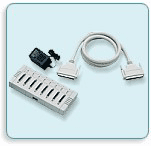
R801
SUCHEN SIE DIE PASSENDE
INDUSTRIELLE LÖSUNG?
Entdecken Sie Embedded-, Kommunikations- und Automatisierungslösungen für Ihre Anwendung.
- Embedded RISC Processor:
Equipped with a 133 MHz TMPR3927 RISC CPU capable of one instruction per cycle, delivering approximately 3927 MIPS of processing power.
- Large Local Memory:
Integrated 16 MB SDRAM dual-port memory accessible by both the local processor and host system. Each serial port can utilize up to 1 MB receive buffer and 512 KB transmit buffer.
- Universal PCI Compatibility:
Supports both 3.3 V and 5 V PCI bus standards at 33 MHz, ensuring compatibility with modern 64‑bit PCI slots.
- High-Speed Serial Communication:
Supports baud rates from 110 bps up to 230,400 bps (230 kBd). Software compatibility mapping allows legacy applications to use standard baud rate identifiers.
- Eight-Port RS‑232 Interface:
Provides eight independent serial channels via a DB‑62 connector and breakout cable (DB‑9 or DB‑25). Each port supports full modem control and hardware/software flow control.
- Flexible Interface Options:
Supports RS‑232, RS‑422, and RS‑485 modes through optional converter boxes (e.g., RS4232‑8 for ground-isolated RS‑422/485).
- Ground Isolation Capability:
When used with RS4232‑8 or IF‑series boxes, provides galvanic isolation for industrial environments to prevent ground loops and signal interference.
- Operating System Support:
Fully supported under Windows NT, 2000, XP, Vista, Windows 7, Linux (kernel 2.2–2.6+), and SCO UNIX/OpenServer.
- High Expandability:
Up to two cards per system, supporting a total of 128 serial ports/users.
- Compact Form Factor:
Dimensions 159 mm (L) × 109 mm (H), designed for standard PCI slots.
Equipped with a 133 MHz TMPR3927 RISC CPU capable of one instruction per cycle, delivering approximately 3927 MIPS of processing power.
- Large Local Memory:
Integrated 16 MB SDRAM dual-port memory accessible by both the local processor and host system. Each serial port can utilize up to 1 MB receive buffer and 512 KB transmit buffer.
- Universal PCI Compatibility:
Supports both 3.3 V and 5 V PCI bus standards at 33 MHz, ensuring compatibility with modern 64‑bit PCI slots.
- High-Speed Serial Communication:
Supports baud rates from 110 bps up to 230,400 bps (230 kBd). Software compatibility mapping allows legacy applications to use standard baud rate identifiers.
- Eight-Port RS‑232 Interface:
Provides eight independent serial channels via a DB‑62 connector and breakout cable (DB‑9 or DB‑25). Each port supports full modem control and hardware/software flow control.
- Flexible Interface Options:
Supports RS‑232, RS‑422, and RS‑485 modes through optional converter boxes (e.g., RS4232‑8 for ground-isolated RS‑422/485).
- Ground Isolation Capability:
When used with RS4232‑8 or IF‑series boxes, provides galvanic isolation for industrial environments to prevent ground loops and signal interference.
- Operating System Support:
Fully supported under Windows NT, 2000, XP, Vista, Windows 7, Linux (kernel 2.2–2.6+), and SCO UNIX/OpenServer.
- High Expandability:
Up to two cards per system, supporting a total of 128 serial ports/users.
- Compact Form Factor:
Dimensions 159 mm (L) × 109 mm (H), designed for standard PCI slots.
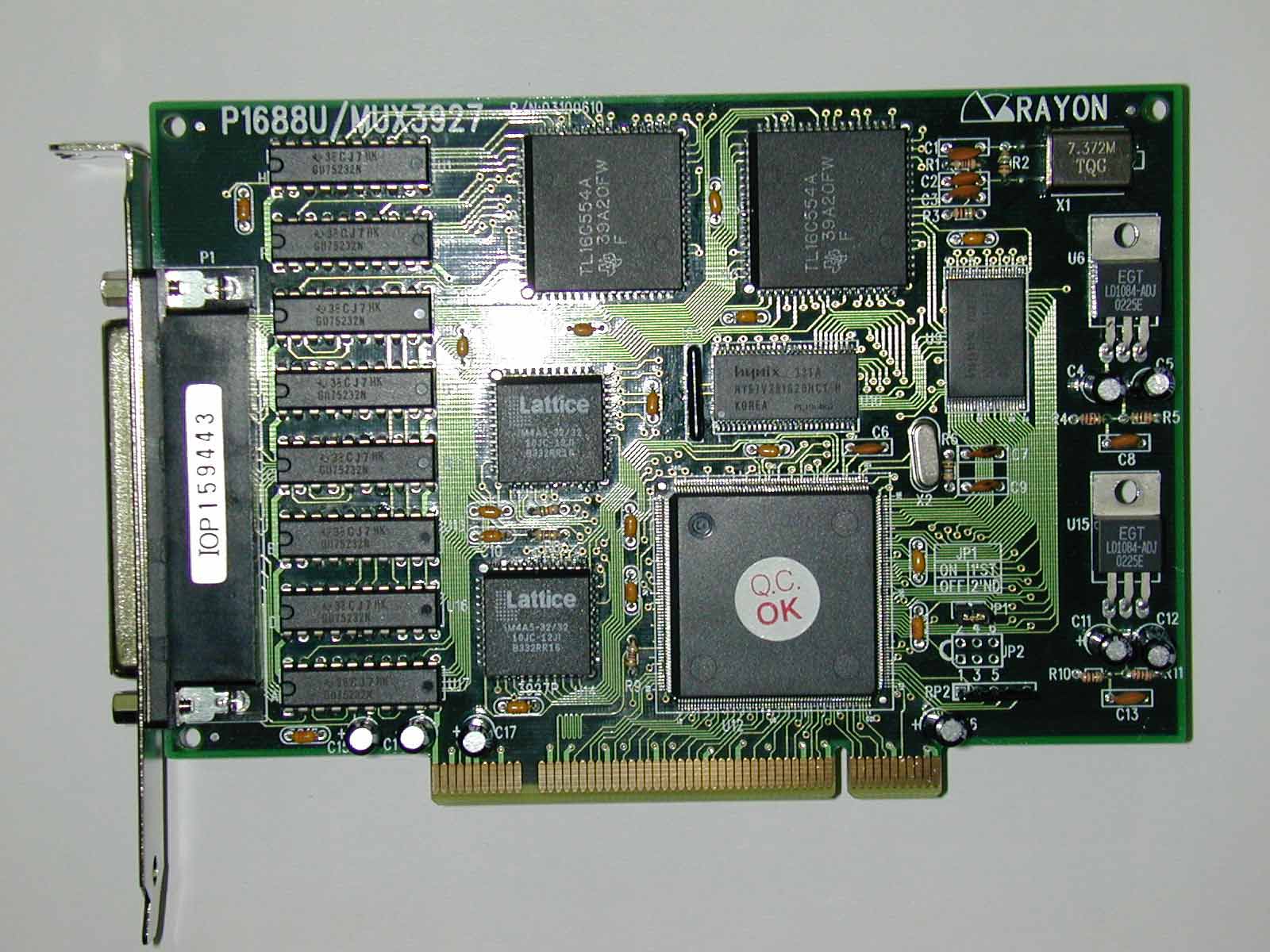
Comprehensive Product Summary – RAYON P1688U UPCI 8-Port 3.3/5V 16MB 133MHz RISC CPU Card
### 1. Product Overview
Product Name: UPCI 8-Port Intelligent Serial CPU Card
Model: P1688U
Series: IOP3927 Intelligent I/O Processor Family
Article Number: P1688U
Manufacturer: RAYON Technology Co., Ltd.
Product Type: Intelligent PCI serial communication controller card with integrated RISC processor and multi-port serial interface capability.
The RAYON P1688U is a high-performance intelligent multi-port serial communication card designed for industrial and multi-user computing environments. It integrates a 133 MHz TMPR3927 RISC processor and 16 MB of dual-port SDRAM, providing autonomous I/O processing to offload the host CPU. The card supports up to eight RS‑232 ports directly and can be expanded to isolated RS‑422/485 interfaces via optional converter boxes. It is compatible with both 3.3 V and 5 V PCI slots, making it suitable for a wide range of legacy and modern PC architectures.
### 2. Key Features
- Embedded RISC Processor:
Equipped with a 133 MHz TMPR3927 RISC CPU capable of one instruction per cycle, delivering approximately 3927 MIPS of processing power.
- Large Local Memory:
Integrated 16 MB SDRAM dual-port memory accessible by both the local processor and host system. Each serial port can utilize up to 1 MB receive buffer and 512 KB transmit buffer.
- Universal PCI Compatibility:
Supports both 3.3 V and 5 V PCI bus standards at 33 MHz, ensuring compatibility with modern 64‑bit PCI slots.
- High-Speed Serial Communication:
Supports baud rates from 110 bps up to 230,400 bps (230 kBd). Software compatibility mapping allows legacy applications to use standard baud rate identifiers.
- Eight-Port RS‑232 Interface:
Provides eight independent serial channels via a DB‑62 connector and breakout cable (DB‑9 or DB‑25). Each port supports full modem control and hardware/software flow control.
- Flexible Interface Options:
Supports RS‑232, RS‑422, and RS‑485 modes through optional converter boxes (e.g., RS4232‑8 for ground-isolated RS‑422/485).
- Ground Isolation Capability:
When used with RS4232‑8 or IF‑series boxes, provides galvanic isolation for industrial environments to prevent ground loops and signal interference.
- Operating System Support:
Fully supported under Windows NT, 2000, XP, Vista, Windows 7, Linux (kernel 2.2–2.6+), and SCO UNIX/OpenServer.
- High Expandability:
Up to two cards per system, supporting a total of 128 serial ports/users.
- Compact Form Factor:
Dimensions 159 mm (L) × 109 mm (H), designed for standard PCI slots.
### 3. Technical Specifications
| Parameter | Specification |
|----------------|------------------|
| Processor | TMPR3927 RISC CPU, 133 MHz, 1 instruction/cycle |
| Memory | 16 MB SDRAM dual-port RAM |
| Bus Interface | 3.3 V/5 V 33 MHz PCI, universal keying |
| Baud Rate Range | 110 bps – 230,400 bps |
| Buffer Allocation | 1 MB RX buffer + 512 KB TX buffer per port |
| Ports | 8 × RS‑232 (expandable to RS‑422/485) |
| Connectors | 62‑pin D‑type female (on card) |
| Cable Options | R801 (8 × DB‑25 M), R804 (8 × DB‑9 M), R803 (for RS4232‑8 box) |
| Flow Control | XON/XOFF (software), RTS/CTS (hardware) |
| Dimensions | 159 mm (L) × 109 mm (H) |
| Power Requirements | PCI bus powered (3.3 V/5 V) |
| Operating Environment | PC/AT or compatible x86 system |
| Max Cards per System | 2 cards (up to 128 ports) |
| Material | Multi‑layer PCB, industrial‑grade components |
| Weight | Approx. 200 g (card only) |
### 4. Functionality
The P1688U functions as an intelligent I/O processor (IOP) that manages serial communication independently of the host CPU. The onboard RISC processor handles data buffering, flow control, and protocol management, significantly reducing host CPU load and improving system throughput in multi‑user or high‑I/O environments.
Operation:
- The card communicates with the host system via PCI bus memory mapping (128 KB address space assigned by BIOS).
- Each serial port operates independently, supporting asynchronous communication with full modem control.
- The dual‑port RAM allows concurrent access by the local processor and host CPU for efficient data exchange.
Use Cases:
- Multi‑terminal UNIX/Linux systems
- Industrial automation and control
- Data acquisition and instrumentation
- POS and kiosk systems
- Communication servers and console management
Compatibility:
- Works with standard RS‑232 devices (modems, terminals, sensors).
- Expandable to RS‑422/485 for long‑distance or differential signaling.
- Compatible with RAYON’s RS4232‑8, IF‑series, and NF‑series interface boxes for various electrical standards.
### 5. Components & Accessories
Included:
- P1688U PCI card with DB‑62 F connector
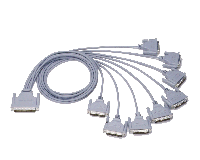
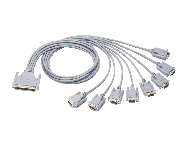
- Octopus cable (DB‑62 M → 8 × DB‑9 M)
*Optional:* DB‑62 M → 8 × DB‑25 M (P1688U‑25 variant)
Optional Accessories:
- R801 Cable: 8 × DB‑25 M RS‑232 breakout cable
- R804 Cable: 8 × DB‑9 M RS‑232 breakout cable
- R803 Cable: Interface cable for RS4232‑8 box (RS‑422/485)
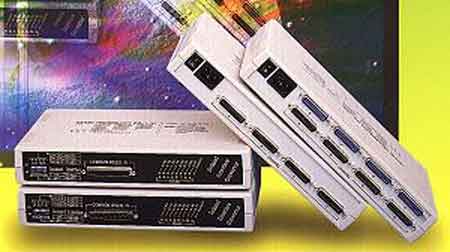
- RS4232‑8 Box: Ground‑isolated RS‑422/485 converter box
- IF‑Series Boxes: Ground‑isolated RS‑232/422/485 selectable interface modules
- NF‑Series Boxes: High‑density 16‑port RS‑232/422/485 interface modules
Connector Pinouts (DB‑9):
1 = DCD (in), 2 = RXD (in), 3 = TXD (out), 4 = DTR (out), 5 = GND, 6 = DSR (in), 7 = RTS (out), 8 = CTS (in), 9 = N.C.
### 6. Installation & Setup
System Requirements:
- IBM PC/AT or compatible x86 system
- Available PCI slot (3.3 V or 5 V)
- Supported OS: Windows NT/2000/XP/Vista/7, Linux, SCO UNIX
Installation Steps:
1. Power off the system and insert the P1688U card into an available PCI slot.
2. Connect the appropriate breakout cable (R801/R804) or converter box (R803 → RS4232‑8).
3. Power on the system; the PCI BIOS assigns memory mapping automatically.
4. Install the appropriate driver for your operating system:
- Windows NT: via *Control Panel → Network → Add Adapter → <Other> → A:\NT4*
- Windows 2000/XP/Vista/7: Plug & Play detection; specify driver path *A:\WIN2000*
- Linux: Extract driver source via `tar xvf /dev/fd0` and run `/etc/rayon/Install`
- SCO UNIX: Install using `/etc/custom` or `tar` method, rebuild kernel
5. Reboot the system to activate new COM ports.
Configuration:
- COM port numbering can be adjusted via driver setup utility.
- For multiple cards, set JP1 jumper: ON = 1st card, OFF = 2nd card.
- Verify installation using “HyperTerminal” (Windows) or “etty/om” utilities (Linux/UNIX).
Caution:
Always power down the PC before connecting or disconnecting cables. The DB‑62 cable carries +5 V, +12 V, –12 V lines; hot‑plugging may damage the card or interface box.
### 7. Performance & Capabilities
- Processing Power: 133 MHz RISC CPU, 3927 MIPS throughput
- Data Rate: Up to 230.4 kbps per port
- Buffering: 16 MB shared SDRAM; up to 1 MB RX + 512 KB TX per port
- Latency: Minimal due to local processing and dual‑port memory
- Efficiency: Offloads serial I/O tasks from host CPU, improving multitasking performance
- Scalability: Two cards per system, up to 128 ports total
- Reliability: Ground isolation (with RS4232‑8) prevents signal degradation in industrial environments
- Limitations:
- Fixed 8‑port configuration (non‑expandable per card)
- Requires driver installation for OS recognition
- RS‑422/485 support via external converter only
### 8. Standards & Compliance
- Electrical Interface Standards:
RS‑232C (EIA/TIA‑232‑E), RS‑422, RS‑485 compliant
- Bus Interface:
PCI 2.2 compliant, universal 3.3 V/5 V signaling
- Operating System Drivers:
Certified for Windows NT 4.0, 2000, XP, Vista, 7; Linux 2.2–2.6; SCO OpenServer 5.x
- Environmental Compliance:
Designed for industrial environments; conforms to standard PC/AT mechanical and electrical specifications
- Safety & Isolation:
Ground‑isolated operation when used with RS4232‑8 or IF‑series boxes
- Regulatory:
CE and FCC Class A (industrial) compliance (manufacturer standard)
### 9. Additional Information
Warranty:
- One‑year limited warranty covering defects in materials and workmanship.
- Excludes damage from misuse, electrical surges, or unauthorized servicing.
- Out‑of‑warranty repairs available at flat‑rate service charge.
Support & Service:
- Technical support via email: rayon@ms1.hinet.net
- RMA (Return Material Authorization) required for repairs.
Provide model number, serial number, and failure description before return.
Maintenance:
- Periodically inspect connectors and cables for wear.
- Keep card contacts clean; avoid electrostatic discharge during handling.
- Firmware and driver updates available from RAYON’s website.
Software Utilities:
- etty: Transmit/receive test utility for verifying TTY ports.
- om: Real‑time monitoring tool for serial data activity (supports up to 16 ports per screen).
- setup: Driver configuration utility for COM port numbering and baud rate assignment.
Driver Update Notes:
- Always remove older driver versions before installing updates.
- Windows 7 requires manual driver installation via Device Manager (“Update Driver” → Browse → A:\WIN2000).
- Linux drivers provided as source code for kernel‑specific compilation.
Physical & Environmental Data:
- Operating Temperature: 0 °C – 50 °C
- Storage Temperature: –20 °C – 70 °C
- Humidity: 10 % – 90 % non‑condensing
Product Comparison (vs. MOXA C218Turbo/PCI):
| Feature | RAYON P1688U | MOXA C218Turbo/PCI |
|----------|---------------|--------------------|
| Local Processor | 133 MHz MIPS (1 instr/cycle) | 57 MHz DSP (1 instr/2 cycles) |
| Local Buffer | 16 MB SDRAM (1 MB RX + 512 KB TX per port) | 512 KB DRAM shared |
| PCI Bus | Universal 3.3 V/5 V 33 MHz | 5 V only |
| Card Size | 159 × 109 mm | 180 × 105 mm |
| Interface Options | RS‑232, RS‑422/485 (GI) | RS‑232, RS‑422 (non‑isolated) |
### Summary
The RAYON P1688U is a robust, intelligent 8‑port serial communication controller engineered for high‑density, high‑reliability industrial and multi‑user systems. Its embedded 133 MHz RISC processor and 16 MB SDRAM enable autonomous serial data handling, drastically reducing host CPU overhead. With universal PCI compatibility, flexible RS‑232/422/485 interfacing, and comprehensive OS driver support, the P1688U provides a scalable and efficient solution for serial connectivity in demanding environments.
Its modular design, extensive buffering, and ground‑isolated options make it ideal for applications requiring stable, high‑speed, and noise‑immune serial communication across multiple devices or users.

### 1. Product Overview
Product Name: UPCI 8-Port Intelligent Serial CPU Card
Model: P1688U
Series: IOP3927 Intelligent I/O Processor Family
Article Number: P1688U
Manufacturer: RAYON Technology Co., Ltd.
Product Type: Intelligent PCI serial communication controller card with integrated RISC processor and multi-port serial interface capability.
The RAYON P1688U is a high-performance intelligent multi-port serial communication card designed for industrial and multi-user computing environments. It integrates a 133 MHz TMPR3927 RISC processor and 16 MB of dual-port SDRAM, providing autonomous I/O processing to offload the host CPU. The card supports up to eight RS‑232 ports directly and can be expanded to isolated RS‑422/485 interfaces via optional converter boxes. It is compatible with both 3.3 V and 5 V PCI slots, making it suitable for a wide range of legacy and modern PC architectures.
### 2. Key Features
- Embedded RISC Processor:
Equipped with a 133 MHz TMPR3927 RISC CPU capable of one instruction per cycle, delivering approximately 3927 MIPS of processing power.
- Large Local Memory:
Integrated 16 MB SDRAM dual-port memory accessible by both the local processor and host system. Each serial port can utilize up to 1 MB receive buffer and 512 KB transmit buffer.
- Universal PCI Compatibility:
Supports both 3.3 V and 5 V PCI bus standards at 33 MHz, ensuring compatibility with modern 64‑bit PCI slots.
- High-Speed Serial Communication:
Supports baud rates from 110 bps up to 230,400 bps (230 kBd). Software compatibility mapping allows legacy applications to use standard baud rate identifiers.
- Eight-Port RS‑232 Interface:
Provides eight independent serial channels via a DB‑62 connector and breakout cable (DB‑9 or DB‑25). Each port supports full modem control and hardware/software flow control.
- Flexible Interface Options:
Supports RS‑232, RS‑422, and RS‑485 modes through optional converter boxes (e.g., RS4232‑8 for ground-isolated RS‑422/485).
- Ground Isolation Capability:
When used with RS4232‑8 or IF‑series boxes, provides galvanic isolation for industrial environments to prevent ground loops and signal interference.
- Operating System Support:
Fully supported under Windows NT, 2000, XP, Vista, Windows 7, Linux (kernel 2.2–2.6+), and SCO UNIX/OpenServer.
- High Expandability:
Up to two cards per system, supporting a total of 128 serial ports/users.
- Compact Form Factor:
Dimensions 159 mm (L) × 109 mm (H), designed for standard PCI slots.
### 3. Technical Specifications
| Parameter | Specification |
|----------------|------------------|
| Processor | TMPR3927 RISC CPU, 133 MHz, 1 instruction/cycle |
| Memory | 16 MB SDRAM dual-port RAM |
| Bus Interface | 3.3 V/5 V 33 MHz PCI, universal keying |
| Baud Rate Range | 110 bps – 230,400 bps |
| Buffer Allocation | 1 MB RX buffer + 512 KB TX buffer per port |
| Ports | 8 × RS‑232 (expandable to RS‑422/485) |
| Connectors | 62‑pin D‑type female (on card) |
| Cable Options | R801 (8 × DB‑25 M), R804 (8 × DB‑9 M), R803 (for RS4232‑8 box) |
| Flow Control | XON/XOFF (software), RTS/CTS (hardware) |
| Dimensions | 159 mm (L) × 109 mm (H) |
| Power Requirements | PCI bus powered (3.3 V/5 V) |
| Operating Environment | PC/AT or compatible x86 system |
| Max Cards per System | 2 cards (up to 128 ports) |
| Material | Multi‑layer PCB, industrial‑grade components |
| Weight | Approx. 200 g (card only) |
### 4. Functionality
The P1688U functions as an intelligent I/O processor (IOP) that manages serial communication independently of the host CPU. The onboard RISC processor handles data buffering, flow control, and protocol management, significantly reducing host CPU load and improving system throughput in multi‑user or high‑I/O environments.
Operation:
- The card communicates with the host system via PCI bus memory mapping (128 KB address space assigned by BIOS).
- Each serial port operates independently, supporting asynchronous communication with full modem control.
- The dual‑port RAM allows concurrent access by the local processor and host CPU for efficient data exchange.
Use Cases:
- Multi‑terminal UNIX/Linux systems
- Industrial automation and control
- Data acquisition and instrumentation
- POS and kiosk systems
- Communication servers and console management
Compatibility:
- Works with standard RS‑232 devices (modems, terminals, sensors).
- Expandable to RS‑422/485 for long‑distance or differential signaling.
- Compatible with RAYON’s RS4232‑8, IF‑series, and NF‑series interface boxes for various electrical standards.
### 5. Components & Accessories
Included:
- P1688U PCI card with DB‑62 F connector
- Octopus cable (DB‑62 M → 8 × DB‑9 M)
*Optional:* DB‑62 M → 8 × DB‑25 M (P1688U‑25 variant)
Optional Accessories:
- R801 Cable: 8 × DB‑25 M RS‑232 breakout cable
- R804 Cable: 8 × DB‑9 M RS‑232 breakout cable
- R803 Cable: Interface cable for RS4232‑8 box (RS‑422/485)
- RS4232‑8 Box: Ground‑isolated RS‑422/485 converter box
- IF‑Series Boxes: Ground‑isolated RS‑232/422/485 selectable interface modules
- NF‑Series Boxes: High‑density 16‑port RS‑232/422/485 interface modules
Connector Pinouts (DB‑9):
1 = DCD (in), 2 = RXD (in), 3 = TXD (out), 4 = DTR (out), 5 = GND, 6 = DSR (in), 7 = RTS (out), 8 = CTS (in), 9 = N.C.
### 6. Installation & Setup
System Requirements:
- IBM PC/AT or compatible x86 system
- Available PCI slot (3.3 V or 5 V)
- Supported OS: Windows NT/2000/XP/Vista/7, Linux, SCO UNIX
Installation Steps:
1. Power off the system and insert the P1688U card into an available PCI slot.
2. Connect the appropriate breakout cable (R801/R804) or converter box (R803 → RS4232‑8).
3. Power on the system; the PCI BIOS assigns memory mapping automatically.
4. Install the appropriate driver for your operating system:
- Windows NT: via *Control Panel → Network → Add Adapter → <Other> → A:\NT4*
- Windows 2000/XP/Vista/7: Plug & Play detection; specify driver path *A:\WIN2000*
- Linux: Extract driver source via `tar xvf /dev/fd0` and run `/etc/rayon/Install`
- SCO UNIX: Install using `/etc/custom` or `tar` method, rebuild kernel
5. Reboot the system to activate new COM ports.
Configuration:
- COM port numbering can be adjusted via driver setup utility.
- For multiple cards, set JP1 jumper: ON = 1st card, OFF = 2nd card.
- Verify installation using “HyperTerminal” (Windows) or “etty/om” utilities (Linux/UNIX).
Caution:
Always power down the PC before connecting or disconnecting cables. The DB‑62 cable carries +5 V, +12 V, –12 V lines; hot‑plugging may damage the card or interface box.
### 7. Performance & Capabilities
- Processing Power: 133 MHz RISC CPU, 3927 MIPS throughput
- Data Rate: Up to 230.4 kbps per port
- Buffering: 16 MB shared SDRAM; up to 1 MB RX + 512 KB TX per port
- Latency: Minimal due to local processing and dual‑port memory
- Efficiency: Offloads serial I/O tasks from host CPU, improving multitasking performance
- Scalability: Two cards per system, up to 128 ports total
- Reliability: Ground isolation (with RS4232‑8) prevents signal degradation in industrial environments
- Limitations:
- Fixed 8‑port configuration (non‑expandable per card)
- Requires driver installation for OS recognition
- RS‑422/485 support via external converter only
### 8. Standards & Compliance
- Electrical Interface Standards:
RS‑232C (EIA/TIA‑232‑E), RS‑422, RS‑485 compliant
- Bus Interface:
PCI 2.2 compliant, universal 3.3 V/5 V signaling
- Operating System Drivers:
Certified for Windows NT 4.0, 2000, XP, Vista, 7; Linux 2.2–2.6; SCO OpenServer 5.x
- Environmental Compliance:
Designed for industrial environments; conforms to standard PC/AT mechanical and electrical specifications
- Safety & Isolation:
Ground‑isolated operation when used with RS4232‑8 or IF‑series boxes
- Regulatory:
CE and FCC Class A (industrial) compliance (manufacturer standard)
### 9. Additional Information
Warranty:
- One‑year limited warranty covering defects in materials and workmanship.
- Excludes damage from misuse, electrical surges, or unauthorized servicing.
- Out‑of‑warranty repairs available at flat‑rate service charge.
Support & Service:
- Technical support via email: rayon@ms1.hinet.net
- RMA (Return Material Authorization) required for repairs.
Provide model number, serial number, and failure description before return.
Maintenance:
- Periodically inspect connectors and cables for wear.
- Keep card contacts clean; avoid electrostatic discharge during handling.
- Firmware and driver updates available from RAYON’s website.
Software Utilities:
- etty: Transmit/receive test utility for verifying TTY ports.
- om: Real‑time monitoring tool for serial data activity (supports up to 16 ports per screen).
- setup: Driver configuration utility for COM port numbering and baud rate assignment.
Driver Update Notes:
- Always remove older driver versions before installing updates.
- Windows 7 requires manual driver installation via Device Manager (“Update Driver” → Browse → A:\WIN2000).
- Linux drivers provided as source code for kernel‑specific compilation.
Physical & Environmental Data:
- Operating Temperature: 0 °C – 50 °C
- Storage Temperature: –20 °C – 70 °C
- Humidity: 10 % – 90 % non‑condensing
Product Comparison (vs. MOXA C218Turbo/PCI):
| Feature | RAYON P1688U | MOXA C218Turbo/PCI |
|----------|---------------|--------------------|
| Local Processor | 133 MHz MIPS (1 instr/cycle) | 57 MHz DSP (1 instr/2 cycles) |
| Local Buffer | 16 MB SDRAM (1 MB RX + 512 KB TX per port) | 512 KB DRAM shared |
| PCI Bus | Universal 3.3 V/5 V 33 MHz | 5 V only |
| Card Size | 159 × 109 mm | 180 × 105 mm |
| Interface Options | RS‑232, RS‑422/485 (GI) | RS‑232, RS‑422 (non‑isolated) |
### Summary
The RAYON P1688U is a robust, intelligent 8‑port serial communication controller engineered for high‑density, high‑reliability industrial and multi‑user systems. Its embedded 133 MHz RISC processor and 16 MB SDRAM enable autonomous serial data handling, drastically reducing host CPU overhead. With universal PCI compatibility, flexible RS‑232/422/485 interfacing, and comprehensive OS driver support, the P1688U provides a scalable and efficient solution for serial connectivity in demanding environments.
Its modular design, extensive buffering, and ground‑isolated options make it ideal for applications requiring stable, high‑speed, and noise‑immune serial communication across multiple devices or users.
-
IOP3927-004.pdf
Manual
-
PCIEXP007.pdf
Manual