A400
SUCHEN SIE DIE PASSENDE
INDUSTRIELLE LÖSUNG?
Entdecken Sie Embedded-, Kommunikations- und Automatisierungslösungen für Ihre Anwendung.
- Four Isolated Serial Ports: Each port supports RS422 or RS485 communication, selectable via DIP switch.
- Electrical Isolation: Each port is galvanically isolated to prevent ground loops and protect against electrical surges.
- Flexible Interface Configuration: DIP switch selectable per port for RS422 (full-duplex) or RS485 (half-duplex) operation.
- ADDC (Auto Data Direction Control): Automatic control of data direction in RS485 mode, eliminating the need for manual RTS signal handling.
- High Compatibility: Fully compatible with 16550A UART standard, ensuring broad software and driver support.
- Plug & Play PCI Interface: Automatic resource allocation (IRQ and I/O mapping) by PCI BIOS; no manual configuration required.
- Shared IRQ Support: Multiple PCI cards can share a single interrupt line, optimizing system resource usage.
- Wide OS Support: Drivers available for DOS, Windows 95/98/ME/NT/2000/XP, Linux, and SCO OpenServer.
- High-Speed Communication: Supports baud rates from 50 bps up to 115,200 bps (standard crystal) or up to 921,600 bps (optional high-speed crystal).
- Robust Construction: Designed for industrial and embedded PC environments requiring reliable multi-port serial communication.
- Included Cable: A404 cable (DB37 female to 4×DB9 male) for direct connection to external serial devices.
- Electrical Isolation: Each port is galvanically isolated to prevent ground loops and protect against electrical surges.
- Flexible Interface Configuration: DIP switch selectable per port for RS422 (full-duplex) or RS485 (half-duplex) operation.
- ADDC (Auto Data Direction Control): Automatic control of data direction in RS485 mode, eliminating the need for manual RTS signal handling.
- High Compatibility: Fully compatible with 16550A UART standard, ensuring broad software and driver support.
- Plug & Play PCI Interface: Automatic resource allocation (IRQ and I/O mapping) by PCI BIOS; no manual configuration required.
- Shared IRQ Support: Multiple PCI cards can share a single interrupt line, optimizing system resource usage.
- Wide OS Support: Drivers available for DOS, Windows 95/98/ME/NT/2000/XP, Linux, and SCO OpenServer.
- High-Speed Communication: Supports baud rates from 50 bps up to 115,200 bps (standard crystal) or up to 921,600 bps (optional high-speed crystal).
- Robust Construction: Designed for industrial and embedded PC environments requiring reliable multi-port serial communication.
- Included Cable: A404 cable (DB37 female to 4×DB9 male) for direct connection to external serial devices.
Comprehensive Product Summary – Rayon Technology P485 PCI 4-Isolated-Port RS422/485 Card (incl. Cable A404)
### 1. Product Overview
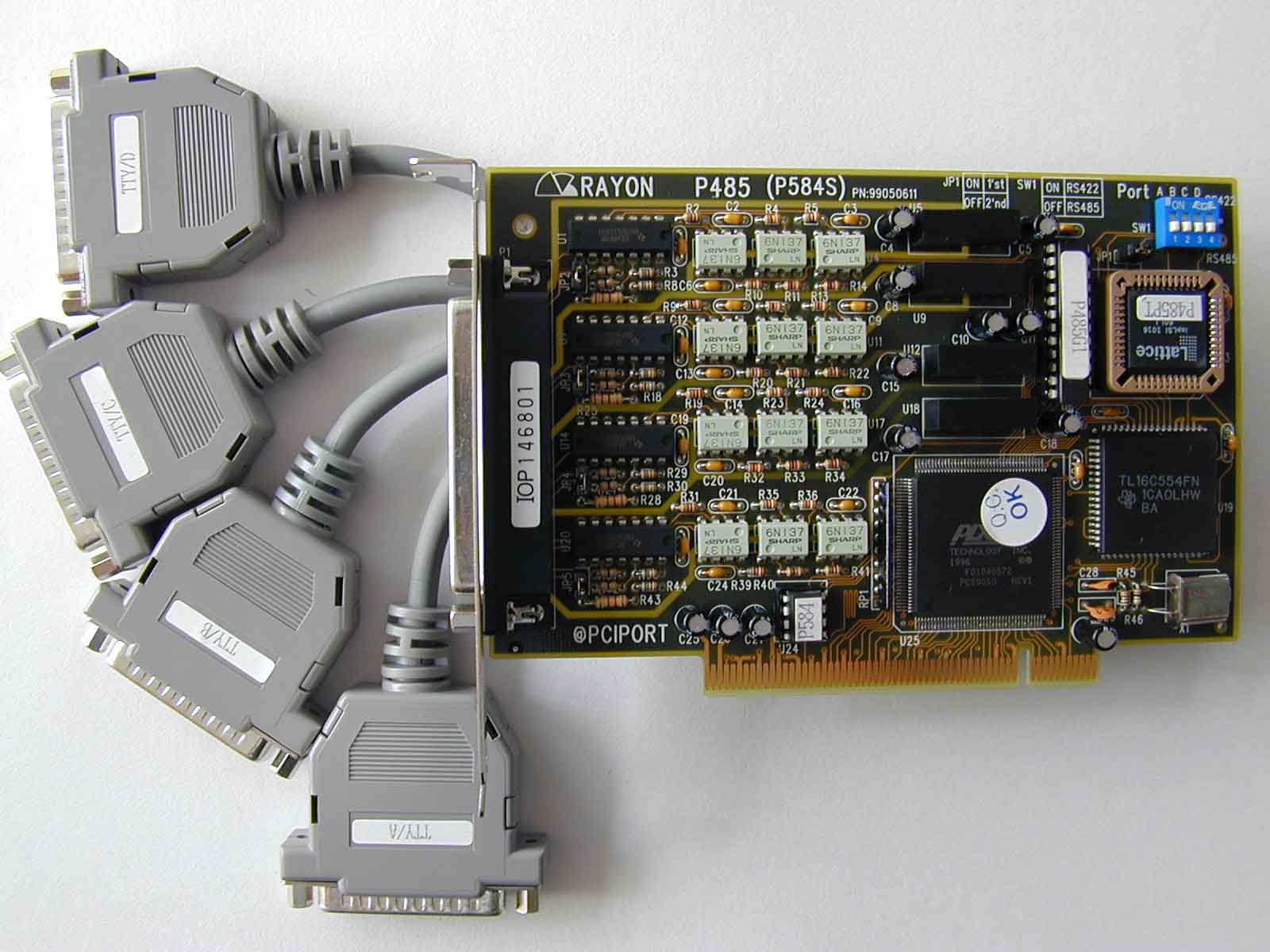
Product Name: PCI 4-Isolated-Port RS422/485 Communication Card
Model: P485
Series: RAYON PCIPORT Series
Article Number: P485
Manufacturer: Rayon Technology Inc.
Included Accessory: Cable A404 (DB37 female to 4×DB9 male)
Manufacturer Contact Information:
- Rayon Technology Co. Ltd. (Taiwan)
2F, No. 177, Chung-Shan 2 Road, Lu-Chou City, Taipei Hsien, Taiwan R.O.C.
Tel: +886 2 82858362 | Fax: +886 2 82857065 | Email: rayon@ms1.hinet.net
- Acceed GmbH (Europe)
Arnoldstraße 19, 40479 Düsseldorf, Germany
Tel/Fax: +49 211 938898 0 | Email: rayon@acceed.com
Website: [www.acceed.com/rayon](http://www.acceed.com/rayon)
### 2. Key Features
- Four Isolated Serial Ports: Each port supports RS422 or RS485 communication, selectable via DIP switch.
- Electrical Isolation: Each port is galvanically isolated to prevent ground loops and protect against electrical surges.
- Flexible Interface Configuration: DIP switch selectable per port for RS422 (full-duplex) or RS485 (half-duplex) operation.
- ADDC (Auto Data Direction Control): Automatic control of data direction in RS485 mode, eliminating the need for manual RTS signal handling.
- High Compatibility: Fully compatible with 16550A UART standard, ensuring broad software and driver support.
- Plug & Play PCI Interface: Automatic resource allocation (IRQ and I/O mapping) by PCI BIOS; no manual configuration required.
- Shared IRQ Support: Multiple PCI cards can share a single interrupt line, optimizing system resource usage.
- Wide OS Support: Drivers available for DOS, Windows 95/98/ME/NT/2000/XP, Linux, and SCO OpenServer.
- High-Speed Communication: Supports baud rates from 50 bps up to 115,200 bps (standard crystal) or up to 921,600 bps (optional high-speed crystal).
- Robust Construction: Designed for industrial and embedded PC environments requiring reliable multi-port serial communication.
- Included Cable: A404 cable (DB37 female to 4×DB9 male) for direct connection to external serial devices.
### 3. Technical Specifications
Physical Characteristics:
- Dimensions: 159 mm (L) × 108 mm (W)
- Weight: Approx. 150 g (card only)
- Material: Multi-layer PCB with EMI shielding and isolation components
- Connector Type: DB37 female on card; DB9 male via A404 cable
Electrical & Interface Specifications:
- Bus Interface: PCI 2.1 compliant, 5V 33 MHz slot (supports 3.3V on universal cards)
- Ports: 4 isolated RS422/RS485 serial ports
- Isolation Voltage: Typically 2.5 kV between ports and system ground
- UART Controller: 16C550A compatible with 16-byte transmit/receive FIFO
- Clock Frequency: 1.8432 MHz (standard), optional 14.7456 MHz for high-speed operation
- Baud Rate Range: 50 bps to 115.2 kbps (standard), up to 921.6 kbps (optional)
- Flow Control: Hardware (RTS/CTS) and software (XON/XOFF)
- Interrupts: PCI BIOS assigned, IRQ shareable
- I/O Mapping: Automatically assigned by PCI BIOS (32-byte + 8-byte I/O space)
- Maximum Cards per System: 2 cards (8 ports total)
Environmental Conditions:
- Operating Temperature: 0°C to 55°C
- Storage Temperature: -20°C to 85°C
- Humidity: 5%–95% non-condensing
- Power Requirements: 5V DC from PCI bus
### 4. Functionality
Operational Overview:
The P485 card provides four independent, isolated serial communication ports that can be configured for RS422 or RS485 operation. Each port’s mode is selectable via DIP switches, allowing flexible deployment in mixed communication environments. The card’s isolation circuitry protects both the host PC and connected devices from voltage surges and ground potential differences.
Use Cases & Applications:
- Industrial automation and control systems
- Data acquisition and instrumentation
- Building management and access control
- SCADA and telemetry systems
- Serial device networking (PLC, sensors, motor controllers)
- Multi-drop RS485 communication networks
Compatibility:
- Compatible with standard PCI slots in PC/AT systems
- Supports both 5V and 3.3V PCI signaling (universal version)
- Works with standard serial communication software and APIs
Communication Modes:
- RS422 Mode: Full-duplex differential signaling for point-to-point or multi-drop connections.
- RS485 Mode: Half-duplex differential signaling for multi-drop bus networks with ADDC automatic direction control.
### 5. Components & Accessories
Included in Package:
- 1× P485 PCI interface card
- 1× A404 expansion cable (DB37 female to 4×DB9 male)
- 1× User manual and driver diskette
Optional Accessories:
- A400 Cable: DB37 to 4×DB25 male connectors (for RS422/485 or RS232 applications)
- A640 Cable: DB37 to DB37 cable for connection to RS4232-4 isolation box
- RS4232-4 Box: External isolation converter supporting RS232/RS422/RS485 modes
- TB485 Converter: DB9 to 3-pin terminal block adapter for RS485 wiring
Connectors:
- On Card: DB37 female connector
- On Cable: Four DB9 male connectors (isolated)
- Pin Assignments:
- DB9: Pin 2 (RXD+), Pin 3 (TXD+), Pin 4 (TXD−), Pin 6 (RXD−), Pin 5 (GND)
- DB25 (A400 cable): Pin 2 (TXD+), Pin 3 (RXD+), Pin 6 (RXD−), Pin 20 (TXD−), Pin 7 (GND)
### 6. Installation & Setup
System Requirements:
- PC/AT compatible system with available PCI slot
- Supported operating system (DOS, Windows, Linux, SCO)
- Administrative privileges for driver installation
Installation Procedure:
1. Power off the PC and remove the cover.
2. Insert the P485 card into an available PCI slot.
3. Connect the A404 cable to the DB37 connector on the card.
4. Secure the cable and reassemble the system.
5. Power on the PC; the PCI BIOS will automatically detect and assign resources.
6. Install the appropriate driver for your operating system.
Jumper & DIP Switch Configuration:
- JP1: Card number selection (ON = 1st card, OFF = 2nd card)
- SW1 (4-bit DIP): Port interface selection
- Bit 1 = Port A, Bit 2 = Port B, Bit 3 = Port C, Bit 4 = Port D
- ON = RS422 mode, OFF = RS485 mode
- JP2–JP5: Terminator resistor insertion (120 Ω) for each port
- Shorted = Terminator inserted, Open = No terminator
RS485 Wiring:
- DB9: Short pins 2 & 3 for DATA+, short pins 4 & 6 for DATA−
- DB25: Short pins 2 & 3 for DATA+, short pins 6 & 20 for DATA−
Driver Installation:
- Windows 2000/XP: Plug & Play detection; specify driver path (A:\WIN2000).
- Windows NT4: Manual installation via Control Panel → Network → Add Adapter → “Other” → A:\P584\NT4.
- Windows 95/98/ME: Plug & Play; specify A:\WIN95.
- DOS: Run `PCIPORT.EXE` from driver diskette.
- Linux: Copy driver source to `/etc/rayon`, run `./Install`, rebuild kernel modules.
- SCO OpenServer: Use `/etc/custom` or manual `tar` and `build` procedure.
### 7. Performance & Capabilities
Communication Performance:
- Baud Rate: 50–115,200 bps (standard), up to 921,600 bps (optional)
- FIFO Buffer: 16-byte transmit and receive per port
- Data Bits: 5, 6, 7, or 8 bits
- Stop Bits: 1 or 2
- Parity: None, Even, Odd, Mark, Space
- Flow Control: RTS/CTS, XON/XOFF
Efficiency & Throughput:
- Reduced CPU load through buffered UARTs and intelligent interrupt handling
- Supports simultaneous multi-port operation with shared IRQ
- Stable communication in electrically noisy industrial environments due to isolation
Limitations:
- Maximum of two P485 cards per system (8 ports total)
- RS485 mode supports half-duplex only
- Requires proper termination for long cable runs or high baud rates
### 8. Standards & Compliance
- PCI Local Bus Specification: Revision 2.1 compliant
- UART Compatibility: 16550A standard
- Electrical Isolation: Meets industrial isolation standards (2.5 kV typical)
- EMC Compliance: Designed for CE and FCC Class A environments
- Operating System Support:
- DOS
- Windows 95/98/ME/NT/2000/XP
- Linux (kernel 2.4.x and later)
- SCO OpenServer
- Environmental Compliance: RoHS (lead-free manufacturing)
### 9. Additional Information
Warranty:
- 1-year limited warranty covering defects in materials and workmanship.
- Excludes damage from misuse, unauthorized servicing, or electrical faults.
- Out-of-warranty repairs available at flat-rate service charge.
Support & Maintenance:
- Technical support via email (Taiwan and Europe).
- Driver updates and documentation available from [www.acceed.com/rayon](http://www.acceed.com/rayon).
- RMA (Return Material Authorization) required for repairs; contact support for RMA number before returning products.
Maintenance Recommendations:
- Handle card using anti-static precautions.
- Ensure proper grounding and shielding in RS422/485 networks.
- Periodically inspect connectors and cables for wear or corrosion.
Software & Driver Updates:
- Updated drivers and installation utilities provided for all supported OS versions.
- Linux drivers distributed as source code for kernel integration.
- DOS utilities include demo programs and API documentation for custom applications.
### Summary
The Rayon Technology P485 PCI 4-Isolated-Port RS422/485 Card is a robust, industrial-grade communication interface designed for reliable multi-port serial connectivity in PC-based control and automation systems. Featuring four individually isolated ports configurable for RS422 or RS485 operation, the P485 ensures safe, noise-immune data transmission across long distances and electrically harsh environments.
With full 16550A UART compatibility, automatic PCI resource management, and comprehensive driver support across major operating systems, the P485 provides a flexible and high-performance solution for engineers and system integrators requiring dependable serial communication expansion.
Its inclusion of the A404 cable (DB37 to 4×DB9) simplifies installation and device connection, while DIP switch and jumper configurability allow precise control over interface modes and termination. Combined with Rayon’s strong technical support and one-year warranty, the P485 stands as a proven, versatile choice for industrial serial communication applications.

### 1. Product Overview
Product Name: PCI 4-Isolated-Port RS422/485 Communication Card
Model: P485
Series: RAYON PCIPORT Series
Article Number: P485
Manufacturer: Rayon Technology Inc.
Included Accessory: Cable A404 (DB37 female to 4×DB9 male)
Manufacturer Contact Information:
- Rayon Technology Co. Ltd. (Taiwan)
2F, No. 177, Chung-Shan 2 Road, Lu-Chou City, Taipei Hsien, Taiwan R.O.C.
Tel: +886 2 82858362 | Fax: +886 2 82857065 | Email: rayon@ms1.hinet.net
- Acceed GmbH (Europe)
Arnoldstraße 19, 40479 Düsseldorf, Germany
Tel/Fax: +49 211 938898 0 | Email: rayon@acceed.com
Website: [www.acceed.com/rayon](http://www.acceed.com/rayon)
### 2. Key Features
- Four Isolated Serial Ports: Each port supports RS422 or RS485 communication, selectable via DIP switch.
- Electrical Isolation: Each port is galvanically isolated to prevent ground loops and protect against electrical surges.
- Flexible Interface Configuration: DIP switch selectable per port for RS422 (full-duplex) or RS485 (half-duplex) operation.
- ADDC (Auto Data Direction Control): Automatic control of data direction in RS485 mode, eliminating the need for manual RTS signal handling.
- High Compatibility: Fully compatible with 16550A UART standard, ensuring broad software and driver support.
- Plug & Play PCI Interface: Automatic resource allocation (IRQ and I/O mapping) by PCI BIOS; no manual configuration required.
- Shared IRQ Support: Multiple PCI cards can share a single interrupt line, optimizing system resource usage.
- Wide OS Support: Drivers available for DOS, Windows 95/98/ME/NT/2000/XP, Linux, and SCO OpenServer.
- High-Speed Communication: Supports baud rates from 50 bps up to 115,200 bps (standard crystal) or up to 921,600 bps (optional high-speed crystal).
- Robust Construction: Designed for industrial and embedded PC environments requiring reliable multi-port serial communication.
- Included Cable: A404 cable (DB37 female to 4×DB9 male) for direct connection to external serial devices.
### 3. Technical Specifications
Physical Characteristics:
- Dimensions: 159 mm (L) × 108 mm (W)
- Weight: Approx. 150 g (card only)
- Material: Multi-layer PCB with EMI shielding and isolation components
- Connector Type: DB37 female on card; DB9 male via A404 cable
Electrical & Interface Specifications:
- Bus Interface: PCI 2.1 compliant, 5V 33 MHz slot (supports 3.3V on universal cards)
- Ports: 4 isolated RS422/RS485 serial ports
- Isolation Voltage: Typically 2.5 kV between ports and system ground
- UART Controller: 16C550A compatible with 16-byte transmit/receive FIFO
- Clock Frequency: 1.8432 MHz (standard), optional 14.7456 MHz for high-speed operation
- Baud Rate Range: 50 bps to 115.2 kbps (standard), up to 921.6 kbps (optional)
- Flow Control: Hardware (RTS/CTS) and software (XON/XOFF)
- Interrupts: PCI BIOS assigned, IRQ shareable
- I/O Mapping: Automatically assigned by PCI BIOS (32-byte + 8-byte I/O space)
- Maximum Cards per System: 2 cards (8 ports total)
Environmental Conditions:
- Operating Temperature: 0°C to 55°C
- Storage Temperature: -20°C to 85°C
- Humidity: 5%–95% non-condensing
- Power Requirements: 5V DC from PCI bus
### 4. Functionality
Operational Overview:
The P485 card provides four independent, isolated serial communication ports that can be configured for RS422 or RS485 operation. Each port’s mode is selectable via DIP switches, allowing flexible deployment in mixed communication environments. The card’s isolation circuitry protects both the host PC and connected devices from voltage surges and ground potential differences.
Use Cases & Applications:
- Industrial automation and control systems
- Data acquisition and instrumentation
- Building management and access control
- SCADA and telemetry systems
- Serial device networking (PLC, sensors, motor controllers)
- Multi-drop RS485 communication networks
Compatibility:
- Compatible with standard PCI slots in PC/AT systems
- Supports both 5V and 3.3V PCI signaling (universal version)
- Works with standard serial communication software and APIs
Communication Modes:
- RS422 Mode: Full-duplex differential signaling for point-to-point or multi-drop connections.
- RS485 Mode: Half-duplex differential signaling for multi-drop bus networks with ADDC automatic direction control.
### 5. Components & Accessories
Included in Package:
- 1× P485 PCI interface card
- 1× A404 expansion cable (DB37 female to 4×DB9 male)
- 1× User manual and driver diskette
Optional Accessories:
- A400 Cable: DB37 to 4×DB25 male connectors (for RS422/485 or RS232 applications)
- A640 Cable: DB37 to DB37 cable for connection to RS4232-4 isolation box
- RS4232-4 Box: External isolation converter supporting RS232/RS422/RS485 modes
- TB485 Converter: DB9 to 3-pin terminal block adapter for RS485 wiring
Connectors:
- On Card: DB37 female connector
- On Cable: Four DB9 male connectors (isolated)
- Pin Assignments:
- DB9: Pin 2 (RXD+), Pin 3 (TXD+), Pin 4 (TXD−), Pin 6 (RXD−), Pin 5 (GND)
- DB25 (A400 cable): Pin 2 (TXD+), Pin 3 (RXD+), Pin 6 (RXD−), Pin 20 (TXD−), Pin 7 (GND)
### 6. Installation & Setup
System Requirements:
- PC/AT compatible system with available PCI slot
- Supported operating system (DOS, Windows, Linux, SCO)
- Administrative privileges for driver installation
Installation Procedure:
1. Power off the PC and remove the cover.
2. Insert the P485 card into an available PCI slot.
3. Connect the A404 cable to the DB37 connector on the card.
4. Secure the cable and reassemble the system.
5. Power on the PC; the PCI BIOS will automatically detect and assign resources.
6. Install the appropriate driver for your operating system.
Jumper & DIP Switch Configuration:
- JP1: Card number selection (ON = 1st card, OFF = 2nd card)
- SW1 (4-bit DIP): Port interface selection
- Bit 1 = Port A, Bit 2 = Port B, Bit 3 = Port C, Bit 4 = Port D
- ON = RS422 mode, OFF = RS485 mode
- JP2–JP5: Terminator resistor insertion (120 Ω) for each port
- Shorted = Terminator inserted, Open = No terminator
RS485 Wiring:
- DB9: Short pins 2 & 3 for DATA+, short pins 4 & 6 for DATA−
- DB25: Short pins 2 & 3 for DATA+, short pins 6 & 20 for DATA−
Driver Installation:
- Windows 2000/XP: Plug & Play detection; specify driver path (A:\WIN2000).
- Windows NT4: Manual installation via Control Panel → Network → Add Adapter → “Other” → A:\P584\NT4.
- Windows 95/98/ME: Plug & Play; specify A:\WIN95.
- DOS: Run `PCIPORT.EXE` from driver diskette.
- Linux: Copy driver source to `/etc/rayon`, run `./Install`, rebuild kernel modules.
- SCO OpenServer: Use `/etc/custom` or manual `tar` and `build` procedure.
### 7. Performance & Capabilities
Communication Performance:
- Baud Rate: 50–115,200 bps (standard), up to 921,600 bps (optional)
- FIFO Buffer: 16-byte transmit and receive per port
- Data Bits: 5, 6, 7, or 8 bits
- Stop Bits: 1 or 2
- Parity: None, Even, Odd, Mark, Space
- Flow Control: RTS/CTS, XON/XOFF
Efficiency & Throughput:
- Reduced CPU load through buffered UARTs and intelligent interrupt handling
- Supports simultaneous multi-port operation with shared IRQ
- Stable communication in electrically noisy industrial environments due to isolation
Limitations:
- Maximum of two P485 cards per system (8 ports total)
- RS485 mode supports half-duplex only
- Requires proper termination for long cable runs or high baud rates
### 8. Standards & Compliance
- PCI Local Bus Specification: Revision 2.1 compliant
- UART Compatibility: 16550A standard
- Electrical Isolation: Meets industrial isolation standards (2.5 kV typical)
- EMC Compliance: Designed for CE and FCC Class A environments
- Operating System Support:
- DOS
- Windows 95/98/ME/NT/2000/XP
- Linux (kernel 2.4.x and later)
- SCO OpenServer
- Environmental Compliance: RoHS (lead-free manufacturing)
### 9. Additional Information
Warranty:
- 1-year limited warranty covering defects in materials and workmanship.
- Excludes damage from misuse, unauthorized servicing, or electrical faults.
- Out-of-warranty repairs available at flat-rate service charge.
Support & Maintenance:
- Technical support via email (Taiwan and Europe).
- Driver updates and documentation available from [www.acceed.com/rayon](http://www.acceed.com/rayon).
- RMA (Return Material Authorization) required for repairs; contact support for RMA number before returning products.
Maintenance Recommendations:
- Handle card using anti-static precautions.
- Ensure proper grounding and shielding in RS422/485 networks.
- Periodically inspect connectors and cables for wear or corrosion.
Software & Driver Updates:
- Updated drivers and installation utilities provided for all supported OS versions.
- Linux drivers distributed as source code for kernel integration.
- DOS utilities include demo programs and API documentation for custom applications.
### Summary
The Rayon Technology P485 PCI 4-Isolated-Port RS422/485 Card is a robust, industrial-grade communication interface designed for reliable multi-port serial connectivity in PC-based control and automation systems. Featuring four individually isolated ports configurable for RS422 or RS485 operation, the P485 ensures safe, noise-immune data transmission across long distances and electrically harsh environments.
With full 16550A UART compatibility, automatic PCI resource management, and comprehensive driver support across major operating systems, the P485 provides a flexible and high-performance solution for engineers and system integrators requiring dependable serial communication expansion.
Its inclusion of the A404 cable (DB37 to 4×DB9) simplifies installation and device connection, while DIP switch and jumper configurability allow precise control over interface modes and termination. Combined with Rayon’s strong technical support and one-year warranty, the P485 stands as a proven, versatile choice for industrial serial communication applications.

-
PCI-Port-015.pdf
Manual
-
P485 card jumper setting.pdf
Manual