R801
SUCHEN SIE DIE PASSENDE
INDUSTRIELLE LÖSUNG?
Entdecken Sie Embedded-, Kommunikations- und Automatisierungslösungen für Ihre Anwendung.
- Eight Independent Serial Ports:
Provides 8 fully functional RS422/RS485 serial ports, each configurable individually via DIP switches for RS422 or RS485 operation.
- High Compatibility:
Each port is 16550A UART compatible, ensuring compatibility with standard serial communication software and drivers.
- Automatic Data Direction Control (ADDC):
Built-in ADDC function for RS485 mode enables automatic transmit/receive switching without software intervention, simplifying half-duplex communication.
- Plug & Play PCI Interface:
Fully compliant with PCI Local Bus Specification Rev. 2.1. All resource assignments (I/O address, IRQ) are automatically managed by the PCI BIOS.
- Shared IRQ Support:
Supports IRQ sharing among multiple PCI devices, reducing system resource conflicts.
- Flexible Baud Rate:
Programmable baud rates from 50 bps up to 115.2 Kbps (with 1.8432 MHz crystal) or up to 921.6 Kbps (with 14.7456 MHz crystal).
- Universal PCI Voltage Support:
Operates in both 3.3V and 5V PCI slots at 33 MHz bus frequency.
- Comprehensive OS Support:
Compatible with DOS, Windows 95/98/ME/NT/2000/XP, Linux, and SCO OpenServer.
- Compact Design:
PCB dimensions of 141 mm × 106 mm, suitable for standard PC chassis.
- High Reliability:
Designed for industrial-grade performance with robust signal integrity and optional isolation via external RS4232-8 box.
- Included Connectivity:
Comes with a DB62 male-to-8×DB9 male cable (R804) or optional DB62-to-8×DB25 male cable (R801).
Provides 8 fully functional RS422/RS485 serial ports, each configurable individually via DIP switches for RS422 or RS485 operation.
- High Compatibility:
Each port is 16550A UART compatible, ensuring compatibility with standard serial communication software and drivers.
- Automatic Data Direction Control (ADDC):
Built-in ADDC function for RS485 mode enables automatic transmit/receive switching without software intervention, simplifying half-duplex communication.
- Plug & Play PCI Interface:
Fully compliant with PCI Local Bus Specification Rev. 2.1. All resource assignments (I/O address, IRQ) are automatically managed by the PCI BIOS.
- Shared IRQ Support:
Supports IRQ sharing among multiple PCI devices, reducing system resource conflicts.
- Flexible Baud Rate:
Programmable baud rates from 50 bps up to 115.2 Kbps (with 1.8432 MHz crystal) or up to 921.6 Kbps (with 14.7456 MHz crystal).
- Universal PCI Voltage Support:
Operates in both 3.3V and 5V PCI slots at 33 MHz bus frequency.
- Comprehensive OS Support:
Compatible with DOS, Windows 95/98/ME/NT/2000/XP, Linux, and SCO OpenServer.
- Compact Design:
PCB dimensions of 141 mm × 106 mm, suitable for standard PC chassis.
- High Reliability:
Designed for industrial-grade performance with robust signal integrity and optional isolation via external RS4232-8 box.
- Included Connectivity:
Comes with a DB62 male-to-8×DB9 male cable (R804) or optional DB62-to-8×DB25 male cable (R801).
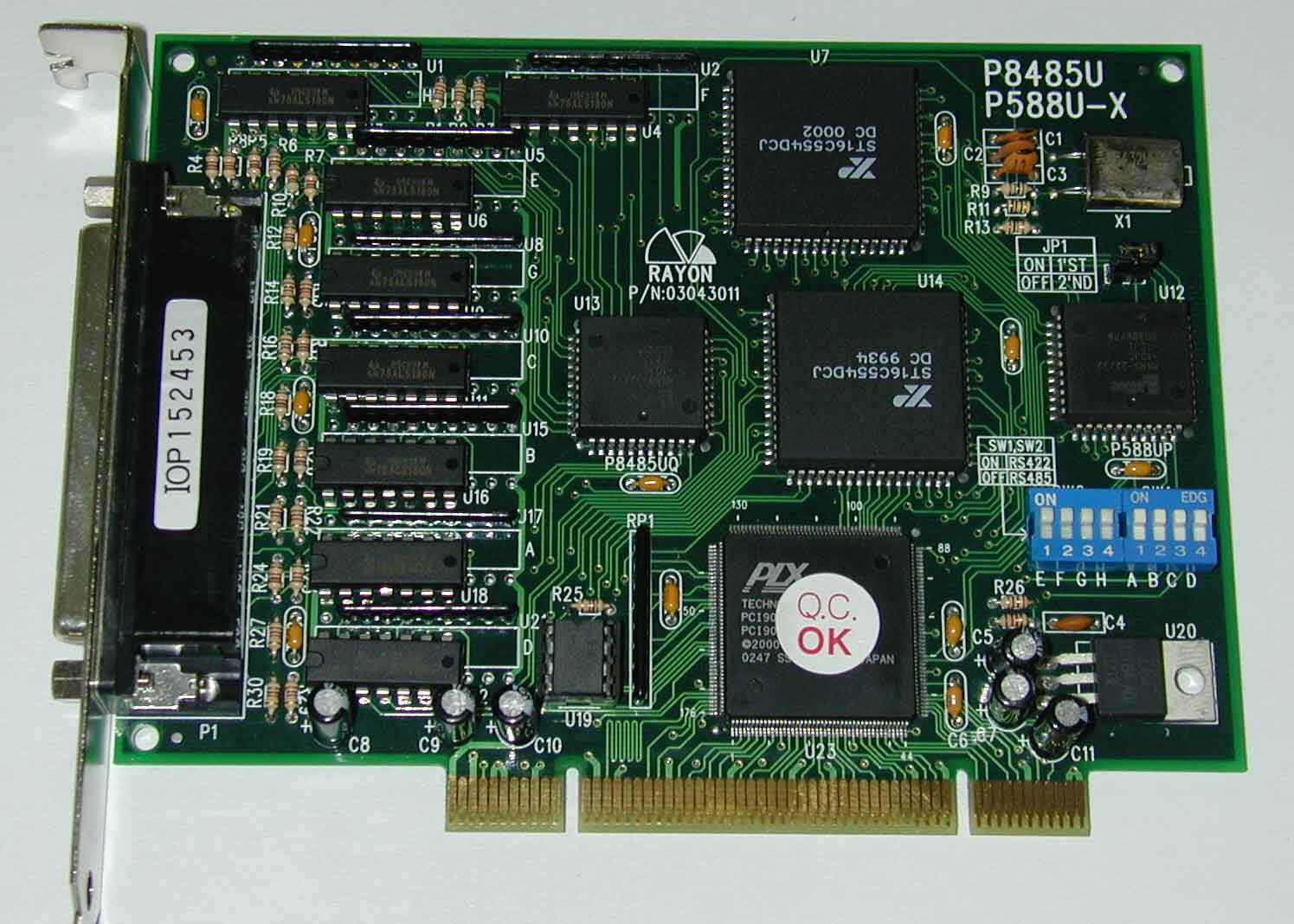
Comprehensive Product Summary – Rayon Technology P8485U 8-Port RS422/RS485 PCI Communication Card
### 1. Product Overview
Product Name: UPCI 8-Port RS422/RS485 Card
Model: P8485U
Series: RAYON PCIPORT Series
Article Number: P8485U
Manufacturer: Rayon Technology Inc.
Origin: Taiwan R.O.C.
Manual Revision: 1.00 (October 19, 2003)
Product Category: Intelligent multi-port serial communication controller card for PCI bus systems
The Rayon P8485U is an intelligent, universal PCI (UPCI) 8-port serial communication card designed for industrial and commercial PC-based systems requiring multiple RS422/RS485 serial interfaces. It provides high-performance asynchronous serial communication with automatic configuration via PCI BIOS, supporting both 3.3V and 5V PCI slots. The card is part of Rayon’s PCIPORT family, engineered for robust, high-speed, and reliable serial data transmission in automation, control, and communication environments.
### 2. Key Features
- Eight Independent Serial Ports:
Provides 8 fully functional RS422/RS485 serial ports, each configurable individually via DIP switches for RS422 or RS485 operation.
- High Compatibility:
Each port is 16550A UART compatible, ensuring compatibility with standard serial communication software and drivers.
- Automatic Data Direction Control (ADDC):
Built-in ADDC function for RS485 mode enables automatic transmit/receive switching without software intervention, simplifying half-duplex communication.
- Plug & Play PCI Interface:
Fully compliant with PCI Local Bus Specification Rev. 2.1. All resource assignments (I/O address, IRQ) are automatically managed by the PCI BIOS.
- Shared IRQ Support:
Supports IRQ sharing among multiple PCI devices, reducing system resource conflicts.
- Flexible Baud Rate:
Programmable baud rates from 50 bps up to 115.2 Kbps (with 1.8432 MHz crystal) or up to 921.6 Kbps (with 14.7456 MHz crystal).
- Universal PCI Voltage Support:
Operates in both 3.3V and 5V PCI slots at 33 MHz bus frequency.
- Comprehensive OS Support:
Compatible with DOS, Windows 95/98/ME/NT/2000/XP, Linux, and SCO OpenServer.
- Compact Design:
PCB dimensions of 141 mm × 106 mm, suitable for standard PC chassis.
- High Reliability:
Designed for industrial-grade performance with robust signal integrity and optional isolation via external RS4232-8 box.
- Included Connectivity:
Comes with a DB62 male-to-8×DB9 male cable (R804) or optional DB62-to-8×DB25 male cable (R801).
### 3. Technical Specifications
| Parameter | Specification |
|----------------|------------------|
| Bus Interface | PCI Local Bus Rev. 2.1, 33 MHz |
| Bus Voltage | 3.3V / 5V Universal PCI |
| Ports | 8 independent RS422/RS485 ports |
| UART Type | 16550A compatible |
| Baud Rate | 50 bps – 115.2 Kbps (1.8432 MHz) / up to 921.6 Kbps (14.7456 MHz) |
| Flow Control | XON/XOFF (software) or RTS/CTS (hardware) |
| Interrupt Control | Plug & Play, IRQ shareable |
| I/O Mapping | Assigned automatically by PCI BIOS |
| Connector Type | DB62 female on card; expansion cable to 8×DB9M or 8×DB25M |
| Dimensions | 141 mm (L) × 106 mm (W) |
| Power Requirement | Single 5V supply from PCI slot |
| Max Cards per System | 2 cards (16 ports total) |
| Operating Environment | PC/AT compatible systems |
| Material | Multi-layer PCB, industrial-grade components |
| Weight | Approx. 150 g (card only) |
| Cable Options | R801 (DB62→8×DB25M), R804 (DB62→8×DB9M), R803 (DB62→DB62 for RS4232-8 box) |
### 4. Functionality
The P8485U functions as an intelligent serial communication controller that offloads serial I/O processing from the host CPU. Each port operates independently and can be configured for RS422 (full-duplex) or RS485 (half-duplex) communication. The ADDC feature automatically manages data direction in RS485 mode, eliminating the need for manual RTS control.
Use Cases and Applications:
- Industrial automation and process control systems
- Data acquisition and SCADA systems
- Building management and access control
- POS and kiosk systems
- Serial device networking (PLC, sensors, barcode scanners, etc.)
- Multi-terminal communication servers
Compatibility:
- Works with standard serial communication software and APIs.
- Supports multiple operating systems with dedicated drivers.
- Compatible with external isolation boxes (RS4232-8) for galvanic isolation and surge protection.
### 5. Components & Accessories
Included in Standard Package:
- 1 × P8485U PCI interface card
- 1 × 62-pin expansion cable (DB62F to 8×DB9M or DB25M)
- 1 × User manual
Optional Accessories:
- R801 Cable: DB62 to 8×DB25 male connectors
- R802 Cable: DB62 to 8×DB25 female connectors
- R804 Cable: DB62 to 8×DB9 male connectors
- R803 Cable: DB62 to DB62 cable for connecting to RS4232-8 isolation box
- RS4232-8 Box: External isolation module providing isolated RS422/RS485 interfaces
- TB485 Converter: DB9 to 3-pin terminal block adapter for RS485 wiring
Connector Pin Assignments:
- DB62 pinout supports TXD±, RXD±, RTS, CTS, DSR, DTR, DCD, and GND for each port.
- Each port’s signal mapping follows standard RS422/RS485 differential signaling conventions.
### 6. Installation & Setup
System Requirements:
- PC/AT compatible system with available PCI slot (3.3V or 5V, 33 MHz)
- Supported operating system (DOS, Windows, Linux, SCO)
Installation Steps:
1. Power off the system and discharge static electricity.
2. Insert the P8485U card into an available PCI slot.
3. Connect the 62-pin expansion cable to the card.
4. Attach the DB9/DB25 connectors to external devices.
5. Power on the system; the PCI BIOS will automatically assign resources.
6. Install the appropriate driver for your operating system.
Jumper Configuration:
- JP1: Card number selection
- ON = First card
- OFF = Second card
DIP Switch Configuration:
- SW1 & SW2: Interface mode selection per port
- ON = RS422 mode
- OFF = RS485 mode
Driver Installation:
- Windows 2000/XP: Automatic Plug & Play detection; specify driver path (A:\WIN2000).
- Windows NT4: Manual installation via Control Panel → Network → Add Adapter → “Other” → specify A:\P588\NT4.
- Windows 95/98/ME: Plug & Play detection; specify A:\WIN95.
- DOS: Run `PCIPORT.EXE` from driver diskette.
- Linux: Copy driver source to `/etc/rayon`, run `./Install`, rebuild kernel modules.
- SCO OpenServer: Use `/etc/custom` or manual `tar` and `build` procedure.
Multi-Card Installation:
- Up to two P8485U cards per system (16 ports total).
- One card must have JP1 ON (first card), the other OFF (second card).
- IRQ sharing supported under Windows and Linux; SCO requires unique IRQs.
### 7. Performance & Capabilities
- Data Throughput:
High-speed asynchronous communication up to 115.2 Kbps (standard) or 921.6 Kbps (optional crystal).
- Buffering:
Each port features 16-byte transmit and receive FIFOs, minimizing CPU interrupts and improving throughput.
- Interrupt Handling:
Intelligent interrupt sharing and buffering reduce CPU load, enhancing multitasking performance.
- Capacity:
Supports up to 8 serial devices per card, 16 devices per system (with two cards).
- Efficiency:
Automatic resource allocation and ADDC reduce software overhead and latency.
- Limitations:
- No onboard isolation (requires RS4232-8 box for galvanic isolation).
- Limited to two cards per system due to IRQ and I/O mapping constraints.
- RS485 mode supports half-duplex communication only.
### 8. Standards & Compliance
- PCI Compliance:
Fully compliant with PCI Local Bus Specification Revision 2.1.
- Electrical Standards:
RS422 and RS485 EIA/TIA standards compliant.
- Operating System Drivers:
Certified for Windows 95/98/ME/NT/2000/XP, Linux kernel 2.4.x and above, and SCO OpenServer.
- Safety & EMC:
Designed for industrial environments with optional isolation and surge protection via RS4232-8 box.
- Environmental Conditions:
- Operating Temperature: 0°C to 55°C (typical)
- Storage Temperature: -20°C to 85°C
- Humidity: 5–95% non-condensing
- Regulatory Compliance:
Meets CE and FCC Class A requirements (industrial/commercial use).
### 9. Additional Information
Warranty:
- One-year limited warranty covering defects in materials and workmanship.
- Excludes damage from misuse, unauthorized servicing, or electrical faults.
- Out-of-warranty repairs available at flat-rate service charge.
Technical Support:
- Rayon Technology Co., Ltd. (Taiwan)
2F, No. 177, Chung-Shan 2 Road, Lu-Chou City, Taipei Hsien, Taiwan R.O.C.
Tel: +886 2 82858362 | Fax: +886 2 82857065
Email: rayon@ms1.hinet.net
- Acceed GmbH (Europe)
Arnoldstraße 19, 40479 Düsseldorf, Germany
Tel/Fax: +49 211 938898 0
Email: rayon@acceed.com
Web: [www.acceed.com/rayon](http://www.acceed.com/rayon)
Maintenance & Repair Procedure:
- Obtain Return Material Authorization (RMA) before returning products.
- Provide model number, serial number, purchase order, and problem description.
- Products under warranty repaired free of charge; non-warranty repairs billed at standard rates.
Software & Updates:
- Driver updates and documentation available via Rayon or Acceed support sites.
- Linux driver source provided for kernel integration and customization.
Troubleshooting Highlights:
- Verify PCI BIOS detects card (Vendor ID 10B5 or 144A, Device ID 9050).
- Ensure correct driver path during installation.
- Check IRQ conflicts if communication fails.
- Use “RAYONTTY.EXE” utility for port testing under DOS.
- For Linux, ensure kernel source is properly linked to `/usr/src/linux`.
### Summary
The Rayon P8485U UPCI 8-Port RS422/RS485 Card is a robust, high-performance serial communication solution for industrial and embedded PC systems. It combines intelligent buffering, automatic configuration, and flexible interface selection to deliver reliable multi-port serial connectivity. With universal PCI compatibility, comprehensive OS driver support, and optional isolation accessories, the P8485U is ideal for demanding applications requiring stable, high-speed, and configurable serial communication across multiple devices. Its modular design, ease of installation, and proven reliability make it a preferred choice for system integrators and industrial automation professionals worldwide.

### 1. Product Overview
Product Name: UPCI 8-Port RS422/RS485 Card
Model: P8485U
Series: RAYON PCIPORT Series
Article Number: P8485U
Manufacturer: Rayon Technology Inc.
Origin: Taiwan R.O.C.
Manual Revision: 1.00 (October 19, 2003)
Product Category: Intelligent multi-port serial communication controller card for PCI bus systems
The Rayon P8485U is an intelligent, universal PCI (UPCI) 8-port serial communication card designed for industrial and commercial PC-based systems requiring multiple RS422/RS485 serial interfaces. It provides high-performance asynchronous serial communication with automatic configuration via PCI BIOS, supporting both 3.3V and 5V PCI slots. The card is part of Rayon’s PCIPORT family, engineered for robust, high-speed, and reliable serial data transmission in automation, control, and communication environments.
### 2. Key Features
- Eight Independent Serial Ports:
Provides 8 fully functional RS422/RS485 serial ports, each configurable individually via DIP switches for RS422 or RS485 operation.
- High Compatibility:
Each port is 16550A UART compatible, ensuring compatibility with standard serial communication software and drivers.
- Automatic Data Direction Control (ADDC):
Built-in ADDC function for RS485 mode enables automatic transmit/receive switching without software intervention, simplifying half-duplex communication.
- Plug & Play PCI Interface:
Fully compliant with PCI Local Bus Specification Rev. 2.1. All resource assignments (I/O address, IRQ) are automatically managed by the PCI BIOS.
- Shared IRQ Support:
Supports IRQ sharing among multiple PCI devices, reducing system resource conflicts.
- Flexible Baud Rate:
Programmable baud rates from 50 bps up to 115.2 Kbps (with 1.8432 MHz crystal) or up to 921.6 Kbps (with 14.7456 MHz crystal).
- Universal PCI Voltage Support:
Operates in both 3.3V and 5V PCI slots at 33 MHz bus frequency.
- Comprehensive OS Support:
Compatible with DOS, Windows 95/98/ME/NT/2000/XP, Linux, and SCO OpenServer.
- Compact Design:
PCB dimensions of 141 mm × 106 mm, suitable for standard PC chassis.
- High Reliability:
Designed for industrial-grade performance with robust signal integrity and optional isolation via external RS4232-8 box.
- Included Connectivity:
Comes with a DB62 male-to-8×DB9 male cable (R804) or optional DB62-to-8×DB25 male cable (R801).
### 3. Technical Specifications
| Parameter | Specification |
|----------------|------------------|
| Bus Interface | PCI Local Bus Rev. 2.1, 33 MHz |
| Bus Voltage | 3.3V / 5V Universal PCI |
| Ports | 8 independent RS422/RS485 ports |
| UART Type | 16550A compatible |
| Baud Rate | 50 bps – 115.2 Kbps (1.8432 MHz) / up to 921.6 Kbps (14.7456 MHz) |
| Flow Control | XON/XOFF (software) or RTS/CTS (hardware) |
| Interrupt Control | Plug & Play, IRQ shareable |
| I/O Mapping | Assigned automatically by PCI BIOS |
| Connector Type | DB62 female on card; expansion cable to 8×DB9M or 8×DB25M |
| Dimensions | 141 mm (L) × 106 mm (W) |
| Power Requirement | Single 5V supply from PCI slot |
| Max Cards per System | 2 cards (16 ports total) |
| Operating Environment | PC/AT compatible systems |
| Material | Multi-layer PCB, industrial-grade components |
| Weight | Approx. 150 g (card only) |
| Cable Options | R801 (DB62→8×DB25M), R804 (DB62→8×DB9M), R803 (DB62→DB62 for RS4232-8 box) |
### 4. Functionality
The P8485U functions as an intelligent serial communication controller that offloads serial I/O processing from the host CPU. Each port operates independently and can be configured for RS422 (full-duplex) or RS485 (half-duplex) communication. The ADDC feature automatically manages data direction in RS485 mode, eliminating the need for manual RTS control.
Use Cases and Applications:
- Industrial automation and process control systems
- Data acquisition and SCADA systems
- Building management and access control
- POS and kiosk systems
- Serial device networking (PLC, sensors, barcode scanners, etc.)
- Multi-terminal communication servers
Compatibility:
- Works with standard serial communication software and APIs.
- Supports multiple operating systems with dedicated drivers.
- Compatible with external isolation boxes (RS4232-8) for galvanic isolation and surge protection.
### 5. Components & Accessories
Included in Standard Package:
- 1 × P8485U PCI interface card
- 1 × 62-pin expansion cable (DB62F to 8×DB9M or DB25M)
- 1 × User manual
Optional Accessories:
- R801 Cable: DB62 to 8×DB25 male connectors
- R802 Cable: DB62 to 8×DB25 female connectors
- R804 Cable: DB62 to 8×DB9 male connectors
- R803 Cable: DB62 to DB62 cable for connecting to RS4232-8 isolation box
- RS4232-8 Box: External isolation module providing isolated RS422/RS485 interfaces
- TB485 Converter: DB9 to 3-pin terminal block adapter for RS485 wiring
Connector Pin Assignments:
- DB62 pinout supports TXD±, RXD±, RTS, CTS, DSR, DTR, DCD, and GND for each port.
- Each port’s signal mapping follows standard RS422/RS485 differential signaling conventions.
### 6. Installation & Setup
System Requirements:
- PC/AT compatible system with available PCI slot (3.3V or 5V, 33 MHz)
- Supported operating system (DOS, Windows, Linux, SCO)
Installation Steps:
1. Power off the system and discharge static electricity.
2. Insert the P8485U card into an available PCI slot.
3. Connect the 62-pin expansion cable to the card.
4. Attach the DB9/DB25 connectors to external devices.
5. Power on the system; the PCI BIOS will automatically assign resources.
6. Install the appropriate driver for your operating system.
Jumper Configuration:
- JP1: Card number selection
- ON = First card
- OFF = Second card
DIP Switch Configuration:
- SW1 & SW2: Interface mode selection per port
- ON = RS422 mode
- OFF = RS485 mode
Driver Installation:
- Windows 2000/XP: Automatic Plug & Play detection; specify driver path (A:\WIN2000).
- Windows NT4: Manual installation via Control Panel → Network → Add Adapter → “Other” → specify A:\P588\NT4.
- Windows 95/98/ME: Plug & Play detection; specify A:\WIN95.
- DOS: Run `PCIPORT.EXE` from driver diskette.
- Linux: Copy driver source to `/etc/rayon`, run `./Install`, rebuild kernel modules.
- SCO OpenServer: Use `/etc/custom` or manual `tar` and `build` procedure.
Multi-Card Installation:
- Up to two P8485U cards per system (16 ports total).
- One card must have JP1 ON (first card), the other OFF (second card).
- IRQ sharing supported under Windows and Linux; SCO requires unique IRQs.
### 7. Performance & Capabilities
- Data Throughput:
High-speed asynchronous communication up to 115.2 Kbps (standard) or 921.6 Kbps (optional crystal).
- Buffering:
Each port features 16-byte transmit and receive FIFOs, minimizing CPU interrupts and improving throughput.
- Interrupt Handling:
Intelligent interrupt sharing and buffering reduce CPU load, enhancing multitasking performance.
- Capacity:
Supports up to 8 serial devices per card, 16 devices per system (with two cards).
- Efficiency:
Automatic resource allocation and ADDC reduce software overhead and latency.
- Limitations:
- No onboard isolation (requires RS4232-8 box for galvanic isolation).
- Limited to two cards per system due to IRQ and I/O mapping constraints.
- RS485 mode supports half-duplex communication only.
### 8. Standards & Compliance
- PCI Compliance:
Fully compliant with PCI Local Bus Specification Revision 2.1.
- Electrical Standards:
RS422 and RS485 EIA/TIA standards compliant.
- Operating System Drivers:
Certified for Windows 95/98/ME/NT/2000/XP, Linux kernel 2.4.x and above, and SCO OpenServer.
- Safety & EMC:
Designed for industrial environments with optional isolation and surge protection via RS4232-8 box.
- Environmental Conditions:
- Operating Temperature: 0°C to 55°C (typical)
- Storage Temperature: -20°C to 85°C
- Humidity: 5–95% non-condensing
- Regulatory Compliance:
Meets CE and FCC Class A requirements (industrial/commercial use).
### 9. Additional Information
Warranty:
- One-year limited warranty covering defects in materials and workmanship.
- Excludes damage from misuse, unauthorized servicing, or electrical faults.
- Out-of-warranty repairs available at flat-rate service charge.
Technical Support:
- Rayon Technology Co., Ltd. (Taiwan)
2F, No. 177, Chung-Shan 2 Road, Lu-Chou City, Taipei Hsien, Taiwan R.O.C.
Tel: +886 2 82858362 | Fax: +886 2 82857065
Email: rayon@ms1.hinet.net
- Acceed GmbH (Europe)
Arnoldstraße 19, 40479 Düsseldorf, Germany
Tel/Fax: +49 211 938898 0
Email: rayon@acceed.com
Web: [www.acceed.com/rayon](http://www.acceed.com/rayon)
Maintenance & Repair Procedure:
- Obtain Return Material Authorization (RMA) before returning products.
- Provide model number, serial number, purchase order, and problem description.
- Products under warranty repaired free of charge; non-warranty repairs billed at standard rates.
Software & Updates:
- Driver updates and documentation available via Rayon or Acceed support sites.
- Linux driver source provided for kernel integration and customization.
Troubleshooting Highlights:
- Verify PCI BIOS detects card (Vendor ID 10B5 or 144A, Device ID 9050).
- Ensure correct driver path during installation.
- Check IRQ conflicts if communication fails.
- Use “RAYONTTY.EXE” utility for port testing under DOS.
- For Linux, ensure kernel source is properly linked to `/usr/src/linux`.
### Summary
The Rayon P8485U UPCI 8-Port RS422/RS485 Card is a robust, high-performance serial communication solution for industrial and embedded PC systems. It combines intelligent buffering, automatic configuration, and flexible interface selection to deliver reliable multi-port serial connectivity. With universal PCI compatibility, comprehensive OS driver support, and optional isolation accessories, the P8485U is ideal for demanding applications requiring stable, high-speed, and configurable serial communication across multiple devices. Its modular design, ease of installation, and proven reliability make it a preferred choice for system integrators and industrial automation professionals worldwide.

-
PCI-Port-015.pdf
Manual