A400
SUCHEN SIE DIE PASSENDE
INDUSTRIELLE LÖSUNG?
Entdecken Sie Embedded-, Kommunikations- und Automatisierungslösungen für Ihre Anwendung.
- Four Independent Serial Ports:
Two RS232 ports (Ports A and B) and two RS422/RS485 ports (Ports C and D), selectable via DIP switch and jumper configuration.
- High Compatibility:
Each port is 16550A UART compatible, ensuring compatibility with standard serial communication software and hardware.
- Flexible Interface Selection:
RS422/RS485 ports can be configured individually for either RS422 or RS485 operation using onboard jumpers (JP5).
- Automatic Data Direction Control (ADDC):
Built-in ADDC function for RS485 communication eliminates the need for manual RTS signal control.
- Plug & Play PCI Interface:
Fully compliant with PCI Local Bus Specification Rev. 2.1. All resource assignments (IRQ, I/O address) are automatically managed by the PCI BIOS.
- Shared IRQ Support:
Supports IRQ sharing among multiple PCI devices, simplifying system integration.
- High-Speed Communication:
Supports baud rates from 50 bps up to 115.2 Kbps (1.8432 MHz crystal) or up to 921.6 Kbps (14.7456 MHz crystal).
- Comprehensive OS Support:
Compatible with DOS, Windows 95/98/ME/NT/2000/XP, Linux, and SCO OpenServer.
- Multi-Card Support:
Up to two P924 cards can be installed in a single system, providing up to eight serial ports.
- Included Expansion Cable:
Comes with a DB37 female to 4×DB9 male connector cable (DB25 male version available upon request).
- Compact Design:
Dimensions of 122 mm × 101 mm, suitable for standard PCI slots.
Two RS232 ports (Ports A and B) and two RS422/RS485 ports (Ports C and D), selectable via DIP switch and jumper configuration.
- High Compatibility:
Each port is 16550A UART compatible, ensuring compatibility with standard serial communication software and hardware.
- Flexible Interface Selection:
RS422/RS485 ports can be configured individually for either RS422 or RS485 operation using onboard jumpers (JP5).
- Automatic Data Direction Control (ADDC):
Built-in ADDC function for RS485 communication eliminates the need for manual RTS signal control.
- Plug & Play PCI Interface:
Fully compliant with PCI Local Bus Specification Rev. 2.1. All resource assignments (IRQ, I/O address) are automatically managed by the PCI BIOS.
- Shared IRQ Support:
Supports IRQ sharing among multiple PCI devices, simplifying system integration.
- High-Speed Communication:
Supports baud rates from 50 bps up to 115.2 Kbps (1.8432 MHz crystal) or up to 921.6 Kbps (14.7456 MHz crystal).
- Comprehensive OS Support:
Compatible with DOS, Windows 95/98/ME/NT/2000/XP, Linux, and SCO OpenServer.
- Multi-Card Support:
Up to two P924 cards can be installed in a single system, providing up to eight serial ports.
- Included Expansion Cable:
Comes with a DB37 female to 4×DB9 male connector cable (DB25 male version available upon request).
- Compact Design:
Dimensions of 122 mm × 101 mm, suitable for standard PCI slots.
Comprehensive Product Summary – Rayon Technology P924 PCI 4-Port Serial Communication Card
### 1. Product Overview
Product Name: PCI 4-Port 2×RS232 and 2×RS422/485 Serial Communication Card
Model: P924
Series: RAYON PCIPORT Series
Article Number: P924
Manufacturer: Rayon Technology Inc.
Manufacturer Address:
2F, No. 177, Chung-Shan 2 Road, Lu-Chou City, Taipei Hsien, Taiwan R.O.C.
European Support Partner: Acceed GmbH, Arnoldstraße 19, 40479 Düsseldorf, Germany
Manual Revision: Rev. 1.00, October 19, 2003
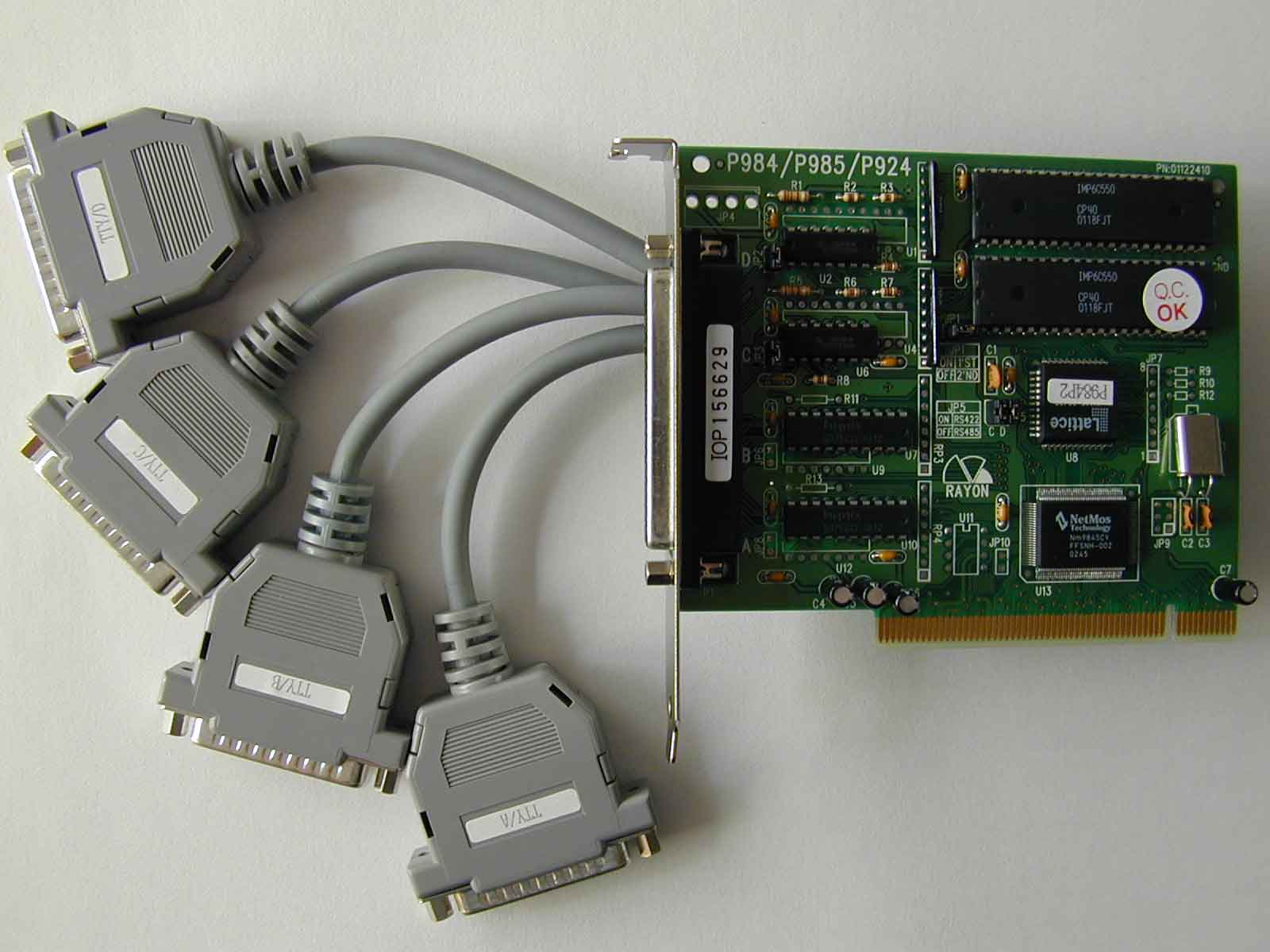
The Rayon P924 is a PCI-based intelligent multi-port serial communication controller designed for PC/AT systems with a 5V or 3.3V 33MHz PCI bus. It provides four independent serial ports—two RS232 and two RS422/RS485—offering flexible connectivity for industrial, automation, and communication applications. The card is fully Plug & Play compliant and supports a wide range of operating systems including DOS, Windows 95/98/ME/NT/2000/XP, Linux, and SCO OpenServer.
### 2. Key Features
- Four Independent Serial Ports:
Two RS232 ports (Ports A and B) and two RS422/RS485 ports (Ports C and D), selectable via DIP switch and jumper configuration.
- High Compatibility:
Each port is 16550A UART compatible, ensuring compatibility with standard serial communication software and hardware.
- Flexible Interface Selection:
RS422/RS485 ports can be configured individually for either RS422 or RS485 operation using onboard jumpers (JP5).
- Automatic Data Direction Control (ADDC):
Built-in ADDC function for RS485 communication eliminates the need for manual RTS signal control.
- Plug & Play PCI Interface:
Fully compliant with PCI Local Bus Specification Rev. 2.1. All resource assignments (IRQ, I/O address) are automatically managed by the PCI BIOS.
- Shared IRQ Support:
Supports IRQ sharing among multiple PCI devices, simplifying system integration.
- High-Speed Communication:
Supports baud rates from 50 bps up to 115.2 Kbps (1.8432 MHz crystal) or up to 921.6 Kbps (14.7456 MHz crystal).
- Comprehensive OS Support:
Compatible with DOS, Windows 95/98/ME/NT/2000/XP, Linux, and SCO OpenServer.
- Multi-Card Support:
Up to two P924 cards can be installed in a single system, providing up to eight serial ports.
- Included Expansion Cable:
Comes with a DB37 female to 4×DB9 male connector cable (DB25 male version available upon request).
- Compact Design:
Dimensions of 122 mm × 101 mm, suitable for standard PCI slots.
### 3. Technical Specifications
Bus Interface:
- PCI Local Bus Specification Rev. 2.1 compliant
- 5V or 3.3V 33MHz PCI slot (Universal PCI supported)
Serial Controller:
- 16C550A compatible UART
- 16-byte transmit and receive FIFO buffers
- 1.8432 MHz crystal oscillator (optional 14.7456 MHz for higher baud rates)
Ports:
- 4 total serial ports
- Port A, B: RS232
- Port C, D: RS422/RS485 (selectable)
- Connector: DB37 female on card
- Expansion cable: DB37 to 4×DB9 male (standard) or DB37 to 4×DB25 male (optional)
Baud Rate:
- Programmable up to 115.2 Kbps (standard)
- Up to 921.6 Kbps with optional high-speed crystal
Flow Control:
- Hardware: RTS/CTS
- Software: XON/XOFF
Interrupts:
- PCI BIOS assigned, IRQ shareable
- Single shared IRQ mapping for all ports
I/O Mapping:
- Automatically assigned by PCI BIOS
- 6×8-byte I/O blocks per card
Dimensions:
- 122 mm (L) × 101 mm (W)
Material:
- Multi-layer PCB with gold-plated edge connector
Operating Environment:
- Operating Temperature: 0°C to 55°C
- Storage Temperature: -20°C to 85°C
- Humidity: 5%–95% non-condensing
Power Requirements:
- 5V or 3.3V PCI bus power (consumption < 2W typical)
### 4. Functionality
The P924 card functions as a multi-port serial communication interface for PCs, providing both asynchronous RS232 and differential RS422/RS485 connectivity. It is ideal for connecting industrial devices such as PLCs, sensors, modems, barcode readers, and other serial peripherals.
Operation:
- The card’s onboard ASIC manages communication between the PCI bus and serial ports, reducing CPU load by buffering data in hardware FIFOs.
- Each port can operate independently with configurable baud rate, parity, stop bits, and flow control.
- RS422/RS485 ports support full-duplex (RS422) or half-duplex (RS485) communication.
- RS485 mode includes automatic data direction control, ensuring reliable half-duplex operation without software intervention.
Use Cases:
- Industrial automation and control systems
- Data acquisition and monitoring
- POS and kiosk systems
- Communication gateways and serial device servers
- Laboratory instrumentation and test equipment
Compatibility:
- Fully compatible with standard serial communication APIs and drivers across supported operating systems.
### 5. Components & Accessories
Included Items:
- 1× P924 PCI interface card
- 1× DB37-to-4×DB9 male expansion cable (A400 or P485 type)
- 1× User manual and driver diskette
Optional Accessories:
- DB37-to-4×DB25 male cable (A400)
- A640 DB37-to-DB37 cable for connection to RS4232-4 isolation box
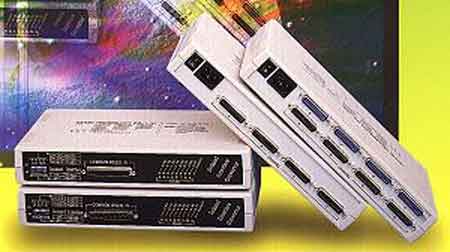
- RS4232-4 isolation box (provides isolated RS232/RS422/RS485 interfaces)
- TB485 converter (DB9 to 3-pin terminal block for RS485 wiring)
Connectors:
- Onboard: DB37 female
- Expansion: DB9 male or DB25 male connectors
- Signal assignments per Appendix A (DB37 pinout)
### 6. Installation & Setup
System Requirements:
- PC/AT compatible system with available PCI slot (5V or 3.3V)
- Supported OS: DOS, Windows 95/98/ME/NT/2000/XP, Linux, SCO OpenServer
Installation Steps:
1. Power off the system and disconnect AC power.
2. Insert the P924 card into an available PCI slot.
3. Connect the DB37 expansion cable to the card.
4. Power on the system.
5. Install the appropriate driver for your operating system.
6. Configure COM port numbers and verify operation.
Jumper Configuration:
- JP1: Card number selection (ON = first card, OFF = second card)
- JP5: Interface selection for ports C and D (short = RS422, open = RS485)
- JP2/JP3: Terminator resistor insertion for RS422/485 (short = 120Ω terminator enabled)
Driver Installation:
- Windows 2000/XP: Plug & Play detection; specify driver path (A:\WIN2000).
- Windows NT4: Manual installation via Control Panel → Network → Add Adapter → “Other” → specify A:\P984\NT4.
- Windows 95/98/ME: Plug & Play detection; specify A:\WIN95.
- DOS: Run `P984` from driver diskette directory.
- Linux: Copy driver source to `/etc/rayon`, run `./Install`, rebuild kernel modules.
- SCO OpenServer: Use `/etc/custom` or manual installation via `/etc/pciport/build`.
Multi-Card Installation:
- Up to two P924 cards per system.
- Set one card’s JP1 ON (first card) and the other OFF (second card).
- Ensure unique IRQ assignment or shared IRQ compatibility.
### 7. Performance & Capabilities
Data Throughput:
- Up to 115.2 Kbps (standard) or 921.6 Kbps (optional high-speed mode)
Buffering:
- 16-byte transmit and receive FIFO per port, minimizing CPU interrupts
IRQ Sharing:
- Supports shared interrupt operation across multiple PCI devices
Capacity:
- 4 independent serial channels per card
- Up to 8 channels with two cards installed
Efficiency:
- Reduced CPU load due to intelligent buffering and hardware flow control
- Automatic resource configuration via PCI BIOS
Limitations:
- Maximum of two cards per system
- RS485 mode supports half-duplex communication only
- Requires proper termination for long cable runs or high baud rates
### 8. Standards & Compliance
Bus Standard:
- PCI Local Bus Specification Revision 2.1
Serial Standards:
- RS232C (EIA/TIA-232)
- RS422 (EIA/TIA-422)
- RS485 (EIA/TIA-485)
Electrical Compliance:
- 5V/3.3V PCI signaling
- TTL-compatible logic levels
Software & OS Compliance:
- Microsoft Windows certified drivers (95/98/ME/NT/2000/XP)
- Linux kernel module source provided
- SCO OpenServer compatible
Environmental & Safety:
- Designed for industrial environments
- Meets general EMC and ESD protection standards (when used with RS4232 isolation box)
### 9. Additional Information
Warranty:
- 1-year limited warranty covering defects in materials and workmanship
- Excludes damage from misuse, unauthorized service, or electrical faults
Support & Service:
- Rayon Taiwan: rayon@ms1.hinet.net
- Acceed Europe: rayon@acceed.com
- RMA procedure requires model number, serial number, and problem description
- Out-of-warranty repairs available at flat-rate service charge
Maintenance:
- Keep connectors clean and free of dust
- Avoid static discharge during installation (use anti-static wrist strap)
- Periodically verify cable integrity and termination settings
Software Updates:
- Updated drivers and documentation available via Rayon or Acceed websites
- Linux driver source updates provided for kernel compatibility
Documentation:
- Detailed pin assignments and wiring diagrams in Appendix A
- Troubleshooting procedures in Appendix C
- RS4232 isolation box configuration in Appendix B
### Summary
The Rayon P924 PCI 4-Port Serial Communication Card is a robust, industrial-grade solution for expanding serial connectivity in PCI-based systems. Combining two RS232 and two RS422/RS485 ports, it offers exceptional flexibility for mixed-interface environments. With intelligent buffering, automatic data direction control, and full Plug & Play PCI compliance, the P924 minimizes CPU overhead while ensuring reliable, high-speed serial communication. Its broad OS support, configurable hardware options, and optional isolation accessories make it ideal for industrial automation, data acquisition, and communication gateway applications.

### 1. Product Overview
Product Name: PCI 4-Port 2×RS232 and 2×RS422/485 Serial Communication Card
Model: P924
Series: RAYON PCIPORT Series
Article Number: P924
Manufacturer: Rayon Technology Inc.
Manufacturer Address:
2F, No. 177, Chung-Shan 2 Road, Lu-Chou City, Taipei Hsien, Taiwan R.O.C.
European Support Partner: Acceed GmbH, Arnoldstraße 19, 40479 Düsseldorf, Germany
Manual Revision: Rev. 1.00, October 19, 2003
The Rayon P924 is a PCI-based intelligent multi-port serial communication controller designed for PC/AT systems with a 5V or 3.3V 33MHz PCI bus. It provides four independent serial ports—two RS232 and two RS422/RS485—offering flexible connectivity for industrial, automation, and communication applications. The card is fully Plug & Play compliant and supports a wide range of operating systems including DOS, Windows 95/98/ME/NT/2000/XP, Linux, and SCO OpenServer.
### 2. Key Features
- Four Independent Serial Ports:
Two RS232 ports (Ports A and B) and two RS422/RS485 ports (Ports C and D), selectable via DIP switch and jumper configuration.
- High Compatibility:
Each port is 16550A UART compatible, ensuring compatibility with standard serial communication software and hardware.
- Flexible Interface Selection:
RS422/RS485 ports can be configured individually for either RS422 or RS485 operation using onboard jumpers (JP5).
- Automatic Data Direction Control (ADDC):
Built-in ADDC function for RS485 communication eliminates the need for manual RTS signal control.
- Plug & Play PCI Interface:
Fully compliant with PCI Local Bus Specification Rev. 2.1. All resource assignments (IRQ, I/O address) are automatically managed by the PCI BIOS.
- Shared IRQ Support:
Supports IRQ sharing among multiple PCI devices, simplifying system integration.
- High-Speed Communication:
Supports baud rates from 50 bps up to 115.2 Kbps (1.8432 MHz crystal) or up to 921.6 Kbps (14.7456 MHz crystal).
- Comprehensive OS Support:
Compatible with DOS, Windows 95/98/ME/NT/2000/XP, Linux, and SCO OpenServer.
- Multi-Card Support:
Up to two P924 cards can be installed in a single system, providing up to eight serial ports.
- Included Expansion Cable:
Comes with a DB37 female to 4×DB9 male connector cable (DB25 male version available upon request).
- Compact Design:
Dimensions of 122 mm × 101 mm, suitable for standard PCI slots.
### 3. Technical Specifications
Bus Interface:
- PCI Local Bus Specification Rev. 2.1 compliant
- 5V or 3.3V 33MHz PCI slot (Universal PCI supported)
Serial Controller:
- 16C550A compatible UART
- 16-byte transmit and receive FIFO buffers
- 1.8432 MHz crystal oscillator (optional 14.7456 MHz for higher baud rates)
Ports:
- 4 total serial ports
- Port A, B: RS232
- Port C, D: RS422/RS485 (selectable)
- Connector: DB37 female on card
- Expansion cable: DB37 to 4×DB9 male (standard) or DB37 to 4×DB25 male (optional)
Baud Rate:
- Programmable up to 115.2 Kbps (standard)
- Up to 921.6 Kbps with optional high-speed crystal
Flow Control:
- Hardware: RTS/CTS
- Software: XON/XOFF
Interrupts:
- PCI BIOS assigned, IRQ shareable
- Single shared IRQ mapping for all ports
I/O Mapping:
- Automatically assigned by PCI BIOS
- 6×8-byte I/O blocks per card
Dimensions:
- 122 mm (L) × 101 mm (W)
Material:
- Multi-layer PCB with gold-plated edge connector
Operating Environment:
- Operating Temperature: 0°C to 55°C
- Storage Temperature: -20°C to 85°C
- Humidity: 5%–95% non-condensing
Power Requirements:
- 5V or 3.3V PCI bus power (consumption < 2W typical)
### 4. Functionality
The P924 card functions as a multi-port serial communication interface for PCs, providing both asynchronous RS232 and differential RS422/RS485 connectivity. It is ideal for connecting industrial devices such as PLCs, sensors, modems, barcode readers, and other serial peripherals.
Operation:
- The card’s onboard ASIC manages communication between the PCI bus and serial ports, reducing CPU load by buffering data in hardware FIFOs.
- Each port can operate independently with configurable baud rate, parity, stop bits, and flow control.
- RS422/RS485 ports support full-duplex (RS422) or half-duplex (RS485) communication.
- RS485 mode includes automatic data direction control, ensuring reliable half-duplex operation without software intervention.
Use Cases:
- Industrial automation and control systems
- Data acquisition and monitoring
- POS and kiosk systems
- Communication gateways and serial device servers
- Laboratory instrumentation and test equipment
Compatibility:
- Fully compatible with standard serial communication APIs and drivers across supported operating systems.
### 5. Components & Accessories
Included Items:
- 1× P924 PCI interface card
- 1× DB37-to-4×DB9 male expansion cable (A400 or P485 type)
- 1× User manual and driver diskette
Optional Accessories:
- DB37-to-4×DB25 male cable (A400)
- A640 DB37-to-DB37 cable for connection to RS4232-4 isolation box
- RS4232-4 isolation box (provides isolated RS232/RS422/RS485 interfaces)
- TB485 converter (DB9 to 3-pin terminal block for RS485 wiring)
Connectors:
- Onboard: DB37 female
- Expansion: DB9 male or DB25 male connectors
- Signal assignments per Appendix A (DB37 pinout)
### 6. Installation & Setup
System Requirements:
- PC/AT compatible system with available PCI slot (5V or 3.3V)
- Supported OS: DOS, Windows 95/98/ME/NT/2000/XP, Linux, SCO OpenServer
Installation Steps:
1. Power off the system and disconnect AC power.
2. Insert the P924 card into an available PCI slot.
3. Connect the DB37 expansion cable to the card.
4. Power on the system.
5. Install the appropriate driver for your operating system.
6. Configure COM port numbers and verify operation.
Jumper Configuration:
- JP1: Card number selection (ON = first card, OFF = second card)
- JP5: Interface selection for ports C and D (short = RS422, open = RS485)
- JP2/JP3: Terminator resistor insertion for RS422/485 (short = 120Ω terminator enabled)
Driver Installation:
- Windows 2000/XP: Plug & Play detection; specify driver path (A:\WIN2000).
- Windows NT4: Manual installation via Control Panel → Network → Add Adapter → “Other” → specify A:\P984\NT4.
- Windows 95/98/ME: Plug & Play detection; specify A:\WIN95.
- DOS: Run `P984` from driver diskette directory.
- Linux: Copy driver source to `/etc/rayon`, run `./Install`, rebuild kernel modules.
- SCO OpenServer: Use `/etc/custom` or manual installation via `/etc/pciport/build`.
Multi-Card Installation:
- Up to two P924 cards per system.
- Set one card’s JP1 ON (first card) and the other OFF (second card).
- Ensure unique IRQ assignment or shared IRQ compatibility.
### 7. Performance & Capabilities
Data Throughput:
- Up to 115.2 Kbps (standard) or 921.6 Kbps (optional high-speed mode)
Buffering:
- 16-byte transmit and receive FIFO per port, minimizing CPU interrupts
IRQ Sharing:
- Supports shared interrupt operation across multiple PCI devices
Capacity:
- 4 independent serial channels per card
- Up to 8 channels with two cards installed
Efficiency:
- Reduced CPU load due to intelligent buffering and hardware flow control
- Automatic resource configuration via PCI BIOS
Limitations:
- Maximum of two cards per system
- RS485 mode supports half-duplex communication only
- Requires proper termination for long cable runs or high baud rates
### 8. Standards & Compliance
Bus Standard:
- PCI Local Bus Specification Revision 2.1
Serial Standards:
- RS232C (EIA/TIA-232)
- RS422 (EIA/TIA-422)
- RS485 (EIA/TIA-485)
Electrical Compliance:
- 5V/3.3V PCI signaling
- TTL-compatible logic levels
Software & OS Compliance:
- Microsoft Windows certified drivers (95/98/ME/NT/2000/XP)
- Linux kernel module source provided
- SCO OpenServer compatible
Environmental & Safety:
- Designed for industrial environments
- Meets general EMC and ESD protection standards (when used with RS4232 isolation box)
### 9. Additional Information
Warranty:
- 1-year limited warranty covering defects in materials and workmanship
- Excludes damage from misuse, unauthorized service, or electrical faults
Support & Service:
- Rayon Taiwan: rayon@ms1.hinet.net
- Acceed Europe: rayon@acceed.com
- RMA procedure requires model number, serial number, and problem description
- Out-of-warranty repairs available at flat-rate service charge
Maintenance:
- Keep connectors clean and free of dust
- Avoid static discharge during installation (use anti-static wrist strap)
- Periodically verify cable integrity and termination settings
Software Updates:
- Updated drivers and documentation available via Rayon or Acceed websites
- Linux driver source updates provided for kernel compatibility
Documentation:
- Detailed pin assignments and wiring diagrams in Appendix A
- Troubleshooting procedures in Appendix C
- RS4232 isolation box configuration in Appendix B
### Summary
The Rayon P924 PCI 4-Port Serial Communication Card is a robust, industrial-grade solution for expanding serial connectivity in PCI-based systems. Combining two RS232 and two RS422/RS485 ports, it offers exceptional flexibility for mixed-interface environments. With intelligent buffering, automatic data direction control, and full Plug & Play PCI compliance, the P924 minimizes CPU overhead while ensuring reliable, high-speed serial communication. Its broad OS support, configurable hardware options, and optional isolation accessories make it ideal for industrial automation, data acquisition, and communication gateway applications.

-
PCI-Port-015.pdf
Manual