DIN-68S-01
SUCHEN SIE DIE PASSENDE
INDUSTRIELLE LÖSUNG?
Entdecken Sie Embedded-, Kommunikations- und Automatisierungslösungen für Ihre Anwendung.
- 32 PhotoMOS Relay Outputs:
Each output channel uses a solid-state PhotoMOS relay (SPST Form A) capable of switching up to 350 V (peak AC) and 0.12 A continuous current.
- 2 Isolated Digital Inputs:
Optically isolated channels (non-polarity sensitive) supporting up to 24 V input range with interrupt capability on both channels.
- High Isolation:
1500 V RMS isolation for relay outputs and 2500 V RMS isolation for digital inputs ensure robust electrical separation between field and system circuits.
- Relay Readback Function:
Allows software to verify the actual ON/OFF status of each relay output.
- Change-of-State (COS) Detection:
Interrupt generation on digital input state changes (rising edge detection) to reduce CPU polling overhead.
- LED Indicators:
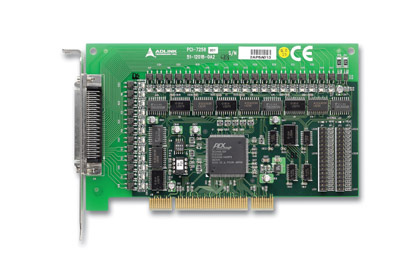
Onboard LEDs display the status of each relay output; external LED connectors (JP1, JP2) allow remote visual indication.
- Board ID Function:
DIP switch-configurable board ID for easy identification when multiple PCI-7258 cards are installed in one system.
- Plug-and-Play PCI Interface:
Fully compliant with 32-bit PCI bus architecture; automatic resource allocation by BIOS.
- Software Support:
Comprehensive driver and library support for Windows and DOS environments, including LabVIEW®, VEE, ActiveX, OPC, and ISaGRAF™ integration.
- Compact Design:
Standard half-size PCI card (175 mm × 107 mm) suitable for industrial PCs and embedded systems.
Each output channel uses a solid-state PhotoMOS relay (SPST Form A) capable of switching up to 350 V (peak AC) and 0.12 A continuous current.
- 2 Isolated Digital Inputs:
Optically isolated channels (non-polarity sensitive) supporting up to 24 V input range with interrupt capability on both channels.
- High Isolation:
1500 V RMS isolation for relay outputs and 2500 V RMS isolation for digital inputs ensure robust electrical separation between field and system circuits.
- Relay Readback Function:
Allows software to verify the actual ON/OFF status of each relay output.
- Change-of-State (COS) Detection:
Interrupt generation on digital input state changes (rising edge detection) to reduce CPU polling overhead.
- LED Indicators:
Onboard LEDs display the status of each relay output; external LED connectors (JP1, JP2) allow remote visual indication.
- Board ID Function:
DIP switch-configurable board ID for easy identification when multiple PCI-7258 cards are installed in one system.
- Plug-and-Play PCI Interface:
Fully compliant with 32-bit PCI bus architecture; automatic resource allocation by BIOS.
- Software Support:
Comprehensive driver and library support for Windows and DOS environments, including LabVIEW®, VEE, ActiveX, OPC, and ISaGRAF™ integration.
- Compact Design:
Standard half-size PCI card (175 mm × 107 mm) suitable for industrial PCs and embedded systems.
Comprehensive Product Summary – ADLINK PCI-7258 PhotoMOS Relay & Isolated DI PCI Card
### 1. Product Overview
Product Name: PCI-7258
Model Number: PCI-7258
Series: NuDAQ® PCI Digital I/O Series
Article Number: PCI-7258
Manufacturer: ADLINK Technology Inc.
Manufacturer Website: [www.adlinktech.com](http://www.adlinktech.com)
Product Type: PCI-Bus Digital I/O Card with PhotoMOS Relay Outputs and Isolated Digital Inputs
The ADLINK PCI-7258 is a 32-channel PhotoMOS relay output and 2-channel isolated digital input card designed for PCI-bus computers. It provides solid-state switching for both AC and DC loads, offering high reliability, long life, and electrical isolation. The card is ideal for industrial automation, laboratory control, and semiconductor or instrumentation systems requiring precise ON/OFF control and signal monitoring.
### 2. Key Features
- 32 PhotoMOS Relay Outputs:
Each output channel uses a solid-state PhotoMOS relay (SPST Form A) capable of switching up to 350 V (peak AC) and 0.12 A continuous current.
- 2 Isolated Digital Inputs:
Optically isolated channels (non-polarity sensitive) supporting up to 24 V input range with interrupt capability on both channels.
- High Isolation:
1500 V RMS isolation for relay outputs and 2500 V RMS isolation for digital inputs ensure robust electrical separation between field and system circuits.
- Relay Readback Function:
Allows software to verify the actual ON/OFF status of each relay output.
- Change-of-State (COS) Detection:
Interrupt generation on digital input state changes (rising edge detection) to reduce CPU polling overhead.
- LED Indicators:
Onboard LEDs display the status of each relay output; external LED connectors (JP1, JP2) allow remote visual indication.
- Board ID Function:
DIP switch-configurable board ID for easy identification when multiple PCI-7258 cards are installed in one system.
- Plug-and-Play PCI Interface:
Fully compliant with 32-bit PCI bus architecture; automatic resource allocation by BIOS.
- Software Support:
Comprehensive driver and library support for Windows and DOS environments, including LabVIEW®, VEE, ActiveX, OPC, and ISaGRAF™ integration.
- Compact Design:
Standard half-size PCI card (175 mm × 107 mm) suitable for industrial PCs and embedded systems.
### 3. Technical Specifications
Relay Output Section:
- Channels: 32
- Type: PhotoMOS SPST (Form A)
- Load Voltage (Peak AC): 350 V
- Continuous Load Current: 0.12 A
- Peak Load Current: 0.3 A
- Maximum Switching Power: 300 mW
- Isolation Voltage: 1500 V RMS
- Output On-Resistance: 17 Ω typical
- Off-State Leakage Current: ≤ 1 µA
- Turn-On Time: 0.23 ms typical
- Turn-Off Time: 0.04 ms typical
- Data Transfer Mode: Programmed I/O
Isolated Digital Input Section:
- Channels: 2
- Input Type: Opto-isolated, non-polarity
- Input Voltage Range: 0–24 V (AC/DC)
- Logic High: 5–24 V
- Logic Low: 0–1.5 V
- Input Resistance: 2.4 kΩ @ 0.5 W
- Isolation Voltage: 2500 V RMS
- Interrupt Sources: DI0 and DI1 (rising edge)
- Data Transfer Mode: Programmed I/O
General Specifications:
- Bus Interface: 32-bit PCI, Plug and Play
- I/O Connector: 68-pin SCSI-II female
- Power Requirement: +5 V @ 380 mA (max, all relays energized)
- Dimensions: 175 mm (L) × 107 mm (H)
- Operating Temperature: 0°C to 60°C
- Storage Temperature: -20°C to 80°C
- Relative Humidity: 5–95%, non-condensing
### 4. Functionality
Operating Principle:
The PCI-7258 uses PhotoMOS relays that combine LED-driven optical isolation with MOSFET switching. When current flows through the LED input, light activates a photoelectric element that charges the MOSFET gate, turning it on and allowing current to flow through the output circuit. This design eliminates mechanical wear, contact bounce, and provides stable resistance over time.
Use Cases and Applications:
- Industrial ON/OFF control of solenoids, valves, and actuators
- Energy management and building automation systems
- Laboratory and test automation setups
- Semiconductor equipment control
- Medical instrumentation switching
- Machine automation and process control
- Limit switch monitoring and contact status sensing
- Integration with A/D and D/A cards for complete data acquisition and control systems
Compatibility:
- Compatible with standard PCI-bus PCs
- Works with ADLINK’s NuDAQ® software suite and third-party automation software
- Supports Windows 95/98/NT/2000 and DOS environments
### 5. Components & Accessories
Included Items:
- PCI-7258 PhotoMOS Relay & Isolated DI Card
- ADLINK Software CD (drivers, libraries, manuals)
- Software Installation Guide
- User’s Manual
Optional Accessories:
- DIN-68S/1S Termination Board:
68-pin SCSI-II connector with DIN-rail mounting, includes 1-meter ACL-10569 cable for easy wiring.
- External LED Connectors (JP1, JP2):
32 external LED connection points for remote relay status indication (with built-in 330 Ω resistors).
Connectors:
- CN1: 68-pin SCSI-II female connector
- NOx: Relay Normally Open contacts (1–32)
- COMx: Relay Common contacts (1–32)
- DI0, DI1: Isolated digital input channels
- DIGND0, DIGND1: Digital input grounds
### 6. Installation & Setup
Requirements:
- Available PCI slot on host computer
- +5 V power supply from PCI bus
- Proper grounding and anti-static handling during installation
Installation Steps:
1. Power off the PC and remove the cover.
2. Insert the PCI-7258 into an available PCI slot.
3. Secure the card with the bracket screw.
4. Connect field wiring via the 68-pin SCSI connector or DIN-68S/1S termination board.
5. Power on the system; BIOS will automatically assign resources.
6. Install ADLINK drivers and software from the provided CD.
Board ID Configuration:
- DIP switch S1 allows setting of a unique board ID (0–15) for multi-card systems.
- Default ID = 0 (all switches ON).
External LED Setup:
- Connect LEDs (Vf < 2 V) to JP1/JP2 observing correct polarity.
- No external current-limiting resistor required (330 Ω onboard).
### 7. Performance & Capabilities
Switching Performance:
- Fast switching with 0.23 ms turn-on and 0.04 ms turn-off times.
- Stable operation with no mechanical wear or contact bounce.
- Capable of switching both AC and DC loads up to 350 V peak.
Input Performance:
- Opto-isolated inputs ensure noise immunity and electrical safety.
- Interrupt-driven input monitoring reduces CPU load.
Efficiency & Reliability:
- Solid-state design ensures long MTBF and consistent performance.
- Latching relay design maintains output state during power loss.
- Low power consumption (1.9 W typical at full load).
Limitations:
- Maximum continuous current per channel limited to 0.12 A.
- Not suitable for high-current inductive loads without external protection diode.
### 8. Standards & Compliance
- Bus Interface: PCI Local Bus Specification, Revision 2.1 compliant
- Isolation: 1500 V RMS (relay), 2500 V RMS (input)
- Environmental: Designed for industrial temperature and humidity ranges
- Safety: Opto-isolation and solid-state switching for electrical protection
- Software Standards:
- Supports OPC, ActiveX, DDE, and ISaGRAF™ interfaces
- Compatible with LabVIEW® and VEE environments
- Quality Assurance: Manufactured under ADLINK’s ISO-certified quality system
### 9. Additional Information
Software & Driver Support:
ADLINK provides a comprehensive suite of software tools and drivers:
- PCIS-DASK: Device drivers and DLLs for Windows 98/NT/2000
- PCIS-LVIEW: LabVIEW® driver package
- PCIS-VEE: VEE driver package
- PCIS-OCX: ActiveX control library for VB/VC++
- PCIS-DDE: DDE server for Windows-based data exchange
- PCIS-ISG: ISaGRAF™ SoftPLC driver
- PCIS-ICL: InControl™ driver
- PCIS-OPC: OPC server for industrial connectivity
Programming Support:
- C/C++ libraries for DOS and Windows
- Functions include initialization, digital output control, readback, digital input read, interrupt control, and status retrieval
- Example functions: `_7258_Initial()`, `_7258_DO()`, `_7258_DI()`, `_7258_INT_Control()`, `_7258_CLR_IRQ()`
Maintenance & Service:
- Handle the card using anti-static precautions.
- Avoid exposure to high humidity, temperature extremes, or corrosive environments.
- Use ADLINK’s RMA process for repairs.
Warranty:
- Standard 2-year warranty from shipment date.
- Covers manufacturing defects and normal operation failures.
- Excludes damage from misuse, improper installation, or environmental factors.
- Customers responsible for shipping costs to service centers.
Technical Support Contacts:
- General Service: service@adlinktech.com
- Automation Products: automation@adlinktech.com
- NuDAQ Support: nudaq@adlinktech.com
- Website: [www.adlinktech.com](http://www.adlinktech.com)
- Phone: +886-2-82265877
- Fax: +886-2-82265717
- Address: 9F, No. 166, Jian Yi Road, Chungho City, Taipei 235, Taiwan
### Summary
The ADLINK PCI-7258 is a robust, high-isolation digital I/O solution for industrial and laboratory automation. With 32 PhotoMOS relay outputs and 2 opto-isolated digital inputs, it provides reliable, noise-immune switching and monitoring capabilities. Its solid-state design ensures long operational life, fast response, and stable performance. The card’s compatibility with multiple software environments and its comprehensive driver support make it a versatile choice for system integrators and engineers seeking dependable digital control within PCI-based systems.
Its combination of compact form factor, high-voltage switching capability, and extensive software ecosystem positions the PCI-7258 as a key component in industrial control, test automation, and data acquisition applications requiring precision, reliability, and ease of integration.

### 1. Product Overview
Product Name: PCI-7258
Model Number: PCI-7258
Series: NuDAQ® PCI Digital I/O Series
Article Number: PCI-7258
Manufacturer: ADLINK Technology Inc.
Manufacturer Website: [www.adlinktech.com](http://www.adlinktech.com)
Product Type: PCI-Bus Digital I/O Card with PhotoMOS Relay Outputs and Isolated Digital Inputs
The ADLINK PCI-7258 is a 32-channel PhotoMOS relay output and 2-channel isolated digital input card designed for PCI-bus computers. It provides solid-state switching for both AC and DC loads, offering high reliability, long life, and electrical isolation. The card is ideal for industrial automation, laboratory control, and semiconductor or instrumentation systems requiring precise ON/OFF control and signal monitoring.
### 2. Key Features
- 32 PhotoMOS Relay Outputs:
Each output channel uses a solid-state PhotoMOS relay (SPST Form A) capable of switching up to 350 V (peak AC) and 0.12 A continuous current.
- 2 Isolated Digital Inputs:
Optically isolated channels (non-polarity sensitive) supporting up to 24 V input range with interrupt capability on both channels.
- High Isolation:
1500 V RMS isolation for relay outputs and 2500 V RMS isolation for digital inputs ensure robust electrical separation between field and system circuits.
- Relay Readback Function:
Allows software to verify the actual ON/OFF status of each relay output.
- Change-of-State (COS) Detection:
Interrupt generation on digital input state changes (rising edge detection) to reduce CPU polling overhead.
- LED Indicators:
Onboard LEDs display the status of each relay output; external LED connectors (JP1, JP2) allow remote visual indication.
- Board ID Function:
DIP switch-configurable board ID for easy identification when multiple PCI-7258 cards are installed in one system.
- Plug-and-Play PCI Interface:
Fully compliant with 32-bit PCI bus architecture; automatic resource allocation by BIOS.
- Software Support:
Comprehensive driver and library support for Windows and DOS environments, including LabVIEW®, VEE, ActiveX, OPC, and ISaGRAF™ integration.
- Compact Design:
Standard half-size PCI card (175 mm × 107 mm) suitable for industrial PCs and embedded systems.
### 3. Technical Specifications
Relay Output Section:
- Channels: 32
- Type: PhotoMOS SPST (Form A)
- Load Voltage (Peak AC): 350 V
- Continuous Load Current: 0.12 A
- Peak Load Current: 0.3 A
- Maximum Switching Power: 300 mW
- Isolation Voltage: 1500 V RMS
- Output On-Resistance: 17 Ω typical
- Off-State Leakage Current: ≤ 1 µA
- Turn-On Time: 0.23 ms typical
- Turn-Off Time: 0.04 ms typical
- Data Transfer Mode: Programmed I/O
Isolated Digital Input Section:
- Channels: 2
- Input Type: Opto-isolated, non-polarity
- Input Voltage Range: 0–24 V (AC/DC)
- Logic High: 5–24 V
- Logic Low: 0–1.5 V
- Input Resistance: 2.4 kΩ @ 0.5 W
- Isolation Voltage: 2500 V RMS
- Interrupt Sources: DI0 and DI1 (rising edge)
- Data Transfer Mode: Programmed I/O
General Specifications:
- Bus Interface: 32-bit PCI, Plug and Play
- I/O Connector: 68-pin SCSI-II female
- Power Requirement: +5 V @ 380 mA (max, all relays energized)
- Dimensions: 175 mm (L) × 107 mm (H)
- Operating Temperature: 0°C to 60°C
- Storage Temperature: -20°C to 80°C
- Relative Humidity: 5–95%, non-condensing
### 4. Functionality
Operating Principle:
The PCI-7258 uses PhotoMOS relays that combine LED-driven optical isolation with MOSFET switching. When current flows through the LED input, light activates a photoelectric element that charges the MOSFET gate, turning it on and allowing current to flow through the output circuit. This design eliminates mechanical wear, contact bounce, and provides stable resistance over time.
Use Cases and Applications:
- Industrial ON/OFF control of solenoids, valves, and actuators
- Energy management and building automation systems
- Laboratory and test automation setups
- Semiconductor equipment control
- Medical instrumentation switching
- Machine automation and process control
- Limit switch monitoring and contact status sensing
- Integration with A/D and D/A cards for complete data acquisition and control systems
Compatibility:
- Compatible with standard PCI-bus PCs
- Works with ADLINK’s NuDAQ® software suite and third-party automation software
- Supports Windows 95/98/NT/2000 and DOS environments
### 5. Components & Accessories
Included Items:
- PCI-7258 PhotoMOS Relay & Isolated DI Card
- ADLINK Software CD (drivers, libraries, manuals)
- Software Installation Guide
- User’s Manual
Optional Accessories:
- DIN-68S/1S Termination Board:
68-pin SCSI-II connector with DIN-rail mounting, includes 1-meter ACL-10569 cable for easy wiring.
- External LED Connectors (JP1, JP2):
32 external LED connection points for remote relay status indication (with built-in 330 Ω resistors).
Connectors:
- CN1: 68-pin SCSI-II female connector
- NOx: Relay Normally Open contacts (1–32)
- COMx: Relay Common contacts (1–32)
- DI0, DI1: Isolated digital input channels
- DIGND0, DIGND1: Digital input grounds
### 6. Installation & Setup
Requirements:
- Available PCI slot on host computer
- +5 V power supply from PCI bus
- Proper grounding and anti-static handling during installation
Installation Steps:
1. Power off the PC and remove the cover.
2. Insert the PCI-7258 into an available PCI slot.
3. Secure the card with the bracket screw.
4. Connect field wiring via the 68-pin SCSI connector or DIN-68S/1S termination board.
5. Power on the system; BIOS will automatically assign resources.
6. Install ADLINK drivers and software from the provided CD.
Board ID Configuration:
- DIP switch S1 allows setting of a unique board ID (0–15) for multi-card systems.
- Default ID = 0 (all switches ON).
External LED Setup:
- Connect LEDs (Vf < 2 V) to JP1/JP2 observing correct polarity.
- No external current-limiting resistor required (330 Ω onboard).
### 7. Performance & Capabilities
Switching Performance:
- Fast switching with 0.23 ms turn-on and 0.04 ms turn-off times.
- Stable operation with no mechanical wear or contact bounce.
- Capable of switching both AC and DC loads up to 350 V peak.
Input Performance:
- Opto-isolated inputs ensure noise immunity and electrical safety.
- Interrupt-driven input monitoring reduces CPU load.
Efficiency & Reliability:
- Solid-state design ensures long MTBF and consistent performance.
- Latching relay design maintains output state during power loss.
- Low power consumption (1.9 W typical at full load).
Limitations:
- Maximum continuous current per channel limited to 0.12 A.
- Not suitable for high-current inductive loads without external protection diode.
### 8. Standards & Compliance
- Bus Interface: PCI Local Bus Specification, Revision 2.1 compliant
- Isolation: 1500 V RMS (relay), 2500 V RMS (input)
- Environmental: Designed for industrial temperature and humidity ranges
- Safety: Opto-isolation and solid-state switching for electrical protection
- Software Standards:
- Supports OPC, ActiveX, DDE, and ISaGRAF™ interfaces
- Compatible with LabVIEW® and VEE environments
- Quality Assurance: Manufactured under ADLINK’s ISO-certified quality system
### 9. Additional Information
Software & Driver Support:
ADLINK provides a comprehensive suite of software tools and drivers:
- PCIS-DASK: Device drivers and DLLs for Windows 98/NT/2000
- PCIS-LVIEW: LabVIEW® driver package
- PCIS-VEE: VEE driver package
- PCIS-OCX: ActiveX control library for VB/VC++
- PCIS-DDE: DDE server for Windows-based data exchange
- PCIS-ISG: ISaGRAF™ SoftPLC driver
- PCIS-ICL: InControl™ driver
- PCIS-OPC: OPC server for industrial connectivity
Programming Support:
- C/C++ libraries for DOS and Windows
- Functions include initialization, digital output control, readback, digital input read, interrupt control, and status retrieval
- Example functions: `_7258_Initial()`, `_7258_DO()`, `_7258_DI()`, `_7258_INT_Control()`, `_7258_CLR_IRQ()`
Maintenance & Service:
- Handle the card using anti-static precautions.
- Avoid exposure to high humidity, temperature extremes, or corrosive environments.
- Use ADLINK’s RMA process for repairs.
Warranty:
- Standard 2-year warranty from shipment date.
- Covers manufacturing defects and normal operation failures.
- Excludes damage from misuse, improper installation, or environmental factors.
- Customers responsible for shipping costs to service centers.
Technical Support Contacts:
- General Service: service@adlinktech.com
- Automation Products: automation@adlinktech.com
- NuDAQ Support: nudaq@adlinktech.com
- Website: [www.adlinktech.com](http://www.adlinktech.com)
- Phone: +886-2-82265877
- Fax: +886-2-82265717
- Address: 9F, No. 166, Jian Yi Road, Chungho City, Taipei 235, Taiwan
### Summary
The ADLINK PCI-7258 is a robust, high-isolation digital I/O solution for industrial and laboratory automation. With 32 PhotoMOS relay outputs and 2 opto-isolated digital inputs, it provides reliable, noise-immune switching and monitoring capabilities. Its solid-state design ensures long operational life, fast response, and stable performance. The card’s compatibility with multiple software environments and its comprehensive driver support make it a versatile choice for system integrators and engineers seeking dependable digital control within PCI-based systems.
Its combination of compact form factor, high-voltage switching capability, and extensive software ecosystem positions the PCI-7258 as a key component in industrial control, test automation, and data acquisition applications requiring precision, reliability, and ease of integration.
-
06-05.pdf
PDF Catalog
-
Digital_IO_Selection_Guide_20151230.pdf
PDF Catalog
-
PCI-7258_Manual_1.pdf
Manual
- DIN-68S-01 - 68pin SCSI-II termination board DIN rail w/o cable
- ACL-10569-1 - SCSI-VHDCI cable 1m for PCI-7256
- ACL-10569-2 - SCSI-VHDCI cable 2m for PCI-7256
- ACL-10569-3 - SCSI-VHDCI cable 3m for PCI-7256