DIN-68S-01
SUCHEN SIE DIE PASSENDE
INDUSTRIELLE LÖSUNG?
Entdecken Sie Embedded-, Kommunikations- und Automatisierungslösungen für Ihre Anwendung.
- PCI Express x1 Interface: Fully compliant with PCI Express x1 bus standard, supporting plug-and-play configuration.
- 16 Latching Relay Outputs: Each output is a single-pole double-throw (SPDT) Form C relay with latching capability, maintaining output state even when power is removed.
- 16 Optically Isolated Digital Inputs: Non-polar, optically isolated inputs with optional RC filtering for noise suppression.
- Relay Output Readback: Allows software to verify the current state of each relay output.
- Change-of-State (COS) Detection: Interrupt generation on digital input state changes for channels 0 and 1, enabling event-driven control.
- LED Indicators: Onboard LEDs display relay status; external LED connectors are also available for remote indication.
- Board ID Function: Hardware DIP switch allows unique identification of multiple cards in a single system.
- Power-Saving Latching Relays: Reduces power consumption by maintaining relay state without continuous coil energization.
- High Isolation: 1500 V RMS isolation for relay outputs and 2500 V RMS isolation for digital inputs.
- Compact Design: Half-size PCIe form factor (175 mm x 107 mm).
- Software Support: Compatible with ADLINK’s PCIS-DASK driver library and SDK for Windows and LabVIEW environments.
- Environmental Compliance: Fully RoHS and WEEE compliant.
- 16 Latching Relay Outputs: Each output is a single-pole double-throw (SPDT) Form C relay with latching capability, maintaining output state even when power is removed.
- 16 Optically Isolated Digital Inputs: Non-polar, optically isolated inputs with optional RC filtering for noise suppression.
- Relay Output Readback: Allows software to verify the current state of each relay output.
- Change-of-State (COS) Detection: Interrupt generation on digital input state changes for channels 0 and 1, enabling event-driven control.
- LED Indicators: Onboard LEDs display relay status; external LED connectors are also available for remote indication.
- Board ID Function: Hardware DIP switch allows unique identification of multiple cards in a single system.
- Power-Saving Latching Relays: Reduces power consumption by maintaining relay state without continuous coil energization.
- High Isolation: 1500 V RMS isolation for relay outputs and 2500 V RMS isolation for digital inputs.
- Compact Design: Half-size PCIe form factor (175 mm x 107 mm).
- Software Support: Compatible with ADLINK’s PCIS-DASK driver library and SDK for Windows and LabVIEW environments.
- Environmental Compliance: Fully RoHS and WEEE compliant.
Comprehensive Product Summary: ADLINK PCIe-7256 Digital I/O Card
### 1. Product Overview
Product Name: PCIe-7256
Model: PCIe-7256
Series: PCI/PCIe-7256 Series
Article Number: 50-11043-1000
Manufacturer: ADLINK Technology, Inc.
Product Type: PCI Express Digital I/O Card with 16 Latching Relay Outputs and 16 Isolated Digital Inputs
Revision: Manual Rev. 2.00 (Released January 7, 2016)
Manufacturer Website: [www.adlinktech.com](http://www.adlinktech.com)
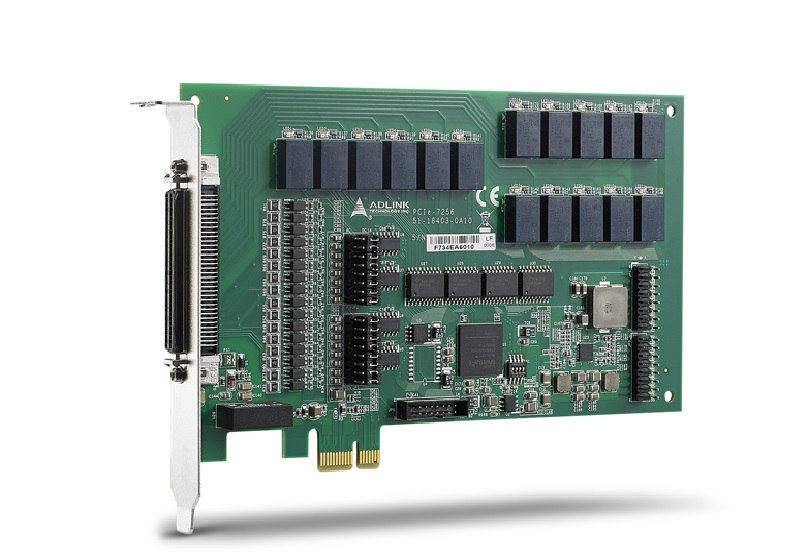
The ADLINK PCIe-7256 is a high-performance industrial digital I/O interface card designed for PCI Express (PCIe x1) bus systems. It provides 16 channels of latching SPDT (Form C) relay outputs and 16 channels of optically isolated digital inputs, making it ideal for industrial automation, laboratory control, and signal switching applications. The card is engineered for reliability, energy efficiency, and robust performance in electrically noisy environments.
### 2. Key Features
- PCI Express x1 Interface: Fully compliant with PCI Express x1 bus standard, supporting plug-and-play configuration.
- 16 Latching Relay Outputs: Each output is a single-pole double-throw (SPDT) Form C relay with latching capability, maintaining output state even when power is removed.
- 16 Optically Isolated Digital Inputs: Non-polar, optically isolated inputs with optional RC filtering for noise suppression.
- Relay Output Readback: Allows software to verify the current state of each relay output.
- Change-of-State (COS) Detection: Interrupt generation on digital input state changes for channels 0 and 1, enabling event-driven control.
- LED Indicators: Onboard LEDs display relay status; external LED connectors are also available for remote indication.
- Board ID Function: Hardware DIP switch allows unique identification of multiple cards in a single system.
- Power-Saving Latching Relays: Reduces power consumption by maintaining relay state without continuous coil energization.
- High Isolation: 1500 V RMS isolation for relay outputs and 2500 V RMS isolation for digital inputs.
- Compact Design: Half-size PCIe form factor (175 mm x 107 mm).
- Software Support: Compatible with ADLINK’s PCIS-DASK driver library and SDK for Windows and LabVIEW environments.
- Environmental Compliance: Fully RoHS and WEEE compliant.
### 3. Technical Specifications
Physical Characteristics
- Dimensions: 175 mm (L) × 107 mm (H) (6.82” × 4.17”)
- Form Factor: Half-size PCIe card
- Weight: Approximately 200 g (typical, without accessories)
- Connector Type: 68-pin SCSI-II female connector
Relay Output Specifications
- Channels: 16
- Relay Type: Latching SPDT (Form C)
- Isolation Voltage: 1500 V RMS
- Contact Rating:
- AC: 125 V @ 0.5 A
- DC: 30 V @ 1 A
- Breakdown Voltage: 1000 V RMS
- Contact Resistance: 60 mΩ (max)
- Operate Time: 3 ms
- Release Time: 3 ms
- Expected Life:
- >200,000 operations @ 1 A, 30 V DC
- >100,000 operations @ 0.5 A, 125 V AC
- Relay Power Supply: +5 V from onboard source
- LED Indicators: 16 onboard LEDs for relay status; external LED connectors (JP3, JP4) with 330 Ω current-limiting resistors
Isolated Digital Input Specifications
- Channels: 16
- Input Type: Optically isolated, non-polar
- Input Voltage Range: 0–24 V DC (non-polarity)
- Logic Levels:
- Logic Low: 0–2 V
- Logic High: 10–24 V
- Input Resistance: 4.7 kΩ @ 0.5 W
- Isolation Voltage: 2500 V RMS channel-to-system
- Interrupt Sources: COS interrupt (channels 0 and 1)
- Data Transfer: Programmed I/O
Isolated Power Supply
- Output Voltage: +5 V
- Output Current: 170 mA max @ 40°C
Power Requirements
| Voltage Rail | Typical Current | Maximum Current* |
|---------------|----------------|------------------|
| +3.3 V | 36.3 mA | 38.2 mA |
| +12 V | 141 mA | 464 mA |
| +5 V (PCI version only) | 340 mA | 980 mA |
\*When all relays are activated simultaneously.
Environmental Conditions
- Operating Temperature: 0°C to 60°C (32°F to 140°F)
- Storage Temperature: -20°C to 80°C (-4°F to 176°F)
- Relative Humidity: 5% to 95%, non-condensing
- Vibration Resistance: 18 G (10–55 Hz, 3 mm double amplitude)
### 4. Functionality
The PCIe-7256 operates as a digital I/O interface card for industrial control systems. It provides both output control and input monitoring capabilities:
- Relay Outputs: Each of the 16 latching relays can be independently controlled to switch external devices such as solenoids, lamps, or contactors. The latching design ensures that the relay maintains its last state even after power loss, making it suitable for safety-critical or fail-safe applications.
- Digital Inputs: The 16 optically isolated inputs can detect external contact closures or logic signals. The non-polar design allows flexible wiring, and optional RC filtering can be enabled via jumpers (JP1, JP2) to suppress AC noise.
- Interrupt Handling: COS interrupts allow the system to respond immediately to input changes without continuous polling, improving efficiency.
- Board Identification: The onboard DIP switch (S1) assigns a unique ID to each card, simplifying multi-card system integration.
- Software Interface: Through ADLINK’s PCIS-DASK driver, users can programmatically control relays, read inputs, and handle interrupts using C/C++ or LabVIEW.
Typical Applications:
- Industrial automation and process control
- Machine status monitoring and control
- Laboratory instrumentation and test systems
- Signal routing and switching
- External relay driving and contact monitoring
### 5. Components & Accessories
Included Items:
- PCIe-7256 Digital I/O Card
- Quick Start Guide
- Anti-static packaging
Optional Accessories:
- DIN-68S-01: Terminal board with one 68-pin SCSI-II connector and DIN-rail mounting (cables not included).
- ACL-10569-1: 68-pin SCSI-II cable (1 meter, compatible with AMP-787082-7).
Connectors:
- CN1: 68-pin SCSI-II female connector for all I/O signals.
- JP1/JP2: Jumpers for AC-filtered or non-AC-filtered input selection.
- JP3/JP4: External LED connectors for relay status indication.
- S1: DIP switch for Board ID configuration.
### 6. Installation & Setup
System Requirements:
- Available PCI Express x1 slot
- Compatible operating system (Windows 7/8.1 or later)
- ADLINK PCIS-DASK driver and SDK installed
Installation Steps:
1. Power off the host system and disconnect from power.
2. Remove the chassis cover and locate an available PCIe x1 slot.
3. Insert the PCIe-7256 card firmly into the slot and secure it with a screw.
4. Replace the chassis cover and reconnect power.
5. Install the ADLINK driver and verify device recognition in the system.
Configuration:
- Input Filtering: Configure JP1 and JP2 for AC-filtered or DC (non-filtered) input modes.
- Board ID: Set DIP switch S1 to assign a unique ID (0–15) for multi-card systems.
- External LEDs: Connect external indicators to JP3 and JP4 observing correct polarity (Vf < 2 V).
Software Setup:
- Install PCIS-DASK driver and SDK.
- Use provided APIs (_7256_DO, _7256_DI, _7256_COS_Channel, etc.) for programming.
- Configure interrupts and COS detection as required.
### 7. Performance & Capabilities
- Relay Switching Speed: 3 ms operate / 3 ms release
- Relay Life Expectancy: Up to 200,000 operations at rated load
- Input Response Time: Determined by optical isolation and optional RC filtering
- Interrupt Latency: Hardware-level COS interrupt for channels 0 and 1
- Power Efficiency: Latching relays minimize coil power consumption
- Data Transfer Mode: Programmed I/O (no DMA required)
- Limitations:
- COS interrupt available only on channels 0 and 1
- Relay contact ratings limited to 125 V AC / 30 V DC
- External LED forward voltage must be <2 V
### 8. Standards & Compliance
- Bus Interface: PCI Express x1, compliant with PCI Express Base Specification
- Electrical Isolation:
- Relay Output: 1500 V RMS
- Digital Input: 2500 V RMS channel-to-system
- Environmental Compliance:
- RoHS (Restriction of Hazardous Substances)
- WEEE (Waste Electrical and Electronic Equipment)
- Safety: Designed for industrial environments with optical isolation and surge protection
- Quality Assurance: Manufactured under ISO-certified processes
- Regulatory Notes: Specifications subject to change without notice for design improvement
### 9. Additional Information
Warranty & Support:
- Standard ADLINK limited warranty (contact local distributor for terms).
- Technical support available via [Ask an Expert](http://askanexpert.adlinktech.com).
- Global service centers in Taiwan, USA, China, Japan, Germany, Singapore, and other regions.
Maintenance:
- Keep card free from dust and moisture.
- Avoid exposure to high humidity or corrosive environments.
- Handle only in ESD-safe conditions using grounded wrist straps.
- Do not attempt to repair or modify the card; contact authorized service personnel.
Software Updates:
- Driver and SDK updates available from ADLINK’s official website.
- PCIS-DASK supports 32/64-bit Windows environments and LabVIEW integration.
Disposal & Environmental Responsibility:
- Dispose of the product in accordance with local electronic waste regulations.
- ADLINK encourages environmentally responsible recycling and recovery.
### Summary
The ADLINK PCIe-7256 is a robust, industrial-grade digital I/O card that combines 16 latching relay outputs with 16 optically isolated digital inputs in a compact PCIe form factor. Its latching relay design ensures output state retention during power loss, while optical isolation and optional filtering provide reliable operation in noisy environments. With COS interrupt capability, LED status indication, and comprehensive software support, the PCIe-7256 is ideal for automation, control, and monitoring applications requiring dependable digital interfacing and event-driven response.
Its compliance with RoHS/WEEE standards, modular accessory options, and global support infrastructure make it a versatile and sustainable choice for industrial system integrators and OEM developers.

### 1. Product Overview
Product Name: PCIe-7256
Model: PCIe-7256
Series: PCI/PCIe-7256 Series
Article Number: 50-11043-1000
Manufacturer: ADLINK Technology, Inc.
Product Type: PCI Express Digital I/O Card with 16 Latching Relay Outputs and 16 Isolated Digital Inputs
Revision: Manual Rev. 2.00 (Released January 7, 2016)
Manufacturer Website: [www.adlinktech.com](http://www.adlinktech.com)
The ADLINK PCIe-7256 is a high-performance industrial digital I/O interface card designed for PCI Express (PCIe x1) bus systems. It provides 16 channels of latching SPDT (Form C) relay outputs and 16 channels of optically isolated digital inputs, making it ideal for industrial automation, laboratory control, and signal switching applications. The card is engineered for reliability, energy efficiency, and robust performance in electrically noisy environments.
### 2. Key Features
- PCI Express x1 Interface: Fully compliant with PCI Express x1 bus standard, supporting plug-and-play configuration.
- 16 Latching Relay Outputs: Each output is a single-pole double-throw (SPDT) Form C relay with latching capability, maintaining output state even when power is removed.
- 16 Optically Isolated Digital Inputs: Non-polar, optically isolated inputs with optional RC filtering for noise suppression.
- Relay Output Readback: Allows software to verify the current state of each relay output.
- Change-of-State (COS) Detection: Interrupt generation on digital input state changes for channels 0 and 1, enabling event-driven control.
- LED Indicators: Onboard LEDs display relay status; external LED connectors are also available for remote indication.
- Board ID Function: Hardware DIP switch allows unique identification of multiple cards in a single system.
- Power-Saving Latching Relays: Reduces power consumption by maintaining relay state without continuous coil energization.
- High Isolation: 1500 V RMS isolation for relay outputs and 2500 V RMS isolation for digital inputs.
- Compact Design: Half-size PCIe form factor (175 mm x 107 mm).
- Software Support: Compatible with ADLINK’s PCIS-DASK driver library and SDK for Windows and LabVIEW environments.
- Environmental Compliance: Fully RoHS and WEEE compliant.
### 3. Technical Specifications
Physical Characteristics
- Dimensions: 175 mm (L) × 107 mm (H) (6.82” × 4.17”)
- Form Factor: Half-size PCIe card
- Weight: Approximately 200 g (typical, without accessories)
- Connector Type: 68-pin SCSI-II female connector
Relay Output Specifications
- Channels: 16
- Relay Type: Latching SPDT (Form C)
- Isolation Voltage: 1500 V RMS
- Contact Rating:
- AC: 125 V @ 0.5 A
- DC: 30 V @ 1 A
- Breakdown Voltage: 1000 V RMS
- Contact Resistance: 60 mΩ (max)
- Operate Time: 3 ms
- Release Time: 3 ms
- Expected Life:
- >200,000 operations @ 1 A, 30 V DC
- >100,000 operations @ 0.5 A, 125 V AC
- Relay Power Supply: +5 V from onboard source
- LED Indicators: 16 onboard LEDs for relay status; external LED connectors (JP3, JP4) with 330 Ω current-limiting resistors
Isolated Digital Input Specifications
- Channels: 16
- Input Type: Optically isolated, non-polar
- Input Voltage Range: 0–24 V DC (non-polarity)
- Logic Levels:
- Logic Low: 0–2 V
- Logic High: 10–24 V
- Input Resistance: 4.7 kΩ @ 0.5 W
- Isolation Voltage: 2500 V RMS channel-to-system
- Interrupt Sources: COS interrupt (channels 0 and 1)
- Data Transfer: Programmed I/O
Isolated Power Supply
- Output Voltage: +5 V
- Output Current: 170 mA max @ 40°C
Power Requirements
| Voltage Rail | Typical Current | Maximum Current* |
|---------------|----------------|------------------|
| +3.3 V | 36.3 mA | 38.2 mA |
| +12 V | 141 mA | 464 mA |
| +5 V (PCI version only) | 340 mA | 980 mA |
\*When all relays are activated simultaneously.
Environmental Conditions
- Operating Temperature: 0°C to 60°C (32°F to 140°F)
- Storage Temperature: -20°C to 80°C (-4°F to 176°F)
- Relative Humidity: 5% to 95%, non-condensing
- Vibration Resistance: 18 G (10–55 Hz, 3 mm double amplitude)
### 4. Functionality
The PCIe-7256 operates as a digital I/O interface card for industrial control systems. It provides both output control and input monitoring capabilities:
- Relay Outputs: Each of the 16 latching relays can be independently controlled to switch external devices such as solenoids, lamps, or contactors. The latching design ensures that the relay maintains its last state even after power loss, making it suitable for safety-critical or fail-safe applications.
- Digital Inputs: The 16 optically isolated inputs can detect external contact closures or logic signals. The non-polar design allows flexible wiring, and optional RC filtering can be enabled via jumpers (JP1, JP2) to suppress AC noise.
- Interrupt Handling: COS interrupts allow the system to respond immediately to input changes without continuous polling, improving efficiency.
- Board Identification: The onboard DIP switch (S1) assigns a unique ID to each card, simplifying multi-card system integration.
- Software Interface: Through ADLINK’s PCIS-DASK driver, users can programmatically control relays, read inputs, and handle interrupts using C/C++ or LabVIEW.
Typical Applications:
- Industrial automation and process control
- Machine status monitoring and control
- Laboratory instrumentation and test systems
- Signal routing and switching
- External relay driving and contact monitoring
### 5. Components & Accessories
Included Items:
- PCIe-7256 Digital I/O Card
- Quick Start Guide
- Anti-static packaging
Optional Accessories:
- DIN-68S-01: Terminal board with one 68-pin SCSI-II connector and DIN-rail mounting (cables not included).
- ACL-10569-1: 68-pin SCSI-II cable (1 meter, compatible with AMP-787082-7).
Connectors:
- CN1: 68-pin SCSI-II female connector for all I/O signals.
- JP1/JP2: Jumpers for AC-filtered or non-AC-filtered input selection.
- JP3/JP4: External LED connectors for relay status indication.
- S1: DIP switch for Board ID configuration.
### 6. Installation & Setup
System Requirements:
- Available PCI Express x1 slot
- Compatible operating system (Windows 7/8.1 or later)
- ADLINK PCIS-DASK driver and SDK installed
Installation Steps:
1. Power off the host system and disconnect from power.
2. Remove the chassis cover and locate an available PCIe x1 slot.
3. Insert the PCIe-7256 card firmly into the slot and secure it with a screw.
4. Replace the chassis cover and reconnect power.
5. Install the ADLINK driver and verify device recognition in the system.
Configuration:
- Input Filtering: Configure JP1 and JP2 for AC-filtered or DC (non-filtered) input modes.
- Board ID: Set DIP switch S1 to assign a unique ID (0–15) for multi-card systems.
- External LEDs: Connect external indicators to JP3 and JP4 observing correct polarity (Vf < 2 V).
Software Setup:
- Install PCIS-DASK driver and SDK.
- Use provided APIs (_7256_DO, _7256_DI, _7256_COS_Channel, etc.) for programming.
- Configure interrupts and COS detection as required.
### 7. Performance & Capabilities
- Relay Switching Speed: 3 ms operate / 3 ms release
- Relay Life Expectancy: Up to 200,000 operations at rated load
- Input Response Time: Determined by optical isolation and optional RC filtering
- Interrupt Latency: Hardware-level COS interrupt for channels 0 and 1
- Power Efficiency: Latching relays minimize coil power consumption
- Data Transfer Mode: Programmed I/O (no DMA required)
- Limitations:
- COS interrupt available only on channels 0 and 1
- Relay contact ratings limited to 125 V AC / 30 V DC
- External LED forward voltage must be <2 V
### 8. Standards & Compliance
- Bus Interface: PCI Express x1, compliant with PCI Express Base Specification
- Electrical Isolation:
- Relay Output: 1500 V RMS
- Digital Input: 2500 V RMS channel-to-system
- Environmental Compliance:
- RoHS (Restriction of Hazardous Substances)
- WEEE (Waste Electrical and Electronic Equipment)
- Safety: Designed for industrial environments with optical isolation and surge protection
- Quality Assurance: Manufactured under ISO-certified processes
- Regulatory Notes: Specifications subject to change without notice for design improvement
### 9. Additional Information
Warranty & Support:
- Standard ADLINK limited warranty (contact local distributor for terms).
- Technical support available via [Ask an Expert](http://askanexpert.adlinktech.com).
- Global service centers in Taiwan, USA, China, Japan, Germany, Singapore, and other regions.
Maintenance:
- Keep card free from dust and moisture.
- Avoid exposure to high humidity or corrosive environments.
- Handle only in ESD-safe conditions using grounded wrist straps.
- Do not attempt to repair or modify the card; contact authorized service personnel.
Software Updates:
- Driver and SDK updates available from ADLINK’s official website.
- PCIS-DASK supports 32/64-bit Windows environments and LabVIEW integration.
Disposal & Environmental Responsibility:
- Dispose of the product in accordance with local electronic waste regulations.
- ADLINK encourages environmentally responsible recycling and recovery.
### Summary
The ADLINK PCIe-7256 is a robust, industrial-grade digital I/O card that combines 16 latching relay outputs with 16 optically isolated digital inputs in a compact PCIe form factor. Its latching relay design ensures output state retention during power loss, while optical isolation and optional filtering provide reliable operation in noisy environments. With COS interrupt capability, LED status indication, and comprehensive software support, the PCIe-7256 is ideal for automation, control, and monitoring applications requiring dependable digital interfacing and event-driven response.
Its compliance with RoHS/WEEE standards, modular accessory options, and global support infrastructure make it a versatile and sustainable choice for industrial system integrators and OEM developers.
-
PCI-7256_Datasheet_en.pdf
PDF Catalog
-
Digital_IO_Selection_Guide_20151230.pdf
PDF Catalog

- DIN-68S-01 - 68pin SCSI-II termination board DIN rail w/o cable
- ACL-10569-1 - SCSI-VHDCI cable 1m for PCI-7256
- ACL-10569-2 - SCSI-VHDCI cable 2m for PCI-7256
- ACL-10569-3 - SCSI-VHDCI cable 3m for PCI-7256