 SUCHEN SIE DIE PASSENDE
INDUSTRIELLE LÖSUNG?
Entdecken Sie Embedded-, Kommunikations- und Automatisierungslösungen für Ihre Anwendung.
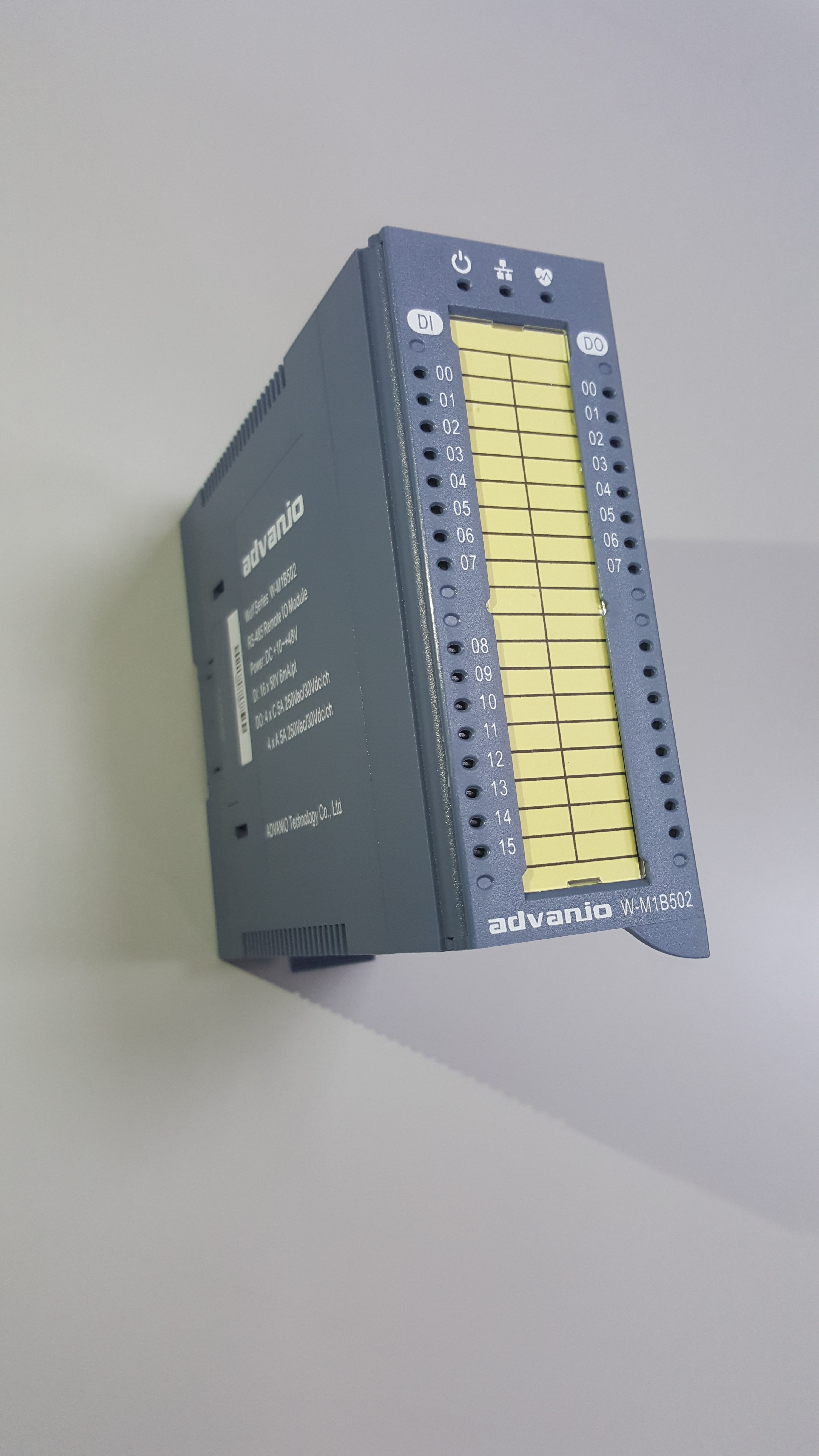
W-M1B116
16*DI AD V/mA RS485 Modbus CMR 240V module
370,00 EUR
inkl. Umsatzsteuer 440,30 EUR
- High‑Density Analog Input:
16 differential analog input channels supporting voltage and current measurement ranges with ±240 V common‑mode protection.
- Universal Input Configuration:
Each channel independently configurable for ±100 mV, ±500 mV, ±1 V, ±5 V, ±10 V, 0–100 mV, 0–500 mV, 0–1 V, 0–5 V, 0–10 V, ±20 mA, 0–20 mA, or 4–20 mA via DIP switch.
- High Accuracy and Resolution:
16‑bit A/D conversion with ±0.1 % FSR accuracy and 2.5 samples/s per channel sampling rate.
- Robust Electrical Protection:
Channel‑to‑channel isolation and over‑voltage protection up to ±240 V; common‑mode voltage tolerance up to 240 V; 3 kV isolation between I/O, power, and communication.
- Wide Power Input Range:
Operates from +10 V DC to +60 V DC (ripple ≤ 5 V p‑p), consuming approximately 2.8 W @ 24 V DC.
- Hot‑Swap and Auto‑Configuration:
Modules can be replaced without rewiring; configuration stored in removable EEPROM for quick transfer between units.
- Programmable Power‑On and Safety Values:
Ensures safe startup and fail‑safe operation during communication loss or watchdog timeout.
- Simple Node Addressing:
Two rotary switches allow Modbus node address setup (1–247) without software tools.
- Diagnostic LEDs:
Three front‑panel LEDs indicate power, communication, and system status for quick on‑site troubleshooting.
- Compact, Space‑Saving Design:
47.2 mm slim vertical housing allows 1.5× higher module density compared to conventional flat I/O modules.
- Industrial‑Grade Reliability:
Designed for harsh environments with operating temperature –25 °C to +70 °C, humidity 5–95 % RH, and built‑in hardware/software watchdogs.
- Communication Interface:
RS‑485 serial interface supporting Modbus/RTU protocol, baud rates from 1200 bps to 115.2 kbps, and communication distance up to 1.2 km.
16 differential analog input channels supporting voltage and current measurement ranges with ±240 V common‑mode protection.
- Universal Input Configuration:
Each channel independently configurable for ±100 mV, ±500 mV, ±1 V, ±5 V, ±10 V, 0–100 mV, 0–500 mV, 0–1 V, 0–5 V, 0–10 V, ±20 mA, 0–20 mA, or 4–20 mA via DIP switch.
- High Accuracy and Resolution:
16‑bit A/D conversion with ±0.1 % FSR accuracy and 2.5 samples/s per channel sampling rate.
- Robust Electrical Protection:
Channel‑to‑channel isolation and over‑voltage protection up to ±240 V; common‑mode voltage tolerance up to 240 V; 3 kV isolation between I/O, power, and communication.
- Wide Power Input Range:
Operates from +10 V DC to +60 V DC (ripple ≤ 5 V p‑p), consuming approximately 2.8 W @ 24 V DC.
- Hot‑Swap and Auto‑Configuration:
Modules can be replaced without rewiring; configuration stored in removable EEPROM for quick transfer between units.
- Programmable Power‑On and Safety Values:
Ensures safe startup and fail‑safe operation during communication loss or watchdog timeout.
- Simple Node Addressing:
Two rotary switches allow Modbus node address setup (1–247) without software tools.
- Diagnostic LEDs:
Three front‑panel LEDs indicate power, communication, and system status for quick on‑site troubleshooting.
- Compact, Space‑Saving Design:
47.2 mm slim vertical housing allows 1.5× higher module density compared to conventional flat I/O modules.
- Industrial‑Grade Reliability:
Designed for harsh environments with operating temperature –25 °C to +70 °C, humidity 5–95 % RH, and built‑in hardware/software watchdogs.
- Communication Interface:
RS‑485 serial interface supporting Modbus/RTU protocol, baud rates from 1200 bps to 115.2 kbps, and communication distance up to 1.2 km.
Comprehensive Product Summary – Advanio W‑M1B116 16‑Channel Differential Analog Input RS‑485 Modbus Module
### 1. Product Overview
Product Name:
W‑M1B116 16×DI AD V/mA RS‑485 Modbus CMR 240 V Module
Model Number:
W‑M1B116
Series:
Wolf Series – RS‑485 Remote I/O Modules
Article Number:
W‑M1B116
Manufacturer:
Advanio Technology Co., Ltd.
Manufacturer Background:
Advanio Technology Co., Ltd. is an industrial automation and IoT‑focused manufacturer founded by a team of system engineers and IoT experts with over 20 years of field experience. The company’s name derives from “Advanced I/O Technologies.” Advanio’s mission is to provide robust, intelligent, and easily maintainable I/O solutions for Industry 4.0 and smart factory applications. Its product portfolio includes wired and wireless I/O modules (RS‑485, CAN, Ethernet, EtherCAT, PROFINET, Wi‑Fi, 3G/4G), industrial computing platforms, and cloud‑based management tools.
### 2. Key Features
- High‑Density Analog Input:
16 differential analog input channels supporting voltage and current measurement ranges with ±240 V common‑mode protection.
- Universal Input Configuration:
Each channel independently configurable for ±100 mV, ±500 mV, ±1 V, ±5 V, ±10 V, 0–100 mV, 0–500 mV, 0–1 V, 0–5 V, 0–10 V, ±20 mA, 0–20 mA, or 4–20 mA via DIP switch.
- High Accuracy and Resolution:
16‑bit A/D conversion with ±0.1 % FSR accuracy and 2.5 samples/s per channel sampling rate.
- Robust Electrical Protection:
Channel‑to‑channel isolation and over‑voltage protection up to ±240 V; common‑mode voltage tolerance up to 240 V; 3 kV isolation between I/O, power, and communication.
- Wide Power Input Range:
Operates from +10 V DC to +60 V DC (ripple ≤ 5 V p‑p), consuming approximately 2.8 W @ 24 V DC.
- Hot‑Swap and Auto‑Configuration:
Modules can be replaced without rewiring; configuration stored in removable EEPROM for quick transfer between units.
- Programmable Power‑On and Safety Values:
Ensures safe startup and fail‑safe operation during communication loss or watchdog timeout.
- Simple Node Addressing:
Two rotary switches allow Modbus node address setup (1–247) without software tools.
- Diagnostic LEDs:
Three front‑panel LEDs indicate power, communication, and system status for quick on‑site troubleshooting.
- Compact, Space‑Saving Design:
47.2 mm slim vertical housing allows 1.5× higher module density compared to conventional flat I/O modules.
- Industrial‑Grade Reliability:
Designed for harsh environments with operating temperature –25 °C to +70 °C, humidity 5–95 % RH, and built‑in hardware/software watchdogs.
- Communication Interface:
RS‑485 serial interface supporting Modbus/RTU protocol, baud rates from 1200 bps to 115.2 kbps, and communication distance up to 1.2 km.
### 3. Technical Specifications
| Parameter | Specification |
|----------------|------------------|
| Input Channels | 16 differential analog inputs |
| Input Ranges (Voltage) | ±100 mV, ±500 mV, ±1 V, ±5 V, ±10 V, 0–100 mV, 0–500 mV, 0–1 V, 0–5 V, 0–10 V |
| Input Ranges (Current) | ±20 mA, 0–20 mA, 4–20 mA |
| Resolution | 16 bits |
| Sampling Rate | 2.5 samples/s per channel |
| Accuracy | ±0.1 % FSR |
| Input Impedance | Voltage 2 MΩ typical; Current 120 Ω |
| Common‑Mode Voltage | Up to 240 V |
| Input Over‑Voltage Protection | ±240 V per channel |
| Isolation Voltage | 3000 V DC (I/O ↔ Power ↔ Communication) |
| Power Supply | +10 V DC to +60 V DC (ripple ≤ 5 V p‑p) |
| Power Consumption | 2.8 W @ 24 V DC |
| Communication Interface | RS‑485, Modbus/RTU |
| Baud Rate | 1200 bps – 115.2 kbps |
| Communication Distance | Up to 1.2 km |
| Watchdog Timers | Hardware (1.6 s fixed) and software (programmable) |
| Operating Temperature | –25 °C to +70 °C |
| Storage Temperature | –30 °C to +75 °C |
| Humidity | 5 % – 95 % RH (non‑condensing) |
| Dimensions (W × H × D) | 47.2 mm × 115.2 mm × 130.2 mm (approx.) |
| Weight | ~ 0.3 kg (typical) |
| Mounting | DIN‑rail (35 mm) or wall‑mount |
| Housing Material | Industrial‑grade flame‑retardant plastic |
| Protection | Reverse polarity, surge, and ESD protection |
### 4. Functionality
Operating Principle:
The W‑M1B116 converts analog voltage or current signals from field sensors into digital data via 16‑bit A/D converters. Each channel operates independently, allowing mixed signal types (voltage, current, thermocouple) within one module. The digitized data are transmitted over an RS‑485 network using the Modbus/RTU protocol to a host controller (PLC, PAC, or SCADA system).
Use Cases and Applications:
- Industrial process monitoring and control
- Energy management and power distribution systems
- Building automation and HVAC control
- Laboratory and test automation
- Remote data acquisition and telemetry
- Supervisory control and data acquisition (SCADA)
- Security and environmental monitoring
Compatibility:
Fully compatible with standard Modbus/RTU masters, PLCs, and industrial PCs. Works with Advanio’s ARIO configuration utility and supports integration with third‑party SCADA software.
### 5. Components & Accessories
Included Items:
- W‑M1B116 module
- Detachable 14‑pin terminal block (signal connector)
- DIN‑rail mounting base (fixed seat)
- Plastic grounding tab and buckle
- Quick start guide
Optional Accessories:
- RS‑232 ↔ RS‑485 isolated converter (G‑M1A001)
- USB ↔ RS‑485 converter (G‑M1E001)
- RS‑485 ↔ RS‑485 repeater (G‑M1F001)
- Replacement EEPROM configuration chip
Connectors:
- Plug‑in terminal block, wire gauge #16 – #30 AWG
- RS‑485 port (D+, D–)
- Power input (+VS, GND, FG)
### 6. Installation & Setup
Requirements:
- DC power supply 10–60 V DC
- Host PC or controller with RS‑485 interface
- Proper grounding and shielding for industrial environments
Mounting Options:
- DIN‑Rail Mounting:
Attach the detachable base to a standard DIN‑35 rail. Modules can be cascaded using the 14‑pin docking connector for power and communication daisy‑chain.
- Wall Mounting:
Secure the base with screws using the provided mounting holes.
Grounding:
Use the aluminum DIN rail as frame ground (FG) or connect FG terminal directly. Plastic isolation tabs are available when electrical isolation from the rail is required.
Power Wiring:
Connect +VS (10–60 V DC) and GND to the power connector. Keep cable length short to minimize voltage drop. Only one power source should feed a chain of up to 10 modules (≈ 30 W total).
Communication Wiring:
RS‑485 differential pair (D+, D–) connects modules in daisy‑chain topology. The first and last nodes should be terminated appropriately. Maximum 32 modules per segment; use repeaters for longer distances or additional nodes.
Configuration:
- Node Address: Set via two rotary switches (1–247).
- Baud Rate & Parity: Default 9600 bps, N, 8, 1; configurable via Modbus command or ARIO utility.
- Factory Reset: Press INIT button ≥ 3 s to restore defaults.
- EEPROM Transfer: Move EEPROM chip to a new module to restore configuration instantly.
Indicators:
- Power LED: Power and system ready.
- System LED: Module status (normal, abnormal, EEPROM error).
- Communication LED: Data exchange and polling timeout indication.
### 7. Performance & Capabilities
- Measurement Precision: ±0.1 % FSR ensures high‑accuracy analog acquisition.
- Resolution: 16‑bit A/D converter provides fine granularity for low‑level signals.
- Sampling Rate: 2.5 samples/s per channel (suitable for slow‑changing industrial signals).
- Isolation: 3 kV DC galvanic isolation prevents ground loops and noise coupling.
- Common‑Mode Rejection: 120 dB @ 50/60 Hz; NMR 100 dB @ 50/60 Hz.
- Input Protection: ±240 V over‑voltage and 240 V common‑mode withstand.
- Power Efficiency: 2.8 W @ 24 V DC typical; low heat dissipation.
- Communication Robustness: Supports baud rates 1200 – 115.2 kbps with 1.2 km range.
- Hot‑Swap Capability: Module replacement without system shutdown.
- Watchdog Recovery: Hardware watchdog resets module after 1.6 s timeout; software watchdog monitors host communication and forces safe output state on failure.
- Environmental Endurance: Operates reliably –25 °C to +70 °C in 5–95 % RH humidity.
Limitations:
Not intended for high‑speed dynamic signal capture; designed for low‑frequency process variables. Requires proper grounding and shielding for full 240 V CMR protection.
### 8. Standards & Compliance
- Communication Protocol: Modbus/RTU over RS‑485 (two‑wire, half‑duplex)
- Isolation & Safety: 3000 V DC isolation between I/O, power, and communication
- EMC Compliance:
- Designed and tested for EMI/EMS immunity
- Recommended installation in CE‑certified industrial chassis
- Regulatory Compliance:
- FCC Part 15 Class A – This device complies with Part 15 of the FCC Rules. Operation is subject to the conditions that it does not cause harmful interference and must accept any interference received.
- CE Mark – Conforms to European EMC and safety requirements.
- Environmental Standards: RoHS compliant; lead‑free construction.
### 9. Additional Information
Warranty:
5‑year limited warranty from the date of purchase. Covers manufacturing defects and component failures under normal operation. Excludes damage from improper installation, misuse, or unauthorized modification.
Support & Service:
- Technical support via service@advanio.com.tw
- Website: [www.advanio.com.tw](http://www.advanio.com.tw)
- RMA procedure available for defective units; requires model number, serial number, and purchase proof.
Maintenance:
No periodic calibration required under normal conditions. Keep terminals clean and ensure proper grounding. Replace EEPROM only when transferring configuration.
Software & Updates:
- ARIO Utility: Windows‑based configuration and diagnostic tool for Wolf series modules.
- Firmware: Upgradeable via RS‑485 interface when new versions are released.
- Mobile Access: Advanio App available for Android and iOS for remote monitoring and configuration.
Service Life & Reliability:
Designed for continuous 24/7 operation in industrial environments. Built‑in watchdogs and EEPROM backup ensure system stability and data retention during power loss.
### Summary
The Advanio W‑M1B116 is a 16‑channel differential analog input module engineered for industrial data acquisition over RS‑485 Modbus/RTU networks. It combines high‑accuracy 16‑bit A/D conversion, wide input range support, and robust electrical isolation within a compact 47.2 mm housing. Designed for Industry 4.0 and smart factory applications, it offers hot‑swap capability, EEPROM‑based auto‑configuration, and programmable safety values to ensure operational continuity and safety.
With ±240 V common‑mode protection, 3 kV isolation, and wide 10–60 V DC power range, the W‑M1B116 delivers exceptional reliability in harsh industrial environments. Its simple rotary address setup, LED diagnostics, and comprehensive software support make it a cost‑effective and maintenance‑friendly solution for remote data acquisition and process control systems.
### 1. Product Overview
Product Name:
W‑M1B116 16×DI AD V/mA RS‑485 Modbus CMR 240 V Module
Model Number:
W‑M1B116
Series:
Wolf Series – RS‑485 Remote I/O Modules
Article Number:
W‑M1B116
Manufacturer:
Advanio Technology Co., Ltd.
Manufacturer Background:
Advanio Technology Co., Ltd. is an industrial automation and IoT‑focused manufacturer founded by a team of system engineers and IoT experts with over 20 years of field experience. The company’s name derives from “Advanced I/O Technologies.” Advanio’s mission is to provide robust, intelligent, and easily maintainable I/O solutions for Industry 4.0 and smart factory applications. Its product portfolio includes wired and wireless I/O modules (RS‑485, CAN, Ethernet, EtherCAT, PROFINET, Wi‑Fi, 3G/4G), industrial computing platforms, and cloud‑based management tools.
### 2. Key Features
- High‑Density Analog Input:
16 differential analog input channels supporting voltage and current measurement ranges with ±240 V common‑mode protection.
- Universal Input Configuration:
Each channel independently configurable for ±100 mV, ±500 mV, ±1 V, ±5 V, ±10 V, 0–100 mV, 0–500 mV, 0–1 V, 0–5 V, 0–10 V, ±20 mA, 0–20 mA, or 4–20 mA via DIP switch.
- High Accuracy and Resolution:
16‑bit A/D conversion with ±0.1 % FSR accuracy and 2.5 samples/s per channel sampling rate.
- Robust Electrical Protection:
Channel‑to‑channel isolation and over‑voltage protection up to ±240 V; common‑mode voltage tolerance up to 240 V; 3 kV isolation between I/O, power, and communication.
- Wide Power Input Range:
Operates from +10 V DC to +60 V DC (ripple ≤ 5 V p‑p), consuming approximately 2.8 W @ 24 V DC.
- Hot‑Swap and Auto‑Configuration:
Modules can be replaced without rewiring; configuration stored in removable EEPROM for quick transfer between units.
- Programmable Power‑On and Safety Values:
Ensures safe startup and fail‑safe operation during communication loss or watchdog timeout.
- Simple Node Addressing:
Two rotary switches allow Modbus node address setup (1–247) without software tools.
- Diagnostic LEDs:
Three front‑panel LEDs indicate power, communication, and system status for quick on‑site troubleshooting.
- Compact, Space‑Saving Design:
47.2 mm slim vertical housing allows 1.5× higher module density compared to conventional flat I/O modules.
- Industrial‑Grade Reliability:
Designed for harsh environments with operating temperature –25 °C to +70 °C, humidity 5–95 % RH, and built‑in hardware/software watchdogs.
- Communication Interface:
RS‑485 serial interface supporting Modbus/RTU protocol, baud rates from 1200 bps to 115.2 kbps, and communication distance up to 1.2 km.
### 3. Technical Specifications
| Parameter | Specification |
|----------------|------------------|
| Input Channels | 16 differential analog inputs |
| Input Ranges (Voltage) | ±100 mV, ±500 mV, ±1 V, ±5 V, ±10 V, 0–100 mV, 0–500 mV, 0–1 V, 0–5 V, 0–10 V |
| Input Ranges (Current) | ±20 mA, 0–20 mA, 4–20 mA |
| Resolution | 16 bits |
| Sampling Rate | 2.5 samples/s per channel |
| Accuracy | ±0.1 % FSR |
| Input Impedance | Voltage 2 MΩ typical; Current 120 Ω |
| Common‑Mode Voltage | Up to 240 V |
| Input Over‑Voltage Protection | ±240 V per channel |
| Isolation Voltage | 3000 V DC (I/O ↔ Power ↔ Communication) |
| Power Supply | +10 V DC to +60 V DC (ripple ≤ 5 V p‑p) |
| Power Consumption | 2.8 W @ 24 V DC |
| Communication Interface | RS‑485, Modbus/RTU |
| Baud Rate | 1200 bps – 115.2 kbps |
| Communication Distance | Up to 1.2 km |
| Watchdog Timers | Hardware (1.6 s fixed) and software (programmable) |
| Operating Temperature | –25 °C to +70 °C |
| Storage Temperature | –30 °C to +75 °C |
| Humidity | 5 % – 95 % RH (non‑condensing) |
| Dimensions (W × H × D) | 47.2 mm × 115.2 mm × 130.2 mm (approx.) |
| Weight | ~ 0.3 kg (typical) |
| Mounting | DIN‑rail (35 mm) or wall‑mount |
| Housing Material | Industrial‑grade flame‑retardant plastic |
| Protection | Reverse polarity, surge, and ESD protection |
### 4. Functionality
Operating Principle:
The W‑M1B116 converts analog voltage or current signals from field sensors into digital data via 16‑bit A/D converters. Each channel operates independently, allowing mixed signal types (voltage, current, thermocouple) within one module. The digitized data are transmitted over an RS‑485 network using the Modbus/RTU protocol to a host controller (PLC, PAC, or SCADA system).
Use Cases and Applications:
- Industrial process monitoring and control
- Energy management and power distribution systems
- Building automation and HVAC control
- Laboratory and test automation
- Remote data acquisition and telemetry
- Supervisory control and data acquisition (SCADA)
- Security and environmental monitoring
Compatibility:
Fully compatible with standard Modbus/RTU masters, PLCs, and industrial PCs. Works with Advanio’s ARIO configuration utility and supports integration with third‑party SCADA software.
### 5. Components & Accessories
Included Items:
- W‑M1B116 module
- Detachable 14‑pin terminal block (signal connector)
- DIN‑rail mounting base (fixed seat)
- Plastic grounding tab and buckle
- Quick start guide
Optional Accessories:
- RS‑232 ↔ RS‑485 isolated converter (G‑M1A001)
- USB ↔ RS‑485 converter (G‑M1E001)
- RS‑485 ↔ RS‑485 repeater (G‑M1F001)
- Replacement EEPROM configuration chip
Connectors:
- Plug‑in terminal block, wire gauge #16 – #30 AWG
- RS‑485 port (D+, D–)
- Power input (+VS, GND, FG)
### 6. Installation & Setup
Requirements:
- DC power supply 10–60 V DC
- Host PC or controller with RS‑485 interface
- Proper grounding and shielding for industrial environments
Mounting Options:
- DIN‑Rail Mounting:
Attach the detachable base to a standard DIN‑35 rail. Modules can be cascaded using the 14‑pin docking connector for power and communication daisy‑chain.
- Wall Mounting:
Secure the base with screws using the provided mounting holes.
Grounding:
Use the aluminum DIN rail as frame ground (FG) or connect FG terminal directly. Plastic isolation tabs are available when electrical isolation from the rail is required.
Power Wiring:
Connect +VS (10–60 V DC) and GND to the power connector. Keep cable length short to minimize voltage drop. Only one power source should feed a chain of up to 10 modules (≈ 30 W total).
Communication Wiring:
RS‑485 differential pair (D+, D–) connects modules in daisy‑chain topology. The first and last nodes should be terminated appropriately. Maximum 32 modules per segment; use repeaters for longer distances or additional nodes.
Configuration:
- Node Address: Set via two rotary switches (1–247).
- Baud Rate & Parity: Default 9600 bps, N, 8, 1; configurable via Modbus command or ARIO utility.
- Factory Reset: Press INIT button ≥ 3 s to restore defaults.
- EEPROM Transfer: Move EEPROM chip to a new module to restore configuration instantly.
Indicators:
- Power LED: Power and system ready.
- System LED: Module status (normal, abnormal, EEPROM error).
- Communication LED: Data exchange and polling timeout indication.
### 7. Performance & Capabilities
- Measurement Precision: ±0.1 % FSR ensures high‑accuracy analog acquisition.
- Resolution: 16‑bit A/D converter provides fine granularity for low‑level signals.
- Sampling Rate: 2.5 samples/s per channel (suitable for slow‑changing industrial signals).
- Isolation: 3 kV DC galvanic isolation prevents ground loops and noise coupling.
- Common‑Mode Rejection: 120 dB @ 50/60 Hz; NMR 100 dB @ 50/60 Hz.
- Input Protection: ±240 V over‑voltage and 240 V common‑mode withstand.
- Power Efficiency: 2.8 W @ 24 V DC typical; low heat dissipation.
- Communication Robustness: Supports baud rates 1200 – 115.2 kbps with 1.2 km range.
- Hot‑Swap Capability: Module replacement without system shutdown.
- Watchdog Recovery: Hardware watchdog resets module after 1.6 s timeout; software watchdog monitors host communication and forces safe output state on failure.
- Environmental Endurance: Operates reliably –25 °C to +70 °C in 5–95 % RH humidity.
Limitations:
Not intended for high‑speed dynamic signal capture; designed for low‑frequency process variables. Requires proper grounding and shielding for full 240 V CMR protection.
### 8. Standards & Compliance
- Communication Protocol: Modbus/RTU over RS‑485 (two‑wire, half‑duplex)
- Isolation & Safety: 3000 V DC isolation between I/O, power, and communication
- EMC Compliance:
- Designed and tested for EMI/EMS immunity
- Recommended installation in CE‑certified industrial chassis
- Regulatory Compliance:
- FCC Part 15 Class A – This device complies with Part 15 of the FCC Rules. Operation is subject to the conditions that it does not cause harmful interference and must accept any interference received.
- CE Mark – Conforms to European EMC and safety requirements.
- Environmental Standards: RoHS compliant; lead‑free construction.
### 9. Additional Information
Warranty:
5‑year limited warranty from the date of purchase. Covers manufacturing defects and component failures under normal operation. Excludes damage from improper installation, misuse, or unauthorized modification.
Support & Service:
- Technical support via service@advanio.com.tw
- Website: [www.advanio.com.tw](http://www.advanio.com.tw)
- RMA procedure available for defective units; requires model number, serial number, and purchase proof.
Maintenance:
No periodic calibration required under normal conditions. Keep terminals clean and ensure proper grounding. Replace EEPROM only when transferring configuration.
Software & Updates:
- ARIO Utility: Windows‑based configuration and diagnostic tool for Wolf series modules.
- Firmware: Upgradeable via RS‑485 interface when new versions are released.
- Mobile Access: Advanio App available for Android and iOS for remote monitoring and configuration.
Service Life & Reliability:
Designed for continuous 24/7 operation in industrial environments. Built‑in watchdogs and EEPROM backup ensure system stability and data retention during power loss.
### Summary
The Advanio W‑M1B116 is a 16‑channel differential analog input module engineered for industrial data acquisition over RS‑485 Modbus/RTU networks. It combines high‑accuracy 16‑bit A/D conversion, wide input range support, and robust electrical isolation within a compact 47.2 mm housing. Designed for Industry 4.0 and smart factory applications, it offers hot‑swap capability, EEPROM‑based auto‑configuration, and programmable safety values to ensure operational continuity and safety.
With ±240 V common‑mode protection, 3 kV isolation, and wide 10–60 V DC power range, the W‑M1B116 delivers exceptional reliability in harsh industrial environments. Its simple rotary address setup, LED diagnostics, and comprehensive software support make it a cost‑effective and maintenance‑friendly solution for remote data acquisition and process control systems.
-
 Datasheeet_Advanio_Wolf_W-M1B201.pdf
PDF Catalog
Datasheeet_Advanio_Wolf_W-M1B201.pdf
PDF Catalog
-
 Advanio_Catalog_Wolf_Series_General.pdf
PDF Catalog
Advanio_Catalog_Wolf_Series_General.pdf
PDF Catalog


Kein Zubehör vorhanden.