

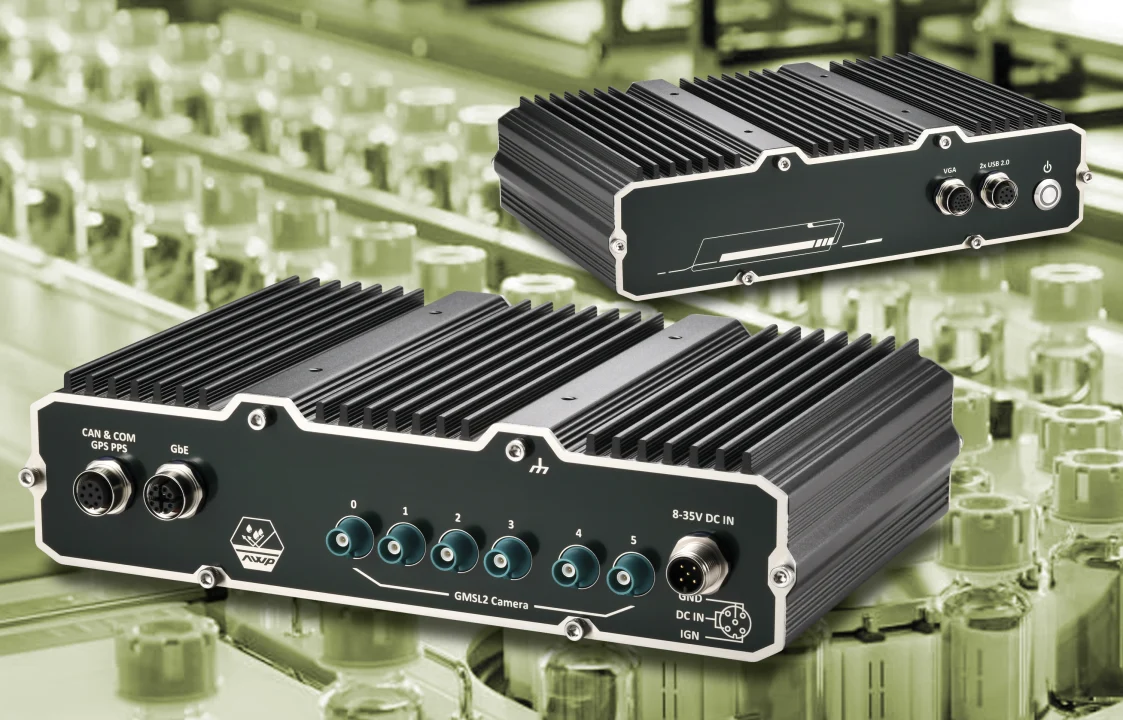
NRU-161V-AWP: Reliable hardware for AI vision applications
Even in pre-industrial times, quality assurance was primarily based on the visual inspection of manufactured products. Despite rapid technological development, this has not changed to this day. Alongside other methods, visual inspection and verification remain the most important means of quality control. In industrial manufacturing today, however, this must be carried out extremely quickly, whilst remaining reliable and robust. Added to this is the control of the production process itself. This calls for hardware that meets industrial requirements: robust in design, safe to use, equipped with high-resolution video cameras, and fast yet compact for in-line applications or mobile use. With the NRU-161V-AWP, the German distributor Acceed is responding to these requirements and has added several models from the series to its range. Equipped with an Nvidia Jetson Orin NX or an Orin Nano SoM, these cost-effective systems are tailored for AI applications in extreme environments. They are compact, have a low profile, operate fanlessly at temperatures ranging from -25 to +70 °C, and are water- and dust-tight to IP66 standard.
According to the manufacturer, the abbreviation ‘AWP’ in the model name NRU-161V-AWP and other models in the series stands for ‘Affordability, Waterproof, Protection’ – in other words, cost-effective, waterproof and protected. The series comprises several models of water- and dust-resistant edge AI computers with integrated GPU acceleration and a remarkable capability: up to six Gigabit Ethernet cameras with PoE power supply can be connected directly, and their data streams processed locally via an Nvidia GPU, entirely without cloud architectures and their well-known bandwidth and latency issues.
The graphics processor (Nvidia’s Jetson Orin NX or Orin Nano-SoM) offers up to 100 sparse TOPS (INT8) of AI inference performance and a video encoding capacity of up to eighteen 1080p video streams simultaneously. In industrial applications, this enables the parallel analysis of multiple high-resolution camera streams, for example for object recognition, classification, defect analysis, or even traffic flow analysis and driver assistance systems. 3D cameras for depth sensing, motion analysis or real-time 3D modelling are also supported by pre-configured drivers.
The system accepts supply voltages across a wide range from 8 to 35 volts, making it suitable for vehicle electrical systems as well. The ignition control function enables defined start-up and shutdown procedures in mobile scenarios.
Thermally, the device is designed for fanless operation at ambient temperatures between -25 and +70 °C (no throttling at 70 °C when operating at a 20 W TDP). The protective, robust aluminium housing also serves to dissipate heat efficiently, enabling use outdoors as well as in production halls and enclosed facilities. In summary, the NRU-161V-AWP represents a logical evolution of classic edge AI systems: a robust IP66 design, an integrated high-performance GPU in a fanless chassis, and direct power supply to six GigE cameras. For integrators and OEMs who need to implement AI image processing under harsh field conditions, this is a compelling option not only from a technical but also from an economic perspective.