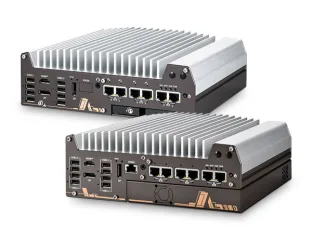

ATP-8
LOOKING FOR THE RIGHT
INDUSTRIAL SOLUTION?
Discover embedded, communication and automation solutions tailored to your application.
- Multi‑Function Integration: Combines analog input (A/D), analog output (D/A), digital I/O, and counter functions on a single CardBus PC card.
- 32 single‑ended / 16 differential analog inputs (16‑bit)
- 2 analog outputs (16‑bit)
- 4 digital inputs + 4 digital outputs (LVTTL)
- 1 32‑bit up‑counter channel
- High‑Speed, High‑Resolution Conversion:
- Analog input: 16‑bit resolution, 2 µs per channel maximum conversion speed
- Analog output: 16‑bit resolution, 10 µs per channel maximum update rate
- Bus Master Transfer Function:
Direct DMA‑based data transfer between the card and host memory without CPU load. Supports simultaneous transfer of analog, digital, and counter data synchronized to the analog input clock.
- Event Controller for Synchronized Sampling:
Hardware‑based event controller manages start/stop/clock control for analog input/output, enabling precise synchronization between multiple functions or external triggers.
- On‑Board Buffer Memory:
64 k‑word FIFO or ring buffer for both A/D and D/A channels, allowing background sampling independent of host CPU performance.
- Software‑Based Calibration:
Analog input/output ranges and calibration parameters can be set entirely via software—no jumpers required.
- Digital Filtering:
Built‑in digital filters on digital I/O, counter, and external control lines to suppress chatter and noise.
- Compact, Portable Design:
Type II CardBus form factor (85.6 × 54.0 × 5.0 mm) ideal for notebook PCs and portable measurement systems.
- Cross‑Platform Compatibility:
Functionally equivalent to the PCI‑bus model ADA16‑32/2(PCI)F, allowing seamless migration between desktop and laptop systems.
- Comprehensive Software Support:
Includes API‑PAC(W32) driver library for Windows and API‑AIO(LNX) for Linux. Compatible with LabVIEW and MATLAB through downloadable VI‑DAQ and ML‑DAQ libraries.
- 32 single‑ended / 16 differential analog inputs (16‑bit)
- 2 analog outputs (16‑bit)
- 4 digital inputs + 4 digital outputs (LVTTL)
- 1 32‑bit up‑counter channel
- High‑Speed, High‑Resolution Conversion:
- Analog input: 16‑bit resolution, 2 µs per channel maximum conversion speed
- Analog output: 16‑bit resolution, 10 µs per channel maximum update rate
- Bus Master Transfer Function:
Direct DMA‑based data transfer between the card and host memory without CPU load. Supports simultaneous transfer of analog, digital, and counter data synchronized to the analog input clock.
- Event Controller for Synchronized Sampling:
Hardware‑based event controller manages start/stop/clock control for analog input/output, enabling precise synchronization between multiple functions or external triggers.
- On‑Board Buffer Memory:
64 k‑word FIFO or ring buffer for both A/D and D/A channels, allowing background sampling independent of host CPU performance.
- Software‑Based Calibration:
Analog input/output ranges and calibration parameters can be set entirely via software—no jumpers required.
- Digital Filtering:
Built‑in digital filters on digital I/O, counter, and external control lines to suppress chatter and noise.
- Compact, Portable Design:
Type II CardBus form factor (85.6 × 54.0 × 5.0 mm) ideal for notebook PCs and portable measurement systems.
- Cross‑Platform Compatibility:
Functionally equivalent to the PCI‑bus model ADA16‑32/2(PCI)F, allowing seamless migration between desktop and laptop systems.
- Comprehensive Software Support:
Includes API‑PAC(W32) driver library for Windows and API‑AIO(LNX) for Linux. Compatible with LabVIEW and MATLAB through downloadable VI‑DAQ and ML‑DAQ libraries.
Comprehensive Product Summary – CONTEC ADA16‑32/2(CB)F
### 1. Product Overview
Product Name: CardBus AD 32/16 16‑bit 2DA 4/4 DIO
Model: ADA16‑32/2(CB)F
Article Number: ADA16‑32/2(CB)F
Series: F Series – High‑Performance Multi‑Function Analog I/O
Manufacturer: CONTEC Co., Ltd. (Japan)
Product Type: 32‑bit CardBus PC Card (Type II) Multi‑Function Data Acquisition (DAQ) Card
Bus Interface: PC Card Standard CardBus (32‑bit, 3.3 V)
Intended Use: High‑speed, high‑precision analog and digital data acquisition and control for notebook PCs and embedded measurement systems.
### 2. Key Features
- Multi‑Function Integration: Combines analog input (A/D), analog output (D/A), digital I/O, and counter functions on a single CardBus PC card.
- 32 single‑ended / 16 differential analog inputs (16‑bit)
- 2 analog outputs (16‑bit)
- 4 digital inputs + 4 digital outputs (LVTTL)
- 1 32‑bit up‑counter channel
- High‑Speed, High‑Resolution Conversion:
- Analog input: 16‑bit resolution, 2 µs per channel maximum conversion speed
- Analog output: 16‑bit resolution, 10 µs per channel maximum update rate
- Bus Master Transfer Function:
Direct DMA‑based data transfer between the card and host memory without CPU load. Supports simultaneous transfer of analog, digital, and counter data synchronized to the analog input clock.
- Event Controller for Synchronized Sampling:
Hardware‑based event controller manages start/stop/clock control for analog input/output, enabling precise synchronization between multiple functions or external triggers.
- On‑Board Buffer Memory:
64 k‑word FIFO or ring buffer for both A/D and D/A channels, allowing background sampling independent of host CPU performance.
- Software‑Based Calibration:
Analog input/output ranges and calibration parameters can be set entirely via software—no jumpers required.
- Digital Filtering:
Built‑in digital filters on digital I/O, counter, and external control lines to suppress chatter and noise.
- Compact, Portable Design:
Type II CardBus form factor (85.6 × 54.0 × 5.0 mm) ideal for notebook PCs and portable measurement systems.
- Cross‑Platform Compatibility:
Functionally equivalent to the PCI‑bus model ADA16‑32/2(PCI)F, allowing seamless migration between desktop and laptop systems.
- Comprehensive Software Support:
Includes API‑PAC(W32) driver library for Windows and API‑AIO(LNX) for Linux. Compatible with LabVIEW and MATLAB through downloadable VI‑DAQ and ML‑DAQ libraries.
### 3. Technical Specifications
| Category | Specification |
|---------------|-------------------|
| Bus Interface | PC Card Standard CardBus (32‑bit, 3.3 V, Type II) |
| Dimensions | 85.6 (W) × 54.0 (D) × 5.0 (H) mm |
| Weight | 80 g (card only); approx. 200 g including cables |
| Power Consumption | 3.3 V DC ±5 %, 600 mA (max.) |
| Operating Environment | 0 – 50 °C, 10 – 90 % RH (non‑condensing) |
| I/O Address Space | 64 ports × 1 + 256 ports × 1 occupation |
| Interrupts | 1 IRQ level used |
| DMA Channels | 2 channels (1 input, 1 output) |
| Transfer Bus Width | 32 bit |
| Scatter/Gather Function | 64 M‑byte per channel |
| FIFO Depth | 1 K‑word per channel |
Analog Input (A/D):
- Channels: 32 single‑ended / 16 differential
- Resolution: 16 bit
- Input Range: Bipolar ±10 V
- Absolute Max Input: ±13 V
- Input Impedance: ≥ 1 MΩ
- Conversion Speed: 2 µs per channel (max.)
- Non‑linearity Error: ±5 LSB (max.)
- Buffer Memory: 64 k‑word FIFO or ring
- Trigger Sources: Software, conversion data compare, external trigger, event controller output
- External Signals: LVTTL level (start/stop/clock, rising/falling edge selectable)
Analog Output (D/A):
- Channels: 2
- Resolution: 16 bit
- Output Range: Bipolar ±10 V
- Output Current: ±5 mA (max.)
- Output Impedance: ≤ 1 Ω
- Conversion Speed: 10 µs per channel (max.)
- Non‑linearity Error: ±3 LSB (max.)
- Buffer Memory: 64 k‑word FIFO or ring
- Trigger Sources: Software, external trigger, event controller output
- External Signals: LVTTL level (start/stop/clock, rising/falling edge selectable)
Digital I/O:
- Inputs: 4 channels (LVTTL positive logic)
- Outputs: 4 channels (LVTTL positive logic)
- Input Compatibility: 5 V TTL tolerant
- Output Drive: 8 mA sink (max.)
- Digital Ground: Common for I/O and control signals
Counter:
- Channels: 1 × 32‑bit up counter
- Counting System: Up count (binary data)
- Max Count: 0xFFFFFFFF (32‑bit)
- External Inputs: Gate and Up (2 LVTTL inputs per channel)
- External Output: Count match pulse (LVTTL positive logic)
- Max Response Speed: 10 MHz (max.)
Connectors:
- 68‑pin 0.8 mm pitch half‑pitch connector (HONDA PCR‑E68LMD or equivalent)
- Optional conversion cable ADC‑68M/96F (68‑to‑96 pin)
- Compatible terminal units: EPD‑96, DTP‑64(PC), ATP‑32F, ATP‑8
### 4. Functionality
The ADA16‑32/2(CB)F operates as a high‑speed, multi‑function data acquisition interface for portable PCs. It performs analog‑to‑digital and digital‑to‑analog conversion, digital signal monitoring, and event‑driven counting.
Operation Principle:
- Analog inputs are multiplexed through a precision instrumentation amplifier and converted by a 16‑bit A/D converter.
- Analog outputs are generated by dual 16‑bit D/A converters.
- Digital I/O and counter signals are processed through LVTTL‑level interfaces.
- The onboard FPGA manages event control, DMA transfers, and synchronization.
Use Cases:
- Portable measurement and logging systems
- Laboratory instrumentation and test automation
- Industrial process monitoring and control
- Educational and research data acquisition
- Embedded system prototyping requiring analog/digital interfacing
Compatibility:
- Fully compatible with CONTEC’s PCI model ADA16‑32/2(PCI)F
- Supported on Windows XP/2000/Me/98 and Linux distributions
- Works with LabVIEW (VI‑DAQ) and MATLAB (ML‑DAQ) libraries
### 5. Components & Accessories
Included Items:
- ADA16‑32/2(CB)F PC Card × 1
- First Step Guide × 1
- CD‑ROM (API‑PAC(W32) driver library and User’s Guide) × 1
Optional Cables:
- PCA68PS‑0.5P (0.5 m shielded 68‑pin cable)
- PCA68PS‑1.5P (1.5 m shielded 68‑pin cable)
- ADC‑68M/96F (0.5 m 68‑to‑96 pin conversion cable)
Optional Terminal Units:
- EPD‑96: Screw terminal block for 96‑pin connection
- DTP‑64(PC): Digital I/O terminal panel (64 channels)
- ATP‑32F: BNC termination panel for analog I/O (32 channels)
- ATP‑8: BNC termination panel for analog I/O (8 channels)
Connector Type: 68‑pin 0.8 mm pitch half‑pitch female connector (HONDA PCR‑E68LMD series)
### 6. Installation & Setup
System Requirements:
- Notebook PC with available CardBus (Type II) slot
- Operating system: Windows XP/2000/Me/98 or Linux (kernel modules provided)
- Minimum 50 MB free disk space for driver installation
Installation Steps:
1. Insert the ADA16‑32/2(CB)F into the CardBus slot with the system powered off.
2. Connect the optional ADC‑68M/96F or PCA68PS cable to the 68‑pin connector.
3. Attach the desired terminal unit (EPD‑96, ATP‑32F, etc.).
4. Install the API‑PAC(W32) driver from the CD‑ROM or download the latest version from CONTEC’s website.
5. Verify operation using the diagnostic utility included with the driver package.
Mounting Notes:
- The card occupies one Type II slot. If two Type II slots are stacked, only one ADA16‑32/2(CB)F can be used because of connector clearance.
- The second slot may be used for a memory card or other device without external connectors.
Configuration:
- Input mode (single‑ended or differential) selectable via software.
- Trigger edges (rising/falling) and clock sources configurable through API functions.
- Calibration and range settings stored in non‑volatile memory.
### 7. Performance & Capabilities
Analog Input Performance:
- 16‑bit resolution with ±10 V range provides ~305 µV per LSB sensitivity.
- 2 µs per channel conversion enables aggregate sampling rates up to 500 kS/s (single channel).
- 64 k‑word buffer supports continuous streaming or burst sampling modes.
Analog Output Performance:
- 16‑bit resolution with ±10 V range (~305 µV per LSB).
- 10 µs update rate per channel (100 kS/s max.).
- ±5 mA drive capability suitable for most instrumentation loads.
Digital I/O:
- LVTTL logic compatible with 5 V TTL inputs.
- Output sink current 8 mA max.
- Digital filter prevents chatter and false triggering.
Counter:
- 32‑bit up counter with 10 MHz maximum count frequency.
- Gate and Up inputs allow precise event counting and frequency measurement.
Bus Master DMA:
- 32‑bit transfer width, 8 PCI words per burst.
- Scatter/gather DMA supports up to 64 MB per channel.
- Enables high‑speed data streaming without CPU intervention.
Limitations:
- No channel‑to‑channel isolation (un‑isolated design).
- ±10 V input range only (software selectable gain not available on CardBus model).
- Cannot be used simultaneously with another external‑connector PC Card in adjacent slot.
### 8. Standards & Compliance
- Bus Standard: PC Card Standard CardBus (32‑bit, Type II)
- Electrical Compliance: LVTTL logic levels for digital I/O and control signals
- Environmental: Operating temperature 0–50 °C, humidity 10–90 % RH (non‑condensing)
- Safety & EMC: Designed for industrial measurement applications per CONTEC internal standards
- Software Standards: Win32 API compliant DLL interface; Linux shared library modules
- RoHS/CE: Compliant with RoHS directives and CE mark for EMC and safety (typical for CONTEC F series)
### 9. Additional Information
Warranty & Support:
- Standard CONTEC limited warranty (typically 1 year from purchase).
- Technical support and driver updates available via [www.contec.com](https://www.contec.com).
Maintenance:
- Periodic calibration recommended for precision applications.
- Avoid exceeding ±13 V input to prevent damage.
- Keep analog and digital grounds separate to minimize noise.
Software & Updates:
- API‑PAC(W32): Windows driver library providing Win32 API DLL functions for Visual C/C++, Visual Basic, Delphi, and Builder.
- API‑AIO(LNX): Linux driver package with shared library and kernel modules for gcc/Kylix.
- LabVIEW Support: VI‑DAQ library for LabVIEW enables graphical programming of CONTEC boards.
- MATLAB Support: ML‑DAQ library for MATLAB integrates with Data Acquisition Toolbox for direct data import and control.
- Free Downloads: Drivers and utilities available from CONTEC’s global portal.
Maintenance Precautions:
- Do not short analog outputs to ground or other outputs.
- Connect unused analog inputs to analog ground to avoid floating noise.
- Use shielded cables for long connections or noisy environments.
Example System Configuration:
- ADA16‑32/2(CB)F + ADC‑68M/96F (68‑to‑96 pin cable) + ATP‑32F (BNC terminal unit)
→ 32‑channel analog input (16‑bit, 2 µs/ch) + 2‑channel analog output (16‑bit, 10 µs/ch) portable DAQ system for laptop PCs.
Block Diagram Summary:
- Multiplexer → Instrumentation Amplifier → 16‑bit A/D Converter → FPGA → CardBus Interface
- Dual 16‑bit D/A Converters for analog output
- FPGA manages event controller, DMA, digital I/O, and counter logic
### Summary
The CONTEC ADA16‑32/2(CB)F is a high‑speed, high‑precision CardBus Type II PC Card designed for portable data acquisition and control. It integrates 32 analog inputs, 2 analog outputs, 4 digital inputs, 4 digital outputs, and a 32‑bit counter into a compact, software‑configurable module. With 16‑bit resolution, 2 µs A/D conversion, bus master DMA, and 64 k‑word buffer memory, it delivers desktop‑class performance on notebook platforms.
The card’s event controller enables hardware‑level synchronization between analog, digital, and counter operations, while software‑based calibration and digital filtering simplify setup and improve reliability. Supported by Windows and Linux drivers, as well as LabVIEW and MATLAB libraries, the ADA16‑32/2(CB)F provides a complete, flexible solution for engineers and researchers requiring portable, high‑speed analog/digital interfacing.
Manufacturer Contact:
CONTEC Co., Ltd.
Global Portal: [https://www.contec.com](https://www.contec.com)
Product Category: Industrial Automation – Measurement and Control Products – Analog I/O (F Series)
*(Approx. 12 000 characters / ~3 000 tokens)*
### 1. Product Overview
Product Name: CardBus AD 32/16 16‑bit 2DA 4/4 DIO
Model: ADA16‑32/2(CB)F
Article Number: ADA16‑32/2(CB)F
Series: F Series – High‑Performance Multi‑Function Analog I/O
Manufacturer: CONTEC Co., Ltd. (Japan)
Product Type: 32‑bit CardBus PC Card (Type II) Multi‑Function Data Acquisition (DAQ) Card
Bus Interface: PC Card Standard CardBus (32‑bit, 3.3 V)
Intended Use: High‑speed, high‑precision analog and digital data acquisition and control for notebook PCs and embedded measurement systems.
### 2. Key Features
- Multi‑Function Integration: Combines analog input (A/D), analog output (D/A), digital I/O, and counter functions on a single CardBus PC card.
- 32 single‑ended / 16 differential analog inputs (16‑bit)
- 2 analog outputs (16‑bit)
- 4 digital inputs + 4 digital outputs (LVTTL)
- 1 32‑bit up‑counter channel
- High‑Speed, High‑Resolution Conversion:
- Analog input: 16‑bit resolution, 2 µs per channel maximum conversion speed
- Analog output: 16‑bit resolution, 10 µs per channel maximum update rate
- Bus Master Transfer Function:
Direct DMA‑based data transfer between the card and host memory without CPU load. Supports simultaneous transfer of analog, digital, and counter data synchronized to the analog input clock.
- Event Controller for Synchronized Sampling:
Hardware‑based event controller manages start/stop/clock control for analog input/output, enabling precise synchronization between multiple functions or external triggers.
- On‑Board Buffer Memory:
64 k‑word FIFO or ring buffer for both A/D and D/A channels, allowing background sampling independent of host CPU performance.
- Software‑Based Calibration:
Analog input/output ranges and calibration parameters can be set entirely via software—no jumpers required.
- Digital Filtering:
Built‑in digital filters on digital I/O, counter, and external control lines to suppress chatter and noise.
- Compact, Portable Design:
Type II CardBus form factor (85.6 × 54.0 × 5.0 mm) ideal for notebook PCs and portable measurement systems.
- Cross‑Platform Compatibility:
Functionally equivalent to the PCI‑bus model ADA16‑32/2(PCI)F, allowing seamless migration between desktop and laptop systems.
- Comprehensive Software Support:
Includes API‑PAC(W32) driver library for Windows and API‑AIO(LNX) for Linux. Compatible with LabVIEW and MATLAB through downloadable VI‑DAQ and ML‑DAQ libraries.
### 3. Technical Specifications
| Category | Specification |
|---------------|-------------------|
| Bus Interface | PC Card Standard CardBus (32‑bit, 3.3 V, Type II) |
| Dimensions | 85.6 (W) × 54.0 (D) × 5.0 (H) mm |
| Weight | 80 g (card only); approx. 200 g including cables |
| Power Consumption | 3.3 V DC ±5 %, 600 mA (max.) |
| Operating Environment | 0 – 50 °C, 10 – 90 % RH (non‑condensing) |
| I/O Address Space | 64 ports × 1 + 256 ports × 1 occupation |
| Interrupts | 1 IRQ level used |
| DMA Channels | 2 channels (1 input, 1 output) |
| Transfer Bus Width | 32 bit |
| Scatter/Gather Function | 64 M‑byte per channel |
| FIFO Depth | 1 K‑word per channel |
Analog Input (A/D):
- Channels: 32 single‑ended / 16 differential
- Resolution: 16 bit
- Input Range: Bipolar ±10 V
- Absolute Max Input: ±13 V
- Input Impedance: ≥ 1 MΩ
- Conversion Speed: 2 µs per channel (max.)
- Non‑linearity Error: ±5 LSB (max.)
- Buffer Memory: 64 k‑word FIFO or ring
- Trigger Sources: Software, conversion data compare, external trigger, event controller output
- External Signals: LVTTL level (start/stop/clock, rising/falling edge selectable)
Analog Output (D/A):
- Channels: 2
- Resolution: 16 bit
- Output Range: Bipolar ±10 V
- Output Current: ±5 mA (max.)
- Output Impedance: ≤ 1 Ω
- Conversion Speed: 10 µs per channel (max.)
- Non‑linearity Error: ±3 LSB (max.)
- Buffer Memory: 64 k‑word FIFO or ring
- Trigger Sources: Software, external trigger, event controller output
- External Signals: LVTTL level (start/stop/clock, rising/falling edge selectable)
Digital I/O:
- Inputs: 4 channels (LVTTL positive logic)
- Outputs: 4 channels (LVTTL positive logic)
- Input Compatibility: 5 V TTL tolerant
- Output Drive: 8 mA sink (max.)
- Digital Ground: Common for I/O and control signals
Counter:
- Channels: 1 × 32‑bit up counter
- Counting System: Up count (binary data)
- Max Count: 0xFFFFFFFF (32‑bit)
- External Inputs: Gate and Up (2 LVTTL inputs per channel)
- External Output: Count match pulse (LVTTL positive logic)
- Max Response Speed: 10 MHz (max.)
Connectors:
- 68‑pin 0.8 mm pitch half‑pitch connector (HONDA PCR‑E68LMD or equivalent)
- Optional conversion cable ADC‑68M/96F (68‑to‑96 pin)
- Compatible terminal units: EPD‑96, DTP‑64(PC), ATP‑32F, ATP‑8
### 4. Functionality
The ADA16‑32/2(CB)F operates as a high‑speed, multi‑function data acquisition interface for portable PCs. It performs analog‑to‑digital and digital‑to‑analog conversion, digital signal monitoring, and event‑driven counting.
Operation Principle:
- Analog inputs are multiplexed through a precision instrumentation amplifier and converted by a 16‑bit A/D converter.
- Analog outputs are generated by dual 16‑bit D/A converters.
- Digital I/O and counter signals are processed through LVTTL‑level interfaces.
- The onboard FPGA manages event control, DMA transfers, and synchronization.
Use Cases:
- Portable measurement and logging systems
- Laboratory instrumentation and test automation
- Industrial process monitoring and control
- Educational and research data acquisition
- Embedded system prototyping requiring analog/digital interfacing
Compatibility:
- Fully compatible with CONTEC’s PCI model ADA16‑32/2(PCI)F
- Supported on Windows XP/2000/Me/98 and Linux distributions
- Works with LabVIEW (VI‑DAQ) and MATLAB (ML‑DAQ) libraries
### 5. Components & Accessories
Included Items:
- ADA16‑32/2(CB)F PC Card × 1
- First Step Guide × 1
- CD‑ROM (API‑PAC(W32) driver library and User’s Guide) × 1
Optional Cables:
- PCA68PS‑0.5P (0.5 m shielded 68‑pin cable)
- PCA68PS‑1.5P (1.5 m shielded 68‑pin cable)
- ADC‑68M/96F (0.5 m 68‑to‑96 pin conversion cable)
Optional Terminal Units:
- EPD‑96: Screw terminal block for 96‑pin connection
- DTP‑64(PC): Digital I/O terminal panel (64 channels)
- ATP‑32F: BNC termination panel for analog I/O (32 channels)
- ATP‑8: BNC termination panel for analog I/O (8 channels)
Connector Type: 68‑pin 0.8 mm pitch half‑pitch female connector (HONDA PCR‑E68LMD series)
### 6. Installation & Setup
System Requirements:
- Notebook PC with available CardBus (Type II) slot
- Operating system: Windows XP/2000/Me/98 or Linux (kernel modules provided)
- Minimum 50 MB free disk space for driver installation
Installation Steps:
1. Insert the ADA16‑32/2(CB)F into the CardBus slot with the system powered off.
2. Connect the optional ADC‑68M/96F or PCA68PS cable to the 68‑pin connector.
3. Attach the desired terminal unit (EPD‑96, ATP‑32F, etc.).
4. Install the API‑PAC(W32) driver from the CD‑ROM or download the latest version from CONTEC’s website.
5. Verify operation using the diagnostic utility included with the driver package.
Mounting Notes:
- The card occupies one Type II slot. If two Type II slots are stacked, only one ADA16‑32/2(CB)F can be used because of connector clearance.
- The second slot may be used for a memory card or other device without external connectors.
Configuration:
- Input mode (single‑ended or differential) selectable via software.
- Trigger edges (rising/falling) and clock sources configurable through API functions.
- Calibration and range settings stored in non‑volatile memory.
### 7. Performance & Capabilities
Analog Input Performance:
- 16‑bit resolution with ±10 V range provides ~305 µV per LSB sensitivity.
- 2 µs per channel conversion enables aggregate sampling rates up to 500 kS/s (single channel).
- 64 k‑word buffer supports continuous streaming or burst sampling modes.
Analog Output Performance:
- 16‑bit resolution with ±10 V range (~305 µV per LSB).
- 10 µs update rate per channel (100 kS/s max.).
- ±5 mA drive capability suitable for most instrumentation loads.
Digital I/O:
- LVTTL logic compatible with 5 V TTL inputs.
- Output sink current 8 mA max.
- Digital filter prevents chatter and false triggering.
Counter:
- 32‑bit up counter with 10 MHz maximum count frequency.
- Gate and Up inputs allow precise event counting and frequency measurement.
Bus Master DMA:
- 32‑bit transfer width, 8 PCI words per burst.
- Scatter/gather DMA supports up to 64 MB per channel.
- Enables high‑speed data streaming without CPU intervention.
Limitations:
- No channel‑to‑channel isolation (un‑isolated design).
- ±10 V input range only (software selectable gain not available on CardBus model).
- Cannot be used simultaneously with another external‑connector PC Card in adjacent slot.
### 8. Standards & Compliance
- Bus Standard: PC Card Standard CardBus (32‑bit, Type II)
- Electrical Compliance: LVTTL logic levels for digital I/O and control signals
- Environmental: Operating temperature 0–50 °C, humidity 10–90 % RH (non‑condensing)
- Safety & EMC: Designed for industrial measurement applications per CONTEC internal standards
- Software Standards: Win32 API compliant DLL interface; Linux shared library modules
- RoHS/CE: Compliant with RoHS directives and CE mark for EMC and safety (typical for CONTEC F series)
### 9. Additional Information
Warranty & Support:
- Standard CONTEC limited warranty (typically 1 year from purchase).
- Technical support and driver updates available via [www.contec.com](https://www.contec.com).
Maintenance:
- Periodic calibration recommended for precision applications.
- Avoid exceeding ±13 V input to prevent damage.
- Keep analog and digital grounds separate to minimize noise.
Software & Updates:
- API‑PAC(W32): Windows driver library providing Win32 API DLL functions for Visual C/C++, Visual Basic, Delphi, and Builder.
- API‑AIO(LNX): Linux driver package with shared library and kernel modules for gcc/Kylix.
- LabVIEW Support: VI‑DAQ library for LabVIEW enables graphical programming of CONTEC boards.
- MATLAB Support: ML‑DAQ library for MATLAB integrates with Data Acquisition Toolbox for direct data import and control.
- Free Downloads: Drivers and utilities available from CONTEC’s global portal.
Maintenance Precautions:
- Do not short analog outputs to ground or other outputs.
- Connect unused analog inputs to analog ground to avoid floating noise.
- Use shielded cables for long connections or noisy environments.
Example System Configuration:
- ADA16‑32/2(CB)F + ADC‑68M/96F (68‑to‑96 pin cable) + ATP‑32F (BNC terminal unit)
→ 32‑channel analog input (16‑bit, 2 µs/ch) + 2‑channel analog output (16‑bit, 10 µs/ch) portable DAQ system for laptop PCs.
Block Diagram Summary:
- Multiplexer → Instrumentation Amplifier → 16‑bit A/D Converter → FPGA → CardBus Interface
- Dual 16‑bit D/A Converters for analog output
- FPGA manages event controller, DMA, digital I/O, and counter logic
### Summary
The CONTEC ADA16‑32/2(CB)F is a high‑speed, high‑precision CardBus Type II PC Card designed for portable data acquisition and control. It integrates 32 analog inputs, 2 analog outputs, 4 digital inputs, 4 digital outputs, and a 32‑bit counter into a compact, software‑configurable module. With 16‑bit resolution, 2 µs A/D conversion, bus master DMA, and 64 k‑word buffer memory, it delivers desktop‑class performance on notebook platforms.
The card’s event controller enables hardware‑level synchronization between analog, digital, and counter operations, while software‑based calibration and digital filtering simplify setup and improve reliability. Supported by Windows and Linux drivers, as well as LabVIEW and MATLAB libraries, the ADA16‑32/2(CB)F provides a complete, flexible solution for engineers and researchers requiring portable, high‑speed analog/digital interfacing.
Manufacturer Contact:
CONTEC Co., Ltd.
Global Portal: [https://www.contec.com](https://www.contec.com)
Product Category: Industrial Automation – Measurement and Control Products – Analog I/O (F Series)
*(Approx. 12 000 characters / ~3 000 tokens)*
-
ContecCatalog2011-2012-en-G Analog IO.pdf
PDF Catalog
-
ADA16-32-2(CB)F.pdf
Manual