 LOOKING FOR THE RIGHT
INDUSTRIAL SOLUTION?
Discover embedded, communication and automation solutions tailored to your application.
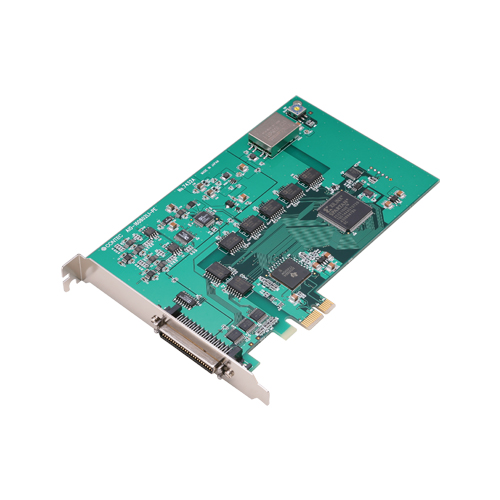
AIO-160802LI-PE
PCIe isolated AD card 100kS/s 16 Bit 8 CH 2*DA 4*DI 4*DO Cou
550,00 EUR
including VAT 654.50 EUR
- Bus‑Isolated Architecture: Digital isolators separate the PC bus from external analog and digital circuits, enhancing noise immunity and protecting the host system.
- High‑Resolution Analog I/O: 16‑bit resolution for both A/D and D/A conversion with ±10 V bipolar range and 100 k samples per second (10 µs per channel).
- Multifunction Integration: 8 analog inputs, 2 analog outputs, 4 digital inputs, 4 digital outputs, and 1 32‑bit counter on a single board.
- Trigger and Clock Flexibility: Sampling start/stop controlled by software commands or external TTL triggers; supports internal or external sampling clocks.
- Buffered Data Acquisition: 1 k‑word FIFO/RING buffer for both input and output enables continuous background operation independent of PC load.
- Digital Filtering: Programmable 1 µs filter to suppress chattering and false triggering on external signals.
- Software Calibration: All gain/offset adjustments performed in software; user can store custom calibration data in addition to factory settings.
- Safety Startup: Analog outputs are forced to 0 V at power‑on to prevent damage to connected equipment.
- Software Support: Bundled API‑PAC(W32) driver library for Windows and Linux, C‑LOGGER data logger, and free downloadable MATLAB (ML‑DAQ) and LabVIEW (VI‑DAQ) libraries.
- Compatibility: Connector and function compatible with legacy PCI board ADAI16‑8/2(LPCI)L for easy system migration.
- High‑Resolution Analog I/O: 16‑bit resolution for both A/D and D/A conversion with ±10 V bipolar range and 100 k samples per second (10 µs per channel).
- Multifunction Integration: 8 analog inputs, 2 analog outputs, 4 digital inputs, 4 digital outputs, and 1 32‑bit counter on a single board.
- Trigger and Clock Flexibility: Sampling start/stop controlled by software commands or external TTL triggers; supports internal or external sampling clocks.
- Buffered Data Acquisition: 1 k‑word FIFO/RING buffer for both input and output enables continuous background operation independent of PC load.
- Digital Filtering: Programmable 1 µs filter to suppress chattering and false triggering on external signals.
- Software Calibration: All gain/offset adjustments performed in software; user can store custom calibration data in addition to factory settings.
- Safety Startup: Analog outputs are forced to 0 V at power‑on to prevent damage to connected equipment.
- Software Support: Bundled API‑PAC(W32) driver library for Windows and Linux, C‑LOGGER data logger, and free downloadable MATLAB (ML‑DAQ) and LabVIEW (VI‑DAQ) libraries.
- Compatibility: Connector and function compatible with legacy PCI board ADAI16‑8/2(LPCI)L for easy system migration.
Comprehensive Product Summary – AIO‑160802LI‑PE PCI Express Isolated Analog I/O Board
*(Approx. 12 000 characters / ~3000 tokens)*
### 1. Product Overview
Product Name: AIO‑160802LI‑PE
Article Number: AIO‑160802LI‑PE
Series: Isolated 16‑bit Analog I/O Boards for PCI Express
Manufacturer: CONTEC CO., LTD. (Japan)
Model Type: PCI Express bus‑isolated analog/digital I/O interface card
The AIO‑160802LI‑PE is a multifunction PCI Express x1 data‑acquisition board providing high‑precision 16‑bit analog inputs and outputs with complete bus isolation between the PC and external I/O circuits. It integrates eight analog input channels, two analog output channels, four isolated digital inputs, four isolated digital outputs, and one 32‑bit counter channel. The board is supplied with Windows and Linux drivers, data‑logging software (C‑LOGGER), and libraries for MATLAB and LabVIEW. It is intended for precision measurement, control, and signal generation applications in industrial and laboratory environments.
### 2. Key Features
- Bus‑Isolated Architecture: Digital isolators separate the PC bus from external analog and digital circuits, enhancing noise immunity and protecting the host system.
- High‑Resolution Analog I/O: 16‑bit resolution for both A/D and D/A conversion with ±10 V bipolar range and 100 k samples per second (10 µs per channel).
- Multifunction Integration: 8 analog inputs, 2 analog outputs, 4 digital inputs, 4 digital outputs, and 1 32‑bit counter on a single board.
- Trigger and Clock Flexibility: Sampling start/stop controlled by software commands or external TTL triggers; supports internal or external sampling clocks.
- Buffered Data Acquisition: 1 k‑word FIFO/RING buffer for both input and output enables continuous background operation independent of PC load.
- Digital Filtering: Programmable 1 µs filter to suppress chattering and false triggering on external signals.
- Software Calibration: All gain/offset adjustments performed in software; user can store custom calibration data in addition to factory settings.
- Safety Startup: Analog outputs are forced to 0 V at power‑on to prevent damage to connected equipment.
- Software Support: Bundled API‑PAC(W32) driver library for Windows and Linux, C‑LOGGER data logger, and free downloadable MATLAB (ML‑DAQ) and LabVIEW (VI‑DAQ) libraries.
- Compatibility: Connector and function compatible with legacy PCI board ADAI16‑8/2(LPCI)L for easy system migration.
### 3. Technical Specifications
Bus Interface: PCI Express Base Specification Rev. 1.0a (x1 lane)
Power Requirement: +3.3 V DC ±5 %, 1100 mA (max)
Dimensions: 169.33 (L) × 110.18 (H) mm
Weight: Approx. 120 g
Operating Environment: 0 – 50 °C, 10 – 90 % RH (non‑condensing)
Connector: 50‑pin mini‑ribbon (3M 10250‑52A2JL)
I/O Address Space: 64 ports / one INTA interrupt line
Analog Input
- Isolation: Bus‑isolated (single‑ended inputs)
- Channels: 8 ch
- Range: ±10 V bipolar (absolute max ±20 V)
- Input Impedance: ≥ 1 MΩ
- Resolution: 16 bit (1 LSB ≈ 0.305 mV at ±10 V)
- Non‑linearity Error: ±16 LSB (≈ 0.1 %)
- Conversion Speed: 10 µs per channel (100 kS/s aggregate)
- Buffer Memory: 1 k word FIFO or RING
- Start Trigger: Software or external TTL edge (selectable rising/falling)
- Stop Trigger: Sample count, external trigger, or software
- External Clock: TTL level input (selectable edge)
- Digital Filter: 1 µs programmable
Analog Output
- Isolation: Bus‑isolated
- Channels: 2 ch
- Range: ±10 V bipolar (absolute max output current ±5 mA)
- Output Impedance: ≤ 1 Ω
- Resolution: 16 bit
- Non‑linearity Error: ±5 LSB
- Conversion Speed: 10 µs (100 kS/s)
- Buffer Memory: 1 k word FIFO or RING
- Start/Stop Trigger: Software or external TTL edge
- External Clock: TTL level input (selectable edge)
- Power‑on Output: 0 V (all channels)
Digital I/O
- Inputs: 4 isolated TTL positive‑logic channels
- Outputs: 4 isolated TTL positive‑logic channels (16 mA sink capability)
- Isolation: Digital isolator between bus and I/O
Counter
- Channels: 1 (32‑bit up counter)
- Max Count: 0xFFFFFFFF (binary)
- External Inputs: 2 (TTL Gate and Up Clock)
- External Output: 1 Count‑match pulse output (TTL positive logic)
- Response Frequency: 1 MHz max
### 4. Functionality and Applications
The AIO‑160802LI‑PE serves as a general‑purpose data‑acquisition and control interface for PCI Express systems. It digitizes analog signals from sensors or transducers and generates analog control voltages for actuators or test equipment. Typical applications include process monitoring, laboratory measurement, automated testing, and signal simulation.
Operation Principle: Analog inputs are multiplexed and converted by a 16‑bit successive‑approximation A/D converter; outputs are generated by 16‑bit D/A converters through isolated buffers. Digital I/O and counter signals are handled through TTL‑level isolators. All I/O operations are controlled by an FPGA core communicating with the PCI Express bus.
Use Cases:
- Multi‑channel voltage measurement (±10 V range)
- Analog signal generation for equipment testing
- Closed‑loop control systems requiring simultaneous A/D and D/A
- Digital status monitoring and control of external devices
- Event counting and frequency measurement via 32‑bit counter
Compatibility: Fully compatible in connector and pin assignment with the earlier PCI ADAI16‑8/2(LPCI)L board, allowing drop‑in replacement in existing systems.
### 5. Components and Accessories
Included Items
- AIO‑160802LI‑PE board × 1
- First Step Guide × 1
- API‑PAC(W32) installation disk (driver software and user’s guide) × 1
- Warranty certificate × 1
- Serial number label × 1
Optional Accessories
- Shield Cables (50‑pin mini‑ribbon): PCB50PS‑0.5P (0.5 m), PCB50PS‑1.5P (1.5 m) – connectors at both ends.
- Shield Cables (one end): PCA50PS‑0.5P / 1.5P.
- Screw Terminal Unit: EPD‑50A (M3 × 50 P, spring‑up type).
- Buffer Amplifier Boxes: ATBA‑8L (8 ch) and ATBA‑16L (16 ch) – require external AC adapter POA200‑20.
- BNC Terminal Unit: ATP‑8L (for 8 AI and 2 AO channels).
All accessories use the 50‑pin mini‑ribbon interface and are available from CONTEC.
### 6. Installation and Setup
Hardware Installation Steps
1. Power off the PC and remove the cover.
2. Insert the AIO‑160802LI‑PE into an available PCI Express x1 slot.
3. Secure the bracket with a screw and reassemble the PC.
4. Power on the system; Windows will detect the new hardware.
5. Install the API‑AIO(WDM) driver from the bundled disk or download the latest version from CONTEC’s website.
Software Initialization
- Device name and board ID (0–Fh) can be set via rotary switch SW1 on the board and through Device Manager.
- Diagnostic utility verifies analog input/output, digital I/O, and counter functions.
Connection Interface
- CN1 (50‑pin mini‑ribbon) provides all analog, digital, trigger, and counter signals.
- Separate analog and digital grounds (AGND/DGND) must not be shorted to avoid noise coupling.
- External signals are TTL level; analog signals are ±10 V bipolar.
Mounting and Cabling Notes
Use shielded cables for long runs or noisy environments. Unused analog inputs should be tied to AGND. All connections must be made with the PC powered off.
### 7. Performance and Capabilities
- Sampling Rate: 100 k samples per second per channel (max).
- Resolution: 16 bits (65 536 quantization levels).
- Accuracy: Non‑linearity ±0.1 % of full scale (typical).
- Buffering: 1 k‑word FIFO or RING for independent background operation.
- Counter Speed: 1 MHz maximum input frequency.
- Digital I/O Response: TTL logic compatible, 16 mA sink current.
- Isolation Voltage: Digital isolator provides robust bus separation (typical several hundred volts DC isolation).
- Startup Behavior: All analog outputs reset to 0 V on power‑up.
- Limitations: Single‑ended input only (no differential mode); maximum input voltage ±20 V absolute; total throughput depends on number of active channels (10 µs × N).
### 8. Standards and Compliance
- Bus Standard: PCI Express Base Specification Rev. 1.0a (x1).
- Electrical Isolation: Digital isolator between bus and I/O circuits for noise immunity.
- Environmental Conditions: 0–50 °C operating, 10–90 % RH non‑condensing.
- Safety and EMC: Designed for industrial PC use; shielded cable recommended to meet CE EMC requirements.
- RoHS Compliance: All CONTEC boards are manufactured to RoHS directives (lead‑free solder and materials).
### 9. Additional Information
Software Package and Development Support
- API‑AIO(WDM) (Windows): Win32 DLL library with Visual C++ and Visual Basic samples.
- API‑AIO(LNX) (Linux): Shared library and kernel module with gcc samples.
- C‑LOGGER: Graphical data logger for signal display, file storage, and Excel export without programming.
- ML‑DAQ: MATLAB Data Acquisition library integrated with MathWorks DAQ Toolbox.
- VI‑DAQ: LabVIEW VI library emulating NI DAQ VIs for easy integration.
Maintenance and Calibration
- Factory‑calibrated before shipment; user software allows re‑calibration using precision voltage sources and DMMs.
- Calibration data can be restored to factory defaults at any time.
Warranty and Support
- Warranty Period: Three years from date of purchase against defects in materials and workmanship.
- Service: Return Merchandise Authorization (RMA) required for repair or replacement.
- Exclusions: Physical damage, misuse, or modification void warranty.
- Technical Support: Documentation, drivers, and updates available at [https://www.contec.com](https://www.contec.com).
Safety and Handling Precautions
- Do not install or remove the board with power applied.
- Avoid touching edge connectors; clean with industrial alcohol if contaminated.
- Keep analog and digital grounds separate to minimize noise.
- Use only specified cables and terminal units to maintain isolation rating.
Storage and Environment
Store in original anti‑static packaging at room temperature, away from moisture and magnetic fields. Dispose of electronic components according to local regulations.
### Summary of Performance and Advantages
The CONTEC AIO‑160802LI‑PE delivers a robust combination of precision, speed, and isolation for PCI Express data‑acquisition systems. Its 16‑bit resolution and 100 kS/s throughput enable accurate measurement and generation of analog signals within ±10 V ranges. Integrated digital I/O and a 1 MHz counter extend its utility to timing and control tasks. The board’s 1 k‑word FIFO/RING buffers allow continuous background operation without CPU intervention, while software‑selectable triggers and clocks provide flexible synchronization with external events. Comprehensive driver libraries and cross‑platform support simplify integration into Windows, Linux, MATLAB, and LabVIEW environments. With bus isolation, software calibration, and a three‑year warranty, the AIO‑160802LI‑PE is a reliable solution for industrial measurement and control applications requiring high accuracy and noise resilience.
*(Approx. 12 000 characters / ~3000 tokens)*
### 1. Product Overview
Product Name: AIO‑160802LI‑PE
Article Number: AIO‑160802LI‑PE
Series: Isolated 16‑bit Analog I/O Boards for PCI Express
Manufacturer: CONTEC CO., LTD. (Japan)
Model Type: PCI Express bus‑isolated analog/digital I/O interface card
The AIO‑160802LI‑PE is a multifunction PCI Express x1 data‑acquisition board providing high‑precision 16‑bit analog inputs and outputs with complete bus isolation between the PC and external I/O circuits. It integrates eight analog input channels, two analog output channels, four isolated digital inputs, four isolated digital outputs, and one 32‑bit counter channel. The board is supplied with Windows and Linux drivers, data‑logging software (C‑LOGGER), and libraries for MATLAB and LabVIEW. It is intended for precision measurement, control, and signal generation applications in industrial and laboratory environments.
### 2. Key Features
- Bus‑Isolated Architecture: Digital isolators separate the PC bus from external analog and digital circuits, enhancing noise immunity and protecting the host system.
- High‑Resolution Analog I/O: 16‑bit resolution for both A/D and D/A conversion with ±10 V bipolar range and 100 k samples per second (10 µs per channel).
- Multifunction Integration: 8 analog inputs, 2 analog outputs, 4 digital inputs, 4 digital outputs, and 1 32‑bit counter on a single board.
- Trigger and Clock Flexibility: Sampling start/stop controlled by software commands or external TTL triggers; supports internal or external sampling clocks.
- Buffered Data Acquisition: 1 k‑word FIFO/RING buffer for both input and output enables continuous background operation independent of PC load.
- Digital Filtering: Programmable 1 µs filter to suppress chattering and false triggering on external signals.
- Software Calibration: All gain/offset adjustments performed in software; user can store custom calibration data in addition to factory settings.
- Safety Startup: Analog outputs are forced to 0 V at power‑on to prevent damage to connected equipment.
- Software Support: Bundled API‑PAC(W32) driver library for Windows and Linux, C‑LOGGER data logger, and free downloadable MATLAB (ML‑DAQ) and LabVIEW (VI‑DAQ) libraries.
- Compatibility: Connector and function compatible with legacy PCI board ADAI16‑8/2(LPCI)L for easy system migration.
### 3. Technical Specifications
Bus Interface: PCI Express Base Specification Rev. 1.0a (x1 lane)
Power Requirement: +3.3 V DC ±5 %, 1100 mA (max)
Dimensions: 169.33 (L) × 110.18 (H) mm
Weight: Approx. 120 g
Operating Environment: 0 – 50 °C, 10 – 90 % RH (non‑condensing)
Connector: 50‑pin mini‑ribbon (3M 10250‑52A2JL)
I/O Address Space: 64 ports / one INTA interrupt line
Analog Input
- Isolation: Bus‑isolated (single‑ended inputs)
- Channels: 8 ch
- Range: ±10 V bipolar (absolute max ±20 V)
- Input Impedance: ≥ 1 MΩ
- Resolution: 16 bit (1 LSB ≈ 0.305 mV at ±10 V)
- Non‑linearity Error: ±16 LSB (≈ 0.1 %)
- Conversion Speed: 10 µs per channel (100 kS/s aggregate)
- Buffer Memory: 1 k word FIFO or RING
- Start Trigger: Software or external TTL edge (selectable rising/falling)
- Stop Trigger: Sample count, external trigger, or software
- External Clock: TTL level input (selectable edge)
- Digital Filter: 1 µs programmable
Analog Output
- Isolation: Bus‑isolated
- Channels: 2 ch
- Range: ±10 V bipolar (absolute max output current ±5 mA)
- Output Impedance: ≤ 1 Ω
- Resolution: 16 bit
- Non‑linearity Error: ±5 LSB
- Conversion Speed: 10 µs (100 kS/s)
- Buffer Memory: 1 k word FIFO or RING
- Start/Stop Trigger: Software or external TTL edge
- External Clock: TTL level input (selectable edge)
- Power‑on Output: 0 V (all channels)
Digital I/O
- Inputs: 4 isolated TTL positive‑logic channels
- Outputs: 4 isolated TTL positive‑logic channels (16 mA sink capability)
- Isolation: Digital isolator between bus and I/O
Counter
- Channels: 1 (32‑bit up counter)
- Max Count: 0xFFFFFFFF (binary)
- External Inputs: 2 (TTL Gate and Up Clock)
- External Output: 1 Count‑match pulse output (TTL positive logic)
- Response Frequency: 1 MHz max
### 4. Functionality and Applications
The AIO‑160802LI‑PE serves as a general‑purpose data‑acquisition and control interface for PCI Express systems. It digitizes analog signals from sensors or transducers and generates analog control voltages for actuators or test equipment. Typical applications include process monitoring, laboratory measurement, automated testing, and signal simulation.
Operation Principle: Analog inputs are multiplexed and converted by a 16‑bit successive‑approximation A/D converter; outputs are generated by 16‑bit D/A converters through isolated buffers. Digital I/O and counter signals are handled through TTL‑level isolators. All I/O operations are controlled by an FPGA core communicating with the PCI Express bus.
Use Cases:
- Multi‑channel voltage measurement (±10 V range)
- Analog signal generation for equipment testing
- Closed‑loop control systems requiring simultaneous A/D and D/A
- Digital status monitoring and control of external devices
- Event counting and frequency measurement via 32‑bit counter
Compatibility: Fully compatible in connector and pin assignment with the earlier PCI ADAI16‑8/2(LPCI)L board, allowing drop‑in replacement in existing systems.
### 5. Components and Accessories
Included Items
- AIO‑160802LI‑PE board × 1
- First Step Guide × 1
- API‑PAC(W32) installation disk (driver software and user’s guide) × 1
- Warranty certificate × 1
- Serial number label × 1
Optional Accessories
- Shield Cables (50‑pin mini‑ribbon): PCB50PS‑0.5P (0.5 m), PCB50PS‑1.5P (1.5 m) – connectors at both ends.
- Shield Cables (one end): PCA50PS‑0.5P / 1.5P.
- Screw Terminal Unit: EPD‑50A (M3 × 50 P, spring‑up type).
- Buffer Amplifier Boxes: ATBA‑8L (8 ch) and ATBA‑16L (16 ch) – require external AC adapter POA200‑20.
- BNC Terminal Unit: ATP‑8L (for 8 AI and 2 AO channels).
All accessories use the 50‑pin mini‑ribbon interface and are available from CONTEC.
### 6. Installation and Setup
Hardware Installation Steps
1. Power off the PC and remove the cover.
2. Insert the AIO‑160802LI‑PE into an available PCI Express x1 slot.
3. Secure the bracket with a screw and reassemble the PC.
4. Power on the system; Windows will detect the new hardware.
5. Install the API‑AIO(WDM) driver from the bundled disk or download the latest version from CONTEC’s website.
Software Initialization
- Device name and board ID (0–Fh) can be set via rotary switch SW1 on the board and through Device Manager.
- Diagnostic utility verifies analog input/output, digital I/O, and counter functions.
Connection Interface
- CN1 (50‑pin mini‑ribbon) provides all analog, digital, trigger, and counter signals.
- Separate analog and digital grounds (AGND/DGND) must not be shorted to avoid noise coupling.
- External signals are TTL level; analog signals are ±10 V bipolar.
Mounting and Cabling Notes
Use shielded cables for long runs or noisy environments. Unused analog inputs should be tied to AGND. All connections must be made with the PC powered off.
### 7. Performance and Capabilities
- Sampling Rate: 100 k samples per second per channel (max).
- Resolution: 16 bits (65 536 quantization levels).
- Accuracy: Non‑linearity ±0.1 % of full scale (typical).
- Buffering: 1 k‑word FIFO or RING for independent background operation.
- Counter Speed: 1 MHz maximum input frequency.
- Digital I/O Response: TTL logic compatible, 16 mA sink current.
- Isolation Voltage: Digital isolator provides robust bus separation (typical several hundred volts DC isolation).
- Startup Behavior: All analog outputs reset to 0 V on power‑up.
- Limitations: Single‑ended input only (no differential mode); maximum input voltage ±20 V absolute; total throughput depends on number of active channels (10 µs × N).
### 8. Standards and Compliance
- Bus Standard: PCI Express Base Specification Rev. 1.0a (x1).
- Electrical Isolation: Digital isolator between bus and I/O circuits for noise immunity.
- Environmental Conditions: 0–50 °C operating, 10–90 % RH non‑condensing.
- Safety and EMC: Designed for industrial PC use; shielded cable recommended to meet CE EMC requirements.
- RoHS Compliance: All CONTEC boards are manufactured to RoHS directives (lead‑free solder and materials).
### 9. Additional Information
Software Package and Development Support
- API‑AIO(WDM) (Windows): Win32 DLL library with Visual C++ and Visual Basic samples.
- API‑AIO(LNX) (Linux): Shared library and kernel module with gcc samples.
- C‑LOGGER: Graphical data logger for signal display, file storage, and Excel export without programming.
- ML‑DAQ: MATLAB Data Acquisition library integrated with MathWorks DAQ Toolbox.
- VI‑DAQ: LabVIEW VI library emulating NI DAQ VIs for easy integration.
Maintenance and Calibration
- Factory‑calibrated before shipment; user software allows re‑calibration using precision voltage sources and DMMs.
- Calibration data can be restored to factory defaults at any time.
Warranty and Support
- Warranty Period: Three years from date of purchase against defects in materials and workmanship.
- Service: Return Merchandise Authorization (RMA) required for repair or replacement.
- Exclusions: Physical damage, misuse, or modification void warranty.
- Technical Support: Documentation, drivers, and updates available at [https://www.contec.com](https://www.contec.com).
Safety and Handling Precautions
- Do not install or remove the board with power applied.
- Avoid touching edge connectors; clean with industrial alcohol if contaminated.
- Keep analog and digital grounds separate to minimize noise.
- Use only specified cables and terminal units to maintain isolation rating.
Storage and Environment
Store in original anti‑static packaging at room temperature, away from moisture and magnetic fields. Dispose of electronic components according to local regulations.
### Summary of Performance and Advantages
The CONTEC AIO‑160802LI‑PE delivers a robust combination of precision, speed, and isolation for PCI Express data‑acquisition systems. Its 16‑bit resolution and 100 kS/s throughput enable accurate measurement and generation of analog signals within ±10 V ranges. Integrated digital I/O and a 1 MHz counter extend its utility to timing and control tasks. The board’s 1 k‑word FIFO/RING buffers allow continuous background operation without CPU intervention, while software‑selectable triggers and clocks provide flexible synchronization with external events. Comprehensive driver libraries and cross‑platform support simplify integration into Windows, Linux, MATLAB, and LabVIEW environments. With bus isolation, software calibration, and a three‑year warranty, the AIO‑160802LI‑PE is a reliable solution for industrial measurement and control applications requiring high accuracy and noise resilience.
-
 ds_aio160802lipe_en.pdf
PDF Catalog
ds_aio160802lipe_en.pdf
PDF Catalog

No accessories available.