 LOOKING FOR THE RIGHT
INDUSTRIAL SOLUTION?
Discover embedded, communication and automation solutions tailored to your application.
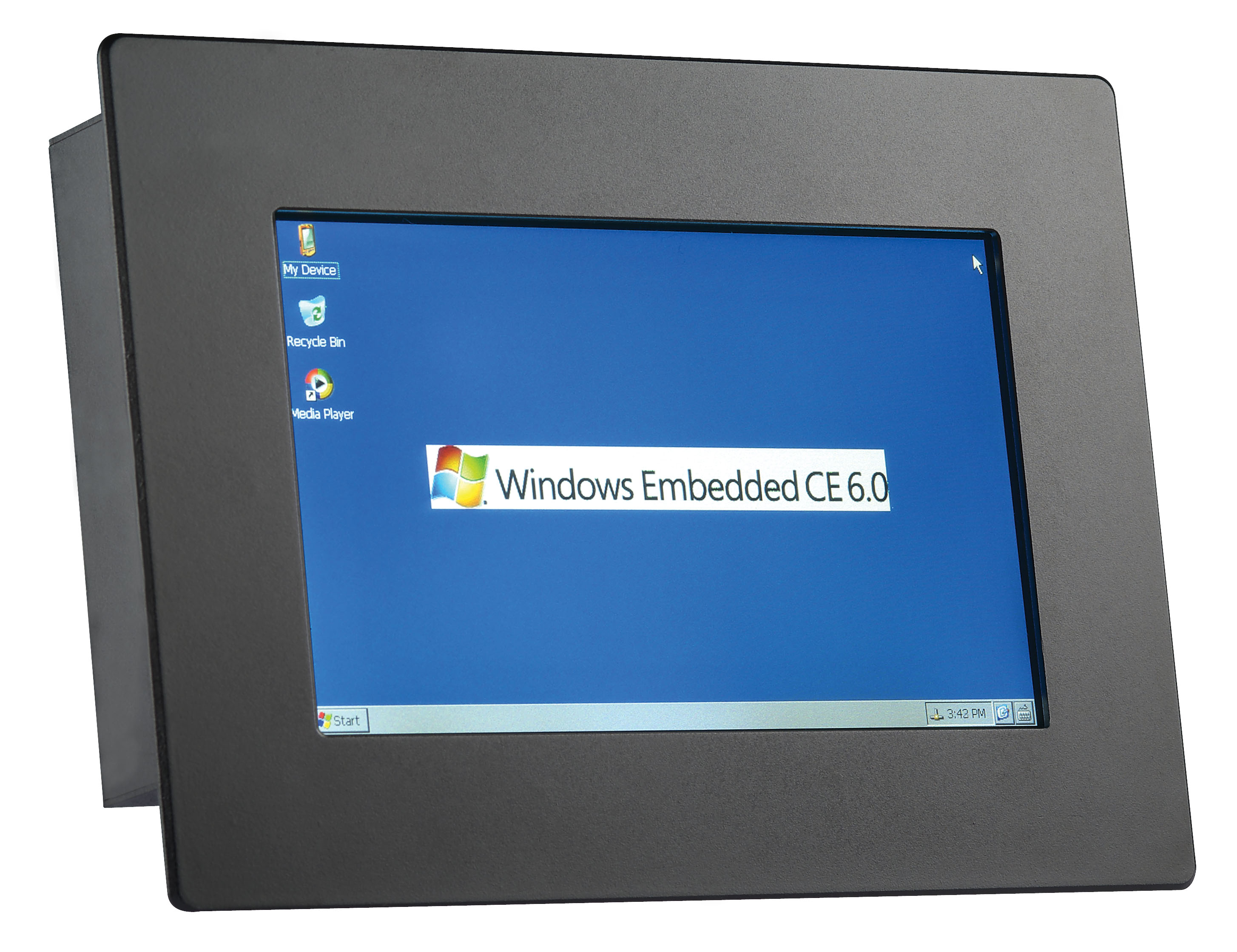
- 7‑inch WVGA TFT‑LCD Display: 800 × 480 resolution, 400 cd/m² brightness, LED backlight rated for 50,000 hours.
- ARM9‑Based CPU: Atmel AT91SAM9G45, 400 MHz, ARM926EJ‑S core with MMU.
- Memory Architecture: 128 MB SDRAM, 128 MB NAND Flash, and 2 MB Data Flash for system recovery.
- Touch Interface: 4‑wire resistive touchscreen with 82.5 % transparency and 1 million‑touch minimum lifetime.
- Fanless Operation: Passive cooling design for silent, maintenance‑free operation.
- Wide Power Input: 12 V – 40 V DC via Phoenix 3‑pin terminal block.
- Multiple Serial Interfaces: 3 × RS‑232 (DB‑9), 1 × RS‑422/485 (Phoenix 10‑pin), and 1 × console port.
- USB Connectivity: 2 × USB 2.0 Type‑A host ports and 1 × USB 2.0 Mini‑AB client port.
- Networking: 1 × 10/100 Mbps Ethernet (RJ‑45).
- GPIO Support: 4 programmable digital I/O channels for control and sensing.
- Audio Output: 3.5 mm phone jack for line‑out.
- Optional Wireless: Internal Wi‑Fi module available via OEM/ODM request.
- Rugged Construction: IP65‑rated front panel, steel or stainless‑steel frame, panel or VESA mounting.
- Environmental Tolerance: Standard 0 – 60 °C; optional T‑model supports −20 – 75 °C.
- Certifications: CE and FCC Class A compliant.
- Software Flexibility: Linux or Windows CE pre‑installed; SDKs for C/C++ development.
- System Recovery: Bootable Data Flash for fail‑safe recovery if NAND Flash fails.
- ARM9‑Based CPU: Atmel AT91SAM9G45, 400 MHz, ARM926EJ‑S core with MMU.
- Memory Architecture: 128 MB SDRAM, 128 MB NAND Flash, and 2 MB Data Flash for system recovery.
- Touch Interface: 4‑wire resistive touchscreen with 82.5 % transparency and 1 million‑touch minimum lifetime.
- Fanless Operation: Passive cooling design for silent, maintenance‑free operation.
- Wide Power Input: 12 V – 40 V DC via Phoenix 3‑pin terminal block.
- Multiple Serial Interfaces: 3 × RS‑232 (DB‑9), 1 × RS‑422/485 (Phoenix 10‑pin), and 1 × console port.
- USB Connectivity: 2 × USB 2.0 Type‑A host ports and 1 × USB 2.0 Mini‑AB client port.
- Networking: 1 × 10/100 Mbps Ethernet (RJ‑45).
- GPIO Support: 4 programmable digital I/O channels for control and sensing.
- Audio Output: 3.5 mm phone jack for line‑out.
- Optional Wireless: Internal Wi‑Fi module available via OEM/ODM request.
- Rugged Construction: IP65‑rated front panel, steel or stainless‑steel frame, panel or VESA mounting.
- Environmental Tolerance: Standard 0 – 60 °C; optional T‑model supports −20 – 75 °C.
- Certifications: CE and FCC Class A compliant.
- Software Flexibility: Linux or Windows CE pre‑installed; SDKs for C/C++ development.
- System Recovery: Bootable Data Flash for fail‑safe recovery if NAND Flash fails.
Comprehensive Product Summary – AdvanIPC BSP‑1070 Series 7” ARM‑Based Fanless Panel PC
### 1. Product Overview
Product Name: BSP‑1070 Series Fanless Panel PC
Model Variants: BSP‑1070A‑5060, BSP‑1070A‑6060, BSP‑1070B‑5060, BSP‑1070B‑6060
Series: BSP‑1070 Industrial HMI Panel PC Series
Article Number: BSP‑1070
Manufacturer: AdvanIPC Technology Corporation
The AdvanIPC BSP‑1070 is a compact, industrial‑grade 7‑inch Human‑Machine Interface (HMI) panel PC designed for embedded control, automation, and monitoring applications. It integrates an Atmel ARM9‑based AT91SAM9G45 processor running at 400 MHz, a 7” WVGA (800 × 480) TFT‑LCD with resistive touch, and a fanless, sealed metal chassis suitable for harsh industrial environments. The system is available in both steel (A‑series) and stainless steel (B‑series) front frames and supports either Linux 2.6.38 or Windows CE 6.0 operating systems.
### 2. Key Features
- 7‑inch WVGA TFT‑LCD Display: 800 × 480 resolution, 400 cd/m² brightness, LED backlight rated for 50,000 hours.
- ARM9‑Based CPU: Atmel AT91SAM9G45, 400 MHz, ARM926EJ‑S core with MMU.
- Memory Architecture: 128 MB SDRAM, 128 MB NAND Flash, and 2 MB Data Flash for system recovery.
- Touch Interface: 4‑wire resistive touchscreen with 82.5 % transparency and 1 million‑touch minimum lifetime.
- Fanless Operation: Passive cooling design for silent, maintenance‑free operation.
- Wide Power Input: 12 V – 40 V DC via Phoenix 3‑pin terminal block.
- Multiple Serial Interfaces: 3 × RS‑232 (DB‑9), 1 × RS‑422/485 (Phoenix 10‑pin), and 1 × console port.
- USB Connectivity: 2 × USB 2.0 Type‑A host ports and 1 × USB 2.0 Mini‑AB client port.
- Networking: 1 × 10/100 Mbps Ethernet (RJ‑45).
- GPIO Support: 4 programmable digital I/O channels for control and sensing.
- Audio Output: 3.5 mm phone jack for line‑out.
- Optional Wireless: Internal Wi‑Fi module available via OEM/ODM request.
- Rugged Construction: IP65‑rated front panel, steel or stainless‑steel frame, panel or VESA mounting.
- Environmental Tolerance: Standard 0 – 60 °C; optional T‑model supports −20 – 75 °C.
- Certifications: CE and FCC Class A compliant.
- Software Flexibility: Linux or Windows CE pre‑installed; SDKs for C/C++ development.
- System Recovery: Bootable Data Flash for fail‑safe recovery if NAND Flash fails.
### 3. Technical Specifications
Processor:
- Atmel AT91SAM9G45 ARM926EJ‑S, 400 MHz
- 32 KB instruction cache, 32 KB data cache
Memory:
- 128 MB SDRAM
- 128 MB NAND Flash
- 2 MB Data Flash (system recovery)
- Internal microSD socket (supports up to 16 GB SDHC)
Display:
- 7” TFT‑LCD, WVGA 800 × 480
- Brightness: 400 cd/m² typical
- LED backlight lifetime: 50,000 hours
- Anti‑glare surface, 3H hardness
Touchscreen:
- 4‑wire resistive type
- Transparency: 82.5 % typical
- Input life: ≥ 1,000,000 touches
I/O Interfaces:
- Ethernet: 1 × RJ‑45 10/100 Mbps
- Serial Ports:
- 3 × RS‑232 (DB‑9 male, COM3/P1, COM5/P3, COM6/P4)
- 1 × RS‑422/485 (Phoenix 10‑pin, COM4/P2)
- 1 × DB‑9 console port
- GPIO: 4 × programmable digital I/O (Phoenix 10‑pin shared with RS‑422/485)
- USB: 2 × USB 2.0 Type‑A host, 1 × USB 2.0 Mini‑AB client
- Audio: 1 × 3.5 mm line‑out jack
- Power Input: 1 × Phoenix 3‑pin terminal (12 – 40 V DC)
- Wi‑Fi Antenna: Optional internal connector
Mechanical:
- Frame Material:
- BSP‑1070A: Steel
- BSP‑1070B: Stainless steel
- Front Panel Protection: IP65
- Mounting: Panel mount / VESA mount
- Dimensions (W × H × D): 214 × 158 × 42 mm (8.43 × 6.22 × 1.65 in)
- Cut‑out Dimensions: 198 × 142 mm (7.80 × 5.59 in)
- Mounting Depth: 90 mm (3.54 in)
- Net Weight: 1.7 kg; Gross Weight: 2.0 kg
Environmental:
- Operating Temperature: 0 – 60 °C (standard) / −20 – 75 °C (T‑model)
- Storage Temperature: −30 – 85 °C
- Operating Humidity: 20 – 85 % RH @ 40 °C, non‑condensing
- Storage Humidity: 10 – 90 % RH @ 40 °C, non‑condensing
- Shock Resistance: 30 G peak, 11 ms duration
- Vibration Resistance: 5 – 500 Hz, 4.5 G RMS random
Certifications: CE, FCC Class A
### 4. Functionality and Applications
The BSP‑1070 functions as a compact embedded HMI or control terminal for industrial automation. Its ARM9 processor and pre‑installed OS enable it to serve as a standalone controller, data acquisition node, or visualization interface.
Typical Use Cases:
- Factory and machine automation
- Process control and monitoring
- Warehouse and logistics management
- Energy management and building automation
- Remote device monitoring and SCADA front‑end
- Embedded web‑based control systems
Operating Systems:
- Linux 2.6.38 (BSP‑1070A/B‑5060):
Includes U‑Boot 1.1.2 bootloader, UBI/JFFS2/EXT2/EXT3/VFAT/NFS file systems, and a rich set of pre‑installed utilities (bash, busybox, lighttpd, vsftpd, iptables, openssh, MySQL, PHP, Qt4‑embedded, GTK+, SNMP, etc.).
Supports package management via *ipkg* and web‑based administration through *Webmin*.
- Windows CE 6.0 Pro (BSP‑1070A/B‑6060):
Provides ASP‑enabled web server, FTP/Telnet services, remote display control, and system utilities (ifconfig, usrmgr, update, gpioctrl).
Includes SDK for C/C++ development and supports ActiveSync, USB, or FTP deployment.
Compatibility:
Supports USB storage, RS‑232/422/485 peripherals, Ethernet networking, and optional Wi‑Fi modules (chipsets: Rt2500, rtl8187, rt73, zd1211).
### 5. Components & Accessories
Standard Package Contents:
- BSP‑1070 Panel PC unit
- 2 × Phoenix 5‑pin female terminal connectors (for RS‑422/485 and GPIO)
- 1 × Phoenix 3‑pin female power connector
- 4 × panel‑mount brackets
- 1 × Product CD (includes drivers, SDK, and documentation)
Optional Accessories:
- Internal Wi‑Fi module (OEM/ODM option)
- MicroSD card (1 GB – 16 GB) pre‑installed upon request
- External power adapter (12 V DC, 1 A)
- VESA mounting kit
Connectors Overview:
- Power: Phoenix 3‑pin (12 – 40 V DC)
- Serial: DB‑9 male connectors for COM ports and console
- RS‑422/485 & GPIO: Phoenix 10‑pin (2 × 5, 3.5 mm pitch)
- USB: Two Type‑A hosts, one Mini‑AB client
- Ethernet: RJ‑45 10/100 Mbps
- Audio: 3.5 mm phone jack
### 6. Installation & Setup
Power Connection:
Connect 12 – 40 V DC to the Phoenix 3‑pin terminal (female connector provided). The system powers on automatically upon connection.
Mounting Options:
- Panel Mount: Secure using four included brackets; cut‑out size 198 × 142 mm.
- VESA Mount: Compatible with standard VESA mounting holes.
I/O Configuration:
- RS‑232 ports (COM3/P1, COM5/P3, COM6/P4) via DB‑9 connectors.
- RS‑422/485 and GPIO via Phoenix 10‑pin header.
- Console port for system recovery and debugging.
- USB ports for peripherals or firmware updates.
- Internal microSD slot accessible during assembly.
Software Setup:
- Linux systems boot automatically from NAND Flash; configuration via SSH, Telnet, or console.
- Windows CE systems boot from onboard Flash; configuration through Control Panel or Telnet.
- Both OS versions support firmware updates via USB or serial console using the *update* utility.
### 7. Performance & Capabilities
Processing Performance:
- 400 MHz ARM9 CPU optimized for embedded control and HMI tasks.
- Hardware JAVA accelerator and efficient Linux kernel for multitasking.
Storage & Data Handling:
- 128 MB NAND Flash for OS and applications.
- 2 MB Data Flash for recovery image.
- Expandable via internal microSD (up to 16 GB).
Networking & Communication:
- 10/100 Mbps Ethernet with static or DHCP configuration.
- Optional Wi‑Fi connectivity for wireless control.
- Secure communication supported via SSL and SSH 1.0/2.0.
I/O Performance:
- Four serial ports configurable for RS‑232/422/485.
- Four GPIO lines programmable for input/output control.
- USB 2.0 host ports (12 Mbps full‑speed) for external devices.
Power Efficiency:
- Typical consumption: 3 W @ 12 V DC (300 mA).
- Fanless design ensures silent operation and low maintenance.
Limitations:
- No built‑in microphone input.
- GPS and battery‑powered operation not supported.
- Brightness and backlight control features vary by model.
### 8. Standards & Compliance
- Electrical Safety & EMC: CE, FCC Class A certified.
- Ingress Protection: IP65 front panel (dust‑tight and water‑jet resistant).
- Environmental Standards: Designed for industrial temperature and vibration ranges.
- Software Compliance:
- Linux kernel 2.6.38 with open‑source utilities.
- Windows CE 6.0 Pro compliant with Microsoft embedded standards.
- RoHS: All materials and components are RoHS‑compliant.
### 9. Additional Information
Warranty & Support:
- Standard manufacturer warranty (typically 1 year, extendable by region).
- Technical support via AdvanIPC service channels.
- Firmware and OS updates available through official support portal.
Maintenance:
- Fanless design minimizes mechanical wear.
- Periodic cleaning of front panel recommended.
- System recovery available via Data Flash or console menu.
Software Development & Updates:
- Linux SDK: GNU GCC toolchain (C/C++), GLIBC POSIX libraries, Qt4‑embedded, GTK+, and X11 GUI frameworks.
- Windows CE SDK: C/C++ development environment with ActiveSync deployment.
- Utilities: *update*, *gpioctrl*, *setuart*, *ifconfig*, *usrmgr*, *init*, *version*, and *webmin* for administration.
- Package Management: *ipkg* for Linux systems (install, upgrade, remove packages).
- System Recovery: Boot from Data Flash when NAND Flash fails; console‑based recovery menu supports loader, kernel, and filesystem updates.
Ordering Information:
| Model | Frame Material | OS | Operating Temp | Availability |
|-------|----------------|----|----------------|--------------|
| BSP‑1070A‑5060 | Steel | Linux 2.6.38 | 0 – 60 °C | Available |
| BSP‑1070A‑6060 | Steel | Windows CE 6.0 | 0 – 60 °C | Available |
| BSP‑1070B‑5060 | Stainless | Linux 2.6.38 | 0 – 60 °C | 4 weeks |
| BSP‑1070B‑6060 | Stainless | Windows CE 6.0 | 0 – 60 °C | 4 weeks |
### Summary
The AdvanIPC BSP‑1070 Series represents a robust, compact, and versatile 7‑inch fanless panel PC platform engineered for industrial automation and embedded control. With its ARM9 400 MHz processor, flexible I/O configuration, and dual OS support (Linux or Windows CE), it provides a reliable foundation for HMI, data acquisition, and control applications. The IP65‑rated front panel, wide power input range, and extended temperature options make it suitable for demanding environments such as factory floors, machinery interfaces, and energy management systems.
Its combination of open‑source Linux tools, Windows CE compatibility, and comprehensive connectivity ensures long‑term adaptability and integration into modern industrial networks.
### 1. Product Overview
Product Name: BSP‑1070 Series Fanless Panel PC
Model Variants: BSP‑1070A‑5060, BSP‑1070A‑6060, BSP‑1070B‑5060, BSP‑1070B‑6060
Series: BSP‑1070 Industrial HMI Panel PC Series
Article Number: BSP‑1070
Manufacturer: AdvanIPC Technology Corporation
The AdvanIPC BSP‑1070 is a compact, industrial‑grade 7‑inch Human‑Machine Interface (HMI) panel PC designed for embedded control, automation, and monitoring applications. It integrates an Atmel ARM9‑based AT91SAM9G45 processor running at 400 MHz, a 7” WVGA (800 × 480) TFT‑LCD with resistive touch, and a fanless, sealed metal chassis suitable for harsh industrial environments. The system is available in both steel (A‑series) and stainless steel (B‑series) front frames and supports either Linux 2.6.38 or Windows CE 6.0 operating systems.
### 2. Key Features
- 7‑inch WVGA TFT‑LCD Display: 800 × 480 resolution, 400 cd/m² brightness, LED backlight rated for 50,000 hours.
- ARM9‑Based CPU: Atmel AT91SAM9G45, 400 MHz, ARM926EJ‑S core with MMU.
- Memory Architecture: 128 MB SDRAM, 128 MB NAND Flash, and 2 MB Data Flash for system recovery.
- Touch Interface: 4‑wire resistive touchscreen with 82.5 % transparency and 1 million‑touch minimum lifetime.
- Fanless Operation: Passive cooling design for silent, maintenance‑free operation.
- Wide Power Input: 12 V – 40 V DC via Phoenix 3‑pin terminal block.
- Multiple Serial Interfaces: 3 × RS‑232 (DB‑9), 1 × RS‑422/485 (Phoenix 10‑pin), and 1 × console port.
- USB Connectivity: 2 × USB 2.0 Type‑A host ports and 1 × USB 2.0 Mini‑AB client port.
- Networking: 1 × 10/100 Mbps Ethernet (RJ‑45).
- GPIO Support: 4 programmable digital I/O channels for control and sensing.
- Audio Output: 3.5 mm phone jack for line‑out.
- Optional Wireless: Internal Wi‑Fi module available via OEM/ODM request.
- Rugged Construction: IP65‑rated front panel, steel or stainless‑steel frame, panel or VESA mounting.
- Environmental Tolerance: Standard 0 – 60 °C; optional T‑model supports −20 – 75 °C.
- Certifications: CE and FCC Class A compliant.
- Software Flexibility: Linux or Windows CE pre‑installed; SDKs for C/C++ development.
- System Recovery: Bootable Data Flash for fail‑safe recovery if NAND Flash fails.
### 3. Technical Specifications
Processor:
- Atmel AT91SAM9G45 ARM926EJ‑S, 400 MHz
- 32 KB instruction cache, 32 KB data cache
Memory:
- 128 MB SDRAM
- 128 MB NAND Flash
- 2 MB Data Flash (system recovery)
- Internal microSD socket (supports up to 16 GB SDHC)
Display:
- 7” TFT‑LCD, WVGA 800 × 480
- Brightness: 400 cd/m² typical
- LED backlight lifetime: 50,000 hours
- Anti‑glare surface, 3H hardness
Touchscreen:
- 4‑wire resistive type
- Transparency: 82.5 % typical
- Input life: ≥ 1,000,000 touches
I/O Interfaces:
- Ethernet: 1 × RJ‑45 10/100 Mbps
- Serial Ports:
- 3 × RS‑232 (DB‑9 male, COM3/P1, COM5/P3, COM6/P4)
- 1 × RS‑422/485 (Phoenix 10‑pin, COM4/P2)
- 1 × DB‑9 console port
- GPIO: 4 × programmable digital I/O (Phoenix 10‑pin shared with RS‑422/485)
- USB: 2 × USB 2.0 Type‑A host, 1 × USB 2.0 Mini‑AB client
- Audio: 1 × 3.5 mm line‑out jack
- Power Input: 1 × Phoenix 3‑pin terminal (12 – 40 V DC)
- Wi‑Fi Antenna: Optional internal connector
Mechanical:
- Frame Material:
- BSP‑1070A: Steel
- BSP‑1070B: Stainless steel
- Front Panel Protection: IP65
- Mounting: Panel mount / VESA mount
- Dimensions (W × H × D): 214 × 158 × 42 mm (8.43 × 6.22 × 1.65 in)
- Cut‑out Dimensions: 198 × 142 mm (7.80 × 5.59 in)
- Mounting Depth: 90 mm (3.54 in)
- Net Weight: 1.7 kg; Gross Weight: 2.0 kg
Environmental:
- Operating Temperature: 0 – 60 °C (standard) / −20 – 75 °C (T‑model)
- Storage Temperature: −30 – 85 °C
- Operating Humidity: 20 – 85 % RH @ 40 °C, non‑condensing
- Storage Humidity: 10 – 90 % RH @ 40 °C, non‑condensing
- Shock Resistance: 30 G peak, 11 ms duration
- Vibration Resistance: 5 – 500 Hz, 4.5 G RMS random
Certifications: CE, FCC Class A
### 4. Functionality and Applications
The BSP‑1070 functions as a compact embedded HMI or control terminal for industrial automation. Its ARM9 processor and pre‑installed OS enable it to serve as a standalone controller, data acquisition node, or visualization interface.
Typical Use Cases:
- Factory and machine automation
- Process control and monitoring
- Warehouse and logistics management
- Energy management and building automation
- Remote device monitoring and SCADA front‑end
- Embedded web‑based control systems
Operating Systems:
- Linux 2.6.38 (BSP‑1070A/B‑5060):
Includes U‑Boot 1.1.2 bootloader, UBI/JFFS2/EXT2/EXT3/VFAT/NFS file systems, and a rich set of pre‑installed utilities (bash, busybox, lighttpd, vsftpd, iptables, openssh, MySQL, PHP, Qt4‑embedded, GTK+, SNMP, etc.).
Supports package management via *ipkg* and web‑based administration through *Webmin*.
- Windows CE 6.0 Pro (BSP‑1070A/B‑6060):
Provides ASP‑enabled web server, FTP/Telnet services, remote display control, and system utilities (ifconfig, usrmgr, update, gpioctrl).
Includes SDK for C/C++ development and supports ActiveSync, USB, or FTP deployment.
Compatibility:
Supports USB storage, RS‑232/422/485 peripherals, Ethernet networking, and optional Wi‑Fi modules (chipsets: Rt2500, rtl8187, rt73, zd1211).
### 5. Components & Accessories
Standard Package Contents:
- BSP‑1070 Panel PC unit
- 2 × Phoenix 5‑pin female terminal connectors (for RS‑422/485 and GPIO)
- 1 × Phoenix 3‑pin female power connector
- 4 × panel‑mount brackets
- 1 × Product CD (includes drivers, SDK, and documentation)
Optional Accessories:
- Internal Wi‑Fi module (OEM/ODM option)
- MicroSD card (1 GB – 16 GB) pre‑installed upon request
- External power adapter (12 V DC, 1 A)
- VESA mounting kit
Connectors Overview:
- Power: Phoenix 3‑pin (12 – 40 V DC)
- Serial: DB‑9 male connectors for COM ports and console
- RS‑422/485 & GPIO: Phoenix 10‑pin (2 × 5, 3.5 mm pitch)
- USB: Two Type‑A hosts, one Mini‑AB client
- Ethernet: RJ‑45 10/100 Mbps
- Audio: 3.5 mm phone jack
### 6. Installation & Setup
Power Connection:
Connect 12 – 40 V DC to the Phoenix 3‑pin terminal (female connector provided). The system powers on automatically upon connection.
Mounting Options:
- Panel Mount: Secure using four included brackets; cut‑out size 198 × 142 mm.
- VESA Mount: Compatible with standard VESA mounting holes.
I/O Configuration:
- RS‑232 ports (COM3/P1, COM5/P3, COM6/P4) via DB‑9 connectors.
- RS‑422/485 and GPIO via Phoenix 10‑pin header.
- Console port for system recovery and debugging.
- USB ports for peripherals or firmware updates.
- Internal microSD slot accessible during assembly.
Software Setup:
- Linux systems boot automatically from NAND Flash; configuration via SSH, Telnet, or console.
- Windows CE systems boot from onboard Flash; configuration through Control Panel or Telnet.
- Both OS versions support firmware updates via USB or serial console using the *update* utility.
### 7. Performance & Capabilities
Processing Performance:
- 400 MHz ARM9 CPU optimized for embedded control and HMI tasks.
- Hardware JAVA accelerator and efficient Linux kernel for multitasking.
Storage & Data Handling:
- 128 MB NAND Flash for OS and applications.
- 2 MB Data Flash for recovery image.
- Expandable via internal microSD (up to 16 GB).
Networking & Communication:
- 10/100 Mbps Ethernet with static or DHCP configuration.
- Optional Wi‑Fi connectivity for wireless control.
- Secure communication supported via SSL and SSH 1.0/2.0.
I/O Performance:
- Four serial ports configurable for RS‑232/422/485.
- Four GPIO lines programmable for input/output control.
- USB 2.0 host ports (12 Mbps full‑speed) for external devices.
Power Efficiency:
- Typical consumption: 3 W @ 12 V DC (300 mA).
- Fanless design ensures silent operation and low maintenance.
Limitations:
- No built‑in microphone input.
- GPS and battery‑powered operation not supported.
- Brightness and backlight control features vary by model.
### 8. Standards & Compliance
- Electrical Safety & EMC: CE, FCC Class A certified.
- Ingress Protection: IP65 front panel (dust‑tight and water‑jet resistant).
- Environmental Standards: Designed for industrial temperature and vibration ranges.
- Software Compliance:
- Linux kernel 2.6.38 with open‑source utilities.
- Windows CE 6.0 Pro compliant with Microsoft embedded standards.
- RoHS: All materials and components are RoHS‑compliant.
### 9. Additional Information
Warranty & Support:
- Standard manufacturer warranty (typically 1 year, extendable by region).
- Technical support via AdvanIPC service channels.
- Firmware and OS updates available through official support portal.
Maintenance:
- Fanless design minimizes mechanical wear.
- Periodic cleaning of front panel recommended.
- System recovery available via Data Flash or console menu.
Software Development & Updates:
- Linux SDK: GNU GCC toolchain (C/C++), GLIBC POSIX libraries, Qt4‑embedded, GTK+, and X11 GUI frameworks.
- Windows CE SDK: C/C++ development environment with ActiveSync deployment.
- Utilities: *update*, *gpioctrl*, *setuart*, *ifconfig*, *usrmgr*, *init*, *version*, and *webmin* for administration.
- Package Management: *ipkg* for Linux systems (install, upgrade, remove packages).
- System Recovery: Boot from Data Flash when NAND Flash fails; console‑based recovery menu supports loader, kernel, and filesystem updates.
Ordering Information:
| Model | Frame Material | OS | Operating Temp | Availability |
|-------|----------------|----|----------------|--------------|
| BSP‑1070A‑5060 | Steel | Linux 2.6.38 | 0 – 60 °C | Available |
| BSP‑1070A‑6060 | Steel | Windows CE 6.0 | 0 – 60 °C | Available |
| BSP‑1070B‑5060 | Stainless | Linux 2.6.38 | 0 – 60 °C | 4 weeks |
| BSP‑1070B‑6060 | Stainless | Windows CE 6.0 | 0 – 60 °C | 4 weeks |
### Summary
The AdvanIPC BSP‑1070 Series represents a robust, compact, and versatile 7‑inch fanless panel PC platform engineered for industrial automation and embedded control. With its ARM9 400 MHz processor, flexible I/O configuration, and dual OS support (Linux or Windows CE), it provides a reliable foundation for HMI, data acquisition, and control applications. The IP65‑rated front panel, wide power input range, and extended temperature options make it suitable for demanding environments such as factory floors, machinery interfaces, and energy management systems.
Its combination of open‑source Linux tools, Windows CE compatibility, and comprehensive connectivity ensures long‑term adaptability and integration into modern industrial networks.
-
 BSP-1070.pdf
PDF Catalog
BSP-1070.pdf
PDF Catalog
-
 BSP-1070-Manual.pdf
Manual
BSP-1070-Manual.pdf
Manual
-
 Matrix-504 User Guide.pdf
Manual
Matrix-504 User Guide.pdf
Manual
-
 Enable Serial Console3.pdf
Manual
Enable Serial Console3.pdf
Manual
-
 LoaderHowTo.pdf
Manual
LoaderHowTo.pdf
Manual
-
 gdbserver_HOW_TO.pdf
Manual
gdbserver_HOW_TO.pdf
Manual


No accessories available.