 LOOKING FOR THE RIGHT
INDUSTRIAL SOLUTION?
Discover embedded, communication and automation solutions tailored to your application.
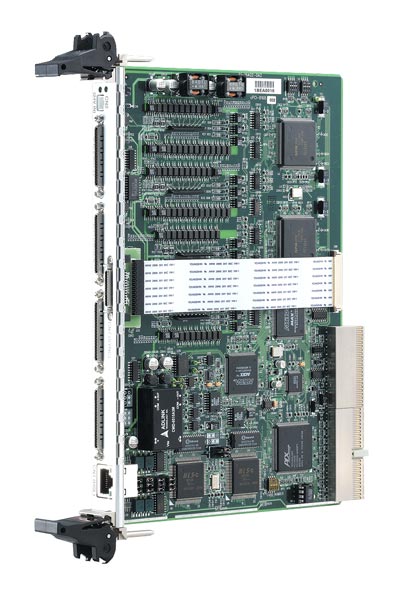
- 8‑Axis Motion Control: Supports coordinated multi‑axis motion for complex automation tasks.
- Dual HSL Ports: Two independent HSL (High‑Speed Link) ports for distributed I/O connectivity.
- High‑Speed Distributed I/O: Up to 6 Mbps data rate with deterministic I/O refreshing.
- Real‑Time Performance: Deterministic scan cycle proportional to the number of slave modules (30.1 µs per module).
- Scalable Architecture: Supports up to 63 slave I/O modules per HSL master, expandable to 16 masters per system.
- CompactPCI Interface: Fully compliant with CompactPCI specifications for industrial embedded systems.
- Easy Wiring: Utilizes standard RJ‑45 connectors and Cat.5 Ethernet cables for simplified installation.
- Self‑Diagnostic and Error Handling: Built‑in CRC12 error checking, slave‑no‑response counters, and communication monitoring.
- Modular Slave I/O Design: Hot‑swappable slave modules with standardized mechanical dimensions and terminal bases.
- Software Support: Comprehensive driver and API support for Windows and Linux, including DLLs, LabVIEW, ISaGRAF, OPC, and DDE servers.
- Open PC‑Based Architecture: Compatible with standard PC/IPC platforms, enabling integration with SCADA, DAQ, and SoftPLC systems.
- Dual HSL Ports: Two independent HSL (High‑Speed Link) ports for distributed I/O connectivity.
- High‑Speed Distributed I/O: Up to 6 Mbps data rate with deterministic I/O refreshing.
- Real‑Time Performance: Deterministic scan cycle proportional to the number of slave modules (30.1 µs per module).
- Scalable Architecture: Supports up to 63 slave I/O modules per HSL master, expandable to 16 masters per system.
- CompactPCI Interface: Fully compliant with CompactPCI specifications for industrial embedded systems.
- Easy Wiring: Utilizes standard RJ‑45 connectors and Cat.5 Ethernet cables for simplified installation.
- Self‑Diagnostic and Error Handling: Built‑in CRC12 error checking, slave‑no‑response counters, and communication monitoring.
- Modular Slave I/O Design: Hot‑swappable slave modules with standardized mechanical dimensions and terminal bases.
- Software Support: Comprehensive driver and API support for Windows and Linux, including DLLs, LabVIEW, ISaGRAF, OPC, and DDE servers.
- Open PC‑Based Architecture: Compatible with standard PC/IPC platforms, enabling integration with SCADA, DAQ, and SoftPLC systems.
Comprehensive Product Summary: ADLINK cPCI‑8168 CompactPCI 8‑Axis Motion Control Card with Dual HSL Ports
### 1. Product Overview
Product Name: cPCI‑8168 CompactPCI 8‑Axis Motion Control Card with 2 HSL Ports
Model Number: cPCI‑8168
Series: HSL (High‑Speed Link) Distributed I/O System
Article Number: cPCI‑8168
Manufacturer: ADLINK Technology Inc.
Part Number: 50‑12100‑200
Manual Revision: 1.00 (March 26, 2001)
Manufacturer Address: 9F, No. 166, Jian Yi Road, Chungho City, Taipei 235, Taiwan, R.O.C.
Website: [www.adlinktech.com](http://www.adlinktech.com)
The ADLINK cPCI‑8168 is a CompactPCI‑based motion control and distributed I/O interface card designed for high‑performance industrial automation systems. It integrates ADLINK’s proprietary HSL (High‑Speed Link) technology, enabling real‑time, deterministic communication between a host controller and multiple remote I/O modules. The card supports up to eight motion control axes and includes two HSL ports for distributed I/O expansion, providing a scalable, modular, and high‑speed control solution for PC‑based automation.
### 2. Key Features
- 8‑Axis Motion Control: Supports coordinated multi‑axis motion for complex automation tasks.
- Dual HSL Ports: Two independent HSL (High‑Speed Link) ports for distributed I/O connectivity.
- High‑Speed Distributed I/O: Up to 6 Mbps data rate with deterministic I/O refreshing.
- Real‑Time Performance: Deterministic scan cycle proportional to the number of slave modules (30.1 µs per module).
- Scalable Architecture: Supports up to 63 slave I/O modules per HSL master, expandable to 16 masters per system.
- CompactPCI Interface: Fully compliant with CompactPCI specifications for industrial embedded systems.
- Easy Wiring: Utilizes standard RJ‑45 connectors and Cat.5 Ethernet cables for simplified installation.
- Self‑Diagnostic and Error Handling: Built‑in CRC12 error checking, slave‑no‑response counters, and communication monitoring.
- Modular Slave I/O Design: Hot‑swappable slave modules with standardized mechanical dimensions and terminal bases.
- Software Support: Comprehensive driver and API support for Windows and Linux, including DLLs, LabVIEW, ISaGRAF, OPC, and DDE servers.
- Open PC‑Based Architecture: Compatible with standard PC/IPC platforms, enabling integration with SCADA, DAQ, and SoftPLC systems.
### 3. Technical Specifications
Bus Interface: CompactPCI (PCI Local Bus Specification Rev. 2.1 compliant)
Controller: Proprietary ASIC motion and communication controller
Clock Frequency: 48 MHz external clock
Memory: 32 KB high‑speed SRAM (12 ns) for I/O data buffering
Communication Interface:
- Electrical Standard: Full‑duplex RS‑422 with transformer isolation
- Data Rate: 6 Mbps (selectable via DIP switch: 3 M, 6 M, 12 M bps)
- Communication Model: Single‑master/multi‑slave command‑response
- Error Checking: CRC‑12 and dedicated protocol
- Isolation: Transformer‑based galvanic isolation
Connectors:
- Two RJ‑45 connectors per HSL master (four on dual‑master variants)
- Standard Cat.5 100Base‑TX Ethernet cable (shielded recommended)
I/O Capacity:
- Up to 63 slave I/O modules per master
- Up to 32 modules per port
- Maximum 16 masters per system (1008 modules total)
- Maximum I/O points: 16,128 DI + 16,128 DO
I/O Refresh Rate: 30.1 µs × number of slaves (90 µs min – 1.895 ms max)
Power Requirements: +5 V DC @ 500 mA typical
Operating Temperature: 0 °C – 60 °C
Storage Temperature: −20 °C – 80 °C
PCB Dimensions: 176 mm (L) × 107 mm (W)
Indicators: Power and communication status LEDs
### 4. Functionality
The cPCI‑8168 operates as a CompactPCI motion controller and HSL master interface. It communicates with distributed slave I/O modules over standard Ethernet cabling using ADLINK’s proprietary HSL protocol. The master card cyclically polls each slave module, updating outputs and reading inputs in a deterministic, time‑synchronized manner.
Operation Principle:
- The master sends output commands to each slave module sequentially.
- Each slave responds with its current input status.
- The master stores all I/O data in onboard SRAM, accessible via the PCI bus.
- The host application reads/writes I/O data directly from/to SRAM, eliminating protocol overhead.
Typical Applications:
- Multi‑axis motion control in industrial automation
- Distributed PLC and SoftPLC systems
- Real‑time data acquisition (DAQ)
- SCADA and HMI integration
- Remote I/O expansion for PC‑based controllers
- Machine vision and robotics requiring deterministic I/O timing
Compatibility:
- Operating Systems: Windows 95/98/2000/NT, Linux
- Programming Environments: C/C++, Visual Basic, LabVIEW, ISaGRAF (IEC 1131‑3), OPC, DDE
- Supports integration with third‑party SCADA and HMI software via OPC/DDE interfaces.
### 5. Components & Accessories
Included Components:
- cPCI‑8168 CompactPCI motion/HSL master card
- User’s Guide and software CD (drivers, utilities, libraries)
- HSL Link Master Utility for diagnostics and configuration
Optional Accessories:
- HSL Slave I/O Modules (various models):
- HSL‑DI16DO16‑DB/‑M/‑C (16 DI + 16 DO)
- HSL‑DI32‑DB/‑M (32 DI)
- HSL‑DO32‑DB/‑M (32 DO)
- HSL‑R8DI16‑DB/‑M (8 relay + 16 DI)
- HSL‑DI8DO8‑C (compact 8 DI + 8 DO)
- Terminal Bases (TB):
- HSL‑TB32‑DIN, HSL‑TB64‑DIN, HSL‑TB32‑DO‑DIN, HSL‑TB32‑M‑DIN, HSL‑TB16‑C
- Standard RJ‑45 Cat.5 cables (up to 200 m per port)
- DIN‑rail mounting accessories for terminal bases
### 6. Installation & Setup
System Requirements:
- CompactPCI or PCI‑bus industrial PC/IPC
- Available slot for cPCI‑8168 card
- Supported OS (Windows NT/2000/98/95 or Linux)
- HSL slave modules and terminal bases as required
Installation Steps:
1. Power off the system and peripherals.
2. Insert the cPCI‑8168 into an available CompactPCI slot.
3. Secure the card and connect RJ‑45 cables to HSL ports.
4. Configure baud rate via onboard DIP switch (default 6 Mbps).
5. Install ADLINK HSL drivers and utilities from the provided CD.
6. Connect slave modules in serial or multi‑drop topology using Cat.5 cables.
7. Assign unique slave addresses (1–63) via DIP switches on each module.
8. Power up the system and verify communication using the HSL Link Master Utility.
Mounting Options:
- CompactPCI backplane installation for industrial chassis
- DIN‑rail mounting for slave terminal bases
Configuration:
- Software configuration via HSL DLL or HSL Link Master Utility
- Auto‑scan and manual slave addressing supported
- Adjustable communication speed and polling parameters
### 7. Performance & Capabilities
Communication Speed: Up to 6 Mbps full‑duplex RS‑422
Polling Cycle Time: 30.1 µs × number of slaves (1.895 ms max for 63 modules)
Data Throughput: Approx. 1000 I/O points per ms
Latency: Deterministic, linear with slave count
Maximum Distance: 200 m per port (serial wiring)
I/O Expansion: Up to 1008 modules per system (16 masters × 63 slaves)
Reliability: CRC12 error detection, self‑diagnostic counters, communication retry logic
Efficiency: Minimal CPU overhead due to direct SRAM access
Limitations:
- Maximum 63 slaves per master
- 200 m cable length per port
- Requires unique slave addressing
### 8. Standards & Compliance
- Bus Compliance: CompactPCI / PCI Local Bus Specification Rev. 2.1
- Electrical Interface: RS‑422 full‑duplex with transformer isolation
- Software Standards:
- OPC DA Server compatibility
- DDE (Dynamic Data Exchange) protocol support
- ISaGRAF IEC 1131‑3 SoftPLC standard
- Environmental: Industrial operating temperature range (0 – 60 °C)
- Quality & Safety: Manufactured under ADLINK’s ISO‑certified quality system
- EMC Considerations: Shielded Cat.5 cabling recommended for noise immunity
### 9. Additional Information
Warranty:
- One‑year limited warranty from date of shipment
- Covers defects in materials and workmanship under normal operation
- Excludes damage from misuse, modification, or unauthorized repair
Support & Service:
- Technical Support:
- NuDAQ/USBDAQ: nudaq@adlink.com.tw
- NuDAM/HSL: nudam@adlink.com.tw
- NuIPC: nuipc@adlink.com.tw
- NuPRO: nupro@adlink.com.tw
- Software: sw@adlink.com.tw
- Telephone: +886‑2‑82265877 Fax: +886‑2‑82265717
- Web: [www.adlinktech.com](http://www.adlinktech.com)
Maintenance:
- Periodic inspection of connectors and cables
- Firmware and driver updates available via ADLINK website
- Hot‑swappable slave modules minimize downtime
Software Updates & Utilities:
- HSL DLL Driver for Windows 95/98/NT/2000
- Linux shared library and device driver
- HSL Link Master Utility for diagnostics
- HSL‑LVIEW for LabVIEW integration
- HSL‑ISG for ISaGRAF SoftPLC
- HSL‑OPC Server for OPC‑compliant SCADA systems
- HSL‑DDE Server for DDE‑based applications (e.g., Wonderware InTouch)
Programming Interface (DLL Functions):
- Initialization and closure: `W_HSL_Initial()`, `W_HSL_Close()`
- Start/stop scanning: `W_HSL_Start()`, `W_HSL_Stop()`
- Auto‑detection: `W_HSL_Auto_Start()`
- Digital I/O operations: `W_HSL_DIO_In()`, `W_HSL_DIO_Out()`
- Channel‑specific I/O: `W_HSL_DIO_Channel_In()`, `W_HSL_DIO_Channel_Out()`
- Memory‑based I/O: `W_HSL_DIO_Memory_In()`, `W_HSL_DIO_Memory_Out()`
- Timer and interrupt control: `W_HSL_TMRINT_Enable()`, `W_HSL_Timer_Set()`
- Communication status and diagnostics: `W_HSL_Connect_Status()`, `W_HSL_Slave_Live()`
Maintenance Recommendations:
- Use shielded Cat.5 cables for long‑distance or noisy environments.
- Ensure unique slave addressing to prevent communication conflicts.
- Enable terminator jumpers on the last slave module in each chain.
- Regularly back up configuration files and firmware.
### Summary
The ADLINK cPCI‑8168 CompactPCI 8‑Axis Motion Control Card with Dual HSL Ports is a robust, high‑performance solution for distributed industrial control and motion applications. Leveraging ADLINK’s HSL technology, it provides deterministic, high‑speed communication between a host controller and remote I/O modules over standard Ethernet cabling. Its modular design, extensive software support, and real‑time performance make it ideal for PC‑based automation, SCADA, and DAQ systems requiring scalability, reliability, and precise timing. With comprehensive driver support, diagnostic utilities, and flexible configuration options, the cPCI‑8168 delivers industrial‑grade performance and ease of integration for modern automation environments.
### 1. Product Overview
Product Name: cPCI‑8168 CompactPCI 8‑Axis Motion Control Card with 2 HSL Ports
Model Number: cPCI‑8168
Series: HSL (High‑Speed Link) Distributed I/O System
Article Number: cPCI‑8168
Manufacturer: ADLINK Technology Inc.
Part Number: 50‑12100‑200
Manual Revision: 1.00 (March 26, 2001)
Manufacturer Address: 9F, No. 166, Jian Yi Road, Chungho City, Taipei 235, Taiwan, R.O.C.
Website: [www.adlinktech.com](http://www.adlinktech.com)
The ADLINK cPCI‑8168 is a CompactPCI‑based motion control and distributed I/O interface card designed for high‑performance industrial automation systems. It integrates ADLINK’s proprietary HSL (High‑Speed Link) technology, enabling real‑time, deterministic communication between a host controller and multiple remote I/O modules. The card supports up to eight motion control axes and includes two HSL ports for distributed I/O expansion, providing a scalable, modular, and high‑speed control solution for PC‑based automation.
### 2. Key Features
- 8‑Axis Motion Control: Supports coordinated multi‑axis motion for complex automation tasks.
- Dual HSL Ports: Two independent HSL (High‑Speed Link) ports for distributed I/O connectivity.
- High‑Speed Distributed I/O: Up to 6 Mbps data rate with deterministic I/O refreshing.
- Real‑Time Performance: Deterministic scan cycle proportional to the number of slave modules (30.1 µs per module).
- Scalable Architecture: Supports up to 63 slave I/O modules per HSL master, expandable to 16 masters per system.
- CompactPCI Interface: Fully compliant with CompactPCI specifications for industrial embedded systems.
- Easy Wiring: Utilizes standard RJ‑45 connectors and Cat.5 Ethernet cables for simplified installation.
- Self‑Diagnostic and Error Handling: Built‑in CRC12 error checking, slave‑no‑response counters, and communication monitoring.
- Modular Slave I/O Design: Hot‑swappable slave modules with standardized mechanical dimensions and terminal bases.
- Software Support: Comprehensive driver and API support for Windows and Linux, including DLLs, LabVIEW, ISaGRAF, OPC, and DDE servers.
- Open PC‑Based Architecture: Compatible with standard PC/IPC platforms, enabling integration with SCADA, DAQ, and SoftPLC systems.
### 3. Technical Specifications
Bus Interface: CompactPCI (PCI Local Bus Specification Rev. 2.1 compliant)
Controller: Proprietary ASIC motion and communication controller
Clock Frequency: 48 MHz external clock
Memory: 32 KB high‑speed SRAM (12 ns) for I/O data buffering
Communication Interface:
- Electrical Standard: Full‑duplex RS‑422 with transformer isolation
- Data Rate: 6 Mbps (selectable via DIP switch: 3 M, 6 M, 12 M bps)
- Communication Model: Single‑master/multi‑slave command‑response
- Error Checking: CRC‑12 and dedicated protocol
- Isolation: Transformer‑based galvanic isolation
Connectors:
- Two RJ‑45 connectors per HSL master (four on dual‑master variants)
- Standard Cat.5 100Base‑TX Ethernet cable (shielded recommended)
I/O Capacity:
- Up to 63 slave I/O modules per master
- Up to 32 modules per port
- Maximum 16 masters per system (1008 modules total)
- Maximum I/O points: 16,128 DI + 16,128 DO
I/O Refresh Rate: 30.1 µs × number of slaves (90 µs min – 1.895 ms max)
Power Requirements: +5 V DC @ 500 mA typical
Operating Temperature: 0 °C – 60 °C
Storage Temperature: −20 °C – 80 °C
PCB Dimensions: 176 mm (L) × 107 mm (W)
Indicators: Power and communication status LEDs
### 4. Functionality
The cPCI‑8168 operates as a CompactPCI motion controller and HSL master interface. It communicates with distributed slave I/O modules over standard Ethernet cabling using ADLINK’s proprietary HSL protocol. The master card cyclically polls each slave module, updating outputs and reading inputs in a deterministic, time‑synchronized manner.
Operation Principle:
- The master sends output commands to each slave module sequentially.
- Each slave responds with its current input status.
- The master stores all I/O data in onboard SRAM, accessible via the PCI bus.
- The host application reads/writes I/O data directly from/to SRAM, eliminating protocol overhead.
Typical Applications:
- Multi‑axis motion control in industrial automation
- Distributed PLC and SoftPLC systems
- Real‑time data acquisition (DAQ)
- SCADA and HMI integration
- Remote I/O expansion for PC‑based controllers
- Machine vision and robotics requiring deterministic I/O timing
Compatibility:
- Operating Systems: Windows 95/98/2000/NT, Linux
- Programming Environments: C/C++, Visual Basic, LabVIEW, ISaGRAF (IEC 1131‑3), OPC, DDE
- Supports integration with third‑party SCADA and HMI software via OPC/DDE interfaces.
### 5. Components & Accessories
Included Components:
- cPCI‑8168 CompactPCI motion/HSL master card
- User’s Guide and software CD (drivers, utilities, libraries)
- HSL Link Master Utility for diagnostics and configuration
Optional Accessories:
- HSL Slave I/O Modules (various models):
- HSL‑DI16DO16‑DB/‑M/‑C (16 DI + 16 DO)
- HSL‑DI32‑DB/‑M (32 DI)
- HSL‑DO32‑DB/‑M (32 DO)
- HSL‑R8DI16‑DB/‑M (8 relay + 16 DI)
- HSL‑DI8DO8‑C (compact 8 DI + 8 DO)
- Terminal Bases (TB):
- HSL‑TB32‑DIN, HSL‑TB64‑DIN, HSL‑TB32‑DO‑DIN, HSL‑TB32‑M‑DIN, HSL‑TB16‑C
- Standard RJ‑45 Cat.5 cables (up to 200 m per port)
- DIN‑rail mounting accessories for terminal bases
### 6. Installation & Setup
System Requirements:
- CompactPCI or PCI‑bus industrial PC/IPC
- Available slot for cPCI‑8168 card
- Supported OS (Windows NT/2000/98/95 or Linux)
- HSL slave modules and terminal bases as required
Installation Steps:
1. Power off the system and peripherals.
2. Insert the cPCI‑8168 into an available CompactPCI slot.
3. Secure the card and connect RJ‑45 cables to HSL ports.
4. Configure baud rate via onboard DIP switch (default 6 Mbps).
5. Install ADLINK HSL drivers and utilities from the provided CD.
6. Connect slave modules in serial or multi‑drop topology using Cat.5 cables.
7. Assign unique slave addresses (1–63) via DIP switches on each module.
8. Power up the system and verify communication using the HSL Link Master Utility.
Mounting Options:
- CompactPCI backplane installation for industrial chassis
- DIN‑rail mounting for slave terminal bases
Configuration:
- Software configuration via HSL DLL or HSL Link Master Utility
- Auto‑scan and manual slave addressing supported
- Adjustable communication speed and polling parameters
### 7. Performance & Capabilities
Communication Speed: Up to 6 Mbps full‑duplex RS‑422
Polling Cycle Time: 30.1 µs × number of slaves (1.895 ms max for 63 modules)
Data Throughput: Approx. 1000 I/O points per ms
Latency: Deterministic, linear with slave count
Maximum Distance: 200 m per port (serial wiring)
I/O Expansion: Up to 1008 modules per system (16 masters × 63 slaves)
Reliability: CRC12 error detection, self‑diagnostic counters, communication retry logic
Efficiency: Minimal CPU overhead due to direct SRAM access
Limitations:
- Maximum 63 slaves per master
- 200 m cable length per port
- Requires unique slave addressing
### 8. Standards & Compliance
- Bus Compliance: CompactPCI / PCI Local Bus Specification Rev. 2.1
- Electrical Interface: RS‑422 full‑duplex with transformer isolation
- Software Standards:
- OPC DA Server compatibility
- DDE (Dynamic Data Exchange) protocol support
- ISaGRAF IEC 1131‑3 SoftPLC standard
- Environmental: Industrial operating temperature range (0 – 60 °C)
- Quality & Safety: Manufactured under ADLINK’s ISO‑certified quality system
- EMC Considerations: Shielded Cat.5 cabling recommended for noise immunity
### 9. Additional Information
Warranty:
- One‑year limited warranty from date of shipment
- Covers defects in materials and workmanship under normal operation
- Excludes damage from misuse, modification, or unauthorized repair
Support & Service:
- Technical Support:
- NuDAQ/USBDAQ: nudaq@adlink.com.tw
- NuDAM/HSL: nudam@adlink.com.tw
- NuIPC: nuipc@adlink.com.tw
- NuPRO: nupro@adlink.com.tw
- Software: sw@adlink.com.tw
- Telephone: +886‑2‑82265877 Fax: +886‑2‑82265717
- Web: [www.adlinktech.com](http://www.adlinktech.com)
Maintenance:
- Periodic inspection of connectors and cables
- Firmware and driver updates available via ADLINK website
- Hot‑swappable slave modules minimize downtime
Software Updates & Utilities:
- HSL DLL Driver for Windows 95/98/NT/2000
- Linux shared library and device driver
- HSL Link Master Utility for diagnostics
- HSL‑LVIEW for LabVIEW integration
- HSL‑ISG for ISaGRAF SoftPLC
- HSL‑OPC Server for OPC‑compliant SCADA systems
- HSL‑DDE Server for DDE‑based applications (e.g., Wonderware InTouch)
Programming Interface (DLL Functions):
- Initialization and closure: `W_HSL_Initial()`, `W_HSL_Close()`
- Start/stop scanning: `W_HSL_Start()`, `W_HSL_Stop()`
- Auto‑detection: `W_HSL_Auto_Start()`
- Digital I/O operations: `W_HSL_DIO_In()`, `W_HSL_DIO_Out()`
- Channel‑specific I/O: `W_HSL_DIO_Channel_In()`, `W_HSL_DIO_Channel_Out()`
- Memory‑based I/O: `W_HSL_DIO_Memory_In()`, `W_HSL_DIO_Memory_Out()`
- Timer and interrupt control: `W_HSL_TMRINT_Enable()`, `W_HSL_Timer_Set()`
- Communication status and diagnostics: `W_HSL_Connect_Status()`, `W_HSL_Slave_Live()`
Maintenance Recommendations:
- Use shielded Cat.5 cables for long‑distance or noisy environments.
- Ensure unique slave addressing to prevent communication conflicts.
- Enable terminator jumpers on the last slave module in each chain.
- Regularly back up configuration files and firmware.
### Summary
The ADLINK cPCI‑8168 CompactPCI 8‑Axis Motion Control Card with Dual HSL Ports is a robust, high‑performance solution for distributed industrial control and motion applications. Leveraging ADLINK’s HSL technology, it provides deterministic, high‑speed communication between a host controller and remote I/O modules over standard Ethernet cabling. Its modular design, extensive software support, and real‑time performance make it ideal for PC‑based automation, SCADA, and DAQ systems requiring scalability, reliability, and precise timing. With comprehensive driver support, diagnostic utilities, and flexible configuration options, the cPCI‑8168 delivers industrial‑grade performance and ease of integration for modern automation environments.
-
 HSLManual.pdf
Manual
HSLManual.pdf
Manual
-
 HSL-DDE Manual.pdf
Manual
HSL-DDE Manual.pdf
Manual
No accessories available.