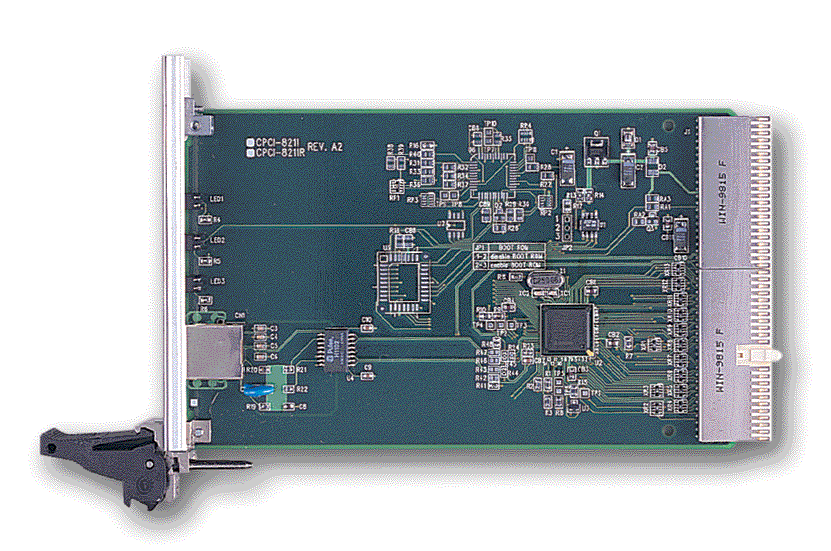
cPCI-8217
LOOKING FOR THE RIGHT
INDUSTRIAL SOLUTION?
Discover embedded, communication and automation solutions tailored to your application.
- Processor Support: Intel Pentium MMX (P54C/P55C), AMD K5/K6, and Cyrix M1/M2 CPUs up to 233 MHz.
- Chipset: Intel 430HX (Triton II) system chipset for stable and efficient performance.
- Memory: Supports up to 256 MB of 3.3V FPM/EDO DRAM via two 144-pin SO-DIMM sockets (notebook standard).
- Cache: 512 KB second-level pipeline burst cache for enhanced data throughput.
- Storage Options:
- Onboard DiskOnChip socket (M-Systems) supporting 2 MB to 72 MB flash storage.
- Dual IDE interfaces supporting up to two PCI Mode 4 Enhanced IDE hard drives.
- Dual floppy drive interfaces supporting 3.5" and/or 5.25" drives.
- I/O Interfaces:
- Two serial ports (one RS-232, one configurable RS-232/RS-422/RS-485).
- One parallel port (EPP/ECP bi-directional).
- Two USB ports.
- PS/2 keyboard and mouse connectors.
- Watchdog Timer: Programmable 0–64 second interval with system reset capability.
- CompactPCI Bus Interface: Fully compliant with PICMG 3U CompactPCI standard.
- Front Panel Design: Aluminum Eurocard front plate with ejector handle for easy installation/removal.
- Operating Temperature: 0°C to 60°C (32°F to 140°F).
- Power Requirements: +5V DC at 4.0A.
The cPCI-8586 is engineered for rugged industrial environments, offering reliable operation, modular expandability, and long-term availability for embedded system integrators.
- Chipset: Intel 430HX (Triton II) system chipset for stable and efficient performance.
- Memory: Supports up to 256 MB of 3.3V FPM/EDO DRAM via two 144-pin SO-DIMM sockets (notebook standard).
- Cache: 512 KB second-level pipeline burst cache for enhanced data throughput.
- Storage Options:
- Onboard DiskOnChip socket (M-Systems) supporting 2 MB to 72 MB flash storage.
- Dual IDE interfaces supporting up to two PCI Mode 4 Enhanced IDE hard drives.
- Dual floppy drive interfaces supporting 3.5" and/or 5.25" drives.
- I/O Interfaces:
- Two serial ports (one RS-232, one configurable RS-232/RS-422/RS-485).
- One parallel port (EPP/ECP bi-directional).
- Two USB ports.
- PS/2 keyboard and mouse connectors.
- Watchdog Timer: Programmable 0–64 second interval with system reset capability.
- CompactPCI Bus Interface: Fully compliant with PICMG 3U CompactPCI standard.
- Front Panel Design: Aluminum Eurocard front plate with ejector handle for easy installation/removal.
- Operating Temperature: 0°C to 60°C (32°F to 140°F).
- Power Requirements: +5V DC at 4.0A.
The cPCI-8586 is engineered for rugged industrial environments, offering reliable operation, modular expandability, and long-term availability for embedded system integrators.
Comprehensive Product Summary – ADLINK cPCI-8586 CompactPCI CPU Card
### 1. Product Overview
Product Name: cPCI-8586
Model: cPCI-8586
Series: CompactPCI 3U CPU Card Series
Article Number: cPCI-8586
Manufacturer: ADLINK Technology Inc.
Manual Revision: Rev. 1.00, September 7, 1998
The ADLINK cPCI-8586 is a high-performance, Pentium-based single-board computer (SBC) designed for industrial and embedded applications that require a robust, modular computing platform. Built to the CompactPCI (cPCI) 3U form factor, the board integrates CPU, memory, storage, and I/O interfaces into a compact, ruggedized Eurocard design. It complies with PICMG CompactPCI standards, ensuring interoperability with other compliant backplanes and peripheral modules.
### 2. Key Features
- Processor Support: Intel Pentium MMX (P54C/P55C), AMD K5/K6, and Cyrix M1/M2 CPUs up to 233 MHz.
- Chipset: Intel 430HX (Triton II) system chipset for stable and efficient performance.
- Memory: Supports up to 256 MB of 3.3V FPM/EDO DRAM via two 144-pin SO-DIMM sockets (notebook standard).
- Cache: 512 KB second-level pipeline burst cache for enhanced data throughput.
- Storage Options:
- Onboard DiskOnChip socket (M-Systems) supporting 2 MB to 72 MB flash storage.
- Dual IDE interfaces supporting up to two PCI Mode 4 Enhanced IDE hard drives.
- Dual floppy drive interfaces supporting 3.5" and/or 5.25" drives.
- I/O Interfaces:
- Two serial ports (one RS-232, one configurable RS-232/RS-422/RS-485).
- One parallel port (EPP/ECP bi-directional).
- Two USB ports.
- PS/2 keyboard and mouse connectors.
- Watchdog Timer: Programmable 0–64 second interval with system reset capability.
- CompactPCI Bus Interface: Fully compliant with PICMG 3U CompactPCI standard.
- Front Panel Design: Aluminum Eurocard front plate with ejector handle for easy installation/removal.
- Operating Temperature: 0°C to 60°C (32°F to 140°F).
- Power Requirements: +5V DC at 4.0A.
The cPCI-8586 is engineered for rugged industrial environments, offering reliable operation, modular expandability, and long-term availability for embedded system integrators.
### 3. Technical Specifications
| Parameter | Specification |
|----------------|-------------------|
| CPU Support | Intel Pentium MMX (P54C/P55C), AMD K5/K6, Cyrix M1/M2 up to 233 MHz |
| Chipset | Intel 430HX (Triton II) |
| Cache Memory | 512 KB 2nd-level pipeline burst cache |
| System Memory | Up to 256 MB via two 144-pin 3.3V SO-DIMM sockets (FPM/EDO DRAM) |
| Storage | DiskOnChip socket (2–72 MB), IDE (2 drives), FDD (2 drives) |
| I/O Controller | SMC 37C669 Super I/O |
| Serial Ports | 1 × RS-232, 1 × RS-232/RS-422/RS-485 selectable |
| Parallel Port | 1 × EPP/ECP bi-directional |
| USB Ports | 2 × USB 1.0 ports |
| Keyboard/Mouse | 2 × PS/2 Mini-DIN connectors |
| Watchdog Timer | 0–64 seconds, 14-level programmable |
| Bus Interface | CompactPCI 3U (PICMG compliant) |
| Power Input | +5V DC ±5%, 4.0A |
| Operating Temperature | 0°C to 60°C |
| Board Dimensions | 160 mm (L) × 100 mm (W) × 20.32 mm (T) |
| Front Panel Width | 8 HP (standard) or 12 HP (with HDD and FDD options) |
| Weight | Approx. 0.35 kg (board only) |
| Construction | Eurocard aluminum front panel, PCB with gold-plated edge connectors |
### 4. Functionality
The cPCI-8586 functions as a standalone CPU module within a CompactPCI system. It interfaces with the system backplane through a 2 mm-pitch HM (IEC-1076) connector, providing PCI bus communication and power distribution.
Operational Overview:
- The CPU executes system instructions and manages peripheral communication through the chipset and I/O controller.
- Memory modules installed in the SO-DIMM sockets provide volatile storage for system operations.
- The onboard DiskOnChip or IDE drives serve as non-volatile storage for operating systems and applications.
- The watchdog timer ensures system reliability by automatically resetting the board if the software becomes unresponsive.
Use Cases and Applications:
- Industrial automation controllers
- Embedded computing systems
- Data acquisition and control
- Telecommunications and network infrastructure
- Transportation and defense systems requiring ruggedized computing
Compatibility:
- Fully compatible with PICMG 2.0 CompactPCI backplanes.
- Supports standard PC peripherals (keyboards, mice, displays, storage devices).
- BIOS supports MS-DOS, Windows, and other x86-compatible operating systems.
### 5. Components & Accessories
Included Components:
- cPCI-8586 CPU card
- Aluminum front panel with ejector handle
- User manual and BIOS utility diskette (including AWDFLASH.EXE)
Onboard Connectors:
- IDE (HDD) connector
- FDD connector
- Parallel port (PRN)
- USB connectors (USB1, USB2)
- PS/2 keyboard and mouse connectors
- Reset switch connector
- HDD LED connector
- Serial ports (COM1, COM2)
- CMOS clear jumper (JP1, pins 11–12)
Optional Accessories:
- DiskOnChip modules (2 MB–72 MB)
- CompactPCI backplane (3U)
- Power supply (+5V DC)
- VGA display card for video output
- Floppy and hard disk drives
### 6. Installation & Setup
System Requirements:
- 3U CompactPCI backplane
- +5V DC regulated power supply
- IBM PC/AT-compatible keyboard
- Display card and monitor
- Storage device (HDD, FDD, or DiskOnChip)
Installation Steps:
1. Memory Installation:
- Power off the system.
- Insert 3.3V 144-pin SO-DIMM modules (2–128 MB each) into the sockets at a slight angle, then press down until locked.
2. CPU Installation:
- Align CPU pin 1 with socket pin 1 (marked corner).
- Gently press the CPU into the PGA socket.
3. Jumper Configuration:
- Set CPU core/bus ratio, voltage, and base speed using JP1 and JP2 jumpers.
- Configure COM2 interface type (RS-232/422/485) using JP3 and JP4.
4. Board Installation:
- Insert the cPCI-8586 into the CompactPCI backplane slot marked with a triangle.
- Secure the board using the ejector handle.
5. Peripheral Connections:
- Connect IDE, FDD, keyboard, mouse, and serial/parallel cables.
6. Power On:
- Apply power and verify system boot.
BIOS Setup:
- Enter BIOS by pressing <Del> or <Ctrl> + <Alt> + <Esc> during POST.
- Configure system parameters, boot order, and peripheral settings.
- Save and exit using F10.
### 7. Performance & Capabilities
Processing Performance:
- Supports up to 233 MHz Pentium MMX-class CPUs with 512 KB L2 cache.
- Efficient memory access via Intel 430HX chipset.
Storage Performance:
- IDE interface supports PIO Mode 4 and DMA transfers for high-speed disk access.
- DiskOnChip provides solid-state storage for OS and applications, ideal for diskless systems.
I/O Performance:
- Dual serial ports support high-speed communication and long-distance RS-422/RS-485 signaling.
- Parallel port supports EPP/ECP modes for fast peripheral interfacing.
- USB ports enable connection of modern peripherals.
Reliability Features:
- Watchdog timer ensures automatic system recovery from software hangs.
- CMOS clear jumper allows quick restoration of BIOS defaults.
- Robust Eurocard construction ensures mechanical stability in vibration-prone environments.
Limitations:
- Limited to 233 MHz CPU speed and 256 MB memory (typical for late-1990s architecture).
- No integrated graphics controller (requires external VGA card).
- USB 1.0 standard (limited bandwidth).
### 8. Standards & Compliance
- CompactPCI Standard: PICMG 2.0 R2.0 compliant (3U form factor).
- Connector Standard: IEC-1076 HM 2 mm-pitch connectors.
- Electrical Compliance: PCI 2.1 bus specification.
- Environmental: Designed for industrial temperature range (0°C–60°C).
- EMC/EMI: Meets typical industrial computing electromagnetic compatibility requirements.
- Safety: Designed to meet CE and FCC Class A industrial standards (manufacturer’s compliance implied).
### 9. Additional Information
Warranty:
Standard manufacturer warranty provided by ADLINK Technology Inc. (terms vary by region and distributor).
Technical Support:
ADLINK provides technical documentation, BIOS updates, and driver support through its authorized service channels.
Maintenance:
- Periodically inspect connectors and jumpers for secure fit.
- Keep the board free from dust and contaminants.
- Use anti-static precautions during handling.
BIOS Updates:
- BIOS can be updated using the included AWDFLASH.EXE utility.
- Update procedure:
1. Boot from DOS diskette containing AWDFLASH.EXE and new BIOS file.
2. Run `AWDFLASH` and specify the new BIOS filename.
3. Follow on-screen prompts to program the BIOS.
4. Power cycle the system after completion.
Watchdog Timer Programming:
- Controlled via I/O ports 043H and 443H.
- Programmable timeout intervals from 0.015 to 64 seconds.
- Automatically resets system if not refreshed within the set interval.
DiskOnChip Installation:
- Supports both 28-pin and 32-pin M-Systems modules.
- Align notched ends and press gently into socket U7.
- Supports capacities from 2 MB to 72 MB.
Connector Pinouts:
Detailed pin assignments are provided for IDE, FDD, serial, parallel, PS/2, and CompactPCI connectors, ensuring full integration with peripheral devices and backplane systems.
### Summary
The ADLINK cPCI-8586 is a robust, modular, and reliable CompactPCI 3U CPU card designed for industrial and embedded computing environments. Featuring Intel Pentium-class processing, flexible memory and storage options, and comprehensive I/O support, it provides a balanced combination of performance and durability. Its compliance with PICMG CompactPCI standards ensures interoperability and scalability within multi-board systems.
With its integrated watchdog timer, DiskOnChip support, and flexible jumper configuration, the cPCI-8586 remains a versatile solution for legacy industrial control, automation, and embedded applications requiring stable, long-term operation in demanding conditions.

### 1. Product Overview
Product Name: cPCI-8586
Model: cPCI-8586
Series: CompactPCI 3U CPU Card Series
Article Number: cPCI-8586
Manufacturer: ADLINK Technology Inc.
Manual Revision: Rev. 1.00, September 7, 1998
The ADLINK cPCI-8586 is a high-performance, Pentium-based single-board computer (SBC) designed for industrial and embedded applications that require a robust, modular computing platform. Built to the CompactPCI (cPCI) 3U form factor, the board integrates CPU, memory, storage, and I/O interfaces into a compact, ruggedized Eurocard design. It complies with PICMG CompactPCI standards, ensuring interoperability with other compliant backplanes and peripheral modules.
### 2. Key Features
- Processor Support: Intel Pentium MMX (P54C/P55C), AMD K5/K6, and Cyrix M1/M2 CPUs up to 233 MHz.
- Chipset: Intel 430HX (Triton II) system chipset for stable and efficient performance.
- Memory: Supports up to 256 MB of 3.3V FPM/EDO DRAM via two 144-pin SO-DIMM sockets (notebook standard).
- Cache: 512 KB second-level pipeline burst cache for enhanced data throughput.
- Storage Options:
- Onboard DiskOnChip socket (M-Systems) supporting 2 MB to 72 MB flash storage.
- Dual IDE interfaces supporting up to two PCI Mode 4 Enhanced IDE hard drives.
- Dual floppy drive interfaces supporting 3.5" and/or 5.25" drives.
- I/O Interfaces:
- Two serial ports (one RS-232, one configurable RS-232/RS-422/RS-485).
- One parallel port (EPP/ECP bi-directional).
- Two USB ports.
- PS/2 keyboard and mouse connectors.
- Watchdog Timer: Programmable 0–64 second interval with system reset capability.
- CompactPCI Bus Interface: Fully compliant with PICMG 3U CompactPCI standard.
- Front Panel Design: Aluminum Eurocard front plate with ejector handle for easy installation/removal.
- Operating Temperature: 0°C to 60°C (32°F to 140°F).
- Power Requirements: +5V DC at 4.0A.
The cPCI-8586 is engineered for rugged industrial environments, offering reliable operation, modular expandability, and long-term availability for embedded system integrators.
### 3. Technical Specifications
| Parameter | Specification |
|----------------|-------------------|
| CPU Support | Intel Pentium MMX (P54C/P55C), AMD K5/K6, Cyrix M1/M2 up to 233 MHz |
| Chipset | Intel 430HX (Triton II) |
| Cache Memory | 512 KB 2nd-level pipeline burst cache |
| System Memory | Up to 256 MB via two 144-pin 3.3V SO-DIMM sockets (FPM/EDO DRAM) |
| Storage | DiskOnChip socket (2–72 MB), IDE (2 drives), FDD (2 drives) |
| I/O Controller | SMC 37C669 Super I/O |
| Serial Ports | 1 × RS-232, 1 × RS-232/RS-422/RS-485 selectable |
| Parallel Port | 1 × EPP/ECP bi-directional |
| USB Ports | 2 × USB 1.0 ports |
| Keyboard/Mouse | 2 × PS/2 Mini-DIN connectors |
| Watchdog Timer | 0–64 seconds, 14-level programmable |
| Bus Interface | CompactPCI 3U (PICMG compliant) |
| Power Input | +5V DC ±5%, 4.0A |
| Operating Temperature | 0°C to 60°C |
| Board Dimensions | 160 mm (L) × 100 mm (W) × 20.32 mm (T) |
| Front Panel Width | 8 HP (standard) or 12 HP (with HDD and FDD options) |
| Weight | Approx. 0.35 kg (board only) |
| Construction | Eurocard aluminum front panel, PCB with gold-plated edge connectors |
### 4. Functionality
The cPCI-8586 functions as a standalone CPU module within a CompactPCI system. It interfaces with the system backplane through a 2 mm-pitch HM (IEC-1076) connector, providing PCI bus communication and power distribution.
Operational Overview:
- The CPU executes system instructions and manages peripheral communication through the chipset and I/O controller.
- Memory modules installed in the SO-DIMM sockets provide volatile storage for system operations.
- The onboard DiskOnChip or IDE drives serve as non-volatile storage for operating systems and applications.
- The watchdog timer ensures system reliability by automatically resetting the board if the software becomes unresponsive.
Use Cases and Applications:
- Industrial automation controllers
- Embedded computing systems
- Data acquisition and control
- Telecommunications and network infrastructure
- Transportation and defense systems requiring ruggedized computing
Compatibility:
- Fully compatible with PICMG 2.0 CompactPCI backplanes.
- Supports standard PC peripherals (keyboards, mice, displays, storage devices).
- BIOS supports MS-DOS, Windows, and other x86-compatible operating systems.
### 5. Components & Accessories
Included Components:
- cPCI-8586 CPU card
- Aluminum front panel with ejector handle
- User manual and BIOS utility diskette (including AWDFLASH.EXE)
Onboard Connectors:
- IDE (HDD) connector
- FDD connector
- Parallel port (PRN)
- USB connectors (USB1, USB2)
- PS/2 keyboard and mouse connectors
- Reset switch connector
- HDD LED connector
- Serial ports (COM1, COM2)
- CMOS clear jumper (JP1, pins 11–12)
Optional Accessories:
- DiskOnChip modules (2 MB–72 MB)
- CompactPCI backplane (3U)
- Power supply (+5V DC)
- VGA display card for video output
- Floppy and hard disk drives
### 6. Installation & Setup
System Requirements:
- 3U CompactPCI backplane
- +5V DC regulated power supply
- IBM PC/AT-compatible keyboard
- Display card and monitor
- Storage device (HDD, FDD, or DiskOnChip)
Installation Steps:
1. Memory Installation:
- Power off the system.
- Insert 3.3V 144-pin SO-DIMM modules (2–128 MB each) into the sockets at a slight angle, then press down until locked.
2. CPU Installation:
- Align CPU pin 1 with socket pin 1 (marked corner).
- Gently press the CPU into the PGA socket.
3. Jumper Configuration:
- Set CPU core/bus ratio, voltage, and base speed using JP1 and JP2 jumpers.
- Configure COM2 interface type (RS-232/422/485) using JP3 and JP4.
4. Board Installation:
- Insert the cPCI-8586 into the CompactPCI backplane slot marked with a triangle.
- Secure the board using the ejector handle.
5. Peripheral Connections:
- Connect IDE, FDD, keyboard, mouse, and serial/parallel cables.
6. Power On:
- Apply power and verify system boot.
BIOS Setup:
- Enter BIOS by pressing <Del> or <Ctrl> + <Alt> + <Esc> during POST.
- Configure system parameters, boot order, and peripheral settings.
- Save and exit using F10.
### 7. Performance & Capabilities
Processing Performance:
- Supports up to 233 MHz Pentium MMX-class CPUs with 512 KB L2 cache.
- Efficient memory access via Intel 430HX chipset.
Storage Performance:
- IDE interface supports PIO Mode 4 and DMA transfers for high-speed disk access.
- DiskOnChip provides solid-state storage for OS and applications, ideal for diskless systems.
I/O Performance:
- Dual serial ports support high-speed communication and long-distance RS-422/RS-485 signaling.
- Parallel port supports EPP/ECP modes for fast peripheral interfacing.
- USB ports enable connection of modern peripherals.
Reliability Features:
- Watchdog timer ensures automatic system recovery from software hangs.
- CMOS clear jumper allows quick restoration of BIOS defaults.
- Robust Eurocard construction ensures mechanical stability in vibration-prone environments.
Limitations:
- Limited to 233 MHz CPU speed and 256 MB memory (typical for late-1990s architecture).
- No integrated graphics controller (requires external VGA card).
- USB 1.0 standard (limited bandwidth).
### 8. Standards & Compliance
- CompactPCI Standard: PICMG 2.0 R2.0 compliant (3U form factor).
- Connector Standard: IEC-1076 HM 2 mm-pitch connectors.
- Electrical Compliance: PCI 2.1 bus specification.
- Environmental: Designed for industrial temperature range (0°C–60°C).
- EMC/EMI: Meets typical industrial computing electromagnetic compatibility requirements.
- Safety: Designed to meet CE and FCC Class A industrial standards (manufacturer’s compliance implied).
### 9. Additional Information
Warranty:
Standard manufacturer warranty provided by ADLINK Technology Inc. (terms vary by region and distributor).
Technical Support:
ADLINK provides technical documentation, BIOS updates, and driver support through its authorized service channels.
Maintenance:
- Periodically inspect connectors and jumpers for secure fit.
- Keep the board free from dust and contaminants.
- Use anti-static precautions during handling.
BIOS Updates:
- BIOS can be updated using the included AWDFLASH.EXE utility.
- Update procedure:
1. Boot from DOS diskette containing AWDFLASH.EXE and new BIOS file.
2. Run `AWDFLASH` and specify the new BIOS filename.
3. Follow on-screen prompts to program the BIOS.
4. Power cycle the system after completion.
Watchdog Timer Programming:
- Controlled via I/O ports 043H and 443H.
- Programmable timeout intervals from 0.015 to 64 seconds.
- Automatically resets system if not refreshed within the set interval.
DiskOnChip Installation:
- Supports both 28-pin and 32-pin M-Systems modules.
- Align notched ends and press gently into socket U7.
- Supports capacities from 2 MB to 72 MB.
Connector Pinouts:
Detailed pin assignments are provided for IDE, FDD, serial, parallel, PS/2, and CompactPCI connectors, ensuring full integration with peripheral devices and backplane systems.
### Summary
The ADLINK cPCI-8586 is a robust, modular, and reliable CompactPCI 3U CPU card designed for industrial and embedded computing environments. Featuring Intel Pentium-class processing, flexible memory and storage options, and comprehensive I/O support, it provides a balanced combination of performance and durability. Its compliance with PICMG CompactPCI standards ensures interoperability and scalability within multi-board systems.
With its integrated watchdog timer, DiskOnChip support, and flexible jumper configuration, the cPCI-8586 remains a versatile solution for legacy industrial control, automation, and embedded applications requiring stable, long-term operation in demanding conditions.
-
CP3500 Manual.PDF
Manual