DIN-68S-01
LOOKING FOR THE RIGHT
INDUSTRIAL SOLUTION?
Discover embedded, communication and automation solutions tailored to your application.
- Simultaneous Sampling:
Four differential analog input channels sampled simultaneously to ensure phase alignment and minimal cross-channel delay.
- High Resolution and Speed:
16-bit analog-to-digital conversion with a maximum sampling rate of 800 kS/s per channel.
- Programmable Input Ranges:
Bipolar: ±10 V, ±5 V, ±2.5 V, ±1.25 V
Unipolar: 0–10 V, 0–5 V, 0–2.5 V, 0–1.25 V
Programmable gain settings of 1, 2, 4, and 8.
- Dual Analog Outputs:
Two 12-bit analog output channels with waveform generation capability, supporting ±10 V or 0–10 V ranges and up to 1 MS/s update rate.
- Digital I/O:
24 programmable digital I/O lines (8255-compatible, TTL/CMOS levels).
- Timer/Counter:
Two 16-bit general-purpose up/down counters, TTL-compatible, with internal 40 MHz or external clock up to 10 MHz.
- Triggering Options:
Supports software, external analog, external digital, and SSI (System Synchronization Interface) triggers.
Trigger modes include pre-trigger, post-trigger, middle-trigger, delay-trigger, and repeated trigger.
- Auto-Calibration:
Fully automatic calibration of analog input and output channels using onboard precision reference (5.000 V, ±2 ppm/°C).
- Bus-Mastering DMA with Scatter-Gather:
High-speed data transfer directly to system memory without CPU intervention, supporting fragmented memory blocks.
- System Synchronization Interface (SSI):
Enables synchronization of multiple DAQ cards for expanded channel count and coordinated sampling.
- Compact Design:
Half-size PCI card (175 mm × 107 mm) suitable for space-constrained systems.
- Software Support:
Compatible with Windows (NT/98/2000/XP) and Linux (kernel 2.4.x).
Supported libraries: D2K-DASK, D2K-DASK/X, LabVIEW® driver (D2K-LVIEW), ActiveX (D2K-OCX), and DAQBench.
Four differential analog input channels sampled simultaneously to ensure phase alignment and minimal cross-channel delay.
- High Resolution and Speed:
16-bit analog-to-digital conversion with a maximum sampling rate of 800 kS/s per channel.
- Programmable Input Ranges:
Bipolar: ±10 V, ±5 V, ±2.5 V, ±1.25 V
Unipolar: 0–10 V, 0–5 V, 0–2.5 V, 0–1.25 V
Programmable gain settings of 1, 2, 4, and 8.
- Dual Analog Outputs:
Two 12-bit analog output channels with waveform generation capability, supporting ±10 V or 0–10 V ranges and up to 1 MS/s update rate.
- Digital I/O:
24 programmable digital I/O lines (8255-compatible, TTL/CMOS levels).
- Timer/Counter:
Two 16-bit general-purpose up/down counters, TTL-compatible, with internal 40 MHz or external clock up to 10 MHz.
- Triggering Options:
Supports software, external analog, external digital, and SSI (System Synchronization Interface) triggers.
Trigger modes include pre-trigger, post-trigger, middle-trigger, delay-trigger, and repeated trigger.
- Auto-Calibration:
Fully automatic calibration of analog input and output channels using onboard precision reference (5.000 V, ±2 ppm/°C).
- Bus-Mastering DMA with Scatter-Gather:
High-speed data transfer directly to system memory without CPU intervention, supporting fragmented memory blocks.
- System Synchronization Interface (SSI):
Enables synchronization of multiple DAQ cards for expanded channel count and coordinated sampling.
- Compact Design:
Half-size PCI card (175 mm × 107 mm) suitable for space-constrained systems.
- Software Support:
Compatible with Windows (NT/98/2000/XP) and Linux (kernel 2.4.x).
Supported libraries: D2K-DASK, D2K-DASK/X, LabVIEW® driver (D2K-LVIEW), ActiveX (D2K-OCX), and DAQBench.
Comprehensive Product Summary: ADLINK DAQ-2016 PCI Data Acquisition Card
### 1. Product Overview
Product Name: DAQ-2016
Model Number: DAQ-2016
Series: DAQ-2000 Series – 4-Channel, 14/16-bit, up to 2 MS/s Simultaneous-Sampling Multi-Function DAQ Cards
Article Number: DAQ-2016
Manufacturer: ADLINK Technology Inc.
Form Factor: PCI Bus Interface (32-bit, Plug-and-Play)
Product Type: Multi-function, simultaneous-sampling data acquisition (DAQ) card
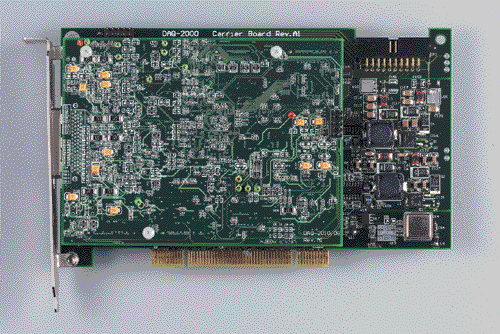
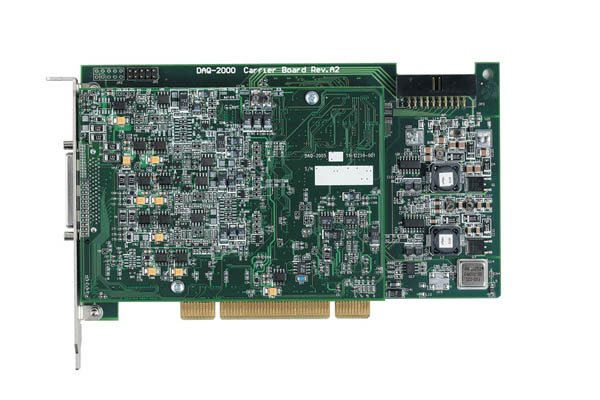
The ADLINK DAQ-2016 is a high-performance PCI-based data acquisition card designed for simultaneous sampling of multiple analog channels with high precision and speed. It belongs to the DAQ-2000 series, which includes models DAQ-2010, DAQ-2005, and DAQ-2006, offering various resolutions and sampling rates. The DAQ-2016 specifically provides 16-bit resolution and a maximum sampling rate of 800 kS/s across four differential analog input channels, making it ideal for applications requiring synchronized, high-accuracy data capture and waveform generation.
### 2. Key Features
- Simultaneous Sampling:
Four differential analog input channels sampled simultaneously to ensure phase alignment and minimal cross-channel delay.
- High Resolution and Speed:
16-bit analog-to-digital conversion with a maximum sampling rate of 800 kS/s per channel.
- Programmable Input Ranges:
Bipolar: ±10 V, ±5 V, ±2.5 V, ±1.25 V
Unipolar: 0–10 V, 0–5 V, 0–2.5 V, 0–1.25 V
Programmable gain settings of 1, 2, 4, and 8.
- Dual Analog Outputs:
Two 12-bit analog output channels with waveform generation capability, supporting ±10 V or 0–10 V ranges and up to 1 MS/s update rate.
- Digital I/O:
24 programmable digital I/O lines (8255-compatible, TTL/CMOS levels).
- Timer/Counter:
Two 16-bit general-purpose up/down counters, TTL-compatible, with internal 40 MHz or external clock up to 10 MHz.
- Triggering Options:
Supports software, external analog, external digital, and SSI (System Synchronization Interface) triggers.
Trigger modes include pre-trigger, post-trigger, middle-trigger, delay-trigger, and repeated trigger.
- Auto-Calibration:
Fully automatic calibration of analog input and output channels using onboard precision reference (5.000 V, ±2 ppm/°C).
- Bus-Mastering DMA with Scatter-Gather:
High-speed data transfer directly to system memory without CPU intervention, supporting fragmented memory blocks.
- System Synchronization Interface (SSI):
Enables synchronization of multiple DAQ cards for expanded channel count and coordinated sampling.
- Compact Design:
Half-size PCI card (175 mm × 107 mm) suitable for space-constrained systems.
- Software Support:
Compatible with Windows (NT/98/2000/XP) and Linux (kernel 2.4.x).
Supported libraries: D2K-DASK, D2K-DASK/X, LabVIEW® driver (D2K-LVIEW), ActiveX (D2K-OCX), and DAQBench.
### 3. Technical Specifications
Analog Input (AI):
- Channels: 4 differential, simultaneous sampling
- Resolution: 16 bits, no missing codes
- Sampling Rate: 800 kS/s maximum
- Input Ranges:
- Bipolar: ±10 V, ±5 V, ±2.5 V, ±1.25 V
- Unipolar: 0–10 V, 0–5 V, 0–2.5 V, 0–1.25 V
- Programmable Gain: 1, 2, 4, 8
- Input Coupling: DC
- Input Impedance: 1 GΩ / 100 pF
- Common Mode Rejection Ratio (CMRR): 85 dB (typical, gain = 1)
- Bandwidth (-3 dB, gain = 1): 600 kHz typical
- Overvoltage Protection: ±35 V (power on), ±15 V (power off)
- Offset Error: ±1 mV after calibration
- Gain Error: ±0.01% of full-scale range (FSR) after calibration
- FIFO Buffer: 512 samples
- Data Transfer: Programmed I/O, polling, or scatter-gather DMA
Analog Output (AO):
- Channels: 2 voltage outputs
- Resolution: 12 bits
- Output Ranges: 0–10 V, ±10 V, 0–AOEXTREF, ±AOEXTREF
- Update Rate: 1 MS/s maximum
- Slew Rate: 20 V/µs
- Settling Time: 3 µs to ±0.5 LSB
- Offset Error: ±1 mV after calibration
- Gain Error: ±0.02% of maximum output
- Output Drive: ±5 mA, stable with passive loads up to 1500 pF
- FIFO Buffer: 2 k samples
- Trigger Sources: Software, external analog/digital, SSI bus
- Trigger Modes: Post-trigger, delay-trigger, repeated trigger
Digital I/O:
- Channels: 24 programmable I/O lines
- Compatibility: 8255 PIO, 5 V TTL/CMOS
- Data Transfer: Programmed I/O
Timer/Counter:
- Channels: 2
- Resolution: 16 bits
- Compatibility: TTL
- Base Clock: Internal 40 MHz or external up to 10 MHz
Auto-Calibration:
- Reference Voltage: 5.000 V
- Temperature Drift: ±2 ppm/°C
- Long-Term Stability: 6 ppm/1000 hours
General:
- Dimensions: 175 mm × 107 mm (excluding connectors)
- Connector: 68-pin VHDCI-type female (AMP-787254-1 or equivalent)
- Operating Temperature: 0–55 °C
- Storage Temperature: –20–70 °C
- Humidity: 5–95%, non-condensing
- Power Requirement: +5 VDC, 2.26 A typical
### 4. Functionality
Operation Principle:
The DAQ-2016 performs simultaneous analog-to-digital conversions across four differential channels, ensuring synchronized data capture. It supports both software-controlled and hardware-triggered acquisition modes. The onboard FIFO buffers and DMA controller enable high-speed, continuous data streaming to system memory.
Use Cases and Applications:
- Automotive and mechanical testing
- Transient signal measurement and waveform analysis
- Automated Test Equipment (ATE)
- Laboratory automation and instrumentation
- Biotech and medical signal acquisition
- Cable and sensor testing
- Process control and industrial monitoring
Compatibility:
- PCI bus (32-bit, plug-and-play)
- Compatible with ADLINK’s termination boards (DIN-68S/1M) and SSI synchronization cables (ACL-SSI-2/3/4).
- Software drivers support Windows and Linux environments, with integration options for LabVIEW®, DASYLab®, HP VEE, and ActiveX-based applications.
### 5. Components & Accessories
Included Items:
- DAQ-2016 PCI DAQ card
- ADLINK All-in-One Software CD (drivers, libraries, manuals)
- Software Installation Guide
Optional Accessories:
- DIN-68S/1M: Termination board with 68-pin SCSI-II connector and DIN-rail mounting (includes 1 m ACL-10568 cable).
- ACL-SSI-2/3/4: SSI bus cables for synchronization of 2, 3, or 4 devices.
- ACL-10568: 68-pin VHDCI cable for signal connection.
Connectors:
- 68-pin VHDCI-type female connector for analog, digital, and timing signals.
- 20-pin SSI connector for synchronization interface.
### 6. Installation & Setup
Requirements:
- PCI slot (32-bit, 5 V signaling)
- +5 VDC power supply (2.26 A typical)
- Compatible operating system (Windows NT/98/2000/XP or Linux kernel 2.4.x)
Mounting Options:
- Standard PCI slot installation
- Optional DIN-rail termination board for external wiring
Configuration:
- Fully jumperless, software-configurable setup
- Plug-and-play PCI resource allocation (IRQ, DMA, base address)
- Automatic calibration and self-test routines
Signal Connections:
- Differential analog inputs (CH0–CH3)
- Analog outputs (DA0OUT, DA1OUT)
- External triggers (EXTATRIG, EXTDTRIG, EXTWFTRG)
- Digital I/O ports (PA, PB, PC)
- Timer/counter signals (GPTC0, GPTC1)
- Auxiliary function inputs (AFI0, AFI1)
- External timebase input (EXTTIMEBASE)
### 7. Performance & Capabilities
Analog Input Performance:
- 16-bit resolution ensures high precision with minimal quantization error.
- 800 kS/s simultaneous sampling across four channels.
- Excellent noise immunity (CMRR 85 dB, system noise <2 LSB rms).
- Programmable gain and range for flexible signal conditioning.
Analog Output Performance:
- 12-bit resolution with 1 MS/s update rate for waveform generation.
- Low distortion and fast settling time (3 µs).
- Supports continuous, finite, and triggered waveform modes.
Data Throughput:
- High-speed DMA transfers with scatter-gather capability for large data sets.
- 40 MHz internal timebase ensures precise timing control.
Limitations:
- Maximum input bandwidth: 600 kHz (–3 dB).
- Maximum analog output drive current: ±5 mA.
- External clock frequency limited to 10 MHz.
### 8. Standards & Compliance
- Bus Interface: PCI Local Bus Specification, Revision 2.2 compliant
- Electrical Compatibility: TTL/CMOS logic levels for digital I/O and triggers
- Environmental:
- Operating temperature: 0–55 °C
- Storage temperature: –20–70 °C
- Humidity: 5–95%, non-condensing
- Safety & Reliability:
- Overvoltage protection up to ±35 V (power on)
- Auto-calibration ensures long-term accuracy
- Software Compliance:
- Windows and Linux driver certification
- LabVIEW®, DASYLab®, and HP VEE driver compatibility
### 9. Additional Information
Warranty:
- Standard two-year limited warranty (one year in China).
- Covers manufacturing defects and hardware failures under normal use.
- Excludes damage from misuse, improper installation, or environmental factors.
Support & Maintenance:
- Technical support via ADLINK service channels:
- Email: service@adlinktech.com
- Website: [www.adlinktech.com](http://www.adlinktech.com)
- RMA service available through ADLINK’s online portal.
- Regular firmware and driver updates provided via ADLINK’s support site.
Maintenance & Calibration:
- Auto-calibration recommended after 15-minute warm-up.
- Calibration constants stored in onboard EEPROM (factory and user banks).
- No manual trimpot adjustments required.
Software Updates & Development Tools:
- D2K-DASK: Windows driver and DLL library for VB, VC++, Delphi, BC5.
- D2K-DASK/X: Linux shared library for C/C++ development.
- D2K-LVIEW: LabVIEW® driver package.
- D2K-OCX: ActiveX control library for Windows.
- DAQBench: Optional ActiveX-based GUI development toolkit.
### Summary
The ADLINK DAQ-2016 is a robust, high-precision PCI data acquisition card engineered for demanding measurement and control applications. With 16-bit resolution, 800 kS/s simultaneous sampling, and dual 12-bit analog outputs, it delivers exceptional performance for real-time data logging, waveform generation, and synchronized multi-channel acquisition. Its auto-calibration, DMA-based data transfer, and multi-card synchronization capabilities make it a versatile solution for laboratory, industrial, and research environments requiring reliable, high-speed analog and digital interfacing.

### 1. Product Overview
Product Name: DAQ-2016
Model Number: DAQ-2016
Series: DAQ-2000 Series – 4-Channel, 14/16-bit, up to 2 MS/s Simultaneous-Sampling Multi-Function DAQ Cards
Article Number: DAQ-2016
Manufacturer: ADLINK Technology Inc.
Form Factor: PCI Bus Interface (32-bit, Plug-and-Play)
Product Type: Multi-function, simultaneous-sampling data acquisition (DAQ) card
The ADLINK DAQ-2016 is a high-performance PCI-based data acquisition card designed for simultaneous sampling of multiple analog channels with high precision and speed. It belongs to the DAQ-2000 series, which includes models DAQ-2010, DAQ-2005, and DAQ-2006, offering various resolutions and sampling rates. The DAQ-2016 specifically provides 16-bit resolution and a maximum sampling rate of 800 kS/s across four differential analog input channels, making it ideal for applications requiring synchronized, high-accuracy data capture and waveform generation.
### 2. Key Features
- Simultaneous Sampling:
Four differential analog input channels sampled simultaneously to ensure phase alignment and minimal cross-channel delay.
- High Resolution and Speed:
16-bit analog-to-digital conversion with a maximum sampling rate of 800 kS/s per channel.
- Programmable Input Ranges:
Bipolar: ±10 V, ±5 V, ±2.5 V, ±1.25 V
Unipolar: 0–10 V, 0–5 V, 0–2.5 V, 0–1.25 V
Programmable gain settings of 1, 2, 4, and 8.
- Dual Analog Outputs:
Two 12-bit analog output channels with waveform generation capability, supporting ±10 V or 0–10 V ranges and up to 1 MS/s update rate.
- Digital I/O:
24 programmable digital I/O lines (8255-compatible, TTL/CMOS levels).
- Timer/Counter:
Two 16-bit general-purpose up/down counters, TTL-compatible, with internal 40 MHz or external clock up to 10 MHz.
- Triggering Options:
Supports software, external analog, external digital, and SSI (System Synchronization Interface) triggers.
Trigger modes include pre-trigger, post-trigger, middle-trigger, delay-trigger, and repeated trigger.
- Auto-Calibration:
Fully automatic calibration of analog input and output channels using onboard precision reference (5.000 V, ±2 ppm/°C).
- Bus-Mastering DMA with Scatter-Gather:
High-speed data transfer directly to system memory without CPU intervention, supporting fragmented memory blocks.
- System Synchronization Interface (SSI):
Enables synchronization of multiple DAQ cards for expanded channel count and coordinated sampling.
- Compact Design:
Half-size PCI card (175 mm × 107 mm) suitable for space-constrained systems.
- Software Support:
Compatible with Windows (NT/98/2000/XP) and Linux (kernel 2.4.x).
Supported libraries: D2K-DASK, D2K-DASK/X, LabVIEW® driver (D2K-LVIEW), ActiveX (D2K-OCX), and DAQBench.
### 3. Technical Specifications
Analog Input (AI):
- Channels: 4 differential, simultaneous sampling
- Resolution: 16 bits, no missing codes
- Sampling Rate: 800 kS/s maximum
- Input Ranges:
- Bipolar: ±10 V, ±5 V, ±2.5 V, ±1.25 V
- Unipolar: 0–10 V, 0–5 V, 0–2.5 V, 0–1.25 V
- Programmable Gain: 1, 2, 4, 8
- Input Coupling: DC
- Input Impedance: 1 GΩ / 100 pF
- Common Mode Rejection Ratio (CMRR): 85 dB (typical, gain = 1)
- Bandwidth (-3 dB, gain = 1): 600 kHz typical
- Overvoltage Protection: ±35 V (power on), ±15 V (power off)
- Offset Error: ±1 mV after calibration
- Gain Error: ±0.01% of full-scale range (FSR) after calibration
- FIFO Buffer: 512 samples
- Data Transfer: Programmed I/O, polling, or scatter-gather DMA
Analog Output (AO):
- Channels: 2 voltage outputs
- Resolution: 12 bits
- Output Ranges: 0–10 V, ±10 V, 0–AOEXTREF, ±AOEXTREF
- Update Rate: 1 MS/s maximum
- Slew Rate: 20 V/µs
- Settling Time: 3 µs to ±0.5 LSB
- Offset Error: ±1 mV after calibration
- Gain Error: ±0.02% of maximum output
- Output Drive: ±5 mA, stable with passive loads up to 1500 pF
- FIFO Buffer: 2 k samples
- Trigger Sources: Software, external analog/digital, SSI bus
- Trigger Modes: Post-trigger, delay-trigger, repeated trigger
Digital I/O:
- Channels: 24 programmable I/O lines
- Compatibility: 8255 PIO, 5 V TTL/CMOS
- Data Transfer: Programmed I/O
Timer/Counter:
- Channels: 2
- Resolution: 16 bits
- Compatibility: TTL
- Base Clock: Internal 40 MHz or external up to 10 MHz
Auto-Calibration:
- Reference Voltage: 5.000 V
- Temperature Drift: ±2 ppm/°C
- Long-Term Stability: 6 ppm/1000 hours
General:
- Dimensions: 175 mm × 107 mm (excluding connectors)
- Connector: 68-pin VHDCI-type female (AMP-787254-1 or equivalent)
- Operating Temperature: 0–55 °C
- Storage Temperature: –20–70 °C
- Humidity: 5–95%, non-condensing
- Power Requirement: +5 VDC, 2.26 A typical
### 4. Functionality
Operation Principle:
The DAQ-2016 performs simultaneous analog-to-digital conversions across four differential channels, ensuring synchronized data capture. It supports both software-controlled and hardware-triggered acquisition modes. The onboard FIFO buffers and DMA controller enable high-speed, continuous data streaming to system memory.
Use Cases and Applications:
- Automotive and mechanical testing
- Transient signal measurement and waveform analysis
- Automated Test Equipment (ATE)
- Laboratory automation and instrumentation
- Biotech and medical signal acquisition
- Cable and sensor testing
- Process control and industrial monitoring
Compatibility:
- PCI bus (32-bit, plug-and-play)
- Compatible with ADLINK’s termination boards (DIN-68S/1M) and SSI synchronization cables (ACL-SSI-2/3/4).
- Software drivers support Windows and Linux environments, with integration options for LabVIEW®, DASYLab®, HP VEE, and ActiveX-based applications.
### 5. Components & Accessories
Included Items:
- DAQ-2016 PCI DAQ card
- ADLINK All-in-One Software CD (drivers, libraries, manuals)
- Software Installation Guide
Optional Accessories:
- DIN-68S/1M: Termination board with 68-pin SCSI-II connector and DIN-rail mounting (includes 1 m ACL-10568 cable).
- ACL-SSI-2/3/4: SSI bus cables for synchronization of 2, 3, or 4 devices.
- ACL-10568: 68-pin VHDCI cable for signal connection.
Connectors:
- 68-pin VHDCI-type female connector for analog, digital, and timing signals.
- 20-pin SSI connector for synchronization interface.
### 6. Installation & Setup
Requirements:
- PCI slot (32-bit, 5 V signaling)
- +5 VDC power supply (2.26 A typical)
- Compatible operating system (Windows NT/98/2000/XP or Linux kernel 2.4.x)
Mounting Options:
- Standard PCI slot installation
- Optional DIN-rail termination board for external wiring
Configuration:
- Fully jumperless, software-configurable setup
- Plug-and-play PCI resource allocation (IRQ, DMA, base address)
- Automatic calibration and self-test routines
Signal Connections:
- Differential analog inputs (CH0–CH3)
- Analog outputs (DA0OUT, DA1OUT)
- External triggers (EXTATRIG, EXTDTRIG, EXTWFTRG)
- Digital I/O ports (PA, PB, PC)
- Timer/counter signals (GPTC0, GPTC1)
- Auxiliary function inputs (AFI0, AFI1)
- External timebase input (EXTTIMEBASE)
### 7. Performance & Capabilities
Analog Input Performance:
- 16-bit resolution ensures high precision with minimal quantization error.
- 800 kS/s simultaneous sampling across four channels.
- Excellent noise immunity (CMRR 85 dB, system noise <2 LSB rms).
- Programmable gain and range for flexible signal conditioning.
Analog Output Performance:
- 12-bit resolution with 1 MS/s update rate for waveform generation.
- Low distortion and fast settling time (3 µs).
- Supports continuous, finite, and triggered waveform modes.
Data Throughput:
- High-speed DMA transfers with scatter-gather capability for large data sets.
- 40 MHz internal timebase ensures precise timing control.
Limitations:
- Maximum input bandwidth: 600 kHz (–3 dB).
- Maximum analog output drive current: ±5 mA.
- External clock frequency limited to 10 MHz.
### 8. Standards & Compliance
- Bus Interface: PCI Local Bus Specification, Revision 2.2 compliant
- Electrical Compatibility: TTL/CMOS logic levels for digital I/O and triggers
- Environmental:
- Operating temperature: 0–55 °C
- Storage temperature: –20–70 °C
- Humidity: 5–95%, non-condensing
- Safety & Reliability:
- Overvoltage protection up to ±35 V (power on)
- Auto-calibration ensures long-term accuracy
- Software Compliance:
- Windows and Linux driver certification
- LabVIEW®, DASYLab®, and HP VEE driver compatibility
### 9. Additional Information
Warranty:
- Standard two-year limited warranty (one year in China).
- Covers manufacturing defects and hardware failures under normal use.
- Excludes damage from misuse, improper installation, or environmental factors.
Support & Maintenance:
- Technical support via ADLINK service channels:
- Email: service@adlinktech.com
- Website: [www.adlinktech.com](http://www.adlinktech.com)
- RMA service available through ADLINK’s online portal.
- Regular firmware and driver updates provided via ADLINK’s support site.
Maintenance & Calibration:
- Auto-calibration recommended after 15-minute warm-up.
- Calibration constants stored in onboard EEPROM (factory and user banks).
- No manual trimpot adjustments required.
Software Updates & Development Tools:
- D2K-DASK: Windows driver and DLL library for VB, VC++, Delphi, BC5.
- D2K-DASK/X: Linux shared library for C/C++ development.
- D2K-LVIEW: LabVIEW® driver package.
- D2K-OCX: ActiveX control library for Windows.
- DAQBench: Optional ActiveX-based GUI development toolkit.
### Summary
The ADLINK DAQ-2016 is a robust, high-precision PCI data acquisition card engineered for demanding measurement and control applications. With 16-bit resolution, 800 kS/s simultaneous sampling, and dual 12-bit analog outputs, it delivers exceptional performance for real-time data logging, waveform generation, and synchronized multi-channel acquisition. Its auto-calibration, DMA-based data transfer, and multi-card synchronization capabilities make it a versatile solution for laboratory, industrial, and research environments requiring reliable, high-speed analog and digital interfacing.
-
DAQ-2000Series_Datasheet_7.pdf
PDF Catalog
-
05-08.pdf
PDF Catalog
-
05-06.pdf
PDF Catalog
-
DAQ-2016_Datasheet_6.pdf
PDF Catalog
-
DAQ-2000Series_Software_Support.pdf
PDF Catalog
-
DAQ-2000Series_Manual_5.pdf
Manual
-
DAQ-2000Series_Manual_1.pdf
Manual
- DIN-68S-01 - 68pin SCSI-II termination board DIN rail w/o cable
- ACL-10568-1 - SCSI-VHDCI cable 1m for DAQ series
- ACL-10568-2 - SCSI-VHDCI cable 2m for DAQ series
- ACL-10568-3 - SCSI-VHDCI cable 3m for DAQ series