 LOOKING FOR THE RIGHT
INDUSTRIAL SOLUTION?
Discover embedded, communication and automation solutions tailored to your application.
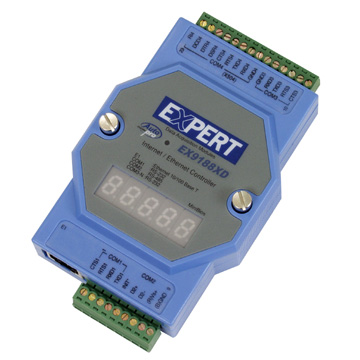
EX9188A
CPU80188 2*RS232 1*RS485 1*RS232/485 flash 512K SRAM 256K
200,00 EUR
including VAT 238.00 EUR
- High‑Performance Embedded CPU: AMD Am188™ ES 16‑bit microprocessor running at 40 MHz, optimized for industrial control and embedded computing.
- Integrated Memory Architecture:
- 256 KB SRAM (A617308V‑12×2) for program execution and RAM‑disk operation.
- 512 KB Flash ROM (Am29F010‑70EC) for ROM‑disk and firmware storage.
- 2 KB EEPROM for parameter and variable storage.
- 32 bytes NVSRAM (DS1302) with 10‑year battery backup.
- Multiple Communication Ports:
- COM1: Selectable RS‑232 (5‑wire) or RS‑485 (2‑wire) interface, up to 115,200 bps.
- COM2: RS‑485 (2‑wire) isolated interface, up to 115,200 bps.
- COM3: RS‑232 (3‑wire) interface, up to 115,200 bps.
- COM4: RS‑232 (3‑wire) interface for program download/debug, up to 115,200 bps.
- Built‑in Display and Indicators:
- Five 7‑segment LED digits capable of displaying hexadecimal characters (0–F) and symbols.
- One user‑controllable LED indicator.
- Operating System: Embedded Datalight ROM‑DOS with miniBIOS support, compatible with standard DOS executables.
- Watchdog Timer: Hardware watchdog with 1.6 s timeout for system recovery.
- Real‑Time Clock: DS1302 RTC, Y2K‑compliant, valid from 1980–2079, battery‑backed for 10 years.
- Wide Power Input Range: 10 V – 30 V DC unregulated input.
- Low Power Consumption: 2.0 W static, 3.0 W dynamic.
- Wide Temperature Range: −40 °C to +80 °C operating, −40 °C to +85 °C storage.
- Compact, Fanless Design: 117 mm × 71 mm × 26 mm aluminum enclosure suitable for DIN‑rail or panel mounting.
- Software Development Support: C‑language library (9188 Library) for COM ports, LED control, EEPROM, Flash, RTC, timers, and watchdog functions.
- Integrated Memory Architecture:
- 256 KB SRAM (A617308V‑12×2) for program execution and RAM‑disk operation.
- 512 KB Flash ROM (Am29F010‑70EC) for ROM‑disk and firmware storage.
- 2 KB EEPROM for parameter and variable storage.
- 32 bytes NVSRAM (DS1302) with 10‑year battery backup.
- Multiple Communication Ports:
- COM1: Selectable RS‑232 (5‑wire) or RS‑485 (2‑wire) interface, up to 115,200 bps.
- COM2: RS‑485 (2‑wire) isolated interface, up to 115,200 bps.
- COM3: RS‑232 (3‑wire) interface, up to 115,200 bps.
- COM4: RS‑232 (3‑wire) interface for program download/debug, up to 115,200 bps.
- Built‑in Display and Indicators:
- Five 7‑segment LED digits capable of displaying hexadecimal characters (0–F) and symbols.
- One user‑controllable LED indicator.
- Operating System: Embedded Datalight ROM‑DOS with miniBIOS support, compatible with standard DOS executables.
- Watchdog Timer: Hardware watchdog with 1.6 s timeout for system recovery.
- Real‑Time Clock: DS1302 RTC, Y2K‑compliant, valid from 1980–2079, battery‑backed for 10 years.
- Wide Power Input Range: 10 V – 30 V DC unregulated input.
- Low Power Consumption: 2.0 W static, 3.0 W dynamic.
- Wide Temperature Range: −40 °C to +80 °C operating, −40 °C to +85 °C storage.
- Compact, Fanless Design: 117 mm × 71 mm × 26 mm aluminum enclosure suitable for DIN‑rail or panel mounting.
- Software Development Support: C‑language library (9188 Library) for COM ports, LED control, EEPROM, Flash, RTC, timers, and watchdog functions.
1. Product Overview
Product Name: EX9188A
Model: EX9188A
Series: EX9188XD Series
Article Number: EX9188A
Manufacturer: Topsccc
The EX9188A is a compact, fanless, multi-purpose embedded controller designed for industrial automation and control applications. It integrates an AMD Am188™ ES CPU operating at 40 MHz, multiple serial communication interfaces (RS‑232 and RS‑485), onboard memory resources (SRAM, Flash, EEPROM, and NVSRAM), and a built‑in real‑time clock (RTC). The module runs Datalight ROM‑DOS, providing a DOS‑compatible environment for embedded control systems. It is engineered for reliability, wide‑temperature operation, and long‑term field deployment in harsh industrial environments.
2. Key Features
- High‑Performance Embedded CPU: AMD Am188™ ES 16‑bit microprocessor running at 40 MHz, optimized for industrial control and embedded computing.
- Integrated Memory Architecture:
- 256 KB SRAM (A617308V‑12×2) for program execution and RAM‑disk operation.
- 512 KB Flash ROM (Am29F010‑70EC) for ROM‑disk and firmware storage.
- 2 KB EEPROM for parameter and variable storage.
- 32 bytes NVSRAM (DS1302) with 10‑year battery backup.
- Multiple Communication Ports:
- COM1: Selectable RS‑232 (5‑wire) or RS‑485 (2‑wire) interface, up to 115,200 bps.
- COM2: RS‑485 (2‑wire) isolated interface, up to 115,200 bps.
- COM3: RS‑232 (3‑wire) interface, up to 115,200 bps.
- COM4: RS‑232 (3‑wire) interface for program download/debug, up to 115,200 bps.
- Built‑in Display and Indicators:
- Five 7‑segment LED digits capable of displaying hexadecimal characters (0–F) and symbols.
- One user‑controllable LED indicator.
- Operating System: Embedded Datalight ROM‑DOS with miniBIOS support, compatible with standard DOS executables.
- Watchdog Timer: Hardware watchdog with 1.6 s timeout for system recovery.
- Real‑Time Clock: DS1302 RTC, Y2K‑compliant, valid from 1980–2079, battery‑backed for 10 years.
- Wide Power Input Range: 10 V – 30 V DC unregulated input.
- Low Power Consumption: 2.0 W static, 3.0 W dynamic.
- Wide Temperature Range: −40 °C to +80 °C operating, −40 °C to +85 °C storage.
- Compact, Fanless Design: 117 mm × 71 mm × 26 mm aluminum enclosure suitable for DIN‑rail or panel mounting.
- Software Development Support: C‑language library (9188 Library) for COM ports, LED control, EEPROM, Flash, RTC, timers, and watchdog functions.
3. Technical Specifications
| Parameter | Specification |
|----------------|-------------------|
| CPU | AMD Am188™ ES, 40 MHz |
| Memory | SRAM 256 KB, Flash 512 KB, EEPROM 2 KB, NVSRAM 32 bytes |
| RTC | DS1302, Y2K‑compliant, 10‑year battery backup |
| COM Ports | 4 total: COM1 (RS‑232/RS‑485), COM2 (RS‑485), COM3 (RS‑232), COM4 (RS‑232) |
| Baud Rate | Up to 115,200 bps per port |
| GPIOs | 32 general‑purpose I/O lines |
| Timers | 2 hardware timers |
| Interrupts | 6 interrupt sources |
| Display | 5 × 7‑segment LED digits, 1 × status LED |
| Power Input | 10 V – 30 V DC unregulated |
| Power Consumption | 2.0 W (static), 3.0 W (dynamic) |
| Dimensions | 117 mm (L) × 71 mm (W) × 26 mm (H) |
| Operating Temperature | −40 °C to +80 °C |
| Storage Temperature | −40 °C to +85 °C |
| Humidity | 0 % – 90 % RH (non‑condensing) |
| Isolation | COM2 RS‑485 port: 3 kV isolation |
| Weight | Approx. 150 g (typical) |
| Enclosure | Fanless, industrial‑grade aluminum housing |
4. Functionality
The EX9188A functions as a standalone embedded controller capable of executing DOS‑based control programs without a host PC. It supports multiple serial communication channels for connecting sensors, actuators, PLCs, and other industrial devices. The onboard ROM‑DOS operating system allows execution of standard DOS applications, while the miniBIOS initializes hardware and provides essential I/O services.
Typical Use Cases:
- Industrial automation and process control
- Data acquisition and serial device networking
- Replacement for PC/PLC in distributed control systems
- Embedded data logging and monitoring
- Communication gateway between RS‑232 and RS‑485 networks
Compatibility:
- Compatible with standard DOS executables and Datalight ROM‑DOS utilities.
- Supports HyperTerminal and COMM.EXE for serial communication and debugging.
- Works with Borland C/C++ 3.1 or Turbo C for application development using the 9188 Library.
5. Components & Accessories
Included Components:
- EX9188A main module
- 10‑pin screw terminal block for COM2–COM4 and power input
- DB‑9 male connector for COM1 (RS‑232/RS‑485 selectable)
- Internal jumpers (JP5, JP6, JP7) for COM1 mode selection
- Embedded lithium battery for RTC/NVRAM backup
Optional Accessories:
- RS‑485 network cables
- DIN‑rail mounting kit
- External power supply (10–30 V DC)
- Serial communication cables (DB‑9 to DB‑9 or terminal‑block adapters)
Connectors:
- 10‑pin terminal block: COM2 (RS‑485 D+/D−), COM3/COM4 (RS‑232 TX/RX/GND), INIT pin, +VS (10–30 V DC), GND.
- DB‑9 male (COM1): Standard RS‑232 pinout with jumper‑selectable RS‑485 D+/D− lines.
6. Installation & Setup
Power Requirements:
Supply 10 V – 30 V DC unregulated to +VS and GND pins. Ensure stable power for reliable operation.
Mounting Options:
Compact form factor allows panel or DIN‑rail mounting in control cabinets. Fanless design ensures silent operation and minimal maintenance.
Configuration Steps:
1. Connect power and communication lines according to pin assignments.
2. Select COM1 mode (RS‑232 or RS‑485) via jumpers JP5–JP7.
3. Connect COM4 to a PC for initial setup or program download.
4. Use HyperTerminal or COMM.EXE to establish serial communication (default 57600 bps for COM4).
5. To update firmware or ROM‑disk image, ground the INIT* pin during power‑on and use Xmodem transfer via COM4.
6. Disconnect INIT* from ground immediately after update completion to prevent system hang.
Software Setup:
- ROM‑DOS boots automatically after power‑on.
- The miniBIOS initializes hardware and transfers control to ROM‑DOS.
- Users can execute DOS commands (e.g., DIR A:\, DIR B:\) and run applications from ROM‑disk or RAM‑disk.
7. Performance & Capabilities
- Processing Speed: 40 MHz Am188 CPU provides sufficient performance for real‑time control and serial communication tasks.
- Communication Throughput: Each COM port supports up to 115,200 bps; simultaneous multi‑port operation is supported.
- Memory Utilization:
- ROM‑disk (Flash) stores system files and applications.
- RAM‑disk (SRAM) provides temporary storage for runtime data.
- VDISK utility allows creation of virtual disks (default 64 KB, configurable).
- Reliability:
- Watchdog timer ensures automatic recovery from software faults.
- Battery‑backed RTC/NVRAM retains time and critical data for 10 years.
- Efficiency:
- Low power consumption (2–3 W) enables energy‑efficient operation.
- Fanless design eliminates moving parts, reducing failure points.
- Limitations:
- No built‑in video, keyboard, or printer interfaces.
- Limited to DOS‑based applications; not compatible with Windows or protected‑mode software.
- EEPROM block 7 reserved for system use.
8. Standards & Compliance
- Electrical Isolation: COM2 RS‑485 port 3 kV isolation for industrial safety.
- Environmental Compliance: Designed for wide‑temperature industrial environments (−40 °C to +80 °C).
- Software Standards:
- Datalight ROM‑DOS compliant with MS‑DOS 6.x API.
- miniBIOS supports INT 10h, 11h, 12h, 16h, 19h, 1Ah calls required by ROM‑DOS.
- Hardware Standards:
- RS‑232 and RS‑485 interfaces conform to EIA/TIA standards.
- Y2K‑compliant RTC (1980–2079).
- Quality Assurance: Manufactured under industrial‑grade quality control for embedded systems.
9. Additional Information
Warranty:
Standard manufacturer warranty (typically 1 year) covering defects in materials and workmanship.
Technical Support:
Comprehensive hardware and software manuals available. Support includes wiring diagrams, pin assignments, and example C library functions.
Maintenance:
- Periodically verify RTC battery voltage (10‑year life).
- Ensure clean power supply and proper grounding.
- Use watchdog timer and EEPROM protection features to prevent data loss.
Software Utilities:
- COMM.EXE: Serial communication utility for DOS.
- TRANSFER.EXE / XM.EXE: File transfer utilities using Xmodem protocol.
- ROMDISK.EXE: Creates ROM‑disk image files.
- TOROM.EXE: Transfers ROM‑disk images to Flash memory.
- VDISK.SYS: Creates virtual RAM‑disk drives.
Development Tools:
- 9188 Library: Provides C functions for COM ports, LED display, EEPROM, Flash, RTC, timers, and watchdog control.
- Supported Compilers: Borland C++ 3.1 / Turbo C for DOS (small model, 80186 CPU target).
- Example Functions:
- `InstallCom1()`, `ToCom()`, `ReadCom()` for serial I/O.
- `LedOn()`, `Show5DigitLed()` for display control.
- `ReadEEP()`, `WriteEEP()` for EEPROM access.
- `EnableWDT()`, `RefreshWDT()` for watchdog management.
System Boot Sequence:
1. miniBIOS initializes hardware, disables DMA, sets interrupts, and tests RAM.
2. ROM‑DOS decompresses and loads into RAM.
3. CONFIG.SYS and AUTOEXEC.BAT execute.
4. DOS prompt (A:\>) appears, ready for user commands or application startup.
Maintenance Utilities:
- ROMDISK.EXE and TOROM.EXE for firmware updates.
- VDISK.SYS for temporary RAM‑disk creation.
- Watchdog Timer for automatic system reset on software failure.
Longevity & Reliability:
- Designed for continuous 24/7 operation in industrial environments.
- Battery‑backed RTC/NVRAM ensures data retention during power loss.
- Flash memory supports multiple reprogramming cycles for firmware updates.
Summary
The EX9188A embedded controller from Topsccc is a robust, low‑power, DOS‑based industrial control module built around the AMD Am188 CPU. It integrates four serial communication ports (RS‑232/RS‑485), multiple memory types, a real‑time clock, and a watchdog timer within a compact, fanless enclosure. Its Datalight ROM‑DOS operating system and comprehensive C library enable developers to create reliable, real‑time control applications without the need for a full PC or PLC. With wide‑temperature tolerance, flexible power input, and long‑term data retention, the EX9188A is ideally suited for automation, data acquisition, and embedded communication systems requiring stability, simplicity, and industrial durability.
Product Name: EX9188A
Model: EX9188A
Series: EX9188XD Series
Article Number: EX9188A
Manufacturer: Topsccc
The EX9188A is a compact, fanless, multi-purpose embedded controller designed for industrial automation and control applications. It integrates an AMD Am188™ ES CPU operating at 40 MHz, multiple serial communication interfaces (RS‑232 and RS‑485), onboard memory resources (SRAM, Flash, EEPROM, and NVSRAM), and a built‑in real‑time clock (RTC). The module runs Datalight ROM‑DOS, providing a DOS‑compatible environment for embedded control systems. It is engineered for reliability, wide‑temperature operation, and long‑term field deployment in harsh industrial environments.
2. Key Features
- High‑Performance Embedded CPU: AMD Am188™ ES 16‑bit microprocessor running at 40 MHz, optimized for industrial control and embedded computing.
- Integrated Memory Architecture:
- 256 KB SRAM (A617308V‑12×2) for program execution and RAM‑disk operation.
- 512 KB Flash ROM (Am29F010‑70EC) for ROM‑disk and firmware storage.
- 2 KB EEPROM for parameter and variable storage.
- 32 bytes NVSRAM (DS1302) with 10‑year battery backup.
- Multiple Communication Ports:
- COM1: Selectable RS‑232 (5‑wire) or RS‑485 (2‑wire) interface, up to 115,200 bps.
- COM2: RS‑485 (2‑wire) isolated interface, up to 115,200 bps.
- COM3: RS‑232 (3‑wire) interface, up to 115,200 bps.
- COM4: RS‑232 (3‑wire) interface for program download/debug, up to 115,200 bps.
- Built‑in Display and Indicators:
- Five 7‑segment LED digits capable of displaying hexadecimal characters (0–F) and symbols.
- One user‑controllable LED indicator.
- Operating System: Embedded Datalight ROM‑DOS with miniBIOS support, compatible with standard DOS executables.
- Watchdog Timer: Hardware watchdog with 1.6 s timeout for system recovery.
- Real‑Time Clock: DS1302 RTC, Y2K‑compliant, valid from 1980–2079, battery‑backed for 10 years.
- Wide Power Input Range: 10 V – 30 V DC unregulated input.
- Low Power Consumption: 2.0 W static, 3.0 W dynamic.
- Wide Temperature Range: −40 °C to +80 °C operating, −40 °C to +85 °C storage.
- Compact, Fanless Design: 117 mm × 71 mm × 26 mm aluminum enclosure suitable for DIN‑rail or panel mounting.
- Software Development Support: C‑language library (9188 Library) for COM ports, LED control, EEPROM, Flash, RTC, timers, and watchdog functions.
3. Technical Specifications
| Parameter | Specification |
|----------------|-------------------|
| CPU | AMD Am188™ ES, 40 MHz |
| Memory | SRAM 256 KB, Flash 512 KB, EEPROM 2 KB, NVSRAM 32 bytes |
| RTC | DS1302, Y2K‑compliant, 10‑year battery backup |
| COM Ports | 4 total: COM1 (RS‑232/RS‑485), COM2 (RS‑485), COM3 (RS‑232), COM4 (RS‑232) |
| Baud Rate | Up to 115,200 bps per port |
| GPIOs | 32 general‑purpose I/O lines |
| Timers | 2 hardware timers |
| Interrupts | 6 interrupt sources |
| Display | 5 × 7‑segment LED digits, 1 × status LED |
| Power Input | 10 V – 30 V DC unregulated |
| Power Consumption | 2.0 W (static), 3.0 W (dynamic) |
| Dimensions | 117 mm (L) × 71 mm (W) × 26 mm (H) |
| Operating Temperature | −40 °C to +80 °C |
| Storage Temperature | −40 °C to +85 °C |
| Humidity | 0 % – 90 % RH (non‑condensing) |
| Isolation | COM2 RS‑485 port: 3 kV isolation |
| Weight | Approx. 150 g (typical) |
| Enclosure | Fanless, industrial‑grade aluminum housing |
4. Functionality
The EX9188A functions as a standalone embedded controller capable of executing DOS‑based control programs without a host PC. It supports multiple serial communication channels for connecting sensors, actuators, PLCs, and other industrial devices. The onboard ROM‑DOS operating system allows execution of standard DOS applications, while the miniBIOS initializes hardware and provides essential I/O services.
Typical Use Cases:
- Industrial automation and process control
- Data acquisition and serial device networking
- Replacement for PC/PLC in distributed control systems
- Embedded data logging and monitoring
- Communication gateway between RS‑232 and RS‑485 networks
Compatibility:
- Compatible with standard DOS executables and Datalight ROM‑DOS utilities.
- Supports HyperTerminal and COMM.EXE for serial communication and debugging.
- Works with Borland C/C++ 3.1 or Turbo C for application development using the 9188 Library.
5. Components & Accessories
Included Components:
- EX9188A main module
- 10‑pin screw terminal block for COM2–COM4 and power input
- DB‑9 male connector for COM1 (RS‑232/RS‑485 selectable)
- Internal jumpers (JP5, JP6, JP7) for COM1 mode selection
- Embedded lithium battery for RTC/NVRAM backup
Optional Accessories:
- RS‑485 network cables
- DIN‑rail mounting kit
- External power supply (10–30 V DC)
- Serial communication cables (DB‑9 to DB‑9 or terminal‑block adapters)
Connectors:
- 10‑pin terminal block: COM2 (RS‑485 D+/D−), COM3/COM4 (RS‑232 TX/RX/GND), INIT pin, +VS (10–30 V DC), GND.
- DB‑9 male (COM1): Standard RS‑232 pinout with jumper‑selectable RS‑485 D+/D− lines.
6. Installation & Setup
Power Requirements:
Supply 10 V – 30 V DC unregulated to +VS and GND pins. Ensure stable power for reliable operation.
Mounting Options:
Compact form factor allows panel or DIN‑rail mounting in control cabinets. Fanless design ensures silent operation and minimal maintenance.
Configuration Steps:
1. Connect power and communication lines according to pin assignments.
2. Select COM1 mode (RS‑232 or RS‑485) via jumpers JP5–JP7.
3. Connect COM4 to a PC for initial setup or program download.
4. Use HyperTerminal or COMM.EXE to establish serial communication (default 57600 bps for COM4).
5. To update firmware or ROM‑disk image, ground the INIT* pin during power‑on and use Xmodem transfer via COM4.
6. Disconnect INIT* from ground immediately after update completion to prevent system hang.
Software Setup:
- ROM‑DOS boots automatically after power‑on.
- The miniBIOS initializes hardware and transfers control to ROM‑DOS.
- Users can execute DOS commands (e.g., DIR A:\, DIR B:\) and run applications from ROM‑disk or RAM‑disk.
7. Performance & Capabilities
- Processing Speed: 40 MHz Am188 CPU provides sufficient performance for real‑time control and serial communication tasks.
- Communication Throughput: Each COM port supports up to 115,200 bps; simultaneous multi‑port operation is supported.
- Memory Utilization:
- ROM‑disk (Flash) stores system files and applications.
- RAM‑disk (SRAM) provides temporary storage for runtime data.
- VDISK utility allows creation of virtual disks (default 64 KB, configurable).
- Reliability:
- Watchdog timer ensures automatic recovery from software faults.
- Battery‑backed RTC/NVRAM retains time and critical data for 10 years.
- Efficiency:
- Low power consumption (2–3 W) enables energy‑efficient operation.
- Fanless design eliminates moving parts, reducing failure points.
- Limitations:
- No built‑in video, keyboard, or printer interfaces.
- Limited to DOS‑based applications; not compatible with Windows or protected‑mode software.
- EEPROM block 7 reserved for system use.
8. Standards & Compliance
- Electrical Isolation: COM2 RS‑485 port 3 kV isolation for industrial safety.
- Environmental Compliance: Designed for wide‑temperature industrial environments (−40 °C to +80 °C).
- Software Standards:
- Datalight ROM‑DOS compliant with MS‑DOS 6.x API.
- miniBIOS supports INT 10h, 11h, 12h, 16h, 19h, 1Ah calls required by ROM‑DOS.
- Hardware Standards:
- RS‑232 and RS‑485 interfaces conform to EIA/TIA standards.
- Y2K‑compliant RTC (1980–2079).
- Quality Assurance: Manufactured under industrial‑grade quality control for embedded systems.
9. Additional Information
Warranty:
Standard manufacturer warranty (typically 1 year) covering defects in materials and workmanship.
Technical Support:
Comprehensive hardware and software manuals available. Support includes wiring diagrams, pin assignments, and example C library functions.
Maintenance:
- Periodically verify RTC battery voltage (10‑year life).
- Ensure clean power supply and proper grounding.
- Use watchdog timer and EEPROM protection features to prevent data loss.
Software Utilities:
- COMM.EXE: Serial communication utility for DOS.
- TRANSFER.EXE / XM.EXE: File transfer utilities using Xmodem protocol.
- ROMDISK.EXE: Creates ROM‑disk image files.
- TOROM.EXE: Transfers ROM‑disk images to Flash memory.
- VDISK.SYS: Creates virtual RAM‑disk drives.
Development Tools:
- 9188 Library: Provides C functions for COM ports, LED display, EEPROM, Flash, RTC, timers, and watchdog control.
- Supported Compilers: Borland C++ 3.1 / Turbo C for DOS (small model, 80186 CPU target).
- Example Functions:
- `InstallCom1()`, `ToCom()`, `ReadCom()` for serial I/O.
- `LedOn()`, `Show5DigitLed()` for display control.
- `ReadEEP()`, `WriteEEP()` for EEPROM access.
- `EnableWDT()`, `RefreshWDT()` for watchdog management.
System Boot Sequence:
1. miniBIOS initializes hardware, disables DMA, sets interrupts, and tests RAM.
2. ROM‑DOS decompresses and loads into RAM.
3. CONFIG.SYS and AUTOEXEC.BAT execute.
4. DOS prompt (A:\>) appears, ready for user commands or application startup.
Maintenance Utilities:
- ROMDISK.EXE and TOROM.EXE for firmware updates.
- VDISK.SYS for temporary RAM‑disk creation.
- Watchdog Timer for automatic system reset on software failure.
Longevity & Reliability:
- Designed for continuous 24/7 operation in industrial environments.
- Battery‑backed RTC/NVRAM ensures data retention during power loss.
- Flash memory supports multiple reprogramming cycles for firmware updates.
Summary
The EX9188A embedded controller from Topsccc is a robust, low‑power, DOS‑based industrial control module built around the AMD Am188 CPU. It integrates four serial communication ports (RS‑232/RS‑485), multiple memory types, a real‑time clock, and a watchdog timer within a compact, fanless enclosure. Its Datalight ROM‑DOS operating system and comprehensive C library enable developers to create reliable, real‑time control applications without the need for a full PC or PLC. With wide‑temperature tolerance, flexible power input, and long‑term data retention, the EX9188A is ideally suited for automation, data acquisition, and embedded communication systems requiring stability, simplicity, and industrial durability.
-
 Manual of EX9188A.pdf
Manual
Manual of EX9188A.pdf
Manual
No accessories available.