 LOOKING FOR THE RIGHT
INDUSTRIAL SOLUTION?
Discover embedded, communication and automation solutions tailored to your application.

- Dual Ethernet Ports: Two 10/100Base-TX LAN interfaces for flexible network topology integration, supporting both uplink and downlink connections.
- Wireless Connectivity: IEEE 802.11b/g compliant WLAN interface for wireless access point functionality, enabling wireless clients to connect to wired networks.
- Industrial Design: Rugged metal housing ensures durability and electromagnetic shielding in industrial environments.
- Flexible Mounting: Supports both DIN-rail and wall-mount installation, allowing easy integration into control cabinets or wall-mounted enclosures.
- Wide Power Input Range: Dual redundant DC power inputs (12–48 VDC) ensure continuous operation and power reliability.
- Low Power Consumption: Typical power consumption of approximately 6 W, optimizing energy efficiency for continuous operation.
- Alarm Relay Output: One relay output for system alarm notification, enabling integration with external monitoring or alert systems.
- Environmental Resilience: Designed for operation in temperatures from -10°C to +55°C and storage from -20°C to +85°C, suitable for industrial and outdoor cabinet environments.
- Compact and Lightweight: Compact dimensions (54.1 × 106.1 × 145 mm) and weight (~800 g) facilitate installation in space-constrained environments.
- High Reliability: Industrial-grade components and redundant power design ensure stable performance and minimal downtime.
- Wireless Connectivity: IEEE 802.11b/g compliant WLAN interface for wireless access point functionality, enabling wireless clients to connect to wired networks.
- Industrial Design: Rugged metal housing ensures durability and electromagnetic shielding in industrial environments.
- Flexible Mounting: Supports both DIN-rail and wall-mount installation, allowing easy integration into control cabinets or wall-mounted enclosures.
- Wide Power Input Range: Dual redundant DC power inputs (12–48 VDC) ensure continuous operation and power reliability.
- Low Power Consumption: Typical power consumption of approximately 6 W, optimizing energy efficiency for continuous operation.
- Alarm Relay Output: One relay output for system alarm notification, enabling integration with external monitoring or alert systems.
- Environmental Resilience: Designed for operation in temperatures from -10°C to +55°C and storage from -20°C to +85°C, suitable for industrial and outdoor cabinet environments.
- Compact and Lightweight: Compact dimensions (54.1 × 106.1 × 145 mm) and weight (~800 g) facilitate installation in space-constrained environments.
- High Reliability: Industrial-grade components and redundant power design ensure stable performance and minimal downtime.
1. Product Overview
Product Name: IAP-120
Model / Article Number: IAP-120
Series: Industrial Wireless Access Point Series
Manufacturer: ORing Industrial Networking Corp.
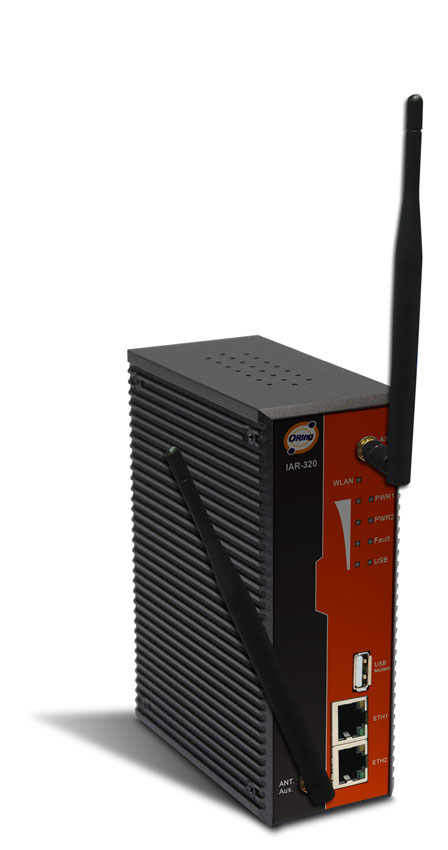
The ORing IAP-120 is an industrial-grade wireless access point designed to bridge wired Ethernet networks with wireless 802.11b/g WLAN environments. It provides robust connectivity between two 10/100Base-TX Ethernet interfaces and a wireless LAN interface, enabling seamless data transmission in industrial automation, transportation, and remote monitoring applications. The device is engineered for reliability in harsh environments, featuring a rugged metal enclosure, wide operating temperature range, and flexible power input options.
2. Key Features
- Dual Ethernet Ports: Two 10/100Base-TX LAN interfaces for flexible network topology integration, supporting both uplink and downlink connections.
- Wireless Connectivity: IEEE 802.11b/g compliant WLAN interface for wireless access point functionality, enabling wireless clients to connect to wired networks.
- Industrial Design: Rugged metal housing ensures durability and electromagnetic shielding in industrial environments.
- Flexible Mounting: Supports both DIN-rail and wall-mount installation, allowing easy integration into control cabinets or wall-mounted enclosures.
- Wide Power Input Range: Dual redundant DC power inputs (12–48 VDC) ensure continuous operation and power reliability.
- Low Power Consumption: Typical power consumption of approximately 6 W, optimizing energy efficiency for continuous operation.
- Alarm Relay Output: One relay output for system alarm notification, enabling integration with external monitoring or alert systems.
- Environmental Resilience: Designed for operation in temperatures from -10°C to +55°C and storage from -20°C to +85°C, suitable for industrial and outdoor cabinet environments.
- Compact and Lightweight: Compact dimensions (54.1 × 106.1 × 145 mm) and weight (~800 g) facilitate installation in space-constrained environments.
- High Reliability: Industrial-grade components and redundant power design ensure stable performance and minimal downtime.
3. Technical Specifications
| Parameter | Specification |
|----------------|-------------------|
| Model | IAP-120 |
| Manufacturer | ORing Industrial Networking Corp. |
| Network Interfaces | 2 × 10/100Base-TX Ethernet ports (RJ-45) |
| Wireless Standard | IEEE 802.11b/g |
| Wireless Frequency Band | 2.4 GHz ISM band |
| Relay Output | 1 × alarm contact (relay output) |
| Power Input | Dual 12–48 VDC inputs |
| Power Consumption | Approx. 6 W |
| Mounting Options | DIN-rail or wall mount |
| Enclosure Material | Metal housing |
| Dimensions (W × H × D) | 54.1 × 106.1 × 145 mm |
| Weight | Approx. 800 g |
| Operating Temperature | -10°C to +55°C |
| Storage Temperature | -20°C to +85°C |
| Humidity | (Typically 5–95% non-condensing, industrial standard) |
| Protection | Industrial-grade metal enclosure, EMC shielding |
| Certifications | (Typical for ORing devices: CE, FCC, RoHS – see section 8) |
4. Functionality
The IAP-120 functions as an industrial wireless access point that bridges wired Ethernet networks to wireless 802.11b/g clients. It allows devices connected via Ethernet to communicate with wireless devices, extending network coverage and enabling mobility in industrial environments.
Operational Concept:
- The two 10/100Base-TX ports can be configured for LAN or uplink connections, allowing the device to serve as a bridge between wired and wireless segments.
- The integrated 802.11b/g radio module provides wireless connectivity at data rates up to 54 Mbps (802.11g) or 11 Mbps (802.11b).
- The access point can be configured for various wireless modes, including Access Point (AP), Client, or Bridge mode, depending on network requirements.
- The relay output can be programmed to trigger alarms in case of power failure, link loss, or other system events, providing proactive maintenance alerts.
Use Cases and Applications:
- Industrial Automation: Wireless connectivity for PLCs, HMIs, and SCADA systems.
- Transportation Systems: Wireless access for onboard or roadside communication equipment.
- Energy and Utilities: Remote monitoring of substations, renewable energy sites, or water treatment facilities.
- Warehouse and Logistics: Wireless network extension for barcode scanners, handheld terminals, and mobile workstations.
- Building Automation: Integration of wireless sensors, controllers, and monitoring devices.
Compatibility:
- Compatible with standard Ethernet devices and IEEE 802.11b/g wireless clients.
- Interoperable with most industrial Ethernet switches, routers, and controllers.
- Supports standard TCP/IP networking protocols for seamless integration into existing infrastructures.
5. Components & Accessories
Included Items:
- IAP-120 main unit (metal enclosure)
- DIN-rail mounting kit
- Wall-mount brackets (optional or included depending on package)
- Quick installation guide or user manual
- Power terminal block connector
Optional Accessories:
- External antennas (depending on wireless configuration)
- Power supply unit (12–48 VDC, if not provided)
- Ethernet cables (Cat5e or higher)
- Grounding kit for enhanced EMC protection
- Configuration software or web-based management interface (provided by ORing)
Connectors:
- Ethernet Ports: 2 × RJ-45 connectors for 10/100Base-TX
- Power Input: Terminal block for dual DC inputs
- Relay Output: Terminal block for alarm contact connection
- Antenna Connector: Standard SMA or RP-SMA connector (depending on model variant)
6. Installation & Setup
Installation Requirements:
- Power supply within 12–48 VDC range
- Proper grounding to ensure EMC compliance and safety
- Adequate ventilation for heat dissipation
- Mounting surface suitable for DIN-rail or wall installation
Mounting Options:
- DIN-Rail Mounting: The device can be clipped onto a standard 35 mm DIN rail, ideal for control cabinets and industrial panels.
- Wall Mounting: Using the provided brackets, the unit can be securely mounted on flat surfaces or enclosures.
Configuration:
- Configuration is typically performed via a web-based interface or command-line interface (CLI).
- Network parameters such as SSID, security settings (WEP/WPA/WPA2), IP addressing, and relay alarm conditions can be set through the management interface.
- Firmware updates and diagnostics are accessible through the same interface.
- LED indicators on the front panel provide status information for power, Ethernet link/activity, and WLAN connectivity.
Setup Procedure:
1. Mount the device on DIN rail or wall surface.
2. Connect power inputs (12–48 VDC) to the terminal block.
3. Connect Ethernet cables to the RJ-45 ports.
4. Attach the antenna(s) to the designated connector(s).
5. Power on the device and verify LED indicators.
6. Access the configuration interface via default IP address.
7. Configure wireless and network parameters as required.
7. Performance & Capabilities
Network Performance:
- Ethernet: Supports 10/100 Mbps auto-negotiation and auto MDI/MDI-X for flexible cabling.
- Wireless: IEEE 802.11b/g compliant, supporting data rates up to 54 Mbps (802.11g) and 11 Mbps (802.11b).
- Throughput: Optimized for industrial data transmission, ensuring stable performance even in environments with high electromagnetic interference.
Capacity:
- Supports multiple simultaneous wireless clients (typical capacity depends on configuration and network load).
- Capable of handling continuous data exchange between wired and wireless segments without packet loss under normal operating conditions.
Efficiency:
- Low power consumption (~6 W) ensures energy-efficient operation.
- Dual power inputs provide redundancy, minimizing downtime due to power source failure.
Limitations:
- Wireless operation limited to 2.4 GHz band (802.11b/g only; no 802.11n/ac support).
- Operating temperature limited to +55°C; for higher-temperature environments, additional cooling or enclosure may be required.
- Range and throughput depend on antenna type, environmental conditions, and interference levels.
8. Standards & Compliance
Wireless Standards:
- IEEE 802.11b (11 Mbps)
- IEEE 802.11g (54 Mbps)
Ethernet Standards:
- IEEE 802.3 (10Base-T)
- IEEE 802.3u (100Base-TX)
Electrical and Safety Compliance:
- Designed to meet industrial EMC and safety standards.
- Typical certifications for ORing industrial devices include:
- CE (Conformité Européenne) for electromagnetic compatibility and safety
- FCC Part 15 Class A for electromagnetic emissions
- RoHS Compliance for restriction of hazardous substances
Environmental Standards:
- Complies with industrial-grade environmental specifications for temperature and vibration.
- Metal enclosure provides shielding against electromagnetic interference (EMI).
Industry Standards:
- Compatible with industrial Ethernet protocols and standard TCP/IP networking.
- Designed for integration into SCADA, PLC, and industrial control systems.
9. Additional Information
Warranty:
- Typically covered by ORing’s standard industrial product warranty (commonly 3 years, depending on region and distributor).
Support:
- Technical support available through ORing’s global service network.
- Firmware updates, configuration utilities, and documentation available on the manufacturer’s website.
Maintenance:
- Minimal maintenance required; periodic inspection of connectors and antenna recommended.
- Firmware updates should be applied as released to ensure security and performance improvements.
- Relay output and alarm functions should be tested periodically to ensure proper operation.
Software & Updates:
- Web-based management interface supports firmware upgrade and configuration backup/restore.
- SNMP or proprietary management protocols may be supported for remote monitoring and control.
Reliability & Longevity:
- Industrial-grade components ensure long operational life and high mean time between failures (MTBF).
- Dual power input design enhances system reliability in mission-critical applications.
Environmental Considerations:
- RoHS-compliant design ensures environmentally responsible manufacturing.
- Metal enclosure is recyclable and designed for long-term durability.
### Summary
The ORing IAP-120 Industrial Access Point is a robust, dual-LAN 802.11b/g wireless access point engineered for industrial networking environments. With two 10/100Base-TX Ethernet ports, a wireless interface, and an integrated alarm relay output, it provides a reliable bridge between wired and wireless networks. Its rugged metal housing, wide temperature tolerance, and redundant 12–48 VDC power inputs make it ideal for demanding applications in automation, transportation, and remote monitoring.
Compact yet powerful, the IAP-120 delivers stable wireless connectivity, flexible installation options, and industrial-grade reliability, ensuring continuous operation in challenging conditions. It adheres to key industry standards (IEEE 802.3, 802.11b/g, CE, FCC, RoHS) and offers easy configuration through a web interface, making it a dependable choice for industrial wireless networking solutions.
Product Name: IAP-120
Model / Article Number: IAP-120
Series: Industrial Wireless Access Point Series
Manufacturer: ORing Industrial Networking Corp.
The ORing IAP-120 is an industrial-grade wireless access point designed to bridge wired Ethernet networks with wireless 802.11b/g WLAN environments. It provides robust connectivity between two 10/100Base-TX Ethernet interfaces and a wireless LAN interface, enabling seamless data transmission in industrial automation, transportation, and remote monitoring applications. The device is engineered for reliability in harsh environments, featuring a rugged metal enclosure, wide operating temperature range, and flexible power input options.
2. Key Features
- Dual Ethernet Ports: Two 10/100Base-TX LAN interfaces for flexible network topology integration, supporting both uplink and downlink connections.
- Wireless Connectivity: IEEE 802.11b/g compliant WLAN interface for wireless access point functionality, enabling wireless clients to connect to wired networks.
- Industrial Design: Rugged metal housing ensures durability and electromagnetic shielding in industrial environments.
- Flexible Mounting: Supports both DIN-rail and wall-mount installation, allowing easy integration into control cabinets or wall-mounted enclosures.
- Wide Power Input Range: Dual redundant DC power inputs (12–48 VDC) ensure continuous operation and power reliability.
- Low Power Consumption: Typical power consumption of approximately 6 W, optimizing energy efficiency for continuous operation.
- Alarm Relay Output: One relay output for system alarm notification, enabling integration with external monitoring or alert systems.
- Environmental Resilience: Designed for operation in temperatures from -10°C to +55°C and storage from -20°C to +85°C, suitable for industrial and outdoor cabinet environments.
- Compact and Lightweight: Compact dimensions (54.1 × 106.1 × 145 mm) and weight (~800 g) facilitate installation in space-constrained environments.
- High Reliability: Industrial-grade components and redundant power design ensure stable performance and minimal downtime.
3. Technical Specifications
| Parameter | Specification |
|----------------|-------------------|
| Model | IAP-120 |
| Manufacturer | ORing Industrial Networking Corp. |
| Network Interfaces | 2 × 10/100Base-TX Ethernet ports (RJ-45) |
| Wireless Standard | IEEE 802.11b/g |
| Wireless Frequency Band | 2.4 GHz ISM band |
| Relay Output | 1 × alarm contact (relay output) |
| Power Input | Dual 12–48 VDC inputs |
| Power Consumption | Approx. 6 W |
| Mounting Options | DIN-rail or wall mount |
| Enclosure Material | Metal housing |
| Dimensions (W × H × D) | 54.1 × 106.1 × 145 mm |
| Weight | Approx. 800 g |
| Operating Temperature | -10°C to +55°C |
| Storage Temperature | -20°C to +85°C |
| Humidity | (Typically 5–95% non-condensing, industrial standard) |
| Protection | Industrial-grade metal enclosure, EMC shielding |
| Certifications | (Typical for ORing devices: CE, FCC, RoHS – see section 8) |
4. Functionality
The IAP-120 functions as an industrial wireless access point that bridges wired Ethernet networks to wireless 802.11b/g clients. It allows devices connected via Ethernet to communicate with wireless devices, extending network coverage and enabling mobility in industrial environments.
Operational Concept:
- The two 10/100Base-TX ports can be configured for LAN or uplink connections, allowing the device to serve as a bridge between wired and wireless segments.
- The integrated 802.11b/g radio module provides wireless connectivity at data rates up to 54 Mbps (802.11g) or 11 Mbps (802.11b).
- The access point can be configured for various wireless modes, including Access Point (AP), Client, or Bridge mode, depending on network requirements.
- The relay output can be programmed to trigger alarms in case of power failure, link loss, or other system events, providing proactive maintenance alerts.
Use Cases and Applications:
- Industrial Automation: Wireless connectivity for PLCs, HMIs, and SCADA systems.
- Transportation Systems: Wireless access for onboard or roadside communication equipment.
- Energy and Utilities: Remote monitoring of substations, renewable energy sites, or water treatment facilities.
- Warehouse and Logistics: Wireless network extension for barcode scanners, handheld terminals, and mobile workstations.
- Building Automation: Integration of wireless sensors, controllers, and monitoring devices.
Compatibility:
- Compatible with standard Ethernet devices and IEEE 802.11b/g wireless clients.
- Interoperable with most industrial Ethernet switches, routers, and controllers.
- Supports standard TCP/IP networking protocols for seamless integration into existing infrastructures.
5. Components & Accessories
Included Items:
- IAP-120 main unit (metal enclosure)
- DIN-rail mounting kit
- Wall-mount brackets (optional or included depending on package)
- Quick installation guide or user manual
- Power terminal block connector
Optional Accessories:
- External antennas (depending on wireless configuration)
- Power supply unit (12–48 VDC, if not provided)
- Ethernet cables (Cat5e or higher)
- Grounding kit for enhanced EMC protection
- Configuration software or web-based management interface (provided by ORing)
Connectors:
- Ethernet Ports: 2 × RJ-45 connectors for 10/100Base-TX
- Power Input: Terminal block for dual DC inputs
- Relay Output: Terminal block for alarm contact connection
- Antenna Connector: Standard SMA or RP-SMA connector (depending on model variant)
6. Installation & Setup
Installation Requirements:
- Power supply within 12–48 VDC range
- Proper grounding to ensure EMC compliance and safety
- Adequate ventilation for heat dissipation
- Mounting surface suitable for DIN-rail or wall installation
Mounting Options:
- DIN-Rail Mounting: The device can be clipped onto a standard 35 mm DIN rail, ideal for control cabinets and industrial panels.
- Wall Mounting: Using the provided brackets, the unit can be securely mounted on flat surfaces or enclosures.
Configuration:
- Configuration is typically performed via a web-based interface or command-line interface (CLI).
- Network parameters such as SSID, security settings (WEP/WPA/WPA2), IP addressing, and relay alarm conditions can be set through the management interface.
- Firmware updates and diagnostics are accessible through the same interface.
- LED indicators on the front panel provide status information for power, Ethernet link/activity, and WLAN connectivity.
Setup Procedure:
1. Mount the device on DIN rail or wall surface.
2. Connect power inputs (12–48 VDC) to the terminal block.
3. Connect Ethernet cables to the RJ-45 ports.
4. Attach the antenna(s) to the designated connector(s).
5. Power on the device and verify LED indicators.
6. Access the configuration interface via default IP address.
7. Configure wireless and network parameters as required.
7. Performance & Capabilities
Network Performance:
- Ethernet: Supports 10/100 Mbps auto-negotiation and auto MDI/MDI-X for flexible cabling.
- Wireless: IEEE 802.11b/g compliant, supporting data rates up to 54 Mbps (802.11g) and 11 Mbps (802.11b).
- Throughput: Optimized for industrial data transmission, ensuring stable performance even in environments with high electromagnetic interference.
Capacity:
- Supports multiple simultaneous wireless clients (typical capacity depends on configuration and network load).
- Capable of handling continuous data exchange between wired and wireless segments without packet loss under normal operating conditions.
Efficiency:
- Low power consumption (~6 W) ensures energy-efficient operation.
- Dual power inputs provide redundancy, minimizing downtime due to power source failure.
Limitations:
- Wireless operation limited to 2.4 GHz band (802.11b/g only; no 802.11n/ac support).
- Operating temperature limited to +55°C; for higher-temperature environments, additional cooling or enclosure may be required.
- Range and throughput depend on antenna type, environmental conditions, and interference levels.
8. Standards & Compliance
Wireless Standards:
- IEEE 802.11b (11 Mbps)
- IEEE 802.11g (54 Mbps)
Ethernet Standards:
- IEEE 802.3 (10Base-T)
- IEEE 802.3u (100Base-TX)
Electrical and Safety Compliance:
- Designed to meet industrial EMC and safety standards.
- Typical certifications for ORing industrial devices include:
- CE (Conformité Européenne) for electromagnetic compatibility and safety
- FCC Part 15 Class A for electromagnetic emissions
- RoHS Compliance for restriction of hazardous substances
Environmental Standards:
- Complies with industrial-grade environmental specifications for temperature and vibration.
- Metal enclosure provides shielding against electromagnetic interference (EMI).
Industry Standards:
- Compatible with industrial Ethernet protocols and standard TCP/IP networking.
- Designed for integration into SCADA, PLC, and industrial control systems.
9. Additional Information
Warranty:
- Typically covered by ORing’s standard industrial product warranty (commonly 3 years, depending on region and distributor).
Support:
- Technical support available through ORing’s global service network.
- Firmware updates, configuration utilities, and documentation available on the manufacturer’s website.
Maintenance:
- Minimal maintenance required; periodic inspection of connectors and antenna recommended.
- Firmware updates should be applied as released to ensure security and performance improvements.
- Relay output and alarm functions should be tested periodically to ensure proper operation.
Software & Updates:
- Web-based management interface supports firmware upgrade and configuration backup/restore.
- SNMP or proprietary management protocols may be supported for remote monitoring and control.
Reliability & Longevity:
- Industrial-grade components ensure long operational life and high mean time between failures (MTBF).
- Dual power input design enhances system reliability in mission-critical applications.
Environmental Considerations:
- RoHS-compliant design ensures environmentally responsible manufacturing.
- Metal enclosure is recyclable and designed for long-term durability.
### Summary
The ORing IAP-120 Industrial Access Point is a robust, dual-LAN 802.11b/g wireless access point engineered for industrial networking environments. With two 10/100Base-TX Ethernet ports, a wireless interface, and an integrated alarm relay output, it provides a reliable bridge between wired and wireless networks. Its rugged metal housing, wide temperature tolerance, and redundant 12–48 VDC power inputs make it ideal for demanding applications in automation, transportation, and remote monitoring.
Compact yet powerful, the IAP-120 delivers stable wireless connectivity, flexible installation options, and industrial-grade reliability, ensuring continuous operation in challenging conditions. It adheres to key industry standards (IEEE 802.3, 802.11b/g, CE, FCC, RoHS) and offers easy configuration through a web interface, making it a dependable choice for industrial wireless networking solutions.
-
 Datasheet_IAP-120_IAP-120+.pdf
PDF Catalog
Datasheet_IAP-120_IAP-120+.pdf
PDF Catalog
No accessories available.