 LOOKING FOR THE RIGHT
INDUSTRIAL SOLUTION?
Discover embedded, communication and automation solutions tailored to your application.
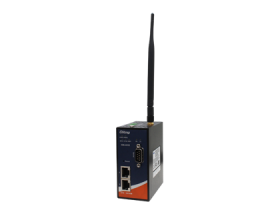
- Multi‑Interface Connectivity:
One RS‑232/422/485 serial port and two 10/100Base‑T(X) Ethernet ports (one PoE PD‑enabled).
Supports WLAN 802.11b/g/n for wireless networking.
- PoE PD Functionality:
IEEE 802.3af‑compliant Power Device input interface with overload and short‑circuit protection.
Ideal for installations where separate power cabling is difficult.
- High‑Security Communication:
Supports HTTPS, SSH, and SSL encryption for secure data transmission.
IP access control, IP whitelist, and NAT pass‑through supported.
- Versatile Operation Modes:
Virtual COM, Serial Tunnel, TCP Server, TCP Client, and UDP modes.
Supports up to five simultaneous host connections for redundancy.
- Advanced Event Notification:
Event warnings via Syslog, Email, SNMP trap, and audible beeper.
Configurable system event triggers for hardware reset, login failure, IP change, etc.
- Comprehensive Management Options:
Configurable via Web interface, Windows DS‑Tool utility, Telnet, or SSH console.
Supports firmware upgrade, configuration backup/restore, and SNMP management.
- Industrial‑Grade Design:
IP30 metal enclosure, DIN‑rail and wall‑mount options, redundant 12–48 VDC power inputs.
Operating temperature from ‑40 °C to +70 °C, humidity 5–95% non‑condensing.
- Ethernet Redundancy:
Dual LAN ports support Ethernet redundancy with recovery time <10 ms.
- Compact and Robust:
Dimensions 45 × 81 × 95 mm, weight 331 g, designed for space‑constrained control cabinets.
One RS‑232/422/485 serial port and two 10/100Base‑T(X) Ethernet ports (one PoE PD‑enabled).
Supports WLAN 802.11b/g/n for wireless networking.
- PoE PD Functionality:
IEEE 802.3af‑compliant Power Device input interface with overload and short‑circuit protection.
Ideal for installations where separate power cabling is difficult.
- High‑Security Communication:
Supports HTTPS, SSH, and SSL encryption for secure data transmission.
IP access control, IP whitelist, and NAT pass‑through supported.
- Versatile Operation Modes:
Virtual COM, Serial Tunnel, TCP Server, TCP Client, and UDP modes.
Supports up to five simultaneous host connections for redundancy.
- Advanced Event Notification:
Event warnings via Syslog, Email, SNMP trap, and audible beeper.
Configurable system event triggers for hardware reset, login failure, IP change, etc.
- Comprehensive Management Options:
Configurable via Web interface, Windows DS‑Tool utility, Telnet, or SSH console.
Supports firmware upgrade, configuration backup/restore, and SNMP management.
- Industrial‑Grade Design:
IP30 metal enclosure, DIN‑rail and wall‑mount options, redundant 12–48 VDC power inputs.
Operating temperature from ‑40 °C to +70 °C, humidity 5–95% non‑condensing.
- Ethernet Redundancy:
Dual LAN ports support Ethernet redundancy with recovery time <10 ms.
- Compact and Robust:
Dimensions 45 × 81 × 95 mm, weight 331 g, designed for space‑constrained control cabinets.
Comprehensive Product Summary – ORing IDS‑4312+ Industrial WLAN Device Server
### 1. Product Overview
Product Name: IDS‑4312+
Model: IDS‑4312+
Series: IDS‑4312(+) Series Industrial Device Servers
Article Number: IDS‑4312+
Manufacturer: ORing Industrial Networking Corp.
Manufacturer Website: [www.oringnet.com](http://www.oringnet.com)
Headquarters: 3F., No.542‑2, Jhongjheng Rd., Sindian District, New Taipei City 231, Taiwan, R.O.C.
Support Contact: support@oringnet.com
Sales Contact: sales@oringnet.com
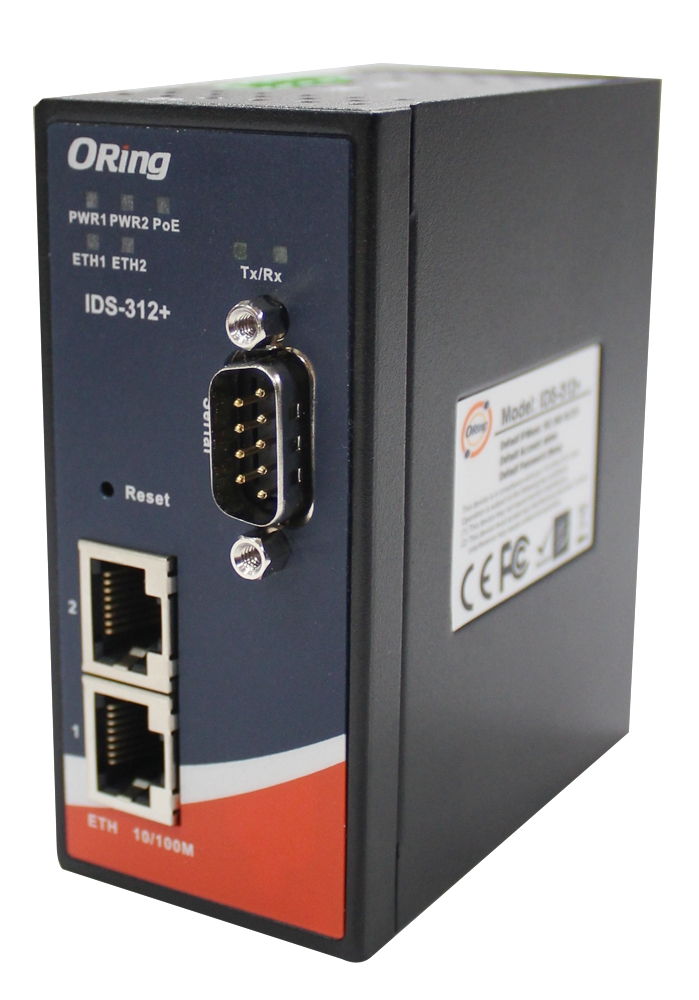
The ORing IDS‑4312+ is an industrial‑grade wireless device server designed to bridge serial communication interfaces (RS‑232/422/485) with Ethernet and WLAN networks. It supports dual 10/100Base‑T(X) LAN ports, one of which provides IEEE 802.3af‑compliant Power‑over‑Ethernet (PoE PD) capability, and integrates 802.11b/g/n wireless connectivity. The device is engineered for harsh industrial environments, offering redundant power inputs, IP30 metal housing, and extended operating temperature range.
### 2. Key Features
- Multi‑Interface Connectivity:
One RS‑232/422/485 serial port and two 10/100Base‑T(X) Ethernet ports (one PoE PD‑enabled).
Supports WLAN 802.11b/g/n for wireless networking.
- PoE PD Functionality:
IEEE 802.3af‑compliant Power Device input interface with overload and short‑circuit protection.
Ideal for installations where separate power cabling is difficult.
- High‑Security Communication:
Supports HTTPS, SSH, and SSL encryption for secure data transmission.
IP access control, IP whitelist, and NAT pass‑through supported.
- Versatile Operation Modes:
Virtual COM, Serial Tunnel, TCP Server, TCP Client, and UDP modes.
Supports up to five simultaneous host connections for redundancy.
- Advanced Event Notification:
Event warnings via Syslog, Email, SNMP trap, and audible beeper.
Configurable system event triggers for hardware reset, login failure, IP change, etc.
- Comprehensive Management Options:
Configurable via Web interface, Windows DS‑Tool utility, Telnet, or SSH console.
Supports firmware upgrade, configuration backup/restore, and SNMP management.
- Industrial‑Grade Design:
IP30 metal enclosure, DIN‑rail and wall‑mount options, redundant 12–48 VDC power inputs.
Operating temperature from ‑40 °C to +70 °C, humidity 5–95% non‑condensing.
- Ethernet Redundancy:
Dual LAN ports support Ethernet redundancy with recovery time <10 ms.
- Compact and Robust:
Dimensions 45 × 81 × 95 mm, weight 331 g, designed for space‑constrained control cabinets.
### 3. Technical Specifications
Physical Ports
- 2 × 10/100Base‑T(X) RJ‑45 ports, auto MDI/MDI‑X
- 1 × RS‑232/422/485 DB9 male serial port
- 1 × Reverse SMA‑type antenna connector (for WLAN)
PoE PD (Power Device)
- IEEE 802.3af compliant input interface
- Isolation voltage: 1000 VDC min
- Isolation resistance: 10⁸ Ω min
- Overload and short‑circuit protection
Wireless LAN (802.11b/g/n)
- Operation Mode: Client
- Frequency Bands:
- FCC (US): 2.412–2.462 GHz (11 channels)
- CE/ETSI (EU): 2.412–2.472 GHz (13 channels)
- Modulation:
- 802.11b: CCK, DQPSK, DBPSK
- 802.11g/n: OFDM with BPSK, QPSK, 16QAM, 64QAM
- Data Rates:
- 802.11b: 1/2/5.5/11 Mbps
- 802.11g: 6–54 Mbps
- 802.11n (40 MHz): up to 150 Mbps
- Transmit Power: 13.5 dBm ± 1.5 dBm (typical across modes)
- Receive Sensitivity:
- 802.11b @ 1 Mbps: ‑90 dBm ± 2 dBm
- 802.11g @ 54 Mbps: ‑72 dBm ± 2 dBm
- 802.11n (40 MHz MCS7): ‑68 dBm ± 2 dBm
- Security: WEP (64/128‑bit), WPA/WPA2 (AES), WPA‑PSK (256‑bit), 802.1X authentication
Serial Communication
- Connector: DB9 male
- Modes: RS‑232, RS‑422, RS‑485 (2‑wire/4‑wire)
- Baud Rate: 110 bps – 460.8 kbps
- Data Bits: 7, 8
- Parity: None, Odd, Even, Mark, Space
- Stop Bits: 1, 1.5, 2
- Flow Control: XON/XOFF, RTS/CTS, DTR/DSR
- RS‑232 Signals: TxD, RxD, RTS, CTS, DTR, DSR, DCD, RI, GND
Network Protocols Supported
ICMP, IP, TCP, UDP, DHCP, BOOTP, SSH, DNS, SNMP v1/v2c, HTTPS, SMTP
LED Indicators
- PWR1/PWR2/PoE: Green = Power ON
- ETH1/ETH2: Green = 100 Mbps link, Red = RX, Green = TX
- WLAN: Green blinking = Wireless activity
- Serial TX/RX: Red = Receiving, Green = Transmitting
Power Requirements
- Dual DC inputs 12–48 VDC via 6‑pin terminal block
- Typical power consumption: 3.98 W
- Reverse polarity and over‑current protection present
Mechanical
- Enclosure: IP30 metal case
- Dimensions: 45 (W) × 81 (D) × 95 (H) mm
- Weight: 331 g (IDS‑4312+), 322 g (IDS‑4312)
Environmental
- Operating Temperature: ‑40 °C to +70 °C (‑40 °F to 158 °F)
- Storage Temperature: ‑40 °C to +85 °C (‑40 °F to 185 °F)
- Humidity: 5 % – 95 % non‑condensing
### 4. Functionality
The IDS‑4312+ acts as a transparent bridge between serial devices and Ethernet/WLAN networks. It converts serial data streams into TCP/IP packets and vice versa, enabling legacy serial equipment to communicate over modern IP networks.
Supported Operation Modes:
- Virtual COM: Maps the serial port to a virtual COM port on a host PC; supports up to 5 simultaneous connections.
- TCP Server: Waits for incoming TCP connections; up to 5 hosts can connect concurrently.
- TCP Client: Initiates TCP connections to a remote server on startup or upon data activity.
- UDP: Enables fast unicast or multicast data transmission to multiple hosts.
- Serial Tunnel: Creates a transparent serial‑to‑serial link over Ethernet or WLAN.
Applications:
Industrial automation, SCADA systems, remote monitoring, building management, energy management, and any environment requiring serial‑to‑Ethernet/WLAN integration.
Compatibility:
Supports Windows NT/2000/XP/2003/Vista (32/64‑bit), Windows 7 (32/64‑bit), and later OS versions through DS‑Tool utility.
### 5. Components & Accessories
Included Items:
- IDS‑4312+ device unit
- DIN‑rail mount kit
- Wall‑mount kit (L‑shaped brackets and screws)
- Terminal block connectors for power and relay
- External reverse SMA antenna connector
- User manual and software utility (DS‑Tool)
Optional Accessories:
- External WLAN antenna (2.4 GHz)
- Power adapter (12–48 VDC)
- Ethernet cables (Cat 5/5e UTP)
- DB9 serial cables for RS‑232/422/485 connections
Connectors:
- 2 × RJ‑45 Ethernet ports
- 1 × DB9 serial port
- 1 × 6‑pin terminal block (PWR1, PWR2, Relay)
- 1 × Reverse SMA antenna connector
### 6. Installation & Setup
Mounting Options:
- DIN‑Rail: Attach the included DIN‑rail kit to the rear panel and snap onto a standard DIN rail.
- Wall Mount: Use the L‑shaped brackets and screws to mount on a flat surface.
Wiring Guidelines:
- Disconnect power before wiring.
- Use separate paths for power and signal wiring to avoid EMI.
- Ground the device properly to reduce electromagnetic interference.
- Redundant power inputs (V+, V–) should be wired to independent power sources for fail‑safe operation.
Network Configuration:
- Default IP Address: 192.168.10.2 (DS‑Tool) or 192.168.10.1 (Web interface)
- Subnet Mask: 255.255.255.0
- Default Gateway: 192.168.10.254
- Default Login: Username = admin / Password = admin
Software Setup:
- Install DS‑Tool utility on Windows host.
- Discover devices via broadcast and assign static or DHCP IP addresses.
- Configure serial port parameters (baud rate, parity, flow control).
- Set operation mode (Virtual COM, TCP Server/Client, UDP).
- Save and apply configuration to flash memory.
### 7. Performance & Capabilities
- Ethernet Redundancy: Dual LAN ports with recovery time < 10 ms.
- Wireless Throughput: Up to 150 Mbps (802.11n 40 MHz).
- Serial Baud Rate: Up to 460.8 kbps.
- Simultaneous Connections: Up to 5 hosts per serial port.
- Power Efficiency: Typical consumption 3.98 W.
- Reliability: Redundant power inputs and PoE PD ensure continuous operation during power loss.
- Latency Optimization: Selectable performance modes (Throughput or Latency).
- Data Buffering: 4 KB buffers with configurable flush intervals and delimiters.
- Event Response: Real‑time alerts via SNMP, email, or Syslog for system and port events.
Limitations:
- Single serial port per unit.
- WLAN limited to 2.4 GHz band (802.11b/g/n).
- PoE input only (PD), not PoE PSE output.
### 8. Standards & Compliance
EMI/EMS Compliance:
- FCC Part 15, CISPR (EN55022 Class A)
- EN61000‑4‑2 (ESD)
- EN61000‑4‑3 (RS)
- EN61000‑4‑4 (EFT)
- EN61000‑4‑5 (Surge)
- EN61000‑4‑6 (CS)
- EN61000‑4‑8 (Magnetic Field)
- EN61000‑4‑11 (Dip/Interruption)
Environmental & Safety:
- Shock: IEC60068‑2‑27
- Vibration: IEC60068‑2‑6
- Free Fall: IEC60068‑2‑32
- Safety: EN60950‑1
Wireless Standards:
- IEEE 802.11b/g/n compliant
- IEEE 802.3af PoE PD compliant
Industrial Protection:
- IP30 metal enclosure
- Operating temperature ‑40 °C to +70 °C
### 9. Additional Information
Warranty:
5‑year limited hardware warranty covering defects in materials and workmanship.
Excludes damage from misuse, improper installation, or unauthorized modifications.
Maintenance:
- Periodically inspect power connections and grounding.
- Keep ventilation openings clear of dust.
- Firmware updates available via Web interface or DS‑Tool.
- Configuration backup and restore supported through Web GUI or utility.
Support & Updates:
- Technical support via email and online resources.
- Firmware and software utilities downloadable from ORing website.
- DS‑Tool supports group firmware updates and device monitoring.
Typical Use Cases:
- Connecting legacy PLC controllers to Ethernet/WLAN networks.
- Remote monitoring of serial sensors and meters.
- Wireless bridge for RS‑485 industrial bus systems.
- Integration of serial devices into SCADA and IoT platforms.
### Summary
The ORing IDS‑4312+ is a compact, rugged, and feature‑rich industrial device server that seamlessly integrates serial communication equipment into Ethernet and wireless networks. With dual LAN ports (one PoE PD), redundant power inputs, and robust security features, it is engineered for mission‑critical applications in industrial automation, transportation, and energy management. Its support for multiple operation modes, advanced event notification, and comprehensive management interfaces make it a versatile solution for modernizing serial infrastructure in harsh environments.
### 1. Product Overview
Product Name: IDS‑4312+
Model: IDS‑4312+
Series: IDS‑4312(+) Series Industrial Device Servers
Article Number: IDS‑4312+
Manufacturer: ORing Industrial Networking Corp.
Manufacturer Website: [www.oringnet.com](http://www.oringnet.com)
Headquarters: 3F., No.542‑2, Jhongjheng Rd., Sindian District, New Taipei City 231, Taiwan, R.O.C.
Support Contact: support@oringnet.com
Sales Contact: sales@oringnet.com
The ORing IDS‑4312+ is an industrial‑grade wireless device server designed to bridge serial communication interfaces (RS‑232/422/485) with Ethernet and WLAN networks. It supports dual 10/100Base‑T(X) LAN ports, one of which provides IEEE 802.3af‑compliant Power‑over‑Ethernet (PoE PD) capability, and integrates 802.11b/g/n wireless connectivity. The device is engineered for harsh industrial environments, offering redundant power inputs, IP30 metal housing, and extended operating temperature range.
### 2. Key Features
- Multi‑Interface Connectivity:
One RS‑232/422/485 serial port and two 10/100Base‑T(X) Ethernet ports (one PoE PD‑enabled).
Supports WLAN 802.11b/g/n for wireless networking.
- PoE PD Functionality:
IEEE 802.3af‑compliant Power Device input interface with overload and short‑circuit protection.
Ideal for installations where separate power cabling is difficult.
- High‑Security Communication:
Supports HTTPS, SSH, and SSL encryption for secure data transmission.
IP access control, IP whitelist, and NAT pass‑through supported.
- Versatile Operation Modes:
Virtual COM, Serial Tunnel, TCP Server, TCP Client, and UDP modes.
Supports up to five simultaneous host connections for redundancy.
- Advanced Event Notification:
Event warnings via Syslog, Email, SNMP trap, and audible beeper.
Configurable system event triggers for hardware reset, login failure, IP change, etc.
- Comprehensive Management Options:
Configurable via Web interface, Windows DS‑Tool utility, Telnet, or SSH console.
Supports firmware upgrade, configuration backup/restore, and SNMP management.
- Industrial‑Grade Design:
IP30 metal enclosure, DIN‑rail and wall‑mount options, redundant 12–48 VDC power inputs.
Operating temperature from ‑40 °C to +70 °C, humidity 5–95% non‑condensing.
- Ethernet Redundancy:
Dual LAN ports support Ethernet redundancy with recovery time <10 ms.
- Compact and Robust:
Dimensions 45 × 81 × 95 mm, weight 331 g, designed for space‑constrained control cabinets.
### 3. Technical Specifications
Physical Ports
- 2 × 10/100Base‑T(X) RJ‑45 ports, auto MDI/MDI‑X
- 1 × RS‑232/422/485 DB9 male serial port
- 1 × Reverse SMA‑type antenna connector (for WLAN)
PoE PD (Power Device)
- IEEE 802.3af compliant input interface
- Isolation voltage: 1000 VDC min
- Isolation resistance: 10⁸ Ω min
- Overload and short‑circuit protection
Wireless LAN (802.11b/g/n)
- Operation Mode: Client
- Frequency Bands:
- FCC (US): 2.412–2.462 GHz (11 channels)
- CE/ETSI (EU): 2.412–2.472 GHz (13 channels)
- Modulation:
- 802.11b: CCK, DQPSK, DBPSK
- 802.11g/n: OFDM with BPSK, QPSK, 16QAM, 64QAM
- Data Rates:
- 802.11b: 1/2/5.5/11 Mbps
- 802.11g: 6–54 Mbps
- 802.11n (40 MHz): up to 150 Mbps
- Transmit Power: 13.5 dBm ± 1.5 dBm (typical across modes)
- Receive Sensitivity:
- 802.11b @ 1 Mbps: ‑90 dBm ± 2 dBm
- 802.11g @ 54 Mbps: ‑72 dBm ± 2 dBm
- 802.11n (40 MHz MCS7): ‑68 dBm ± 2 dBm
- Security: WEP (64/128‑bit), WPA/WPA2 (AES), WPA‑PSK (256‑bit), 802.1X authentication
Serial Communication
- Connector: DB9 male
- Modes: RS‑232, RS‑422, RS‑485 (2‑wire/4‑wire)
- Baud Rate: 110 bps – 460.8 kbps
- Data Bits: 7, 8
- Parity: None, Odd, Even, Mark, Space
- Stop Bits: 1, 1.5, 2
- Flow Control: XON/XOFF, RTS/CTS, DTR/DSR
- RS‑232 Signals: TxD, RxD, RTS, CTS, DTR, DSR, DCD, RI, GND
Network Protocols Supported
ICMP, IP, TCP, UDP, DHCP, BOOTP, SSH, DNS, SNMP v1/v2c, HTTPS, SMTP
LED Indicators
- PWR1/PWR2/PoE: Green = Power ON
- ETH1/ETH2: Green = 100 Mbps link, Red = RX, Green = TX
- WLAN: Green blinking = Wireless activity
- Serial TX/RX: Red = Receiving, Green = Transmitting
Power Requirements
- Dual DC inputs 12–48 VDC via 6‑pin terminal block
- Typical power consumption: 3.98 W
- Reverse polarity and over‑current protection present
Mechanical
- Enclosure: IP30 metal case
- Dimensions: 45 (W) × 81 (D) × 95 (H) mm
- Weight: 331 g (IDS‑4312+), 322 g (IDS‑4312)
Environmental
- Operating Temperature: ‑40 °C to +70 °C (‑40 °F to 158 °F)
- Storage Temperature: ‑40 °C to +85 °C (‑40 °F to 185 °F)
- Humidity: 5 % – 95 % non‑condensing
### 4. Functionality
The IDS‑4312+ acts as a transparent bridge between serial devices and Ethernet/WLAN networks. It converts serial data streams into TCP/IP packets and vice versa, enabling legacy serial equipment to communicate over modern IP networks.
Supported Operation Modes:
- Virtual COM: Maps the serial port to a virtual COM port on a host PC; supports up to 5 simultaneous connections.
- TCP Server: Waits for incoming TCP connections; up to 5 hosts can connect concurrently.
- TCP Client: Initiates TCP connections to a remote server on startup or upon data activity.
- UDP: Enables fast unicast or multicast data transmission to multiple hosts.
- Serial Tunnel: Creates a transparent serial‑to‑serial link over Ethernet or WLAN.
Applications:
Industrial automation, SCADA systems, remote monitoring, building management, energy management, and any environment requiring serial‑to‑Ethernet/WLAN integration.
Compatibility:
Supports Windows NT/2000/XP/2003/Vista (32/64‑bit), Windows 7 (32/64‑bit), and later OS versions through DS‑Tool utility.
### 5. Components & Accessories
Included Items:
- IDS‑4312+ device unit
- DIN‑rail mount kit
- Wall‑mount kit (L‑shaped brackets and screws)
- Terminal block connectors for power and relay
- External reverse SMA antenna connector
- User manual and software utility (DS‑Tool)
Optional Accessories:
- External WLAN antenna (2.4 GHz)
- Power adapter (12–48 VDC)
- Ethernet cables (Cat 5/5e UTP)
- DB9 serial cables for RS‑232/422/485 connections
Connectors:
- 2 × RJ‑45 Ethernet ports
- 1 × DB9 serial port
- 1 × 6‑pin terminal block (PWR1, PWR2, Relay)
- 1 × Reverse SMA antenna connector
### 6. Installation & Setup
Mounting Options:
- DIN‑Rail: Attach the included DIN‑rail kit to the rear panel and snap onto a standard DIN rail.
- Wall Mount: Use the L‑shaped brackets and screws to mount on a flat surface.
Wiring Guidelines:
- Disconnect power before wiring.
- Use separate paths for power and signal wiring to avoid EMI.
- Ground the device properly to reduce electromagnetic interference.
- Redundant power inputs (V+, V–) should be wired to independent power sources for fail‑safe operation.
Network Configuration:
- Default IP Address: 192.168.10.2 (DS‑Tool) or 192.168.10.1 (Web interface)
- Subnet Mask: 255.255.255.0
- Default Gateway: 192.168.10.254
- Default Login: Username = admin / Password = admin
Software Setup:
- Install DS‑Tool utility on Windows host.
- Discover devices via broadcast and assign static or DHCP IP addresses.
- Configure serial port parameters (baud rate, parity, flow control).
- Set operation mode (Virtual COM, TCP Server/Client, UDP).
- Save and apply configuration to flash memory.
### 7. Performance & Capabilities
- Ethernet Redundancy: Dual LAN ports with recovery time < 10 ms.
- Wireless Throughput: Up to 150 Mbps (802.11n 40 MHz).
- Serial Baud Rate: Up to 460.8 kbps.
- Simultaneous Connections: Up to 5 hosts per serial port.
- Power Efficiency: Typical consumption 3.98 W.
- Reliability: Redundant power inputs and PoE PD ensure continuous operation during power loss.
- Latency Optimization: Selectable performance modes (Throughput or Latency).
- Data Buffering: 4 KB buffers with configurable flush intervals and delimiters.
- Event Response: Real‑time alerts via SNMP, email, or Syslog for system and port events.
Limitations:
- Single serial port per unit.
- WLAN limited to 2.4 GHz band (802.11b/g/n).
- PoE input only (PD), not PoE PSE output.
### 8. Standards & Compliance
EMI/EMS Compliance:
- FCC Part 15, CISPR (EN55022 Class A)
- EN61000‑4‑2 (ESD)
- EN61000‑4‑3 (RS)
- EN61000‑4‑4 (EFT)
- EN61000‑4‑5 (Surge)
- EN61000‑4‑6 (CS)
- EN61000‑4‑8 (Magnetic Field)
- EN61000‑4‑11 (Dip/Interruption)
Environmental & Safety:
- Shock: IEC60068‑2‑27
- Vibration: IEC60068‑2‑6
- Free Fall: IEC60068‑2‑32
- Safety: EN60950‑1
Wireless Standards:
- IEEE 802.11b/g/n compliant
- IEEE 802.3af PoE PD compliant
Industrial Protection:
- IP30 metal enclosure
- Operating temperature ‑40 °C to +70 °C
### 9. Additional Information
Warranty:
5‑year limited hardware warranty covering defects in materials and workmanship.
Excludes damage from misuse, improper installation, or unauthorized modifications.
Maintenance:
- Periodically inspect power connections and grounding.
- Keep ventilation openings clear of dust.
- Firmware updates available via Web interface or DS‑Tool.
- Configuration backup and restore supported through Web GUI or utility.
Support & Updates:
- Technical support via email and online resources.
- Firmware and software utilities downloadable from ORing website.
- DS‑Tool supports group firmware updates and device monitoring.
Typical Use Cases:
- Connecting legacy PLC controllers to Ethernet/WLAN networks.
- Remote monitoring of serial sensors and meters.
- Wireless bridge for RS‑485 industrial bus systems.
- Integration of serial devices into SCADA and IoT platforms.
### Summary
The ORing IDS‑4312+ is a compact, rugged, and feature‑rich industrial device server that seamlessly integrates serial communication equipment into Ethernet and wireless networks. With dual LAN ports (one PoE PD), redundant power inputs, and robust security features, it is engineered for mission‑critical applications in industrial automation, transportation, and energy management. Its support for multiple operation modes, advanced event notification, and comprehensive management interfaces make it a versatile solution for modernizing serial infrastructure in harsh environments.
-
.webp) Datasheet_IDS-4312(+).pdf
PDF Catalog
Datasheet_IDS-4312(+).pdf
PDF Catalog
-
.webp) UserManual_IDS-4312(+).pdf
Manual
UserManual_IDS-4312(+).pdf
Manual
No accessories available.