 LOOKING FOR THE RIGHT
INDUSTRIAL SOLUTION?
Discover embedded, communication and automation solutions tailored to your application.
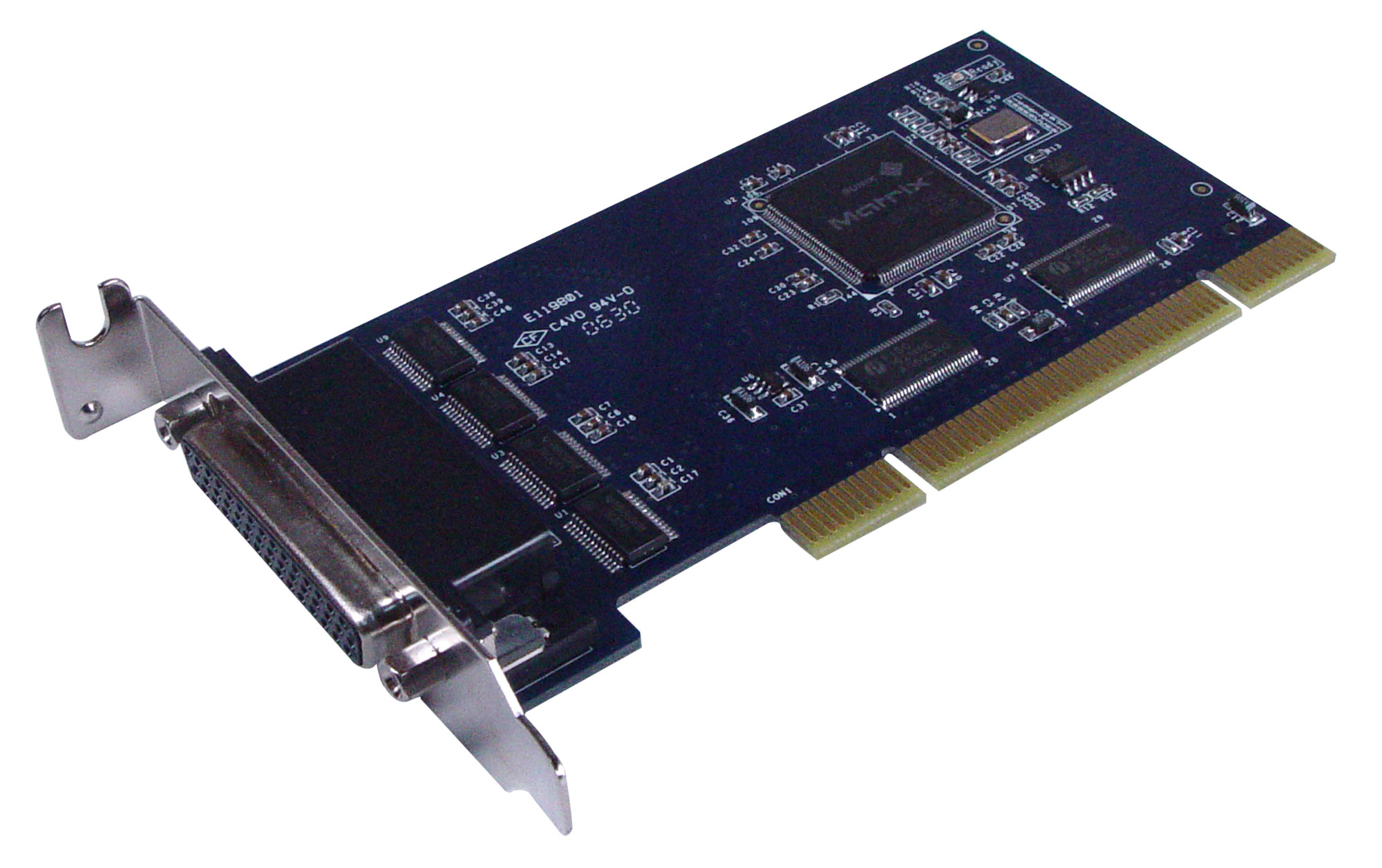
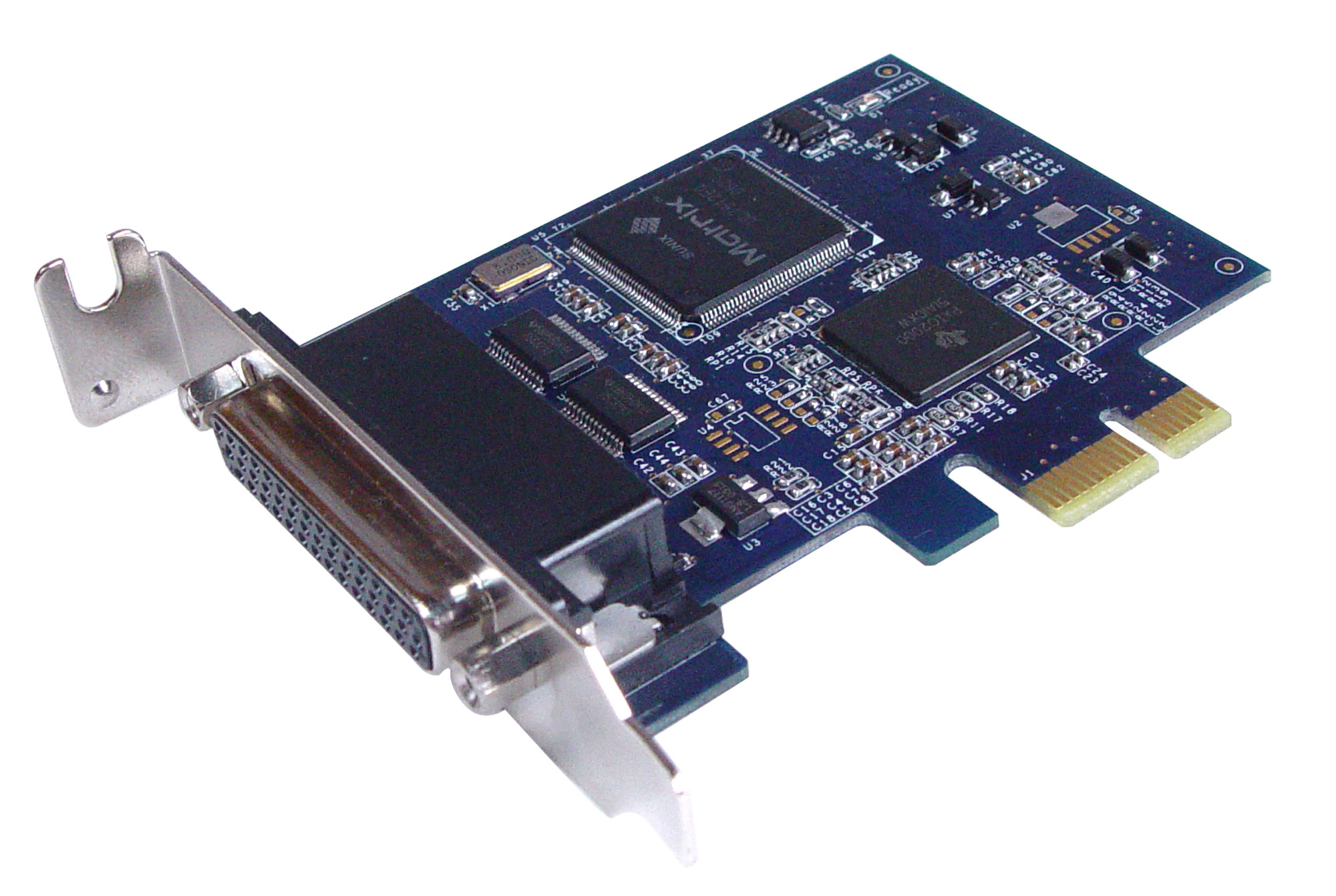
- Four Independent RS‑232 Ports: Provides four fully functional serial channels for simultaneous communication with multiple RS‑232 devices.
- Universal PCI Interface: Compatible with both 3.3 V and 5 V PCI slots (PCI Ver. 3.0/2.3/2.2), supporting 32‑bit and 64‑bit PCI and PCI‑X buses at 33 MHz or 66 MHz.
- High‑Speed Communication: Supports baud rates from 75 bps up to 921.6 Kbps per port, suitable for high‑throughput industrial data exchange.
- 64‑Byte Hardware FIFO: Each port integrates a 64‑byte transmit/receive FIFO buffer, 16C750‑compatible, ensuring smooth data flow and reduced CPU overhead.
- Unlimited Scalability: Multiple cards can be installed in a single system, limited only by available PCI slots.
- Embedded 15 kV ESD Protection: Built‑in electrostatic discharge protection on all signal lines safeguards connected equipment and the card itself.
- DB‑44 Female Connector: Compact high‑density connector on the card, with breakout cable to standard DB‑9 or DB‑25 male connectors.
- Comprehensive Driver Support: Compatible with Windows 2000/XP/2003/Vista (32/64‑bit), DOS, Linux 2.4/2.6, SCO OpenServer 5.06/5.07, and Unix systems.
- Wide Operating Range: Designed for industrial environments with operating temperature from 0 °C to 70 °C and storage temperature from –40 °C to 85 °C.
- Long‑Term Reliability: Backed by a 5‑year manufacturer warranty.
- Universal PCI Interface: Compatible with both 3.3 V and 5 V PCI slots (PCI Ver. 3.0/2.3/2.2), supporting 32‑bit and 64‑bit PCI and PCI‑X buses at 33 MHz or 66 MHz.
- High‑Speed Communication: Supports baud rates from 75 bps up to 921.6 Kbps per port, suitable for high‑throughput industrial data exchange.
- 64‑Byte Hardware FIFO: Each port integrates a 64‑byte transmit/receive FIFO buffer, 16C750‑compatible, ensuring smooth data flow and reduced CPU overhead.
- Unlimited Scalability: Multiple cards can be installed in a single system, limited only by available PCI slots.
- Embedded 15 kV ESD Protection: Built‑in electrostatic discharge protection on all signal lines safeguards connected equipment and the card itself.
- DB‑44 Female Connector: Compact high‑density connector on the card, with breakout cable to standard DB‑9 or DB‑25 male connectors.
- Comprehensive Driver Support: Compatible with Windows 2000/XP/2003/Vista (32/64‑bit), DOS, Linux 2.4/2.6, SCO OpenServer 5.06/5.07, and Unix systems.
- Wide Operating Range: Designed for industrial environments with operating temperature from 0 °C to 70 °C and storage temperature from –40 °C to 85 °C.
- Long‑Term Reliability: Backed by a 5‑year manufacturer warranty.
Comprehensive Product Summary: SUNIX IPC‑P1004 Universal PCI 4‑Port RS‑232 Professional Serial Card
*(Approx. 12,000 characters / ~3,000 tokens)*
### 1. Product Overview
Product Name: UPCI 4×RS‑232 Professional Card
Model: IPC‑P1004
Article Number: IPC‑P1004
Series: SUNIX Industrial Multi‑Port Serial Communication Boards – Universal PCI Series
Manufacturer: SUNIX Co., Ltd.
The SUNIX IPC‑P1004 is a professional‑grade Universal PCI serial communication card designed to expand a computer system with four independent RS‑232 serial ports. It is part of SUNIX’s industrial multi‑port serial card family, which includes PCI, PCI‑Express, and PCI/104 variants. The IPC‑P1004 provides high‑performance, reliable, and electrically protected serial connectivity for industrial automation, POS, data acquisition, and embedded control applications.
### 2. Key Features
- Four Independent RS‑232 Ports: Provides four fully functional serial channels for simultaneous communication with multiple RS‑232 devices.
- Universal PCI Interface: Compatible with both 3.3 V and 5 V PCI slots (PCI Ver. 3.0/2.3/2.2), supporting 32‑bit and 64‑bit PCI and PCI‑X buses at 33 MHz or 66 MHz.
- High‑Speed Communication: Supports baud rates from 75 bps up to 921.6 Kbps per port, suitable for high‑throughput industrial data exchange.
- 64‑Byte Hardware FIFO: Each port integrates a 64‑byte transmit/receive FIFO buffer, 16C750‑compatible, ensuring smooth data flow and reduced CPU overhead.
- Unlimited Scalability: Multiple cards can be installed in a single system, limited only by available PCI slots.
- Embedded 15 kV ESD Protection: Built‑in electrostatic discharge protection on all signal lines safeguards connected equipment and the card itself.
- DB‑44 Female Connector: Compact high‑density connector on the card, with breakout cable to standard DB‑9 or DB‑25 male connectors.
- Comprehensive Driver Support: Compatible with Windows 2000/XP/2003/Vista (32/64‑bit), DOS, Linux 2.4/2.6, SCO OpenServer 5.06/5.07, and Unix systems.
- Wide Operating Range: Designed for industrial environments with operating temperature from 0 °C to 70 °C and storage temperature from –40 °C to 85 °C.
- Long‑Term Reliability: Backed by a 5‑year manufacturer warranty.
### 3. Technical Specifications
| Parameter | Specification |
|----------------|------------------|
| Interface Type | Universal PCI (3.3 V/5 V, 32/64‑bit, PCI & PCI‑X 33/66 MHz) |
| Number of Ports | 4 independent RS‑232 ports |
| Connector Type | DB‑44 Female on card |
| Cable | DB‑44 Male → 4× DB‑9 Male or DB‑25 Male, 40 cm / 100 cm |
| UART Controller | 16C750‑compatible, single‑chip ASIC design |
| FIFO Buffer | 64 bytes hardware FIFO per port |
| Baud Rate | 75 bps – 921.6 Kbps |
| Data Bits | 5, 6, 7, 8 |
| Stop Bits | 1, 1.5, 2 |
| Parity | None, Even, Odd, Space, Mark |
| Flow Control | XON/XOFF (software) |
| Signal Lines (RS‑232) | TxD, RxD, RTS, CTS, DTR, DSR, DCD, GND |
| IRQ / I/O Address | Assigned automatically by system BIOS/OS |
| ESD Protection | 15 kV embedded protection on all signal lines |
| Operating Temperature | 0 °C to 70 °C |
| Storage Temperature | –40 °C to 85 °C |
| Operating Humidity | 5 % – 95 % RH (non‑condensing) |
| Dimensions | 63.5 mm × 120 mm (Low‑Profile & Standard Bracket) |
| Weight | Approx. 100 g (card only) |
| Regulatory Compliance | CE, FCC Class B |
| Warranty | 5 years |
### 4. Functionality
The IPC‑P1004 functions as a Universal PCI expansion card that adds four RS‑232 serial interfaces to a host computer. Each port operates independently, allowing simultaneous communication with multiple serial devices such as barcode scanners, printers, PLCs, sensors, or POS peripherals.
Operation Principle:
The card uses a SUNIX‑developed single‑chip ASIC with integrated UART controllers. Each UART provides a 64‑byte FIFO buffer for transmit and receive operations, minimizing CPU load and ensuring stable data transfer even at high baud rates. The card automatically assigns system resources (IRQ and I/O addresses) through Plug‑and‑Play BIOS or operating system configuration.
Use Cases and Applications:
- Industrial Automation: Communication with PLCs, sensors, and control modules.
- POS Systems: Connection of receipt printers, barcode readers, pole displays, and card readers.
- Data Acquisition: Integration with measurement instruments and serial data loggers.
- Embedded Systems: Expansion of serial interfaces in industrial PCs or embedded controllers.
- Healthcare: Centralized patient data collection and device interfacing in hospital networks.
Compatibility:
The IPC‑P1004 supports all major operating systems and is compatible with Intel® and AMD® 32‑bit and 64‑bit architectures. It can coexist with other PCI devices and supports installation of multiple cards for large‑scale serial networking.
### 5. Components & Accessories
Included Items:
- IPC‑P1004 Universal PCI 4‑Port RS‑232 Serial Card
- DB‑44 Male → 4× DB‑9 Male or DB‑25 Male connection cable (40 cm / 100 cm)
- Standard and Low‑Profile mounting brackets
- Driver CD (Windows, Linux, DOS)
- Quick Installation Guide and User Manual
Optional Accessories:
- Extended‑length DB‑44 breakout cables
- DB‑9 to DB‑25 adapters
- External surge protection modules (for high‑voltage environments)
Connectors:
- On‑board DB‑44 Female connector for external cable connection
- Each port terminates in standard DB‑9 Male or DB‑25 Male connectors for peripheral devices
### 6. Installation & Setup
Hardware Installation Steps:
1. Power off the computer and disconnect all power sources.
2. Remove the system cover and locate an available PCI slot.
3. Remove the slot’s metal cover plate.
4. Insert the IPC‑P1004 card firmly into the PCI slot and secure it with a screw.
5. Attach the DB‑44 breakout cable to the card’s connector.
6. Replace the system cover and reconnect power.
7. Boot the system; the card will be automatically detected by the BIOS/OS.
Software Installation:
- Windows 2000/XP/2003/Vista: Insert the driver CD when prompted by the “Found New Hardware” wizard. Select the appropriate driver folder (e.g., `\Windows\2K&XP&2003&Vista_32bit` or `\Windows\XP&2003_64bit`). Follow on‑screen instructions to complete installation.
- Linux 2.4/2.6: Extract the driver package (e.g., `matrix_2.6_Vx.xx.tgz`), compile, and install using `make install`. Load the module with `modprobe sunix_matrix`. Device nodes will appear as `/dev/ttySMX0` – `ttySMX3`.
- DOS/Unix: Use provided driver utilities and configuration files.
Configuration:
After installation, COM port numbers can be reassigned via Device Manager (Windows) or system configuration tools (Linux). FIFO buffer size and flow control options can be adjusted for performance optimization.
Mounting Options:
The card supports both standard and low‑profile brackets, allowing installation in full‑height or compact industrial chassis.
### 7. Performance & Capabilities
- Data Throughput: Up to 921.6 Kbps per port, full‑duplex RS‑232 communication.
- FIFO Efficiency: 64‑byte hardware buffering minimizes overrun errors and ensures stable high‑speed transmission.
- Latency: Optimized for low‑latency real‑time applications due to SUNIX’s single‑chip UART design.
- System Load: Minimal CPU utilization thanks to hardware buffering and efficient interrupt handling.
- Scalability: Unlimited number of cards per system (limited only by available PCI slots).
- Reliability: 15 kV ESD protection prevents damage from electrostatic discharge; robust PCB design ensures long‑term stability.
- Limitations: RS‑232 interface only (no RS‑422/485 support on this model); for mixed or differential signaling, SUNIX IPC‑P3004 or IPC‑P2004 models are recommended.
### 8. Standards & Compliance
Electrical and Interface Standards:
- RS‑232 C standard compliant signaling
- PCI Bus Specification Ver. 3.0/2.3/2.2
- PCI‑X 33/66 MHz compatibility
- 3.3 V and 5 V universal keying
Protection and Safety Standards:
- 15 kV ESD protection (IEC 61000‑4‑2 compliant)
- Surge protection (optional SI versions meet IEC 61000‑4‑5 600 W peak)
- Operating temperature and humidity ranges suitable for industrial environments
Regulatory Certifications:
- CE: Conforms to European EMC Directive for Class B equipment
- FCC Class B: Meets U.S. Federal Communications Commission standards for electromagnetic emissions
Environmental Compliance:
- Designed for RoHS‑compliant manufacturing (lead‑free components)
- Low‑power consumption ASIC design reduces environmental impact
### 9. Additional Information
Warranty:
5‑year limited hardware warranty covering manufacturing defects and component failures under normal operating conditions.
Technical Support & Updates:
SUNIX provides comprehensive technical support, driver updates, and documentation through its official website and support email:
- Website: [www.sunix-ncci.com.tw](http://www.sunix-ncci.com.tw)
- Email: info@sunix-ncci.com.tw
Maintenance:
- Keep the card free from dust and moisture.
- Avoid exposure to direct sunlight or magnetic fields.
- Do not attempt to disassemble or repair the card; warranty will be voided.
- Ensure the system is powered off before installation or removal.
Firmware & Driver Updates:
SUNIX periodically releases updated drivers for new operating systems and kernel versions. Users are encouraged to check the support site for the latest versions to ensure optimal performance and compatibility.
Troubleshooting Highlights:
- Card Not Detected: Verify proper seating in PCI slot; check BIOS resource allocation.
- Communication Errors: Adjust FIFO buffer size or enable flow control.
- Driver Conflicts: Uninstall previous versions before reinstalling updated drivers.
- Overrun Errors: Reduce baud rate or enable hardware/software flow control.
Service Life & Reliability:
The IPC‑P1004 is engineered for continuous 24/7 operation in industrial environments. The combination of robust PCB design, high‑quality components, and ESD protection ensures long‑term reliability and minimal downtime.
### Summary
The SUNIX IPC‑P1004 Universal PCI 4‑Port RS‑232 Professional Card is a high‑performance, industrial‑grade serial communication solution that expands a system’s connectivity with four independent RS‑232 ports. Featuring a universal PCI interface, 64‑byte FIFO buffers, and embedded 15 kV ESD protection, it delivers reliable, high‑speed serial communication for demanding industrial and commercial applications.
Its compatibility with multiple operating systems, plug‑and‑play installation, and long‑term warranty make it an ideal choice for system integrators, OEMs, and industrial automation professionals seeking robust and scalable serial connectivity.
Key Technical Summary (Quick Reference):
| Attribute | Details |
|----------------|-------------|
| Model | IPC‑P1004 |
| Interface | Universal PCI (3.3 V/5 V, 32/64‑bit) |
| Ports | 4 × RS‑232 |
| Baud Rate | 75 bps – 921.6 Kbps |
| FIFO | 64 bytes hardware (16C750 compatible) |
| Connector | DB‑44 Female → 4× DB‑9/DB‑25 Male |
| Protection | 15 kV ESD embedded |
| Dimensions | 63.5 × 120 mm |
| Operating Temp. | 0 °C – 70 °C |
| Storage Temp. | –40 °C – 85 °C |
| Certifications | CE, FCC Class B |
| Warranty | 5 years |
| Drivers | Windows 2000/XP/2003/Vista, Linux 2.4/2.6, DOS, Unix |
In essence, the IPC‑P1004 exemplifies SUNIX’s commitment to industrial‑grade serial communication technology—offering a compact, reliable, and high‑speed RS‑232 expansion solution for modern and legacy systems alike.
*(Approx. 12,000 characters / ~3,000 tokens)*
### 1. Product Overview
Product Name: UPCI 4×RS‑232 Professional Card
Model: IPC‑P1004
Article Number: IPC‑P1004
Series: SUNIX Industrial Multi‑Port Serial Communication Boards – Universal PCI Series
Manufacturer: SUNIX Co., Ltd.
The SUNIX IPC‑P1004 is a professional‑grade Universal PCI serial communication card designed to expand a computer system with four independent RS‑232 serial ports. It is part of SUNIX’s industrial multi‑port serial card family, which includes PCI, PCI‑Express, and PCI/104 variants. The IPC‑P1004 provides high‑performance, reliable, and electrically protected serial connectivity for industrial automation, POS, data acquisition, and embedded control applications.
### 2. Key Features
- Four Independent RS‑232 Ports: Provides four fully functional serial channels for simultaneous communication with multiple RS‑232 devices.
- Universal PCI Interface: Compatible with both 3.3 V and 5 V PCI slots (PCI Ver. 3.0/2.3/2.2), supporting 32‑bit and 64‑bit PCI and PCI‑X buses at 33 MHz or 66 MHz.
- High‑Speed Communication: Supports baud rates from 75 bps up to 921.6 Kbps per port, suitable for high‑throughput industrial data exchange.
- 64‑Byte Hardware FIFO: Each port integrates a 64‑byte transmit/receive FIFO buffer, 16C750‑compatible, ensuring smooth data flow and reduced CPU overhead.
- Unlimited Scalability: Multiple cards can be installed in a single system, limited only by available PCI slots.
- Embedded 15 kV ESD Protection: Built‑in electrostatic discharge protection on all signal lines safeguards connected equipment and the card itself.
- DB‑44 Female Connector: Compact high‑density connector on the card, with breakout cable to standard DB‑9 or DB‑25 male connectors.
- Comprehensive Driver Support: Compatible with Windows 2000/XP/2003/Vista (32/64‑bit), DOS, Linux 2.4/2.6, SCO OpenServer 5.06/5.07, and Unix systems.
- Wide Operating Range: Designed for industrial environments with operating temperature from 0 °C to 70 °C and storage temperature from –40 °C to 85 °C.
- Long‑Term Reliability: Backed by a 5‑year manufacturer warranty.
### 3. Technical Specifications
| Parameter | Specification |
|----------------|------------------|
| Interface Type | Universal PCI (3.3 V/5 V, 32/64‑bit, PCI & PCI‑X 33/66 MHz) |
| Number of Ports | 4 independent RS‑232 ports |
| Connector Type | DB‑44 Female on card |
| Cable | DB‑44 Male → 4× DB‑9 Male or DB‑25 Male, 40 cm / 100 cm |
| UART Controller | 16C750‑compatible, single‑chip ASIC design |
| FIFO Buffer | 64 bytes hardware FIFO per port |
| Baud Rate | 75 bps – 921.6 Kbps |
| Data Bits | 5, 6, 7, 8 |
| Stop Bits | 1, 1.5, 2 |
| Parity | None, Even, Odd, Space, Mark |
| Flow Control | XON/XOFF (software) |
| Signal Lines (RS‑232) | TxD, RxD, RTS, CTS, DTR, DSR, DCD, GND |
| IRQ / I/O Address | Assigned automatically by system BIOS/OS |
| ESD Protection | 15 kV embedded protection on all signal lines |
| Operating Temperature | 0 °C to 70 °C |
| Storage Temperature | –40 °C to 85 °C |
| Operating Humidity | 5 % – 95 % RH (non‑condensing) |
| Dimensions | 63.5 mm × 120 mm (Low‑Profile & Standard Bracket) |
| Weight | Approx. 100 g (card only) |
| Regulatory Compliance | CE, FCC Class B |
| Warranty | 5 years |
### 4. Functionality
The IPC‑P1004 functions as a Universal PCI expansion card that adds four RS‑232 serial interfaces to a host computer. Each port operates independently, allowing simultaneous communication with multiple serial devices such as barcode scanners, printers, PLCs, sensors, or POS peripherals.
Operation Principle:
The card uses a SUNIX‑developed single‑chip ASIC with integrated UART controllers. Each UART provides a 64‑byte FIFO buffer for transmit and receive operations, minimizing CPU load and ensuring stable data transfer even at high baud rates. The card automatically assigns system resources (IRQ and I/O addresses) through Plug‑and‑Play BIOS or operating system configuration.
Use Cases and Applications:
- Industrial Automation: Communication with PLCs, sensors, and control modules.
- POS Systems: Connection of receipt printers, barcode readers, pole displays, and card readers.
- Data Acquisition: Integration with measurement instruments and serial data loggers.
- Embedded Systems: Expansion of serial interfaces in industrial PCs or embedded controllers.
- Healthcare: Centralized patient data collection and device interfacing in hospital networks.
Compatibility:
The IPC‑P1004 supports all major operating systems and is compatible with Intel® and AMD® 32‑bit and 64‑bit architectures. It can coexist with other PCI devices and supports installation of multiple cards for large‑scale serial networking.
### 5. Components & Accessories
Included Items:
- IPC‑P1004 Universal PCI 4‑Port RS‑232 Serial Card
- DB‑44 Male → 4× DB‑9 Male or DB‑25 Male connection cable (40 cm / 100 cm)
- Standard and Low‑Profile mounting brackets
- Driver CD (Windows, Linux, DOS)
- Quick Installation Guide and User Manual
Optional Accessories:
- Extended‑length DB‑44 breakout cables
- DB‑9 to DB‑25 adapters
- External surge protection modules (for high‑voltage environments)
Connectors:
- On‑board DB‑44 Female connector for external cable connection
- Each port terminates in standard DB‑9 Male or DB‑25 Male connectors for peripheral devices
### 6. Installation & Setup
Hardware Installation Steps:
1. Power off the computer and disconnect all power sources.
2. Remove the system cover and locate an available PCI slot.
3. Remove the slot’s metal cover plate.
4. Insert the IPC‑P1004 card firmly into the PCI slot and secure it with a screw.
5. Attach the DB‑44 breakout cable to the card’s connector.
6. Replace the system cover and reconnect power.
7. Boot the system; the card will be automatically detected by the BIOS/OS.
Software Installation:
- Windows 2000/XP/2003/Vista: Insert the driver CD when prompted by the “Found New Hardware” wizard. Select the appropriate driver folder (e.g., `\Windows\2K&XP&2003&Vista_32bit` or `\Windows\XP&2003_64bit`). Follow on‑screen instructions to complete installation.
- Linux 2.4/2.6: Extract the driver package (e.g., `matrix_2.6_Vx.xx.tgz`), compile, and install using `make install`. Load the module with `modprobe sunix_matrix`. Device nodes will appear as `/dev/ttySMX0` – `ttySMX3`.
- DOS/Unix: Use provided driver utilities and configuration files.
Configuration:
After installation, COM port numbers can be reassigned via Device Manager (Windows) or system configuration tools (Linux). FIFO buffer size and flow control options can be adjusted for performance optimization.
Mounting Options:
The card supports both standard and low‑profile brackets, allowing installation in full‑height or compact industrial chassis.
### 7. Performance & Capabilities
- Data Throughput: Up to 921.6 Kbps per port, full‑duplex RS‑232 communication.
- FIFO Efficiency: 64‑byte hardware buffering minimizes overrun errors and ensures stable high‑speed transmission.
- Latency: Optimized for low‑latency real‑time applications due to SUNIX’s single‑chip UART design.
- System Load: Minimal CPU utilization thanks to hardware buffering and efficient interrupt handling.
- Scalability: Unlimited number of cards per system (limited only by available PCI slots).
- Reliability: 15 kV ESD protection prevents damage from electrostatic discharge; robust PCB design ensures long‑term stability.
- Limitations: RS‑232 interface only (no RS‑422/485 support on this model); for mixed or differential signaling, SUNIX IPC‑P3004 or IPC‑P2004 models are recommended.
### 8. Standards & Compliance
Electrical and Interface Standards:
- RS‑232 C standard compliant signaling
- PCI Bus Specification Ver. 3.0/2.3/2.2
- PCI‑X 33/66 MHz compatibility
- 3.3 V and 5 V universal keying
Protection and Safety Standards:
- 15 kV ESD protection (IEC 61000‑4‑2 compliant)
- Surge protection (optional SI versions meet IEC 61000‑4‑5 600 W peak)
- Operating temperature and humidity ranges suitable for industrial environments
Regulatory Certifications:
- CE: Conforms to European EMC Directive for Class B equipment
- FCC Class B: Meets U.S. Federal Communications Commission standards for electromagnetic emissions
Environmental Compliance:
- Designed for RoHS‑compliant manufacturing (lead‑free components)
- Low‑power consumption ASIC design reduces environmental impact
### 9. Additional Information
Warranty:
5‑year limited hardware warranty covering manufacturing defects and component failures under normal operating conditions.
Technical Support & Updates:
SUNIX provides comprehensive technical support, driver updates, and documentation through its official website and support email:
- Website: [www.sunix-ncci.com.tw](http://www.sunix-ncci.com.tw)
- Email: info@sunix-ncci.com.tw
Maintenance:
- Keep the card free from dust and moisture.
- Avoid exposure to direct sunlight or magnetic fields.
- Do not attempt to disassemble or repair the card; warranty will be voided.
- Ensure the system is powered off before installation or removal.
Firmware & Driver Updates:
SUNIX periodically releases updated drivers for new operating systems and kernel versions. Users are encouraged to check the support site for the latest versions to ensure optimal performance and compatibility.
Troubleshooting Highlights:
- Card Not Detected: Verify proper seating in PCI slot; check BIOS resource allocation.
- Communication Errors: Adjust FIFO buffer size or enable flow control.
- Driver Conflicts: Uninstall previous versions before reinstalling updated drivers.
- Overrun Errors: Reduce baud rate or enable hardware/software flow control.
Service Life & Reliability:
The IPC‑P1004 is engineered for continuous 24/7 operation in industrial environments. The combination of robust PCB design, high‑quality components, and ESD protection ensures long‑term reliability and minimal downtime.
### Summary
The SUNIX IPC‑P1004 Universal PCI 4‑Port RS‑232 Professional Card is a high‑performance, industrial‑grade serial communication solution that expands a system’s connectivity with four independent RS‑232 ports. Featuring a universal PCI interface, 64‑byte FIFO buffers, and embedded 15 kV ESD protection, it delivers reliable, high‑speed serial communication for demanding industrial and commercial applications.
Its compatibility with multiple operating systems, plug‑and‑play installation, and long‑term warranty make it an ideal choice for system integrators, OEMs, and industrial automation professionals seeking robust and scalable serial connectivity.
Key Technical Summary (Quick Reference):
| Attribute | Details |
|----------------|-------------|
| Model | IPC‑P1004 |
| Interface | Universal PCI (3.3 V/5 V, 32/64‑bit) |
| Ports | 4 × RS‑232 |
| Baud Rate | 75 bps – 921.6 Kbps |
| FIFO | 64 bytes hardware (16C750 compatible) |
| Connector | DB‑44 Female → 4× DB‑9/DB‑25 Male |
| Protection | 15 kV ESD embedded |
| Dimensions | 63.5 × 120 mm |
| Operating Temp. | 0 °C – 70 °C |
| Storage Temp. | –40 °C – 85 °C |
| Certifications | CE, FCC Class B |
| Warranty | 5 years |
| Drivers | Windows 2000/XP/2003/Vista, Linux 2.4/2.6, DOS, Unix |
In essence, the IPC‑P1004 exemplifies SUNIX’s commitment to industrial‑grade serial communication technology—offering a compact, reliable, and high‑speed RS‑232 expansion solution for modern and legacy systems alike.
-
 MultiportSerialCards.pdf
PDF Catalog
MultiportSerialCards.pdf
PDF Catalog
-
 SUNIX Manual_PCI V1.0.pdf
Manual
SUNIX Manual_PCI V1.0.pdf
Manual
No accessories available.