CBL-F10M9-20
LOOKING FOR THE RIGHT
INDUSTRIAL SOLUTION?
Discover embedded, communication and automation solutions tailored to your application.
- Four Independent Serial Ports:
- 2 × RS‑232/422/485 selectable via DIP switches
- 2 × dedicated RS‑232 ports
- High‑Speed Data Transfer:
- Baud rates from 50 bps to 921.6 kbps
- Over 700 kbps throughput per port concurrently
- Advanced UART Architecture:
- 16C950‑compatible UARTs with 128‑byte transmit/receive FIFOs
- Oxford OXmPCI954 chipset for high‑efficiency PCI/mini‑PCI communication
- Hardware Auto‑Direction Control:
- Automatic TX/RX switching for RS‑485 half‑duplex operation
- Surge and ESD Protection:
- 15 kV ESD protection on all signal lines
- Compact Mini‑PCI Form Factor:
- Dimensions: 59 × 50 mm, height 50 mm
- Low Power Consumption:
- 200 mA @ 3.3 VDC typical
- Software Compatibility:
- Drivers for Windows 95/98/ME/NT/2000/XP/2003 and Linux kernel 2.4.12+
- Industrial Reliability:
- Operating temperature 0–55 °C, humidity 5–95 % RH
- CE Class A and FCC Class A compliance
- 2 × RS‑232/422/485 selectable via DIP switches
- 2 × dedicated RS‑232 ports
- High‑Speed Data Transfer:
- Baud rates from 50 bps to 921.6 kbps
- Over 700 kbps throughput per port concurrently
- Advanced UART Architecture:
- 16C950‑compatible UARTs with 128‑byte transmit/receive FIFOs
- Oxford OXmPCI954 chipset for high‑efficiency PCI/mini‑PCI communication
- Hardware Auto‑Direction Control:
- Automatic TX/RX switching for RS‑485 half‑duplex operation
- Surge and ESD Protection:
- 15 kV ESD protection on all signal lines
- Compact Mini‑PCI Form Factor:
- Dimensions: 59 × 50 mm, height 50 mm
- Low Power Consumption:
- 200 mA @ 3.3 VDC typical
- Software Compatibility:
- Drivers for Windows 95/98/ME/NT/2000/XP/2003 and Linux kernel 2.4.12+
- Industrial Reliability:
- Operating temperature 0–55 °C, humidity 5–95 % RH
- CE Class A and FCC Class A compliance
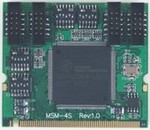
Comprehensive Product Summary – Artila MSM‑4S Mini‑PCI 4‑Port RS‑232/422/485 Module
### 1. Product Overview
Product Name: MSM‑4S
Model: MSM‑4S
Series: Mini‑PCI Industrial Serial Communication Module
Article Number: MSM‑4S
Manufacturer: Artila Electronics Co., Ltd.
Chipset: Oxford Semiconductor OXmPCI954 (Quad UART Controller)
The Artila MSM‑4S is a compact, high‑performance Mini‑PCI serial communication module designed for embedded and industrial computing platforms requiring multiple serial interfaces. It integrates four independent serial ports—two configurable as RS‑232/422/485 and two fixed RS‑232—based on the Oxford OXmPCI954 quad‑UART controller. The module provides robust data throughput, hardware‑based flow control, and comprehensive driver support for Windows and Linux environments.
### 2. Key Features
- Four Independent Serial Ports:
- 2 × RS‑232/422/485 selectable via DIP switches
- 2 × dedicated RS‑232 ports
- High‑Speed Data Transfer:
- Baud rates from 50 bps to 921.6 kbps
- Over 700 kbps throughput per port concurrently
- Advanced UART Architecture:
- 16C950‑compatible UARTs with 128‑byte transmit/receive FIFOs
- Oxford OXmPCI954 chipset for high‑efficiency PCI/mini‑PCI communication
- Hardware Auto‑Direction Control:
- Automatic TX/RX switching for RS‑485 half‑duplex operation
- Surge and ESD Protection:
- 15 kV ESD protection on all signal lines
- Compact Mini‑PCI Form Factor:
- Dimensions: 59 × 50 mm, height 50 mm
- Low Power Consumption:
- 200 mA @ 3.3 VDC typical
- Software Compatibility:
- Drivers for Windows 95/98/ME/NT/2000/XP/2003 and Linux kernel 2.4.12+
- Industrial Reliability:
- Operating temperature 0–55 °C, humidity 5–95 % RH
- CE Class A and FCC Class A compliance
### 3. Technical Specifications
Bus Interface: Mini‑PCI (3.3 V signaling)
IRQ Usage: Single shared IRQ for all ports (up to four boards sharing one IRQ)
UART Controller: Oxford Semiconductor OXmPCI954 or compatible
Connector Type: 10‑pin header per serial port
Protection: 15 kV ESD on all signal lines
Power Requirements: 3.3 VDC @ 200 mA
Dimensions: 59 mm (L) × 50 mm (W)
Operating Environment:
- Temperature: 0 – 55 °C (32 – 131 °F)
- Humidity: 5 – 95 % RH (non‑condensing)
Certifications: CE Class A, FCC Class A
Serial Port Configuration:
- P1, P2: RS‑232/422/485 selectable via DIP switches (S1–S4)
- P3, P4: RS‑232 only
Serial Communication Parameters:
- Baud Rate: 50 bps – 921.6 kbps
- Parity: None, Even, Odd, Mark, Space
- Data Bits: 5, 6, 7, 8
- Stop Bits: 1, 1.5, 2
- Flow Control: RTS/CTS, XON/XOFF, or None
### 4. Functionality
The MSM‑4S operates as a four‑channel serial expansion card for embedded PCs or industrial controllers equipped with a Mini‑PCI slot. Each port functions independently, supporting asynchronous serial communication for a wide range of devices such as PLCs, sensors, modems, barcode scanners, and industrial automation equipment.
Operation Modes:
- RS‑232: Standard full‑duplex communication for legacy serial devices.
- RS‑422: Differential signaling for long‑distance, noise‑immune communication.
- RS‑485: Half‑duplex multi‑drop bus with automatic direction control.
Compatibility:
- Fully compatible with 16C550/16C950 UART standards.
- Supports Windows and Linux serial drivers without custom firmware.
Applications:
- Industrial automation and control systems
- Data acquisition and instrumentation
- Embedded computing and communication gateways
- POS and kiosk systems
- SCADA and telemetry networks
### 5. Components & Accessories
Included Items:
- MSM‑4S Mini‑PCI module
- Four CBL‑F10M9‑20 cables (10‑pin header to DB9 male, 20 cm length)
Optional Accessories:
- Additional CBL‑F10M9‑20 cables for replacement or extended installations
- Custom cable assemblies for panel‑mount DB9 connectors
Connectors:
- 10‑pin internal headers for each serial port
- DB9 male connectors via included cables
### 6. Installation & Setup
System Requirements:
- Mini‑PCI slot supporting 3.3 V signaling
- Available IRQ (shared across ports)
- Supported operating system (Windows 95–2003 or Linux 2.4.12+)
Installation Steps:
1. Power off the host system and insert the MSM‑4S into the Mini‑PCI slot.
2. Secure the module using the mounting screw.
3. Connect the provided CBL‑F10M9‑20 cables to the 10‑pin headers.
4. Configure P1 and P2 interface modes (RS‑232/422/485) using DIP switches S1–S4.
5. Boot the system and install the appropriate driver package.
6. Verify port detection in the OS device manager or via `dmesg` (Linux).
Configuration:
- DIP switch selection determines electrical interface type.
- Software configuration of baud rate, parity, and flow control via driver settings.
### 7. Performance & Capabilities
Data Throughput:
- Sustained > 700 kbps per port concurrently
- Maximum baud rate 921.6 kbps
FIFO Buffers:
- 128‑byte transmit and receive FIFOs per UART channel
- Reduced CPU overhead and improved multitasking performance
Latency & Efficiency:
- Zero or one PCI wait‑state access to internal UARTs
- Global interrupt status and shadowed FIFO levels for low‑latency driver response
Power Efficiency:
- 3.3 V operation with 200 mA typical draw
- Compliant with PCI Power Management Specification 1.1
Limitations:
- Operating temperature limited to 55 °C
- Mini‑PCI form factor restricts external isolation or galvanic separation
### 8. Standards & Compliance
Electrical & Interface Standards:
- RS‑232 (TIA/EIA‑232‑F)
- RS‑422 (TIA/EIA‑422‑B)
- RS‑485 (TIA/EIA‑485‑A)
- PCI Local Bus Specification 3.0
- Mini‑PCI Specification 1.0
Regulatory Compliance:
- CE Class A (EMC Directive)
- FCC Class A (Part 15, Subpart B)
Chipset Compliance:
- PCI Power Management Specification 1.1
- Microsoft Communications Device‑Class Power Management Specification 2.0
- IEEE 1284 (parallel port compatibility within OXmPCI954 architecture)
### 9. Additional Information
Warranty:
- Standard manufacturer warranty (typically one year; refer to Artila policy)
Technical Support:
- Driver downloads and documentation available from Artila’s support portal
- OEM customization and integration assistance available
Maintenance:
- No periodic calibration required
- Ensure adequate airflow and ESD‑safe handling during installation
Firmware & Driver Updates:
- Windows and Linux driver packages maintained by Artila
- Compatible with Oxford Semiconductor reference drivers
### Detailed Chipset Summary – Oxford OXmPCI954
The MSM‑4S’s performance is driven by the Oxford Semiconductor OXmPCI954, a high‑integration quad‑UART and parallel‑port controller optimized for PCI and Mini‑PCI applications.
Core Architecture:
- Four internal OX16C950 UARTs, each with 128‑byte FIFOs
- Optional IEEE 1284‑compliant parallel port or 8‑bit local bus
- 32‑bit, 33 MHz PCI target‑only controller
- Fully compliant with PCI Local Bus 3.0 and Power Management 1.1
UART Capabilities:
- Baud rates up to 15 Mbps (asynchronous) or 60 Mbps (1× clock mode)
- 9‑bit data framing, parity, and stop‑bit configuration
- Automatic in‑band (XON/XOFF) and out‑of‑band (RTS/CTS, DSR/DTR) flow control
- Programmable trigger levels and readable FIFO fill status
- Infrared (IrDA) mode support
- RS‑485 buffer enable output for half‑duplex control
Power Management:
- Supports D0, D2, D3 states with PME# wake‑up capability
- Optional EEPROM configuration for subsystem IDs and power parameters
Electrical Characteristics:
- 3.3 V operation, 5 V‑tolerant I/O
- 160‑pin LQFP package
- Operating temperature 0 – 70 °C
Performance Enhancements:
- Zero wait‑state PCI access to internal UARTs
- Global interrupt and FIFO shadow registers for efficient multi‑port drivers
- Optional EEPROM for configuration and function pre‑initialization
### 10. Summary of Advantages
- High Integration: Four serial channels on a single Mini‑PCI card reduce system footprint.
- Flexible Interface Selection: Two ports configurable for RS‑232/422/485 enable mixed‑protocol environments.
- Industrial Robustness: 15 kV ESD protection and wide environmental tolerance.
- Driver Availability: Broad OS support ensures plug‑and‑play integration.
- High Throughput: 128‑byte FIFOs and optimized PCI access minimize CPU load.
- Scalability: Up to four MSM‑4S modules can share a single IRQ, supporting up to 16 serial ports per system.
### 11. Ordering Information
| Model | Description | Included Accessories |
|------------|-----------------|--------------------------|
| MSM‑4S | Mini‑PCI 4‑Port Industrial Serial Communication Module | Four CBL‑F10M9‑20 cables (10‑pin header to DB9 male, 20 cm) |
| CBL‑F10M9‑20 | Optional replacement cable | 10‑pin header to DB9 male, 20 cm length |
### 12. Typical Applications
- Embedded industrial PCs and automation controllers
- Serial device servers and communication gateways
- Machine vision and robotics systems
- Transportation and fleet management terminals
- Energy monitoring and building automation
- Laboratory instrumentation and test equipment
### 13. Compliance & Reliability Summary
| Parameter | Specification |
|----------------|------------------|
| ESD Protection | ±15 kV on all signal lines |
| Operating Voltage | 3.3 VDC |
| Power Consumption | 200 mA typical |
| Operating Temperature | 0 – 55 °C |
| Humidity | 5 – 95 % RH |
| EMC Compliance | CE Class A, FCC Class A |
| UART Compatibility | 16C950 / 16C550 software compatible |
| Supported OS | Windows 95–2003, Linux 2.4.12+ |
### 14. Conclusion
The Artila MSM‑4S Mini‑PCI 4‑Port RS‑232/422/485 Module delivers a compact, reliable, and high‑performance serial communication solution for embedded and industrial systems. Leveraging the Oxford OXmPCI954 quad‑UART controller, it provides advanced flow control, high‑speed data handling, and robust electrical protection. Its flexible configuration, broad OS support, and industrial‑grade design make it ideal for OEMs and system integrators seeking scalable serial connectivity within space‑constrained platforms.

### 1. Product Overview
Product Name: MSM‑4S
Model: MSM‑4S
Series: Mini‑PCI Industrial Serial Communication Module
Article Number: MSM‑4S
Manufacturer: Artila Electronics Co., Ltd.
Chipset: Oxford Semiconductor OXmPCI954 (Quad UART Controller)
The Artila MSM‑4S is a compact, high‑performance Mini‑PCI serial communication module designed for embedded and industrial computing platforms requiring multiple serial interfaces. It integrates four independent serial ports—two configurable as RS‑232/422/485 and two fixed RS‑232—based on the Oxford OXmPCI954 quad‑UART controller. The module provides robust data throughput, hardware‑based flow control, and comprehensive driver support for Windows and Linux environments.
### 2. Key Features
- Four Independent Serial Ports:
- 2 × RS‑232/422/485 selectable via DIP switches
- 2 × dedicated RS‑232 ports
- High‑Speed Data Transfer:
- Baud rates from 50 bps to 921.6 kbps
- Over 700 kbps throughput per port concurrently
- Advanced UART Architecture:
- 16C950‑compatible UARTs with 128‑byte transmit/receive FIFOs
- Oxford OXmPCI954 chipset for high‑efficiency PCI/mini‑PCI communication
- Hardware Auto‑Direction Control:
- Automatic TX/RX switching for RS‑485 half‑duplex operation
- Surge and ESD Protection:
- 15 kV ESD protection on all signal lines
- Compact Mini‑PCI Form Factor:
- Dimensions: 59 × 50 mm, height 50 mm
- Low Power Consumption:
- 200 mA @ 3.3 VDC typical
- Software Compatibility:
- Drivers for Windows 95/98/ME/NT/2000/XP/2003 and Linux kernel 2.4.12+
- Industrial Reliability:
- Operating temperature 0–55 °C, humidity 5–95 % RH
- CE Class A and FCC Class A compliance
### 3. Technical Specifications
Bus Interface: Mini‑PCI (3.3 V signaling)
IRQ Usage: Single shared IRQ for all ports (up to four boards sharing one IRQ)
UART Controller: Oxford Semiconductor OXmPCI954 or compatible
Connector Type: 10‑pin header per serial port
Protection: 15 kV ESD on all signal lines
Power Requirements: 3.3 VDC @ 200 mA
Dimensions: 59 mm (L) × 50 mm (W)
Operating Environment:
- Temperature: 0 – 55 °C (32 – 131 °F)
- Humidity: 5 – 95 % RH (non‑condensing)
Certifications: CE Class A, FCC Class A
Serial Port Configuration:
- P1, P2: RS‑232/422/485 selectable via DIP switches (S1–S4)
- P3, P4: RS‑232 only
Serial Communication Parameters:
- Baud Rate: 50 bps – 921.6 kbps
- Parity: None, Even, Odd, Mark, Space
- Data Bits: 5, 6, 7, 8
- Stop Bits: 1, 1.5, 2
- Flow Control: RTS/CTS, XON/XOFF, or None
### 4. Functionality
The MSM‑4S operates as a four‑channel serial expansion card for embedded PCs or industrial controllers equipped with a Mini‑PCI slot. Each port functions independently, supporting asynchronous serial communication for a wide range of devices such as PLCs, sensors, modems, barcode scanners, and industrial automation equipment.
Operation Modes:
- RS‑232: Standard full‑duplex communication for legacy serial devices.
- RS‑422: Differential signaling for long‑distance, noise‑immune communication.
- RS‑485: Half‑duplex multi‑drop bus with automatic direction control.
Compatibility:
- Fully compatible with 16C550/16C950 UART standards.
- Supports Windows and Linux serial drivers without custom firmware.
Applications:
- Industrial automation and control systems
- Data acquisition and instrumentation
- Embedded computing and communication gateways
- POS and kiosk systems
- SCADA and telemetry networks
### 5. Components & Accessories
Included Items:
- MSM‑4S Mini‑PCI module
- Four CBL‑F10M9‑20 cables (10‑pin header to DB9 male, 20 cm length)
Optional Accessories:
- Additional CBL‑F10M9‑20 cables for replacement or extended installations
- Custom cable assemblies for panel‑mount DB9 connectors
Connectors:
- 10‑pin internal headers for each serial port
- DB9 male connectors via included cables
### 6. Installation & Setup
System Requirements:
- Mini‑PCI slot supporting 3.3 V signaling
- Available IRQ (shared across ports)
- Supported operating system (Windows 95–2003 or Linux 2.4.12+)
Installation Steps:
1. Power off the host system and insert the MSM‑4S into the Mini‑PCI slot.
2. Secure the module using the mounting screw.
3. Connect the provided CBL‑F10M9‑20 cables to the 10‑pin headers.
4. Configure P1 and P2 interface modes (RS‑232/422/485) using DIP switches S1–S4.
5. Boot the system and install the appropriate driver package.
6. Verify port detection in the OS device manager or via `dmesg` (Linux).
Configuration:
- DIP switch selection determines electrical interface type.
- Software configuration of baud rate, parity, and flow control via driver settings.
### 7. Performance & Capabilities
Data Throughput:
- Sustained > 700 kbps per port concurrently
- Maximum baud rate 921.6 kbps
FIFO Buffers:
- 128‑byte transmit and receive FIFOs per UART channel
- Reduced CPU overhead and improved multitasking performance
Latency & Efficiency:
- Zero or one PCI wait‑state access to internal UARTs
- Global interrupt status and shadowed FIFO levels for low‑latency driver response
Power Efficiency:
- 3.3 V operation with 200 mA typical draw
- Compliant with PCI Power Management Specification 1.1
Limitations:
- Operating temperature limited to 55 °C
- Mini‑PCI form factor restricts external isolation or galvanic separation
### 8. Standards & Compliance
Electrical & Interface Standards:
- RS‑232 (TIA/EIA‑232‑F)
- RS‑422 (TIA/EIA‑422‑B)
- RS‑485 (TIA/EIA‑485‑A)
- PCI Local Bus Specification 3.0
- Mini‑PCI Specification 1.0
Regulatory Compliance:
- CE Class A (EMC Directive)
- FCC Class A (Part 15, Subpart B)
Chipset Compliance:
- PCI Power Management Specification 1.1
- Microsoft Communications Device‑Class Power Management Specification 2.0
- IEEE 1284 (parallel port compatibility within OXmPCI954 architecture)
### 9. Additional Information
Warranty:
- Standard manufacturer warranty (typically one year; refer to Artila policy)
Technical Support:
- Driver downloads and documentation available from Artila’s support portal
- OEM customization and integration assistance available
Maintenance:
- No periodic calibration required
- Ensure adequate airflow and ESD‑safe handling during installation
Firmware & Driver Updates:
- Windows and Linux driver packages maintained by Artila
- Compatible with Oxford Semiconductor reference drivers
### Detailed Chipset Summary – Oxford OXmPCI954
The MSM‑4S’s performance is driven by the Oxford Semiconductor OXmPCI954, a high‑integration quad‑UART and parallel‑port controller optimized for PCI and Mini‑PCI applications.
Core Architecture:
- Four internal OX16C950 UARTs, each with 128‑byte FIFOs
- Optional IEEE 1284‑compliant parallel port or 8‑bit local bus
- 32‑bit, 33 MHz PCI target‑only controller
- Fully compliant with PCI Local Bus 3.0 and Power Management 1.1
UART Capabilities:
- Baud rates up to 15 Mbps (asynchronous) or 60 Mbps (1× clock mode)
- 9‑bit data framing, parity, and stop‑bit configuration
- Automatic in‑band (XON/XOFF) and out‑of‑band (RTS/CTS, DSR/DTR) flow control
- Programmable trigger levels and readable FIFO fill status
- Infrared (IrDA) mode support
- RS‑485 buffer enable output for half‑duplex control
Power Management:
- Supports D0, D2, D3 states with PME# wake‑up capability
- Optional EEPROM configuration for subsystem IDs and power parameters
Electrical Characteristics:
- 3.3 V operation, 5 V‑tolerant I/O
- 160‑pin LQFP package
- Operating temperature 0 – 70 °C
Performance Enhancements:
- Zero wait‑state PCI access to internal UARTs
- Global interrupt and FIFO shadow registers for efficient multi‑port drivers
- Optional EEPROM for configuration and function pre‑initialization
### 10. Summary of Advantages
- High Integration: Four serial channels on a single Mini‑PCI card reduce system footprint.
- Flexible Interface Selection: Two ports configurable for RS‑232/422/485 enable mixed‑protocol environments.
- Industrial Robustness: 15 kV ESD protection and wide environmental tolerance.
- Driver Availability: Broad OS support ensures plug‑and‑play integration.
- High Throughput: 128‑byte FIFOs and optimized PCI access minimize CPU load.
- Scalability: Up to four MSM‑4S modules can share a single IRQ, supporting up to 16 serial ports per system.
### 11. Ordering Information
| Model | Description | Included Accessories |
|------------|-----------------|--------------------------|
| MSM‑4S | Mini‑PCI 4‑Port Industrial Serial Communication Module | Four CBL‑F10M9‑20 cables (10‑pin header to DB9 male, 20 cm) |
| CBL‑F10M9‑20 | Optional replacement cable | 10‑pin header to DB9 male, 20 cm length |
### 12. Typical Applications
- Embedded industrial PCs and automation controllers
- Serial device servers and communication gateways
- Machine vision and robotics systems
- Transportation and fleet management terminals
- Energy monitoring and building automation
- Laboratory instrumentation and test equipment
### 13. Compliance & Reliability Summary
| Parameter | Specification |
|----------------|------------------|
| ESD Protection | ±15 kV on all signal lines |
| Operating Voltage | 3.3 VDC |
| Power Consumption | 200 mA typical |
| Operating Temperature | 0 – 55 °C |
| Humidity | 5 – 95 % RH |
| EMC Compliance | CE Class A, FCC Class A |
| UART Compatibility | 16C950 / 16C550 software compatible |
| Supported OS | Windows 95–2003, Linux 2.4.12+ |
### 14. Conclusion
The Artila MSM‑4S Mini‑PCI 4‑Port RS‑232/422/485 Module delivers a compact, reliable, and high‑performance serial communication solution for embedded and industrial systems. Leveraging the Oxford OXmPCI954 quad‑UART controller, it provides advanced flow control, high‑speed data handling, and robust electrical protection. Its flexible configuration, broad OS support, and industrial‑grade design make it ideal for OEMs and system integrators seeking scalable serial connectivity within space‑constrained platforms.

-
ds_msm4s.pdf
PDF Catalog
-
oxmpci954ds.pdf
PDF Catalog
- CBL-F10M9-20 - Cable MSM-4S 10pin header to DB9m 20cm