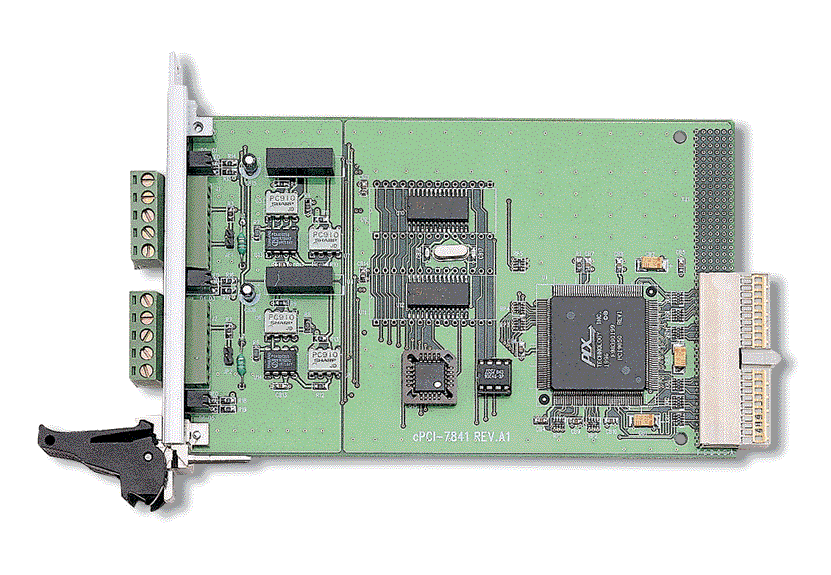
Comprehensive Product Summary – ADLINK PCI‑7841 Dual‑Port Isolated CAN Interface Card
### 1. Product Overview
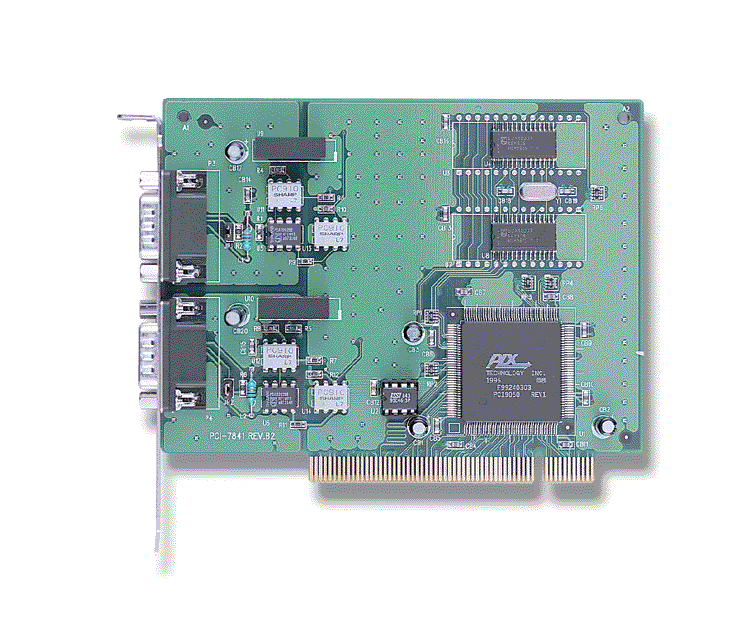
Product Name: PCI‑7841 Dual‑Port Isolated CAN Interface Card
Model Numbers: PCI‑7841 / cPCI‑7841 / PM‑7841
Series: NuCOM® Industrial Communication Interface Series
Article Number: PCI‑7841
Manufacturer: ADLINK Technology Inc.
Product Type: Dual‑Port Isolated Controller Area Network (CAN) Interface Card
Supported Bus Standards: PCI, CompactPCI (cPCI), and PC/104 (PM)
The ADLINK PCI‑7841 family provides a high‑performance, dual‑channel CAN interface solution for industrial PCs. Designed for robust and deterministic communication in automation and control environments, the PCI‑7841 series supports CAN 2.0A and 2.0B protocols and offers optical isolation for reliable operation in electrically noisy environments. The product line includes three form factors—standard PCI, CompactPCI, and PC/104—ensuring compatibility across a wide range of embedded and industrial computing platforms.
### 2. Key Features
- Dual Independent CAN Channels: Two fully independent CAN ports allow simultaneous communication on separate CAN networks or bridging between them.
- Optical Isolation: Each CAN port provides up to 2500 Vrms isolation (1000 Vrms for PM‑7841), protecting the host system from voltage surges and ground loops.
- CAN Specification Compliance: Fully compliant with CAN 2.0A (11‑bit ID) and CAN 2.0B (29‑bit ID) standards.
- High‑Speed Communication: Supports programmable data rates up to 1 Mbps, with standard DeviceNet rates of 125 kbps, 250 kbps, and 500 kbps.
- Bridge Functionality: Enables interconnection between two CAN networks for data exchange or protocol translation.
- Integrated CAN Controller: Utilizes the Philips SJA1000 CAN controller for reliable bus arbitration, error detection, and automatic retransmission.
- Transceiver Technology: Employs 82C250/82C251 transceivers for robust physical‑layer performance.
- Plug‑and‑Play PCI Configuration: Automatic resource allocation via BIOS—no manual jumper settings required for PCI and cPCI versions.
- Software Support: Includes DOS libraries, Windows 95/98/NT drivers, and comprehensive C/C++ and Visual Basic APIs for CAN and DeviceNet communication.
- Application Layer Support: Provides master‑side interfaces for CANopen, DeviceNet, and Smart Distributed System (SDS) protocols.
- Industrial‑Grade Design: Wide operating temperature range (0 – 60 °C), high humidity tolerance (5 – 95 % non‑condensing), and durable PCB construction.
- Diagnostic LEDs (cPCI/PM versions): On‑board LEDs indicate port activity and status for quick troubleshooting.
- Termination Control: On‑board 120 Ω termination resistors selectable via jumpers (JP1/JP2).
### 3. Technical Specifications
| Parameter | PCI‑7841 | cPCI‑7841 | PM‑7841 |
|----------------|--------------|---------------|-------------|
| Ports | 2 × CAN channels (V2.0 A/B) | 2 × CAN channels (V2.0 A/B) | 2 × CAN channels (V2.0 A/B) |
| CAN Controller | Philips SJA1000 | Philips SJA1000 | Philips SJA1000 |
| CAN Transceiver | 82C250 | 82C250 | 82C250 / 82C251 |
| Signal Lines | CAN_H, CAN_L | CAN_H, CAN_L | CAN_H, CAN_L |
| Isolation Voltage | 2500 Vrms | 2500 Vrms | 1000 Vrms |
| Connectors | Dual DB‑9 male | Dual DB‑9 male | Dual 5‑pin male headers |
| Bus Interface | PCI 2.1 | CompactPCI | PC‑104 (ISA compatible) |
| IRQ / I/O Address | Set by Plug‑and‑Play BIOS | Set by Plug‑and‑Play BIOS | Set by jumper (IRQ) and DIP switch (I/O base) |
| Memory Mapping | Direct memory‑mapped CAN controller | Direct memory‑mapped CAN controller | 128 bytes software‑programmable |
| Power Consumption | 400 mA @ 5 V typical / 900 mA max | 400 mA @ 5 V typical / 900 mA max | 400 mA @ 5 V typical / 900 mA max |
| Operating Temperature | 0 – 60 °C | 0 – 60 °C | 0 – 60 °C |
| Storage Temperature | −20 – 80 °C | −20 – 80 °C | −20 – 80 °C |
| Humidity | 5 – 95 % RH, non‑condensing | 5 – 95 % RH | 5 – 95 % RH |
| Dimensions (L × H) | 132 mm × 98 mm | 132 mm × 98 mm | 90.17 mm × 95.89 mm |
### 4. Functionality
The PCI‑7841 family provides a hardware and software platform for implementing CAN‑based communication in industrial automation, process control, and manufacturing systems. Each card integrates two independent CAN channels that can operate separately or in bridge mode. The onboard SJA1000 controllers handle message arbitration, error detection, and retransmission automatically, ensuring deterministic and fault‑tolerant communication.
Use Cases and Applications:
- Industrial automation networks using CANopen or DeviceNet protocols
- Process monitoring and distributed control systems
- Manufacturing automation and robotics
- Product testing and data acquisition systems
- Embedded PC‑based control platforms requiring isolated CAN connectivity
Compatibility:
- Fully compatible with CAN 2.0A/B physical and data‑link layers
- Supports DeviceNet, CANopen, and SDS application layers
- Software libraries available for DOS, Windows 95/98/NT environments
- Compatible with standard PCI, CompactPCI, and PC‑104 bus architectures
### 5. Components & Accessories
Package Contents:
- PCI‑7841 (or cPCI‑7841 / PM‑7841) Dual‑Port Isolated CAN Interface Card
- ADLINK “All‑xxxxxx” CD‑ROM containing drivers, libraries, and example code
- User’s Guide and installation documentation
On‑Board Components:
- Two CAN transceiver channels (82C250/82C251)
- Two SJA1000 CAN controllers
- Optical isolation circuitry
- Jumper‑selectable 120 Ω termination resistors (JP1 = Port 0, JP2 = Port 1)
- Diagnostic LEDs (for cPCI and PM versions)
- DIP switch (PM‑7841) for base address configuration
- Jumpers for IRQ selection (PM‑7841)
Optional Accessories:
- CAN bus cables (DB‑9 male to DB‑9 male)
- External termination adapters
- DeviceNet‑compliant cabling and connectors
### 6. Installation & Setup
Handling Precautions:
The card contains static‑sensitive components. Installation should be performed on a grounded anti‑static mat with the operator wearing a grounded wrist strap. Inspect the module for shipping damage before installation.
PCI‑7841 Installation:
1. Power off the host PC and remove the cover.
2. Insert the PCI‑7841 into an available PCI slot.
3. Secure the bracket and close the chassis.
4. Power on the system; the BIOS automatically assigns I/O and IRQ resources.
5. Install the ADLINK driver and software from the provided CD‑ROM.
cPCI‑7841 Installation:
1. Insert the module into a CompactPCI slot.
2. Ensure proper seating and secure the module.
3. Termination resistors (JP1/JP2) can be enabled as required.
4. Install drivers and verify operation via software utilities.
PM‑7841 Installation:
1. Mount the PC‑104 module onto the stack using the standard PC‑104 connectors.
2. Configure the base I/O address using the 5‑position DIP switch (SW1).
- Address range: 0x200 – 0x3F0 (default = 0x200).
3. Set IRQ level via jumpers (default = IRQ 15).
4. Verify that no other add‑on card shares the same interrupt.
5. Install the software and test communication.
Termination Configuration:
Each CAN port includes a 120 Ω resistor. Enable or disable termination via JP1 (Port 0) and JP2 (Port 1) depending on network topology.
### 7. Performance & Capabilities
- Data Rate: Programmable up to 1 Mbps; supports standard DeviceNet rates (125 / 250 / 500 kbps).
- Bus Arbitration: Non‑destructive bitwise arbitration ensures deterministic message priority.
- Error Handling: Automatic error detection, correction, and retransmission.
- Isolation: 2500 Vrms (PCI/cPCI) or 1000 Vrms (PM) galvanic isolation between CAN and host system.
- Buffering: Hardware FIFO and driver‑level buffering for reliable data throughput.
- Software API: Comprehensive function library for CAN and DeviceNet operations, including:
- Port configuration (`CanConfigPort`, `CanDetectBaudrate`)
- Message transmission and reception (`CanSendMsg`, `CanRcvMsg`)
- Error and status monitoring (`CanGetErrorCode`, `CanGetPortStatus`)
- Event handling (`CanInstallCallBack`, `CanInstallEvent`)
- DeviceNet communication (`SendDeviceNetPacket`, `RcvDeviceNetPacket`, `DNetScan`, `DNetSetBaud`, etc.)
- Throughput: Optimized for real‑time industrial communication with minimal latency.
- Limitations: FIFO depth limited to 64 bytes (3–21 packets); driver buffering compensates for high‑load conditions.
### 8. Standards & Compliance
- CAN Protocol: ISO 11898‑1/2 compliant (CAN 2.0A/B)
- DeviceNet Compatibility: Supports ODVA DeviceNet protocol layers
- Electrical Isolation: Meets industrial isolation standards up to 2500 Vrms
- Bus Interface Standards:
- PCI 2.1 compliant (32‑bit, 33 MHz)
- CompactPCI 2.0 compliant
- PC‑104 (ISA) compliant
- Environmental Compliance: Designed for industrial temperature and humidity ranges
- Software Environment: Compatible with DOS, Windows 95/98/NT operating systems
- Safety and EMC: Designed for high noise immunity and robust industrial operation
### 9. Additional Information
Warranty & Support:
ADLINK provides standard limited warranty coverage for manufacturing defects. Technical support, driver updates, and documentation are available through ADLINK’s support portal.
Maintenance:
- Keep connectors clean and free from dust.
- Verify termination and grounding periodically in field installations.
- Use only ADLINK‑approved cables and accessories to maintain isolation integrity.
Software Updates:
Driver and library updates are periodically released to support new operating systems and enhance performance. The ADLINK “All‑xxxxxx” CD‑ROM includes sample code, API documentation, and diagnostic utilities.
Developer Resources:
- Programming Interfaces: C/C++ and Visual Basic APIs for CAN and DeviceNet layers.
- Structures and Data Types:
- `PORT_STRUCT` for port configuration (mode, acceptance code/mask, baud rate).
- `CAN_PACKET` for CAN message frames (ID, RTR, data length, payload).
- `DEVICENET_PACKET` for DeviceNet message encapsulation (Group, MAC_ID, Message_ID, data).
- Event Handling: Callback and event‑driven mechanisms for error, overrun, and bus events under DOS and Windows environments.
- Diagnostic Functions: Error counters, LED status control, and receive‑count queries for real‑time monitoring.
Typical Development Workflow:
1. Install driver and library.
2. Open CAN port using `CanOpenDriver()`.
3. Configure port parameters via `CanConfigPort()`.
4. Send and receive messages using `CanSendMsg()` and `CanRcvMsg()`.
5. Monitor errors and status with `CanGetErrorCode()` and related functions.
6. Close port with `CanCloseDriver()` after operation.
DeviceNet Functionality Highlights:
- Explicit and Poll‑IO connection management (`DNetOpenExp`, `DNetOpenIO`, `DNetCloseExp`, `DNetCloseIO`).
- Network scanning and identity retrieval (`DNetScan`, `DNetIdentity`).
- Parameter configuration (`DNetSetID`, `DNetSetBaud`, `DNetSetSafeOut`).
- Assembly object access (`DNetAsmIn`, `DNetAsmOut`).
- Watchdog configuration (`DNetSetWDTime`, `DNetSetWD`).
Reliability and Longevity:
The PCI‑7841 series has been field‑proven in industrial environments since its introduction, offering stable operation, long‑term availability, and backward compatibility with legacy systems.
### Summary
The ADLINK PCI‑7841 Dual‑Port Isolated CAN Interface Card is a versatile, industrial‑grade communication interface designed for high‑reliability CAN and DeviceNet networking. With dual isolated channels, full compliance with CAN 2.0A/B, and comprehensive software support, it provides a robust platform for automation, control, and embedded applications. The availability of PCI, CompactPCI, and PC‑104 versions ensures seamless integration into diverse system architectures, while its extensive API library simplifies development of custom CAN‑based solutions.
Engineered for performance, isolation, and ease of use, the PCI‑7841 family remains a dependable choice for developers and system integrators implementing real‑time industrial communication networks.


 LOOKING FOR THE RIGHT
 PCI7841 Manual.PDF
Manual
PCI7841 Manual.PDF
Manual