 LOOKING FOR THE RIGHT
INDUSTRIAL SOLUTION?
Discover embedded, communication and automation solutions tailored to your application.

- High-Speed Distributed I/O Communication:
Operates at a data rate of 6 Mbps using a full-duplex RS-422 communication scheme with transformer isolation.
- Real-Time Deterministic Performance:
The I/O scan time is linearly proportional to the number of slave modules, ensuring predictable and repeatable timing. Each additional slave adds 30.1 µs to the total scan cycle.
- Large I/O Capacity:
Supports up to 63 slave I/O modules per master, with each module providing up to 32 input/output channels. A single PC can host up to 16 masters, enabling control of over 16,000 I/O points.
- Simple and Cost-Effective Wiring:
Uses standard Cat.5 100Base-TX Ethernet cables with RJ45 connectors, minimizing wiring complexity and installation cost.
- Self-Diagnostic and Error Handling:
Built-in CRC12 error checking and slave no-response counters ensure robust communication integrity. The system automatically detects and flags communication errors.
- Modular and Scalable Architecture:
The HSL system’s modular design allows easy expansion by adding slave modules without requiring additional PCI slots.
- Ease of Programming:
Equipped with 32 KB of onboard SRAM for I/O data buffering. Users can access I/O data directly through memory-mapped PCI operations without complex protocol handling.
- Comprehensive Software Support:
Includes Windows DLL drivers, Linux drivers, LabVIEW VIs, ISaGRAF SoftPLC drivers, OPC server, and DDE server for SCADA integration.
- Industrial-Grade Reliability:
Designed for continuous operation in industrial environments with operating temperatures from 0°C to 60°C.
Operates at a data rate of 6 Mbps using a full-duplex RS-422 communication scheme with transformer isolation.
- Real-Time Deterministic Performance:
The I/O scan time is linearly proportional to the number of slave modules, ensuring predictable and repeatable timing. Each additional slave adds 30.1 µs to the total scan cycle.
- Large I/O Capacity:
Supports up to 63 slave I/O modules per master, with each module providing up to 32 input/output channels. A single PC can host up to 16 masters, enabling control of over 16,000 I/O points.
- Simple and Cost-Effective Wiring:
Uses standard Cat.5 100Base-TX Ethernet cables with RJ45 connectors, minimizing wiring complexity and installation cost.
- Self-Diagnostic and Error Handling:
Built-in CRC12 error checking and slave no-response counters ensure robust communication integrity. The system automatically detects and flags communication errors.
- Modular and Scalable Architecture:
The HSL system’s modular design allows easy expansion by adding slave modules without requiring additional PCI slots.
- Ease of Programming:
Equipped with 32 KB of onboard SRAM for I/O data buffering. Users can access I/O data directly through memory-mapped PCI operations without complex protocol handling.
- Comprehensive Software Support:
Includes Windows DLL drivers, Linux drivers, LabVIEW VIs, ISaGRAF SoftPLC drivers, OPC server, and DDE server for SCADA integration.
- Industrial-Grade Reliability:
Designed for continuous operation in industrial environments with operating temperatures from 0°C to 60°C.
Comprehensive Product Summary: ADLINK PCI-7851 HSL Master Controller Interface Card
### 1. Product Overview
Product Name: HSL Master Controller Interface Card
Model: PCI-7851
Series: HSL (High Speed Link) Distributed I/O System
Article Number: PCI-7851
Manufacturer: ADLINK Technology Inc.
Part Number: 50-12100-200
Revision: Manual Rev. 1.00 (March 26, 2001)
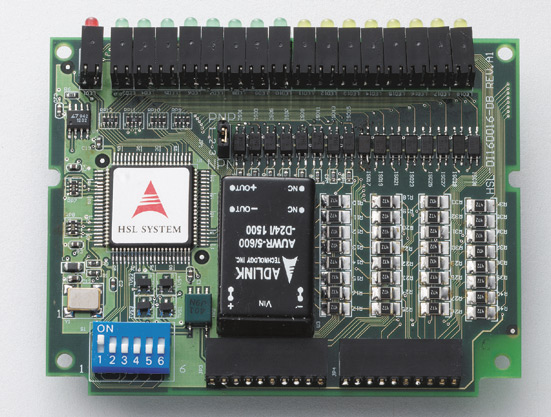
The ADLINK PCI-7851 is a high-performance HSL (High Speed Link) master controller interface card designed for distributed I/O systems. It serves as the central communication controller between a host PC and multiple remote HSL slave I/O modules. The PCI-7851 enables real-time, deterministic, and high-speed data acquisition and control over a distributed network using standard Ethernet cabling. It is part of ADLINK’s HSL product family, which includes master controllers, slave I/O modules, and terminal bases for industrial automation and data acquisition applications.
### 2. Key Features
- High-Speed Distributed I/O Communication:
Operates at a data rate of 6 Mbps using a full-duplex RS-422 communication scheme with transformer isolation.
- Real-Time Deterministic Performance:
The I/O scan time is linearly proportional to the number of slave modules, ensuring predictable and repeatable timing. Each additional slave adds 30.1 µs to the total scan cycle.
- Large I/O Capacity:
Supports up to 63 slave I/O modules per master, with each module providing up to 32 input/output channels. A single PC can host up to 16 masters, enabling control of over 16,000 I/O points.
- Simple and Cost-Effective Wiring:
Uses standard Cat.5 100Base-TX Ethernet cables with RJ45 connectors, minimizing wiring complexity and installation cost.
- Self-Diagnostic and Error Handling:
Built-in CRC12 error checking and slave no-response counters ensure robust communication integrity. The system automatically detects and flags communication errors.
- Modular and Scalable Architecture:
The HSL system’s modular design allows easy expansion by adding slave modules without requiring additional PCI slots.
- Ease of Programming:
Equipped with 32 KB of onboard SRAM for I/O data buffering. Users can access I/O data directly through memory-mapped PCI operations without complex protocol handling.
- Comprehensive Software Support:
Includes Windows DLL drivers, Linux drivers, LabVIEW VIs, ISaGRAF SoftPLC drivers, OPC server, and DDE server for SCADA integration.
- Industrial-Grade Reliability:
Designed for continuous operation in industrial environments with operating temperatures from 0°C to 60°C.
### 3. Technical Specifications
Bus Interface:
- PCI Local Bus Specification Rev. 2.1 compliant
- Plug-and-play configuration (IRQ and memory assigned by BIOS)
Controller:
- ASIC-based HSL master controller
- External clock: 48 MHz
Memory:
- 32 KB SRAM (12 ns) for I/O data buffering
Communication Interface:
- RS-422 full-duplex with transformer isolation
- Data rate: 6 Mbps (selectable via DIP switch: 3M, 6M, 12M)
- Two RJ45 ports per master
- Communication model: single-master/multi-slave
- Protocol: command-response with CRC12 error detection
Connectors:
- RJ45 x 2 (PCI-7851)
- RJ45 x 4 (PCI-7852 dual-master variant)
Electrical Characteristics:
- Power consumption: +5V @ 500 mA (typical)
Physical Dimensions:
- PCB size: 176 mm (L) x 107 mm (W)
Environmental Conditions:
- Operating temperature: 0°C to 60°C
- Storage temperature: -20°C to 80°C
Indicators:
- Power LED status indicator
### 4. Functionality
The PCI-7851 functions as the master controller in an HSL distributed I/O system. It manages communication between the host PC and remote slave I/O modules through a deterministic polling mechanism. The master continuously updates output values and retrieves input data from each slave module in a cyclic manner.
Operation Principle:
- The master sends output commands to each slave module sequentially.
- Each slave responds with its current input status.
- The master stores all I/O data in its onboard SRAM.
- The host PC accesses this data directly via the PCI bus.
Use Cases and Applications:
- Distributed PLC Replacement: Enables PC-based control systems to replace traditional PLC networks using Ethernet cabling.
- Remote Real-Time Data Acquisition (DAQ): Ideal for high-speed, deterministic data collection from distributed sensors and actuators.
- SCADA Systems: Serves as the hardware interface for supervisory control and data acquisition systems.
- Industrial Automation: Suitable for machine control, process monitoring, and factory automation.
Compatibility:
- Operating Systems: Windows 95/98/2000/NT, Linux
- Programming Environments: C/C++, Visual Basic, LabVIEW, ISaGRAF, OPC, DDE
### 5. Components & Accessories
Included Components:
- PCI-7851 HSL Master Controller Card
- Driver and Utility Software (on ADLINK All-In-One CD)
- User Manual and Installation Guide
Optional Accessories:
- HSL Slave I/O Modules:
- HSL-DI16DO16-DB, HSL-DI32-DB, HSL-DO32-DB, HSL-R8DI16-DB, etc.
- Available in DB (Daughter Board), M (Metal Enclosure), and C (Compact) formats.
- Terminal Bases:
- HSL-TB32-DIN, HSL-TB64-DIN, HSL-TB32-M-DIN, HSL-TB16-C
- Provide field wiring interfaces and DIN-rail mounting.
- Cabling:
- Standard Cat.5 100Base-TX Ethernet cables with RJ45 connectors (up to 200 m per port).
### 6. Installation & Setup
Hardware Installation:
1. Power off the PC and disconnect peripherals.
2. Insert the PCI-7851 into an available 32-bit PCI slot.
3. Secure the card with the chassis screw.
4. Connect slave modules using RJ45 Ethernet cables.
5. Power on the system; BIOS will automatically assign resources.
Configuration:
- Set communication speed via DIP switch (SW1).
Default: 6 Mbps
- Connect up to 32 slave modules per port (maximum 63 per master).
- Assign unique slave addresses (1–63) using DIP switches on each module.
- Enable termination resistor on the last module in the chain.
Software Setup:
- Install HSL DLL driver from ADLINK CD.
- Use the HSL Link Master Utility for diagnostics and auto-scan of slave modules.
- Configure and test communication before deploying application software.
### 7. Performance & Capabilities
Communication Speed:
- 6 Mbps full-duplex RS-422
I/O Refresh Rate:
- 30.1 µs × number of slave modules
- 5 modules → 150.5 µs
- 30 modules → 0.903 ms
- 63 modules → 1.895 ms (maximum)
Polling Cycle:
- Deterministic and linear with respect to slave count
- Minimum cycle time: 90.3 µs (for ≤3 modules)
Capacity:
- 63 slave modules per master
- 16 masters per PC (up to 1008 modules total)
- Maximum I/O points: 16,128 DI + 16,128 DO
Error Handling:
- CRC12 error detection
- Slave no-response counter (0–7)
- Automatic communication error flagging after 3 failed attempts
- Self-diagnostic monitoring with interrupt-driven error reporting
Limitations:
- Maximum cable length per port: 200 m
- Maximum 63 slave addresses per master (address 0 reserved)
### 8. Standards & Compliance
- PCI Local Bus Specification: Rev. 2.1 compliant
- Electrical Interface: RS-422 full-duplex with transformer isolation
- Software Standards:
- OPC (OLE for Process Control)
- DDE (Dynamic Data Exchange)
- ISaGRAF (IEC 1131-3 SoftPLC standard)
- Operating System Support: Windows 95/98/2000/NT, Linux
- Environmental Compliance: Industrial-grade design for 0–60°C operation
- Safety & EMC: Designed for industrial environments with isolation and shielding to minimize interference.
### 9. Additional Information
Warranty:
- 1-year limited warranty covering defects in materials and workmanship.
- Excludes damage from misuse, unauthorized modification, or operation beyond specifications.
Support & Service:
- Technical support via dedicated email channels:
- HSL Support: nudam@adlink.com.tw
- NuDAQ/USBDAQ: nudaq@adlink.com.tw
- Software: sw@adlink.com.tw
- Global website: [www.adlinktech.com](http://www.adlinktech.com)
Maintenance:
- Periodic inspection of cabling and connectors recommended.
- Firmware and driver updates available through ADLINK’s support portal.
Software Updates & Utilities:
- HSL DLL Driver: For Windows and Linux environments.
- HSL Link Master Utility: Diagnostic and configuration tool.
- HSL DDE Server: For SCADA integration with Wonderware InTouch.
- HSL OPC Server: For OPC-compliant client applications.
- LabVIEW VIs: For graphical programming environments.
- ISaGRAF Driver: For IEC 1131-3 SoftPLC applications.
Programming Interface (DLL Functions):
- Initialization: `W_HSL_Initial()`, `W_HSL_Close()`
- Operation Control: `W_HSL_Start()`, `W_HSL_Stop()`, `W_HSL_Auto_Start()`
- I/O Access: `W_HSL_DIO_In()`, `W_HSL_DIO_Out()`, `W_HSL_DIO_Memory_In()`, `W_HSL_DIO_Memory_Out()`
- Diagnostics: `W_HSL_Slave_Live()`, `W_HSL_Connect_Status()`
- Timer Control: `W_HSL_TMRINT_Enable()`, `W_HSL_Timer_Set()`
Maintenance Recommendations:
- Use shielded Ethernet cables in high-noise environments.
- Ensure proper grounding of terminal bases.
- Replace damaged cables or connectors immediately to maintain communication integrity.
### Summary
The ADLINK PCI-7851 HSL Master Controller Interface Card is a robust, high-speed, and deterministic distributed I/O controller designed for industrial automation, data acquisition, and control applications. Its modular architecture, real-time performance, and ease of integration with standard PC platforms make it an ideal solution for replacing traditional PLC systems with flexible, scalable, and cost-effective PC-based control networks. With comprehensive software support, extensive I/O capacity, and proven reliability, the PCI-7851 forms the backbone of ADLINK’s HSL distributed I/O ecosystem.
### 1. Product Overview
Product Name: HSL Master Controller Interface Card
Model: PCI-7851
Series: HSL (High Speed Link) Distributed I/O System
Article Number: PCI-7851
Manufacturer: ADLINK Technology Inc.
Part Number: 50-12100-200
Revision: Manual Rev. 1.00 (March 26, 2001)
The ADLINK PCI-7851 is a high-performance HSL (High Speed Link) master controller interface card designed for distributed I/O systems. It serves as the central communication controller between a host PC and multiple remote HSL slave I/O modules. The PCI-7851 enables real-time, deterministic, and high-speed data acquisition and control over a distributed network using standard Ethernet cabling. It is part of ADLINK’s HSL product family, which includes master controllers, slave I/O modules, and terminal bases for industrial automation and data acquisition applications.
### 2. Key Features
- High-Speed Distributed I/O Communication:
Operates at a data rate of 6 Mbps using a full-duplex RS-422 communication scheme with transformer isolation.
- Real-Time Deterministic Performance:
The I/O scan time is linearly proportional to the number of slave modules, ensuring predictable and repeatable timing. Each additional slave adds 30.1 µs to the total scan cycle.
- Large I/O Capacity:
Supports up to 63 slave I/O modules per master, with each module providing up to 32 input/output channels. A single PC can host up to 16 masters, enabling control of over 16,000 I/O points.
- Simple and Cost-Effective Wiring:
Uses standard Cat.5 100Base-TX Ethernet cables with RJ45 connectors, minimizing wiring complexity and installation cost.
- Self-Diagnostic and Error Handling:
Built-in CRC12 error checking and slave no-response counters ensure robust communication integrity. The system automatically detects and flags communication errors.
- Modular and Scalable Architecture:
The HSL system’s modular design allows easy expansion by adding slave modules without requiring additional PCI slots.
- Ease of Programming:
Equipped with 32 KB of onboard SRAM for I/O data buffering. Users can access I/O data directly through memory-mapped PCI operations without complex protocol handling.
- Comprehensive Software Support:
Includes Windows DLL drivers, Linux drivers, LabVIEW VIs, ISaGRAF SoftPLC drivers, OPC server, and DDE server for SCADA integration.
- Industrial-Grade Reliability:
Designed for continuous operation in industrial environments with operating temperatures from 0°C to 60°C.
### 3. Technical Specifications
Bus Interface:
- PCI Local Bus Specification Rev. 2.1 compliant
- Plug-and-play configuration (IRQ and memory assigned by BIOS)
Controller:
- ASIC-based HSL master controller
- External clock: 48 MHz
Memory:
- 32 KB SRAM (12 ns) for I/O data buffering
Communication Interface:
- RS-422 full-duplex with transformer isolation
- Data rate: 6 Mbps (selectable via DIP switch: 3M, 6M, 12M)
- Two RJ45 ports per master
- Communication model: single-master/multi-slave
- Protocol: command-response with CRC12 error detection
Connectors:
- RJ45 x 2 (PCI-7851)
- RJ45 x 4 (PCI-7852 dual-master variant)
Electrical Characteristics:
- Power consumption: +5V @ 500 mA (typical)
Physical Dimensions:
- PCB size: 176 mm (L) x 107 mm (W)
Environmental Conditions:
- Operating temperature: 0°C to 60°C
- Storage temperature: -20°C to 80°C
Indicators:
- Power LED status indicator
### 4. Functionality
The PCI-7851 functions as the master controller in an HSL distributed I/O system. It manages communication between the host PC and remote slave I/O modules through a deterministic polling mechanism. The master continuously updates output values and retrieves input data from each slave module in a cyclic manner.
Operation Principle:
- The master sends output commands to each slave module sequentially.
- Each slave responds with its current input status.
- The master stores all I/O data in its onboard SRAM.
- The host PC accesses this data directly via the PCI bus.
Use Cases and Applications:
- Distributed PLC Replacement: Enables PC-based control systems to replace traditional PLC networks using Ethernet cabling.
- Remote Real-Time Data Acquisition (DAQ): Ideal for high-speed, deterministic data collection from distributed sensors and actuators.
- SCADA Systems: Serves as the hardware interface for supervisory control and data acquisition systems.
- Industrial Automation: Suitable for machine control, process monitoring, and factory automation.
Compatibility:
- Operating Systems: Windows 95/98/2000/NT, Linux
- Programming Environments: C/C++, Visual Basic, LabVIEW, ISaGRAF, OPC, DDE
### 5. Components & Accessories
Included Components:
- PCI-7851 HSL Master Controller Card
- Driver and Utility Software (on ADLINK All-In-One CD)
- User Manual and Installation Guide
Optional Accessories:
- HSL Slave I/O Modules:
- HSL-DI16DO16-DB, HSL-DI32-DB, HSL-DO32-DB, HSL-R8DI16-DB, etc.
- Available in DB (Daughter Board), M (Metal Enclosure), and C (Compact) formats.
- Terminal Bases:
- HSL-TB32-DIN, HSL-TB64-DIN, HSL-TB32-M-DIN, HSL-TB16-C
- Provide field wiring interfaces and DIN-rail mounting.
- Cabling:
- Standard Cat.5 100Base-TX Ethernet cables with RJ45 connectors (up to 200 m per port).
### 6. Installation & Setup
Hardware Installation:
1. Power off the PC and disconnect peripherals.
2. Insert the PCI-7851 into an available 32-bit PCI slot.
3. Secure the card with the chassis screw.
4. Connect slave modules using RJ45 Ethernet cables.
5. Power on the system; BIOS will automatically assign resources.
Configuration:
- Set communication speed via DIP switch (SW1).
Default: 6 Mbps
- Connect up to 32 slave modules per port (maximum 63 per master).
- Assign unique slave addresses (1–63) using DIP switches on each module.
- Enable termination resistor on the last module in the chain.
Software Setup:
- Install HSL DLL driver from ADLINK CD.
- Use the HSL Link Master Utility for diagnostics and auto-scan of slave modules.
- Configure and test communication before deploying application software.
### 7. Performance & Capabilities
Communication Speed:
- 6 Mbps full-duplex RS-422
I/O Refresh Rate:
- 30.1 µs × number of slave modules
- 5 modules → 150.5 µs
- 30 modules → 0.903 ms
- 63 modules → 1.895 ms (maximum)
Polling Cycle:
- Deterministic and linear with respect to slave count
- Minimum cycle time: 90.3 µs (for ≤3 modules)
Capacity:
- 63 slave modules per master
- 16 masters per PC (up to 1008 modules total)
- Maximum I/O points: 16,128 DI + 16,128 DO
Error Handling:
- CRC12 error detection
- Slave no-response counter (0–7)
- Automatic communication error flagging after 3 failed attempts
- Self-diagnostic monitoring with interrupt-driven error reporting
Limitations:
- Maximum cable length per port: 200 m
- Maximum 63 slave addresses per master (address 0 reserved)
### 8. Standards & Compliance
- PCI Local Bus Specification: Rev. 2.1 compliant
- Electrical Interface: RS-422 full-duplex with transformer isolation
- Software Standards:
- OPC (OLE for Process Control)
- DDE (Dynamic Data Exchange)
- ISaGRAF (IEC 1131-3 SoftPLC standard)
- Operating System Support: Windows 95/98/2000/NT, Linux
- Environmental Compliance: Industrial-grade design for 0–60°C operation
- Safety & EMC: Designed for industrial environments with isolation and shielding to minimize interference.
### 9. Additional Information
Warranty:
- 1-year limited warranty covering defects in materials and workmanship.
- Excludes damage from misuse, unauthorized modification, or operation beyond specifications.
Support & Service:
- Technical support via dedicated email channels:
- HSL Support: nudam@adlink.com.tw
- NuDAQ/USBDAQ: nudaq@adlink.com.tw
- Software: sw@adlink.com.tw
- Global website: [www.adlinktech.com](http://www.adlinktech.com)
Maintenance:
- Periodic inspection of cabling and connectors recommended.
- Firmware and driver updates available through ADLINK’s support portal.
Software Updates & Utilities:
- HSL DLL Driver: For Windows and Linux environments.
- HSL Link Master Utility: Diagnostic and configuration tool.
- HSL DDE Server: For SCADA integration with Wonderware InTouch.
- HSL OPC Server: For OPC-compliant client applications.
- LabVIEW VIs: For graphical programming environments.
- ISaGRAF Driver: For IEC 1131-3 SoftPLC applications.
Programming Interface (DLL Functions):
- Initialization: `W_HSL_Initial()`, `W_HSL_Close()`
- Operation Control: `W_HSL_Start()`, `W_HSL_Stop()`, `W_HSL_Auto_Start()`
- I/O Access: `W_HSL_DIO_In()`, `W_HSL_DIO_Out()`, `W_HSL_DIO_Memory_In()`, `W_HSL_DIO_Memory_Out()`
- Diagnostics: `W_HSL_Slave_Live()`, `W_HSL_Connect_Status()`
- Timer Control: `W_HSL_TMRINT_Enable()`, `W_HSL_Timer_Set()`
Maintenance Recommendations:
- Use shielded Ethernet cables in high-noise environments.
- Ensure proper grounding of terminal bases.
- Replace damaged cables or connectors immediately to maintain communication integrity.
### Summary
The ADLINK PCI-7851 HSL Master Controller Interface Card is a robust, high-speed, and deterministic distributed I/O controller designed for industrial automation, data acquisition, and control applications. Its modular architecture, real-time performance, and ease of integration with standard PC platforms make it an ideal solution for replacing traditional PLC systems with flexible, scalable, and cost-effective PC-based control networks. With comprehensive software support, extensive I/O capacity, and proven reliability, the PCI-7851 forms the backbone of ADLINK’s HSL distributed I/O ecosystem.
-
 HSLManual.pdf
Manual
HSLManual.pdf
Manual
-
 HSL-DDE Manual.pdf
Manual
HSL-DDE Manual.pdf
Manual
No accessories available.