
 LOOKING FOR THE RIGHT
INDUSTRIAL SOLUTION?
Discover embedded, communication and automation solutions tailored to your application.
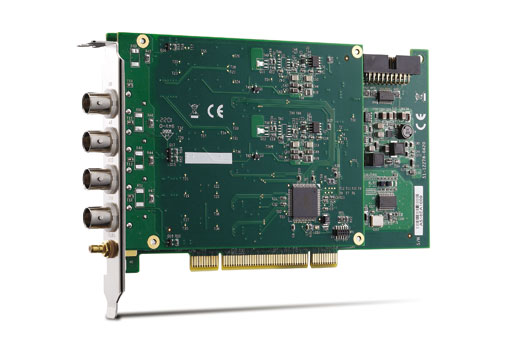
- 24‑bit Sigma‑Delta ADC and DAC: High‑resolution converters for superior dynamic range and low noise.
- Simultaneous Sampling and Output: Two analog input channels and two analog output channels operate concurrently for synchronized acquisition and generation.
- High Sampling Rates:
- Analog input: up to 432 kS/s per channel.
- Analog output: up to 216 kS/s per channel.
- Programmable Input Ranges: ±0.316 V, ±1 V, ±3.16 V, ±10 V, ±40 V.
- Programmable Output Ranges: ±0.1 V, ±1 V, ±10 V.
- AC/DC Coupling: Software‑selectable input coupling for flexible measurement of DC or AC signals.
- IEPE Sensor Support: Built‑in 4 mA excitation current for integrated electronic piezoelectric sensors (accelerometers, microphones).
- Triggering Flexibility: Supports software, analog, and external digital triggers; compatible with 5 V TTL logic.
- System Synchronization Interface (SSI): Enables synchronization of multiple PCI‑9527 cards for multi‑channel systems.
- Universal PCI Interface: 32‑bit/33 MHz PCI bus supporting both 3.3 V and 5 V signaling.
- Comprehensive Software Support: Drivers for Windows and Linux, with APIs for LabVIEW™, MATLAB®, and Visual Studio environments.
- Applications: Audio testing, acoustic measurement, vibration and noise analysis, machine condition monitoring, and structural dynamics.
- Simultaneous Sampling and Output: Two analog input channels and two analog output channels operate concurrently for synchronized acquisition and generation.
- High Sampling Rates:
- Analog input: up to 432 kS/s per channel.
- Analog output: up to 216 kS/s per channel.
- Programmable Input Ranges: ±0.316 V, ±1 V, ±3.16 V, ±10 V, ±40 V.
- Programmable Output Ranges: ±0.1 V, ±1 V, ±10 V.
- AC/DC Coupling: Software‑selectable input coupling for flexible measurement of DC or AC signals.
- IEPE Sensor Support: Built‑in 4 mA excitation current for integrated electronic piezoelectric sensors (accelerometers, microphones).
- Triggering Flexibility: Supports software, analog, and external digital triggers; compatible with 5 V TTL logic.
- System Synchronization Interface (SSI): Enables synchronization of multiple PCI‑9527 cards for multi‑channel systems.
- Universal PCI Interface: 32‑bit/33 MHz PCI bus supporting both 3.3 V and 5 V signaling.
- Comprehensive Software Support: Drivers for Windows and Linux, with APIs for LabVIEW™, MATLAB®, and Visual Studio environments.
- Applications: Audio testing, acoustic measurement, vibration and noise analysis, machine condition monitoring, and structural dynamics.
Comprehensive Product Summary – ADLINK PCI‑9527 Dynamic Signal Acquisition and Generation Card
### 1. Product Overview
Product Name: PCI‑9527
Model: PCI‑9527
Series: High‑Resolution Dynamic Signal Acquisition and Generation Modules
Article Number: PCI‑9527
Manufacturer: ADLINK Technology Inc.
The ADLINK PCI‑9527 is a high‑performance, 24‑bit, two‑channel analog input and two‑channel analog output dynamic signal acquisition and generation card designed for the PCI bus. It is part of ADLINK’s high‑resolution dynamic signal acquisition (DSA) product line, optimized for precision measurement and signal generation in audio, acoustic, and vibration analysis applications. The PCI‑9527 provides simultaneous sampling and updating on all channels, ensuring phase‑coherent data capture and playback for demanding test and measurement environments.
### 2. Key Features
- 24‑bit Sigma‑Delta ADC and DAC: High‑resolution converters for superior dynamic range and low noise.
- Simultaneous Sampling and Output: Two analog input channels and two analog output channels operate concurrently for synchronized acquisition and generation.
- High Sampling Rates:
- Analog input: up to 432 kS/s per channel.
- Analog output: up to 216 kS/s per channel.
- Programmable Input Ranges: ±0.316 V, ±1 V, ±3.16 V, ±10 V, ±40 V.
- Programmable Output Ranges: ±0.1 V, ±1 V, ±10 V.
- AC/DC Coupling: Software‑selectable input coupling for flexible measurement of DC or AC signals.
- IEPE Sensor Support: Built‑in 4 mA excitation current for integrated electronic piezoelectric sensors (accelerometers, microphones).
- Triggering Flexibility: Supports software, analog, and external digital triggers; compatible with 5 V TTL logic.
- System Synchronization Interface (SSI): Enables synchronization of multiple PCI‑9527 cards for multi‑channel systems.
- Universal PCI Interface: 32‑bit/33 MHz PCI bus supporting both 3.3 V and 5 V signaling.
- Comprehensive Software Support: Drivers for Windows and Linux, with APIs for LabVIEW™, MATLAB®, and Visual Studio environments.
- Applications: Audio testing, acoustic measurement, vibration and noise analysis, machine condition monitoring, and structural dynamics.
### 3. Technical Specifications
Physical Characteristics
- Dimensions: 174.6 mm (W) × 106.6 mm (H) (6.82" × 4.2")
- Weight: Approx. 0.4 kg (board only)
- Connectors: 4 × BNC (AI0, AI1, AO0, AO1), 1 × SMB (external trigger)
- Bus Interface: PCI, 32‑bit/33 MHz, universal signaling (3.3 V/5 V)
Environmental Conditions
- Operating Temperature: 0°C to 50°C
- Storage Temperature: –20°C to 70°C
- Relative Humidity: 10% to 90%, non‑condensing
Power Requirements
- +5 V rail: 930 mA (standby), 2330 mA (full load)
- +12 V rail: 310 mA (standby), 350 mA (full load)
Calibration
- Onboard reference: +5 V
- Temperature coefficient: ≤ ±5 ppm/°C
- Warm‑up time: 15 minutes
- Calibration interval: 1 year recommended
### 4. Functionality
The PCI‑9527 functions as a dual‑channel, simultaneous‑sampling data acquisition and generation card. Each analog input channel uses a 24‑bit sigma‑delta ADC for high‑accuracy digitization of dynamic signals, while each analog output channel employs a 24‑bit sigma‑delta DAC for precise waveform generation.
Use Cases and Applications:
- Audio Testing: Frequency response, distortion, and noise analysis.
- Acoustic Measurement: Microphone calibration, sound pressure level testing.
- Vibration Analysis: Accelerometer‑based structural and machine vibration monitoring.
- Machine Condition Monitoring: Predictive maintenance and fault detection.
- Research and Education: Laboratory signal analysis and instrumentation.
Compatibility:
- Operating Systems: Windows 7/Vista/XP, Linux
- Programming Environments: VB.NET, VC.NET, C/C++, Delphi, LabVIEW, MATLAB
- Supported Drivers: DAQPilot, DASK, DASK/X, and Dynamic Signal Assistant (DSA Utility)
### 5. Components & Accessories
Included Items:
- PCI‑9527 card
- ADLINK All‑in‑One software CD
- User manual and documentation
Optional Accessories:
- SMB‑SMB‑1M: 1‑meter SMB‑to‑SMB cable
- SMB‑BNC‑1M: 1‑meter SMB‑to‑BNC cable
Connectors:
- Analog Inputs: AI0, AI1 (BNC)
- Analog Outputs: AO0, AO1 (BNC)
- External Trigger: SMB connector (5 V TTL compatible)
### 6. Installation & Setup
Requirements:
- PCI slot (32‑bit/33 MHz) on a compatible PC motherboard
- Anti‑static handling precautions during installation
Mounting:
- Insert the PCI‑9527 into an available PCI slot, ensuring full seating of the connector.
- Secure the front panel bracket with the retaining screw.
- Connect BNC cables to the desired input/output channels.
Configuration:
- Software installation via ADLINK All‑in‑One CD.
- Device configuration and calibration through ADLINK’s Dynamic Signal Assistant or DAQPilot utility.
- Supports plug‑and‑play detection under Windows and Linux.
### 7. Performance & Capabilities
Analog Input (AI):
- Channels: 2 simultaneous sampling
- Resolution: 24 bits
- ADC Type: Sigma‑delta
- Sampling Rate: 1 kS/s to 432 kS/s (programmable in 454.7 µS/s increments)
- Input Configuration: Differential or pseudo‑differential (software‑selectable)
- Input Coupling: AC or DC (software‑selectable)
- Input Ranges: ±0.316 V, ±1 V, ±3.16 V, ±10 V, ±40 V
- Input Impedance:
- Differential: 1 MΩ to ground (both + and –)
- Pseudo‑differential: + input 1 MΩ to ground, – input 50 Ω to ground
- IEPE Excitation: 4 mA per channel, 24 V compliance
- Overvoltage Protection: ±40 Vpk (differential), ±40 V/+10 V (pseudo‑differential)
- Bandwidth (–3 dB): 130 kHz
- AC Coupling Cutoff: –3 dB at 3.5 Hz, –0.1 dB at 26 Hz
- Crosstalk: < –100 dB (adjacent channels)
- FIFO Buffer: 2048 samples per channel
- Data Transfer: Bus‑mastering DMA
Analog Output (AO):
- Channels: 2 simultaneous update
- Resolution: 24 bits
- DAC Type: Sigma‑delta
- Update Rate: 1 kS/s to 216 kS/s (programmable in 227.3 µS/s increments)
- Output Configuration: Differential or pseudo‑differential (software‑selectable)
- Output Ranges: ±0.1 V, ±1 V, ±10 V
- Output Coupling: DC
- Minimum Load: 600 Ω
- Output Impedance:
- Differential: 50 kΩ to chassis ground (both + and –), 10 kΩ between outputs
- Pseudo‑differential: + output 10 kΩ to chassis, – output 50 Ω to chassis
- Bandwidth (–3 dB): 110 kHz
- THD+N:
- ±0.1 V range: –89 dB
- ±1 V and ±10 V ranges: –101 dB
- FIFO Buffer: 2048 samples per channel
Timing & Synchronization:
- Internal Clock: 80 MHz, ±20 ppm accuracy
- DDS Clock Source: 125 MHz onboard oscillator
- External Clock (optional): 10 MHz reference via PXI backplane (for PXI variant)
- Filter Delays:
- ADC: 5–12 samples depending on rate
- DAC: 43–177 samples depending on rate
Triggering:
- Sources: Software, analog (AI0/AI1), external digital (SMB), SSI bus
- Analog Trigger: ±Full‑scale range, 24‑bit resolution, positive/negative slope selectable
- Digital Trigger: 5 V TTL, rising/falling edge, ≥12.5 ns pulse width
- Modes: Post‑trigger and delay‑trigger
- Synchronization: Multiple modules via SSI or PXI Trigger Bus
Performance Metrics:
- AI Offset Error: ±0.05–0.5 mV depending on range
- AI Gain Error: ±0.2% (±40 V range ±0.5%)
- AO Offset Error: ±0.05–1 mV depending on range
- AO Gain Error: ±0.4%
- Dynamic Range: >100 dB typical
Limitations:
- Maximum total throughput limited by PCI bus bandwidth.
- Shared timebase between ADC and DAC requires coordinated configuration for simultaneous operation.
### 8. Standards & Compliance
- Bus Compliance: PCI Local Bus Specification, 32‑bit/33 MHz, universal signaling
- EMC/EMI: CE, FCC Class A
- Environmental Compliance: RoHS and WEEE directives
- Calibration Standards: Factory calibrated to NIST‑traceable references
- PXI Variant Compliance: PXI Specification Rev. 2.2 (for PXI‑9527)
### 9. Additional Information
Warranty:
- Standard manufacturer’s warranty (typically one year, extendable).
- Factory calibration valid for one year; user self‑calibration supported via software.
Support & Maintenance:
- Global technical support through ADLINK regional offices.
- Software updates and driver downloads available from [www.adlinktech.com](https://www.adlinktech.com).
- Maintenance includes periodic calibration and firmware updates.
Software Tools:
- Dynamic Signal Assistant (DSA Utility): GUI‑based configuration and visualization tool for real‑time signal acquisition and generation.
- DAQPilot SDK: Comprehensive API for Windows and LabVIEW integration.
- DASK/DASK‑X: Low‑level driver libraries for Windows and Linux.
- MATLAB Toolbox Adapter: For advanced signal processing and analysis.
Safety & Handling:
- Handle only in ESD‑protected environments.
- Avoid exposure to moisture, high temperature, or mechanical shock.
- Follow all installation and grounding instructions in the user manual.
Manufacturer Contact:
ADLINK Technology, Inc.
9F, No.166 Jian Yi Road, Zhonghe District, New Taipei City 235, Taiwan
Tel: +886‑2‑8226‑5877 | Email: service@adlinktech.com
### Summary
The ADLINK PCI‑9527 is a precision 24‑bit, 2‑in/2‑out dynamic signal acquisition and generation card engineered for high‑fidelity measurement and playback of analog signals. With simultaneous sampling, wide input/output ranges, and flexible triggering, it is ideal for laboratory, industrial, and research applications requiring accurate time‑synchronized data. Its sigma‑delta architecture ensures exceptional noise performance and linearity, while comprehensive software support enables seamless integration into test systems and automation frameworks.
The PCI‑9527’s combination of high resolution, broad dynamic range, and robust synchronization capabilities make it a versatile solution for audio, vibration, and acoustic analysis, as well as general‑purpose data acquisition and signal generation tasks.
### 1. Product Overview
Product Name: PCI‑9527
Model: PCI‑9527
Series: High‑Resolution Dynamic Signal Acquisition and Generation Modules
Article Number: PCI‑9527
Manufacturer: ADLINK Technology Inc.
The ADLINK PCI‑9527 is a high‑performance, 24‑bit, two‑channel analog input and two‑channel analog output dynamic signal acquisition and generation card designed for the PCI bus. It is part of ADLINK’s high‑resolution dynamic signal acquisition (DSA) product line, optimized for precision measurement and signal generation in audio, acoustic, and vibration analysis applications. The PCI‑9527 provides simultaneous sampling and updating on all channels, ensuring phase‑coherent data capture and playback for demanding test and measurement environments.
### 2. Key Features
- 24‑bit Sigma‑Delta ADC and DAC: High‑resolution converters for superior dynamic range and low noise.
- Simultaneous Sampling and Output: Two analog input channels and two analog output channels operate concurrently for synchronized acquisition and generation.
- High Sampling Rates:
- Analog input: up to 432 kS/s per channel.
- Analog output: up to 216 kS/s per channel.
- Programmable Input Ranges: ±0.316 V, ±1 V, ±3.16 V, ±10 V, ±40 V.
- Programmable Output Ranges: ±0.1 V, ±1 V, ±10 V.
- AC/DC Coupling: Software‑selectable input coupling for flexible measurement of DC or AC signals.
- IEPE Sensor Support: Built‑in 4 mA excitation current for integrated electronic piezoelectric sensors (accelerometers, microphones).
- Triggering Flexibility: Supports software, analog, and external digital triggers; compatible with 5 V TTL logic.
- System Synchronization Interface (SSI): Enables synchronization of multiple PCI‑9527 cards for multi‑channel systems.
- Universal PCI Interface: 32‑bit/33 MHz PCI bus supporting both 3.3 V and 5 V signaling.
- Comprehensive Software Support: Drivers for Windows and Linux, with APIs for LabVIEW™, MATLAB®, and Visual Studio environments.
- Applications: Audio testing, acoustic measurement, vibration and noise analysis, machine condition monitoring, and structural dynamics.
### 3. Technical Specifications
Physical Characteristics
- Dimensions: 174.6 mm (W) × 106.6 mm (H) (6.82" × 4.2")
- Weight: Approx. 0.4 kg (board only)
- Connectors: 4 × BNC (AI0, AI1, AO0, AO1), 1 × SMB (external trigger)
- Bus Interface: PCI, 32‑bit/33 MHz, universal signaling (3.3 V/5 V)
Environmental Conditions
- Operating Temperature: 0°C to 50°C
- Storage Temperature: –20°C to 70°C
- Relative Humidity: 10% to 90%, non‑condensing
Power Requirements
- +5 V rail: 930 mA (standby), 2330 mA (full load)
- +12 V rail: 310 mA (standby), 350 mA (full load)
Calibration
- Onboard reference: +5 V
- Temperature coefficient: ≤ ±5 ppm/°C
- Warm‑up time: 15 minutes
- Calibration interval: 1 year recommended
### 4. Functionality
The PCI‑9527 functions as a dual‑channel, simultaneous‑sampling data acquisition and generation card. Each analog input channel uses a 24‑bit sigma‑delta ADC for high‑accuracy digitization of dynamic signals, while each analog output channel employs a 24‑bit sigma‑delta DAC for precise waveform generation.
Use Cases and Applications:
- Audio Testing: Frequency response, distortion, and noise analysis.
- Acoustic Measurement: Microphone calibration, sound pressure level testing.
- Vibration Analysis: Accelerometer‑based structural and machine vibration monitoring.
- Machine Condition Monitoring: Predictive maintenance and fault detection.
- Research and Education: Laboratory signal analysis and instrumentation.
Compatibility:
- Operating Systems: Windows 7/Vista/XP, Linux
- Programming Environments: VB.NET, VC.NET, C/C++, Delphi, LabVIEW, MATLAB
- Supported Drivers: DAQPilot, DASK, DASK/X, and Dynamic Signal Assistant (DSA Utility)
### 5. Components & Accessories
Included Items:
- PCI‑9527 card
- ADLINK All‑in‑One software CD
- User manual and documentation
Optional Accessories:
- SMB‑SMB‑1M: 1‑meter SMB‑to‑SMB cable
- SMB‑BNC‑1M: 1‑meter SMB‑to‑BNC cable
Connectors:
- Analog Inputs: AI0, AI1 (BNC)
- Analog Outputs: AO0, AO1 (BNC)
- External Trigger: SMB connector (5 V TTL compatible)
### 6. Installation & Setup
Requirements:
- PCI slot (32‑bit/33 MHz) on a compatible PC motherboard
- Anti‑static handling precautions during installation
Mounting:
- Insert the PCI‑9527 into an available PCI slot, ensuring full seating of the connector.
- Secure the front panel bracket with the retaining screw.
- Connect BNC cables to the desired input/output channels.
Configuration:
- Software installation via ADLINK All‑in‑One CD.
- Device configuration and calibration through ADLINK’s Dynamic Signal Assistant or DAQPilot utility.
- Supports plug‑and‑play detection under Windows and Linux.
### 7. Performance & Capabilities
Analog Input (AI):
- Channels: 2 simultaneous sampling
- Resolution: 24 bits
- ADC Type: Sigma‑delta
- Sampling Rate: 1 kS/s to 432 kS/s (programmable in 454.7 µS/s increments)
- Input Configuration: Differential or pseudo‑differential (software‑selectable)
- Input Coupling: AC or DC (software‑selectable)
- Input Ranges: ±0.316 V, ±1 V, ±3.16 V, ±10 V, ±40 V
- Input Impedance:
- Differential: 1 MΩ to ground (both + and –)
- Pseudo‑differential: + input 1 MΩ to ground, – input 50 Ω to ground
- IEPE Excitation: 4 mA per channel, 24 V compliance
- Overvoltage Protection: ±40 Vpk (differential), ±40 V/+10 V (pseudo‑differential)
- Bandwidth (–3 dB): 130 kHz
- AC Coupling Cutoff: –3 dB at 3.5 Hz, –0.1 dB at 26 Hz
- Crosstalk: < –100 dB (adjacent channels)
- FIFO Buffer: 2048 samples per channel
- Data Transfer: Bus‑mastering DMA
Analog Output (AO):
- Channels: 2 simultaneous update
- Resolution: 24 bits
- DAC Type: Sigma‑delta
- Update Rate: 1 kS/s to 216 kS/s (programmable in 227.3 µS/s increments)
- Output Configuration: Differential or pseudo‑differential (software‑selectable)
- Output Ranges: ±0.1 V, ±1 V, ±10 V
- Output Coupling: DC
- Minimum Load: 600 Ω
- Output Impedance:
- Differential: 50 kΩ to chassis ground (both + and –), 10 kΩ between outputs
- Pseudo‑differential: + output 10 kΩ to chassis, – output 50 Ω to chassis
- Bandwidth (–3 dB): 110 kHz
- THD+N:
- ±0.1 V range: –89 dB
- ±1 V and ±10 V ranges: –101 dB
- FIFO Buffer: 2048 samples per channel
Timing & Synchronization:
- Internal Clock: 80 MHz, ±20 ppm accuracy
- DDS Clock Source: 125 MHz onboard oscillator
- External Clock (optional): 10 MHz reference via PXI backplane (for PXI variant)
- Filter Delays:
- ADC: 5–12 samples depending on rate
- DAC: 43–177 samples depending on rate
Triggering:
- Sources: Software, analog (AI0/AI1), external digital (SMB), SSI bus
- Analog Trigger: ±Full‑scale range, 24‑bit resolution, positive/negative slope selectable
- Digital Trigger: 5 V TTL, rising/falling edge, ≥12.5 ns pulse width
- Modes: Post‑trigger and delay‑trigger
- Synchronization: Multiple modules via SSI or PXI Trigger Bus
Performance Metrics:
- AI Offset Error: ±0.05–0.5 mV depending on range
- AI Gain Error: ±0.2% (±40 V range ±0.5%)
- AO Offset Error: ±0.05–1 mV depending on range
- AO Gain Error: ±0.4%
- Dynamic Range: >100 dB typical
Limitations:
- Maximum total throughput limited by PCI bus bandwidth.
- Shared timebase between ADC and DAC requires coordinated configuration for simultaneous operation.
### 8. Standards & Compliance
- Bus Compliance: PCI Local Bus Specification, 32‑bit/33 MHz, universal signaling
- EMC/EMI: CE, FCC Class A
- Environmental Compliance: RoHS and WEEE directives
- Calibration Standards: Factory calibrated to NIST‑traceable references
- PXI Variant Compliance: PXI Specification Rev. 2.2 (for PXI‑9527)
### 9. Additional Information
Warranty:
- Standard manufacturer’s warranty (typically one year, extendable).
- Factory calibration valid for one year; user self‑calibration supported via software.
Support & Maintenance:
- Global technical support through ADLINK regional offices.
- Software updates and driver downloads available from [www.adlinktech.com](https://www.adlinktech.com).
- Maintenance includes periodic calibration and firmware updates.
Software Tools:
- Dynamic Signal Assistant (DSA Utility): GUI‑based configuration and visualization tool for real‑time signal acquisition and generation.
- DAQPilot SDK: Comprehensive API for Windows and LabVIEW integration.
- DASK/DASK‑X: Low‑level driver libraries for Windows and Linux.
- MATLAB Toolbox Adapter: For advanced signal processing and analysis.
Safety & Handling:
- Handle only in ESD‑protected environments.
- Avoid exposure to moisture, high temperature, or mechanical shock.
- Follow all installation and grounding instructions in the user manual.
Manufacturer Contact:
ADLINK Technology, Inc.
9F, No.166 Jian Yi Road, Zhonghe District, New Taipei City 235, Taiwan
Tel: +886‑2‑8226‑5877 | Email: service@adlinktech.com
### Summary
The ADLINK PCI‑9527 is a precision 24‑bit, 2‑in/2‑out dynamic signal acquisition and generation card engineered for high‑fidelity measurement and playback of analog signals. With simultaneous sampling, wide input/output ranges, and flexible triggering, it is ideal for laboratory, industrial, and research applications requiring accurate time‑synchronized data. Its sigma‑delta architecture ensures exceptional noise performance and linearity, while comprehensive software support enables seamless integration into test systems and automation frameworks.
The PCI‑9527’s combination of high resolution, broad dynamic range, and robust synchronization capabilities make it a versatile solution for audio, vibration, and acoustic analysis, as well as general‑purpose data acquisition and signal generation tasks.
-
 PXI-9527_Datasheet_en_1.pdf
PDF Catalog
PXI-9527_Datasheet_en_1.pdf
PDF Catalog
-
 C101-04-P10.pdf
PDF Catalog
C101-04-P10.pdf
PDF Catalog

No accessories available.

la_conn_rgb_96dpi_500x500.jpg)
ev_rgb_96dpi_500x500.jpg)