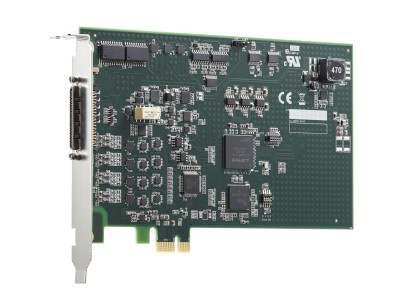
1. Product Overview
Product Name: PCIe-9101
Model: PCIe-9101
Series: PCI Express Data Acquisition (DAQ) Series
Article Number: PCIe-9101
Manufacturer: ADLINK Technology Inc.
The ADLINK PCIe-9101 is a high-performance, multifunction data acquisition card designed for precision analog and digital signal measurement and generation. It integrates 16-bit resolution analog input and output channels, digital I/O, and counter/timer functions into a single PCI Express (PCIe) interface card. Engineered for laboratory, industrial, and embedded applications, the PCIe-9101 provides reliable, high-speed data acquisition with flexible triggering, buffering, and transfer mechanisms. Its robust design and versatile configuration options make it suitable for a wide range of test, measurement, and control systems requiring accurate analog and digital interfacing.
2. Key Features
- High-Resolution Analog Input: 16-bit resolution with up to 250 kS/s sampling rate for single-channel operation, ensuring precise signal capture and analysis.
- Flexible Channel Configuration: Supports 16 single-ended (SE) or 8 differential (DI) analog input channels, allowing users to adapt to various measurement topologies.
- Wide Input Range: Programmable input voltage ranges of ±10 V, ±5 V, ±2.5 V, ±1.25 V, ±0.625 V, and ±0.3125 V accommodate diverse signal levels.
- High Signal Integrity: 10 MΩ input impedance and 90 dB signal-to-noise ratio (SNR) deliver accurate, low-noise measurements.
- Dual 16-bit Analog Outputs: Two analog output channels with ±10 V range and 10 V/μs slew rate for precise waveform generation and control applications.
- Comprehensive Digital I/O: 16 digital input and 16 digital output channels, TTL-compatible, supporting up to 1 MHz frequency operation.
- Advanced Triggering: Multiple trigger sources including software, digital, and analog triggers for flexible synchronization.
- Efficient Data Handling: Onboard FIFO buffers for analog input (4K samples), analog output (1K samples shared), and digital I/O (512 samples each) ensure smooth data throughput.
- High-Speed Data Transfer: Supports both polling and DMA (Direct Memory Access) modes for optimized system performance.
- Integrated Timer/Counter: Two 32-bit general-purpose timer/counter channels with internal and external clock options up to 32 MHz.
- Compact PCIe Form Factor: Designed for easy integration into modern PC-based systems with a standard PCI Express interface.
- Robust Overvoltage Protection: Continuous ±20 V protection on analog input channels safeguards against accidental overvoltage conditions.
3. Technical Specifications
Analog Input (AI):
- Channels: 16 single-ended or 8 differential
- Resolution: 16-bit
- Sampling Rate:
- Single-channel: 250 kS/s
- Multi-channel scanning: 100 kS/s
- FIFO Buffer: 4K samples onboard
- Input Voltage Ranges: ±10 V, ±5 V, ±2.5 V, ±1.25 V, ±0.625 V, ±0.3125 V
- Input Impedance: 10 MΩ
- Input Coupling: DC
- Overvoltage Protection: Continuous ±20 V
- Trigger Sources: Software, Digital, Analog
- Data Transfer Modes: Polling, DMA
- Signal-to-Noise Ratio (SNR): 90 dB
- Effective Number of Bits (ENOB): 14.5 bits
Analog Output (AO):
- Channels: 2
- Resolution: 16-bit
- Output Range: ±10 V
- FIFO Buffer: 1K samples (shared between two channels)
- Output Drive Capability: ±20 mA maximum
- Slew Rate: 10 V/μs
- Settling Time: Fast response (typical for 16-bit precision)
- Output Coupling: DC
- Output Impedance: < 0.1 Ω
- Trigger Sources: Software, Digital
- Data Transfer Modes: Polling, DMA
Digital Input (DI):
- Channels: 16
- Compatibility: TTL
- Input Impedance: Pull-low 100 kΩ
- Frequency Range: 0.01 Hz to 1 MHz
- FIFO Buffer: 512 samples onboard
- Isolation: None
- Trigger Sources: Software, Digital
- Data Transfer Modes: Polling, DMA
Digital Output (DO):
- Channels: 16
- Compatibility: TTL
- Output Impedance: Pull-low 100 kΩ
- Frequency Range: 0.01 Hz to 1 MHz
- FIFO Buffer: 512 samples onboard
- Isolation: None
- Trigger Sources: Software, Digital
- Data Transfer Modes: Polling, DMA
General-Purpose Timer/Counter:
- Channels: 2
- Resolution: 32-bit
- Compatibility: TTL
- Clock Sources:
- Internal: Fixed 33 MHz
- External: 0.01 Hz to 8 MHz (maximum)
- Clock source selectable via software
- Output Frequency:
- Internal clock: up to 16.5 MHz
- External clock: up to 32 MHz maximum
General Specifications:
- Dimensions (L × W × H): 169.55 mm × 16.15 mm × 98.4 mm
- Connector Type: 37-pin D-type connector
- Interface: PCI Express (PCIe)
- Manufacturer: ADLINK Technology Inc.
4. Functionality
The PCIe-9101 functions as a multifunction data acquisition card that interfaces directly with a host PC via the PCI Express bus. It captures analog and digital signals, processes them with high precision, and transfers data efficiently to system memory for analysis or control.
Analog Input Functionality:
The analog input subsystem supports both single-ended and differential configurations, enabling flexible measurement setups. The 16-bit ADC provides high-resolution sampling up to 250 kS/s for single-channel operation, ideal for capturing dynamic signals. The onboard 4K-sample FIFO buffer ensures continuous data acquisition without loss, even under high-speed conditions.
Analog Output Functionality:
The dual 16-bit DAC channels generate precise analog voltages within ±10 V range. With a 10 V/μs slew rate and ±20 mA drive capability, the outputs can reproduce waveforms or control analog actuators with high fidelity.
Digital I/O Functionality:
The 16 digital input and 16 digital output channels provide TTL-level interfacing for logic control, status monitoring, and event triggering. Each digital channel supports up to 1 MHz operation, suitable for high-speed digital communication or control tasks.
Timer/Counter Functionality:
Two 32-bit timer/counter channels allow precise timing, frequency measurement, or pulse generation. The internal 33 MHz clock or external clock input (up to 8 MHz) provides flexibility for synchronization with external systems.
Applications:
- Data acquisition and signal analysis
- Process monitoring and control
- Automated test equipment (ATE)
- Laboratory instrumentation
- Industrial automation and machine control
- Sensor signal conditioning and logging
- Waveform generation and simulation
Compatibility:
The PCIe-9101 is compatible with standard PCI Express slots and supports integration with ADLINK’s software drivers and SDKs for Windows and Linux environments. It can be used with third-party data acquisition software or custom applications developed using C/C++, LabVIEW, MATLAB, or Python APIs.
5. Components & Accessories
Included Items:
- PCIe-9101 data acquisition card
- 37-pin D-type connector interface
- Quick start guide and documentation
- Driver and software utility package (downloadable from ADLINK support site)
Optional Accessories:
- Shielded cable assemblies for analog and digital I/O
- Terminal boards for signal breakout and wiring convenience
- External clock and trigger cables
- Mounting brackets or retention clips for secure installation
Connectors:
- Primary I/O Connector: 37-pin D-type connector providing access to analog input/output, digital I/O, and timer/counter signals.
6. Installation & Setup
System Requirements:
- Available PCI Express slot (x1 or higher)
- Compatible operating system (Windows or Linux)
- ADLINK driver and SDK installation
Installation Steps:
1. Power off the host PC and open the chassis.
2. Insert the PCIe-9101 card into an available PCIe slot.
3. Secure the card using the bracket screw.
4. Connect the 37-pin D-type cable to the external terminal board or signal source.
5. Power on the system and install the ADLINK driver package.
6. Verify installation using the provided diagnostic utility.
Configuration:
- Input range, channel mode (SE/DI), and trigger sources are configured via software.
- Clock source selection and data transfer mode (Polling/DMA) are adjustable through the driver interface.
- Calibration and self-test routines can be executed using ADLINK’s software tools.
Mounting Options:
- Standard PCIe bracket for desktop or industrial PC chassis.
- Optional low-profile bracket available for compact systems.
7. Performance & Capabilities
Analog Input Performance:
- High-speed sampling up to 250 kS/s ensures accurate time-domain signal capture.
- 16-bit resolution provides fine granularity for voltage measurement.
- 90 dB SNR and 14.5-bit ENOB ensure low noise and high linearity.
- Programmable input ranges allow optimal scaling for different signal amplitudes.
Analog Output Performance:
- Dual 16-bit DACs deliver smooth, precise voltage outputs.
- ±10 V range supports a wide variety of actuators and analog devices.
- 10 V/μs slew rate enables fast waveform transitions.
- ±20 mA drive capability supports moderate load driving without external amplifiers.
Digital I/O Performance:
- TTL-compatible I/O ensures compatibility with standard logic circuits.
- 1 MHz maximum frequency supports high-speed digital control.
- Buffered operation with 512-sample FIFO minimizes latency.
Timer/Counter Performance:
- 32-bit resolution allows long-duration timing and high-frequency counting.
- Internal 33 MHz clock provides stable timing reference.
- External clock input up to 8 MHz allows synchronization with external systems.
- Output frequency up to 32 MHz supports pulse generation and timing control.
Limitations:
- No galvanic isolation on analog or digital channels; external isolation recommended for high-voltage environments.
- Limited onboard memory (4K AI FIFO, 1K AO FIFO) may constrain extremely high-speed continuous acquisition without DMA.
8. Standards & Compliance
- Interface Standard: PCI Express (PCIe)
- Signal Compatibility: TTL for digital I/O and timer/counter channels
- Electrical Protection: ±20 V continuous overvoltage protection on analog inputs
- Regulatory Compliance:
- CE (Conformité Européenne) for electromagnetic compatibility and safety
- RoHS (Restriction of Hazardous Substances) compliant
- FCC Class A (for industrial and laboratory environments)
- Industry Standards:
- Follows standard DAQ hardware design conventions for PCIe-based systems
- Compatible with ADLINK’s DAQ SDK and driver architecture
9. Additional Information
Warranty:
ADLINK provides a standard limited warranty covering manufacturing defects and hardware reliability for a specified period (typically one year, extendable depending on region and distributor policy).
Technical Support:
Comprehensive technical support is available through ADLINK’s global support network, including online documentation, driver downloads, and software updates.
Maintenance:
- Periodic inspection of connectors and cables recommended to ensure signal integrity.
- Firmware and driver updates available from ADLINK’s website to maintain compatibility and performance.
- Calibration verification recommended annually for precision measurement applications.
Software & Updates:
- Compatible with ADLINK’s DAQPilot software suite and SDKs.
- Supports major programming environments (C/C++, LabVIEW, MATLAB, Python).
- Regular driver updates ensure compatibility with new operating systems and hardware platforms.
Summary:
The ADLINK PCIe-9101 is a versatile, high-precision PCI Express data acquisition card that combines analog and digital I/O, counter/timer functionality, and flexible triggering in a compact form factor. With 16-bit resolution, high sampling rates, and robust data handling, it is ideal for laboratory instrumentation, industrial automation, and embedded measurement systems. Its combination of performance, configurability, and reliability makes it a powerful solution for engineers and researchers requiring accurate, high-speed data acquisition and control in modern PC-based environments.


 LOOKING FOR THE RIGHT
 PCIe-9100_50M-18094-1030_13.pdf
PDF Catalog
PCIe-9100_50M-18094-1030_13.pdf
PDF Catalog
 PCIe-9100_Series_manual.pdf
Manual
PCIe-9100_Series_manual.pdf
Manual