 LOOKING FOR THE RIGHT
INDUSTRIAL SOLUTION?
Discover embedded, communication and automation solutions tailored to your application.
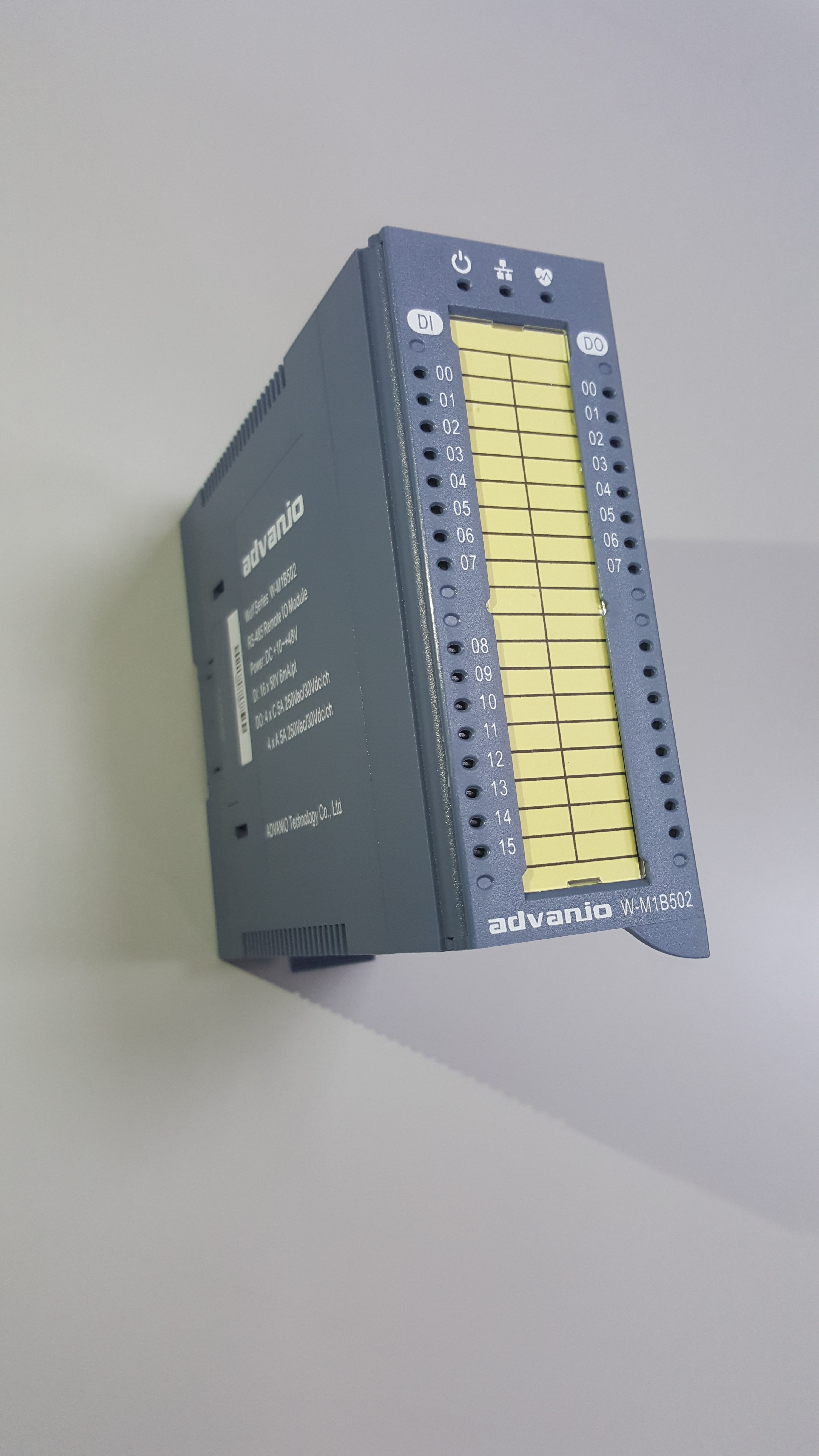
W-M1B108
16*DI AD V/thermo RS485 Modbus module
249,00 EUR
including VAT 296.31 EUR
- Universal 16‑Channel Thermocouple/Analog Input:
Accepts direct connection of J, K, T, E, R, S, B, N thermocouples or low‑level voltage signals (±100 mV to ±10 V).
- High‑Resolution Data Acquisition:
16‑bit A/D conversion with 2.5 samples per second per channel ensures precise measurement for temperature and voltage inputs.
- Cold Junction Compensation (CJC):
Integrated temperature sensor provides automatic cold‑junction compensation for thermocouple accuracy.
- Independent Channel Configuration:
Each channel can be individually configured for input type and range via Modbus registers.
- Sensor Burn‑Out and Disconnection Detection:
Detects open‑circuit or failed sensors to prevent erroneous readings and unsafe control actions.
- Electrical Isolation:
3 kV DC isolation between power, communication, and I/O circuits protects against ground loops and industrial noise.
- Wide Power Supply Range:
Operates from +10 V DC to +60 V DC with reverse‑polarity protection; ripple peak ≤ 5 V.
- Hot‑Swap and Auto‑Configuration:
Modules can be replaced without rewiring; configuration stored in removable EEPROM for quick restoration.
- Compact, Space‑Saving Design:
Slim 47.2 mm vertical housing allows dense DIN‑rail installation—up to 1.5× more modules per panel than flat‑mounted competitors.
- User‑Friendly Setup:
Modbus node address set by dual rotary switches (1–247); no PC required.
- Diagnostic LEDs:
Three front‑panel LEDs indicate power, communication, and system status for rapid on‑site troubleshooting.
- Programmable Power‑On and Safety Values:
Ensures controlled startup and safe fallback states during communication loss.
- Rugged Industrial Reliability:
Built‑in hardware and software watchdogs automatically recover from transient faults or host communication failures.
- Modbus/RTU Compatibility:
Fully compliant with standard Modbus RTU protocol; baud rates selectable from 1200 bps to 115.2 kbps.
Accepts direct connection of J, K, T, E, R, S, B, N thermocouples or low‑level voltage signals (±100 mV to ±10 V).
- High‑Resolution Data Acquisition:
16‑bit A/D conversion with 2.5 samples per second per channel ensures precise measurement for temperature and voltage inputs.
- Cold Junction Compensation (CJC):
Integrated temperature sensor provides automatic cold‑junction compensation for thermocouple accuracy.
- Independent Channel Configuration:
Each channel can be individually configured for input type and range via Modbus registers.
- Sensor Burn‑Out and Disconnection Detection:
Detects open‑circuit or failed sensors to prevent erroneous readings and unsafe control actions.
- Electrical Isolation:
3 kV DC isolation between power, communication, and I/O circuits protects against ground loops and industrial noise.
- Wide Power Supply Range:
Operates from +10 V DC to +60 V DC with reverse‑polarity protection; ripple peak ≤ 5 V.
- Hot‑Swap and Auto‑Configuration:
Modules can be replaced without rewiring; configuration stored in removable EEPROM for quick restoration.
- Compact, Space‑Saving Design:
Slim 47.2 mm vertical housing allows dense DIN‑rail installation—up to 1.5× more modules per panel than flat‑mounted competitors.
- User‑Friendly Setup:
Modbus node address set by dual rotary switches (1–247); no PC required.
- Diagnostic LEDs:
Three front‑panel LEDs indicate power, communication, and system status for rapid on‑site troubleshooting.
- Programmable Power‑On and Safety Values:
Ensures controlled startup and safe fallback states during communication loss.
- Rugged Industrial Reliability:
Built‑in hardware and software watchdogs automatically recover from transient faults or host communication failures.
- Modbus/RTU Compatibility:
Fully compliant with standard Modbus RTU protocol; baud rates selectable from 1200 bps to 115.2 kbps.
Comprehensive Product Summary – Advanio W‑M1B108 16‑Channel Thermocouple/Analog Input RS‑485 Modbus Module
### 1. Product Overview
Product Name: 16×DI AD V/Thermo RS‑485 Modbus Module
Model Number: W‑M1B108
Series: Wolf Series RS‑485 Remote I/O Modules
Article Number: W‑M1B108
Manufacturer: Advanio Technology Co., Ltd.
The Advanio W‑M1B108 is a 16‑channel thermocouple and analog input module designed for distributed data acquisition and process control over an RS‑485 Modbus/RTU network. It belongs to the Wolf Series, a family of modular, high‑density, industrial I/O devices engineered for rugged environments and Industry 4.0 applications. The module supports multiple thermocouple types (J, K, T, E, R, S, B, N) and analog voltage ranges, providing 16‑bit resolution and ±0.1 % FSR accuracy.
### 2. Key Features
- Universal 16‑Channel Thermocouple/Analog Input:
Accepts direct connection of J, K, T, E, R, S, B, N thermocouples or low‑level voltage signals (±100 mV to ±10 V).
- High‑Resolution Data Acquisition:
16‑bit A/D conversion with 2.5 samples per second per channel ensures precise measurement for temperature and voltage inputs.
- Cold Junction Compensation (CJC):
Integrated temperature sensor provides automatic cold‑junction compensation for thermocouple accuracy.
- Independent Channel Configuration:
Each channel can be individually configured for input type and range via Modbus registers.
- Sensor Burn‑Out and Disconnection Detection:
Detects open‑circuit or failed sensors to prevent erroneous readings and unsafe control actions.
- Electrical Isolation:
3 kV DC isolation between power, communication, and I/O circuits protects against ground loops and industrial noise.
- Wide Power Supply Range:
Operates from +10 V DC to +60 V DC with reverse‑polarity protection; ripple peak ≤ 5 V.
- Hot‑Swap and Auto‑Configuration:
Modules can be replaced without rewiring; configuration stored in removable EEPROM for quick restoration.
- Compact, Space‑Saving Design:
Slim 47.2 mm vertical housing allows dense DIN‑rail installation—up to 1.5× more modules per panel than flat‑mounted competitors.
- User‑Friendly Setup:
Modbus node address set by dual rotary switches (1–247); no PC required.
- Diagnostic LEDs:
Three front‑panel LEDs indicate power, communication, and system status for rapid on‑site troubleshooting.
- Programmable Power‑On and Safety Values:
Ensures controlled startup and safe fallback states during communication loss.
- Rugged Industrial Reliability:
Built‑in hardware and software watchdogs automatically recover from transient faults or host communication failures.
- Modbus/RTU Compatibility:
Fully compliant with standard Modbus RTU protocol; baud rates selectable from 1200 bps to 115.2 kbps.
### 3. Technical Specifications
| Parameter | Specification |
|----------------|------------------|
| Input Channels | 16 isolated differential inputs |
| Input Types | Thermocouple J/K/T/E/R/S/B/N; voltage ±100 mV to ±10 V |
| Sampling Rate | 2.5 samples/s per channel |
| Resolution | 16 bits |
| Accuracy | ±0.1 % FSR |
| Input Impedance | 2 MΩ |
| Common‑Mode Voltage | 2.5 V |
| Input Protection | ±35 V continuous |
| CJC Range | –20 °C to +20 °C adjustable (0.1 °C units) |
| Span Drift | ±25 ppm/°C |
| Zero Drift | ±6 µV/°C |
| Isolation Voltage | 3000 V DC between I/O, power, and communication |
| Power Supply | +10 V DC to +60 V DC (reverse‑polarity protected) |
| Power Consumption | 2.8 W @ 24 V DC |
| Communication Interface | RS‑485, 2‑wire half‑duplex |
| Protocol | Modbus RTU |
| Baud Rate | 1200 bps – 115.2 kbps |
| Communication Distance | Up to 1.2 km (4000 ft) |
| Connectors | Plug‑in terminal blocks, 16–30 AWG |
| Operating Temperature | –25 °C to +70 °C |
| Storage Temperature | –30 °C to +75 °C |
| Humidity | 5 % – 95 % RH (non‑condensing) |
| Dimensions (W × H × D) | 47.2 mm × 115.2 mm × 126.7 mm (typical Wolf housing) |
| Mounting | DIN‑rail 35 mm or wall‑mount |
| Weight | Approx. 0.3 kg |
| Enclosure Material | Industrial‑grade ABS/PC plastic |
| Isolation Protection | Power, communication, and I/O isolated to 3 kV DC |
### 4. Functionality
The W‑M1B108 functions as a remote analog input node in an RS‑485 Modbus network. A host controller—PLC, PAC, or PC—issues Modbus commands to read temperature or voltage data. Each channel’s configuration (input type, range, CJC enable, scaling) is stored in non‑volatile memory and can be modified via Modbus registers or Advanio’s configuration utility.
Use Cases and Applications:
- Industrial process temperature monitoring
- Energy management and power distribution systems
- Building automation and HVAC control
- Laboratory and test instrumentation
- Supervisory control and data acquisition (SCADA)
- Factory automation and machine condition monitoring
Compatibility:
Works with any Modbus RTU master device. Optional Advanio converters (USB‑to‑RS‑485 G‑M1A001, RS‑232‑to‑RS‑485 G‑M1E001) and repeaters (G‑M1F001) extend connectivity.
### 5. Components & Accessories
Included Items:
- W‑M1B108 module
- Detachable DIN‑rail base (fixed seat)
- 14‑pin plug‑in terminal connector
- Plastic grounding tab and buckle
- Quick‑start guide
Optional Accessories:
- RS‑232/RS‑485 or USB/RS‑485 isolated converters
- RS‑485 repeaters for long‑distance or multi‑segment networks
- Replacement EEPROM for configuration backup
- Label tabs for channel identification
Connectors:
- Power Input: +VS, GND, Frame Ground
- Communication: RS‑485 D+, D–
- Signal Terminals: 16 pairs of differential inputs (IN0+ / IN0 … IN15+ / IN15)
### 6. Installation & Setup
Requirements:
- DC power supply 10–60 V DC
- RS‑485 communication port on host or converter
- Proper grounding and shielding for noise immunity
Mounting Options:
- DIN‑Rail: Snap the detachable base onto a standard DIN 35 mm rail; modules interconnect via 14‑pin docking connectors for power and communication bus.
- Wall Mount: Secure the base with screws using provided mounting holes.
Grounding:
Use aluminum DIN rail for frame ground or connect FG terminal directly. Plastic isolation tabs are available when electrical isolation from the rail is required.
Configuration Steps:
1. Set Modbus node address (1–247) using two rotary switches.
2. Connect RS‑485 D+ / D– lines in daisy‑chain topology.
3. Apply power (10–60 V DC).
4. Verify LED indicators: Power ON, System OK, Communication active.
5. Configure channel types and ranges via Modbus registers or Advanio Utility software.
Indicators:
- Power LED: Steady ON = power OK.
- System LED: Flashing = normal operation; solid = fault.
- Communication LED: Flashes on data exchange; steady = timeout.
Factory Reset:
Press the INIT button for 3 seconds to restore default settings (address 01, 9600 bps, N‑8‑1).
### 7. Performance & Capabilities
- Measurement Speed: 2.5 Hz per channel (40 ms per sample).
- Resolution: 16 bits (1 part in 65 536).
- Accuracy: ±0.1 % FSR typical.
- Noise Rejection: 120 dB CMR, 100 dB NMR @ 50/60 Hz.
- Input Overvoltage Tolerance: ±35 V continuous.
- Isolation: 3 kV DC between channels and system bus.
- Watchdog Recovery: Hardware watchdog = 1.6 s fixed; software watchdog programmable (0–25.5 s).
- Power Efficiency: 2.8 W @ 24 V DC (≈ 117 mA).
- Network Capacity: Up to 32 modules per RS‑485 segment; 247 nodes max with repeaters.
- Communication Distance: 1.2 km (4000 ft) per segment using twisted‑pair shielded cable.
Limitations:
Sampling rate and communication throughput depend on baud rate and number of channels polled. Thermocouple accuracy subject to sensor quality and ambient temperature stability.
### 8. Standards & Compliance
- Communication Protocol: Modbus RTU (standard function codes 03, 04, 06, 16).
- Electrical Safety: 3 kV DC isolation barrier.
- EMC Compliance:
- Designed and tested for EMI/EMS immunity.
- Recommended installation in CE‑certified industrial chassis.
- Regulatory Compliance:
- FCC Part 15 Class A – operation subject to non‑interference conditions.
- CE EMC Directive – compliant when installed per manufacturer guidelines.
- Environmental: RoHS‑compliant materials; operating –25 °C to +70 °C.
### 9. Additional Information
Warranty:
5‑year limited warranty from date of purchase. Covers manufacturing defects and normal operation failures. Excludes damage from misuse, improper installation, or unauthorized repair.
Support & Service:
- Email: service@advanio.com.tw
- Website: [www.advanio.com.tw](http://www.advanio.com.tw)
- RMA procedure available through authorized distributors.
Maintenance:
No routine calibration required under normal conditions. Periodic verification recommended for critical measurement applications. EEPROM allows configuration backup and transfer between modules.
Software & Updates:
- Advanio Utility for Windows provides configuration, calibration, and diagnostics.
- Firmware updates available via Modbus interface or authorized service.
Manufacturer Background:
Advanio Technology Co., Ltd. specializes in advanced industrial I/O and embedded automation solutions. Founded by IoT and automation experts with over 20 years of field experience, Advanio develops robust, user‑centric modules for smart factories and Industry 4.0 integration. The Wolf Series exemplifies this philosophy—combining compact design, high reliability, and ease of maintenance for real‑world industrial environments.
### Summary
The Advanio W‑M1B108 is a high‑density, 16‑channel thermocouple and analog input module optimized for distributed temperature and voltage measurement in industrial automation systems. With 16‑bit resolution, 3 kV isolation, wide power tolerance, and Modbus RTU connectivity, it delivers precise, reliable data acquisition across harsh environments. Its modular Wolf‑series architecture supports hot‑swap replacement, EEPROM‑based configuration portability, and intuitive setup via rotary switches and LED diagnostics—making it a cost‑effective, space‑saving solution for modern SCADA and process‑control networks.
### 1. Product Overview
Product Name: 16×DI AD V/Thermo RS‑485 Modbus Module
Model Number: W‑M1B108
Series: Wolf Series RS‑485 Remote I/O Modules
Article Number: W‑M1B108
Manufacturer: Advanio Technology Co., Ltd.
The Advanio W‑M1B108 is a 16‑channel thermocouple and analog input module designed for distributed data acquisition and process control over an RS‑485 Modbus/RTU network. It belongs to the Wolf Series, a family of modular, high‑density, industrial I/O devices engineered for rugged environments and Industry 4.0 applications. The module supports multiple thermocouple types (J, K, T, E, R, S, B, N) and analog voltage ranges, providing 16‑bit resolution and ±0.1 % FSR accuracy.
### 2. Key Features
- Universal 16‑Channel Thermocouple/Analog Input:
Accepts direct connection of J, K, T, E, R, S, B, N thermocouples or low‑level voltage signals (±100 mV to ±10 V).
- High‑Resolution Data Acquisition:
16‑bit A/D conversion with 2.5 samples per second per channel ensures precise measurement for temperature and voltage inputs.
- Cold Junction Compensation (CJC):
Integrated temperature sensor provides automatic cold‑junction compensation for thermocouple accuracy.
- Independent Channel Configuration:
Each channel can be individually configured for input type and range via Modbus registers.
- Sensor Burn‑Out and Disconnection Detection:
Detects open‑circuit or failed sensors to prevent erroneous readings and unsafe control actions.
- Electrical Isolation:
3 kV DC isolation between power, communication, and I/O circuits protects against ground loops and industrial noise.
- Wide Power Supply Range:
Operates from +10 V DC to +60 V DC with reverse‑polarity protection; ripple peak ≤ 5 V.
- Hot‑Swap and Auto‑Configuration:
Modules can be replaced without rewiring; configuration stored in removable EEPROM for quick restoration.
- Compact, Space‑Saving Design:
Slim 47.2 mm vertical housing allows dense DIN‑rail installation—up to 1.5× more modules per panel than flat‑mounted competitors.
- User‑Friendly Setup:
Modbus node address set by dual rotary switches (1–247); no PC required.
- Diagnostic LEDs:
Three front‑panel LEDs indicate power, communication, and system status for rapid on‑site troubleshooting.
- Programmable Power‑On and Safety Values:
Ensures controlled startup and safe fallback states during communication loss.
- Rugged Industrial Reliability:
Built‑in hardware and software watchdogs automatically recover from transient faults or host communication failures.
- Modbus/RTU Compatibility:
Fully compliant with standard Modbus RTU protocol; baud rates selectable from 1200 bps to 115.2 kbps.
### 3. Technical Specifications
| Parameter | Specification |
|----------------|------------------|
| Input Channels | 16 isolated differential inputs |
| Input Types | Thermocouple J/K/T/E/R/S/B/N; voltage ±100 mV to ±10 V |
| Sampling Rate | 2.5 samples/s per channel |
| Resolution | 16 bits |
| Accuracy | ±0.1 % FSR |
| Input Impedance | 2 MΩ |
| Common‑Mode Voltage | 2.5 V |
| Input Protection | ±35 V continuous |
| CJC Range | –20 °C to +20 °C adjustable (0.1 °C units) |
| Span Drift | ±25 ppm/°C |
| Zero Drift | ±6 µV/°C |
| Isolation Voltage | 3000 V DC between I/O, power, and communication |
| Power Supply | +10 V DC to +60 V DC (reverse‑polarity protected) |
| Power Consumption | 2.8 W @ 24 V DC |
| Communication Interface | RS‑485, 2‑wire half‑duplex |
| Protocol | Modbus RTU |
| Baud Rate | 1200 bps – 115.2 kbps |
| Communication Distance | Up to 1.2 km (4000 ft) |
| Connectors | Plug‑in terminal blocks, 16–30 AWG |
| Operating Temperature | –25 °C to +70 °C |
| Storage Temperature | –30 °C to +75 °C |
| Humidity | 5 % – 95 % RH (non‑condensing) |
| Dimensions (W × H × D) | 47.2 mm × 115.2 mm × 126.7 mm (typical Wolf housing) |
| Mounting | DIN‑rail 35 mm or wall‑mount |
| Weight | Approx. 0.3 kg |
| Enclosure Material | Industrial‑grade ABS/PC plastic |
| Isolation Protection | Power, communication, and I/O isolated to 3 kV DC |
### 4. Functionality
The W‑M1B108 functions as a remote analog input node in an RS‑485 Modbus network. A host controller—PLC, PAC, or PC—issues Modbus commands to read temperature or voltage data. Each channel’s configuration (input type, range, CJC enable, scaling) is stored in non‑volatile memory and can be modified via Modbus registers or Advanio’s configuration utility.
Use Cases and Applications:
- Industrial process temperature monitoring
- Energy management and power distribution systems
- Building automation and HVAC control
- Laboratory and test instrumentation
- Supervisory control and data acquisition (SCADA)
- Factory automation and machine condition monitoring
Compatibility:
Works with any Modbus RTU master device. Optional Advanio converters (USB‑to‑RS‑485 G‑M1A001, RS‑232‑to‑RS‑485 G‑M1E001) and repeaters (G‑M1F001) extend connectivity.
### 5. Components & Accessories
Included Items:
- W‑M1B108 module
- Detachable DIN‑rail base (fixed seat)
- 14‑pin plug‑in terminal connector
- Plastic grounding tab and buckle
- Quick‑start guide
Optional Accessories:
- RS‑232/RS‑485 or USB/RS‑485 isolated converters
- RS‑485 repeaters for long‑distance or multi‑segment networks
- Replacement EEPROM for configuration backup
- Label tabs for channel identification
Connectors:
- Power Input: +VS, GND, Frame Ground
- Communication: RS‑485 D+, D–
- Signal Terminals: 16 pairs of differential inputs (IN0+ / IN0 … IN15+ / IN15)
### 6. Installation & Setup
Requirements:
- DC power supply 10–60 V DC
- RS‑485 communication port on host or converter
- Proper grounding and shielding for noise immunity
Mounting Options:
- DIN‑Rail: Snap the detachable base onto a standard DIN 35 mm rail; modules interconnect via 14‑pin docking connectors for power and communication bus.
- Wall Mount: Secure the base with screws using provided mounting holes.
Grounding:
Use aluminum DIN rail for frame ground or connect FG terminal directly. Plastic isolation tabs are available when electrical isolation from the rail is required.
Configuration Steps:
1. Set Modbus node address (1–247) using two rotary switches.
2. Connect RS‑485 D+ / D– lines in daisy‑chain topology.
3. Apply power (10–60 V DC).
4. Verify LED indicators: Power ON, System OK, Communication active.
5. Configure channel types and ranges via Modbus registers or Advanio Utility software.
Indicators:
- Power LED: Steady ON = power OK.
- System LED: Flashing = normal operation; solid = fault.
- Communication LED: Flashes on data exchange; steady = timeout.
Factory Reset:
Press the INIT button for 3 seconds to restore default settings (address 01, 9600 bps, N‑8‑1).
### 7. Performance & Capabilities
- Measurement Speed: 2.5 Hz per channel (40 ms per sample).
- Resolution: 16 bits (1 part in 65 536).
- Accuracy: ±0.1 % FSR typical.
- Noise Rejection: 120 dB CMR, 100 dB NMR @ 50/60 Hz.
- Input Overvoltage Tolerance: ±35 V continuous.
- Isolation: 3 kV DC between channels and system bus.
- Watchdog Recovery: Hardware watchdog = 1.6 s fixed; software watchdog programmable (0–25.5 s).
- Power Efficiency: 2.8 W @ 24 V DC (≈ 117 mA).
- Network Capacity: Up to 32 modules per RS‑485 segment; 247 nodes max with repeaters.
- Communication Distance: 1.2 km (4000 ft) per segment using twisted‑pair shielded cable.
Limitations:
Sampling rate and communication throughput depend on baud rate and number of channels polled. Thermocouple accuracy subject to sensor quality and ambient temperature stability.
### 8. Standards & Compliance
- Communication Protocol: Modbus RTU (standard function codes 03, 04, 06, 16).
- Electrical Safety: 3 kV DC isolation barrier.
- EMC Compliance:
- Designed and tested for EMI/EMS immunity.
- Recommended installation in CE‑certified industrial chassis.
- Regulatory Compliance:
- FCC Part 15 Class A – operation subject to non‑interference conditions.
- CE EMC Directive – compliant when installed per manufacturer guidelines.
- Environmental: RoHS‑compliant materials; operating –25 °C to +70 °C.
### 9. Additional Information
Warranty:
5‑year limited warranty from date of purchase. Covers manufacturing defects and normal operation failures. Excludes damage from misuse, improper installation, or unauthorized repair.
Support & Service:
- Email: service@advanio.com.tw
- Website: [www.advanio.com.tw](http://www.advanio.com.tw)
- RMA procedure available through authorized distributors.
Maintenance:
No routine calibration required under normal conditions. Periodic verification recommended for critical measurement applications. EEPROM allows configuration backup and transfer between modules.
Software & Updates:
- Advanio Utility for Windows provides configuration, calibration, and diagnostics.
- Firmware updates available via Modbus interface or authorized service.
Manufacturer Background:
Advanio Technology Co., Ltd. specializes in advanced industrial I/O and embedded automation solutions. Founded by IoT and automation experts with over 20 years of field experience, Advanio develops robust, user‑centric modules for smart factories and Industry 4.0 integration. The Wolf Series exemplifies this philosophy—combining compact design, high reliability, and ease of maintenance for real‑world industrial environments.
### Summary
The Advanio W‑M1B108 is a high‑density, 16‑channel thermocouple and analog input module optimized for distributed temperature and voltage measurement in industrial automation systems. With 16‑bit resolution, 3 kV isolation, wide power tolerance, and Modbus RTU connectivity, it delivers precise, reliable data acquisition across harsh environments. Its modular Wolf‑series architecture supports hot‑swap replacement, EEPROM‑based configuration portability, and intuitive setup via rotary switches and LED diagnostics—making it a cost‑effective, space‑saving solution for modern SCADA and process‑control networks.
-
 Datasheeet_Advanio_Wolf_W-M1B107-W-M1B108.pdf
PDF Catalog
Datasheeet_Advanio_Wolf_W-M1B107-W-M1B108.pdf
PDF Catalog
-
 Advanio_Catalog_Wolf_Series_General.pdf
PDF Catalog
Advanio_Catalog_Wolf_Series_General.pdf
PDF Catalog


No accessories available.