 LOOKING FOR THE RIGHT
INDUSTRIAL SOLUTION?
Discover embedded, communication and automation solutions tailored to your application.
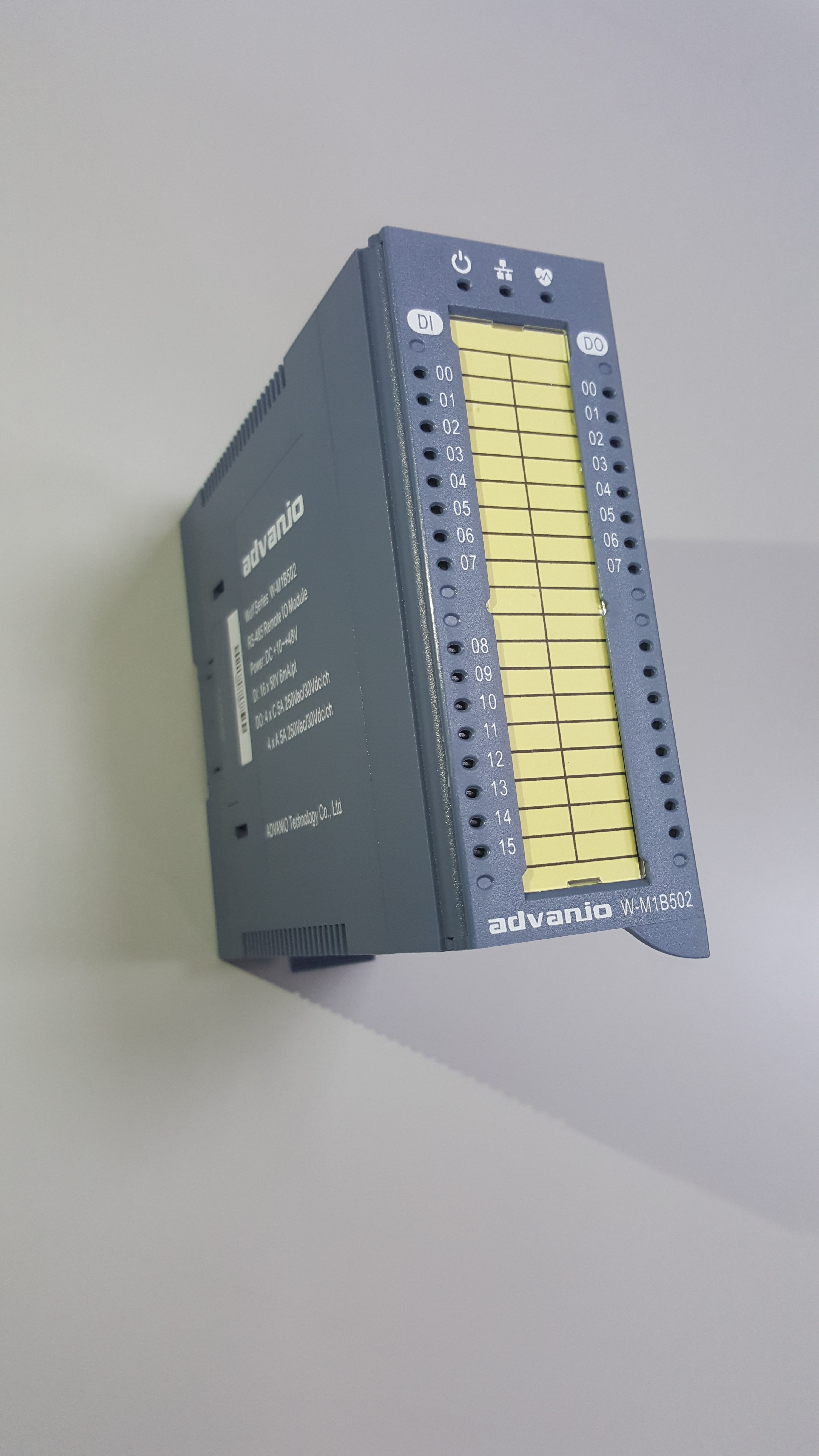
W-M1B502
16*DI 8*Relay 4*A/4*C RS485 Modbus module
198,00 EUR
including VAT 235.62 EUR
- Mixed I/O Configuration:
16 isolated digital input channels and 8 relay output channels (4 Form A + 4 Form C).
- Relay Output Ratings:
5 A @ 250 VAC / 30 VDC per channel, dielectric strength 3 kV.
- Digital Input Characteristics:
Supports both dry and wet contact modes; configurable logic polarity (normal/inverted).
- Communication Interface:
RS‑485 serial bus with Modbus RTU protocol, supporting baud rates from 1200 bps to 115.2 kbps.
- Isolation & Protection:
3000 VDC isolation between power, communication, and I/O; ±70 V input over‑voltage protection.
- Hot‑Swap & Auto‑Configuration:
Modules can be replaced without rewiring; configuration stored in detachable EEPROM for quick restoration.
- Programmable Power‑On & Safety Values:
User‑defined startup and safe‑state output values prevent unintended actuation during power cycling or communication loss.
- Wide Power Input Range:
+10 VDC to +60 VDC (ripple ≤ 5 V p‑p).
- Compact Form Factor:
47.2 mm slim vertical housing for space‑constrained control panels.
- Diagnostics & Maintenance:
Three front‑panel LEDs indicate power, communication, and system status; Modbus node address set via dual rotary switches.
- Environmental Robustness:
Operating temperature –25 °C to +70 °C; humidity 5 – 95 % RH; EMC‑tested for EMI/EMS immunity.
- Reliability Enhancements:
Hardware module watchdog (1.6 s fixed) and programmable system watchdog ensure automatic recovery from faults.
- Warranty:
5‑year limited manufacturer warranty.
16 isolated digital input channels and 8 relay output channels (4 Form A + 4 Form C).
- Relay Output Ratings:
5 A @ 250 VAC / 30 VDC per channel, dielectric strength 3 kV.
- Digital Input Characteristics:
Supports both dry and wet contact modes; configurable logic polarity (normal/inverted).
- Communication Interface:
RS‑485 serial bus with Modbus RTU protocol, supporting baud rates from 1200 bps to 115.2 kbps.
- Isolation & Protection:
3000 VDC isolation between power, communication, and I/O; ±70 V input over‑voltage protection.
- Hot‑Swap & Auto‑Configuration:
Modules can be replaced without rewiring; configuration stored in detachable EEPROM for quick restoration.
- Programmable Power‑On & Safety Values:
User‑defined startup and safe‑state output values prevent unintended actuation during power cycling or communication loss.
- Wide Power Input Range:
+10 VDC to +60 VDC (ripple ≤ 5 V p‑p).
- Compact Form Factor:
47.2 mm slim vertical housing for space‑constrained control panels.
- Diagnostics & Maintenance:
Three front‑panel LEDs indicate power, communication, and system status; Modbus node address set via dual rotary switches.
- Environmental Robustness:
Operating temperature –25 °C to +70 °C; humidity 5 – 95 % RH; EMC‑tested for EMI/EMS immunity.
- Reliability Enhancements:
Hardware module watchdog (1.6 s fixed) and programmable system watchdog ensure automatic recovery from faults.
- Warranty:
5‑year limited manufacturer warranty.
Comprehensive Product Summary – Advanio W‑M1B502 RS‑485 Modbus Remote I/O Module
### 1. Product Overview
Product Name:
W‑M1B502 – 16‑Channel Digital Input / 8‑Channel Relay Output RS‑485 Modbus Module
Model / Series:
Wolf Series RS‑485 Remote I/O Modules
Article Number:
W‑M1B502
Manufacturer:
Advanio Technology Co., Ltd.
Manufacturer Background:
Advanio Technology Co., Ltd. is an industrial automation and IoT‑focused manufacturer founded by a team of system engineers and automation experts with over 20 years of field experience. The company’s name derives from “Advanced I/O Technologies.” Advanio’s mission is to deliver rugged, intelligent, and easily maintainable I/O and data acquisition modules for Industry 4.0 and smart factory applications. Its product portfolio spans wired and wireless I/O systems (RS‑485, CAN, Ethernet, EtherCAT, PROFINET, Modbus/TCP, Bluetooth, Wi‑Fi, 3G/4G) and industrial computing platforms.
### 2. Key Features
- Mixed I/O Configuration:
16 isolated digital input channels and 8 relay output channels (4 Form A + 4 Form C).
- Relay Output Ratings:
5 A @ 250 VAC / 30 VDC per channel, dielectric strength 3 kV.
- Digital Input Characteristics:
Supports both dry and wet contact modes; configurable logic polarity (normal/inverted).
- Communication Interface:
RS‑485 serial bus with Modbus RTU protocol, supporting baud rates from 1200 bps to 115.2 kbps.
- Isolation & Protection:
3000 VDC isolation between power, communication, and I/O; ±70 V input over‑voltage protection.
- Hot‑Swap & Auto‑Configuration:
Modules can be replaced without rewiring; configuration stored in detachable EEPROM for quick restoration.
- Programmable Power‑On & Safety Values:
User‑defined startup and safe‑state output values prevent unintended actuation during power cycling or communication loss.
- Wide Power Input Range:
+10 VDC to +60 VDC (ripple ≤ 5 V p‑p).
- Compact Form Factor:
47.2 mm slim vertical housing for space‑constrained control panels.
- Diagnostics & Maintenance:
Three front‑panel LEDs indicate power, communication, and system status; Modbus node address set via dual rotary switches.
- Environmental Robustness:
Operating temperature –25 °C to +70 °C; humidity 5 – 95 % RH; EMC‑tested for EMI/EMS immunity.
- Reliability Enhancements:
Hardware module watchdog (1.6 s fixed) and programmable system watchdog ensure automatic recovery from faults.
- Warranty:
5‑year limited manufacturer warranty.
### 3. Technical Specifications
| Parameter | Specification |
|----------------|-------------------|
| Digital Inputs | 16 channels, isolated |
| Input Type | Dry contact or wet contact |
| Logic Levels (Dry) | Logic 0 = open; Logic 1 = closed to GND |
| Logic Levels (Wet) | Logic 0 = ≤ 3 V; Logic 1 = 10 – 50 VDC |
| Input Resistance | 10 kΩ |
| Input Isolation Voltage | 2500 VDC |
| Over‑Voltage Protection | 70 VDC |
| Counter Input Range | Max 100 Hz (16‑bit) |
| Latch Function | Yes, captures pulses ≥ 5 ms |
| Relay Outputs | 8 channels (4 Form A + 4 Form C) |
| Contact Rating | 5 A @ 250 VAC / 30 VDC |
| Dielectric Strength | 3 kV |
| Operate / Release Time | 10 ms / 5 ms (max) |
| Electrical Endurance | 1 × 10⁵ operations @ 3 A 250 VAC / 30 VDC |
| Power Supply | +10 VDC to +60 VDC (unregulated) |
| Power Consumption | 3 W @ 24 VDC |
| Isolation Protection | 3000 VDC (power, comms, I/O) |
| Communication Interface | RS‑485 (Modbus RTU) |
| Baud Rate Range | 1200 – 115.2 kbps |
| Communication Distance | Up to 1.2 km (4000 ft) |
| Connectors | Plug‑in terminal blocks (#16 – 30 AWG) |
| Indicators | Power LED, Communication LED, System LED |
| Operating Temperature | –25 °C to +70 °C |
| Storage Temperature | –30 °C to +75 °C |
| Humidity | 5 – 95 % RH (non‑condensing) |
| Mounting | DIN‑rail (35 mm) or wall‑mount |
| Dimensions | 47.2 mm (W) × ~115 mm (H) × ~130 mm (D) (typical Wolf series) |
| Weight | Approx. 0.3 – 0.4 kg (depending on configuration) |
| Housing Material | Industrial‑grade ABS plastic |
| Ingress Protection | IP20 (panel mount environment) |
### 4. Functionality
Operating Principle:
The W‑M1B502 acts as a remote I/O node on an RS‑485 Modbus RTU network. A host controller (PLC, PAC, or PC) sends Modbus commands to read digital inputs or control relay outputs. The module responds with status data or executes output switching accordingly.
Use Cases & Applications:
- Industrial process monitoring and control
- Building and facility automation
- Energy management and power distribution systems
- Security and access control
- Laboratory and test automation
- Supervisory control and data acquisition (SCADA)
- Remote telemetry and distributed I/O expansion
Compatibility:
Fully compatible with Modbus RTU master devices and Advanio’s Wolf‑series ecosystem. Can be integrated with RS‑232/RS‑485 converters, USB‑to‑RS‑485 adapters, or repeaters for extended networks.
Advanced DI Functions:
- Latch Function: Captures transient pulses ≥ 5 ms to prevent missed events during polling.
- Low‑Speed Counter: Counts input transitions up to 100 Hz (16‑bit).
- Normal/Inverted Logic: Configurable per channel for flexible integration with existing wiring logic.
Advanced DO Functions:
- Programmable Power‑On Values: Defines initial relay states after power‑up.
- Safety (Fail‑Safe) Values: Defines output states upon watchdog timeout or communication loss.
- Active State Polarity: Selectable (active‑high or active‑low).
### 5. Components & Accessories
Included Items:
- W‑M1B502 module
- Detachable 14‑pin terminal block connectors
- DIN‑rail mounting base (fixed seat)
- Plastic isolation tab and buckle set
- Quick start guide
Optional Accessories:
- RS‑232 ↔ RS‑485 isolated converter (Advanio G‑M1A001)
- USB ↔ RS‑485 converter (Advanio G‑M1E001)
- RS‑485 ↔ RS‑485 repeater (Advanio G‑M1F001)
- Replacement EEPROM module for configuration backup
Connectors:
Plug‑in terminal blocks for I/O and power; RJ‑type or screw terminals for RS‑485 D+/D– lines.
### 6. Installation & Setup
Requirements:
- DC power supply 10 – 60 VDC (ripple ≤ 5 V p‑p)
- RS‑485 network connection (2‑wire twisted pair with shield)
- Host PC or controller with Modbus RTU master software
Mounting Options:
- DIN‑Rail Mounting: Attach detachable base to standard DIN 35 mm rail; modules can be docked side‑by‑side using pin arrays for power and bus continuity.
- Wall Mounting: Secure base with screws through pre‑drilled holes.
Grounding:
Frame ground (F.G.) connection via DIN rail or power connector; plastic isolation tab available to decouple noisy grounds.
Power Wiring:
Parallel power distribution through DIN rail bus; maximum 10 modules per rail (~30 W total). Use short power leads to minimize voltage drop.
Communication Setup:
- Default baud rate: 9600 bps (N, 8, 1)
- Node address range: 1 – 247 (0x01 – 0xF7) set via two rotary switches
- Communication distance: up to 1.2 km (4000 ft)
- Topologies: daisy chain, star (via repeaters), or hybrid
Indicators:
- Power LED: ON = power OK; flashes 3× on initialization.
- Communication LED: Flashes on data activity; steady ON = timeout.
- System LED: Flashes normally every 0.5 s; steady ON = fault.
EEPROM Handling:
Configuration parameters stored in removable EEPROM; transfer EEPROM to replacement module for instant restoration.
Factory Reset:
Press INIT button for 3 seconds to restore defaults (baud 9600 bps, N, 8, 1, address 01).
### 7. Performance & Capabilities
- Communication Speed: 1200 – 115.2 kbps selectable.
- Network Capacity: Up to 32 modules per segment (247 max with repeaters).
- Response Time: Deterministic Modbus RTU latency < 10 ms typical at 9.6 kbps.
- Power Efficiency: 3 W @ 24 VDC typical.
- Reliability: Hardware watchdog (1.6 s fixed) and software watchdog (timeout programmable 0 – 25.5 s).
- Hot‑Swap Capability: Modules can be replaced without power down or rewiring.
- EEPROM Data Retention: Non‑volatile storage for configuration and calibration parameters.
- Environmental Endurance: Designed for continuous operation in industrial environments with high EMI and temperature variations.
Limitations:
- Relay outputs limited to 5 A per channel; not intended for high‑power motor control.
- RS‑485 requires proper termination and bias resistors for long cables.
- Maximum 10 modules per DIN rail segment due to power distribution limits.
### 8. Standards & Compliance
- Communication Protocol: Modbus RTU (ANSI standard EIA/TIA‑485‑A)
- Electrical Isolation: 3000 VDC tested between I/O, power, and communication circuits
- EMC Compliance: Tested for EMI and EMS per industrial EMC standards
- Safety Compliance: Designed for CE and FCC Part 15 Class A environments
- FCC Statement: Complies with Part 15 of FCC Rules (does not cause harmful interference and must accept interference received)
- Recommended Installation: Use with CE‑certified industrial chassis for full EMC protection
### 9. Additional Information
Warranty & Service:
- Standard 5‑year limited warranty from date of purchase.
- Covers manufacturing defects and component failures under normal use.
- Excludes damage from improper installation, modification, or misuse.
- Out‑of‑warranty repairs available at nominal cost.
Support & Maintenance:
- Technical support via email (service@advanio.com.tw) and official website (www.advanio.com.tw).
- Firmware updates and configuration utilities available for download.
- RMA procedure requires model number, serial number, and proof of purchase.
Maintenance Guidelines:
- Periodically inspect terminal connections for tightness and oxidation.
- Keep ventilation openings free of dust.
- Replace relays after rated electrical life if used at maximum load.
- Store modules at –30 °C to +75 °C in dry conditions.
Software & Configuration Tools:
- ARIO Utility Software: Windows‑based configuration and diagnostic tool for Wolf series modules.
- Mobile Access: Advanio Android/iOS apps for remote monitoring and sales support.
Firmware Features:
- Modbus register mapping for DI/DO status, latch values, counters, and configuration parameters.
- EEPROM parameter backup and restore functions.
- Watchdog timeout and safe‑state configuration registers.
### Summary
The Advanio W‑M1B502 is a compact, high‑reliability RS‑485 Modbus RTU remote I/O module combining 16 isolated digital inputs and 8 relay outputs in a single 47.2 mm‑wide housing. Designed for industrial automation, building control, and energy management, it provides robust 3 kV isolation, wide 10 – 60 VDC power tolerance, and advanced diagnostic and safety features. The module’s hot‑swappable design, EEPROM‑based configuration backup, and rotary‑switch addressing simplify installation and maintenance. With programmable power‑on/safe‑state outputs, watchdog protection, and EMC‑certified reliability, the W‑M1B502 delivers a cost‑effective, space‑saving solution for distributed control systems in harsh industrial environments.
### 1. Product Overview
Product Name:
W‑M1B502 – 16‑Channel Digital Input / 8‑Channel Relay Output RS‑485 Modbus Module
Model / Series:
Wolf Series RS‑485 Remote I/O Modules
Article Number:
W‑M1B502
Manufacturer:
Advanio Technology Co., Ltd.
Manufacturer Background:
Advanio Technology Co., Ltd. is an industrial automation and IoT‑focused manufacturer founded by a team of system engineers and automation experts with over 20 years of field experience. The company’s name derives from “Advanced I/O Technologies.” Advanio’s mission is to deliver rugged, intelligent, and easily maintainable I/O and data acquisition modules for Industry 4.0 and smart factory applications. Its product portfolio spans wired and wireless I/O systems (RS‑485, CAN, Ethernet, EtherCAT, PROFINET, Modbus/TCP, Bluetooth, Wi‑Fi, 3G/4G) and industrial computing platforms.
### 2. Key Features
- Mixed I/O Configuration:
16 isolated digital input channels and 8 relay output channels (4 Form A + 4 Form C).
- Relay Output Ratings:
5 A @ 250 VAC / 30 VDC per channel, dielectric strength 3 kV.
- Digital Input Characteristics:
Supports both dry and wet contact modes; configurable logic polarity (normal/inverted).
- Communication Interface:
RS‑485 serial bus with Modbus RTU protocol, supporting baud rates from 1200 bps to 115.2 kbps.
- Isolation & Protection:
3000 VDC isolation between power, communication, and I/O; ±70 V input over‑voltage protection.
- Hot‑Swap & Auto‑Configuration:
Modules can be replaced without rewiring; configuration stored in detachable EEPROM for quick restoration.
- Programmable Power‑On & Safety Values:
User‑defined startup and safe‑state output values prevent unintended actuation during power cycling or communication loss.
- Wide Power Input Range:
+10 VDC to +60 VDC (ripple ≤ 5 V p‑p).
- Compact Form Factor:
47.2 mm slim vertical housing for space‑constrained control panels.
- Diagnostics & Maintenance:
Three front‑panel LEDs indicate power, communication, and system status; Modbus node address set via dual rotary switches.
- Environmental Robustness:
Operating temperature –25 °C to +70 °C; humidity 5 – 95 % RH; EMC‑tested for EMI/EMS immunity.
- Reliability Enhancements:
Hardware module watchdog (1.6 s fixed) and programmable system watchdog ensure automatic recovery from faults.
- Warranty:
5‑year limited manufacturer warranty.
### 3. Technical Specifications
| Parameter | Specification |
|----------------|-------------------|
| Digital Inputs | 16 channels, isolated |
| Input Type | Dry contact or wet contact |
| Logic Levels (Dry) | Logic 0 = open; Logic 1 = closed to GND |
| Logic Levels (Wet) | Logic 0 = ≤ 3 V; Logic 1 = 10 – 50 VDC |
| Input Resistance | 10 kΩ |
| Input Isolation Voltage | 2500 VDC |
| Over‑Voltage Protection | 70 VDC |
| Counter Input Range | Max 100 Hz (16‑bit) |
| Latch Function | Yes, captures pulses ≥ 5 ms |
| Relay Outputs | 8 channels (4 Form A + 4 Form C) |
| Contact Rating | 5 A @ 250 VAC / 30 VDC |
| Dielectric Strength | 3 kV |
| Operate / Release Time | 10 ms / 5 ms (max) |
| Electrical Endurance | 1 × 10⁵ operations @ 3 A 250 VAC / 30 VDC |
| Power Supply | +10 VDC to +60 VDC (unregulated) |
| Power Consumption | 3 W @ 24 VDC |
| Isolation Protection | 3000 VDC (power, comms, I/O) |
| Communication Interface | RS‑485 (Modbus RTU) |
| Baud Rate Range | 1200 – 115.2 kbps |
| Communication Distance | Up to 1.2 km (4000 ft) |
| Connectors | Plug‑in terminal blocks (#16 – 30 AWG) |
| Indicators | Power LED, Communication LED, System LED |
| Operating Temperature | –25 °C to +70 °C |
| Storage Temperature | –30 °C to +75 °C |
| Humidity | 5 – 95 % RH (non‑condensing) |
| Mounting | DIN‑rail (35 mm) or wall‑mount |
| Dimensions | 47.2 mm (W) × ~115 mm (H) × ~130 mm (D) (typical Wolf series) |
| Weight | Approx. 0.3 – 0.4 kg (depending on configuration) |
| Housing Material | Industrial‑grade ABS plastic |
| Ingress Protection | IP20 (panel mount environment) |
### 4. Functionality
Operating Principle:
The W‑M1B502 acts as a remote I/O node on an RS‑485 Modbus RTU network. A host controller (PLC, PAC, or PC) sends Modbus commands to read digital inputs or control relay outputs. The module responds with status data or executes output switching accordingly.
Use Cases & Applications:
- Industrial process monitoring and control
- Building and facility automation
- Energy management and power distribution systems
- Security and access control
- Laboratory and test automation
- Supervisory control and data acquisition (SCADA)
- Remote telemetry and distributed I/O expansion
Compatibility:
Fully compatible with Modbus RTU master devices and Advanio’s Wolf‑series ecosystem. Can be integrated with RS‑232/RS‑485 converters, USB‑to‑RS‑485 adapters, or repeaters for extended networks.
Advanced DI Functions:
- Latch Function: Captures transient pulses ≥ 5 ms to prevent missed events during polling.
- Low‑Speed Counter: Counts input transitions up to 100 Hz (16‑bit).
- Normal/Inverted Logic: Configurable per channel for flexible integration with existing wiring logic.
Advanced DO Functions:
- Programmable Power‑On Values: Defines initial relay states after power‑up.
- Safety (Fail‑Safe) Values: Defines output states upon watchdog timeout or communication loss.
- Active State Polarity: Selectable (active‑high or active‑low).
### 5. Components & Accessories
Included Items:
- W‑M1B502 module
- Detachable 14‑pin terminal block connectors
- DIN‑rail mounting base (fixed seat)
- Plastic isolation tab and buckle set
- Quick start guide
Optional Accessories:
- RS‑232 ↔ RS‑485 isolated converter (Advanio G‑M1A001)
- USB ↔ RS‑485 converter (Advanio G‑M1E001)
- RS‑485 ↔ RS‑485 repeater (Advanio G‑M1F001)
- Replacement EEPROM module for configuration backup
Connectors:
Plug‑in terminal blocks for I/O and power; RJ‑type or screw terminals for RS‑485 D+/D– lines.
### 6. Installation & Setup
Requirements:
- DC power supply 10 – 60 VDC (ripple ≤ 5 V p‑p)
- RS‑485 network connection (2‑wire twisted pair with shield)
- Host PC or controller with Modbus RTU master software
Mounting Options:
- DIN‑Rail Mounting: Attach detachable base to standard DIN 35 mm rail; modules can be docked side‑by‑side using pin arrays for power and bus continuity.
- Wall Mounting: Secure base with screws through pre‑drilled holes.
Grounding:
Frame ground (F.G.) connection via DIN rail or power connector; plastic isolation tab available to decouple noisy grounds.
Power Wiring:
Parallel power distribution through DIN rail bus; maximum 10 modules per rail (~30 W total). Use short power leads to minimize voltage drop.
Communication Setup:
- Default baud rate: 9600 bps (N, 8, 1)
- Node address range: 1 – 247 (0x01 – 0xF7) set via two rotary switches
- Communication distance: up to 1.2 km (4000 ft)
- Topologies: daisy chain, star (via repeaters), or hybrid
Indicators:
- Power LED: ON = power OK; flashes 3× on initialization.
- Communication LED: Flashes on data activity; steady ON = timeout.
- System LED: Flashes normally every 0.5 s; steady ON = fault.
EEPROM Handling:
Configuration parameters stored in removable EEPROM; transfer EEPROM to replacement module for instant restoration.
Factory Reset:
Press INIT button for 3 seconds to restore defaults (baud 9600 bps, N, 8, 1, address 01).
### 7. Performance & Capabilities
- Communication Speed: 1200 – 115.2 kbps selectable.
- Network Capacity: Up to 32 modules per segment (247 max with repeaters).
- Response Time: Deterministic Modbus RTU latency < 10 ms typical at 9.6 kbps.
- Power Efficiency: 3 W @ 24 VDC typical.
- Reliability: Hardware watchdog (1.6 s fixed) and software watchdog (timeout programmable 0 – 25.5 s).
- Hot‑Swap Capability: Modules can be replaced without power down or rewiring.
- EEPROM Data Retention: Non‑volatile storage for configuration and calibration parameters.
- Environmental Endurance: Designed for continuous operation in industrial environments with high EMI and temperature variations.
Limitations:
- Relay outputs limited to 5 A per channel; not intended for high‑power motor control.
- RS‑485 requires proper termination and bias resistors for long cables.
- Maximum 10 modules per DIN rail segment due to power distribution limits.
### 8. Standards & Compliance
- Communication Protocol: Modbus RTU (ANSI standard EIA/TIA‑485‑A)
- Electrical Isolation: 3000 VDC tested between I/O, power, and communication circuits
- EMC Compliance: Tested for EMI and EMS per industrial EMC standards
- Safety Compliance: Designed for CE and FCC Part 15 Class A environments
- FCC Statement: Complies with Part 15 of FCC Rules (does not cause harmful interference and must accept interference received)
- Recommended Installation: Use with CE‑certified industrial chassis for full EMC protection
### 9. Additional Information
Warranty & Service:
- Standard 5‑year limited warranty from date of purchase.
- Covers manufacturing defects and component failures under normal use.
- Excludes damage from improper installation, modification, or misuse.
- Out‑of‑warranty repairs available at nominal cost.
Support & Maintenance:
- Technical support via email (service@advanio.com.tw) and official website (www.advanio.com.tw).
- Firmware updates and configuration utilities available for download.
- RMA procedure requires model number, serial number, and proof of purchase.
Maintenance Guidelines:
- Periodically inspect terminal connections for tightness and oxidation.
- Keep ventilation openings free of dust.
- Replace relays after rated electrical life if used at maximum load.
- Store modules at –30 °C to +75 °C in dry conditions.
Software & Configuration Tools:
- ARIO Utility Software: Windows‑based configuration and diagnostic tool for Wolf series modules.
- Mobile Access: Advanio Android/iOS apps for remote monitoring and sales support.
Firmware Features:
- Modbus register mapping for DI/DO status, latch values, counters, and configuration parameters.
- EEPROM parameter backup and restore functions.
- Watchdog timeout and safe‑state configuration registers.
### Summary
The Advanio W‑M1B502 is a compact, high‑reliability RS‑485 Modbus RTU remote I/O module combining 16 isolated digital inputs and 8 relay outputs in a single 47.2 mm‑wide housing. Designed for industrial automation, building control, and energy management, it provides robust 3 kV isolation, wide 10 – 60 VDC power tolerance, and advanced diagnostic and safety features. The module’s hot‑swappable design, EEPROM‑based configuration backup, and rotary‑switch addressing simplify installation and maintenance. With programmable power‑on/safe‑state outputs, watchdog protection, and EMC‑certified reliability, the W‑M1B502 delivers a cost‑effective, space‑saving solution for distributed control systems in harsh industrial environments.
-
 Datasheeet_Advanio_Wolf_W-M1B501_W-M1B502.pdf
PDF Catalog
Datasheeet_Advanio_Wolf_W-M1B501_W-M1B502.pdf
PDF Catalog
-
 Advanio_Catalog_Wolf_Series_General.pdf
PDF Catalog
Advanio_Catalog_Wolf_Series_General.pdf
PDF Catalog


No accessories available.