 SUCHEN SIE DIE PASSENDE
INDUSTRIELLE LÖSUNG?
Entdecken Sie Embedded-, Kommunikations- und Automatisierungslösungen für Ihre Anwendung.

- HSL Communication Protocol: Fully compatible with ADLINK’s High Speed Link (HSL) distributed I/O and motion control network.
- Selectable Transmission Speeds: 3 Mbps, 6 Mbps, or 12 Mbps data rates.
- Duplex Modes: Supports both half-duplex and full-duplex communication.
- On-board DSP (TMS320C6711): Handles motion command processing and data management independently of the host CPU.
- 4-Axis Pulse Train Output: Controls up to four stepper or servo motors simultaneously.
- Scalable Network: Up to 15 modules (60 axes) can be connected on a single HSL network.
- High Pulse Frequency: Pulse train output up to 6.55 MHz.
- Interpolation Capabilities:
- 2–4 axes linear interpolation
- 2 axes circular interpolation
- Continuous contouring for smooth multi-axis motion
- Dynamic Motion Control: Position and velocity can be modified on-the-fly during motion.
- Motion Point Table Management: Supports up to 2000 motion points stored locally for reduced CPU load.
- Motion Script Download: Supports G-code-like scripting for autonomous motion sequences.
- 13 Home Return Modes: Flexible homing configurations for various mechanical setups.
- Dedicated Motion I/O: Includes EL, ORG, INP, RDY, SVON, ERC, and ALM signals.
- High-Speed Position Latch and Compare: Hardware-based position compare and trigger output.
- Backlash Compensation & Vibration Suppression: Automatic correction and damping functions.
- Safety & Isolation: All digital I/O channels are optically isolated to 2500 Vrms.
- Software Support: Compatible with ADLINK’s Motion Creator utility and LinkMaster configuration software.
- Selectable Transmission Speeds: 3 Mbps, 6 Mbps, or 12 Mbps data rates.
- Duplex Modes: Supports both half-duplex and full-duplex communication.
- On-board DSP (TMS320C6711): Handles motion command processing and data management independently of the host CPU.
- 4-Axis Pulse Train Output: Controls up to four stepper or servo motors simultaneously.
- Scalable Network: Up to 15 modules (60 axes) can be connected on a single HSL network.
- High Pulse Frequency: Pulse train output up to 6.55 MHz.
- Interpolation Capabilities:
- 2–4 axes linear interpolation
- 2 axes circular interpolation
- Continuous contouring for smooth multi-axis motion
- Dynamic Motion Control: Position and velocity can be modified on-the-fly during motion.
- Motion Point Table Management: Supports up to 2000 motion points stored locally for reduced CPU load.
- Motion Script Download: Supports G-code-like scripting for autonomous motion sequences.
- 13 Home Return Modes: Flexible homing configurations for various mechanical setups.
- Dedicated Motion I/O: Includes EL, ORG, INP, RDY, SVON, ERC, and ALM signals.
- High-Speed Position Latch and Compare: Hardware-based position compare and trigger output.
- Backlash Compensation & Vibration Suppression: Automatic correction and damping functions.
- Safety & Isolation: All digital I/O channels are optically isolated to 2500 Vrms.
- Software Support: Compatible with ADLINK’s Motion Creator utility and LinkMaster configuration software.
Comprehensive Product Summary: ADLINK HSL-4XMO-CG-P Remote 4-Axis Stepper & Servo Motor Module
### 1. Product Overview
Product Name: HSL-4XMO-CG-P
Model: HSL-4XMO-CG-P
Series: HSL-4XMO (High Speed Link 4-Axis Motion Control Module)
Article Number: HSL-4XMO-CG-P
Manufacturer: ADLINK Technology Inc.
Part Number: 50-1I001-200
Revision: Manual Rev. 2.02 (December 21, 2006)
Product Type: Remote 4-axis stepper and servo motor control module for distributed motion systems using the HSL (High Speed Link) bus.
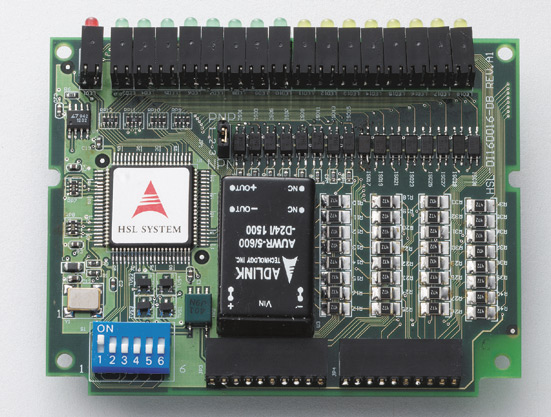
The ADLINK HSL-4XMO-CG-P is a distributed 4-axis motion control module designed for high-performance stepper and servo motor applications. It integrates a digital signal processor (DSP) and motion control ASIC to deliver precise, real-time motion control over the HSL network. The module supports both stepper and servo motor control via pulse train outputs and provides advanced motion features such as interpolation, on-the-fly parameter changes, and motion scripting.
### 2. Key Features
- HSL Communication Protocol: Fully compatible with ADLINK’s High Speed Link (HSL) distributed I/O and motion control network.
- Selectable Transmission Speeds: 3 Mbps, 6 Mbps, or 12 Mbps data rates.
- Duplex Modes: Supports both half-duplex and full-duplex communication.
- On-board DSP (TMS320C6711): Handles motion command processing and data management independently of the host CPU.
- 4-Axis Pulse Train Output: Controls up to four stepper or servo motors simultaneously.
- Scalable Network: Up to 15 modules (60 axes) can be connected on a single HSL network.
- High Pulse Frequency: Pulse train output up to 6.55 MHz.
- Interpolation Capabilities:
- 2–4 axes linear interpolation
- 2 axes circular interpolation
- Continuous contouring for smooth multi-axis motion
- Dynamic Motion Control: Position and velocity can be modified on-the-fly during motion.
- Motion Point Table Management: Supports up to 2000 motion points stored locally for reduced CPU load.
- Motion Script Download: Supports G-code-like scripting for autonomous motion sequences.
- 13 Home Return Modes: Flexible homing configurations for various mechanical setups.
- Dedicated Motion I/O: Includes EL, ORG, INP, RDY, SVON, ERC, and ALM signals.
- High-Speed Position Latch and Compare: Hardware-based position compare and trigger output.
- Backlash Compensation & Vibration Suppression: Automatic correction and damping functions.
- Safety & Isolation: All digital I/O channels are optically isolated to 2500 Vrms.
- Software Support: Compatible with ADLINK’s Motion Creator utility and LinkMaster configuration software.
### 3. Technical Specifications
Axes Control: 4 independent axes per module
Maximum Network Axes: 60 (15 modules)
Slave ID Consumption: 4 IDs per module
Pulse Output Frequency: Up to 6.55 MHz
Encoder Input Frequency: Up to 5 MHz
Position Counter Range: ±134,217,727 pulses (28-bit)
Internal Reference Clock: 19.66 MHz
Power Supply: 22–26 VDC (nominal 24 VDC)
Power Consumption: 8 W (max.)
Isolation Voltage: 2500 Vrms (I/O), 500 Vrms (signal isolation)
Operating Temperature: 0°C to 60°C
Storage Temperature: -20°C to 80°C
Humidity: 0–90% RH, non-condensing
Dimensions: 163.5 mm (W) × 74.9 mm (D) × 52.7 mm (H)
Weight: Approx. 0.5 kg (module only)
Certification: CE compliant
Electrical Characteristics:
- Digital Inputs: NPN/PNP selectable, 6.5–24 V ON, 0–3 V OFF, 10 kHz switching rate
- Digital Outputs: NPN (sinking) or PNP (sourcing), ±90 mA max., 2 kHz switching rate
- Encoder Inputs: Differential, 3–5 V logic, 220 Ω input resistance
- Pulse Outputs: Differential line driver, Logic H ≥ 2.5 V, Logic L ≤ 0.5 V
### 4. Functionality
The HSL-4XMO-CG-P operates as a distributed motion control slave module within ADLINK’s HSL network. It generates high-frequency pulse trains to drive stepper or servo motor amplifiers. The onboard DSP executes motion commands, manages interpolation, and handles I/O processing in real time, minimizing host CPU load.
Supported Motion Modes:
- Point-to-Point Motion: Absolute or relative positioning with trapezoidal or S-curve velocity profiles.
- Velocity Mode: Continuous motion with adjustable acceleration/deceleration.
- Interpolation:
- Linear interpolation (2–4 axes)
- Circular interpolation (2 axes)
- Continuous contouring for smooth transitions
- Home Return: 13 configurable homing sequences with automatic zeroing.
- On-the-Fly Adjustments: Real-time speed and position modification during motion.
- Position Compare & Trigger: Hardware-based trigger output when encoder count matches preset values.
- Backlash Compensation: Automatic correction pulses on direction change.
- Software Limits: Dual programmable software limits per axis.
Applications:
- Multi-axis CNC systems
- Pick-and-place automation
- Semiconductor and PCB assembly equipment
- Precision inspection and measurement systems
- Robotics and gantry motion platforms
Compatibility:
- Compatible with stepper, AC/DC servo, linear, and rotary motors using pulse train interfaces.
- Works with ADLINK’s HSL master controllers and LinkMaster software suite.
### 5. Components & Accessories
Included Items:
- HSL-4XMO-CG-P module
- ADLINK All-in-One Software CD (drivers, libraries, utilities)
- User’s Manual and installation guide
Connectors:
- CN1: External power input (+24 VDC, EGND)
- CN2: Emergency stop input and input common (EMG, ICOM)
- HS1/HS2: HSL communication ports (RJ-45)
- HS3: HSL communication (WAGO type)
- CM1–CM4: Servo interface connectors (encoder, pulse, control I/O)
- IOIF1–IOIF4: Mechanical I/O and GPIO connectors
Optional Accessories:
- HSL communication cables (RJ-45 or WAGO)
- Servo interface cables (D-sub or general-purpose)
- Mounting brackets and DIN-rail adapters
### 6. Installation & Setup
Requirements:
- 24 VDC regulated power supply (22–26 VDC range)
- HSL master controller and compatible host PC
- Proper grounding and shielding for signal integrity
Mounting Options:
- DIN-rail or panel mounting
- RJ-45 or WAGO connectors for HSL communication
Configuration Steps:
1. Assign Slave ID using DIP switch S1 (occupies 4 IDs per module).
2. Set communication speed via jumper JP1 (3/6/12 Mbps).
3. Select duplex mode using JP2–JP3.
4. Configure termination resistor (JP4) for end-of-line modules.
5. Connect motor drivers, encoders, and I/O signals per pin assignments.
6. Install software drivers and LinkMaster utility.
7. Verify communication and test motion using Motion Creator.
Software Setup:
- Configure motion parameters, I/O logic, and interpolation modes via Motion Creator GUI.
- Save configurations to HSL-4XMO.ini for reuse.
- Use ADLINK’s API libraries for custom application development (C/C++, Windows, Linux).
### 7. Performance & Capabilities
Motion Performance:
- Pulse Output Rate: Up to 6.55 MHz
- Encoder Feedback Rate: Up to 5 MHz
- Command Response Time:
- Half Duplex: 240 µs/module @ 6 Mbps
- Full Duplex: 240 µs/2 modules @ 6 Mbps
- Command Execution Time:
- Single-axis motion: ~2.6 ms
- Two-axis motion: ~3.0 ms
- Simple I/O commands: ~0.5 ms
Interpolation & Motion Control:
- 2–4 axis linear interpolation with synchronized start/stop
- 2-axis circular interpolation with optional acceleration/deceleration profiles
- Continuous contouring for seamless multi-segment motion
- Trapezoidal and S-curve velocity profiles for smooth acceleration
- Real-time velocity and position override
Capacity:
- Up to 2000 motion points in point table memory
- Up to 63 axes per HSL network (16 modules max.)
Efficiency:
- Offloads motion computation to onboard DSP
- Reduces host CPU utilization
- Supports autonomous motion via script execution
Limitations:
- On-the-fly changes limited by remaining motion distance
- Circular interpolation with acceleration requires dedicated auxiliary axis
- Maximum cable length: 100 m @ 12 Mbps, 200 m @ 6 Mbps, 400 m @ 3 Mbps
### 8. Standards & Compliance
- CE Certified: Conforms to European EMC and safety standards.
- Electrical Isolation: 2500 Vrms isolation for all digital I/O channels.
- Environmental Compliance: RoHS-compliant materials.
- Industry Standards:
- HSL (High Speed Link) communication protocol
- G-code-like motion scripting compatibility
- Supports standard pulse train motor interfaces (OUT/DIR, CW/CCW, AB phase)
### 9. Additional Information
Warranty:
- Standard 2-year limited warranty (1 year in China).
- Covers manufacturing defects and hardware failures under normal use.
- Excludes damage from misuse, improper installation, or environmental factors.
- RMA service available via ADLINK’s online portal: [rma.adlinktech.com](http://rma.adlinktech.com).
Technical Support:
- Email: service@adlinktech.com
- Phone: +886-2-82265877
- Fax: +886-2-82265717
- Website: [www.adlinktech.com](http://www.adlinktech.com)
- Address: 9F, No. 166, Jian Yi Road, Chungho City, Taipei 235, Taiwan
Maintenance & Updates:
- Firmware and driver updates available through ADLINK’s website.
- Regular calibration and inspection of connectors recommended.
- Software utilities (LinkMaster, Motion Creator) support configuration backup and diagnostics.
Software Ecosystem:
- Motion Creator: Windows-based GUI for configuration, testing, and motion control.
- LinkMaster Utility: Integrates motion and I/O configuration for HSL systems.
- Programming Libraries: C/C++ APIs for DOS, Windows 9x/NT/2000/XP, and Linux.
- Motion Script Support: G-code-like scripting for standalone operation.
### Summary
The ADLINK HSL-4XMO-CG-P is a high-performance, distributed 4-axis motion control module engineered for precision automation and motion synchronization. Its combination of a powerful DSP, flexible interpolation modes, and robust HSL communication makes it ideal for complex multi-axis systems requiring deterministic control and minimal CPU overhead. With comprehensive I/O isolation, advanced motion features, and extensive software support, the HSL-4XMO-CG-P provides a scalable and reliable solution for industrial motion control applications across manufacturing, robotics, and semiconductor industries.
### 1. Product Overview
Product Name: HSL-4XMO-CG-P
Model: HSL-4XMO-CG-P
Series: HSL-4XMO (High Speed Link 4-Axis Motion Control Module)
Article Number: HSL-4XMO-CG-P
Manufacturer: ADLINK Technology Inc.
Part Number: 50-1I001-200
Revision: Manual Rev. 2.02 (December 21, 2006)
Product Type: Remote 4-axis stepper and servo motor control module for distributed motion systems using the HSL (High Speed Link) bus.
The ADLINK HSL-4XMO-CG-P is a distributed 4-axis motion control module designed for high-performance stepper and servo motor applications. It integrates a digital signal processor (DSP) and motion control ASIC to deliver precise, real-time motion control over the HSL network. The module supports both stepper and servo motor control via pulse train outputs and provides advanced motion features such as interpolation, on-the-fly parameter changes, and motion scripting.
### 2. Key Features
- HSL Communication Protocol: Fully compatible with ADLINK’s High Speed Link (HSL) distributed I/O and motion control network.
- Selectable Transmission Speeds: 3 Mbps, 6 Mbps, or 12 Mbps data rates.
- Duplex Modes: Supports both half-duplex and full-duplex communication.
- On-board DSP (TMS320C6711): Handles motion command processing and data management independently of the host CPU.
- 4-Axis Pulse Train Output: Controls up to four stepper or servo motors simultaneously.
- Scalable Network: Up to 15 modules (60 axes) can be connected on a single HSL network.
- High Pulse Frequency: Pulse train output up to 6.55 MHz.
- Interpolation Capabilities:
- 2–4 axes linear interpolation
- 2 axes circular interpolation
- Continuous contouring for smooth multi-axis motion
- Dynamic Motion Control: Position and velocity can be modified on-the-fly during motion.
- Motion Point Table Management: Supports up to 2000 motion points stored locally for reduced CPU load.
- Motion Script Download: Supports G-code-like scripting for autonomous motion sequences.
- 13 Home Return Modes: Flexible homing configurations for various mechanical setups.
- Dedicated Motion I/O: Includes EL, ORG, INP, RDY, SVON, ERC, and ALM signals.
- High-Speed Position Latch and Compare: Hardware-based position compare and trigger output.
- Backlash Compensation & Vibration Suppression: Automatic correction and damping functions.
- Safety & Isolation: All digital I/O channels are optically isolated to 2500 Vrms.
- Software Support: Compatible with ADLINK’s Motion Creator utility and LinkMaster configuration software.
### 3. Technical Specifications
Axes Control: 4 independent axes per module
Maximum Network Axes: 60 (15 modules)
Slave ID Consumption: 4 IDs per module
Pulse Output Frequency: Up to 6.55 MHz
Encoder Input Frequency: Up to 5 MHz
Position Counter Range: ±134,217,727 pulses (28-bit)
Internal Reference Clock: 19.66 MHz
Power Supply: 22–26 VDC (nominal 24 VDC)
Power Consumption: 8 W (max.)
Isolation Voltage: 2500 Vrms (I/O), 500 Vrms (signal isolation)
Operating Temperature: 0°C to 60°C
Storage Temperature: -20°C to 80°C
Humidity: 0–90% RH, non-condensing
Dimensions: 163.5 mm (W) × 74.9 mm (D) × 52.7 mm (H)
Weight: Approx. 0.5 kg (module only)
Certification: CE compliant
Electrical Characteristics:
- Digital Inputs: NPN/PNP selectable, 6.5–24 V ON, 0–3 V OFF, 10 kHz switching rate
- Digital Outputs: NPN (sinking) or PNP (sourcing), ±90 mA max., 2 kHz switching rate
- Encoder Inputs: Differential, 3–5 V logic, 220 Ω input resistance
- Pulse Outputs: Differential line driver, Logic H ≥ 2.5 V, Logic L ≤ 0.5 V
### 4. Functionality
The HSL-4XMO-CG-P operates as a distributed motion control slave module within ADLINK’s HSL network. It generates high-frequency pulse trains to drive stepper or servo motor amplifiers. The onboard DSP executes motion commands, manages interpolation, and handles I/O processing in real time, minimizing host CPU load.
Supported Motion Modes:
- Point-to-Point Motion: Absolute or relative positioning with trapezoidal or S-curve velocity profiles.
- Velocity Mode: Continuous motion with adjustable acceleration/deceleration.
- Interpolation:
- Linear interpolation (2–4 axes)
- Circular interpolation (2 axes)
- Continuous contouring for smooth transitions
- Home Return: 13 configurable homing sequences with automatic zeroing.
- On-the-Fly Adjustments: Real-time speed and position modification during motion.
- Position Compare & Trigger: Hardware-based trigger output when encoder count matches preset values.
- Backlash Compensation: Automatic correction pulses on direction change.
- Software Limits: Dual programmable software limits per axis.
Applications:
- Multi-axis CNC systems
- Pick-and-place automation
- Semiconductor and PCB assembly equipment
- Precision inspection and measurement systems
- Robotics and gantry motion platforms
Compatibility:
- Compatible with stepper, AC/DC servo, linear, and rotary motors using pulse train interfaces.
- Works with ADLINK’s HSL master controllers and LinkMaster software suite.
### 5. Components & Accessories
Included Items:
- HSL-4XMO-CG-P module
- ADLINK All-in-One Software CD (drivers, libraries, utilities)
- User’s Manual and installation guide
Connectors:
- CN1: External power input (+24 VDC, EGND)
- CN2: Emergency stop input and input common (EMG, ICOM)
- HS1/HS2: HSL communication ports (RJ-45)
- HS3: HSL communication (WAGO type)
- CM1–CM4: Servo interface connectors (encoder, pulse, control I/O)
- IOIF1–IOIF4: Mechanical I/O and GPIO connectors
Optional Accessories:
- HSL communication cables (RJ-45 or WAGO)
- Servo interface cables (D-sub or general-purpose)
- Mounting brackets and DIN-rail adapters
### 6. Installation & Setup
Requirements:
- 24 VDC regulated power supply (22–26 VDC range)
- HSL master controller and compatible host PC
- Proper grounding and shielding for signal integrity
Mounting Options:
- DIN-rail or panel mounting
- RJ-45 or WAGO connectors for HSL communication
Configuration Steps:
1. Assign Slave ID using DIP switch S1 (occupies 4 IDs per module).
2. Set communication speed via jumper JP1 (3/6/12 Mbps).
3. Select duplex mode using JP2–JP3.
4. Configure termination resistor (JP4) for end-of-line modules.
5. Connect motor drivers, encoders, and I/O signals per pin assignments.
6. Install software drivers and LinkMaster utility.
7. Verify communication and test motion using Motion Creator.
Software Setup:
- Configure motion parameters, I/O logic, and interpolation modes via Motion Creator GUI.
- Save configurations to HSL-4XMO.ini for reuse.
- Use ADLINK’s API libraries for custom application development (C/C++, Windows, Linux).
### 7. Performance & Capabilities
Motion Performance:
- Pulse Output Rate: Up to 6.55 MHz
- Encoder Feedback Rate: Up to 5 MHz
- Command Response Time:
- Half Duplex: 240 µs/module @ 6 Mbps
- Full Duplex: 240 µs/2 modules @ 6 Mbps
- Command Execution Time:
- Single-axis motion: ~2.6 ms
- Two-axis motion: ~3.0 ms
- Simple I/O commands: ~0.5 ms
Interpolation & Motion Control:
- 2–4 axis linear interpolation with synchronized start/stop
- 2-axis circular interpolation with optional acceleration/deceleration profiles
- Continuous contouring for seamless multi-segment motion
- Trapezoidal and S-curve velocity profiles for smooth acceleration
- Real-time velocity and position override
Capacity:
- Up to 2000 motion points in point table memory
- Up to 63 axes per HSL network (16 modules max.)
Efficiency:
- Offloads motion computation to onboard DSP
- Reduces host CPU utilization
- Supports autonomous motion via script execution
Limitations:
- On-the-fly changes limited by remaining motion distance
- Circular interpolation with acceleration requires dedicated auxiliary axis
- Maximum cable length: 100 m @ 12 Mbps, 200 m @ 6 Mbps, 400 m @ 3 Mbps
### 8. Standards & Compliance
- CE Certified: Conforms to European EMC and safety standards.
- Electrical Isolation: 2500 Vrms isolation for all digital I/O channels.
- Environmental Compliance: RoHS-compliant materials.
- Industry Standards:
- HSL (High Speed Link) communication protocol
- G-code-like motion scripting compatibility
- Supports standard pulse train motor interfaces (OUT/DIR, CW/CCW, AB phase)
### 9. Additional Information
Warranty:
- Standard 2-year limited warranty (1 year in China).
- Covers manufacturing defects and hardware failures under normal use.
- Excludes damage from misuse, improper installation, or environmental factors.
- RMA service available via ADLINK’s online portal: [rma.adlinktech.com](http://rma.adlinktech.com).
Technical Support:
- Email: service@adlinktech.com
- Phone: +886-2-82265877
- Fax: +886-2-82265717
- Website: [www.adlinktech.com](http://www.adlinktech.com)
- Address: 9F, No. 166, Jian Yi Road, Chungho City, Taipei 235, Taiwan
Maintenance & Updates:
- Firmware and driver updates available through ADLINK’s website.
- Regular calibration and inspection of connectors recommended.
- Software utilities (LinkMaster, Motion Creator) support configuration backup and diagnostics.
Software Ecosystem:
- Motion Creator: Windows-based GUI for configuration, testing, and motion control.
- LinkMaster Utility: Integrates motion and I/O configuration for HSL systems.
- Programming Libraries: C/C++ APIs for DOS, Windows 9x/NT/2000/XP, and Linux.
- Motion Script Support: G-code-like scripting for standalone operation.
### Summary
The ADLINK HSL-4XMO-CG-P is a high-performance, distributed 4-axis motion control module engineered for precision automation and motion synchronization. Its combination of a powerful DSP, flexible interpolation modes, and robust HSL communication makes it ideal for complex multi-axis systems requiring deterministic control and minimal CPU overhead. With comprehensive I/O isolation, advanced motion features, and extensive software support, the HSL-4XMO-CG-P provides a scalable and reliable solution for industrial motion control applications across manufacturing, robotics, and semiconductor industries.
-
 HSL-4XMO_Datasheet_17.pdf
PDF Catalog
HSL-4XMO_Datasheet_17.pdf
PDF Catalog
-
 HSL-4XMO_Manual_9.pdf
Manual
HSL-4XMO_Manual_9.pdf
Manual
Kein Zubehör vorhanden.