 SUCHEN SIE DIE PASSENDE
INDUSTRIELLE LÖSUNG?
Entdecken Sie Embedded-, Kommunikations- und Automatisierungslösungen für Ihre Anwendung.
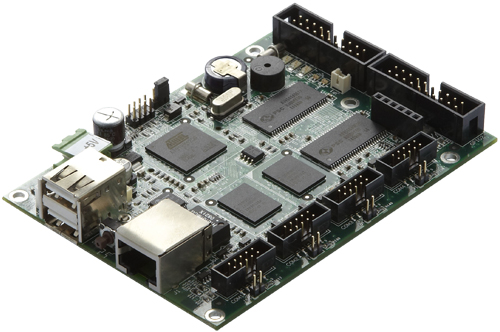
- ARM9 Architecture: Powered by the Atmel AT91RM9200 ARM920T processor (180 MHz, 200 MIPS) with integrated Memory Management Unit (MMU), 16 KB instruction cache, and 16 KB data cache.
- Linux-Ready Platform: Pre-installed Linux 2.6.x kernel with U-Boot 1.1.2 bootloader, supporting JFFS2, EXT2/EXT3, VFAT/FAT, and NFS file systems.
- Wide Temperature Operation: Industrial-grade components ensure reliable operation from –20 °C to +80 °C (M-508T model).
- Non-Volatile SRAM: 512 KB FRAM for data retention during power loss (M-508T only).
- Low Power Consumption: Typical power draw of 600 mA at 5 VDC (<3 W total).
- Comprehensive Connectivity:
- 1× 10/100 Mbps Ethernet (RJ-45, 1.5 kV isolation)
- 4× RS-232/485 serial ports (Port 4 also supports RS-422)
- 2× USB 2.0 full-speed host ports (12 Mbps)
- 1× SD 1.0 memory card slot
- 32× CMOS-level GPIO channels
- Security and Networking: Built-in SSL, SSH 1.0/2.0, SNMP v1/v2, and firewall (iptables) support.
- Compact Design: PCB dimensions 105 mm × 75 mm, suitable for embedded integration.
- Development Support: Includes GNU C/C++ cross-compilation toolchain for Linux and Windows (CygWin).
- Integrated Peripherals: Real-Time Clock (RTC), watchdog timer, buzzer, and status LEDs for power, readiness, and communication activity.
- Web and Remote Management: Built-in Boa web server, Telnet, FTP, and SSH daemons for remote configuration and monitoring.
- Linux-Ready Platform: Pre-installed Linux 2.6.x kernel with U-Boot 1.1.2 bootloader, supporting JFFS2, EXT2/EXT3, VFAT/FAT, and NFS file systems.
- Wide Temperature Operation: Industrial-grade components ensure reliable operation from –20 °C to +80 °C (M-508T model).
- Non-Volatile SRAM: 512 KB FRAM for data retention during power loss (M-508T only).
- Low Power Consumption: Typical power draw of 600 mA at 5 VDC (<3 W total).
- Comprehensive Connectivity:
- 1× 10/100 Mbps Ethernet (RJ-45, 1.5 kV isolation)
- 4× RS-232/485 serial ports (Port 4 also supports RS-422)
- 2× USB 2.0 full-speed host ports (12 Mbps)
- 1× SD 1.0 memory card slot
- 32× CMOS-level GPIO channels
- Security and Networking: Built-in SSL, SSH 1.0/2.0, SNMP v1/v2, and firewall (iptables) support.
- Compact Design: PCB dimensions 105 mm × 75 mm, suitable for embedded integration.
- Development Support: Includes GNU C/C++ cross-compilation toolchain for Linux and Windows (CygWin).
- Integrated Peripherals: Real-Time Clock (RTC), watchdog timer, buzzer, and status LEDs for power, readiness, and communication activity.
- Web and Remote Management: Built-in Boa web server, Telnet, FTP, and SSH daemons for remote configuration and monitoring.
1. Product Overview
Product Name: M-508T
Model: M-508T (part of the M-508/M-508T series)
Article Number: M-508T
Manufacturer: Artila Electronics Co., Ltd.
Product Type: ARM9-based Stand-Alone Embedded Computer
Series Description: The M-508/M-508T series are compact, Linux-ready single board computers (SBCs) designed for industrial and embedded applications requiring low power consumption, extended temperature operation, and multiple communication interfaces.
Summary: The M-508T is a high-reliability, ultra-low-power ARM9 embedded computer featuring a 180 MHz Atmel AT91RM9200 processor, 64 MB SDRAM, 32 MB Flash, and 512 KB non-volatile SRAM. It supports Linux kernel 2.6.x, includes a built-in web server, and provides extensive connectivity options including Ethernet, USB, RS-232/422/485 serial ports, and 32 GPIO channels. The M-508T is engineered for industrial environments with an operating temperature range of –20 °C to +80 °C and power consumption under 3 W.
2. Key Features
- ARM9 Architecture: Powered by the Atmel AT91RM9200 ARM920T processor (180 MHz, 200 MIPS) with integrated Memory Management Unit (MMU), 16 KB instruction cache, and 16 KB data cache.
- Linux-Ready Platform: Pre-installed Linux 2.6.x kernel with U-Boot 1.1.2 bootloader, supporting JFFS2, EXT2/EXT3, VFAT/FAT, and NFS file systems.
- Wide Temperature Operation: Industrial-grade components ensure reliable operation from –20 °C to +80 °C (M-508T model).
- Non-Volatile SRAM: 512 KB FRAM for data retention during power loss (M-508T only).
- Low Power Consumption: Typical power draw of 600 mA at 5 VDC (<3 W total).
- Comprehensive Connectivity:
- 1× 10/100 Mbps Ethernet (RJ-45, 1.5 kV isolation)
- 4× RS-232/485 serial ports (Port 4 also supports RS-422)
- 2× USB 2.0 full-speed host ports (12 Mbps)
- 1× SD 1.0 memory card slot
- 32× CMOS-level GPIO channels
- Security and Networking: Built-in SSL, SSH 1.0/2.0, SNMP v1/v2, and firewall (iptables) support.
- Compact Design: PCB dimensions 105 mm × 75 mm, suitable for embedded integration.
- Development Support: Includes GNU C/C++ cross-compilation toolchain for Linux and Windows (CygWin).
- Integrated Peripherals: Real-Time Clock (RTC), watchdog timer, buzzer, and status LEDs for power, readiness, and communication activity.
- Web and Remote Management: Built-in Boa web server, Telnet, FTP, and SSH daemons for remote configuration and monitoring.
3. Technical Specifications
Processor and Memory
- CPU: Atmel AT91RM9200 (ARM920T core, 180 MHz, 200 MIPS)
- Memory: 64 MB SDRAM
- Flash Storage: 32 MB onboard
- Non-Volatile SRAM: 512 KB (M-508T only)
- Caches: 16 KB instruction + 16 KB data
Networking
- Interface: 10/100 Base-T Ethernet
- Connector: RJ-45 with 1.5 kV magnetic isolation
- Protocols: IPv4, TCP/IP, UDP, DHCP, NTP, FTP, Telnet, HTTP, PPP, PPPoE, SMTP, SNMP, SSL, SSH
Serial Communication
- Ports: 4× RS-232/485 (software selectable)
- Port 4: RS-232/422/485 selectable
- Port 2: Full modem signal support (DCD, DSR, DTR)
- Baud Rate: Up to 921.6 Kbps
- Data Bits: 5, 6, 7, 8
- Stop Bits: 1, 1.5, 2
- Parity: None, Even, Odd, Mark, Space
- Flow Control: RTS/CTS, XON/XOFF, None
- Connector: 10-pin header (male)
USB Interfaces
- 2× USB 2.0 full-speed host ports (12 Mbps)
- Supported Devices: USB storage, Wi-Fi (Ralink RT2571), USB modem (CDC), USB camera
Digital I/O (GPIO)
- 32× CMOS-level GPIO pins (2× 20-pin headers, 2.54 mm pitch)
- Programmable as input or output
- Voltage Levels: +3.3 V and +5 V reference pins provided
Mass Storage
- 1× SD 1.0 compliant socket (rear-mounted)
- Supports SD/MMC cards for storage expansion
Power and Environmental
- Input Voltage: +5 VDC
- Typical Current: 600 mA
- Power Consumption: <3 W
- Operating Temperature:
- M-508: 0 °C – 70 °C
- M-508T: –20 °C – 80 °C
- Dimensions: 105 mm × 75 mm
- Mounting: 3 mm screw holes
- Regulatory: CE Class A, FCC Class A
Indicators and Controls
- Power LED (PWR): Solid green when powered
- Ready LED (RDY): Solid green after successful boot
- LAN LED: Link/Activity indication
- Serial Port LEDs (LD3–LD6): Dual-color TX/RX indicators
- Debug LEDs (LD1–LD2): Boot diagnostics
- Reset Button: Hardware reset (use only if software reboot fails)
4. Functionality
The M-508T operates as a compact, standalone embedded Linux computer. Upon power-up, the U-Boot loader initializes the system, decompresses the Linux kernel and root filesystem into RAMDISK, and mounts the user flash disk (/disk). The system provides a full Linux environment accessible via SSH, Telnet, or serial console.
Use Cases and Applications:
- Industrial automation and control systems
- Data acquisition and remote monitoring
- Networked instrumentation and gateways
- Embedded web servers and IoT controllers
- Serial-to-Ethernet communication bridges
- Edge computing and protocol conversion
Compatibility:
- Linux kernel 2.6.x compatible
- Supports GNU C/C++ toolchain for cross-compilation
- Works with standard USB 2.0 peripherals and SD 1.0 memory cards
- Compatible with Ralink RT2571-based Wi-Fi adapters
5. Components & Accessories
Included Items:
- M-508T main board
- 4× CB-F10M9-20 (10-pin header to DB9 male serial cables)
- Artila CD-ROM containing:
- GNU C/C++ toolchain
- Installation guide
- Example programs and utilities
Optional Accessories:
- CB-F9F9-150: DB9 female serial console cable
- CB-RJ2CON-100: Serial console cable for enabling console access
- USB Wi-Fi adapter (Ralink RT2571 chipset)
- USB storage devices and modems
Connectors and Headers:
- Power connector (+5 VDC input)
- RJ-45 Ethernet port
- 2× USB 2.0 host ports
- 4× serial port headers (COM1–COM4)
- 2× 20-pin GPIO headers (GPIO1, GPIO2)
- CN1 JTAG header (2×4 pins, 2.0 mm pitch)
- COM2 TTL header (6 pins)
- JP2 boot manager jumper (set to 2–3)
- J3 USB client connector (reserved)
- RS-485 terminator jumpers (J5, J7, J8, J9)
6. Installation & Setup
Power Requirements:
Supply regulated +5 VDC to the power connector, ensuring correct polarity. The PWR LED will illuminate solid green when power is applied.
Mounting:
Four 3 mm screw holes allow secure mounting within enclosures or panels.
Network Configuration:
Default IP: 192.168.2.127
Default login: guest / guest
Supervisor (root) login via SSH: root / root
To change network settings, edit `/disk/etc/rc` or use DHCP (`dhcpcd eth0 &`).
Serial Console Setup:
- Baud rate: 115200 bps
- Data bits: 8
- Parity: None
- Stop bits: 1
- Terminal type: ANSI
Use CB-F9F9-150 cable on COM3 to enable console access.
Wireless LAN Setup:
Insert a supported USB Wi-Fi adapter (Ralink RT2571).
Commands:
```
modprobe rt73
ifconfig wlan0 up
iwconfig wlan0 essid <SSID> key <KEY> mode managed
dhcpcd wlan0 &
```
File System Structure:
- Root filesystem: RAMDISK (8 MB)
- User disk (/disk): Flash-based (12 MB available)
- Additional flash partition: disk-1 (15 MB)
- M-508T FRAM: 512 KB mounted as /sram
Mounting External Storage:
- USB disk: `mount /dev/sda1`
- SD card: `mount /dev/mmc0`
7. Performance & Capabilities
Processing Performance:
- 200 MIPS at 180 MHz ARM920T core
- Efficient multitasking under Linux 2.6.x
- Hardware MMU for memory protection and virtual memory
Data Throughput:
- Serial ports up to 921.6 Kbps
- Ethernet 10/100 Mbps full duplex
- USB 2.0 full-speed (12 Mbps)
Storage Capacity:
- 32 MB onboard Flash (approx. 12 MB user space)
- Expandable via SD card or USB storage
- 512 KB non-volatile SRAM for critical data retention
Power Efficiency:
- <3 W total consumption
- Ideal for battery-powered or energy-sensitive embedded systems
Limitations:
- No hardware floating-point unit (software emulation required)
- USB 2.0 limited to full-speed (12 Mbps, not high-speed 480 Mbps)
- SD 1.0 standard (no SDHC support)
8. Standards & Compliance
- Operating System: Linux 2.6.x kernel
- Bootloader: U-Boot 1.1.2
- Networking Protocols: IPv4, TCP/IP, UDP, DHCP, NTP, FTP, Telnet, HTTP, PPP, PPPoE, SMTP, SNMP v1/v2, SSL, SSH 1.0/2.0
- Electrical Safety: 1.5 kV Ethernet isolation
- Regulatory Compliance: CE Class A, FCC Class A
- Environmental: Industrial-grade components for –20 °C – 80 °C operation
- Software Development: GNU C/C++ toolchain (GCC 3.3.2), GLIBC POSIX library
- File Systems Supported: JFFS2, EXT2/EXT3, VFAT/FAT, NFS
9. Additional Information
Warranty and Support:
Artila Electronics provides standard warranty coverage for manufacturing defects. Technical support, firmware updates, and software utilities are available through the Artila website and support channels.
Maintenance:
- Use the `update` utility to refresh loader, kernel, or root filesystem images.
- Format user disk with `update —FORMAT` (erases all user data).
- Backup user data to USB storage before formatting.
- Use watchdog timer and RTC for system reliability.
Software Utilities:
- update: Firmware and filesystem management
- setuart: Configure serial port modes and baud rates
- gpioctl: Manage GPIO direction and state
- iptables: Firewall configuration
- armd: Artila management daemon
- busybox: Core Linux utilities
- boa: Lightweight web server
- sshd, ftpd, telnetd, snmpd: Network service daemons
Development Environment:
- Cross-compilation via GNU toolchain (arm-linux-3.3.2.tar.gz)
- Example programs and Makefiles provided on Artila CD
- Supports FTP file transfer and remote execution
Factory Defaults:
- IP: 192.168.2.127
- User: guest / guest
- Root: root / root
- Serial console: disabled (enable via COM3)
Reset and Recovery:
- Hardware reset button for emergency reboot
- Restore factory settings via `/update —FORMAT`
- Retrieve forgotten IP using Artila Java Manager or serial console
Firmware Updates and Customization:
- Kernel and root filesystem images can be updated via `update` command
- Custom utilities can be compiled using provided GNU toolchain
- SSH key generation supported via `ssh_keygen` utility
Summary
The Artila M-508T is a robust, Linux-ready ARM9 embedded computer engineered for industrial and embedded control applications. Combining a 180 MHz ARM920T processor, 64 MB SDRAM, 32 MB Flash, and 512 KB non-volatile SRAM, it delivers reliable performance under harsh environmental conditions (–20 °C – 80 °C) with minimal power consumption (<3 W). Its extensive I/O capabilities—four serial ports, Ethernet, USB, SD, and 32 GPIOs—make it ideal for automation, data acquisition, and networked embedded systems. Preloaded with Linux 2.6.x and supported by a full GNU C/C++ toolchain, the M-508T offers developers a flexible, open platform for rapid application deployment and long-term industrial reliability.
Product Name: M-508T
Model: M-508T (part of the M-508/M-508T series)
Article Number: M-508T
Manufacturer: Artila Electronics Co., Ltd.
Product Type: ARM9-based Stand-Alone Embedded Computer
Series Description: The M-508/M-508T series are compact, Linux-ready single board computers (SBCs) designed for industrial and embedded applications requiring low power consumption, extended temperature operation, and multiple communication interfaces.
Summary: The M-508T is a high-reliability, ultra-low-power ARM9 embedded computer featuring a 180 MHz Atmel AT91RM9200 processor, 64 MB SDRAM, 32 MB Flash, and 512 KB non-volatile SRAM. It supports Linux kernel 2.6.x, includes a built-in web server, and provides extensive connectivity options including Ethernet, USB, RS-232/422/485 serial ports, and 32 GPIO channels. The M-508T is engineered for industrial environments with an operating temperature range of –20 °C to +80 °C and power consumption under 3 W.
2. Key Features
- ARM9 Architecture: Powered by the Atmel AT91RM9200 ARM920T processor (180 MHz, 200 MIPS) with integrated Memory Management Unit (MMU), 16 KB instruction cache, and 16 KB data cache.
- Linux-Ready Platform: Pre-installed Linux 2.6.x kernel with U-Boot 1.1.2 bootloader, supporting JFFS2, EXT2/EXT3, VFAT/FAT, and NFS file systems.
- Wide Temperature Operation: Industrial-grade components ensure reliable operation from –20 °C to +80 °C (M-508T model).
- Non-Volatile SRAM: 512 KB FRAM for data retention during power loss (M-508T only).
- Low Power Consumption: Typical power draw of 600 mA at 5 VDC (<3 W total).
- Comprehensive Connectivity:
- 1× 10/100 Mbps Ethernet (RJ-45, 1.5 kV isolation)
- 4× RS-232/485 serial ports (Port 4 also supports RS-422)
- 2× USB 2.0 full-speed host ports (12 Mbps)
- 1× SD 1.0 memory card slot
- 32× CMOS-level GPIO channels
- Security and Networking: Built-in SSL, SSH 1.0/2.0, SNMP v1/v2, and firewall (iptables) support.
- Compact Design: PCB dimensions 105 mm × 75 mm, suitable for embedded integration.
- Development Support: Includes GNU C/C++ cross-compilation toolchain for Linux and Windows (CygWin).
- Integrated Peripherals: Real-Time Clock (RTC), watchdog timer, buzzer, and status LEDs for power, readiness, and communication activity.
- Web and Remote Management: Built-in Boa web server, Telnet, FTP, and SSH daemons for remote configuration and monitoring.
3. Technical Specifications
Processor and Memory
- CPU: Atmel AT91RM9200 (ARM920T core, 180 MHz, 200 MIPS)
- Memory: 64 MB SDRAM
- Flash Storage: 32 MB onboard
- Non-Volatile SRAM: 512 KB (M-508T only)
- Caches: 16 KB instruction + 16 KB data
Networking
- Interface: 10/100 Base-T Ethernet
- Connector: RJ-45 with 1.5 kV magnetic isolation
- Protocols: IPv4, TCP/IP, UDP, DHCP, NTP, FTP, Telnet, HTTP, PPP, PPPoE, SMTP, SNMP, SSL, SSH
Serial Communication
- Ports: 4× RS-232/485 (software selectable)
- Port 4: RS-232/422/485 selectable
- Port 2: Full modem signal support (DCD, DSR, DTR)
- Baud Rate: Up to 921.6 Kbps
- Data Bits: 5, 6, 7, 8
- Stop Bits: 1, 1.5, 2
- Parity: None, Even, Odd, Mark, Space
- Flow Control: RTS/CTS, XON/XOFF, None
- Connector: 10-pin header (male)
USB Interfaces
- 2× USB 2.0 full-speed host ports (12 Mbps)
- Supported Devices: USB storage, Wi-Fi (Ralink RT2571), USB modem (CDC), USB camera
Digital I/O (GPIO)
- 32× CMOS-level GPIO pins (2× 20-pin headers, 2.54 mm pitch)
- Programmable as input or output
- Voltage Levels: +3.3 V and +5 V reference pins provided
Mass Storage
- 1× SD 1.0 compliant socket (rear-mounted)
- Supports SD/MMC cards for storage expansion
Power and Environmental
- Input Voltage: +5 VDC
- Typical Current: 600 mA
- Power Consumption: <3 W
- Operating Temperature:
- M-508: 0 °C – 70 °C
- M-508T: –20 °C – 80 °C
- Dimensions: 105 mm × 75 mm
- Mounting: 3 mm screw holes
- Regulatory: CE Class A, FCC Class A
Indicators and Controls
- Power LED (PWR): Solid green when powered
- Ready LED (RDY): Solid green after successful boot
- LAN LED: Link/Activity indication
- Serial Port LEDs (LD3–LD6): Dual-color TX/RX indicators
- Debug LEDs (LD1–LD2): Boot diagnostics
- Reset Button: Hardware reset (use only if software reboot fails)
4. Functionality
The M-508T operates as a compact, standalone embedded Linux computer. Upon power-up, the U-Boot loader initializes the system, decompresses the Linux kernel and root filesystem into RAMDISK, and mounts the user flash disk (/disk). The system provides a full Linux environment accessible via SSH, Telnet, or serial console.
Use Cases and Applications:
- Industrial automation and control systems
- Data acquisition and remote monitoring
- Networked instrumentation and gateways
- Embedded web servers and IoT controllers
- Serial-to-Ethernet communication bridges
- Edge computing and protocol conversion
Compatibility:
- Linux kernel 2.6.x compatible
- Supports GNU C/C++ toolchain for cross-compilation
- Works with standard USB 2.0 peripherals and SD 1.0 memory cards
- Compatible with Ralink RT2571-based Wi-Fi adapters
5. Components & Accessories
Included Items:
- M-508T main board
- 4× CB-F10M9-20 (10-pin header to DB9 male serial cables)
- Artila CD-ROM containing:
- GNU C/C++ toolchain
- Installation guide
- Example programs and utilities
Optional Accessories:
- CB-F9F9-150: DB9 female serial console cable
- CB-RJ2CON-100: Serial console cable for enabling console access
- USB Wi-Fi adapter (Ralink RT2571 chipset)
- USB storage devices and modems
Connectors and Headers:
- Power connector (+5 VDC input)
- RJ-45 Ethernet port
- 2× USB 2.0 host ports
- 4× serial port headers (COM1–COM4)
- 2× 20-pin GPIO headers (GPIO1, GPIO2)
- CN1 JTAG header (2×4 pins, 2.0 mm pitch)
- COM2 TTL header (6 pins)
- JP2 boot manager jumper (set to 2–3)
- J3 USB client connector (reserved)
- RS-485 terminator jumpers (J5, J7, J8, J9)
6. Installation & Setup
Power Requirements:
Supply regulated +5 VDC to the power connector, ensuring correct polarity. The PWR LED will illuminate solid green when power is applied.
Mounting:
Four 3 mm screw holes allow secure mounting within enclosures or panels.
Network Configuration:
Default IP: 192.168.2.127
Default login: guest / guest
Supervisor (root) login via SSH: root / root
To change network settings, edit `/disk/etc/rc` or use DHCP (`dhcpcd eth0 &`).
Serial Console Setup:
- Baud rate: 115200 bps
- Data bits: 8
- Parity: None
- Stop bits: 1
- Terminal type: ANSI
Use CB-F9F9-150 cable on COM3 to enable console access.
Wireless LAN Setup:
Insert a supported USB Wi-Fi adapter (Ralink RT2571).
Commands:
```
modprobe rt73
ifconfig wlan0 up
iwconfig wlan0 essid <SSID> key <KEY> mode managed
dhcpcd wlan0 &
```
File System Structure:
- Root filesystem: RAMDISK (8 MB)
- User disk (/disk): Flash-based (12 MB available)
- Additional flash partition: disk-1 (15 MB)
- M-508T FRAM: 512 KB mounted as /sram
Mounting External Storage:
- USB disk: `mount /dev/sda1`
- SD card: `mount /dev/mmc0`
7. Performance & Capabilities
Processing Performance:
- 200 MIPS at 180 MHz ARM920T core
- Efficient multitasking under Linux 2.6.x
- Hardware MMU for memory protection and virtual memory
Data Throughput:
- Serial ports up to 921.6 Kbps
- Ethernet 10/100 Mbps full duplex
- USB 2.0 full-speed (12 Mbps)
Storage Capacity:
- 32 MB onboard Flash (approx. 12 MB user space)
- Expandable via SD card or USB storage
- 512 KB non-volatile SRAM for critical data retention
Power Efficiency:
- <3 W total consumption
- Ideal for battery-powered or energy-sensitive embedded systems
Limitations:
- No hardware floating-point unit (software emulation required)
- USB 2.0 limited to full-speed (12 Mbps, not high-speed 480 Mbps)
- SD 1.0 standard (no SDHC support)
8. Standards & Compliance
- Operating System: Linux 2.6.x kernel
- Bootloader: U-Boot 1.1.2
- Networking Protocols: IPv4, TCP/IP, UDP, DHCP, NTP, FTP, Telnet, HTTP, PPP, PPPoE, SMTP, SNMP v1/v2, SSL, SSH 1.0/2.0
- Electrical Safety: 1.5 kV Ethernet isolation
- Regulatory Compliance: CE Class A, FCC Class A
- Environmental: Industrial-grade components for –20 °C – 80 °C operation
- Software Development: GNU C/C++ toolchain (GCC 3.3.2), GLIBC POSIX library
- File Systems Supported: JFFS2, EXT2/EXT3, VFAT/FAT, NFS
9. Additional Information
Warranty and Support:
Artila Electronics provides standard warranty coverage for manufacturing defects. Technical support, firmware updates, and software utilities are available through the Artila website and support channels.
Maintenance:
- Use the `update` utility to refresh loader, kernel, or root filesystem images.
- Format user disk with `update —FORMAT` (erases all user data).
- Backup user data to USB storage before formatting.
- Use watchdog timer and RTC for system reliability.
Software Utilities:
- update: Firmware and filesystem management
- setuart: Configure serial port modes and baud rates
- gpioctl: Manage GPIO direction and state
- iptables: Firewall configuration
- armd: Artila management daemon
- busybox: Core Linux utilities
- boa: Lightweight web server
- sshd, ftpd, telnetd, snmpd: Network service daemons
Development Environment:
- Cross-compilation via GNU toolchain (arm-linux-3.3.2.tar.gz)
- Example programs and Makefiles provided on Artila CD
- Supports FTP file transfer and remote execution
Factory Defaults:
- IP: 192.168.2.127
- User: guest / guest
- Root: root / root
- Serial console: disabled (enable via COM3)
Reset and Recovery:
- Hardware reset button for emergency reboot
- Restore factory settings via `/update —FORMAT`
- Retrieve forgotten IP using Artila Java Manager or serial console
Firmware Updates and Customization:
- Kernel and root filesystem images can be updated via `update` command
- Custom utilities can be compiled using provided GNU toolchain
- SSH key generation supported via `ssh_keygen` utility
Summary
The Artila M-508T is a robust, Linux-ready ARM9 embedded computer engineered for industrial and embedded control applications. Combining a 180 MHz ARM920T processor, 64 MB SDRAM, 32 MB Flash, and 512 KB non-volatile SRAM, it delivers reliable performance under harsh environmental conditions (–20 °C – 80 °C) with minimal power consumption (<3 W). Its extensive I/O capabilities—four serial ports, Ethernet, USB, SD, and 32 GPIOs—make it ideal for automation, data acquisition, and networked embedded systems. Preloaded with Linux 2.6.x and supported by a full GNU C/C++ toolchain, the M-508T offers developers a flexible, open platform for rapid application deployment and long-term industrial reliability.
-
 ds_m508.pdf
PDF Catalog
ds_m508.pdf
PDF Catalog
-
 Warranty Declaration.pdf
PDF Catalog
Warranty Declaration.pdf
PDF Catalog
-
 M508_QIG.pdf
Manual
M508_QIG.pdf
Manual
-
 M-508_User_Guide.pdf
Manual
M-508_User_Guide.pdf
Manual
Kein Zubehör vorhanden.