DK-35A
SUCHEN SIE DIE PASSENDE
INDUSTRIELLE LÖSUNG?
Entdecken Sie Embedded-, Kommunikations- und Automatisierungslösungen für Ihre Anwendung.
- Processor & Architecture: ARM926EJ-S (ARM9) 400 MHz CPU with Memory Management Unit (MMU), 32 KB instruction cache, and 32 KB data cache.
- Memory: 64 MB SDRAM and 256 MB NAND Flash; 2 MB DataFlash® for system backup.
- Storage Expansion: Internal microSD socket supporting up to 32 GB SDHC cards.
- Operating System: Pre-installed Linux kernel 2.6.29 with U-Boot 1.1.2 bootloader.
- Networking: 1 × 10/100 Mbps Ethernet port (RJ45) with 1.5 kV magnetic isolation.
- Serial Communication:
- 1 × software-configurable RS-232/422/485 port.
- 3 × RS-232/485 ports.
- All ports use RJ45 connectors; baud rates up to 921.6 kbps.
- USB Connectivity:
- 2 × USB 2.0 full-speed (12 Mbps) host ports.
- 1 × reserved USB client port.
- Digital I/O: 5 × programmable GPIO channels (CMOS I/O, configurable as input/output).
- Indicators: Power, Ready, Ethernet Link/Activity, and per-port serial TX/RX LEDs.
- Power Supply: 9–48 V DC input, 250 mA @ 12 V DC (≈ 3 W).
- Form Factor: Compact metal enclosure, fanless, DIN-rail mountable.
- Software Tools: GNU C/C++ cross-compilation toolchain for Linux and Windows; supports Java accelerator.
- Security & Networking: SSH 1.0/2.0, SSL, FTP, Telnet, and Web server (Apache2 or lighttpd).
- Low Power Design: < 3 W typical consumption.
- Wide Temperature Option: Matrix-504T variant supports −20 °C to +80 °C.
- Memory: 64 MB SDRAM and 256 MB NAND Flash; 2 MB DataFlash® for system backup.
- Storage Expansion: Internal microSD socket supporting up to 32 GB SDHC cards.
- Operating System: Pre-installed Linux kernel 2.6.29 with U-Boot 1.1.2 bootloader.
- Networking: 1 × 10/100 Mbps Ethernet port (RJ45) with 1.5 kV magnetic isolation.
- Serial Communication:
- 1 × software-configurable RS-232/422/485 port.
- 3 × RS-232/485 ports.
- All ports use RJ45 connectors; baud rates up to 921.6 kbps.
- USB Connectivity:
- 2 × USB 2.0 full-speed (12 Mbps) host ports.
- 1 × reserved USB client port.
- Digital I/O: 5 × programmable GPIO channels (CMOS I/O, configurable as input/output).
- Indicators: Power, Ready, Ethernet Link/Activity, and per-port serial TX/RX LEDs.
- Power Supply: 9–48 V DC input, 250 mA @ 12 V DC (≈ 3 W).
- Form Factor: Compact metal enclosure, fanless, DIN-rail mountable.
- Software Tools: GNU C/C++ cross-compilation toolchain for Linux and Windows; supports Java accelerator.
- Security & Networking: SSH 1.0/2.0, SSL, FTP, Telnet, and Web server (Apache2 or lighttpd).
- Low Power Design: < 3 W typical consumption.
- Wide Temperature Option: Matrix-504T variant supports −20 °C to +80 °C.
1. Product Overview
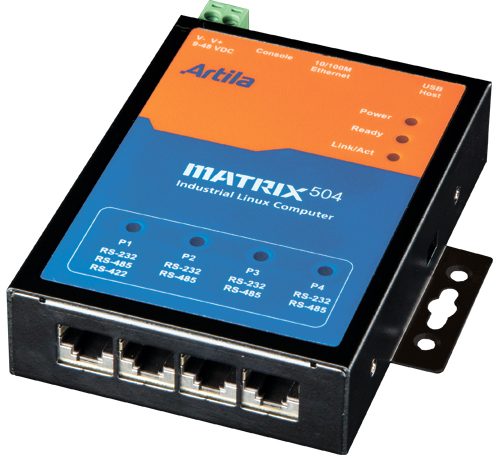
Product Name: Matrix-504
Model / Article Number: Matrix-504
Series: Matrix-500 Series (upward compatible)
Manufacturer: Artila Electronics Co., Ltd.
Product Type: Linux-ready ARM9 Industrial Box Computer
The Artila Matrix-504 is a compact, fanless, ARM9-based embedded industrial computer designed for automation, control, and data communication applications. It integrates a 400 MHz Atmel AT91SAM9G20 processor, pre-installed Linux 2.6.29 operating system, and a full suite of industrial-grade interfaces. The system is engineered for low power consumption, high reliability, and extended temperature operation, making it suitable for harsh industrial environments.
2. Key Features
- Processor & Architecture: ARM926EJ-S (ARM9) 400 MHz CPU with Memory Management Unit (MMU), 32 KB instruction cache, and 32 KB data cache.
- Memory: 64 MB SDRAM and 256 MB NAND Flash; 2 MB DataFlash® for system backup.
- Storage Expansion: Internal microSD socket supporting up to 32 GB SDHC cards.
- Operating System: Pre-installed Linux kernel 2.6.29 with U-Boot 1.1.2 bootloader.
- Networking: 1 × 10/100 Mbps Ethernet port (RJ45) with 1.5 kV magnetic isolation.
- Serial Communication:
- 1 × software-configurable RS-232/422/485 port.
- 3 × RS-232/485 ports.
- All ports use RJ45 connectors; baud rates up to 921.6 kbps.
- USB Connectivity:
- 2 × USB 2.0 full-speed (12 Mbps) host ports.
- 1 × reserved USB client port.
- Digital I/O: 5 × programmable GPIO channels (CMOS I/O, configurable as input/output).
- Indicators: Power, Ready, Ethernet Link/Activity, and per-port serial TX/RX LEDs.
- Power Supply: 9–48 V DC input, 250 mA @ 12 V DC (≈ 3 W).
- Form Factor: Compact metal enclosure, fanless, DIN-rail mountable.
- Software Tools: GNU C/C++ cross-compilation toolchain for Linux and Windows; supports Java accelerator.
- Security & Networking: SSH 1.0/2.0, SSL, FTP, Telnet, and Web server (Apache2 or lighttpd).
- Low Power Design: < 3 W typical consumption.
- Wide Temperature Option: Matrix-504T variant supports −20 °C to +80 °C.
3. Technical Specifications
CPU / Memory
- Processor: Atmel AT91SAM9G20 (ARM926EJ-S core, 400 MHz)
- SDRAM: 64 MB
- NAND Flash: 256 MB
- DataFlash: 2 MB (system backup)
- Cache: 32 KB instruction + 32 KB data
Networking
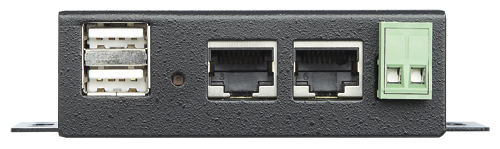
- Interface: 1 × 10/100 Base‑T Ethernet (RJ45)
- Isolation: 1.5 kV magnetic isolation
- Default IP: 192.168.2.127
Serial Interfaces (TTY Ports)
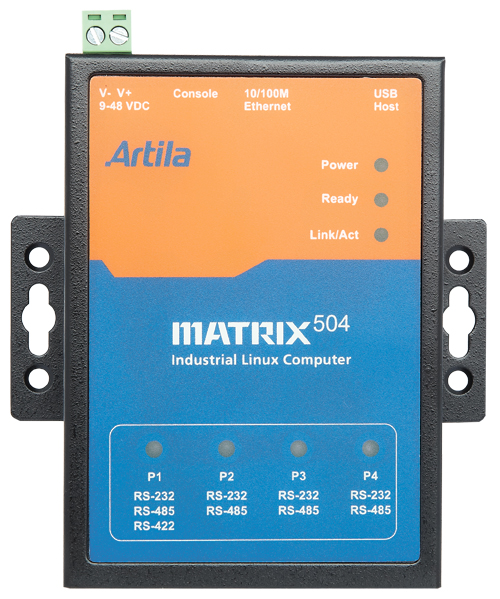
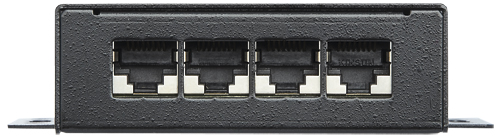
- Port 1: RS‑232/422/485 selectable
- Ports 2–4: RS‑232/485 selectable
- Connector: RJ45
- Baud Rate: up to 921.6 kbps
- Data Bits: 5–8
- Stop Bits: 1, 1.5, 2
- Parity: None, Even, Odd, Mark, Space
- Flow Control: RTS/CTS, XON/XOFF, None
- RS‑485 Direction Control: Automatic (hardware)
USB Interfaces
- Host Ports: 2 × USB 2.0 (12 Mbps full‑speed)
- Client Port: 1 × reserved
- Supported Devices: USB flash drives, Ralink RT73 Wi‑Fi dongles, FTDI USB‑to‑UART adapters, CDC‑compliant modems, USB cameras
General Hardware
- Watchdog Timer: Yes
- Real‑Time Clock: Yes
- Buzzer: Yes
- microSD Socket: Yes (up to 32 GB)
- Power Input: 9–48 V DC
- Power Consumption: 250 mA @ 12 V DC (~3 W)
- Dimensions (W × H × D): 78 × 108 × 24 mm
- Operating Temperature: 0 °C to 70 °C (standard), −20 °C to 80 °C (Matrix‑504T)
- Regulatory: CE Class A, FCC Class A
Enclosure & Mounting
- Material: Metal, fanless design
- Mounting: DIN‑rail (optional DK‑35A kit)
4. Functionality
The Matrix‑504 operates as a compact embedded Linux computer for industrial automation, data acquisition, and communication gateway applications. It boots from onboard NAND Flash using U‑Boot, loads the Linux 2.6.29 kernel, and mounts the root file system automatically.
Use Cases & Applications:
- Industrial control and monitoring systems
- Serial‑to‑Ethernet communication gateways
- Data logging and remote telemetry (RTU)
- Web‑based HMI or device management servers
- Protocol conversion (Modbus RTU/TCP, custom serial protocols)
- Edge computing and IoT gateway applications
Compatibility:
- Upward compatible with Matrix‑500 series software and accessories.
- Supports cross‑development using GNU C/C++ toolchains on Linux or Windows (via Cygwin).
- Supports USB peripherals and network connectivity for flexible expansion.
5. Components & Accessories
Standard Package Contents:
1. Matrix‑504 main unit
2. Artila CD (includes toolchain, installation guide, utilities, drivers, and example programs)
Optional Accessories:
- CB‑RJ45F9‑150 (91‑R45F9‑150): RJ45‑to‑DB9 Female serial cable, 150 cm
- CB‑RJ2CON‑100 (91‑RJCON‑100): RJ45‑to‑DB9 Female console cable, 100 cm
- DK‑35A (36‑DK35A‑000): DIN‑rail mounting kit
- PWR‑12V‑1A (31‑62100‑000): 110–240 V AC to 12 V DC 1 A power adapter
Ordering Variants:
- Matrix‑504: Standard model (0 °C to 70 °C)
- Matrix‑504T: Wide‑temperature model (−20 °C to 80 °C)
6. Installation & Setup
Power Connection:
Connect a regulated 9–48 V DC supply to the power terminal. The Power LED glows solid green when voltage is applied correctly.
Mounting:
DIN‑rail mounting via optional DK‑35A kit; fanless metal enclosure suitable for control cabinets.
Network Configuration:
Default static IP 192.168.2.127. Configure via `/etc/network/interfaces` or enable DHCP using `udhcpc eth0`.
Serial Console Access:
Use the console port (RJ45) with cable CB‑RJ2CON‑100. Default settings: 115200 bps, 8N1, no flow control, VT100 terminal.
System Boot:
Upon power‑on, U‑Boot initializes hardware, loads the Linux kernel, and mounts the root file system. Boot scripts are defined in `/etc/inittab` and `/etc/rcS.d`.
Reset & Recovery:
Hardware reset button available; use only if software reboot fails. In case of NAND corruption, the system automatically boots from DataFlash for recovery.
Software Setup:
- Access via SSH, Telnet, or serial console.
- Modify configuration files using `vi`.
- Use `ipkg` for package management and software updates.
7. Performance & Capabilities
- CPU Performance: 400 MHz ARM9 core with hardware MMU and cache architecture optimized for embedded Linux.
- Memory Throughput: 64 MB SDRAM ensures stable multitasking for web, SSH, and serial services.
- Storage: 256 MB NAND Flash for OS and user data; expandable via microSD (≤ 32 GB).
- Networking: 10/100 Mbps Ethernet with full TCP/IP stack, SSH, FTP, HTTP, and Telnet services.
- Serial Communication: Four high‑speed serial ports (up to 921.6 kbps) supporting RS‑232/422/485; automatic direction control for RS‑485.
- USB Expansion: Supports flash drives, Wi‑Fi dongles, serial adapters, and modems for flexible I/O expansion.
- Power Efficiency: < 3 W typical consumption enables fanless, always‑on operation.
- Reliability: Watchdog timer and DataFlash backup ensure system recovery and stability.
- Limitations: No built‑in display or GPU; designed for headless operation; USB client port reserved for factory use.
8. Standards & Compliance
- Regulatory Certifications: CE Class A, FCC Class A (industrial/commercial use).
- Electrical Protection: 1.5 kV magnetic isolation on Ethernet interface.
- Environmental:
- Operating Temperature: 0 °C to 70 °C (standard), −20 °C to 80 °C (Matrix‑504T).
- Humidity: 5 % to 95 % non‑condensing.
- Software Standards:
- POSIX‑compliant GLIBC library.
- Linux 2.6.29 kernel with UBI, JFFS2, EXT2/3, VFAT, NFS file systems.
- GNU GCC 4.3.3 toolchain (Linux/Windows).
- Network Protocols: TCP/IP, SSH, FTP, HTTP, Telnet, PPP, NTP.
9. Additional Information
Warranty & Support:
Artila provides standard warranty coverage and technical support via documentation, FTP resources, and firmware updates.
Maintenance & Updates:
- Software Management: `ipkg` package manager for installation, upgrade, and removal of software modules.
- Webmin Integration: Optional web‑based administration interface accessible at `http://<device IP>:10000`.
- System Recovery:
- Automatic DataFlash boot if NAND fails.
- Recovery menu allows updating loader, kernel, and file system via USB.
- Image files:
- Loader: `matrix504/matrix504.alf`
- Kernel: `matrix504/matrix504K`
- Root FS: `matrix504/matrix504R`
- Toolchain Installation:
- Linux: `arm-linux-gnueabi-gcc/g++/strip` (v4.3.3, glibc 2.9).
- Windows: CodeSourcery ARM toolchain (v4.3.3, glibc 2.8).
- Development Workflow:
- Compile applications using cross‑compiler.
- Transfer via FTP or SSH.
- Execute and debug using gdbserver or DDD.
- Utility Software Collection:
- busybox v1.14.2, sysvinit v2.86, util‑linux v2.12r, ssh v4.6p1, usbutils v0.7, Apache2 v2.23, wget v1.9.1, iptables v1.3.8, ipkg v0.99.163, procps v3.2.7, vsftpd v2.0.5, bash v3.2, wireless_tools v29, ppp v2.4.3, psmics v22.2, artila utility v1.1.
- Artila Utilities:
- `update` – update loader, kernel, or environment.
- `setuart` – configure serial port modes and baud rates.
- `version` – display OS version.
- `gpioctl` – configure GPIO direction and state.
System Indicators:
- Power LED: Solid green when powered.
- Ready LED: Solid green after successful boot; off after halt.
- Ethernet LED: Solid green (link), blinking (activity).
- Serial LEDs: Dual‑color per port (green = RX, yellow = TX).
Default Login Credentials:
- Username: root / guest (telnet guest only)
- Password: root / guest
- Console: 115200 bps, 8N1, no flow control
Recovery & Troubleshooting:
- Forgot Password: Boot to run‑level 1 via serial console and reset using `passwd`.
- Forgot IP: Use Artila Java Manager or `ifconfig` via console.
- System Boot Failure: Automatic DataFlash boot for recovery; use USB image update.
Development & Automation Integration:
Matrix‑504 supports automated startup scripts via `/etc/rc.local`, enabling user applications to launch at boot. It can serve as a web‑enabled controller, data logger, or communication bridge in SCADA, IoT, and industrial networking systems.
Summary
The Artila Matrix‑504 is a robust, Linux‑ready ARM9 industrial computer optimized for embedded control and communication tasks. With its 400 MHz ARM9 CPU, 64 MB RAM, 256 MB Flash, and versatile I/O—including Ethernet, four serial ports, USB, GPIO, and microSD expansion—it provides a flexible platform for industrial automation, data acquisition, and IoT gateway applications. Its fanless, low‑power design, wide input voltage range, and extended temperature option ensure reliable operation in demanding environments. Pre‑installed Linux, comprehensive development tools, and extensive connectivity make the Matrix‑504 a complete solution for embedded system developers and system integrators seeking a compact, open, and stable industrial computing platform.

Product Name: Matrix-504
Model / Article Number: Matrix-504
Series: Matrix-500 Series (upward compatible)
Manufacturer: Artila Electronics Co., Ltd.
Product Type: Linux-ready ARM9 Industrial Box Computer
The Artila Matrix-504 is a compact, fanless, ARM9-based embedded industrial computer designed for automation, control, and data communication applications. It integrates a 400 MHz Atmel AT91SAM9G20 processor, pre-installed Linux 2.6.29 operating system, and a full suite of industrial-grade interfaces. The system is engineered for low power consumption, high reliability, and extended temperature operation, making it suitable for harsh industrial environments.
2. Key Features
- Processor & Architecture: ARM926EJ-S (ARM9) 400 MHz CPU with Memory Management Unit (MMU), 32 KB instruction cache, and 32 KB data cache.
- Memory: 64 MB SDRAM and 256 MB NAND Flash; 2 MB DataFlash® for system backup.
- Storage Expansion: Internal microSD socket supporting up to 32 GB SDHC cards.
- Operating System: Pre-installed Linux kernel 2.6.29 with U-Boot 1.1.2 bootloader.
- Networking: 1 × 10/100 Mbps Ethernet port (RJ45) with 1.5 kV magnetic isolation.
- Serial Communication:
- 1 × software-configurable RS-232/422/485 port.
- 3 × RS-232/485 ports.
- All ports use RJ45 connectors; baud rates up to 921.6 kbps.
- USB Connectivity:
- 2 × USB 2.0 full-speed (12 Mbps) host ports.
- 1 × reserved USB client port.
- Digital I/O: 5 × programmable GPIO channels (CMOS I/O, configurable as input/output).
- Indicators: Power, Ready, Ethernet Link/Activity, and per-port serial TX/RX LEDs.
- Power Supply: 9–48 V DC input, 250 mA @ 12 V DC (≈ 3 W).
- Form Factor: Compact metal enclosure, fanless, DIN-rail mountable.
- Software Tools: GNU C/C++ cross-compilation toolchain for Linux and Windows; supports Java accelerator.
- Security & Networking: SSH 1.0/2.0, SSL, FTP, Telnet, and Web server (Apache2 or lighttpd).
- Low Power Design: < 3 W typical consumption.
- Wide Temperature Option: Matrix-504T variant supports −20 °C to +80 °C.
3. Technical Specifications
CPU / Memory
- Processor: Atmel AT91SAM9G20 (ARM926EJ-S core, 400 MHz)
- SDRAM: 64 MB
- NAND Flash: 256 MB
- DataFlash: 2 MB (system backup)
- Cache: 32 KB instruction + 32 KB data
Networking
- Interface: 1 × 10/100 Base‑T Ethernet (RJ45)
- Isolation: 1.5 kV magnetic isolation
- Default IP: 192.168.2.127
Serial Interfaces (TTY Ports)
- Port 1: RS‑232/422/485 selectable
- Ports 2–4: RS‑232/485 selectable
- Connector: RJ45
- Baud Rate: up to 921.6 kbps
- Data Bits: 5–8
- Stop Bits: 1, 1.5, 2
- Parity: None, Even, Odd, Mark, Space
- Flow Control: RTS/CTS, XON/XOFF, None
- RS‑485 Direction Control: Automatic (hardware)
USB Interfaces
- Host Ports: 2 × USB 2.0 (12 Mbps full‑speed)
- Client Port: 1 × reserved
- Supported Devices: USB flash drives, Ralink RT73 Wi‑Fi dongles, FTDI USB‑to‑UART adapters, CDC‑compliant modems, USB cameras
General Hardware
- Watchdog Timer: Yes
- Real‑Time Clock: Yes
- Buzzer: Yes
- microSD Socket: Yes (up to 32 GB)
- Power Input: 9–48 V DC
- Power Consumption: 250 mA @ 12 V DC (~3 W)
- Dimensions (W × H × D): 78 × 108 × 24 mm
- Operating Temperature: 0 °C to 70 °C (standard), −20 °C to 80 °C (Matrix‑504T)
- Regulatory: CE Class A, FCC Class A
Enclosure & Mounting
- Material: Metal, fanless design
- Mounting: DIN‑rail (optional DK‑35A kit)
4. Functionality
The Matrix‑504 operates as a compact embedded Linux computer for industrial automation, data acquisition, and communication gateway applications. It boots from onboard NAND Flash using U‑Boot, loads the Linux 2.6.29 kernel, and mounts the root file system automatically.
Use Cases & Applications:
- Industrial control and monitoring systems
- Serial‑to‑Ethernet communication gateways
- Data logging and remote telemetry (RTU)
- Web‑based HMI or device management servers
- Protocol conversion (Modbus RTU/TCP, custom serial protocols)
- Edge computing and IoT gateway applications
Compatibility:
- Upward compatible with Matrix‑500 series software and accessories.
- Supports cross‑development using GNU C/C++ toolchains on Linux or Windows (via Cygwin).
- Supports USB peripherals and network connectivity for flexible expansion.
5. Components & Accessories
Standard Package Contents:
1. Matrix‑504 main unit
2. Artila CD (includes toolchain, installation guide, utilities, drivers, and example programs)
Optional Accessories:
- CB‑RJ45F9‑150 (91‑R45F9‑150): RJ45‑to‑DB9 Female serial cable, 150 cm
- CB‑RJ2CON‑100 (91‑RJCON‑100): RJ45‑to‑DB9 Female console cable, 100 cm
- DK‑35A (36‑DK35A‑000): DIN‑rail mounting kit
- PWR‑12V‑1A (31‑62100‑000): 110–240 V AC to 12 V DC 1 A power adapter
Ordering Variants:
- Matrix‑504: Standard model (0 °C to 70 °C)
- Matrix‑504T: Wide‑temperature model (−20 °C to 80 °C)
6. Installation & Setup
Power Connection:
Connect a regulated 9–48 V DC supply to the power terminal. The Power LED glows solid green when voltage is applied correctly.
Mounting:
DIN‑rail mounting via optional DK‑35A kit; fanless metal enclosure suitable for control cabinets.
Network Configuration:
Default static IP 192.168.2.127. Configure via `/etc/network/interfaces` or enable DHCP using `udhcpc eth0`.
Serial Console Access:
Use the console port (RJ45) with cable CB‑RJ2CON‑100. Default settings: 115200 bps, 8N1, no flow control, VT100 terminal.
System Boot:
Upon power‑on, U‑Boot initializes hardware, loads the Linux kernel, and mounts the root file system. Boot scripts are defined in `/etc/inittab` and `/etc/rcS.d`.
Reset & Recovery:
Hardware reset button available; use only if software reboot fails. In case of NAND corruption, the system automatically boots from DataFlash for recovery.
Software Setup:
- Access via SSH, Telnet, or serial console.
- Modify configuration files using `vi`.
- Use `ipkg` for package management and software updates.
7. Performance & Capabilities
- CPU Performance: 400 MHz ARM9 core with hardware MMU and cache architecture optimized for embedded Linux.
- Memory Throughput: 64 MB SDRAM ensures stable multitasking for web, SSH, and serial services.
- Storage: 256 MB NAND Flash for OS and user data; expandable via microSD (≤ 32 GB).
- Networking: 10/100 Mbps Ethernet with full TCP/IP stack, SSH, FTP, HTTP, and Telnet services.
- Serial Communication: Four high‑speed serial ports (up to 921.6 kbps) supporting RS‑232/422/485; automatic direction control for RS‑485.
- USB Expansion: Supports flash drives, Wi‑Fi dongles, serial adapters, and modems for flexible I/O expansion.
- Power Efficiency: < 3 W typical consumption enables fanless, always‑on operation.
- Reliability: Watchdog timer and DataFlash backup ensure system recovery and stability.
- Limitations: No built‑in display or GPU; designed for headless operation; USB client port reserved for factory use.
8. Standards & Compliance
- Regulatory Certifications: CE Class A, FCC Class A (industrial/commercial use).
- Electrical Protection: 1.5 kV magnetic isolation on Ethernet interface.
- Environmental:
- Operating Temperature: 0 °C to 70 °C (standard), −20 °C to 80 °C (Matrix‑504T).
- Humidity: 5 % to 95 % non‑condensing.
- Software Standards:
- POSIX‑compliant GLIBC library.
- Linux 2.6.29 kernel with UBI, JFFS2, EXT2/3, VFAT, NFS file systems.
- GNU GCC 4.3.3 toolchain (Linux/Windows).
- Network Protocols: TCP/IP, SSH, FTP, HTTP, Telnet, PPP, NTP.
9. Additional Information
Warranty & Support:
Artila provides standard warranty coverage and technical support via documentation, FTP resources, and firmware updates.
Maintenance & Updates:
- Software Management: `ipkg` package manager for installation, upgrade, and removal of software modules.
- Webmin Integration: Optional web‑based administration interface accessible at `http://<device IP>:10000`.
- System Recovery:
- Automatic DataFlash boot if NAND fails.
- Recovery menu allows updating loader, kernel, and file system via USB.
- Image files:
- Loader: `matrix504/matrix504.alf`
- Kernel: `matrix504/matrix504K`
- Root FS: `matrix504/matrix504R`
- Toolchain Installation:
- Linux: `arm-linux-gnueabi-gcc/g++/strip` (v4.3.3, glibc 2.9).
- Windows: CodeSourcery ARM toolchain (v4.3.3, glibc 2.8).
- Development Workflow:
- Compile applications using cross‑compiler.
- Transfer via FTP or SSH.
- Execute and debug using gdbserver or DDD.
- Utility Software Collection:
- busybox v1.14.2, sysvinit v2.86, util‑linux v2.12r, ssh v4.6p1, usbutils v0.7, Apache2 v2.23, wget v1.9.1, iptables v1.3.8, ipkg v0.99.163, procps v3.2.7, vsftpd v2.0.5, bash v3.2, wireless_tools v29, ppp v2.4.3, psmics v22.2, artila utility v1.1.
- Artila Utilities:
- `update` – update loader, kernel, or environment.
- `setuart` – configure serial port modes and baud rates.
- `version` – display OS version.
- `gpioctl` – configure GPIO direction and state.
System Indicators:
- Power LED: Solid green when powered.
- Ready LED: Solid green after successful boot; off after halt.
- Ethernet LED: Solid green (link), blinking (activity).
- Serial LEDs: Dual‑color per port (green = RX, yellow = TX).
Default Login Credentials:
- Username: root / guest (telnet guest only)
- Password: root / guest
- Console: 115200 bps, 8N1, no flow control
Recovery & Troubleshooting:
- Forgot Password: Boot to run‑level 1 via serial console and reset using `passwd`.
- Forgot IP: Use Artila Java Manager or `ifconfig` via console.
- System Boot Failure: Automatic DataFlash boot for recovery; use USB image update.
Development & Automation Integration:
Matrix‑504 supports automated startup scripts via `/etc/rc.local`, enabling user applications to launch at boot. It can serve as a web‑enabled controller, data logger, or communication bridge in SCADA, IoT, and industrial networking systems.
Summary
The Artila Matrix‑504 is a robust, Linux‑ready ARM9 industrial computer optimized for embedded control and communication tasks. With its 400 MHz ARM9 CPU, 64 MB RAM, 256 MB Flash, and versatile I/O—including Ethernet, four serial ports, USB, GPIO, and microSD expansion—it provides a flexible platform for industrial automation, data acquisition, and IoT gateway applications. Its fanless, low‑power design, wide input voltage range, and extended temperature option ensure reliable operation in demanding environments. Pre‑installed Linux, comprehensive development tools, and extensive connectivity make the Matrix‑504 a complete solution for embedded system developers and system integrators seeking a compact, open, and stable industrial computing platform.
-
Warranty Declaration.pdf
PDF Catalog
-
Matrix-504_Datasheet_en.pdf
PDF Catalog
-
Matrix-504_User_Guide.pdf
Manual
-
Matrix-504 User Guide.pdf
Manual
-
Enable Serial Console3.pdf
Manual
-
LoaderHowTo.pdf
Manual
- DK-35A - DIN rail mounting kit (2pcs, 4 screws)
- CB-RJ45F9-150 - Data Cable DB9f Matrix-5xx series
- CB-RJ2Con-100 - Console Cable Matrix-5xx series