 SUCHEN SIE DIE PASSENDE
INDUSTRIELLE LÖSUNG?
Entdecken Sie Embedded-, Kommunikations- und Automatisierungslösungen für Ihre Anwendung.
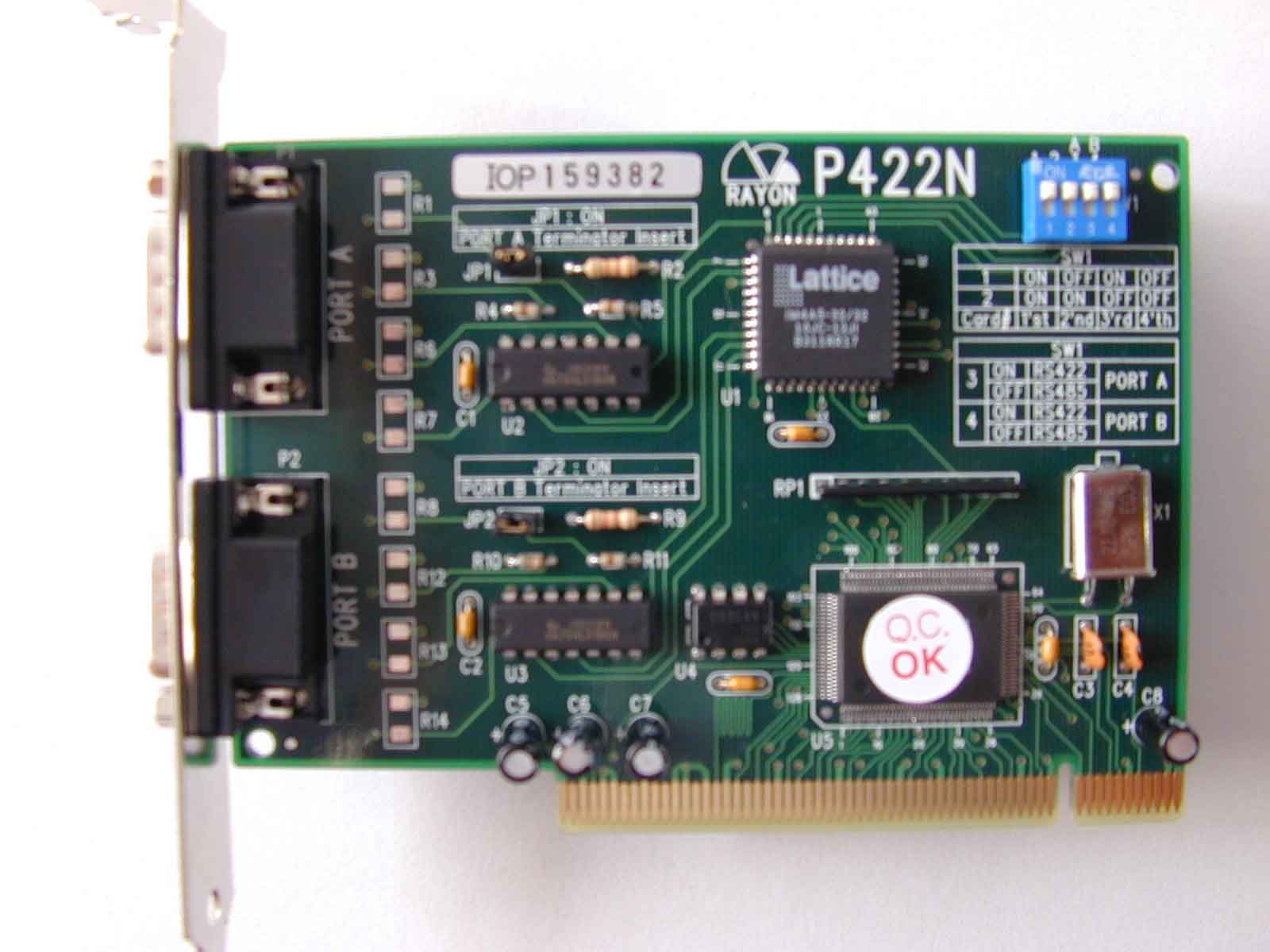
- Dual-Port RS422/RS485 Interface: Two independent serial ports supporting RS422 or RS485 communication modes, selectable via DIP switches.
- Automatic Data Direction Control (ADDC): Enables seamless half-duplex RS485 communication without manual RTS control.
- High-Speed Communication: Supports baud rates from 50 bps up to 115,200 bps (standard 1.8432 MHz crystal) or up to 921.6 kbps with optional 14.7456 MHz crystal.
- 16550A UART Compatibility: Each port includes a 16-byte transmit and receive FIFO buffer for efficient data handling and reduced CPU load.
- Plug & Play PCI Interface: Fully compliant with PCI Local Bus Specification Rev. 2.1, with automatic IRQ and I/O address assignment by the PCI BIOS.
- Shared IRQ Support: Allows multiple PCI cards to share a single interrupt line, optimizing system resource usage.
- Multi-OS Driver Support: Compatible with DOS, Windows 95/98/ME/NT/2000/XP, Linux, and SCO OpenServer.
- Compact Design: Standard PCI form factor with dimensions of 122 mm × 86 mm.
- Industrial Reliability: Designed for robust serial communication in industrial control, automation, and data acquisition systems.
- Multiple Card Support: Up to four P422N cards can be installed in a single system, providing up to eight serial ports.
- Flexible Configuration: DIP switches and jumpers allow selection of card number, interface type (RS422/RS485), and termination resistors.
- Automatic Data Direction Control (ADDC): Enables seamless half-duplex RS485 communication without manual RTS control.
- High-Speed Communication: Supports baud rates from 50 bps up to 115,200 bps (standard 1.8432 MHz crystal) or up to 921.6 kbps with optional 14.7456 MHz crystal.
- 16550A UART Compatibility: Each port includes a 16-byte transmit and receive FIFO buffer for efficient data handling and reduced CPU load.
- Plug & Play PCI Interface: Fully compliant with PCI Local Bus Specification Rev. 2.1, with automatic IRQ and I/O address assignment by the PCI BIOS.
- Shared IRQ Support: Allows multiple PCI cards to share a single interrupt line, optimizing system resource usage.
- Multi-OS Driver Support: Compatible with DOS, Windows 95/98/ME/NT/2000/XP, Linux, and SCO OpenServer.
- Compact Design: Standard PCI form factor with dimensions of 122 mm × 86 mm.
- Industrial Reliability: Designed for robust serial communication in industrial control, automation, and data acquisition systems.
- Multiple Card Support: Up to four P422N cards can be installed in a single system, providing up to eight serial ports.
- Flexible Configuration: DIP switches and jumpers allow selection of card number, interface type (RS422/RS485), and termination resistors.
Comprehensive Product Summary – Rayon Technology P422N PCI 2-Port RS422/RS485 Card
### 1. Product Overview
Product Name: PCI 2-Port RS422/RS485 Card
Model: P422N
Series: RAYON PCIPORT Series
Article Number: P422N
Manufacturer: Rayon Technology Inc.
Manufacturer Locations:
- Headquarters: 2F, No. 177, Chung-Shan 2 Road, Lu-Chou City, Taipei Hsien, Taiwan, R.O.C.
- European Support: Acceed GmbH, Arnoldstraße 19, 40479 Düsseldorf, Germany
Product Description:
The Rayon P422N is an intelligent PCI-based dual-port serial communication card designed for RS422 and RS485 industrial communication environments. It provides two independent high-speed serial ports with automatic data direction control (ADDC) and supports both 4-wire RS485 and RS422 modes. The card is fully plug-and-play compliant with PCI BIOS configuration and supports a wide range of operating systems including DOS, Windows (95/98/ME/NT/2000/XP), Linux, and SCO OpenServer.
### 2. Key Features
- Dual-Port RS422/RS485 Interface: Two independent serial ports supporting RS422 or RS485 communication modes, selectable via DIP switches.
- Automatic Data Direction Control (ADDC): Enables seamless half-duplex RS485 communication without manual RTS control.
- High-Speed Communication: Supports baud rates from 50 bps up to 115,200 bps (standard 1.8432 MHz crystal) or up to 921.6 kbps with optional 14.7456 MHz crystal.
- 16550A UART Compatibility: Each port includes a 16-byte transmit and receive FIFO buffer for efficient data handling and reduced CPU load.
- Plug & Play PCI Interface: Fully compliant with PCI Local Bus Specification Rev. 2.1, with automatic IRQ and I/O address assignment by the PCI BIOS.
- Shared IRQ Support: Allows multiple PCI cards to share a single interrupt line, optimizing system resource usage.
- Multi-OS Driver Support: Compatible with DOS, Windows 95/98/ME/NT/2000/XP, Linux, and SCO OpenServer.
- Compact Design: Standard PCI form factor with dimensions of 122 mm × 86 mm.
- Industrial Reliability: Designed for robust serial communication in industrial control, automation, and data acquisition systems.
- Multiple Card Support: Up to four P422N cards can be installed in a single system, providing up to eight serial ports.
- Flexible Configuration: DIP switches and jumpers allow selection of card number, interface type (RS422/RS485), and termination resistors.
### 3. Technical Specifications
| Parameter | Specification |
|----------------|------------------|
| Bus Interface | PCI Local Bus Specification Rev. 2.1 |
| Bus Voltage | 5V, 33 MHz PCI slot |
| Ports | 2 independent RS422/RS485 serial ports |
| UART Type | 16C550A compatible with 16-byte FIFO |
| Baud Rate | 50 bps to 115,200 bps (standard), up to 921.6 kbps (optional crystal) |
| Flow Control | XON/XOFF (software) or RTS/CTS (hardware) |
| Interrupt Control | Plug & Play, IRQ assigned by PCI BIOS, IRQ shareable |
| I/O Mapping | Assigned automatically by PCI BIOS |
| Connectors | Two DB9 male connectors |
| Dimensions | 122 mm (L) × 86 mm (H) |
| Material | Multi-layer PCB with gold-plated PCI edge connector |
| Operating Environment | PC/AT compatible systems with 5V PCI bus |
| Max Cards per System | 4 cards (8 ports total) |
| Isolation | Common ground (non-isolated) |
| Termination | 120 Ω termination selectable via jumpers (JP1, JP2) |
| Indicators | None (status via software) |
| Weight | Approx. 100 g |
| Operating Temperature | 0°C to 60°C (typical) |
| Storage Temperature | -20°C to 85°C |
| Humidity | 5%–95% non-condensing |
### 4. Functionality
Operation Principle:
The P422N card provides two asynchronous serial communication channels that can operate in either RS422 (full-duplex) or RS485 (half-duplex) mode. Each port’s mode is selectable via DIP switches. In RS485 mode, the card’s ADDC circuitry automatically manages data direction, eliminating the need for manual RTS signal control.
Use Cases and Applications:
- Industrial automation and control systems
- Data acquisition and SCADA networks
- Building management systems (BMS)
- Machine-to-machine (M2M) communication
- Remote terminal units (RTUs) and programmable logic controllers (PLCs)
- Serial device networking and monitoring
Compatibility:
The P422N is compatible with standard PCI slots in desktop and industrial PCs. It supports communication with RS422/RS485 devices such as sensors, controllers, and modems. The card can coexist with other PCI devices and supports IRQ sharing.
### 5. Components & Accessories
Included Items:
- P422N PCI 2-Port RS422/RS485 Card
- User Manual (PDF or printed)
- Driver Diskette or downloadable driver package
Optional Accessories:
- TB485 Converter: Converts DB9 connector to 3-pin terminal block for RS485 wiring (DATA+, DATA-, GND).
- Cables: Standard DB9 male-to-female serial cables for device connection.
- RS4232-4/8 Isolated Boxes: Optional external modules for galvanic isolation and signal conversion (RS232 ↔ RS422/RS485).
Connectors:
- Two DB9 male connectors on the bracket.
- Pin assignments per port (RS422/RS485 mode):
- Pin 1: DCD (In)
- Pin 2: RXD+ (In)
- Pin 3: TXD+ (Out)
- Pin 4: TXD– (Out)
- Pin 5: GND
- Pin 6: RXD– (In)
- Pin 7: RTS (Out)
- Pin 8: CTS (In)
- Pin 9: RI (In)
### 6. Installation & Setup
System Requirements:
- IBM PC/AT compatible system with available 5V PCI slot
- Supported operating systems: DOS, Windows 95/98/ME/NT/2000/XP, Linux, SCO OpenServer
Installation Steps:
1. Power off the computer and unplug it.
2. Insert the P422N card into an available PCI slot.
3. Secure the card with the bracket screw.
4. Connect serial cables to the DB9 connectors.
5. Power on the system.
6. Install the appropriate driver for your operating system.
Configuration:
- DIP Switch (SW1):
- Bits 1–2: Card number (ON = first card, OFF = second card).
- Bits 3–4: Port interface type (ON = RS422, OFF = RS485).
- Jumpers (JP1, JP2):
- Enable or disable 120 Ω termination resistors for each port.
- Default: Open (no termination).
- RS485 Wiring:
- Short pins 2 & 3 for DATA+ and pins 4 & 6 for DATA–.
- Use TB485 converter for terminal block connection if required.
Driver Installation:
- Windows 2000/XP: Plug & Play detection; specify driver path (A:\WIN2000).
- Windows NT4: Manual installation via Control Panel → Network → Add Adapter → “Other” → specify A:\P220\NT4.
- Windows 95/98/ME: Plug & Play detection; specify A:\WIN95.
- DOS: Copy driver files from diskette to C:\RAYON\P220 and run “P984”.
- Linux: Extract driver package (`tar xvf /dev/fd0`), run `./Install`, select “PCIPORT card”, rebuild kernel modules.
- SCO OpenServer: Use `/etc/custom` or manual installation via `/etc/pciport/build`.
### 7. Performance & Capabilities
- Data Rate: Up to 115.2 kbps (standard), 921.6 kbps (optional).
- Buffering: 16-byte transmit and receive FIFO per port.
- Interrupt Handling: Shared IRQ support for multiple cards.
- Latency Reduction: Intelligent buffering minimizes CPU interrupts, improving system throughput.
- Multi-Card Operation: Up to four P422N cards per system (eight ports total).
- Signal Integrity: Optional 120 Ω termination resistors for long-distance or high-speed communication.
- RS485 Mode: Half-duplex operation with automatic direction control.
- RS422 Mode: Full-duplex differential signaling for point-to-point or multi-drop communication.
- Limitations:
- No galvanic isolation (use P422I for isolated version).
- Common ground shared between ports.
- Requires proper termination for long cable runs.
### 8. Standards & Compliance
- PCI Local Bus Specification: Revision 2.1 compliant.
- Serial Communication Standards:
- EIA/TIA RS422
- EIA/TIA RS485
- Electrical Compliance: 5V PCI signaling environment.
- Operating System Compatibility:
- DOS
- Windows 95/98/ME/NT/2000/XP
- Linux (kernel 2.4.x and later)
- SCO OpenServer
- EMC & Safety: Designed for industrial environments; compliance with general CE and FCC Class A standards (typical for Rayon PCIPORT series).
### 9. Additional Information
Warranty:
- Duration: 1-year limited warranty covering defects in materials and workmanship.
- Exclusions: Damage due to misuse, electrical surges, unauthorized servicing, or operation outside specified conditions.
- Repair Policy:
- Warranty repairs: No charge if product found defective.
- Out-of-warranty repairs: Flat-rate service charge.
- Handling/testing fee applies for non-defective returns.
Support & Service Contacts:
- Rayon Technology Co., Ltd. (Taiwan):
- Tel: +886 2 82858362
- Fax: +886 2 82857065
- Email: rayon@ms1.hinet.net
- Acceed GmbH (Europe):
- Tel: +49 211 938898 0
- Fax: +49 211 938898 0
- Email: rayon@acceed.com
- Web: [www.acceed.com/rayon](http://www.acceed.com/rayon)
Maintenance:
- Handle card using anti-static precautions.
- Avoid inserting/removing card while system power is on.
- Periodically check connectors and cables for secure fit.
- Use proper grounding and shielding for long-distance RS485 networks.
Software & Updates:
- Driver updates and documentation available from Rayon or Acceed websites.
- Linux driver source code provided for kernel integration.
- DOS API and demo programs included for custom application development.
Troubleshooting Highlights:
- If card not detected, verify PCI slot and BIOS resource assignment.
- For communication issues, confirm correct DIP switch settings and termination.
- Use “RAYONTTY.EXE” terminal utility for loopback testing.
- Ensure IRQ sharing compatibility with other PCI devices.
### Summary
The Rayon P422N PCI 2-Port RS422/RS485 Card is a robust, high-performance serial communication interface designed for industrial and embedded applications requiring reliable differential signaling. With its dual-port configuration, automatic data direction control, and full PCI Plug & Play compliance, it simplifies integration into modern PC-based control systems. The card’s flexible configuration options, broad OS support, and compatibility with both RS422 and RS485 standards make it a versatile solution for engineers and system integrators seeking dependable serial connectivity in demanding environments.
### 1. Product Overview
Product Name: PCI 2-Port RS422/RS485 Card
Model: P422N
Series: RAYON PCIPORT Series
Article Number: P422N
Manufacturer: Rayon Technology Inc.
Manufacturer Locations:
- Headquarters: 2F, No. 177, Chung-Shan 2 Road, Lu-Chou City, Taipei Hsien, Taiwan, R.O.C.
- European Support: Acceed GmbH, Arnoldstraße 19, 40479 Düsseldorf, Germany
Product Description:
The Rayon P422N is an intelligent PCI-based dual-port serial communication card designed for RS422 and RS485 industrial communication environments. It provides two independent high-speed serial ports with automatic data direction control (ADDC) and supports both 4-wire RS485 and RS422 modes. The card is fully plug-and-play compliant with PCI BIOS configuration and supports a wide range of operating systems including DOS, Windows (95/98/ME/NT/2000/XP), Linux, and SCO OpenServer.
### 2. Key Features
- Dual-Port RS422/RS485 Interface: Two independent serial ports supporting RS422 or RS485 communication modes, selectable via DIP switches.
- Automatic Data Direction Control (ADDC): Enables seamless half-duplex RS485 communication without manual RTS control.
- High-Speed Communication: Supports baud rates from 50 bps up to 115,200 bps (standard 1.8432 MHz crystal) or up to 921.6 kbps with optional 14.7456 MHz crystal.
- 16550A UART Compatibility: Each port includes a 16-byte transmit and receive FIFO buffer for efficient data handling and reduced CPU load.
- Plug & Play PCI Interface: Fully compliant with PCI Local Bus Specification Rev. 2.1, with automatic IRQ and I/O address assignment by the PCI BIOS.
- Shared IRQ Support: Allows multiple PCI cards to share a single interrupt line, optimizing system resource usage.
- Multi-OS Driver Support: Compatible with DOS, Windows 95/98/ME/NT/2000/XP, Linux, and SCO OpenServer.
- Compact Design: Standard PCI form factor with dimensions of 122 mm × 86 mm.
- Industrial Reliability: Designed for robust serial communication in industrial control, automation, and data acquisition systems.
- Multiple Card Support: Up to four P422N cards can be installed in a single system, providing up to eight serial ports.
- Flexible Configuration: DIP switches and jumpers allow selection of card number, interface type (RS422/RS485), and termination resistors.
### 3. Technical Specifications
| Parameter | Specification |
|----------------|------------------|
| Bus Interface | PCI Local Bus Specification Rev. 2.1 |
| Bus Voltage | 5V, 33 MHz PCI slot |
| Ports | 2 independent RS422/RS485 serial ports |
| UART Type | 16C550A compatible with 16-byte FIFO |
| Baud Rate | 50 bps to 115,200 bps (standard), up to 921.6 kbps (optional crystal) |
| Flow Control | XON/XOFF (software) or RTS/CTS (hardware) |
| Interrupt Control | Plug & Play, IRQ assigned by PCI BIOS, IRQ shareable |
| I/O Mapping | Assigned automatically by PCI BIOS |
| Connectors | Two DB9 male connectors |
| Dimensions | 122 mm (L) × 86 mm (H) |
| Material | Multi-layer PCB with gold-plated PCI edge connector |
| Operating Environment | PC/AT compatible systems with 5V PCI bus |
| Max Cards per System | 4 cards (8 ports total) |
| Isolation | Common ground (non-isolated) |
| Termination | 120 Ω termination selectable via jumpers (JP1, JP2) |
| Indicators | None (status via software) |
| Weight | Approx. 100 g |
| Operating Temperature | 0°C to 60°C (typical) |
| Storage Temperature | -20°C to 85°C |
| Humidity | 5%–95% non-condensing |
### 4. Functionality
Operation Principle:
The P422N card provides two asynchronous serial communication channels that can operate in either RS422 (full-duplex) or RS485 (half-duplex) mode. Each port’s mode is selectable via DIP switches. In RS485 mode, the card’s ADDC circuitry automatically manages data direction, eliminating the need for manual RTS signal control.
Use Cases and Applications:
- Industrial automation and control systems
- Data acquisition and SCADA networks
- Building management systems (BMS)
- Machine-to-machine (M2M) communication
- Remote terminal units (RTUs) and programmable logic controllers (PLCs)
- Serial device networking and monitoring
Compatibility:
The P422N is compatible with standard PCI slots in desktop and industrial PCs. It supports communication with RS422/RS485 devices such as sensors, controllers, and modems. The card can coexist with other PCI devices and supports IRQ sharing.
### 5. Components & Accessories
Included Items:
- P422N PCI 2-Port RS422/RS485 Card
- User Manual (PDF or printed)
- Driver Diskette or downloadable driver package
Optional Accessories:
- TB485 Converter: Converts DB9 connector to 3-pin terminal block for RS485 wiring (DATA+, DATA-, GND).
- Cables: Standard DB9 male-to-female serial cables for device connection.
- RS4232-4/8 Isolated Boxes: Optional external modules for galvanic isolation and signal conversion (RS232 ↔ RS422/RS485).
Connectors:
- Two DB9 male connectors on the bracket.
- Pin assignments per port (RS422/RS485 mode):
- Pin 1: DCD (In)
- Pin 2: RXD+ (In)
- Pin 3: TXD+ (Out)
- Pin 4: TXD– (Out)
- Pin 5: GND
- Pin 6: RXD– (In)
- Pin 7: RTS (Out)
- Pin 8: CTS (In)
- Pin 9: RI (In)
### 6. Installation & Setup
System Requirements:
- IBM PC/AT compatible system with available 5V PCI slot
- Supported operating systems: DOS, Windows 95/98/ME/NT/2000/XP, Linux, SCO OpenServer
Installation Steps:
1. Power off the computer and unplug it.
2. Insert the P422N card into an available PCI slot.
3. Secure the card with the bracket screw.
4. Connect serial cables to the DB9 connectors.
5. Power on the system.
6. Install the appropriate driver for your operating system.
Configuration:
- DIP Switch (SW1):
- Bits 1–2: Card number (ON = first card, OFF = second card).
- Bits 3–4: Port interface type (ON = RS422, OFF = RS485).
- Jumpers (JP1, JP2):
- Enable or disable 120 Ω termination resistors for each port.
- Default: Open (no termination).
- RS485 Wiring:
- Short pins 2 & 3 for DATA+ and pins 4 & 6 for DATA–.
- Use TB485 converter for terminal block connection if required.
Driver Installation:
- Windows 2000/XP: Plug & Play detection; specify driver path (A:\WIN2000).
- Windows NT4: Manual installation via Control Panel → Network → Add Adapter → “Other” → specify A:\P220\NT4.
- Windows 95/98/ME: Plug & Play detection; specify A:\WIN95.
- DOS: Copy driver files from diskette to C:\RAYON\P220 and run “P984”.
- Linux: Extract driver package (`tar xvf /dev/fd0`), run `./Install`, select “PCIPORT card”, rebuild kernel modules.
- SCO OpenServer: Use `/etc/custom` or manual installation via `/etc/pciport/build`.
### 7. Performance & Capabilities
- Data Rate: Up to 115.2 kbps (standard), 921.6 kbps (optional).
- Buffering: 16-byte transmit and receive FIFO per port.
- Interrupt Handling: Shared IRQ support for multiple cards.
- Latency Reduction: Intelligent buffering minimizes CPU interrupts, improving system throughput.
- Multi-Card Operation: Up to four P422N cards per system (eight ports total).
- Signal Integrity: Optional 120 Ω termination resistors for long-distance or high-speed communication.
- RS485 Mode: Half-duplex operation with automatic direction control.
- RS422 Mode: Full-duplex differential signaling for point-to-point or multi-drop communication.
- Limitations:
- No galvanic isolation (use P422I for isolated version).
- Common ground shared between ports.
- Requires proper termination for long cable runs.
### 8. Standards & Compliance
- PCI Local Bus Specification: Revision 2.1 compliant.
- Serial Communication Standards:
- EIA/TIA RS422
- EIA/TIA RS485
- Electrical Compliance: 5V PCI signaling environment.
- Operating System Compatibility:
- DOS
- Windows 95/98/ME/NT/2000/XP
- Linux (kernel 2.4.x and later)
- SCO OpenServer
- EMC & Safety: Designed for industrial environments; compliance with general CE and FCC Class A standards (typical for Rayon PCIPORT series).
### 9. Additional Information
Warranty:
- Duration: 1-year limited warranty covering defects in materials and workmanship.
- Exclusions: Damage due to misuse, electrical surges, unauthorized servicing, or operation outside specified conditions.
- Repair Policy:
- Warranty repairs: No charge if product found defective.
- Out-of-warranty repairs: Flat-rate service charge.
- Handling/testing fee applies for non-defective returns.
Support & Service Contacts:
- Rayon Technology Co., Ltd. (Taiwan):
- Tel: +886 2 82858362
- Fax: +886 2 82857065
- Email: rayon@ms1.hinet.net
- Acceed GmbH (Europe):
- Tel: +49 211 938898 0
- Fax: +49 211 938898 0
- Email: rayon@acceed.com
- Web: [www.acceed.com/rayon](http://www.acceed.com/rayon)
Maintenance:
- Handle card using anti-static precautions.
- Avoid inserting/removing card while system power is on.
- Periodically check connectors and cables for secure fit.
- Use proper grounding and shielding for long-distance RS485 networks.
Software & Updates:
- Driver updates and documentation available from Rayon or Acceed websites.
- Linux driver source code provided for kernel integration.
- DOS API and demo programs included for custom application development.
Troubleshooting Highlights:
- If card not detected, verify PCI slot and BIOS resource assignment.
- For communication issues, confirm correct DIP switch settings and termination.
- Use “RAYONTTY.EXE” terminal utility for loopback testing.
- Ensure IRQ sharing compatibility with other PCI devices.
### Summary
The Rayon P422N PCI 2-Port RS422/RS485 Card is a robust, high-performance serial communication interface designed for industrial and embedded applications requiring reliable differential signaling. With its dual-port configuration, automatic data direction control, and full PCI Plug & Play compliance, it simplifies integration into modern PC-based control systems. The card’s flexible configuration options, broad OS support, and compatibility with both RS422 and RS485 standards make it a versatile solution for engineers and system integrators seeking dependable serial connectivity in demanding environments.
-
 PCI-Port-015.pdf
Manual
PCI-Port-015.pdf
Manual

Kein Zubehör vorhanden.