CB-F10M9-20
SUCHEN SIE DIE PASSENDE
INDUSTRIELLE LÖSUNG?
Entdecken Sie Embedded-, Kommunikations- und Automatisierungslösungen für Ihre Anwendung.
- Processor & Architecture:
ARM920T core (Atmel AT91RM9200) running at 180 MHz, delivering approximately 200 MIPS performance with integrated Memory Management Unit (MMU), 16 KB instruction cache, and 16 KB data cache.
- Operating System:
Pre‑installed Linux kernel 2.6.14 with JFFS2, EXT2/EXT3, VFAT/FAT, and NFS file system support. Includes U‑Boot 1.1.2 bootloader.
- Memory:
64 MB SDRAM and 16 MB NOR Flash memory, expandable via SD card slot (SD 1.0 compliant).
- Networking:
Dual 10/100 Base‑T Ethernet ports (RJ‑45) with independent MAC addresses, supporting IPv4, DHCP, NTP, SNMP, SSL, SSH, and other standard protocols.
- I/O Interfaces:
- 4 × 16‑bit high‑precision isolated analog inputs (±150 mV … ±10 V, 0–20 mA)
- 8 × optically isolated digital inputs (2.5 kVrms isolation)
- 8 × high‑drive digital outputs (500 mA max per channel, 5–50 VDC source)
- 1 × RS‑232 port (full modem control)
- 1 × RS‑485 port (data + / data –)
- 1 × RS‑232 console port (10‑pin header)
- 2 × USB 2.0 host ports (12 Mbps full‑speed)
- Storage & Expansion:
SD memory card slot for data logging or program storage; USB host ports support flash disks, Wi‑Fi adapters, and RS‑232 adapters.
- Power Supply:
Wide input range 9 – 40 VDC with surge and polarity protection; typical consumption 800 mA @ 12 VDC.
- Environmental:
Operating temperature 0 – 70 °C; fanless design for industrial reliability.
- Software Development:
Includes GNU C/C++ cross‑compiler toolchain for Linux and Windows (Cygwin), with POSIX‑compliant GLIBC library.
- Security & Connectivity:
Supports SSL, SSH 1.0/2.0, firewall (iptables), and remote management via Telnet, FTP, HTTP, and SNMP.
- Mounting:
Ready for DIN‑rail installation; compact PCB form factor for control cabinets.
ARM920T core (Atmel AT91RM9200) running at 180 MHz, delivering approximately 200 MIPS performance with integrated Memory Management Unit (MMU), 16 KB instruction cache, and 16 KB data cache.
- Operating System:
Pre‑installed Linux kernel 2.6.14 with JFFS2, EXT2/EXT3, VFAT/FAT, and NFS file system support. Includes U‑Boot 1.1.2 bootloader.
- Memory:
64 MB SDRAM and 16 MB NOR Flash memory, expandable via SD card slot (SD 1.0 compliant).
- Networking:
Dual 10/100 Base‑T Ethernet ports (RJ‑45) with independent MAC addresses, supporting IPv4, DHCP, NTP, SNMP, SSL, SSH, and other standard protocols.
- I/O Interfaces:
- 4 × 16‑bit high‑precision isolated analog inputs (±150 mV … ±10 V, 0–20 mA)
- 8 × optically isolated digital inputs (2.5 kVrms isolation)
- 8 × high‑drive digital outputs (500 mA max per channel, 5–50 VDC source)
- 1 × RS‑232 port (full modem control)
- 1 × RS‑485 port (data + / data –)
- 1 × RS‑232 console port (10‑pin header)
- 2 × USB 2.0 host ports (12 Mbps full‑speed)
- Storage & Expansion:
SD memory card slot for data logging or program storage; USB host ports support flash disks, Wi‑Fi adapters, and RS‑232 adapters.
- Power Supply:
Wide input range 9 – 40 VDC with surge and polarity protection; typical consumption 800 mA @ 12 VDC.
- Environmental:
Operating temperature 0 – 70 °C; fanless design for industrial reliability.
- Software Development:
Includes GNU C/C++ cross‑compiler toolchain for Linux and Windows (Cygwin), with POSIX‑compliant GLIBC library.
- Security & Connectivity:
Supports SSL, SSH 1.0/2.0, firewall (iptables), and remote management via Telnet, FTP, HTTP, and SNMP.
- Mounting:
Ready for DIN‑rail installation; compact PCB form factor for control cabinets.
Comprehensive Product Summary – Artila PAC‑5070 Programmable Automation Controller
*(Approx. 12,000 characters / ~3,000 tokens)*
### 1. Product Overview
Product Name: PAC‑5070
Article Number: PAC‑5070
Model / Series: ARM9‑based Linux Programmable Automation Controller (PAC Series)
Manufacturer: Artila Electronics Co., Ltd.
Product Type: Fanless Industrial Linux Controller for Automation and Data Acquisition
Mounting Type: DIN‑Rail mountable
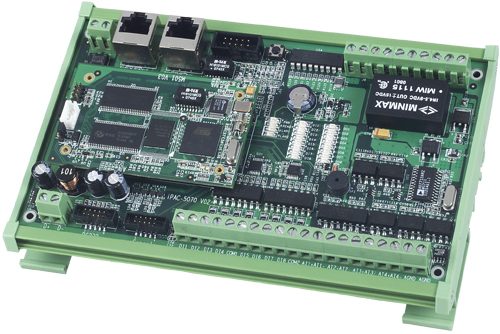
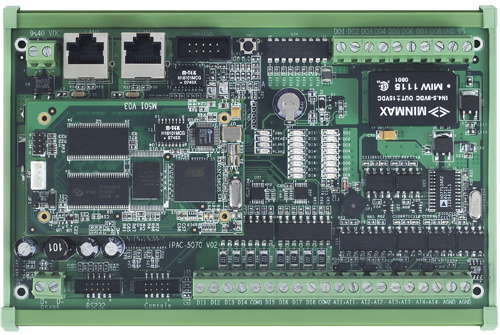
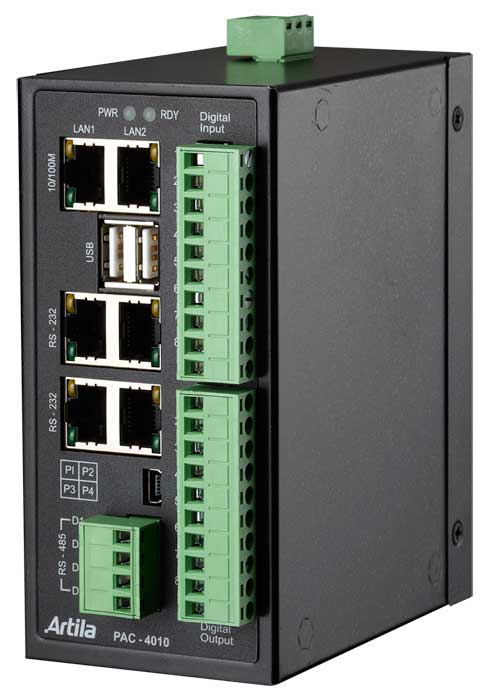
The Artila PAC‑5070 is a compact, fanless, ARM9‑based industrial automation controller designed for embedded control, data acquisition, and networked automation applications. It integrates a 180 MHz Atmel AT91RM9200 ARM920T processor, dual Ethernet ports, isolated analog and digital I/O, and a Linux 2.6 operating system. The controller provides a robust, open‑source platform for industrial automation, remote monitoring, and control system integration, supporting both standalone and networked operation.
### 2. Key Features
- Processor & Architecture:
ARM920T core (Atmel AT91RM9200) running at 180 MHz, delivering approximately 200 MIPS performance with integrated Memory Management Unit (MMU), 16 KB instruction cache, and 16 KB data cache.
- Operating System:
Pre‑installed Linux kernel 2.6.14 with JFFS2, EXT2/EXT3, VFAT/FAT, and NFS file system support. Includes U‑Boot 1.1.2 bootloader.
- Memory:
64 MB SDRAM and 16 MB NOR Flash memory, expandable via SD card slot (SD 1.0 compliant).
- Networking:
Dual 10/100 Base‑T Ethernet ports (RJ‑45) with independent MAC addresses, supporting IPv4, DHCP, NTP, SNMP, SSL, SSH, and other standard protocols.
- I/O Interfaces:
- 4 × 16‑bit high‑precision isolated analog inputs (±150 mV … ±10 V, 0–20 mA)
- 8 × optically isolated digital inputs (2.5 kVrms isolation)
- 8 × high‑drive digital outputs (500 mA max per channel, 5–50 VDC source)
- 1 × RS‑232 port (full modem control)
- 1 × RS‑485 port (data + / data –)
- 1 × RS‑232 console port (10‑pin header)
- 2 × USB 2.0 host ports (12 Mbps full‑speed)
- Storage & Expansion:
SD memory card slot for data logging or program storage; USB host ports support flash disks, Wi‑Fi adapters, and RS‑232 adapters.
- Power Supply:
Wide input range 9 – 40 VDC with surge and polarity protection; typical consumption 800 mA @ 12 VDC.
- Environmental:
Operating temperature 0 – 70 °C; fanless design for industrial reliability.
- Software Development:
Includes GNU C/C++ cross‑compiler toolchain for Linux and Windows (Cygwin), with POSIX‑compliant GLIBC library.
- Security & Connectivity:
Supports SSL, SSH 1.0/2.0, firewall (iptables), and remote management via Telnet, FTP, HTTP, and SNMP.
- Mounting:
Ready for DIN‑rail installation; compact PCB form factor for control cabinets.
### 3. Technical Specifications
CPU / Memory
- Processor: Atmel AT91RM9200 (ARM9, 180 MHz)
- Performance: ~200 MIPS
- Cache: 16 KB instruction, 16 KB data
- SDRAM: 64 MB
- Flash Memory: 16 MB NOR Flash
Network Interface
- 2 × 10/100 Base‑T Ethernet (RJ‑45)
- Protocols: IPv4, ICMP, ARP, DHCP, NTP, TCP, UDP, FTP, TELNET, HTTP, PPP, PPPoE, SMTP, SNMP v1/v2, SSL, SSH
Serial Communication
- COM1: RS‑485 (Data + / Data –)
- COM2: RS‑232 (full modem control)
- COM3: RS‑232 console (RxD, TxD)
- Baud Rate: up to 115,200 bps (console default)
- Console Access: via CBL‑F10M9‑20 cable (10‑pin header → DB9 male, 20 cm)
USB Interface
- 2 × USB 2.0 host ports (10‑pin header)
- Data Rate: up to 12 Mbps
- Supported Devices: Flash disk, Wi‑Fi (IEEE 802.11 b/g), RS‑232 adapters
Mass Storage
- 1 × SD 1.0 compliant socket (internal)
- File Systems: JFFS2, EXT2/3, VFAT/FAT, NFS
Analog Input (A/D Conversion)
- Converter: AD7712 (Analog Devices)
- Channels: 4 differential, multiplexed
- Resolution: 16‑bit
- Sampling Rate: 10 – 100 samples/s
- Input Ranges (software‑selectable):
- Voltage (unipolar): 0–150 mV, 0–500 mV, 0–1 V, 0–5 V, 0–10 V
- Voltage (bipolar): ±150 mV, ±500 mV, ±1 V, ±5 V, ±10 V
- Current: 0–20 mA
- Accuracy: ±0.1 %
- Input Impedance: 20 MΩ (voltage), 120 Ω (current)
- Common‑Mode Rejection: 100 dB @ 50/60 Hz
- Isolation: 1500 VDC (three‑way)
Digital Inputs (DI)
- Channels: 8 optically isolated
- Logic High: 5 – 24 VDC
- Logic Low: 0 – 1.5 VDC
- Input Resistance: 1.2 kΩ @ 0.5 W
- Response Time: 20 µs
- Isolation: 2500 Vrms
Digital Outputs (DO)
- Channels: 8 high‑drive outputs
- Driver IC: UDN2981A (Allegro MicroSystems)
- Source Voltage: 5 – 50 VDC
- Max Output Current: 500 mA per channel
- Protection: Integrated transient‑suppression diodes for inductive loads
General Hardware
- Watchdog Timer: Yes (kernel‑controlled)
- Real‑Time Clock: Yes (battery‑backed)
- Buzzer: Yes (system status)
- Power Input: 9 – 40 VDC
- Power Consumption: 800 mA @ 12 VDC
- Dimensions (W × H × D): 160 × 104 × 32 mm
- Operating Temperature: 0 – 70 °C (32 – 158 °F)
- Regulatory Compliance: CE Class A, FCC Class A
### 4. Functionality
The PAC‑5070 functions as a compact embedded Linux controller for industrial automation, data acquisition, and remote monitoring. It combines analog and digital I/O with network connectivity and serial communication interfaces, enabling integration with sensors, actuators, and supervisory systems.
Operation & Use Cases:
- Industrial process control and monitoring
- Remote data logging and SCADA integration
- Machine automation and PLC replacement
- Environmental and energy monitoring systems
- Networked control nodes in distributed automation
System Operation:
Upon power‑up, the controller boots Linux 2.6.14 from Flash, initializes the file system, and activates network and I/O services. Users can log in via Telnet, SSH, or serial console. The system supports web‑based configuration through the built‑in Boa web server and remote management via SNMP or FTP.
Compatibility:
- Supports USB Wi‑Fi adapters (Ralink RT2571/RT73 chipset) for wireless LAN.
- Compatible with standard Ethernet networks and TCP/IP‑based industrial protocols.
- Programmable using GNU C/C++ toolchain; supports cross‑compilation from Linux or Windows hosts.
### 5. Components & Accessories
Included Items:
1. PAC‑5070 main unit
2. CBL‑F10M9‑20 (91‑0P9M9‑001) console cable (10‑pin header → DB9 male, 20 cm)
3. Artila CD containing documentation, GNU toolchain, and utility software
Optional Accessories:
- USB Wi‑Fi adapter (IEEE 802.11 b/g, Ralink RT2571)
- USB → RS‑232 adapters
- SD memory cards for data storage
- DIN‑rail mounting hardware (integrated on PCB)
Connectors:
- Power Input (J3): +9 – 40 VDC, surge and polarity protection
- Analog Input: 4 × differential channels (+, –, AGND)
- Digital Input: 8 × isolated channels (DI1–DI8, COM1–COM2)
- Digital Output: 8 × channels (DO1–DO8, VS, GND)
- Serial Ports: COM1 (RS‑485), COM2 (RS‑232), COM3 (Console)
- USB Header: 10‑pin (Vcc1, Vcc2, Data1±, Data2±, GND)
- Ethernet: LAN1 / LAN2 (RJ‑45)
### 6. Installation & Setup
Power Requirements:
Supply 9 – 40 VDC via J3 connector. The input circuit includes surge and reverse‑polarity protection.
Mounting:
DIN‑rail mountable; compact 160 × 104 × 32 mm enclosure suitable for control cabinets.
Initial Configuration:
- Factory default IPs:
- LAN1: 192.168.2.127
- LAN2: DHCP
- Default login credentials:
- User: guest / guest
- Supervisor (SSH only): root / root
Network Setup:
Modify `/disk/etc/rc` to set static IP or enable DHCP.
Example:
`ifconfig eth0 192.168.2.127 netmask 255.255.255.0`
or
`dhcpcd eth1 &`
Wireless LAN Setup:
Supports USB WLAN adapters (Ralink RT2571).
Commands:
```
ifconfig wlan0 up
iwconfig wlan0 essid <SSID> key <KEY> mode managed
dhcpcd wlan0 &
```
Serial Console Access:
Use CBL‑F10M9‑20 cable and terminal software (115200 bps, 8N1, ANSI). Provides direct access for configuration and debugging.
File System Layout:
- Root file system: RAMDISK (8 MB)
- User disk (/disk): Flash storage (~11 MB) for user programs and configuration
Files outside `/disk` are volatile and lost after power‑off.
Restoring Factory Defaults:
Copy files from `/default` to `/disk` to restore original configuration.
### 7. Performance & Capabilities
- Processing Speed: 180 MHz ARM9 (200 MIPS)
- Analog Sampling: 10 – 100 samples/s, 16‑bit resolution
- Digital I/O Response: 20 µs typical
- Network Throughput: 10/100 Mbps per Ethernet port
- Power Efficiency: < 10 W typical at 12 VDC
- Reliability: Fanless, solid‑state design with watchdog timer and real‑time clock
- Limitations: No hardware floating‑point unit; limited Flash storage (16 MB) requires external SD or USB for large data sets.
### 8. Standards & Compliance
- Electrical Isolation:
- Analog Inputs: 1500 VDC
- Digital Inputs: 2500 Vrms
- Safety & EMC:
- CE Class A
- FCC Class A
- Environmental:
- Operating Temperature: 0 – 70 °C
- Humidity: Industrial standard (non‑condensing)
- Software Standards:
- POSIX‑compliant GLIBC library
- GNU C/C++ toolchain
- Linux 2.6 kernel compliance
### 9. Additional Information
Warranty & Support:
Artila provides standard manufacturer warranty and technical support via [www.artila.com](http://www.artila.com). Firmware updates, documentation, and software utilities are available through the Artila support portal.
Maintenance:
- Periodically back up configuration files from `/disk`.
- Use the `update` utility to refresh loader, kernel, or root file system images.
- Use `update --FORMAT` to reformat user disk if necessary (supervisor mode only).
Software Utilities (Pre‑installed):
- System Utilities: bash, tinylogin, telnet, busybox, ftp
- Daemons: pppd, snmpd, telnetd, inetd, ftpd, boa (web server), sshd, iptables, amgrd
- Artila Utilities:
- `update` – firmware and file system management
- `setuart` – serial port configuration
- `gpioctl` – digital I/O control
- `setadc` – analog input configuration
- Manager Utility (manager.jar): Java‑based discovery tool for locating PAC‑5070 units on a network and launching Telnet sessions.
Development Environment:
- Toolchain: GCC 3.3.2 cross‑compiler for ARM‑Linux
- Installation: Extract `arm-linux-3.3.2.tar.gz` on a Linux 2.6 PC and install under root directory.
- Example Workflow:
1. Compile source using `make`.
2. Transfer binary via FTP to `/disk`.
3. Set execute permission (`chmod +x file.o`).
4. Run program (`./file.o`).
Time Synchronization:
- Adjust RTC using `date MMDDhhmmYYYY` and `hwclock -w`.
- NTP synchronization supported via `ntpclient <server IP>`.
Web Server Configuration:
- Web root: `/home/httpd`
- Configuration file: `boa.conf`
- Default home page: `index.html`
Device Mapping (/dev):
- `ttyS0` – Console (COM3)
- `ttyS1` – RS‑485 (COM1)
- `ttyS2` – RS‑232 (COM2)
- `mmc0–mmc2` – SD card
- `sda–sde` – USB flash disks
- `ttyUSB0–ttyUSB1` – USB RS‑232 adapters
- `rtc` – Real‑time clock
- `gpio` – Digital I/O
- `adc0–adc3` – Analog input channels
LED Indicators:
- Power LED: Solid green = power applied
- Ready LED: Solid green = system boot complete
- LAN1/LAN2 LEDs: Solid = link, flashing = activity
- Serial Port LEDs: Red = RXD high, Green = TXD high
Reset Function:
Hardware reset button available; use only when software is unresponsive.
### Summary
The Artila PAC‑5070 is a robust, Linux‑based ARM9 programmable automation controller engineered for industrial environments requiring reliable, network‑enabled control and data acquisition. Its combination of dual Ethernet ports, isolated analog and digital I/O, and open‑source Linux platform makes it ideal for OEMs, system integrators, and automation engineers seeking a flexible, programmable, and network‑ready embedded controller.
With comprehensive I/O isolation, wide power input range, and full TCP/IP stack support, the PAC‑5070 bridges traditional industrial control with modern networked automation. Its open Linux environment and GNU toolchain empower developers to create custom applications, integrate with SCADA systems, and deploy secure, connected industrial solutions.

*(Approx. 12,000 characters / ~3,000 tokens)*
### 1. Product Overview
Product Name: PAC‑5070
Article Number: PAC‑5070
Model / Series: ARM9‑based Linux Programmable Automation Controller (PAC Series)
Manufacturer: Artila Electronics Co., Ltd.
Product Type: Fanless Industrial Linux Controller for Automation and Data Acquisition
Mounting Type: DIN‑Rail mountable
The Artila PAC‑5070 is a compact, fanless, ARM9‑based industrial automation controller designed for embedded control, data acquisition, and networked automation applications. It integrates a 180 MHz Atmel AT91RM9200 ARM920T processor, dual Ethernet ports, isolated analog and digital I/O, and a Linux 2.6 operating system. The controller provides a robust, open‑source platform for industrial automation, remote monitoring, and control system integration, supporting both standalone and networked operation.
### 2. Key Features
- Processor & Architecture:
ARM920T core (Atmel AT91RM9200) running at 180 MHz, delivering approximately 200 MIPS performance with integrated Memory Management Unit (MMU), 16 KB instruction cache, and 16 KB data cache.
- Operating System:
Pre‑installed Linux kernel 2.6.14 with JFFS2, EXT2/EXT3, VFAT/FAT, and NFS file system support. Includes U‑Boot 1.1.2 bootloader.
- Memory:
64 MB SDRAM and 16 MB NOR Flash memory, expandable via SD card slot (SD 1.0 compliant).
- Networking:
Dual 10/100 Base‑T Ethernet ports (RJ‑45) with independent MAC addresses, supporting IPv4, DHCP, NTP, SNMP, SSL, SSH, and other standard protocols.
- I/O Interfaces:
- 4 × 16‑bit high‑precision isolated analog inputs (±150 mV … ±10 V, 0–20 mA)
- 8 × optically isolated digital inputs (2.5 kVrms isolation)
- 8 × high‑drive digital outputs (500 mA max per channel, 5–50 VDC source)
- 1 × RS‑232 port (full modem control)
- 1 × RS‑485 port (data + / data –)
- 1 × RS‑232 console port (10‑pin header)
- 2 × USB 2.0 host ports (12 Mbps full‑speed)
- Storage & Expansion:
SD memory card slot for data logging or program storage; USB host ports support flash disks, Wi‑Fi adapters, and RS‑232 adapters.
- Power Supply:
Wide input range 9 – 40 VDC with surge and polarity protection; typical consumption 800 mA @ 12 VDC.
- Environmental:
Operating temperature 0 – 70 °C; fanless design for industrial reliability.
- Software Development:
Includes GNU C/C++ cross‑compiler toolchain for Linux and Windows (Cygwin), with POSIX‑compliant GLIBC library.
- Security & Connectivity:
Supports SSL, SSH 1.0/2.0, firewall (iptables), and remote management via Telnet, FTP, HTTP, and SNMP.
- Mounting:
Ready for DIN‑rail installation; compact PCB form factor for control cabinets.
### 3. Technical Specifications
CPU / Memory
- Processor: Atmel AT91RM9200 (ARM9, 180 MHz)
- Performance: ~200 MIPS
- Cache: 16 KB instruction, 16 KB data
- SDRAM: 64 MB
- Flash Memory: 16 MB NOR Flash
Network Interface
- 2 × 10/100 Base‑T Ethernet (RJ‑45)
- Protocols: IPv4, ICMP, ARP, DHCP, NTP, TCP, UDP, FTP, TELNET, HTTP, PPP, PPPoE, SMTP, SNMP v1/v2, SSL, SSH
Serial Communication
- COM1: RS‑485 (Data + / Data –)
- COM2: RS‑232 (full modem control)
- COM3: RS‑232 console (RxD, TxD)
- Baud Rate: up to 115,200 bps (console default)
- Console Access: via CBL‑F10M9‑20 cable (10‑pin header → DB9 male, 20 cm)
USB Interface
- 2 × USB 2.0 host ports (10‑pin header)
- Data Rate: up to 12 Mbps
- Supported Devices: Flash disk, Wi‑Fi (IEEE 802.11 b/g), RS‑232 adapters
Mass Storage
- 1 × SD 1.0 compliant socket (internal)
- File Systems: JFFS2, EXT2/3, VFAT/FAT, NFS
Analog Input (A/D Conversion)
- Converter: AD7712 (Analog Devices)
- Channels: 4 differential, multiplexed
- Resolution: 16‑bit
- Sampling Rate: 10 – 100 samples/s
- Input Ranges (software‑selectable):
- Voltage (unipolar): 0–150 mV, 0–500 mV, 0–1 V, 0–5 V, 0–10 V
- Voltage (bipolar): ±150 mV, ±500 mV, ±1 V, ±5 V, ±10 V
- Current: 0–20 mA
- Accuracy: ±0.1 %
- Input Impedance: 20 MΩ (voltage), 120 Ω (current)
- Common‑Mode Rejection: 100 dB @ 50/60 Hz
- Isolation: 1500 VDC (three‑way)
Digital Inputs (DI)
- Channels: 8 optically isolated
- Logic High: 5 – 24 VDC
- Logic Low: 0 – 1.5 VDC
- Input Resistance: 1.2 kΩ @ 0.5 W
- Response Time: 20 µs
- Isolation: 2500 Vrms
Digital Outputs (DO)
- Channels: 8 high‑drive outputs
- Driver IC: UDN2981A (Allegro MicroSystems)
- Source Voltage: 5 – 50 VDC
- Max Output Current: 500 mA per channel
- Protection: Integrated transient‑suppression diodes for inductive loads
General Hardware
- Watchdog Timer: Yes (kernel‑controlled)
- Real‑Time Clock: Yes (battery‑backed)
- Buzzer: Yes (system status)
- Power Input: 9 – 40 VDC
- Power Consumption: 800 mA @ 12 VDC
- Dimensions (W × H × D): 160 × 104 × 32 mm
- Operating Temperature: 0 – 70 °C (32 – 158 °F)
- Regulatory Compliance: CE Class A, FCC Class A
### 4. Functionality
The PAC‑5070 functions as a compact embedded Linux controller for industrial automation, data acquisition, and remote monitoring. It combines analog and digital I/O with network connectivity and serial communication interfaces, enabling integration with sensors, actuators, and supervisory systems.
Operation & Use Cases:
- Industrial process control and monitoring
- Remote data logging and SCADA integration
- Machine automation and PLC replacement
- Environmental and energy monitoring systems
- Networked control nodes in distributed automation
System Operation:
Upon power‑up, the controller boots Linux 2.6.14 from Flash, initializes the file system, and activates network and I/O services. Users can log in via Telnet, SSH, or serial console. The system supports web‑based configuration through the built‑in Boa web server and remote management via SNMP or FTP.
Compatibility:
- Supports USB Wi‑Fi adapters (Ralink RT2571/RT73 chipset) for wireless LAN.
- Compatible with standard Ethernet networks and TCP/IP‑based industrial protocols.
- Programmable using GNU C/C++ toolchain; supports cross‑compilation from Linux or Windows hosts.
### 5. Components & Accessories
Included Items:
1. PAC‑5070 main unit
2. CBL‑F10M9‑20 (91‑0P9M9‑001) console cable (10‑pin header → DB9 male, 20 cm)
3. Artila CD containing documentation, GNU toolchain, and utility software
Optional Accessories:
- USB Wi‑Fi adapter (IEEE 802.11 b/g, Ralink RT2571)
- USB → RS‑232 adapters
- SD memory cards for data storage
- DIN‑rail mounting hardware (integrated on PCB)
Connectors:
- Power Input (J3): +9 – 40 VDC, surge and polarity protection
- Analog Input: 4 × differential channels (+, –, AGND)
- Digital Input: 8 × isolated channels (DI1–DI8, COM1–COM2)
- Digital Output: 8 × channels (DO1–DO8, VS, GND)
- Serial Ports: COM1 (RS‑485), COM2 (RS‑232), COM3 (Console)
- USB Header: 10‑pin (Vcc1, Vcc2, Data1±, Data2±, GND)
- Ethernet: LAN1 / LAN2 (RJ‑45)
### 6. Installation & Setup
Power Requirements:
Supply 9 – 40 VDC via J3 connector. The input circuit includes surge and reverse‑polarity protection.
Mounting:
DIN‑rail mountable; compact 160 × 104 × 32 mm enclosure suitable for control cabinets.
Initial Configuration:
- Factory default IPs:
- LAN1: 192.168.2.127
- LAN2: DHCP
- Default login credentials:
- User: guest / guest
- Supervisor (SSH only): root / root
Network Setup:
Modify `/disk/etc/rc` to set static IP or enable DHCP.
Example:
`ifconfig eth0 192.168.2.127 netmask 255.255.255.0`
or
`dhcpcd eth1 &`
Wireless LAN Setup:
Supports USB WLAN adapters (Ralink RT2571).
Commands:
```
ifconfig wlan0 up
iwconfig wlan0 essid <SSID> key <KEY> mode managed
dhcpcd wlan0 &
```
Serial Console Access:
Use CBL‑F10M9‑20 cable and terminal software (115200 bps, 8N1, ANSI). Provides direct access for configuration and debugging.
File System Layout:
- Root file system: RAMDISK (8 MB)
- User disk (/disk): Flash storage (~11 MB) for user programs and configuration
Files outside `/disk` are volatile and lost after power‑off.
Restoring Factory Defaults:
Copy files from `/default` to `/disk` to restore original configuration.
### 7. Performance & Capabilities
- Processing Speed: 180 MHz ARM9 (200 MIPS)
- Analog Sampling: 10 – 100 samples/s, 16‑bit resolution
- Digital I/O Response: 20 µs typical
- Network Throughput: 10/100 Mbps per Ethernet port
- Power Efficiency: < 10 W typical at 12 VDC
- Reliability: Fanless, solid‑state design with watchdog timer and real‑time clock
- Limitations: No hardware floating‑point unit; limited Flash storage (16 MB) requires external SD or USB for large data sets.
### 8. Standards & Compliance
- Electrical Isolation:
- Analog Inputs: 1500 VDC
- Digital Inputs: 2500 Vrms
- Safety & EMC:
- CE Class A
- FCC Class A
- Environmental:
- Operating Temperature: 0 – 70 °C
- Humidity: Industrial standard (non‑condensing)
- Software Standards:
- POSIX‑compliant GLIBC library
- GNU C/C++ toolchain
- Linux 2.6 kernel compliance
### 9. Additional Information
Warranty & Support:
Artila provides standard manufacturer warranty and technical support via [www.artila.com](http://www.artila.com). Firmware updates, documentation, and software utilities are available through the Artila support portal.
Maintenance:
- Periodically back up configuration files from `/disk`.
- Use the `update` utility to refresh loader, kernel, or root file system images.
- Use `update --FORMAT` to reformat user disk if necessary (supervisor mode only).
Software Utilities (Pre‑installed):
- System Utilities: bash, tinylogin, telnet, busybox, ftp
- Daemons: pppd, snmpd, telnetd, inetd, ftpd, boa (web server), sshd, iptables, amgrd
- Artila Utilities:
- `update` – firmware and file system management
- `setuart` – serial port configuration
- `gpioctl` – digital I/O control
- `setadc` – analog input configuration
- Manager Utility (manager.jar): Java‑based discovery tool for locating PAC‑5070 units on a network and launching Telnet sessions.
Development Environment:
- Toolchain: GCC 3.3.2 cross‑compiler for ARM‑Linux
- Installation: Extract `arm-linux-3.3.2.tar.gz` on a Linux 2.6 PC and install under root directory.
- Example Workflow:
1. Compile source using `make`.
2. Transfer binary via FTP to `/disk`.
3. Set execute permission (`chmod +x file.o`).
4. Run program (`./file.o`).
Time Synchronization:
- Adjust RTC using `date MMDDhhmmYYYY` and `hwclock -w`.
- NTP synchronization supported via `ntpclient <server IP>`.
Web Server Configuration:
- Web root: `/home/httpd`
- Configuration file: `boa.conf`
- Default home page: `index.html`
Device Mapping (/dev):
- `ttyS0` – Console (COM3)
- `ttyS1` – RS‑485 (COM1)
- `ttyS2` – RS‑232 (COM2)
- `mmc0–mmc2` – SD card
- `sda–sde` – USB flash disks
- `ttyUSB0–ttyUSB1` – USB RS‑232 adapters
- `rtc` – Real‑time clock
- `gpio` – Digital I/O
- `adc0–adc3` – Analog input channels
LED Indicators:
- Power LED: Solid green = power applied
- Ready LED: Solid green = system boot complete
- LAN1/LAN2 LEDs: Solid = link, flashing = activity
- Serial Port LEDs: Red = RXD high, Green = TXD high
Reset Function:
Hardware reset button available; use only when software is unresponsive.
### Summary
The Artila PAC‑5070 is a robust, Linux‑based ARM9 programmable automation controller engineered for industrial environments requiring reliable, network‑enabled control and data acquisition. Its combination of dual Ethernet ports, isolated analog and digital I/O, and open‑source Linux platform makes it ideal for OEMs, system integrators, and automation engineers seeking a flexible, programmable, and network‑ready embedded controller.
With comprehensive I/O isolation, wide power input range, and full TCP/IP stack support, the PAC‑5070 bridges traditional industrial control with modern networked automation. Its open Linux environment and GNU toolchain empower developers to create custom applications, integrate with SCADA systems, and deploy secure, connected industrial solutions.

-
PAC-5070_Datasheet.pdf
PDF Catalog
-
Warranty Declaration.pdf
PDF Catalog
-
PAC_5070_user_guide.pdf
Manual
- CB-F10M9-20 - DB9m adapter cable iPAC-50XX