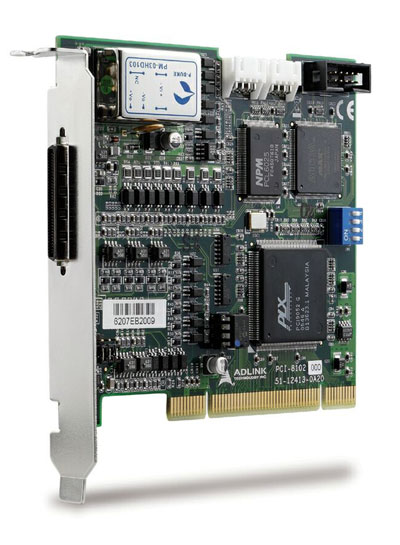
Comprehensive Product Summary: ADLINK PCI‑8174 Advanced DSP‑Based 4‑Axis Motion Control Card
### 1. Product Overview
Product Name: PCI‑8174 Advanced 4‑Axis Motion Control Card
Model: PCI‑8174
Series: UPCI Advanced Motion Control Series
Article Number: PCI‑8174
Manufacturer: ADLINK Technology Inc.
Part Number: 50‑11148‑1000
Revision: Manual Rev. 2.00 (April 22, 2007)
Product Type: DSP‑based 4‑axis stepping and servo motor motion control card with PCI interface
Manufacturer Website: [www.adlinktech.com](http://www.adlinktech.com)
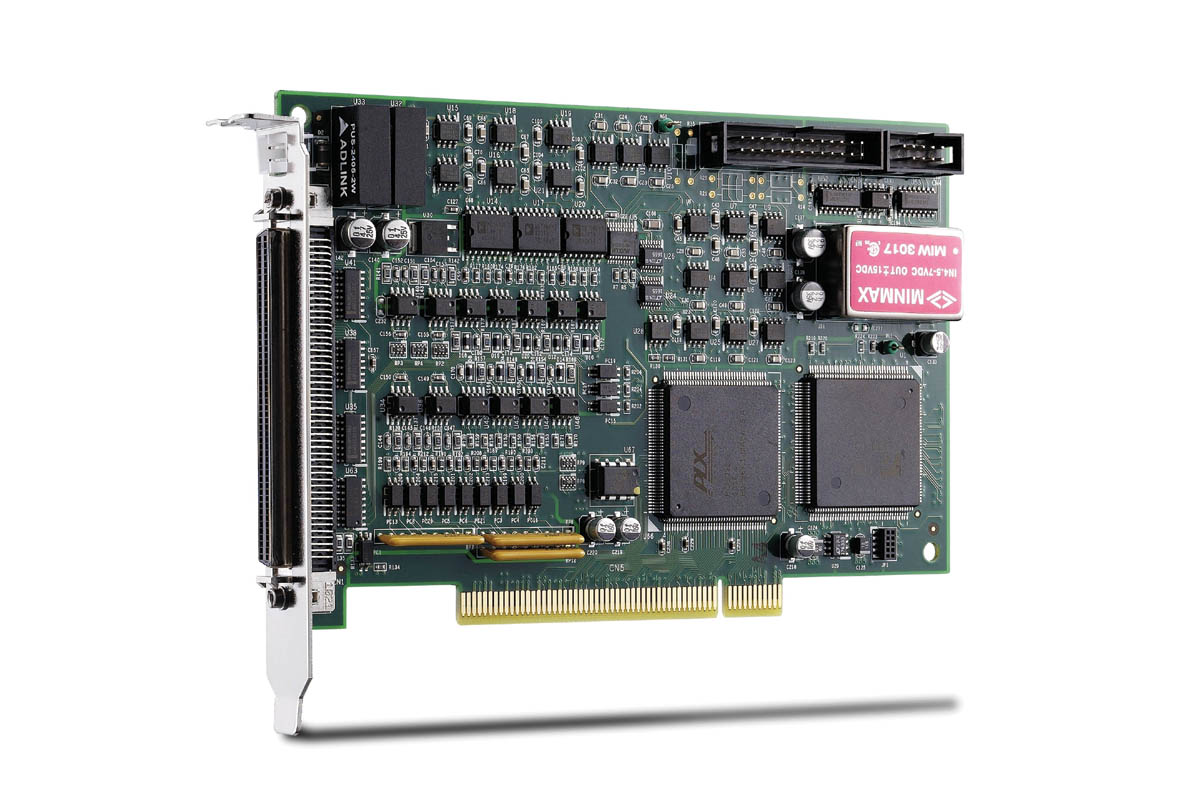
The ADLINK PCI‑8174 is a high‑performance, DSP‑based motion control card designed for precision multi‑axis control of stepper and servo motors. It integrates a dedicated motion ASIC and a 200 MHz TI TMS320C6711D DSP to execute time‑critical motion sequences independently of the host CPU, enabling deterministic control and synchronization across up to four axes. The card supports both stepping and servo motor drivers via pulse train interfaces and provides advanced interpolation, triggering, and feedback functions for industrial automation and machine control applications.
### 2. Key Features
- DSP‑Based Architecture: On‑board 200 MHz TI TMS320C6711D DSP (1200 MFLOPS) with motion ASIC (PCL6045) for real‑time control without CPU load.
- High‑Speed Pulse Output: Up to 6.55 MHz pulse output rate for stepper or servo motor control.
- Multi‑Axis Interpolation: Supports 2–4‑axis linear interpolation, 2‑axis circular interpolation, and 3‑axis helical interpolation.
- Continuous Contouring: Pre‑register architecture enables seamless motion chaining for continuous path control.
- Dynamic Motion Adjustment: Allows on‑the‑fly changes to speed or position during motion execution.
- Advanced Motion Profiles: Programmable acceleration/deceleration with trapezoidal and S‑curve velocity profiles.
- Position Feedback: 28‑bit up/down counter for incremental encoder feedback (up to 6.5 MHz).
- Hardware Triggering: Position compare and trigger output with hardware‑based latency‑free response.
- Position Latch: Hardware latch captures encoder position on external trigger input.
- Automatic Backlash Compensation: Hardware‑based backlash correction on direction change.
- Home Return Flexibility: 13 selectable home return modes with auto‑search capability.
- Simultaneous Start/Stop: Multi‑axis synchronization across one or multiple cards.
- Isolation & Protection: 2500 Vrms optical isolation on all digital I/O channels.
- Multi‑Card Scalability: Supports up to 12 PCI‑8174 cards in one system.
- Software Limit & Safety: Dual software end‑limits per axis, emergency stop input, and programmable interrupt sources.
- Manual Pulser Interface: Supports manual pulse generator input for jog or teach functions.
- Security & Reliability: EEPROM‑based program protection and hardware watchdog.
- Software Tools: Bundled with MotionCreatorPro™ for configuration, debugging, and motion testing.
- Cross‑Platform Support: Drivers and APIs for Windows 2000/XP/Vista and Linux (RedHat, Fedora, SUSE).
### 3. Technical Specifications
Applicable Motors:
- Stepping motors
- AC/DC servo motors with pulse train input drivers
Performance:
- Controllable Axes: 4
- Maximum Pulse Output Frequency: 6.55 MPPS
- Internal Reference Clock: 19.66 MHz
- Encoder Counter Resolution: 28‑bit (±134,217,727 counts)
- Pulse Input Frequency: Up to 3.2 MHz (CW/CCW or AB × 1), 6.5 MHz (AB × 4)
- Pulse Output Modes: OUT/DIR, CW/CCW, AB phase
- Pulse Input Modes: CW/CCW, AB phase (×1, ×2, ×4)
- Acceleration/Deceleration: Programmable (trapezoidal or S‑curve)
- Position Range: ±134,217,728 pulses
- Pulse Rate Range: 0.1 PPS – 6.55 MPPS (scalable multipliers 0.1, 1, 100)
Electrical & I/O:
- Isolation Voltage: 2500 Vrms (all digital I/O)
- Command Pulse Outputs: OUT ±, DIR ± (differential)
- Encoder Inputs: EA ±, EB ±, EZ ± (differential)
- Limit & Home Inputs: ±EL, ORG
- Servo Interface I/O: INP, ALM, ERC, SVON, RDY
- Multi‑Function Inputs: DI/LTC/SD/PCS/CLR/EMG (per axis)
- Multi‑Function Outputs: DO/CMP (per axis)
- General‑Purpose I/O: 4 × isolated DI, 4 × open‑collector DO
- Simultaneous Start/Stop: STA, STP signals
- Manual Pulser Input: PA ±, PB ± (differential)
Connectors:
- Main I/O: 100‑pin SCSI‑II type connector (CN1)
- Simultaneous Start/Stop: 6‑pin header (CN2)
- Manual Pulser: 10‑pin header (CN3)
Power Requirements:
- PCI Bus Input: +5 V DC ± 5%, 900 mA max
- External Input: +24 V DC ± 5%, 500 mA max
- External Output: +5 V DC ± 5%, 300 mA max
Environmental:
- Operating Temperature: 0 °C – 50 °C
- Storage Temperature: −20 °C – 80 °C
- Humidity: 5 – 85% RH, non‑condensing
Physical:
- PCB Dimensions: 185 mm (L) × 100 mm (W)
- Bus Interface: 32‑bit/33 MHz PCI (universal 3.3 V/5 V)
### 4. Functionality
The PCI‑8174 functions as a standalone motion controller executing motion profiles directly on its DSP and ASIC hardware. The host PC issues high‑level commands via the ADLINK motion library, while the DSP handles trajectory generation, interpolation, and synchronization in real time.
Supported Motion Modes:
- Single‑Axis Positioning: Absolute or relative moves with trapezoidal or S‑curve profiles.
- Velocity Mode: Continuous rotation at defined speed until stop command.
- Linear Interpolation: 2–4‑axis coordinated motion along straight‑line paths.
- Circular/Helical Interpolation: 2‑axis circular or 3‑axis helical trajectories.
- Continuous Contouring: Seamless chaining of motion segments for smooth path transitions.
- Home Return: 13 selectable homing algorithms with auto‑search and offset options.
- Manual Pulser Mode: Real‑time jog control via external handwheel encoder.
- Simultaneous Start/Stop: Hardware or software‑triggered multi‑axis synchronization.
- Speed/Position Override: Dynamic modification of velocity or target position during motion.
- Backlash & Vibration Compensation: Automatic correction pulses and damping control.
- Triggering & Latching: Hardware position compare outputs and latch inputs for precise event timing.
Applications:
- Semiconductor front‑ and back‑end equipment
- LCD/TFT manufacturing systems
- Electronic assembly and testing automation
- AOI (Automatic Optical Inspection) systems
- Dispenser and coating machinery
- CNC cutting, carving, and engraving machines
- Flight/vehicle simulators and motion platforms
Compatibility:
- Compatible with ADLINK PCI‑8134/8164 pinouts for easy migration.
- Interfaces with most stepper and servo drivers (Mitsubishi, Panasonic, Yaskawa, etc.).
### 5. Components & Accessories
Included Items:
- PCI‑8174 motion control card
- ADLINK All‑in‑One software CD (drivers, libraries, MotionCreatorPro)
- User’s Manual
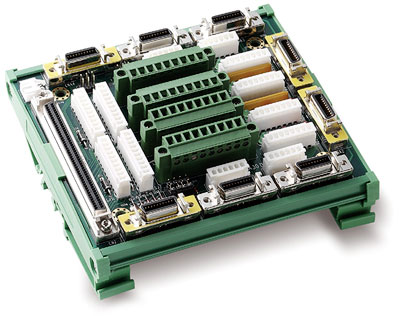
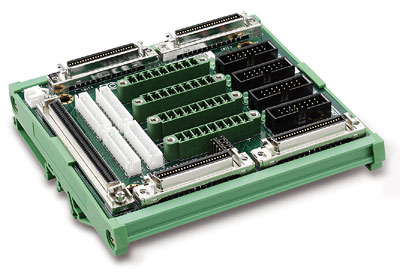
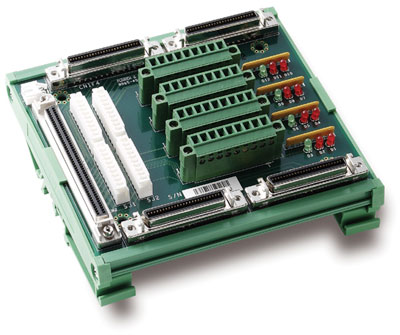
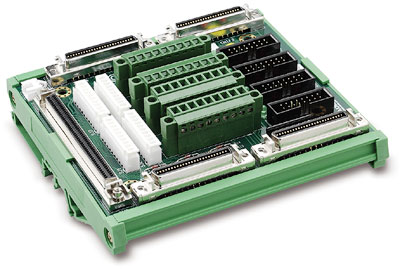
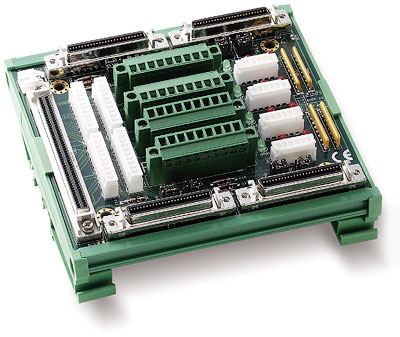
Optional Termination Boards:
- DIN‑100M15: General‑purpose terminal board with 1.5 m cable
- DIN‑100M30: General‑purpose terminal board with 3 m cable
- DIN‑814M: For Mitsubishi MR‑J2S‑A servo amplifier (1 m cable)
- DIN‑814M‑J3A: For Mitsubishi MR‑J3‑A servo amplifier (1 m cable)
- DIN‑814PA: For Panasonic MINAS A servo amplifier (1 m cable)
- DIN‑814P‑A4: For Panasonic MINAS A4 amplifier (1 m cable)
- DIN‑814Y: For Yaskawa Sigma II amplifier (1 m cable)
Connectors:
- CN1: 100‑pin SCSI‑II main I/O
- CN2: 6‑pin simultaneous start/stop
- CN3: 10‑pin manual pulser input
### 6. Installation & Setup
Hardware Installation:
1. Power off the PC and peripherals.
2. Insert the PCI‑8174 into an available 32‑bit PCI slot (do not use ISA slots).
3. Secure the card and reconnect power.
4. BIOS automatically assigns I/O and IRQ resources (Plug‑and‑Play compliant).
5. Connect external devices via CN1/CN2/CN3 or termination boards.
Software Installation:
- Run ADLINK All‑in‑One CD → *Driver Installation > Motion Control > PCI‑8174*.
- Follow on‑screen instructions and reboot.
- Latest drivers available from ADLINK website.
Configuration:
- DIP Switch SW1 sets card index (0–15).
- MotionCreatorPro™ utility configures I/O logic, motion parameters, and tests axes.
- Supports up to 12 cards per system with unique IDs.
Signal Wiring:
- Differential pulse outputs (OUT ±/DIR ±) to motor driver inputs.
- Differential encoder inputs (EA ±/EB ±/EZ ±) from motor feedback.
- Limit, home, and emergency inputs via opto‑isolated channels.
- Optional manual pulser connection via CN3.
### 7. Performance & Capabilities
Speed & Precision:
- Pulse output up to 6.55 MHz ensures high‑resolution motion control.
- Encoder feedback up to 6.5 MHz (AB × 4) for accurate position tracking.
- 28‑bit counters provide ±134 million pulse range per axis.
Interpolation & Synchronization:
- Linear interpolation across 2–4 axes with constant velocity vector.
- Circular interpolation between any two axes; helical interpolation for 3D paths.
- Continuous contouring with triple command buffers for uninterrupted motion.
- Simultaneous start/stop across multiple axes or cards via STA/STP signals.
Efficiency & Real‑Time Control:
- DSP executes motion profiles independently, eliminating host CPU latency.
- Hardware comparators and latch circuits ensure deterministic triggering.
- Supports closed‑loop gantry synchronization and DSP‑based high‑frequency triggering (up to 100 kHz).
Limitations:
- Open‑loop pulse control; closed‑loop feedback handled by servo driver.
- Requires external 24 V DC for isolated I/O operation.
- Limited to 4 axes per card (expandable via multiple cards).
### 8. Standards & Compliance
- Bus Interface: PCI 2.2 compliant (32‑bit/33 MHz, universal 3.3 V/5 V)
- Electrical Isolation: 2500 Vrms optical isolation on all digital I/O
- Safety & EMC: Designed for industrial environments; compliant with CE/EMC standards (manufacturer specification)
- Software Compatibility:
- Windows 2000/XP/Vista (DLL libraries for VB, VC++, BCB, Delphi, VB.NET, C#)
- Linux (RedHat 9, Fedora Core 3–5, SUSE 10; kernels 2.4.x–2.6.15)
- Programming Interfaces: C/C++ API, Visual Basic, .NET libraries
- MotionCreatorPro™ Utility: Windows‑based configuration and diagnostic tool
### 9. Additional Information
Warranty:
- Standard 2‑year limited warranty (1 year in China) from shipment date.
- Covers manufacturing defects; excludes damage from misuse, environment, or unauthorized repair.
- RMA service available via [rma.adlinktech.com](http://rma.adlinktech.com/policy).
Support & Service:
- Technical Support: service@adlinktech.com
- Phone: +886‑2‑82265877 Fax: +886‑2‑82265717
- Address: 9F, No. 166, Jian Yi Road, Chungho City, Taipei 235, Taiwan
Maintenance:
- Ensure proper ventilation and avoid high humidity.
- Use isolated power supplies and shielded cables for noise immunity.
- Periodically verify connector integrity and grounding.
Software Updates:
- Firmware and driver updates available from ADLINK website.
- MotionCreatorPro™ provides configuration backup via 8174.ini and 8174MC.ini files.
Customization:
- DSP firmware customization (ODM) available from ADLINK for specialized motion kernels.
### Summary
The ADLINK PCI‑8174 is a robust, high‑precision motion control solution for industrial automation requiring deterministic multi‑axis coordination. Its combination of a high‑speed DSP, dedicated motion ASIC, and optically isolated I/O delivers reliable, real‑time control for stepper and servo systems. With advanced interpolation, triggering, and feedback capabilities, it supports complex motion profiles and synchronization across multiple axes and cards. Comprehensive software tools and cross‑platform APIs make it suitable for OEMs and system integrators developing semiconductor, inspection, and precision manufacturing equipment.


 SUCHEN SIE DIE PASSENDE
 PCI-8174_Datasheet_2.pdf
PDF Catalog
PCI-8174_Datasheet_2.pdf
PDF Catalog
 PCI-8174_Manual_1.pdf
Manual
PCI-8174_Manual_1.pdf
Manual