 SUCHEN SIE DIE PASSENDE
INDUSTRIELLE LÖSUNG?
Entdecken Sie Embedded-, Kommunikations- und Automatisierungslösungen für Ihre Anwendung.
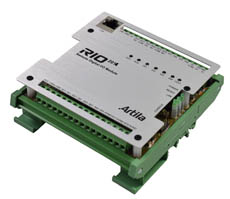
- High-performance ARM Cortex-M4 CPU: Powered by the Atmel SAM4E16E SoC running at 120 MHz, providing robust processing for real-time control and data acquisition tasks.
- Integrated FreeRTOS environment: Enables deterministic multitasking and real-time performance for embedded applications.
- Comprehensive I/O capabilities:
- 4 × 16-bit isolated analog input channels (voltage or current mode)
- 4 × opto-isolated digital inputs (2500 Vrms isolation)
- 2 × relay outputs (30 VDC @ 1 A or 125 VAC @ 0.5 A)
- 2 × Maxim 1‑Wire interfaces for digital sensors
- Multiple communication interfaces:
- 1 × 10/100 Mbps Ethernet port with 1.5 kV magnetic isolation
- 1 × isolated RS‑485 port (1500 Vrms)
- 1 × RS‑232 serial console port
- Embedded web server and networking stack: Supports lwIP and BSD socket libraries, enabling TCP/IP communication and web-based configuration.
- Flexible power input: Operates from 9 VDC to 48 VDC, suitable for industrial power systems.
- DIN‑rail mountable design: Compact and rugged enclosure for control cabinet installation.
- Windows configuration utility: Simplifies device discovery, configuration, and firmware upgrades.
- Toolchain support: Compatible with Atmel Studio, Sourcery CodeBench Lite, and Keil ARM toolchains.
- Expandable storage: Onboard microSD socket for data logging and firmware storage.
- High isolation protection: Analog, digital, and communication ports are isolated to prevent ground loops and electrical interference.
- Integrated FreeRTOS environment: Enables deterministic multitasking and real-time performance for embedded applications.
- Comprehensive I/O capabilities:
- 4 × 16-bit isolated analog input channels (voltage or current mode)
- 4 × opto-isolated digital inputs (2500 Vrms isolation)
- 2 × relay outputs (30 VDC @ 1 A or 125 VAC @ 0.5 A)
- 2 × Maxim 1‑Wire interfaces for digital sensors
- Multiple communication interfaces:
- 1 × 10/100 Mbps Ethernet port with 1.5 kV magnetic isolation
- 1 × isolated RS‑485 port (1500 Vrms)
- 1 × RS‑232 serial console port
- Embedded web server and networking stack: Supports lwIP and BSD socket libraries, enabling TCP/IP communication and web-based configuration.
- Flexible power input: Operates from 9 VDC to 48 VDC, suitable for industrial power systems.
- DIN‑rail mountable design: Compact and rugged enclosure for control cabinet installation.
- Windows configuration utility: Simplifies device discovery, configuration, and firmware upgrades.
- Toolchain support: Compatible with Atmel Studio, Sourcery CodeBench Lite, and Keil ARM toolchains.
- Expandable storage: Onboard microSD socket for data logging and firmware storage.
- High isolation protection: Analog, digital, and communication ports are isolated to prevent ground loops and electrical interference.
1. Product Overview
Product Name: RIO-2014PG
Model / Article Number: RIO-2014PG
Series: Artila Remote I/O (RIO) Series
Manufacturer: Artila Electronics Co., Ltd.
Product Type: FreeRTOS Programmable Remote I/O Module
Processor Platform: Atmel SAM4E16E ARM Cortex-M4 SoC
Operating System: FreeRTOS
Programming Environment: C programmable via Atmel Studio
The Artila RIO-2014PG is a compact, industrial-grade, programmable remote I/O module designed for distributed data acquisition, control, and monitoring applications. It integrates analog and digital I/O channels, relay outputs, and communication interfaces into a single DIN-rail mountable unit. The device runs FreeRTOS and supports C programming, enabling developers to build custom embedded applications for industrial automation, IoT gateways, and remote monitoring systems.
2. Key Features
- High-performance ARM Cortex-M4 CPU: Powered by the Atmel SAM4E16E SoC running at 120 MHz, providing robust processing for real-time control and data acquisition tasks.
- Integrated FreeRTOS environment: Enables deterministic multitasking and real-time performance for embedded applications.
- Comprehensive I/O capabilities:
- 4 × 16-bit isolated analog input channels (voltage or current mode)
- 4 × opto-isolated digital inputs (2500 Vrms isolation)
- 2 × relay outputs (30 VDC @ 1 A or 125 VAC @ 0.5 A)
- 2 × Maxim 1‑Wire interfaces for digital sensors
- Multiple communication interfaces:
- 1 × 10/100 Mbps Ethernet port with 1.5 kV magnetic isolation
- 1 × isolated RS‑485 port (1500 Vrms)
- 1 × RS‑232 serial console port
- Embedded web server and networking stack: Supports lwIP and BSD socket libraries, enabling TCP/IP communication and web-based configuration.
- Flexible power input: Operates from 9 VDC to 48 VDC, suitable for industrial power systems.
- DIN‑rail mountable design: Compact and rugged enclosure for control cabinet installation.
- Windows configuration utility: Simplifies device discovery, configuration, and firmware upgrades.
- Toolchain support: Compatible with Atmel Studio, Sourcery CodeBench Lite, and Keil ARM toolchains.
- Expandable storage: Onboard microSD socket for data logging and firmware storage.
- High isolation protection: Analog, digital, and communication ports are isolated to prevent ground loops and electrical interference.
3. Technical Specifications
Processor & Memory
- CPU: Atmel SAM4E16E ARM Cortex‑M4, 120 MHz
- On‑chip Memory: 1 MB Flash, 128 KB SRAM
- External Memory: 2 MB Flash (SPI expansion), 128 KB SRAM
- Operating System: FreeRTOS
Network Interface
- Ethernet: 1 × 10/100 Mbps, RJ‑45 connector
- Isolation: 1.5 kV magnetic isolation
Serial Communication
- RS‑232: 1 × serial console port (3‑wire or full modem)
- RS‑485: 1 × isolated port (1500 Vrms)
- Baud Rate: 1200 – 921600 bps
- Data Bits: 5 – 8
- Stop Bits: 1 – 2
- Flow Control: None / Hardware / Xon‑Xoff
- ESD Protection: 15 kV
Analog Input (Isolated)
- Channels: 4 differential inputs
- Resolution: 16‑bit
- Input Modes: Voltage or current
- Voltage Ranges (Unipolar): 0–150 mV, 0–500 mV, 0–1 V, 0–5 V, 0–10 V
- Voltage Ranges (Bipolar): ±150 mV, ±500 mV, ±1 V, ±5 V, ±10 V
- Current Range: 0–20 mA
- Input Impedance: 20 MΩ (voltage), 120 Ω (current)
- Accuracy: ±0.1 % FSR
- Isolation: 1500 Vrms
Digital Input (Isolated)
- Channels: 4 opto‑isolated inputs
- Isolation: 2500 Vrms
- Logic High: 5–24 VDC
- Logic Low: 0–1.5 VDC
- Input Resistance: 1.2 kΩ @ 0.5 W
- LED Indicators: Yes (per channel)
Relay Output
- Channels: 2
- Contact Rating: 30 VDC @ 1 A or 125 VAC @ 0.5 A
- Configurable: Normally Open (NO) or Normally Closed (NC) via jumper
- LED Indicators: Yes (per relay)
1‑Wire Interface
- Channels: 2
- Connector: 3‑pin terminal block (VDD, DQ, GND)
- Compatible Sensors: Maxim DS18B20 and similar 1‑Wire devices
Power & Environmental
- Power Input: 9–48 VDC
- Operating Temperature: 0 °C – 70 °C
- Storage Temperature: −20 °C – 85 °C
- Dimensions (W × L × H): 115.7 × 121.5 × 43 mm (4.56 × 4.78 × 1.69 in)
- Weight: 242 g (0.53 lb)
- Mounting: DIN‑rail
Mass Storage
- microSD socket (internal)
4. Functionality
The RIO‑2014PG functions as a programmable remote I/O controller capable of acquiring analog and digital signals, controlling relays, and communicating with supervisory systems or cloud platforms. It operates under FreeRTOS, allowing developers to implement multitasking applications for real‑time data processing and control.
Typical Use Cases:
- Industrial automation and process control
- Remote data acquisition and monitoring
- IoT gateway for sensor networks
- Building management and environmental monitoring
- PLC extension via Modbus or RESTful APIs
Operation:
Analog and digital inputs capture field signals, which can be processed locally or transmitted over Ethernet or serial interfaces. Relay outputs can drive actuators or alarms. The embedded web server and lwIP stack enable remote configuration and monitoring through a standard browser.
Compatibility:
- Works with Artila IoT gateways and Node‑RED environments
- Supports Modbus, MQTT, and RESTful web APIs for integration with SCADA or cloud systems
- Programmable via Atmel Studio using C language
5. Components & Accessories
Included Items:
- RIO‑2014PG main module
- Manager Utility (downloadable from Artila website)
- Software toolchain (Atmel Studio support)
Optional Accessories:
- CBL‑F10M9‑20 (91‑0P9M9‑001): Console cable (10‑pin header to DB9 male, 20 cm)
- DS18B20 (91‑6DS18‑001): Programmable resolution 1‑Wire digital thermometer
- PWR‑12V‑1A (31‑62100‑000): 110–240 VAC to 12 VDC 1 A power adapter
Connectors:
- CN1: Power input, relay outputs, digital inputs, RS‑485
- CN2: 1‑Wire interfaces and analog inputs
- RJ‑45: Ethernet port
- 10‑pin header: RS‑232/console port
6. Installation & Setup
Power Connection:
Connect 9–48 VDC to the VIN and GND terminals (CN1 P1–P2). The chassis ground (P3) may be tied to earth ground for noise suppression. The Power LED illuminates solid green when voltage is within range.
Mounting:
DIN‑rail mounting is supported for quick installation in control cabinets.
Configuration:
- Use the Windows Manager Utility to discover the device on the network, configure IP settings, and update firmware.
- The embedded web server allows browser‑based configuration and monitoring.
- Jumper settings (JP2–JP7) define serial port mode and analog input mode (voltage or current).
Jumper Settings:
- JP2/JP3: Select between RS‑232 (COM2) and console (COM3) on the shared 10‑pin header.
- JP4–JP7: Select analog input mode (1‑2 = Voltage, 2‑3 = Current).
LED Indicators:
- Power LED: Solid ON when powered.
- Ready LED: ON when firmware is operational.
- LAN LED: Indicates Ethernet link and activity.
- DI/DO LEDs: Show digital input and relay output status.
- Serial LED: Dual‑color (yellow = RX, green = TX) for serial activity.
7. Performance & Capabilities
Processing Performance:
The 120 MHz Cortex‑M4 processor with hardware floating‑point support ensures fast signal processing and deterministic control.
Analog Performance:
16‑bit resolution with ±0.1 % FSR accuracy provides precise measurement for voltage and current signals.
Isolation & Protection:
High isolation levels (1500–2500 Vrms) protect against electrical surges and ground potential differences, ensuring reliable operation in noisy industrial environments.
Networking & Communication:
The integrated Ethernet interface supports TCP/IP communication, web services, and socket programming. The RS‑485 port allows multi‑drop serial communication with PLCs or other field devices.
Data Handling:
The internal and external flash memory, combined with microSD storage, supports local data buffering and logging.
Efficiency & Reliability:
Low power consumption and wide input voltage range make the RIO‑2014PG suitable for continuous operation in industrial systems.
Limitations:
- Operating temperature limited to 0–70 °C (not suitable for extreme outdoor environments without enclosure).
- Relay outputs limited to 1 A @ 30 VDC or 0.5 A @ 125 VAC.
- No built‑in analog output (D/A) channels on this model.
8. Standards & Compliance
- Isolation Standards: 1500 Vrms (analog and RS‑485), 2500 Vrms (digital inputs)
- ESD Protection: 15 kV on serial ports
- Ethernet Isolation: 1.5 kV magnetic isolation
- Mounting Standard: DIN‑rail (EN 50022 compatible)
- Electrical Safety: Designed for low‑voltage DC operation (9–48 VDC)
- Software Environment: FreeRTOS compliant, supports lwIP networking stack
- Industry Protocols: Compatible with Modbus, MQTT, and RESTful APIs via Artila IoT gateway integration
9. Additional Information
Warranty & Support:
Artila Electronics provides standard warranty coverage for manufacturing defects. Technical support, firmware updates, and software utilities are available through the official Artila website (www.artila.com).
Maintenance:
- Periodically inspect terminal connections and ensure proper grounding.
- Keep ventilation openings clear to maintain operating temperature.
- Firmware updates can be applied via the Manager Utility or web interface.
Software & Development Tools:
- Atmel Studio: Primary IDE for C programming, compiling, and debugging.
- FreeRTOS SDK: Provides multitasking and real‑time scheduling capabilities.
- lwIP & BSD Socket Libraries: Enable TCP/IP networking and socket‑based communication.
- Tiny Web Server: Allows embedded web‑based control and monitoring.
- Windows Configuration Utility: Simplifies network setup and firmware management.
Integration with IoT Platforms:
The RIO‑2014PG can be integrated into Artila’s IoT gateway ecosystem, enabling data collection, buffering, and cloud transmission via MQTT or RESTful APIs. Node‑RED, a graphical flow‑based programming tool, can be used to visually configure data flows between the RIO module and other devices or cloud services.
Node‑RED Integration Example:
- Install Node‑RED on an Artila IoT gateway using standard Linux package commands.
- Connect the RIO‑2014PG via Ethernet or RS‑485.
- Use HTTP or MQTT nodes in Node‑RED to retrieve or publish I/O data.
- Data is exchanged in JSON format, allowing easy integration with dashboards or databases.
Firmware & Updates:
Firmware upgrades are supported through the Manager Utility. The device can be discovered automatically on the network, and firmware images can be uploaded directly.
Summary:
The Artila RIO‑2014PG is a versatile, programmable remote I/O module that combines analog and digital signal acquisition, relay control, and network communication in a compact, isolated design. Its FreeRTOS environment and C programmability make it ideal for developers building custom industrial control or IoT applications. With robust isolation, flexible power input, and comprehensive connectivity, the RIO‑2014PG delivers reliable performance for automation, monitoring, and data acquisition systems.
End of Product Summary – RIO‑2014PG FreeRTOS Programmable Remote I/O Module
Product Name: RIO-2014PG
Model / Article Number: RIO-2014PG
Series: Artila Remote I/O (RIO) Series
Manufacturer: Artila Electronics Co., Ltd.
Product Type: FreeRTOS Programmable Remote I/O Module
Processor Platform: Atmel SAM4E16E ARM Cortex-M4 SoC
Operating System: FreeRTOS
Programming Environment: C programmable via Atmel Studio
The Artila RIO-2014PG is a compact, industrial-grade, programmable remote I/O module designed for distributed data acquisition, control, and monitoring applications. It integrates analog and digital I/O channels, relay outputs, and communication interfaces into a single DIN-rail mountable unit. The device runs FreeRTOS and supports C programming, enabling developers to build custom embedded applications for industrial automation, IoT gateways, and remote monitoring systems.
2. Key Features
- High-performance ARM Cortex-M4 CPU: Powered by the Atmel SAM4E16E SoC running at 120 MHz, providing robust processing for real-time control and data acquisition tasks.
- Integrated FreeRTOS environment: Enables deterministic multitasking and real-time performance for embedded applications.
- Comprehensive I/O capabilities:
- 4 × 16-bit isolated analog input channels (voltage or current mode)
- 4 × opto-isolated digital inputs (2500 Vrms isolation)
- 2 × relay outputs (30 VDC @ 1 A or 125 VAC @ 0.5 A)
- 2 × Maxim 1‑Wire interfaces for digital sensors
- Multiple communication interfaces:
- 1 × 10/100 Mbps Ethernet port with 1.5 kV magnetic isolation
- 1 × isolated RS‑485 port (1500 Vrms)
- 1 × RS‑232 serial console port
- Embedded web server and networking stack: Supports lwIP and BSD socket libraries, enabling TCP/IP communication and web-based configuration.
- Flexible power input: Operates from 9 VDC to 48 VDC, suitable for industrial power systems.
- DIN‑rail mountable design: Compact and rugged enclosure for control cabinet installation.
- Windows configuration utility: Simplifies device discovery, configuration, and firmware upgrades.
- Toolchain support: Compatible with Atmel Studio, Sourcery CodeBench Lite, and Keil ARM toolchains.
- Expandable storage: Onboard microSD socket for data logging and firmware storage.
- High isolation protection: Analog, digital, and communication ports are isolated to prevent ground loops and electrical interference.
3. Technical Specifications
Processor & Memory
- CPU: Atmel SAM4E16E ARM Cortex‑M4, 120 MHz
- On‑chip Memory: 1 MB Flash, 128 KB SRAM
- External Memory: 2 MB Flash (SPI expansion), 128 KB SRAM
- Operating System: FreeRTOS
Network Interface
- Ethernet: 1 × 10/100 Mbps, RJ‑45 connector
- Isolation: 1.5 kV magnetic isolation
Serial Communication
- RS‑232: 1 × serial console port (3‑wire or full modem)
- RS‑485: 1 × isolated port (1500 Vrms)
- Baud Rate: 1200 – 921600 bps
- Data Bits: 5 – 8
- Stop Bits: 1 – 2
- Flow Control: None / Hardware / Xon‑Xoff
- ESD Protection: 15 kV
Analog Input (Isolated)
- Channels: 4 differential inputs
- Resolution: 16‑bit
- Input Modes: Voltage or current
- Voltage Ranges (Unipolar): 0–150 mV, 0–500 mV, 0–1 V, 0–5 V, 0–10 V
- Voltage Ranges (Bipolar): ±150 mV, ±500 mV, ±1 V, ±5 V, ±10 V
- Current Range: 0–20 mA
- Input Impedance: 20 MΩ (voltage), 120 Ω (current)
- Accuracy: ±0.1 % FSR
- Isolation: 1500 Vrms
Digital Input (Isolated)
- Channels: 4 opto‑isolated inputs
- Isolation: 2500 Vrms
- Logic High: 5–24 VDC
- Logic Low: 0–1.5 VDC
- Input Resistance: 1.2 kΩ @ 0.5 W
- LED Indicators: Yes (per channel)
Relay Output
- Channels: 2
- Contact Rating: 30 VDC @ 1 A or 125 VAC @ 0.5 A
- Configurable: Normally Open (NO) or Normally Closed (NC) via jumper
- LED Indicators: Yes (per relay)
1‑Wire Interface
- Channels: 2
- Connector: 3‑pin terminal block (VDD, DQ, GND)
- Compatible Sensors: Maxim DS18B20 and similar 1‑Wire devices
Power & Environmental
- Power Input: 9–48 VDC
- Operating Temperature: 0 °C – 70 °C
- Storage Temperature: −20 °C – 85 °C
- Dimensions (W × L × H): 115.7 × 121.5 × 43 mm (4.56 × 4.78 × 1.69 in)
- Weight: 242 g (0.53 lb)
- Mounting: DIN‑rail
Mass Storage
- microSD socket (internal)
4. Functionality
The RIO‑2014PG functions as a programmable remote I/O controller capable of acquiring analog and digital signals, controlling relays, and communicating with supervisory systems or cloud platforms. It operates under FreeRTOS, allowing developers to implement multitasking applications for real‑time data processing and control.
Typical Use Cases:
- Industrial automation and process control
- Remote data acquisition and monitoring
- IoT gateway for sensor networks
- Building management and environmental monitoring
- PLC extension via Modbus or RESTful APIs
Operation:
Analog and digital inputs capture field signals, which can be processed locally or transmitted over Ethernet or serial interfaces. Relay outputs can drive actuators or alarms. The embedded web server and lwIP stack enable remote configuration and monitoring through a standard browser.
Compatibility:
- Works with Artila IoT gateways and Node‑RED environments
- Supports Modbus, MQTT, and RESTful web APIs for integration with SCADA or cloud systems
- Programmable via Atmel Studio using C language
5. Components & Accessories
Included Items:
- RIO‑2014PG main module
- Manager Utility (downloadable from Artila website)
- Software toolchain (Atmel Studio support)
Optional Accessories:
- CBL‑F10M9‑20 (91‑0P9M9‑001): Console cable (10‑pin header to DB9 male, 20 cm)
- DS18B20 (91‑6DS18‑001): Programmable resolution 1‑Wire digital thermometer
- PWR‑12V‑1A (31‑62100‑000): 110–240 VAC to 12 VDC 1 A power adapter
Connectors:
- CN1: Power input, relay outputs, digital inputs, RS‑485
- CN2: 1‑Wire interfaces and analog inputs
- RJ‑45: Ethernet port
- 10‑pin header: RS‑232/console port
6. Installation & Setup
Power Connection:
Connect 9–48 VDC to the VIN and GND terminals (CN1 P1–P2). The chassis ground (P3) may be tied to earth ground for noise suppression. The Power LED illuminates solid green when voltage is within range.
Mounting:
DIN‑rail mounting is supported for quick installation in control cabinets.
Configuration:
- Use the Windows Manager Utility to discover the device on the network, configure IP settings, and update firmware.
- The embedded web server allows browser‑based configuration and monitoring.
- Jumper settings (JP2–JP7) define serial port mode and analog input mode (voltage or current).
Jumper Settings:
- JP2/JP3: Select between RS‑232 (COM2) and console (COM3) on the shared 10‑pin header.
- JP4–JP7: Select analog input mode (1‑2 = Voltage, 2‑3 = Current).
LED Indicators:
- Power LED: Solid ON when powered.
- Ready LED: ON when firmware is operational.
- LAN LED: Indicates Ethernet link and activity.
- DI/DO LEDs: Show digital input and relay output status.
- Serial LED: Dual‑color (yellow = RX, green = TX) for serial activity.
7. Performance & Capabilities
Processing Performance:
The 120 MHz Cortex‑M4 processor with hardware floating‑point support ensures fast signal processing and deterministic control.
Analog Performance:
16‑bit resolution with ±0.1 % FSR accuracy provides precise measurement for voltage and current signals.
Isolation & Protection:
High isolation levels (1500–2500 Vrms) protect against electrical surges and ground potential differences, ensuring reliable operation in noisy industrial environments.
Networking & Communication:
The integrated Ethernet interface supports TCP/IP communication, web services, and socket programming. The RS‑485 port allows multi‑drop serial communication with PLCs or other field devices.
Data Handling:
The internal and external flash memory, combined with microSD storage, supports local data buffering and logging.
Efficiency & Reliability:
Low power consumption and wide input voltage range make the RIO‑2014PG suitable for continuous operation in industrial systems.
Limitations:
- Operating temperature limited to 0–70 °C (not suitable for extreme outdoor environments without enclosure).
- Relay outputs limited to 1 A @ 30 VDC or 0.5 A @ 125 VAC.
- No built‑in analog output (D/A) channels on this model.
8. Standards & Compliance
- Isolation Standards: 1500 Vrms (analog and RS‑485), 2500 Vrms (digital inputs)
- ESD Protection: 15 kV on serial ports
- Ethernet Isolation: 1.5 kV magnetic isolation
- Mounting Standard: DIN‑rail (EN 50022 compatible)
- Electrical Safety: Designed for low‑voltage DC operation (9–48 VDC)
- Software Environment: FreeRTOS compliant, supports lwIP networking stack
- Industry Protocols: Compatible with Modbus, MQTT, and RESTful APIs via Artila IoT gateway integration
9. Additional Information
Warranty & Support:
Artila Electronics provides standard warranty coverage for manufacturing defects. Technical support, firmware updates, and software utilities are available through the official Artila website (www.artila.com).
Maintenance:
- Periodically inspect terminal connections and ensure proper grounding.
- Keep ventilation openings clear to maintain operating temperature.
- Firmware updates can be applied via the Manager Utility or web interface.
Software & Development Tools:
- Atmel Studio: Primary IDE for C programming, compiling, and debugging.
- FreeRTOS SDK: Provides multitasking and real‑time scheduling capabilities.
- lwIP & BSD Socket Libraries: Enable TCP/IP networking and socket‑based communication.
- Tiny Web Server: Allows embedded web‑based control and monitoring.
- Windows Configuration Utility: Simplifies network setup and firmware management.
Integration with IoT Platforms:
The RIO‑2014PG can be integrated into Artila’s IoT gateway ecosystem, enabling data collection, buffering, and cloud transmission via MQTT or RESTful APIs. Node‑RED, a graphical flow‑based programming tool, can be used to visually configure data flows between the RIO module and other devices or cloud services.
Node‑RED Integration Example:
- Install Node‑RED on an Artila IoT gateway using standard Linux package commands.
- Connect the RIO‑2014PG via Ethernet or RS‑485.
- Use HTTP or MQTT nodes in Node‑RED to retrieve or publish I/O data.
- Data is exchanged in JSON format, allowing easy integration with dashboards or databases.
Firmware & Updates:
Firmware upgrades are supported through the Manager Utility. The device can be discovered automatically on the network, and firmware images can be uploaded directly.
Summary:
The Artila RIO‑2014PG is a versatile, programmable remote I/O module that combines analog and digital signal acquisition, relay control, and network communication in a compact, isolated design. Its FreeRTOS environment and C programmability make it ideal for developers building custom industrial control or IoT applications. With robust isolation, flexible power input, and comprehensive connectivity, the RIO‑2014PG delivers reliable performance for automation, monitoring, and data acquisition systems.
End of Product Summary – RIO‑2014PG FreeRTOS Programmable Remote I/O Module
-
 RIO-2014PG_Datasheet.pdf
PDF Catalog
RIO-2014PG_Datasheet.pdf
PDF Catalog
-
 Warranty Declaration.pdf
PDF Catalog
Warranty Declaration.pdf
PDF Catalog


Kein Zubehör vorhanden.