 SUCHEN SIE DIE PASSENDE
INDUSTRIELLE LÖSUNG?
Entdecken Sie Embedded-, Kommunikations- und Automatisierungslösungen für Ihre Anwendung.

SMC-4DL-PCI
UPCI 4 axis motion controller high speed
275,00 EUR
inkl. Umsatzsteuer 327,25 EUR
- Four‑Axis Independent Control: Supports simultaneous control of up to four axes, each with independent motion parameters.
- High‑Speed Pulse Output: Generates pulse trains from 0.3 Mpps to 9.8 Mpps, suitable for high‑resolution servo and stepper drives.
- Multiple Output Modes: Selectable pulse output formats:
- 2‑pulse (CW/CCW)
- Common‑pulse (Pulse/Direction)
- 90° phase difference (Lead/Lag)
- Differential Line Driver Output: Ensures noise‑resistant, long‑distance signal transmission.
- Encoder Feedback Support: Accepts differential, TTL‑level, or open‑collector encoder signals for position verification and closed‑loop control.
- High‑Speed Encoder Input: Up to 5 MHz (differential), 3 MHz (TTL), or 1 MHz (open collector) input frequency.
- Opto‑Isolated Limit and Origin Inputs: Three opto‑isolated limit inputs per axis (ORG, +LIM, –LIM) for reliable end‑of‑travel and home detection.
- General‑Purpose I/O: Seven opto‑isolated general‑purpose input signals per axis for flexible system integration.
- Open‑Collector Outputs: Three general‑purpose outputs per axis, 50 V DC, 100 mA per channel (300 mA per axis).
- Controller Chip: Equipped with PCL6143 motion control LSI (Nippon Pulse Motor or equivalent).
- Frame Memory: Supports up to 1024 positioning frames per axis for complex motion sequences.
- Synchronization Control: Allows simultaneous start/stop of multiple axes or multiple boards (up to 16 boards).
- Software Override: Real‑time override of speed or target position during motion.
- Windows Driver Support: Includes CONTEC’s API‑TOOL driver library for Windows (Win32 API DLL).
- RoHS Compliant: Environmentally friendly, lead‑free design.
- High‑Speed Pulse Output: Generates pulse trains from 0.3 Mpps to 9.8 Mpps, suitable for high‑resolution servo and stepper drives.
- Multiple Output Modes: Selectable pulse output formats:
- 2‑pulse (CW/CCW)
- Common‑pulse (Pulse/Direction)
- 90° phase difference (Lead/Lag)
- Differential Line Driver Output: Ensures noise‑resistant, long‑distance signal transmission.
- Encoder Feedback Support: Accepts differential, TTL‑level, or open‑collector encoder signals for position verification and closed‑loop control.
- High‑Speed Encoder Input: Up to 5 MHz (differential), 3 MHz (TTL), or 1 MHz (open collector) input frequency.
- Opto‑Isolated Limit and Origin Inputs: Three opto‑isolated limit inputs per axis (ORG, +LIM, –LIM) for reliable end‑of‑travel and home detection.
- General‑Purpose I/O: Seven opto‑isolated general‑purpose input signals per axis for flexible system integration.
- Open‑Collector Outputs: Three general‑purpose outputs per axis, 50 V DC, 100 mA per channel (300 mA per axis).
- Controller Chip: Equipped with PCL6143 motion control LSI (Nippon Pulse Motor or equivalent).
- Frame Memory: Supports up to 1024 positioning frames per axis for complex motion sequences.
- Synchronization Control: Allows simultaneous start/stop of multiple axes or multiple boards (up to 16 boards).
- Software Override: Real‑time override of speed or target position during motion.
- Windows Driver Support: Includes CONTEC’s API‑TOOL driver library for Windows (Win32 API DLL).
- RoHS Compliant: Environmentally friendly, lead‑free design.
Comprehensive Product Summary – SMC‑4DL‑PCI High‑Speed 4‑Axis Motion Controller
### 1. Product Overview
Product Name: High‑Speed 4‑Axis Motion Controller
Model: SMC‑4DL‑PCI
Series: SMC‑DL Series (High‑Speed Motion Controllers)
Article Number: SMC‑4DL‑PCI
Manufacturer: CONTEC Co., Ltd. (Japan)
Product Category: PCI Bus Motion Controller Board
Bus Interface: PCI (32‑bit, 33 MHz, 5 V or 3.3 V compatible)
Product Type: 4‑axis pulse‑train motion control board for stepping and servo motors
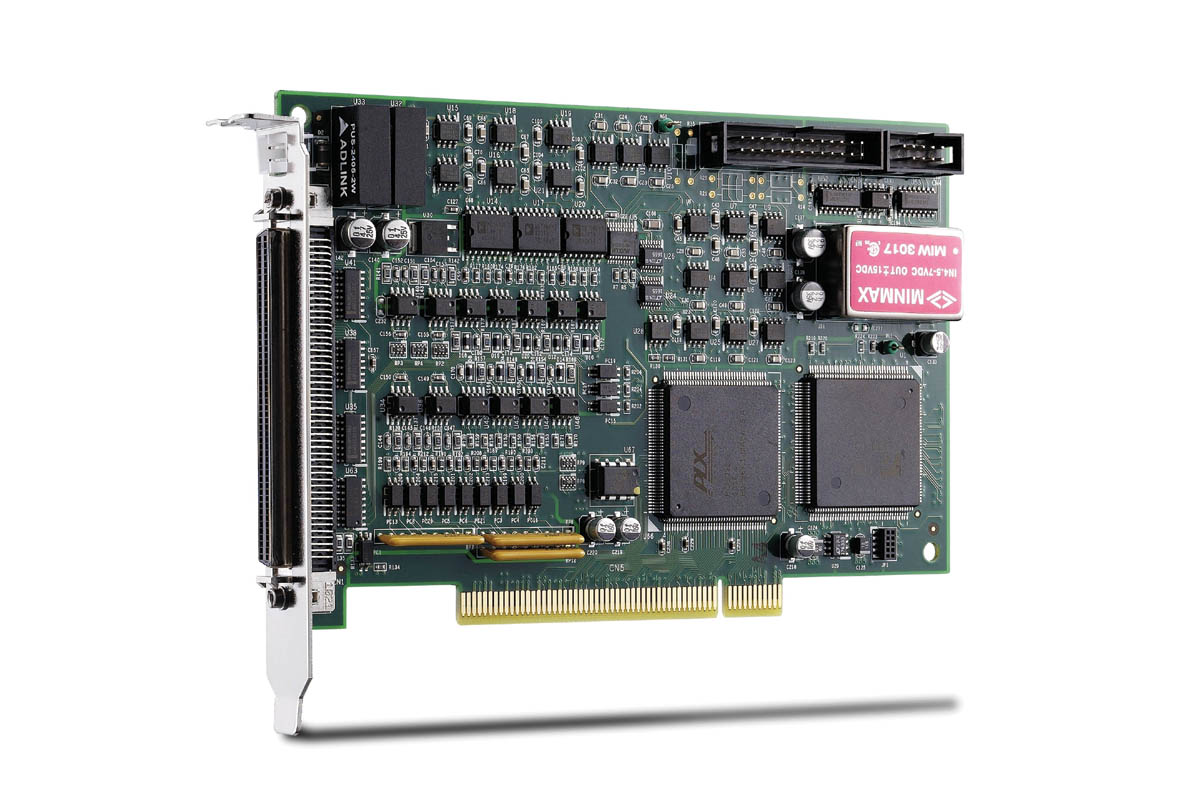
The CONTEC SMC‑4DL‑PCI is a high‑performance, four‑axis motion control board designed for industrial automation systems requiring precise, high‑speed control of pulse‑input type stepping or servo motors. It provides advanced motion control functions such as target positioning, origin return, linear and circular interpolation, and synchronized multi‑axis operation. The board is fully compliant with the PCI bus standard and integrates seamlessly into PC‑based control systems.
### 2. Key Features
- Four‑Axis Independent Control: Supports simultaneous control of up to four axes, each with independent motion parameters.
- High‑Speed Pulse Output: Generates pulse trains from 0.3 Mpps to 9.8 Mpps, suitable for high‑resolution servo and stepper drives.
- Multiple Output Modes: Selectable pulse output formats:
- 2‑pulse (CW/CCW)
- Common‑pulse (Pulse/Direction)
- 90° phase difference (Lead/Lag)
- Differential Line Driver Output: Ensures noise‑resistant, long‑distance signal transmission.
- Encoder Feedback Support: Accepts differential, TTL‑level, or open‑collector encoder signals for position verification and closed‑loop control.
- High‑Speed Encoder Input: Up to 5 MHz (differential), 3 MHz (TTL), or 1 MHz (open collector) input frequency.
- Opto‑Isolated Limit and Origin Inputs: Three opto‑isolated limit inputs per axis (ORG, +LIM, –LIM) for reliable end‑of‑travel and home detection.
- General‑Purpose I/O: Seven opto‑isolated general‑purpose input signals per axis for flexible system integration.
- Open‑Collector Outputs: Three general‑purpose outputs per axis, 50 V DC, 100 mA per channel (300 mA per axis).
- Controller Chip: Equipped with PCL6143 motion control LSI (Nippon Pulse Motor or equivalent).
- Frame Memory: Supports up to 1024 positioning frames per axis for complex motion sequences.
- Synchronization Control: Allows simultaneous start/stop of multiple axes or multiple boards (up to 16 boards).
- Software Override: Real‑time override of speed or target position during motion.
- Windows Driver Support: Includes CONTEC’s API‑TOOL driver library for Windows (Win32 API DLL).
- RoHS Compliant: Environmentally friendly, lead‑free design.
### 3. Technical Specifications
| Parameter | Specification |
|----------------|------------------|
| Number of Controlled Axes | 4 |
| Pulse Output Type | 2‑pulse (CW/CCW), Common‑pulse (Pulse/Direction), or 90° Phase Difference (Lead/Lag) |
| Output Signal Form | Differential Line Driver |
| Pulse Output Rate | 0.3 Mpps – 9.8 Mpps |
| Output Rating | 20 mA (Differential Line Driver) |
| Encoder Input Type | Single‑phase (UP/DOWN/Z) or Two‑phase (A/B/Z) |
| Encoder Input Signal Form | Differential, TTL‑level, or Open Collector |
| Encoder Input Frequency (Max.) | 5 MHz (Differential, duty 50%), 3 MHz (TTL, duty 50%), 1 MHz (Open Collector, duty 50%) |
| Limit Switch Inputs | 3 per axis (ORG, +LIM, –LIM), opto‑isolated (sink current type) |
| Limit Input Resistance | 4.7 kΩ |
| General‑Purpose Inputs | 7 per axis, opto‑isolated (sink current type) |
| General‑Purpose Outputs | 3 per axis, open collector (current sinking, software‑selectable logic) |
| Output Rating | 50 V DC, 100 mA per channel, 300 mA per axis |
| Controller Chip | PCL6143 (NPM or equivalent) |
| Interrupts | 1 interrupt source |
| I/O Address Allocation | Any 128‑byte boundary |
| Power Consumption (Max.) | 5 V DC, 700 mA |
| Bus Interface | PCI (32‑bit, 33 MHz, 5 V or 3.3 V compatible) |
| Board Dimensions (L × H) | 176.41 mm × 106.68 mm |
| Connector Type | 100‑pin, 0.8 mm pitch half‑pitch connector (HDRA‑EC100LFDT+ [HONDA Tsushin Kogyo] or equivalent) |
| Operating Environment | 0 – 50 °C, 10 – 90 % RH (non‑condensing) |
| Compliance | PCI Bus Specification, RoHS Directive |
### 4. Functionality
The SMC‑4DL‑PCI provides precise pulse‑train generation and feedback monitoring for motion control applications. Each axis can be configured independently for position, velocity, or interpolation control. The board outputs pulse signals corresponding to motion parameters such as target position, speed, and acceleration/deceleration rate.
Core Functions:
- Positioning Control: Executes absolute or relative moves based on stored frame data.
- Origin (ORG) Return: Automatically returns each axis to its mechanical home position.
- Linear and Circular Interpolation: Enables coordinated multi‑axis motion for contouring or path following.
- Acceleration/Deceleration Profiles: Supports fixed‑speed or linear acceleration/deceleration control.
- Consecutive Movement: Executes multiple stored frames sequentially for complex motion sequences.
- Synchronous Control: Coordinates simultaneous start/stop across multiple axes or boards.
- Speed/Position Override: Allows dynamic adjustment of motion parameters during operation.
- Encoder Feedback: Monitors actual position and speed for closed‑loop verification.
- Limit and Emergency Stop Inputs: Provides hardware protection against over‑travel or collision.
Typical Applications:
- Multi‑axis positioning systems
- CNC and machine tool control
- Semiconductor and PCB manufacturing equipment
- Pick‑and‑place robotics
- Inspection and measurement automation
- Precision assembly and packaging systems
Compatibility:
- Compatible with pulse‑input type stepping motors and servo motors.
- Works with encoders providing differential, TTL, or open‑collector outputs.
- Operates under Windows environments using CONTEC’s API‑TOOL driver library.
### 5. Components & Accessories
Included Items:
- SMC‑4DL‑PCI motion controller board
- Windows driver software (API‑TOOL for Windows)
- Documentation and installation guide
Optional Accessories:
- PCB100PS – 100‑pin half‑pitch cable (required for external connection)
- PPCA100P – Connector set for external wiring
- CCB‑SMC2 – Synchronization control cable (for multi‑board synchronization)
- EPD‑100A – Terminal block for external signal wiring
- 37‑pin D‑SUB and 9‑pin D‑SUB connectors – For motor and encoder connections (via optional cables)
Connector Details:
- 100‑pin, 0.8 mm pitch half‑pitch connector × 1
- Supports connection to four 37‑pin D‑SUB and four 9‑pin D‑SUB connectors via optional cables
### 6. Installation & Setup
System Requirements:
- PC with available PCI slot (32‑bit, 33 MHz, 5 V or 3.3 V)
- +5 V DC power supply from PCI bus (board does not operate on 3.3 V‑only systems)
- Windows operating system (supported by CONTEC API‑TOOL driver)
Installation Procedure:
1. Power off the PC and insert the SMC‑4DL‑PCI into an available PCI slot.
2. Secure the board using the bracket screw.
3. Connect external devices (motors, encoders, limit switches) using the optional PCB100PS cable and terminal blocks.
4. Power on the PC and install the API‑TOOL driver software.
5. Configure I/O addresses and motion parameters using the provided API or sample programs.
Mounting Options:
- Standard PCI bracket (fits full‑height PCI slots).
- Optional accessories allow connection to external terminal blocks for simplified wiring.
Configuration:
- Motion parameters (speed, acceleration, deceleration, target position) are set via software commands.
- Each axis can be configured independently or grouped for synchronized operation.
- Interrupts and I/O addresses are software‑assignable.
### 7. Performance & Capabilities
- Pulse Output Rate: 0.3 – 9.8 Mpps, suitable for high‑speed servo control.
- Encoder Input Frequency: Up to 5 MHz (differential), ensuring accurate feedback at high speeds.
- Frame Memory: 1024 frames per axis for complex motion sequences.
- Synchronization: Up to 16 boards can be synchronized using optional cables.
- Response Time: Determined by PCI bus latency and driver configuration; optimized for real‑time control.
- Power Efficiency: 5 V DC, 700 mA typical consumption.
- Reliability: Opto‑isolated inputs protect against electrical noise and ground loops.
- Limitations: Requires +5 V PCI slot; not compatible with 3.3 V‑only PCI systems.
### 8. Standards & Compliance
- Bus Standard: PCI Local Bus Specification (32‑bit, 33 MHz)
- Electrical Compliance: 5 V/3.3 V signaling compatible
- Environmental Compliance: RoHS Directive (lead‑free)
- Safety: Opto‑isolated inputs for electrical protection
- EMC Considerations: Differential signaling minimizes noise and crosstalk
- Manufacturer Quality: CONTEC industrial‑grade design for continuous operation in automation environments
### 9. Additional Information
Warranty & Support:
- Standard manufacturer warranty (typically one year; refer to CONTEC policy).
- Technical support available via CONTEC’s global portal: [www.contec.com](http://www.contec.com).
- Firmware and driver updates downloadable from the manufacturer’s website.
Maintenance:
- Periodic inspection of connectors and cables recommended.
- Ensure proper grounding and shielding for noise immunity.
- Keep board free from dust and contaminants; operate within specified temperature and humidity ranges.
Software & Development Tools:
- API‑TOOL for Windows:
- License‑free driver package (development and runtime).
- Provides Win32 API (DLL) functions for direct control of motion parameters.
- Includes sample programs and documentation.
- LabVIEW Compatibility:
- VI‑DAQ library available for integration with National Instruments LabVIEW.
- Simplifies motion control programming in graphical environments.
- Linux Driver:
- Module‑style device driver and shared library available for Linux systems.
Product Family:
- SMC‑8DL‑PCI: 8‑axis version (same specifications, double channel count).
- SMC‑4DF‑PCI / SMC‑8DF‑PCI: Advanced models with frame‑based motion control and S‑curve acceleration.
- SMC‑2P(PCI) / SMC‑4P(PCI): Standard‑speed models (0.1 – 1 Mpps).
Applications in Industry:
- Semiconductor wafer handling and inspection
- Automated optical inspection (AOI) systems
- Precision dispensing and assembly machines
- Robotics and mechatronics research
- Laboratory automation and test equipment
Ordering Information:
- Model: SMC‑4DL‑PCI
- Optional Accessories:
- PCB100PS (100‑pin cable)
- PPCA100P (connector set)
- CCB‑SMC2 (synchronization cable)
- EPD‑100A (terminal block)
Physical & Environmental Data:
- Dimensions: 176.41 mm (L) × 106.68 mm (H)
- Weight: Approx. 150 g (board only)
- Operating Temperature: 0 – 50 °C
- Storage Temperature: –10 – 60 °C
- Humidity: 10 – 90 % RH (non‑condensing)
### Summary
The CONTEC SMC‑4DL‑PCI is a robust, high‑speed, four‑axis motion controller optimized for PC‑based automation systems. It combines high‑frequency pulse generation (up to 9.8 Mpps) with flexible encoder feedback and opto‑isolated I/O, enabling precise control of stepping and servo motors. Its differential line‑driver outputs ensure reliable signal integrity in electrically noisy industrial environments.
With support for 1024 motion frames per axis, synchronization across multiple boards, and comprehensive software tools for Windows and Linux, the SMC‑4DL‑PCI provides a complete solution for demanding motion control applications. Its compliance with PCI standards and RoHS directives ensures long‑term compatibility and environmental responsibility, making it a preferred choice for OEMs and system integrators in precision automation, robotics, and manufacturing control systems.
### 1. Product Overview
Product Name: High‑Speed 4‑Axis Motion Controller
Model: SMC‑4DL‑PCI
Series: SMC‑DL Series (High‑Speed Motion Controllers)
Article Number: SMC‑4DL‑PCI
Manufacturer: CONTEC Co., Ltd. (Japan)
Product Category: PCI Bus Motion Controller Board
Bus Interface: PCI (32‑bit, 33 MHz, 5 V or 3.3 V compatible)
Product Type: 4‑axis pulse‑train motion control board for stepping and servo motors
The CONTEC SMC‑4DL‑PCI is a high‑performance, four‑axis motion control board designed for industrial automation systems requiring precise, high‑speed control of pulse‑input type stepping or servo motors. It provides advanced motion control functions such as target positioning, origin return, linear and circular interpolation, and synchronized multi‑axis operation. The board is fully compliant with the PCI bus standard and integrates seamlessly into PC‑based control systems.
### 2. Key Features
- Four‑Axis Independent Control: Supports simultaneous control of up to four axes, each with independent motion parameters.
- High‑Speed Pulse Output: Generates pulse trains from 0.3 Mpps to 9.8 Mpps, suitable for high‑resolution servo and stepper drives.
- Multiple Output Modes: Selectable pulse output formats:
- 2‑pulse (CW/CCW)
- Common‑pulse (Pulse/Direction)
- 90° phase difference (Lead/Lag)
- Differential Line Driver Output: Ensures noise‑resistant, long‑distance signal transmission.
- Encoder Feedback Support: Accepts differential, TTL‑level, or open‑collector encoder signals for position verification and closed‑loop control.
- High‑Speed Encoder Input: Up to 5 MHz (differential), 3 MHz (TTL), or 1 MHz (open collector) input frequency.
- Opto‑Isolated Limit and Origin Inputs: Three opto‑isolated limit inputs per axis (ORG, +LIM, –LIM) for reliable end‑of‑travel and home detection.
- General‑Purpose I/O: Seven opto‑isolated general‑purpose input signals per axis for flexible system integration.
- Open‑Collector Outputs: Three general‑purpose outputs per axis, 50 V DC, 100 mA per channel (300 mA per axis).
- Controller Chip: Equipped with PCL6143 motion control LSI (Nippon Pulse Motor or equivalent).
- Frame Memory: Supports up to 1024 positioning frames per axis for complex motion sequences.
- Synchronization Control: Allows simultaneous start/stop of multiple axes or multiple boards (up to 16 boards).
- Software Override: Real‑time override of speed or target position during motion.
- Windows Driver Support: Includes CONTEC’s API‑TOOL driver library for Windows (Win32 API DLL).
- RoHS Compliant: Environmentally friendly, lead‑free design.
### 3. Technical Specifications
| Parameter | Specification |
|----------------|------------------|
| Number of Controlled Axes | 4 |
| Pulse Output Type | 2‑pulse (CW/CCW), Common‑pulse (Pulse/Direction), or 90° Phase Difference (Lead/Lag) |
| Output Signal Form | Differential Line Driver |
| Pulse Output Rate | 0.3 Mpps – 9.8 Mpps |
| Output Rating | 20 mA (Differential Line Driver) |
| Encoder Input Type | Single‑phase (UP/DOWN/Z) or Two‑phase (A/B/Z) |
| Encoder Input Signal Form | Differential, TTL‑level, or Open Collector |
| Encoder Input Frequency (Max.) | 5 MHz (Differential, duty 50%), 3 MHz (TTL, duty 50%), 1 MHz (Open Collector, duty 50%) |
| Limit Switch Inputs | 3 per axis (ORG, +LIM, –LIM), opto‑isolated (sink current type) |
| Limit Input Resistance | 4.7 kΩ |
| General‑Purpose Inputs | 7 per axis, opto‑isolated (sink current type) |
| General‑Purpose Outputs | 3 per axis, open collector (current sinking, software‑selectable logic) |
| Output Rating | 50 V DC, 100 mA per channel, 300 mA per axis |
| Controller Chip | PCL6143 (NPM or equivalent) |
| Interrupts | 1 interrupt source |
| I/O Address Allocation | Any 128‑byte boundary |
| Power Consumption (Max.) | 5 V DC, 700 mA |
| Bus Interface | PCI (32‑bit, 33 MHz, 5 V or 3.3 V compatible) |
| Board Dimensions (L × H) | 176.41 mm × 106.68 mm |
| Connector Type | 100‑pin, 0.8 mm pitch half‑pitch connector (HDRA‑EC100LFDT+ [HONDA Tsushin Kogyo] or equivalent) |
| Operating Environment | 0 – 50 °C, 10 – 90 % RH (non‑condensing) |
| Compliance | PCI Bus Specification, RoHS Directive |
### 4. Functionality
The SMC‑4DL‑PCI provides precise pulse‑train generation and feedback monitoring for motion control applications. Each axis can be configured independently for position, velocity, or interpolation control. The board outputs pulse signals corresponding to motion parameters such as target position, speed, and acceleration/deceleration rate.
Core Functions:
- Positioning Control: Executes absolute or relative moves based on stored frame data.
- Origin (ORG) Return: Automatically returns each axis to its mechanical home position.
- Linear and Circular Interpolation: Enables coordinated multi‑axis motion for contouring or path following.
- Acceleration/Deceleration Profiles: Supports fixed‑speed or linear acceleration/deceleration control.
- Consecutive Movement: Executes multiple stored frames sequentially for complex motion sequences.
- Synchronous Control: Coordinates simultaneous start/stop across multiple axes or boards.
- Speed/Position Override: Allows dynamic adjustment of motion parameters during operation.
- Encoder Feedback: Monitors actual position and speed for closed‑loop verification.
- Limit and Emergency Stop Inputs: Provides hardware protection against over‑travel or collision.
Typical Applications:
- Multi‑axis positioning systems
- CNC and machine tool control
- Semiconductor and PCB manufacturing equipment
- Pick‑and‑place robotics
- Inspection and measurement automation
- Precision assembly and packaging systems
Compatibility:
- Compatible with pulse‑input type stepping motors and servo motors.
- Works with encoders providing differential, TTL, or open‑collector outputs.
- Operates under Windows environments using CONTEC’s API‑TOOL driver library.
### 5. Components & Accessories
Included Items:
- SMC‑4DL‑PCI motion controller board
- Windows driver software (API‑TOOL for Windows)
- Documentation and installation guide
Optional Accessories:
- PCB100PS – 100‑pin half‑pitch cable (required for external connection)
- PPCA100P – Connector set for external wiring
- CCB‑SMC2 – Synchronization control cable (for multi‑board synchronization)
- EPD‑100A – Terminal block for external signal wiring
- 37‑pin D‑SUB and 9‑pin D‑SUB connectors – For motor and encoder connections (via optional cables)
Connector Details:
- 100‑pin, 0.8 mm pitch half‑pitch connector × 1
- Supports connection to four 37‑pin D‑SUB and four 9‑pin D‑SUB connectors via optional cables
### 6. Installation & Setup
System Requirements:
- PC with available PCI slot (32‑bit, 33 MHz, 5 V or 3.3 V)
- +5 V DC power supply from PCI bus (board does not operate on 3.3 V‑only systems)
- Windows operating system (supported by CONTEC API‑TOOL driver)
Installation Procedure:
1. Power off the PC and insert the SMC‑4DL‑PCI into an available PCI slot.
2. Secure the board using the bracket screw.
3. Connect external devices (motors, encoders, limit switches) using the optional PCB100PS cable and terminal blocks.
4. Power on the PC and install the API‑TOOL driver software.
5. Configure I/O addresses and motion parameters using the provided API or sample programs.
Mounting Options:
- Standard PCI bracket (fits full‑height PCI slots).
- Optional accessories allow connection to external terminal blocks for simplified wiring.
Configuration:
- Motion parameters (speed, acceleration, deceleration, target position) are set via software commands.
- Each axis can be configured independently or grouped for synchronized operation.
- Interrupts and I/O addresses are software‑assignable.
### 7. Performance & Capabilities
- Pulse Output Rate: 0.3 – 9.8 Mpps, suitable for high‑speed servo control.
- Encoder Input Frequency: Up to 5 MHz (differential), ensuring accurate feedback at high speeds.
- Frame Memory: 1024 frames per axis for complex motion sequences.
- Synchronization: Up to 16 boards can be synchronized using optional cables.
- Response Time: Determined by PCI bus latency and driver configuration; optimized for real‑time control.
- Power Efficiency: 5 V DC, 700 mA typical consumption.
- Reliability: Opto‑isolated inputs protect against electrical noise and ground loops.
- Limitations: Requires +5 V PCI slot; not compatible with 3.3 V‑only PCI systems.
### 8. Standards & Compliance
- Bus Standard: PCI Local Bus Specification (32‑bit, 33 MHz)
- Electrical Compliance: 5 V/3.3 V signaling compatible
- Environmental Compliance: RoHS Directive (lead‑free)
- Safety: Opto‑isolated inputs for electrical protection
- EMC Considerations: Differential signaling minimizes noise and crosstalk
- Manufacturer Quality: CONTEC industrial‑grade design for continuous operation in automation environments
### 9. Additional Information
Warranty & Support:
- Standard manufacturer warranty (typically one year; refer to CONTEC policy).
- Technical support available via CONTEC’s global portal: [www.contec.com](http://www.contec.com).
- Firmware and driver updates downloadable from the manufacturer’s website.
Maintenance:
- Periodic inspection of connectors and cables recommended.
- Ensure proper grounding and shielding for noise immunity.
- Keep board free from dust and contaminants; operate within specified temperature and humidity ranges.
Software & Development Tools:
- API‑TOOL for Windows:
- License‑free driver package (development and runtime).
- Provides Win32 API (DLL) functions for direct control of motion parameters.
- Includes sample programs and documentation.
- LabVIEW Compatibility:
- VI‑DAQ library available for integration with National Instruments LabVIEW.
- Simplifies motion control programming in graphical environments.
- Linux Driver:
- Module‑style device driver and shared library available for Linux systems.
Product Family:
- SMC‑8DL‑PCI: 8‑axis version (same specifications, double channel count).
- SMC‑4DF‑PCI / SMC‑8DF‑PCI: Advanced models with frame‑based motion control and S‑curve acceleration.
- SMC‑2P(PCI) / SMC‑4P(PCI): Standard‑speed models (0.1 – 1 Mpps).
Applications in Industry:
- Semiconductor wafer handling and inspection
- Automated optical inspection (AOI) systems
- Precision dispensing and assembly machines
- Robotics and mechatronics research
- Laboratory automation and test equipment
Ordering Information:
- Model: SMC‑4DL‑PCI
- Optional Accessories:
- PCB100PS (100‑pin cable)
- PPCA100P (connector set)
- CCB‑SMC2 (synchronization cable)
- EPD‑100A (terminal block)
Physical & Environmental Data:
- Dimensions: 176.41 mm (L) × 106.68 mm (H)
- Weight: Approx. 150 g (board only)
- Operating Temperature: 0 – 50 °C
- Storage Temperature: –10 – 60 °C
- Humidity: 10 – 90 % RH (non‑condensing)
### Summary
The CONTEC SMC‑4DL‑PCI is a robust, high‑speed, four‑axis motion controller optimized for PC‑based automation systems. It combines high‑frequency pulse generation (up to 9.8 Mpps) with flexible encoder feedback and opto‑isolated I/O, enabling precise control of stepping and servo motors. Its differential line‑driver outputs ensure reliable signal integrity in electrically noisy industrial environments.
With support for 1024 motion frames per axis, synchronization across multiple boards, and comprehensive software tools for Windows and Linux, the SMC‑4DL‑PCI provides a complete solution for demanding motion control applications. Its compliance with PCI standards and RoHS directives ensures long‑term compatibility and environmental responsibility, making it a preferred choice for OEMs and system integrators in precision automation, robotics, and manufacturing control systems.

Kein Zubehör vorhanden.