 SUCHEN SIE DIE PASSENDE
INDUSTRIELLE LÖSUNG?
Entdecken Sie Embedded-, Kommunikations- und Automatisierungslösungen für Ihre Anwendung.

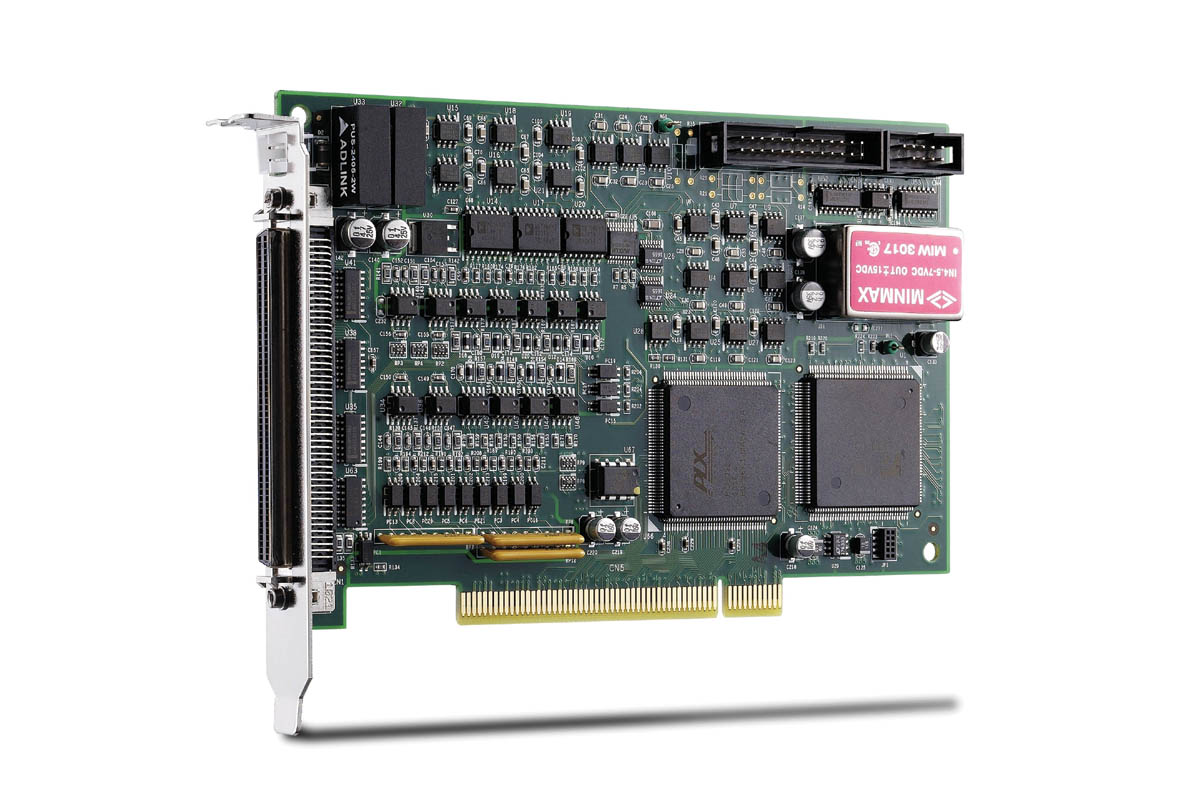
SMC-8DF-PCI
UPCI 8 axis motion controller high functionality
680,00 EUR
inkl. Umsatzsteuer 809,20 EUR
- Eight‑Axis Control: Supports simultaneous control of up to eight independent motor axes.
- High‑Speed Pulse Output: Generates pulse trains from 0.1 Mpps to 6.5 Mpps per axis.
- Multiple Pulse Modes: Selectable output modes—2‑pulse (CW/CCW), common‑pulse (Pulse/Direction), or 90° phase difference (Lead/Lag).
- Differential Line Driver Output: Ensures noise‑resistant, long‑distance signal transmission.
- Encoder Feedback Compatibility: Accepts differential, TTL‑level, or open‑collector encoder signals for position feedback.
- Advanced Motion Profiles: Supports target positioning, origin (ORG) return, linear and circular interpolation, S‑curve acceleration/deceleration, and frame‑based consecutive movement.
- Frame Memory: Up to 1024 positioning frames per axis stored onboard, enabling autonomous motion sequences without CPU load.
- Synchronous Multi‑Board Control: Up to 16 boards (SMC‑4DF‑PCI and SMC‑8DF‑PCI combined) can operate synchronously via synchronization control connectors.
- Override Function: Allows real‑time modification of speed or target position during motion.
- Opto‑Isolated Limit Inputs: Each axis includes opto‑isolated limit and origin inputs for reliable operation in noisy industrial environments.
- General‑Purpose I/O: Seven opto‑isolated inputs and three opto‑isolated outputs for auxiliary control and status signaling.
- High‑Speed Isolated Outputs: Designed for robust interfacing with external devices.
- PCI Bus Compliance: Fully compliant with PCI 2.2 standard; supports both 3.3 V and 5 V signaling environments.
- Compact Form Factor: 176 mm × 107 mm PCB suitable for standard industrial PC chassis.
- Software Support: Windows driver (API‑TOOL for Win32), Linux driver, and LabVIEW VI‑DAQ library available free of charge.
- RoHS Compliant: Environmentally friendly, lead‑free construction.
- High‑Speed Pulse Output: Generates pulse trains from 0.1 Mpps to 6.5 Mpps per axis.
- Multiple Pulse Modes: Selectable output modes—2‑pulse (CW/CCW), common‑pulse (Pulse/Direction), or 90° phase difference (Lead/Lag).
- Differential Line Driver Output: Ensures noise‑resistant, long‑distance signal transmission.
- Encoder Feedback Compatibility: Accepts differential, TTL‑level, or open‑collector encoder signals for position feedback.
- Advanced Motion Profiles: Supports target positioning, origin (ORG) return, linear and circular interpolation, S‑curve acceleration/deceleration, and frame‑based consecutive movement.
- Frame Memory: Up to 1024 positioning frames per axis stored onboard, enabling autonomous motion sequences without CPU load.
- Synchronous Multi‑Board Control: Up to 16 boards (SMC‑4DF‑PCI and SMC‑8DF‑PCI combined) can operate synchronously via synchronization control connectors.
- Override Function: Allows real‑time modification of speed or target position during motion.
- Opto‑Isolated Limit Inputs: Each axis includes opto‑isolated limit and origin inputs for reliable operation in noisy industrial environments.
- General‑Purpose I/O: Seven opto‑isolated inputs and three opto‑isolated outputs for auxiliary control and status signaling.
- High‑Speed Isolated Outputs: Designed for robust interfacing with external devices.
- PCI Bus Compliance: Fully compliant with PCI 2.2 standard; supports both 3.3 V and 5 V signaling environments.
- Compact Form Factor: 176 mm × 107 mm PCB suitable for standard industrial PC chassis.
- Software Support: Windows driver (API‑TOOL for Win32), Linux driver, and LabVIEW VI‑DAQ library available free of charge.
- RoHS Compliant: Environmentally friendly, lead‑free construction.
Comprehensive Product Summary – SMC‑8DF‑PCI High‑Functionality 8‑Axis Motion Controller
### 1. Product Overview
Product Name: High‑Functionality 8‑Axis Motion Controller
Model: SMC‑8DF‑PCI
Series: UPCI Motion Controller Series
Article Number: SMC‑8DF‑PCI
Manufacturer: CONTEC Co., Ltd. (Japan)
Product Category: PCI‑bus Motion Control Board for Stepping and Servo Motors
Bus Type: PCI (32‑bit, 33 MHz, 5 V or 3.3 V compatible)
Product Dimensions: 176.41 mm (L) × 106.68 mm (H)
Product Type: Add‑on motion control card for industrial automation PCs
The CONTEC SMC‑8DF‑PCI is a high‑performance, eight‑axis motion control board designed for precise control of stepping and servo motors through a standard PCI interface. It belongs to CONTEC’s UPCI series of motion controllers and is engineered for high‑speed, multi‑axis synchronization, advanced interpolation, and frame‑based motion sequencing. The board integrates the NPM PCL6045B motion control LSI and provides a complete hardware platform for industrial motion control applications requiring deterministic, high‑speed pulse output and feedback processing.
### 2. Key Features
- Eight‑Axis Control: Supports simultaneous control of up to eight independent motor axes.
- High‑Speed Pulse Output: Generates pulse trains from 0.1 Mpps to 6.5 Mpps per axis.
- Multiple Pulse Modes: Selectable output modes—2‑pulse (CW/CCW), common‑pulse (Pulse/Direction), or 90° phase difference (Lead/Lag).
- Differential Line Driver Output: Ensures noise‑resistant, long‑distance signal transmission.
- Encoder Feedback Compatibility: Accepts differential, TTL‑level, or open‑collector encoder signals for position feedback.
- Advanced Motion Profiles: Supports target positioning, origin (ORG) return, linear and circular interpolation, S‑curve acceleration/deceleration, and frame‑based consecutive movement.
- Frame Memory: Up to 1024 positioning frames per axis stored onboard, enabling autonomous motion sequences without CPU load.
- Synchronous Multi‑Board Control: Up to 16 boards (SMC‑4DF‑PCI and SMC‑8DF‑PCI combined) can operate synchronously via synchronization control connectors.
- Override Function: Allows real‑time modification of speed or target position during motion.
- Opto‑Isolated Limit Inputs: Each axis includes opto‑isolated limit and origin inputs for reliable operation in noisy industrial environments.
- General‑Purpose I/O: Seven opto‑isolated inputs and three opto‑isolated outputs for auxiliary control and status signaling.
- High‑Speed Isolated Outputs: Designed for robust interfacing with external devices.
- PCI Bus Compliance: Fully compliant with PCI 2.2 standard; supports both 3.3 V and 5 V signaling environments.
- Compact Form Factor: 176 mm × 107 mm PCB suitable for standard industrial PC chassis.
- Software Support: Windows driver (API‑TOOL for Win32), Linux driver, and LabVIEW VI‑DAQ library available free of charge.
- RoHS Compliant: Environmentally friendly, lead‑free construction.
### 3. Technical Specifications
| Parameter | Specification |
|----------------|------------------|
| Number of Controlled Axes | 8 |
| Controller Chip | PCL6045B (Nippon Pulse Motor Co., Ltd.) |
| Bus Interface | PCI, 32‑bit, 33 MHz, 5 V or 3.3 V |
| Pulse Output Type | 2‑pulse (CW/CCW), common‑pulse (Pulse/Direction), or 90° phase difference (Lead/Lag) |
| Output Driver | Differential line driver |
| Pulse Output Rate | 0.1 Mpps – 6.5 Mpps |
| Output Current Rating | 20 mA per channel |
| Encoder Input Type | Differential, TTL‑level, or open‑collector |
| Encoder Input Frequency | 5 MHz (differential, two‑phase, ×4), 3 MHz (TTL, two‑phase, ×4), 1 MHz (open‑collector, two‑phase, ×4) |
| Encoder Input Resistance | 150 Ω (software‑cuttable) |
| Limit Switch Inputs | 3 signals per axis (ORG, +LIM, –LIM), opto‑isolated (sink current type), 4.7 kΩ input resistance |
| General‑Purpose Inputs | 7 signals, opto‑isolated (sink current type), 4.7 kΩ input resistance |
| General‑Purpose Outputs | 3 signals per axis, open‑collector (current sinking type), 50 V DC 100 mA per channel, 300 mA per axis |
| Interrupts | 1 interrupt (count match, count error, sampling, SCC error, carry/borrow, timer) |
| I/O Address Range | Any 128‑byte boundary |
| Frame Memory | 1024 frames per axis |
| Power Consumption | 5 V DC ± 5 %, 1.6 A (max.) |
| Dimensions | 176.41 mm (L) × 106.68 mm (H) |
| Connector Type | 100‑pin 0.8 mm pitch half‑pitch connector (HDRA‑E100W1LFDT1EC‑SL+ [HONDA Tsushin Kogyo] or equivalent) |
| Operating Temperature | 0 °C – 50 °C (typical industrial PC environment) |
| Storage Temperature | –10 °C – 60 °C |
| Humidity | 10 % – 90 % RH (non‑condensing) |
| Weight | Approx. 200 g (board only) |
| Compliance | RoHS, CE (industrial EMC) |
### 4. Functionality
The SMC‑8DF‑PCI provides deterministic, hardware‑based motion control for up to eight axes of stepping or servo motors. Each axis can be independently configured for position, velocity, or interpolation control. The onboard PCL6045B controller executes motion profiles defined by the host PC through the PCI bus, minimizing CPU overhead.
Core Functional Modes:
- Positioning Control: Executes absolute or incremental moves to target positions with programmable acceleration and deceleration profiles.
- Interpolation: Supports linear and circular interpolation across multiple axes for coordinated motion.
- Origin Return (ORG): Automatically returns each axis to a defined home position using limit and origin sensors.
- Frame‑Based Sequencing: Each axis can store up to 1024 frames, each containing parameters such as target position, speed, and acceleration/deceleration rate.
- Synchronous Control: Multiple axes or multiple boards can start and stop simultaneously for coordinated multi‑axis operations.
- Override Control: Allows dynamic adjustment of speed or target position during motion execution.
- Limit and Emergency Stop Inputs: Hardware‑level safety inputs prevent over‑travel or mechanical collision.
- Encoder Feedback: Real‑time position verification and closed‑loop monitoring for servo systems.
Typical Applications:
- Multi‑axis positioning systems in semiconductor or electronics assembly equipment.
- CNC and precision machining centers.
- Automated inspection and measurement systems.
- Robotics and pick‑and‑place automation.
- Laboratory automation and motion‑based testing setups.
Compatibility:
- Compatible with both stepping and servo motors that accept pulse‑train control signals.
- Works with encoders providing differential, TTL, or open‑collector outputs.
- Operates in standard PCI‑bus industrial PCs running Windows or Linux.
### 5. Components & Accessories
Included Items:
- SMC‑8DF‑PCI motion control board
- Standard PCI bracket
- User manual and driver software (downloadable from CONTEC website)
Optional Accessories:
- Cables:
- PCB100PS (100‑pin half‑pitch cable)
- PPCA100P (100‑pin connector set)
- Connector/Terminal Blocks:
- EPD‑100A (terminal block for 100‑pin connector)
- CCB‑SMC2 synchronization control cable (for multi‑board synchronization)
- Additional Accessories:
- CN5‑H96F, PCA96P/PS, PCB96P/PS (for related counter/motion products)
Connectors:
- 100‑pin 0.8 mm pitch half‑pitch connector × 1
- Optional breakout to 37‑pin D‑SUB × 4 and 9‑pin D‑SUB × 4 via accessory cables
### 6. Installation & Setup
System Requirements:
- PC with available PCI slot (32‑bit, 33 MHz, 5 V or 3.3 V)
- +5 V DC power supply from PCI bus (board does not operate on 3.3 V‑only systems)
- Supported OS: Windows 10/11 (32/64‑bit), Linux kernel 2.6 or later
Installation Steps:
1. Power off the host PC and insert the SMC‑8DF‑PCI into an available PCI slot.
2. Secure the board using the supplied bracket.
3. Connect motor driver inputs to the pulse output connector using the appropriate cable (e.g., PCB100PS).
4. Connect encoder feedback, limit switches, and general‑purpose I/O as required.
5. Power on the PC and install the CONTEC API‑TOOL driver package.
6. Verify board recognition via the device manager or Linux device list.
7. Configure motion parameters using the provided API or sample applications.
Mounting Options:
- Standard PCI slot mounting in industrial PC chassis.
- Compatible with rackmount or desktop industrial PCs.
Configuration:
- Software‑selectable pulse output mode (CW/CCW, Pulse/Direction, or Phase Difference).
- Adjustable acceleration/deceleration profiles and motion parameters via API commands.
- Assignable interrupt sources for motion completion or error detection.
### 7. Performance & Capabilities
- Pulse Output Rate: 0.1 – 6.5 million pulses per second (Mpps) per axis.
- Encoder Input Frequency: Up to 5 MHz (differential, ×4).
- Frame Execution: 1024 frames per axis stored in onboard memory for autonomous operation.
- Synchronization: Up to 16 boards can be synchronized for 128‑axis coordinated control.
- Response Time: Hardware‑level deterministic timing independent of host CPU load.
- Power Efficiency: 5 V DC 1.6 A (max.) consumption ensures low thermal load.
- Reliability: Opto‑isolated I/O and differential signaling minimize noise and interference.
- Limitations: Requires +5 V PCI slot; not compatible with PCI‑Express or 3.3 V‑only systems.
### 8. Standards & Compliance
- Bus Standard: PCI Local Bus Specification Rev. 2.2 (32‑bit, 33 MHz)
- Electrical Compliance: Supports both 3.3 V and 5 V signaling environments
- Environmental Compliance: RoHS‑compliant, lead‑free construction
- Safety & EMC: Designed for CE industrial environments (EN 55011/EN 61000‑6‑2)
- Quality Assurance: Manufactured under ISO 9001‑certified quality management system
### 9. Additional Information
Warranty:
- Standard 1‑year manufacturer’s warranty covering defects in materials and workmanship.
Technical Support:
- Global support via CONTEC’s technical service network.
- Online documentation, driver downloads, and sample code available at [www.contec.com](http://www.contec.com).
Maintenance:
- No periodic calibration required.
- Keep connectors and contacts clean; avoid electrostatic discharge during handling.
Software & Updates:
- Windows Driver (API‑TOOL for Win32): License‑free development and runtime libraries providing direct access to motion control functions through standard DLL calls.
- Linux Driver: Open‑source module‑style driver with shared library interface.
- LabVIEW Support: VI‑DAQ library for National Instruments LabVIEW, enabling graphical programming of motion sequences.
- Firmware: Embedded firmware in PCL6045B; no user update required.
Documentation:
- User’s Manual (English/Japanese)
- API Reference Guide
- Sample Programs for Windows and Linux
Ordering Information:
- SMC‑8DF‑PCI: 8‑axis PCI motion controller board
- Optional Accessories:
- PCB100PS (100‑pin cable)
- EPD‑100A (terminal block)
- CCB‑SMC2 (synchronization cable)
### Summary
The CONTEC SMC‑8DF‑PCI is a robust, high‑functionality motion control board engineered for demanding industrial automation tasks. It provides eight channels of high‑speed pulse output with flexible control modes, extensive onboard frame memory, and hardware‑based synchronization for multi‑axis systems. Its compatibility with both stepping and servo motors, combined with opto‑isolated I/O and differential encoder interfaces, ensures precise, noise‑immune operation in harsh environments. The board’s PCI compliance and comprehensive software support make it an ideal solution for OEMs and system integrators developing PC‑based motion control systems requiring deterministic performance, scalability, and ease of integration.
### 1. Product Overview
Product Name: High‑Functionality 8‑Axis Motion Controller
Model: SMC‑8DF‑PCI
Series: UPCI Motion Controller Series
Article Number: SMC‑8DF‑PCI
Manufacturer: CONTEC Co., Ltd. (Japan)
Product Category: PCI‑bus Motion Control Board for Stepping and Servo Motors
Bus Type: PCI (32‑bit, 33 MHz, 5 V or 3.3 V compatible)
Product Dimensions: 176.41 mm (L) × 106.68 mm (H)
Product Type: Add‑on motion control card for industrial automation PCs
The CONTEC SMC‑8DF‑PCI is a high‑performance, eight‑axis motion control board designed for precise control of stepping and servo motors through a standard PCI interface. It belongs to CONTEC’s UPCI series of motion controllers and is engineered for high‑speed, multi‑axis synchronization, advanced interpolation, and frame‑based motion sequencing. The board integrates the NPM PCL6045B motion control LSI and provides a complete hardware platform for industrial motion control applications requiring deterministic, high‑speed pulse output and feedback processing.
### 2. Key Features
- Eight‑Axis Control: Supports simultaneous control of up to eight independent motor axes.
- High‑Speed Pulse Output: Generates pulse trains from 0.1 Mpps to 6.5 Mpps per axis.
- Multiple Pulse Modes: Selectable output modes—2‑pulse (CW/CCW), common‑pulse (Pulse/Direction), or 90° phase difference (Lead/Lag).
- Differential Line Driver Output: Ensures noise‑resistant, long‑distance signal transmission.
- Encoder Feedback Compatibility: Accepts differential, TTL‑level, or open‑collector encoder signals for position feedback.
- Advanced Motion Profiles: Supports target positioning, origin (ORG) return, linear and circular interpolation, S‑curve acceleration/deceleration, and frame‑based consecutive movement.
- Frame Memory: Up to 1024 positioning frames per axis stored onboard, enabling autonomous motion sequences without CPU load.
- Synchronous Multi‑Board Control: Up to 16 boards (SMC‑4DF‑PCI and SMC‑8DF‑PCI combined) can operate synchronously via synchronization control connectors.
- Override Function: Allows real‑time modification of speed or target position during motion.
- Opto‑Isolated Limit Inputs: Each axis includes opto‑isolated limit and origin inputs for reliable operation in noisy industrial environments.
- General‑Purpose I/O: Seven opto‑isolated inputs and three opto‑isolated outputs for auxiliary control and status signaling.
- High‑Speed Isolated Outputs: Designed for robust interfacing with external devices.
- PCI Bus Compliance: Fully compliant with PCI 2.2 standard; supports both 3.3 V and 5 V signaling environments.
- Compact Form Factor: 176 mm × 107 mm PCB suitable for standard industrial PC chassis.
- Software Support: Windows driver (API‑TOOL for Win32), Linux driver, and LabVIEW VI‑DAQ library available free of charge.
- RoHS Compliant: Environmentally friendly, lead‑free construction.
### 3. Technical Specifications
| Parameter | Specification |
|----------------|------------------|
| Number of Controlled Axes | 8 |
| Controller Chip | PCL6045B (Nippon Pulse Motor Co., Ltd.) |
| Bus Interface | PCI, 32‑bit, 33 MHz, 5 V or 3.3 V |
| Pulse Output Type | 2‑pulse (CW/CCW), common‑pulse (Pulse/Direction), or 90° phase difference (Lead/Lag) |
| Output Driver | Differential line driver |
| Pulse Output Rate | 0.1 Mpps – 6.5 Mpps |
| Output Current Rating | 20 mA per channel |
| Encoder Input Type | Differential, TTL‑level, or open‑collector |
| Encoder Input Frequency | 5 MHz (differential, two‑phase, ×4), 3 MHz (TTL, two‑phase, ×4), 1 MHz (open‑collector, two‑phase, ×4) |
| Encoder Input Resistance | 150 Ω (software‑cuttable) |
| Limit Switch Inputs | 3 signals per axis (ORG, +LIM, –LIM), opto‑isolated (sink current type), 4.7 kΩ input resistance |
| General‑Purpose Inputs | 7 signals, opto‑isolated (sink current type), 4.7 kΩ input resistance |
| General‑Purpose Outputs | 3 signals per axis, open‑collector (current sinking type), 50 V DC 100 mA per channel, 300 mA per axis |
| Interrupts | 1 interrupt (count match, count error, sampling, SCC error, carry/borrow, timer) |
| I/O Address Range | Any 128‑byte boundary |
| Frame Memory | 1024 frames per axis |
| Power Consumption | 5 V DC ± 5 %, 1.6 A (max.) |
| Dimensions | 176.41 mm (L) × 106.68 mm (H) |
| Connector Type | 100‑pin 0.8 mm pitch half‑pitch connector (HDRA‑E100W1LFDT1EC‑SL+ [HONDA Tsushin Kogyo] or equivalent) |
| Operating Temperature | 0 °C – 50 °C (typical industrial PC environment) |
| Storage Temperature | –10 °C – 60 °C |
| Humidity | 10 % – 90 % RH (non‑condensing) |
| Weight | Approx. 200 g (board only) |
| Compliance | RoHS, CE (industrial EMC) |
### 4. Functionality
The SMC‑8DF‑PCI provides deterministic, hardware‑based motion control for up to eight axes of stepping or servo motors. Each axis can be independently configured for position, velocity, or interpolation control. The onboard PCL6045B controller executes motion profiles defined by the host PC through the PCI bus, minimizing CPU overhead.
Core Functional Modes:
- Positioning Control: Executes absolute or incremental moves to target positions with programmable acceleration and deceleration profiles.
- Interpolation: Supports linear and circular interpolation across multiple axes for coordinated motion.
- Origin Return (ORG): Automatically returns each axis to a defined home position using limit and origin sensors.
- Frame‑Based Sequencing: Each axis can store up to 1024 frames, each containing parameters such as target position, speed, and acceleration/deceleration rate.
- Synchronous Control: Multiple axes or multiple boards can start and stop simultaneously for coordinated multi‑axis operations.
- Override Control: Allows dynamic adjustment of speed or target position during motion execution.
- Limit and Emergency Stop Inputs: Hardware‑level safety inputs prevent over‑travel or mechanical collision.
- Encoder Feedback: Real‑time position verification and closed‑loop monitoring for servo systems.
Typical Applications:
- Multi‑axis positioning systems in semiconductor or electronics assembly equipment.
- CNC and precision machining centers.
- Automated inspection and measurement systems.
- Robotics and pick‑and‑place automation.
- Laboratory automation and motion‑based testing setups.
Compatibility:
- Compatible with both stepping and servo motors that accept pulse‑train control signals.
- Works with encoders providing differential, TTL, or open‑collector outputs.
- Operates in standard PCI‑bus industrial PCs running Windows or Linux.
### 5. Components & Accessories
Included Items:
- SMC‑8DF‑PCI motion control board
- Standard PCI bracket
- User manual and driver software (downloadable from CONTEC website)
Optional Accessories:
- Cables:
- PCB100PS (100‑pin half‑pitch cable)
- PPCA100P (100‑pin connector set)
- Connector/Terminal Blocks:
- EPD‑100A (terminal block for 100‑pin connector)
- CCB‑SMC2 synchronization control cable (for multi‑board synchronization)
- Additional Accessories:
- CN5‑H96F, PCA96P/PS, PCB96P/PS (for related counter/motion products)
Connectors:
- 100‑pin 0.8 mm pitch half‑pitch connector × 1
- Optional breakout to 37‑pin D‑SUB × 4 and 9‑pin D‑SUB × 4 via accessory cables
### 6. Installation & Setup
System Requirements:
- PC with available PCI slot (32‑bit, 33 MHz, 5 V or 3.3 V)
- +5 V DC power supply from PCI bus (board does not operate on 3.3 V‑only systems)
- Supported OS: Windows 10/11 (32/64‑bit), Linux kernel 2.6 or later
Installation Steps:
1. Power off the host PC and insert the SMC‑8DF‑PCI into an available PCI slot.
2. Secure the board using the supplied bracket.
3. Connect motor driver inputs to the pulse output connector using the appropriate cable (e.g., PCB100PS).
4. Connect encoder feedback, limit switches, and general‑purpose I/O as required.
5. Power on the PC and install the CONTEC API‑TOOL driver package.
6. Verify board recognition via the device manager or Linux device list.
7. Configure motion parameters using the provided API or sample applications.
Mounting Options:
- Standard PCI slot mounting in industrial PC chassis.
- Compatible with rackmount or desktop industrial PCs.
Configuration:
- Software‑selectable pulse output mode (CW/CCW, Pulse/Direction, or Phase Difference).
- Adjustable acceleration/deceleration profiles and motion parameters via API commands.
- Assignable interrupt sources for motion completion or error detection.
### 7. Performance & Capabilities
- Pulse Output Rate: 0.1 – 6.5 million pulses per second (Mpps) per axis.
- Encoder Input Frequency: Up to 5 MHz (differential, ×4).
- Frame Execution: 1024 frames per axis stored in onboard memory for autonomous operation.
- Synchronization: Up to 16 boards can be synchronized for 128‑axis coordinated control.
- Response Time: Hardware‑level deterministic timing independent of host CPU load.
- Power Efficiency: 5 V DC 1.6 A (max.) consumption ensures low thermal load.
- Reliability: Opto‑isolated I/O and differential signaling minimize noise and interference.
- Limitations: Requires +5 V PCI slot; not compatible with PCI‑Express or 3.3 V‑only systems.
### 8. Standards & Compliance
- Bus Standard: PCI Local Bus Specification Rev. 2.2 (32‑bit, 33 MHz)
- Electrical Compliance: Supports both 3.3 V and 5 V signaling environments
- Environmental Compliance: RoHS‑compliant, lead‑free construction
- Safety & EMC: Designed for CE industrial environments (EN 55011/EN 61000‑6‑2)
- Quality Assurance: Manufactured under ISO 9001‑certified quality management system
### 9. Additional Information
Warranty:
- Standard 1‑year manufacturer’s warranty covering defects in materials and workmanship.
Technical Support:
- Global support via CONTEC’s technical service network.
- Online documentation, driver downloads, and sample code available at [www.contec.com](http://www.contec.com).
Maintenance:
- No periodic calibration required.
- Keep connectors and contacts clean; avoid electrostatic discharge during handling.
Software & Updates:
- Windows Driver (API‑TOOL for Win32): License‑free development and runtime libraries providing direct access to motion control functions through standard DLL calls.
- Linux Driver: Open‑source module‑style driver with shared library interface.
- LabVIEW Support: VI‑DAQ library for National Instruments LabVIEW, enabling graphical programming of motion sequences.
- Firmware: Embedded firmware in PCL6045B; no user update required.
Documentation:
- User’s Manual (English/Japanese)
- API Reference Guide
- Sample Programs for Windows and Linux
Ordering Information:
- SMC‑8DF‑PCI: 8‑axis PCI motion controller board
- Optional Accessories:
- PCB100PS (100‑pin cable)
- EPD‑100A (terminal block)
- CCB‑SMC2 (synchronization cable)
### Summary
The CONTEC SMC‑8DF‑PCI is a robust, high‑functionality motion control board engineered for demanding industrial automation tasks. It provides eight channels of high‑speed pulse output with flexible control modes, extensive onboard frame memory, and hardware‑based synchronization for multi‑axis systems. Its compatibility with both stepping and servo motors, combined with opto‑isolated I/O and differential encoder interfaces, ensures precise, noise‑immune operation in harsh environments. The board’s PCI compliance and comprehensive software support make it an ideal solution for OEMs and system integrators developing PC‑based motion control systems requiring deterministic performance, scalability, and ease of integration.

Kein Zubehör vorhanden.