 LOOKING FOR THE RIGHT
INDUSTRIAL SOLUTION?
Discover embedded, communication and automation solutions tailored to your application.
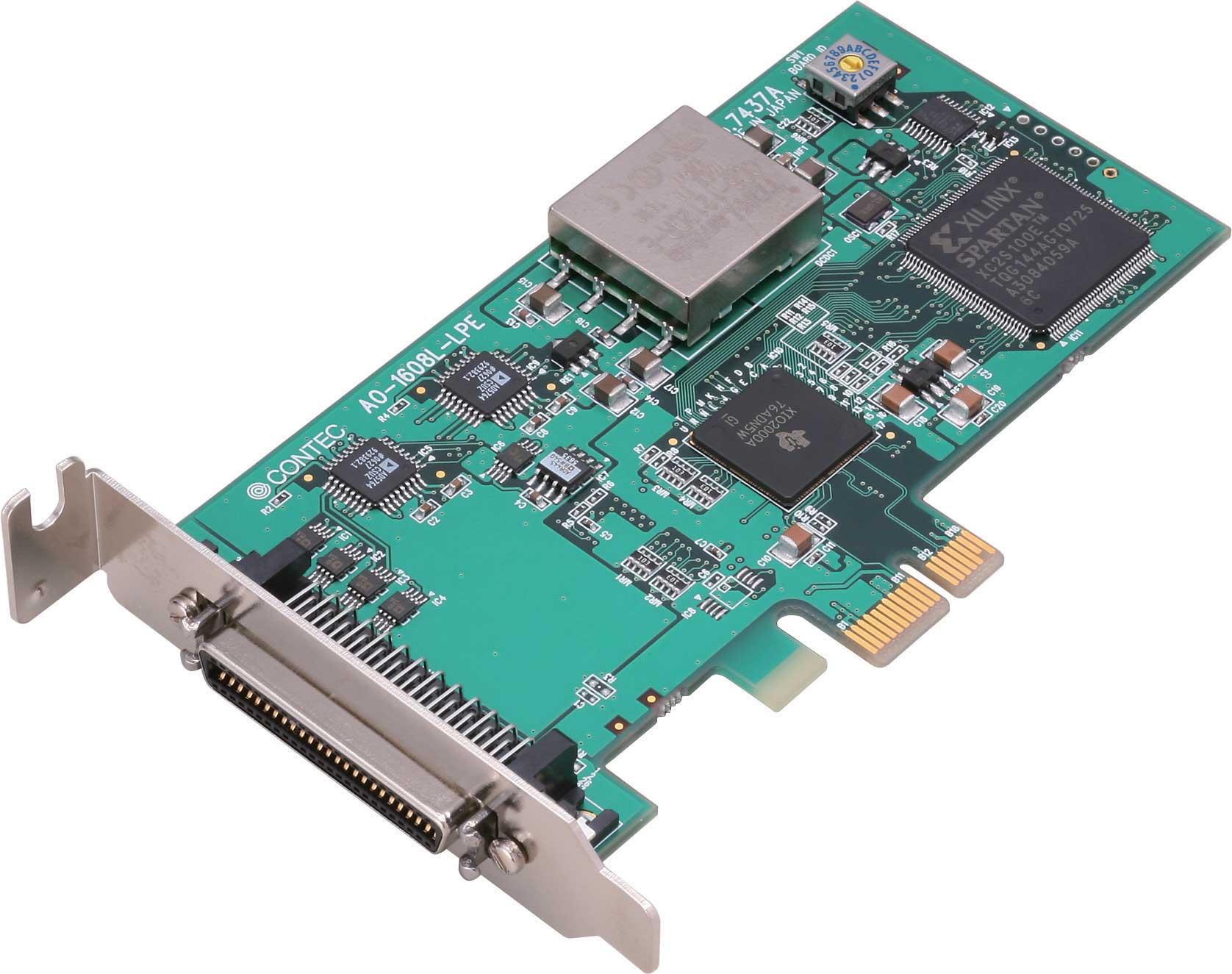
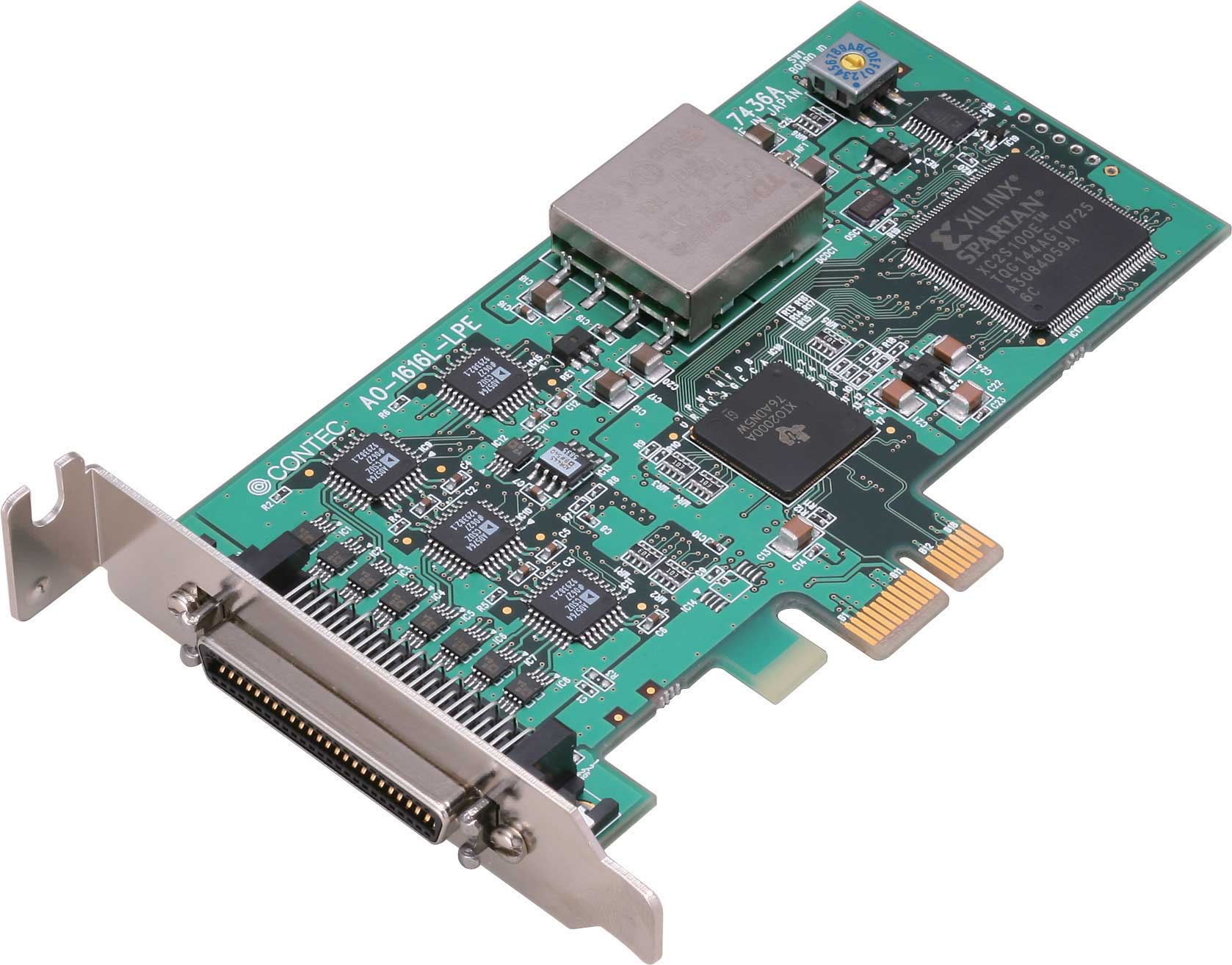
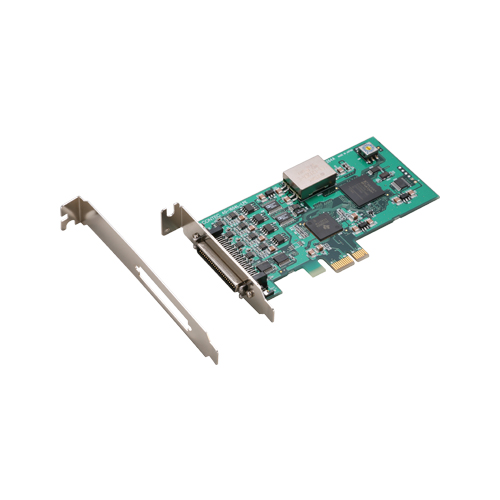
AO-1608L-LPE
PCIe Low Profile DA 100kS/s 16 Bit 8 CH + 4*DI + 4*DO + Cou
530,00 EUR
including VAT 630.70 EUR
- Eight 16‑bit Analog Outputs: Unisolated bipolar ±10 V range with ≤ 1 Ω output impedance and ±3 mA maximum drive current per channel.
- High Speed Conversion: 10 µs conversion time (100 kS/s aggregate) for precise waveform generation and control applications.
- Integrated 1 k‑word Buffer Memory: Configurable as FIFO or RING for continuous or repetitive output without CPU intervention.
- Flexible Trigger and Clock Control: Start/stop sampling via software command or external LVTTL trigger; internal or external clock selectable.
- Digital I/O and Counter: 4 × LVTTL inputs and 4 × LVTTL outputs (positive logic) plus one 32‑bit up‑counter with 10 MHz max response frequency.
- Digital Filter Function: 1 µs software‑selectable filter to suppress chattering and noise on external trigger, clock, and I/O signals.
- Safe Power‑On Design: All analog outputs forced to 0 V at power‑up to protect connected equipment.
- Software Calibration: Full software‑based gain/offset adjustment with user‑storable calibration data.
- Driver and Library Support: API‑PAC(W32) for Windows and Linux (API‑AIO WDM/LNX), plus free ML‑DAQ (MATLAB) and VI‑DAQ (LabVIEW) libraries.
- Compatibility: Connector and function compatible with legacy PCI board DA16‑8(LPCI)L for easy system migration.
- Dual Bracket Support: Includes both low‑profile and standard PCI brackets for installation flexibility.
- RoHS and VCCI Compliant.
- High Speed Conversion: 10 µs conversion time (100 kS/s aggregate) for precise waveform generation and control applications.
- Integrated 1 k‑word Buffer Memory: Configurable as FIFO or RING for continuous or repetitive output without CPU intervention.
- Flexible Trigger and Clock Control: Start/stop sampling via software command or external LVTTL trigger; internal or external clock selectable.
- Digital I/O and Counter: 4 × LVTTL inputs and 4 × LVTTL outputs (positive logic) plus one 32‑bit up‑counter with 10 MHz max response frequency.
- Digital Filter Function: 1 µs software‑selectable filter to suppress chattering and noise on external trigger, clock, and I/O signals.
- Safe Power‑On Design: All analog outputs forced to 0 V at power‑up to protect connected equipment.
- Software Calibration: Full software‑based gain/offset adjustment with user‑storable calibration data.
- Driver and Library Support: API‑PAC(W32) for Windows and Linux (API‑AIO WDM/LNX), plus free ML‑DAQ (MATLAB) and VI‑DAQ (LabVIEW) libraries.
- Compatibility: Connector and function compatible with legacy PCI board DA16‑8(LPCI)L for easy system migration.
- Dual Bracket Support: Includes both low‑profile and standard PCI brackets for installation flexibility.
- RoHS and VCCI Compliant.
Comprehensive Product Summary – AO‑1608L‑LPE PCI Express Low‑Profile Analog Output Board
*(Approx. 12 000 characters / ~3000 tokens)*
### 1. Product Overview
Product Name: AO‑1608L‑LPE
Article Number: AO‑1608L‑LPE
Series: AO‑16 L‑LPE Series (PCI Express Low Profile Analog Output Boards)
Manufacturer: CONTEC CO., LTD., Osaka Japan
Version: Ver. 1.02 (Rev. 1.00er.1)
The AO‑1608L‑LPE is a low‑profile PCI Express bus‑compliant multifunction analog output interface board for PC‑based data‑acquisition and control systems. It provides eight high‑precision 16‑bit analog output channels with a maximum conversion rate of 100 k samples per second (10 µs per channel), plus four LVTTL digital inputs, four LVTTL digital outputs, and one 32‑bit counter channel. The board is supplied with Windows and Linux drivers and supports MATLAB and LabVIEW through dedicated libraries. It is mechanically compatible with both low‑profile and standard PCI slots via interchangeable brackets.
### 2. Key Features
- Eight 16‑bit Analog Outputs: Unisolated bipolar ±10 V range with ≤ 1 Ω output impedance and ±3 mA maximum drive current per channel.
- High Speed Conversion: 10 µs conversion time (100 kS/s aggregate) for precise waveform generation and control applications.
- Integrated 1 k‑word Buffer Memory: Configurable as FIFO or RING for continuous or repetitive output without CPU intervention.
- Flexible Trigger and Clock Control: Start/stop sampling via software command or external LVTTL trigger; internal or external clock selectable.
- Digital I/O and Counter: 4 × LVTTL inputs and 4 × LVTTL outputs (positive logic) plus one 32‑bit up‑counter with 10 MHz max response frequency.
- Digital Filter Function: 1 µs software‑selectable filter to suppress chattering and noise on external trigger, clock, and I/O signals.
- Safe Power‑On Design: All analog outputs forced to 0 V at power‑up to protect connected equipment.
- Software Calibration: Full software‑based gain/offset adjustment with user‑storable calibration data.
- Driver and Library Support: API‑PAC(W32) for Windows and Linux (API‑AIO WDM/LNX), plus free ML‑DAQ (MATLAB) and VI‑DAQ (LabVIEW) libraries.
- Compatibility: Connector and function compatible with legacy PCI board DA16‑8(LPCI)L for easy system migration.
- Dual Bracket Support: Includes both low‑profile and standard PCI brackets for installation flexibility.
- RoHS and VCCI Compliant.
### 3. Technical Specifications
| Parameter | Specification |
|----------------|------------------|
| Bus Interface | PCI Express Base Specification Rev. 1.0a ×1 lane |
| Analog Outputs | 8 channels, unisolated, bipolar ±10 V |
| Resolution | 16 bits (1 LSB ≈ 0.305 mV at ±10 V range) |
| Conversion Speed | 10 µs per channel (100 kS/s max) |
| Output Impedance | ≤ 1 Ω |
| Max Output Current | ±3 mA per channel |
| Non‑linearity Error | ±5 LSB (≈ 0.1 % FS at 0–50 °C) |
| Buffer Memory | 1 k word (FIFO or RING mode) |
| Trigger Control | Start/stop by software or external LVTTL trigger (rising/falling edge selectable) |
| External Clock | LVTTL level input (rising/falling edge selectable) |
| Digital I/O | 4 inputs + 4 outputs, LVTTL positive logic, unisolated |
| Counter | 1 channel, 32‑bit up‑counter, LVTTL inputs (Gate/Up), LVTTL output (count match pulse), 10 MHz max |
| Connector | 50‑pin mini‑ribbon (3M 10250‑52A2JL) |
| Power Consumption | +3.3 V DC 300 mA max, +12 V DC 300 mA max |
| Operating Temperature | 0 – 50 °C |
| Operating Humidity | 10 – 90 % RH (non‑condensing) |
| Dimensions (L × H) | 121.69 mm × 67.90 mm (low‑profile PCB) |
| Weight | Approx. 70 g |
| Certifications | RoHS, VCCI Class A |
### 4. Functionality and Applications
Operating Principle:
The AO‑1608L‑LPE converts digital data from the host PC into analog voltages through eight 16‑bit DAC channels. Each channel can output a bipolar ±10 V signal with high accuracy and low output impedance. Sampling is controlled by software commands or external triggers and clocks. The on‑board 1 k‑word buffer supports continuous streaming (FIFO) or cyclic waveform generation (RING). Digital I/O lines allow synchronous control or status monitoring, while the counter channel enables event counting or frequency measurement up to 10 MHz.
Typical Use Cases:
- Waveform generation and signal simulation for test benches.
- Closed‑loop control systems requiring precise analog actuation.
- Automated measurement and data‑acquisition systems.
- Hardware‑in‑the‑loop simulation and process control.
- Integration with MATLAB or LabVIEW for scientific and engineering applications.
Compatibility:
Fully supported under Windows (through API‑AIO WDM) and Linux (API‑AIO LNX). MATLAB ML‑DAQ and LabVIEW VI‑DAQ libraries enable direct use within those environments. Connector and pin assignments are identical to the legacy PCI DA16‑8(LPCI)L board, simplifying system upgrades.
### 5. Components and Accessories
Included Items (Packing List):
- AO‑1608L‑LPE board × 1
- Low‑profile bracket (pre‑installed) and standard bracket × 1
- API‑PAC(W32) driver disk (Windows and Linux drivers, user guide)
- First Step Guide and User Documentation
- Product Registration Card and Warranty Certificate
- Serial number label
Optional Cables:
- PCB50PS‑0.5P (0.5 m) – Shielded 50‑pin mini‑ribbon both ends
- PCB50PS‑1.5P (1.5 m) – Shielded 50‑pin mini‑ribbon both ends
- PCA50PS‑0.5P (0.5 m) – Shielded 50‑pin mini‑ribbon one end
- PCA50PS‑1.5P (1.5 m) – Shielded 50‑pin mini‑ribbon one end
Optional Terminal Unit:
- EPD‑50A (M3 × 50 P screw terminal block, spring‑up type) – requires PCB50PS cable.
Connector Details:
- Interface connector CN1 = 3M 10250‑52A2JL (compatible with 3M 10150‑6000EL).
- 50‑pin mini‑ribbon pinout includes AO0–AO7, AGND, digital I/O, counter I/O, and trigger/clock signals.
### 6. Installation and Setup
Hardware Preparation:
1. Power off the PC and remove the cover.
2. If using a standard PCI slot, replace the low‑profile bracket with the supplied standard bracket.
3. Set the Board ID (SW1 rotary switch) to a unique value (0–Fh) if multiple boards are installed.
4. Insert the board into a PCI Express ×1 slot and secure it with a screw.
5. Reconnect power and boot the system.
Software Installation:
- Install the API‑PAC(W32) driver package before inserting the board.
- Windows automatically detects the device and loads the API‑AIO(WDM) driver.
- Linux users compile and install API‑AIO(LNX) from the provided source (tar package).
- Device naming and diagnostic utilities are available through the driver suite.
Verification:
Use the included diagnostic program to test analog output, digital I/O, and counter functions. A diagnosis report can be generated listing device settings and status.
### 7. Performance and Capabilities
Analog Output Performance:
- 16‑bit resolution provides 65 536 discrete steps over a ±10 V range (≈ 0.305 mV per LSB).
- Settling time ≈ 10 µs; typical update rate 100 kS/s.
- Output buffer supports continuous streaming (FIFO) or cyclic waveform (RING).
- Software or external trigger control enables precise timing synchronization.
- Digital filter (1 µs) reduces false triggering from noise.
Digital I/O Performance:
- LVTTL logic levels (0–3.3 V), positive logic.
- Input impedance ≈ 10 kΩ pull‑up; output sink current 8 mA max.
- Suitable for status monitoring and simple control signals.
Counter Performance:
- 32‑bit up‑counter (0 to FFFFFFFFh).
- External Gate and Up inputs (LVTTL), Count Match pulse output.
- Maximum count frequency 10 MHz.
- Digital filter (1 µs) available on inputs.
Timing Characteristics:
- External sampling clock delay tDEC = 100 ns.
- Settling time tWS = 10 000 ns.
- Trigger setup/hold times ≈ 100 ns.
- Counter input setup/hold 100 ns; output pulse width 1 µs.
Limitations:
- Analog outputs are unisolated; analog and digital grounds must remain separate to avoid noise coupling.
- Maximum output current ±3 mA; do not short outputs to ground or other channels.
- Operating environment limited to 0–50 °C and 10–90 % RH (non‑condensing).
### 8. Standards and Compliance
- Bus Standard: PCI Express Base Specification Rev. 1.0a ×1.
- Electrical Levels: LVTTL (3.3 V logic).
- Environmental Compliance: RoHS Directive compliant.
- EMC Compliance: VCCI Class A (when used with shielded cables).
- Safety Design: Outputs forced to 0 V at power‑on; digital filter for noise immunity.
- Calibration and Traceability: Factory‑calibrated; user software calibration supported.
### 9. Additional Information
Software Support and Development Tools:
- API‑AIO(WDM) (Windows): Win32 DLL library with Visual Basic / C++ samples and diagnostic utilities.
- API‑AIO(LNX) (Linux): Kernel module and shared library with gcc sample programs.
- ML‑DAQ (MATLAB): Interface to MATLAB Data Acquisition Toolbox for direct use of CONTEC devices.
- VI‑DAQ (LabVIEW): VI library compatible with NI DAQ VIs for simplified integration.
All libraries and updates are available free from [https://www.contec.com](https://www.contec.com).
Maintenance and Calibration:
- Analog outputs can be re‑calibrated via software using a high‑precision digital multimeter (≥ 5 digits).
- Factory calibration data can be restored at any time.
- Periodic inspection recommended to ensure clean connectors and secure mounting.
Warranty and Service:
- Limited three‑year warranty against defects in materials and workmanship.
- Repairs performed free of charge when returned freight‑prepaid with proof of purchase and RMA authorization.
- Warranty excludes damage from misuse, modification, or abuse.
- Technical support and driver updates available via CONTEC website.
Environmental and Handling Precautions:
- Operate in non‑corrosive, dust‑free environment within specified temperature and humidity range.
- Avoid static discharge and mechanical shock; handle by edges only.
- Use shielded cables to maintain EMC compliance.
- Dispose of the board according to local electronic waste regulations.
Migration and Compatibility Notes:
The AO‑1608L‑LPE is a PCI Express successor to the DA16‑8(LPCI)L PCI board. It retains identical connector pinouts and software functionality while reducing power consumption (+3.3 V 300 mA vs +5 V 850 mA) and supporting modern PCIe systems. External signal levels are LVTTL instead of TTL.
### Summary
The CONTEC AO‑1608L‑LPE is a compact, high‑precision PCI Express analog output solution designed for engineers and researchers requiring reliable multi‑channel voltage generation and digital control within PC‑based systems. Its combination of eight 16‑bit outputs, programmable triggering, digital I/O, and counter functions makes it ideal for test automation, signal simulation, and process control applications. With comprehensive driver support for Windows, Linux, MATLAB, and LabVIEW, and a three‑year manufacturer warranty, the AO‑1608L‑LPE offers a robust and future‑proof platform for data acquisition and control in modern PCI Express environments.
*(Approx. 12 000 characters / ~3000 tokens)*
### 1. Product Overview
Product Name: AO‑1608L‑LPE
Article Number: AO‑1608L‑LPE
Series: AO‑16 L‑LPE Series (PCI Express Low Profile Analog Output Boards)
Manufacturer: CONTEC CO., LTD., Osaka Japan
Version: Ver. 1.02 (Rev. 1.00er.1)
The AO‑1608L‑LPE is a low‑profile PCI Express bus‑compliant multifunction analog output interface board for PC‑based data‑acquisition and control systems. It provides eight high‑precision 16‑bit analog output channels with a maximum conversion rate of 100 k samples per second (10 µs per channel), plus four LVTTL digital inputs, four LVTTL digital outputs, and one 32‑bit counter channel. The board is supplied with Windows and Linux drivers and supports MATLAB and LabVIEW through dedicated libraries. It is mechanically compatible with both low‑profile and standard PCI slots via interchangeable brackets.
### 2. Key Features
- Eight 16‑bit Analog Outputs: Unisolated bipolar ±10 V range with ≤ 1 Ω output impedance and ±3 mA maximum drive current per channel.
- High Speed Conversion: 10 µs conversion time (100 kS/s aggregate) for precise waveform generation and control applications.
- Integrated 1 k‑word Buffer Memory: Configurable as FIFO or RING for continuous or repetitive output without CPU intervention.
- Flexible Trigger and Clock Control: Start/stop sampling via software command or external LVTTL trigger; internal or external clock selectable.
- Digital I/O and Counter: 4 × LVTTL inputs and 4 × LVTTL outputs (positive logic) plus one 32‑bit up‑counter with 10 MHz max response frequency.
- Digital Filter Function: 1 µs software‑selectable filter to suppress chattering and noise on external trigger, clock, and I/O signals.
- Safe Power‑On Design: All analog outputs forced to 0 V at power‑up to protect connected equipment.
- Software Calibration: Full software‑based gain/offset adjustment with user‑storable calibration data.
- Driver and Library Support: API‑PAC(W32) for Windows and Linux (API‑AIO WDM/LNX), plus free ML‑DAQ (MATLAB) and VI‑DAQ (LabVIEW) libraries.
- Compatibility: Connector and function compatible with legacy PCI board DA16‑8(LPCI)L for easy system migration.
- Dual Bracket Support: Includes both low‑profile and standard PCI brackets for installation flexibility.
- RoHS and VCCI Compliant.
### 3. Technical Specifications
| Parameter | Specification |
|----------------|------------------|
| Bus Interface | PCI Express Base Specification Rev. 1.0a ×1 lane |
| Analog Outputs | 8 channels, unisolated, bipolar ±10 V |
| Resolution | 16 bits (1 LSB ≈ 0.305 mV at ±10 V range) |
| Conversion Speed | 10 µs per channel (100 kS/s max) |
| Output Impedance | ≤ 1 Ω |
| Max Output Current | ±3 mA per channel |
| Non‑linearity Error | ±5 LSB (≈ 0.1 % FS at 0–50 °C) |
| Buffer Memory | 1 k word (FIFO or RING mode) |
| Trigger Control | Start/stop by software or external LVTTL trigger (rising/falling edge selectable) |
| External Clock | LVTTL level input (rising/falling edge selectable) |
| Digital I/O | 4 inputs + 4 outputs, LVTTL positive logic, unisolated |
| Counter | 1 channel, 32‑bit up‑counter, LVTTL inputs (Gate/Up), LVTTL output (count match pulse), 10 MHz max |
| Connector | 50‑pin mini‑ribbon (3M 10250‑52A2JL) |
| Power Consumption | +3.3 V DC 300 mA max, +12 V DC 300 mA max |
| Operating Temperature | 0 – 50 °C |
| Operating Humidity | 10 – 90 % RH (non‑condensing) |
| Dimensions (L × H) | 121.69 mm × 67.90 mm (low‑profile PCB) |
| Weight | Approx. 70 g |
| Certifications | RoHS, VCCI Class A |
### 4. Functionality and Applications
Operating Principle:
The AO‑1608L‑LPE converts digital data from the host PC into analog voltages through eight 16‑bit DAC channels. Each channel can output a bipolar ±10 V signal with high accuracy and low output impedance. Sampling is controlled by software commands or external triggers and clocks. The on‑board 1 k‑word buffer supports continuous streaming (FIFO) or cyclic waveform generation (RING). Digital I/O lines allow synchronous control or status monitoring, while the counter channel enables event counting or frequency measurement up to 10 MHz.
Typical Use Cases:
- Waveform generation and signal simulation for test benches.
- Closed‑loop control systems requiring precise analog actuation.
- Automated measurement and data‑acquisition systems.
- Hardware‑in‑the‑loop simulation and process control.
- Integration with MATLAB or LabVIEW for scientific and engineering applications.
Compatibility:
Fully supported under Windows (through API‑AIO WDM) and Linux (API‑AIO LNX). MATLAB ML‑DAQ and LabVIEW VI‑DAQ libraries enable direct use within those environments. Connector and pin assignments are identical to the legacy PCI DA16‑8(LPCI)L board, simplifying system upgrades.
### 5. Components and Accessories
Included Items (Packing List):
- AO‑1608L‑LPE board × 1
- Low‑profile bracket (pre‑installed) and standard bracket × 1
- API‑PAC(W32) driver disk (Windows and Linux drivers, user guide)
- First Step Guide and User Documentation
- Product Registration Card and Warranty Certificate
- Serial number label
Optional Cables:
- PCB50PS‑0.5P (0.5 m) – Shielded 50‑pin mini‑ribbon both ends
- PCB50PS‑1.5P (1.5 m) – Shielded 50‑pin mini‑ribbon both ends
- PCA50PS‑0.5P (0.5 m) – Shielded 50‑pin mini‑ribbon one end
- PCA50PS‑1.5P (1.5 m) – Shielded 50‑pin mini‑ribbon one end
Optional Terminal Unit:
- EPD‑50A (M3 × 50 P screw terminal block, spring‑up type) – requires PCB50PS cable.
Connector Details:
- Interface connector CN1 = 3M 10250‑52A2JL (compatible with 3M 10150‑6000EL).
- 50‑pin mini‑ribbon pinout includes AO0–AO7, AGND, digital I/O, counter I/O, and trigger/clock signals.
### 6. Installation and Setup
Hardware Preparation:
1. Power off the PC and remove the cover.
2. If using a standard PCI slot, replace the low‑profile bracket with the supplied standard bracket.
3. Set the Board ID (SW1 rotary switch) to a unique value (0–Fh) if multiple boards are installed.
4. Insert the board into a PCI Express ×1 slot and secure it with a screw.
5. Reconnect power and boot the system.
Software Installation:
- Install the API‑PAC(W32) driver package before inserting the board.
- Windows automatically detects the device and loads the API‑AIO(WDM) driver.
- Linux users compile and install API‑AIO(LNX) from the provided source (tar package).
- Device naming and diagnostic utilities are available through the driver suite.
Verification:
Use the included diagnostic program to test analog output, digital I/O, and counter functions. A diagnosis report can be generated listing device settings and status.
### 7. Performance and Capabilities
Analog Output Performance:
- 16‑bit resolution provides 65 536 discrete steps over a ±10 V range (≈ 0.305 mV per LSB).
- Settling time ≈ 10 µs; typical update rate 100 kS/s.
- Output buffer supports continuous streaming (FIFO) or cyclic waveform (RING).
- Software or external trigger control enables precise timing synchronization.
- Digital filter (1 µs) reduces false triggering from noise.
Digital I/O Performance:
- LVTTL logic levels (0–3.3 V), positive logic.
- Input impedance ≈ 10 kΩ pull‑up; output sink current 8 mA max.
- Suitable for status monitoring and simple control signals.
Counter Performance:
- 32‑bit up‑counter (0 to FFFFFFFFh).
- External Gate and Up inputs (LVTTL), Count Match pulse output.
- Maximum count frequency 10 MHz.
- Digital filter (1 µs) available on inputs.
Timing Characteristics:
- External sampling clock delay tDEC = 100 ns.
- Settling time tWS = 10 000 ns.
- Trigger setup/hold times ≈ 100 ns.
- Counter input setup/hold 100 ns; output pulse width 1 µs.
Limitations:
- Analog outputs are unisolated; analog and digital grounds must remain separate to avoid noise coupling.
- Maximum output current ±3 mA; do not short outputs to ground or other channels.
- Operating environment limited to 0–50 °C and 10–90 % RH (non‑condensing).
### 8. Standards and Compliance
- Bus Standard: PCI Express Base Specification Rev. 1.0a ×1.
- Electrical Levels: LVTTL (3.3 V logic).
- Environmental Compliance: RoHS Directive compliant.
- EMC Compliance: VCCI Class A (when used with shielded cables).
- Safety Design: Outputs forced to 0 V at power‑on; digital filter for noise immunity.
- Calibration and Traceability: Factory‑calibrated; user software calibration supported.
### 9. Additional Information
Software Support and Development Tools:
- API‑AIO(WDM) (Windows): Win32 DLL library with Visual Basic / C++ samples and diagnostic utilities.
- API‑AIO(LNX) (Linux): Kernel module and shared library with gcc sample programs.
- ML‑DAQ (MATLAB): Interface to MATLAB Data Acquisition Toolbox for direct use of CONTEC devices.
- VI‑DAQ (LabVIEW): VI library compatible with NI DAQ VIs for simplified integration.
All libraries and updates are available free from [https://www.contec.com](https://www.contec.com).
Maintenance and Calibration:
- Analog outputs can be re‑calibrated via software using a high‑precision digital multimeter (≥ 5 digits).
- Factory calibration data can be restored at any time.
- Periodic inspection recommended to ensure clean connectors and secure mounting.
Warranty and Service:
- Limited three‑year warranty against defects in materials and workmanship.
- Repairs performed free of charge when returned freight‑prepaid with proof of purchase and RMA authorization.
- Warranty excludes damage from misuse, modification, or abuse.
- Technical support and driver updates available via CONTEC website.
Environmental and Handling Precautions:
- Operate in non‑corrosive, dust‑free environment within specified temperature and humidity range.
- Avoid static discharge and mechanical shock; handle by edges only.
- Use shielded cables to maintain EMC compliance.
- Dispose of the board according to local electronic waste regulations.
Migration and Compatibility Notes:
The AO‑1608L‑LPE is a PCI Express successor to the DA16‑8(LPCI)L PCI board. It retains identical connector pinouts and software functionality while reducing power consumption (+3.3 V 300 mA vs +5 V 850 mA) and supporting modern PCIe systems. External signal levels are LVTTL instead of TTL.
### Summary
The CONTEC AO‑1608L‑LPE is a compact, high‑precision PCI Express analog output solution designed for engineers and researchers requiring reliable multi‑channel voltage generation and digital control within PC‑based systems. Its combination of eight 16‑bit outputs, programmable triggering, digital I/O, and counter functions makes it ideal for test automation, signal simulation, and process control applications. With comprehensive driver support for Windows, Linux, MATLAB, and LabVIEW, and a three‑year manufacturer warranty, the AO‑1608L‑LPE offers a robust and future‑proof platform for data acquisition and control in modern PCI Express environments.
-
 ds_ao1608llpe_en.pdf
PDF Catalog
ds_ao1608llpe_en.pdf
PDF Catalog

No accessories available.