
 LOOKING FOR THE RIGHT
INDUSTRIAL SOLUTION?
Discover embedded, communication and automation solutions tailored to your application.
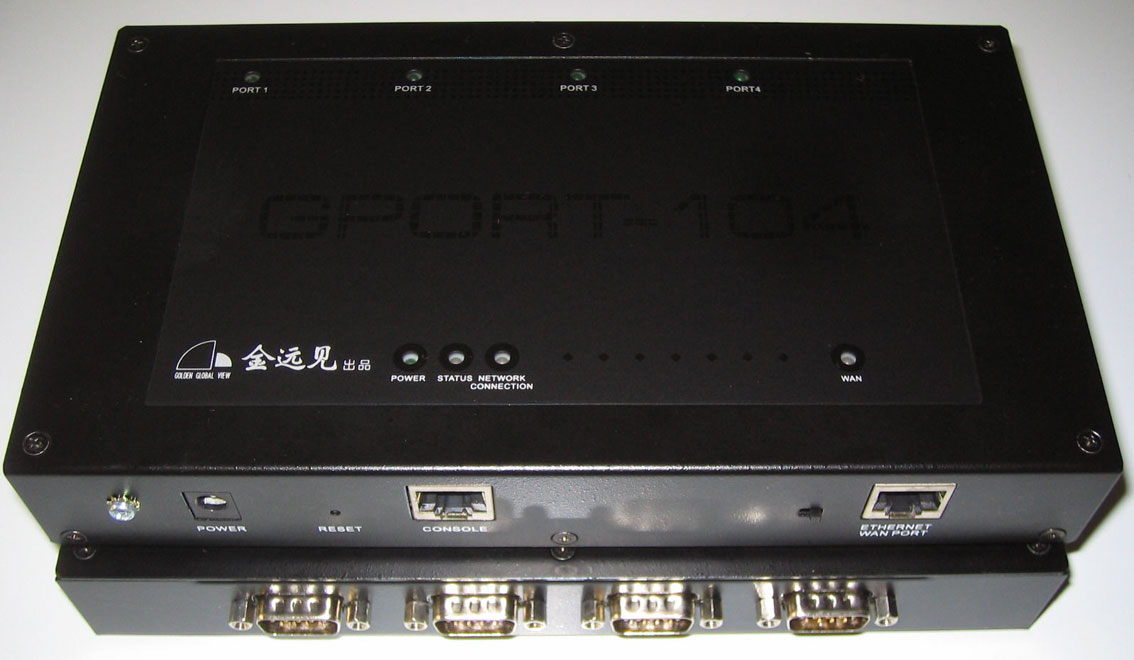
GPort104
IP Server 4*RS232 (SDK LINUX available)
140,00 EUR
including VAT 166.60 EUR
- Multi-Port Serial Networking:
Four independent RS-232 serial ports (DB9 male connectors) supporting up to 230,400 bps per port.
- Embedded Linux System:
Built on a stable Linux kernel, allowing flexible configuration, remote management, and SDK-based customization.
- High-Performance CPU:
32-bit 100 MHz MIPS RISC processor ensures efficient data handling and low latency communication.
- Network Connectivity:
Auto-detecting 10/100 Mbps Ethernet interface (100Base-T, RJ45 connector). Optional dual Ethernet configuration available.
- Cross-Platform Compatibility:
Supports Windows (NT/2000/XP/2003/Vista) via virtual COM drivers, and UNIX/Linux systems via real TTY or raw TTY drivers.
- Multiple Communication Modes:
- TCP Server Mode: Accepts incoming socket or Telnet connections.
- TCP Client Mode: Initiates connections to designated servers.
- UDP Send/Receive Mode: Supports up to four destination hosts for broadcast or multi-host communication.
- Real TTY (COM/Gvmodem) Modes: Provides fixed or virtual serial port mapping for UNIX/Linux/Windows systems.
- Flexible Configuration Interfaces:
Web-based GUI, Telnet interface, and console terminal setup (RJ45 console port, 115200 bps).
- Security and Reliability:
- Surge protection (15 kV ESD) on all serial ports.
- Watchdog timer for system stability.
- Password-protected configuration access.
- Software Development Kit (SDK):
Enables users to develop and deploy custom Linux applications directly on the GPort104 hardware platform.
- Firmware Upgrade Support:
TFTP-based firmware upgrade via console and Ethernet interface.
- Compact and Durable Design:
Industrial-grade construction with small footprint (210 × 120 × 30 mm).
Four independent RS-232 serial ports (DB9 male connectors) supporting up to 230,400 bps per port.
- Embedded Linux System:
Built on a stable Linux kernel, allowing flexible configuration, remote management, and SDK-based customization.
- High-Performance CPU:
32-bit 100 MHz MIPS RISC processor ensures efficient data handling and low latency communication.
- Network Connectivity:
Auto-detecting 10/100 Mbps Ethernet interface (100Base-T, RJ45 connector). Optional dual Ethernet configuration available.
- Cross-Platform Compatibility:
Supports Windows (NT/2000/XP/2003/Vista) via virtual COM drivers, and UNIX/Linux systems via real TTY or raw TTY drivers.
- Multiple Communication Modes:
- TCP Server Mode: Accepts incoming socket or Telnet connections.
- TCP Client Mode: Initiates connections to designated servers.
- UDP Send/Receive Mode: Supports up to four destination hosts for broadcast or multi-host communication.
- Real TTY (COM/Gvmodem) Modes: Provides fixed or virtual serial port mapping for UNIX/Linux/Windows systems.
- Flexible Configuration Interfaces:
Web-based GUI, Telnet interface, and console terminal setup (RJ45 console port, 115200 bps).
- Security and Reliability:
- Surge protection (15 kV ESD) on all serial ports.
- Watchdog timer for system stability.
- Password-protected configuration access.
- Software Development Kit (SDK):
Enables users to develop and deploy custom Linux applications directly on the GPort104 hardware platform.
- Firmware Upgrade Support:
TFTP-based firmware upgrade via console and Ethernet interface.
- Compact and Durable Design:
Industrial-grade construction with small footprint (210 × 120 × 30 mm).
Comprehensive Product Summary – GPort104 IP Serial Device Server
### 1. Product Overview
Product Name: GPort104
Model: GPORT104
Series: GPort Serial Router Series (GPort104 / GPort108 / GPort116)
Article Number: GPort104
Manufacturer: RAYON Technology Co., Ltd. (Taiwan)
Distributor / Partner: Beijing Golden Global View Co., Ltd.
Version: V1.01
The GPort104 is a compact, Linux-based IP serial device server designed to connect up to four RS-232 serial devices to an Ethernet network. It enables remote access, control, and data communication over TCP/IP or UDP/IP networks. The device integrates a 32-bit 100 MHz MIPS CPU, 8 MB Flash ROM, and 16 MB SDRAM, providing a stable embedded Linux environment with SDK support for custom application development.
### 2. Key Features
- Multi-Port Serial Networking:
Four independent RS-232 serial ports (DB9 male connectors) supporting up to 230,400 bps per port.
- Embedded Linux System:
Built on a stable Linux kernel, allowing flexible configuration, remote management, and SDK-based customization.
- High-Performance CPU:
32-bit 100 MHz MIPS RISC processor ensures efficient data handling and low latency communication.
- Network Connectivity:
Auto-detecting 10/100 Mbps Ethernet interface (100Base-T, RJ45 connector). Optional dual Ethernet configuration available.
- Cross-Platform Compatibility:
Supports Windows (NT/2000/XP/2003/Vista) via virtual COM drivers, and UNIX/Linux systems via real TTY or raw TTY drivers.
- Multiple Communication Modes:
- TCP Server Mode: Accepts incoming socket or Telnet connections.
- TCP Client Mode: Initiates connections to designated servers.
- UDP Send/Receive Mode: Supports up to four destination hosts for broadcast or multi-host communication.
- Real TTY (COM/Gvmodem) Modes: Provides fixed or virtual serial port mapping for UNIX/Linux/Windows systems.
- Flexible Configuration Interfaces:
Web-based GUI, Telnet interface, and console terminal setup (RJ45 console port, 115200 bps).
- Security and Reliability:
- Surge protection (15 kV ESD) on all serial ports.
- Watchdog timer for system stability.
- Password-protected configuration access.
- Software Development Kit (SDK):
Enables users to develop and deploy custom Linux applications directly on the GPort104 hardware platform.
- Firmware Upgrade Support:
TFTP-based firmware upgrade via console and Ethernet interface.
- Compact and Durable Design:
Industrial-grade construction with small footprint (210 × 120 × 30 mm).
### 3. Technical Specifications
Hardware Specifications:
- CPU: 32-bit MIPS RISC, 100 MHz
- Flash Memory: 8 MB
- SDRAM: 16 MB
- Operating System: Embedded Linux
- Serial Ports: 4 × RS-232 (DB9 male connectors)
- Baud rate: up to 230,400 bps
- Signal lines: DCD, RXD, TXD, DTR, GND, DSR, RTS, CTS, RI
- ESD protection: 15 kV
- Console Port: 1 × RS-232 (RJ45 connector, 115200 bps, N81)
- Ethernet Port: 1 × 10/100 Mbps (RJ45, auto MDI/MDIX)
- Power Supply: 9 VDC @ 1000 mA (external adapter)
- Dimensions: 210 mm (W) × 120 mm (D) × 30 mm (H)
- Weight: Approx. 0.5 kg
- Material: Industrial-grade Rayon composite enclosure
Environmental Conditions:
- Operating temperature: 5°C to 40°C
- Storage temperature: 0°C to 65°C
- Operating humidity: 10%–90% RH (non-condensing)
- Storage humidity: 5%–90% RH
### 4. Functionality
The GPort104 functions as a serial-to-Ethernet communication server, bridging traditional RS-232 devices with modern IP networks. Each serial port can be configured independently for different communication modes, allowing simultaneous multi-protocol operation.
Supported Operating Modes:
1. Real TTY (COM) Mode:
Maps GPort serial ports as standard COM ports in Windows or TTY devices in SCO UNIX.
2. Real TTY (Gvmodem) Mode:
Creates fixed virtual terminal ports (ttyp?) in UNIX/Linux systems.
3. TCP Server Mode:
Listens for incoming TCP connections on assigned port numbers.
4. TCP Client Mode:
Initiates outbound TCP connections to specified IP and port.
5. UDP Send/Receive Mode:
Enables broadcast or multi-host communication (up to four destinations).
Use Cases and Applications:
- Industrial automation and control systems (PLC, sensors, data loggers).
- Remote console management for routers, switches, and UPS systems.
- Serial device networking and data acquisition.
- Transparent serial-to-serial communication over IP networks.
- Custom embedded Linux applications for protocol conversion or data processing.
Compatibility:
- Windows: NT, 2000, XP, 2003, Vista (Virtual COM driver).
- UNIX/Linux: SCO OpenServer, HP/UX, AIX, DEC/UX (Real TTY and Gvmodem drivers).
- Network Protocols: TCP/IP, UDP/IP, DHCP, Telnet, HTTP, TFTP.
### 5. Components & Accessories
Included Items:
- GPort104 main unit
- 9 VDC power adapter
- GPort500 RJ45-to-DB9 female console cable
- User manual and software CD (drivers, SDK, utilities)
- Warranty card
Optional Accessories:
- GPort502 RJ45-to-DB25 male cable
- GPort503 RJ45-to-DB9 male cable
- Additional Ethernet interface (dual LAN option)
Connectors:
- Serial Ports: DB9 male (RS-232 standard pinout)
- Console Port: RJ45 (convertible to DB9F via GPort500 cable)
- Ethernet Port: RJ45 (10/100Base-T)
- Power Input: DC barrel jack (9 VDC)
### 6. Installation & Setup
Hardware Installation Steps:
1. Connect the power adapter to the GPort104 and verify the Power LED is on.
2. Connect the Ethernet port to a network switch or hub using a standard LAN cable.
3. Connect the console port (RJ45) to a terminal or PC using the provided cable.
- Default console settings: 115200 bps, 8 data bits, no parity, 1 stop bit.
4. Connect RS-232 devices to the DB9 serial ports.
5. Power on the device; status LEDs indicate LAN speed (green for 100 Mbps, orange for 10 Mbps).
Software Configuration:
- Access via Web browser (default IP: 192.168.1.254, password: 11111).
- Alternatively, configure via Telnet or console terminal.
- Set static or dynamic IP (DHCP) addressing.
- Configure each serial port’s mode, baud rate, parity, stop bits, and flow control.
- Save and restart to apply changes.
Driver Installation (Windows):
- Install virtual COM driver (APORTP.SYS, APORT_AP.EXE, etc.) from CD.
- Map GPort serial ports to COM1–COM64.
- Reboot system to activate new COM ports.
Driver Installation (UNIX/Linux):
- Extract and configure `gvmodem_linux.tar` or `rtty100.tar` packages.
- Define IP and port mappings in configuration files (`gtstcpd.cf`, `nasd.rc`).
- Start daemon processes (`gtstcpd.rc start`, `/etc/nasd.rc`).
### 7. Performance & Capabilities
- Serial Communication Speed: Up to 230,400 bps per port.
- Network Throughput: 10/100 Mbps auto-negotiation.
- Concurrent Connections: Up to four UDP destinations per port; multiple TCP sessions supported.
- Latency: Low-latency serial-to-IP conversion optimized by MIPS CPU.
- Reliability: Watchdog timer and ESD protection ensure continuous operation.
- Firmware Upgrade: TFTP-based, with console monitoring for progress.
- SDK Development Capacity:
- 3 MB available Flash ROM for user applications.
- 8 MB SDRAM for runtime processes.
Limitations:
- Only one firmware type (standard IP server or custom Linux application) can be active at a time.
- DHCP mode not recommended for static network environments due to dynamic IP assignment.
### 8. Standards & Compliance
- Communication Standards:
- RS-232 (EIA/TIA-232)
- IEEE 802.3 (10/100Base-T Ethernet)
- TCP/IP, UDP/IP, Telnet, HTTP, TFTP protocols
- Electrical & Safety:
- Surge protection: 15 kV ESD on all serial ports
- Power input: 9 VDC regulated adapter
- Software Standards:
- Linux kernel-based embedded OS
- SDK compliant with GNU cross-compilation tools (mipsel-linux-gcc)
- Regulatory Compliance:
- CE and FCC Class A (industrial environment)
- RoHS compliant materials
### 9. Additional Information
Warranty & Support:
- Warranty Period: 1 year limited warranty covering defects in materials and workmanship.
- Exclusions: Damage from misuse, unauthorized servicing, or electrical faults.
- Repair Policy:
- RMA (Return Material Authorization) required before return.
- Warranty repairs free of charge; out-of-warranty repairs at flat-rate cost.
- Technical Support:
- Email: [rayon@ms1.hinet.net](mailto:rayon@ms1.hinet.net)
- Website: [www.computex.com.tw/rayon](http://www.computex.com.tw/rayon)
Maintenance & Firmware Updates:
- Firmware upgrades via TFTP (IP 192.168.1.254, default mode).
- Console monitoring recommended during upgrade.
- SDK-based firmware customization supported (Private Key protection).
SDK Development Environment:
- Cross-compiler: `mipsel-linux-gcc` toolchain.
- Development host: Linux PC with `/usr/gv242` environment.
- Application integration via `/etc/inittab` or `/etc/init.d/rcS`.
- Supports FTP and NFS file transfer for application deployment.
Recovery & Reset:
- Factory reset via Web interface or hardware jumper (J3).
- Default credentials:
- IP: 192.168.1.254
- Password: 11111
Related Products:
- IP101: 1-port RS232/422/485 serial device server.
- GTS588: 8-port RS232 communication server.
- GTS586: 16-port RS232 communication server.
### Summary
The RAYON GPort104 is a robust, industrial-grade IP serial device server that bridges legacy RS-232 equipment with modern Ethernet networks. Its embedded Linux architecture, flexible configuration modes, and SDK support make it suitable for a wide range of industrial, commercial, and research applications. With comprehensive driver support across Windows and UNIX/Linux platforms, the GPort104 simplifies serial device networking, remote management, and system integration.
Its combination of high performance, cross-platform compatibility, and customization potential positions it as a versatile solution for serial communication over IP, console management, and embedded system development.
### 1. Product Overview
Product Name: GPort104
Model: GPORT104
Series: GPort Serial Router Series (GPort104 / GPort108 / GPort116)
Article Number: GPort104
Manufacturer: RAYON Technology Co., Ltd. (Taiwan)
Distributor / Partner: Beijing Golden Global View Co., Ltd.
Version: V1.01
The GPort104 is a compact, Linux-based IP serial device server designed to connect up to four RS-232 serial devices to an Ethernet network. It enables remote access, control, and data communication over TCP/IP or UDP/IP networks. The device integrates a 32-bit 100 MHz MIPS CPU, 8 MB Flash ROM, and 16 MB SDRAM, providing a stable embedded Linux environment with SDK support for custom application development.
### 2. Key Features
- Multi-Port Serial Networking:
Four independent RS-232 serial ports (DB9 male connectors) supporting up to 230,400 bps per port.
- Embedded Linux System:
Built on a stable Linux kernel, allowing flexible configuration, remote management, and SDK-based customization.
- High-Performance CPU:
32-bit 100 MHz MIPS RISC processor ensures efficient data handling and low latency communication.
- Network Connectivity:
Auto-detecting 10/100 Mbps Ethernet interface (100Base-T, RJ45 connector). Optional dual Ethernet configuration available.
- Cross-Platform Compatibility:
Supports Windows (NT/2000/XP/2003/Vista) via virtual COM drivers, and UNIX/Linux systems via real TTY or raw TTY drivers.
- Multiple Communication Modes:
- TCP Server Mode: Accepts incoming socket or Telnet connections.
- TCP Client Mode: Initiates connections to designated servers.
- UDP Send/Receive Mode: Supports up to four destination hosts for broadcast or multi-host communication.
- Real TTY (COM/Gvmodem) Modes: Provides fixed or virtual serial port mapping for UNIX/Linux/Windows systems.
- Flexible Configuration Interfaces:
Web-based GUI, Telnet interface, and console terminal setup (RJ45 console port, 115200 bps).
- Security and Reliability:
- Surge protection (15 kV ESD) on all serial ports.
- Watchdog timer for system stability.
- Password-protected configuration access.
- Software Development Kit (SDK):
Enables users to develop and deploy custom Linux applications directly on the GPort104 hardware platform.
- Firmware Upgrade Support:
TFTP-based firmware upgrade via console and Ethernet interface.
- Compact and Durable Design:
Industrial-grade construction with small footprint (210 × 120 × 30 mm).
### 3. Technical Specifications
Hardware Specifications:
- CPU: 32-bit MIPS RISC, 100 MHz
- Flash Memory: 8 MB
- SDRAM: 16 MB
- Operating System: Embedded Linux
- Serial Ports: 4 × RS-232 (DB9 male connectors)
- Baud rate: up to 230,400 bps
- Signal lines: DCD, RXD, TXD, DTR, GND, DSR, RTS, CTS, RI
- ESD protection: 15 kV
- Console Port: 1 × RS-232 (RJ45 connector, 115200 bps, N81)
- Ethernet Port: 1 × 10/100 Mbps (RJ45, auto MDI/MDIX)
- Power Supply: 9 VDC @ 1000 mA (external adapter)
- Dimensions: 210 mm (W) × 120 mm (D) × 30 mm (H)
- Weight: Approx. 0.5 kg
- Material: Industrial-grade Rayon composite enclosure
Environmental Conditions:
- Operating temperature: 5°C to 40°C
- Storage temperature: 0°C to 65°C
- Operating humidity: 10%–90% RH (non-condensing)
- Storage humidity: 5%–90% RH
### 4. Functionality
The GPort104 functions as a serial-to-Ethernet communication server, bridging traditional RS-232 devices with modern IP networks. Each serial port can be configured independently for different communication modes, allowing simultaneous multi-protocol operation.
Supported Operating Modes:
1. Real TTY (COM) Mode:
Maps GPort serial ports as standard COM ports in Windows or TTY devices in SCO UNIX.
2. Real TTY (Gvmodem) Mode:
Creates fixed virtual terminal ports (ttyp?) in UNIX/Linux systems.
3. TCP Server Mode:
Listens for incoming TCP connections on assigned port numbers.
4. TCP Client Mode:
Initiates outbound TCP connections to specified IP and port.
5. UDP Send/Receive Mode:
Enables broadcast or multi-host communication (up to four destinations).
Use Cases and Applications:
- Industrial automation and control systems (PLC, sensors, data loggers).
- Remote console management for routers, switches, and UPS systems.
- Serial device networking and data acquisition.
- Transparent serial-to-serial communication over IP networks.
- Custom embedded Linux applications for protocol conversion or data processing.
Compatibility:
- Windows: NT, 2000, XP, 2003, Vista (Virtual COM driver).
- UNIX/Linux: SCO OpenServer, HP/UX, AIX, DEC/UX (Real TTY and Gvmodem drivers).
- Network Protocols: TCP/IP, UDP/IP, DHCP, Telnet, HTTP, TFTP.
### 5. Components & Accessories
Included Items:
- GPort104 main unit
- 9 VDC power adapter
- GPort500 RJ45-to-DB9 female console cable
- User manual and software CD (drivers, SDK, utilities)
- Warranty card
Optional Accessories:
- GPort502 RJ45-to-DB25 male cable
- GPort503 RJ45-to-DB9 male cable
- Additional Ethernet interface (dual LAN option)
Connectors:
- Serial Ports: DB9 male (RS-232 standard pinout)
- Console Port: RJ45 (convertible to DB9F via GPort500 cable)
- Ethernet Port: RJ45 (10/100Base-T)
- Power Input: DC barrel jack (9 VDC)
### 6. Installation & Setup
Hardware Installation Steps:
1. Connect the power adapter to the GPort104 and verify the Power LED is on.
2. Connect the Ethernet port to a network switch or hub using a standard LAN cable.
3. Connect the console port (RJ45) to a terminal or PC using the provided cable.
- Default console settings: 115200 bps, 8 data bits, no parity, 1 stop bit.
4. Connect RS-232 devices to the DB9 serial ports.
5. Power on the device; status LEDs indicate LAN speed (green for 100 Mbps, orange for 10 Mbps).
Software Configuration:
- Access via Web browser (default IP: 192.168.1.254, password: 11111).
- Alternatively, configure via Telnet or console terminal.
- Set static or dynamic IP (DHCP) addressing.
- Configure each serial port’s mode, baud rate, parity, stop bits, and flow control.
- Save and restart to apply changes.
Driver Installation (Windows):
- Install virtual COM driver (APORTP.SYS, APORT_AP.EXE, etc.) from CD.
- Map GPort serial ports to COM1–COM64.
- Reboot system to activate new COM ports.
Driver Installation (UNIX/Linux):
- Extract and configure `gvmodem_linux.tar` or `rtty100.tar` packages.
- Define IP and port mappings in configuration files (`gtstcpd.cf`, `nasd.rc`).
- Start daemon processes (`gtstcpd.rc start`, `/etc/nasd.rc`).
### 7. Performance & Capabilities
- Serial Communication Speed: Up to 230,400 bps per port.
- Network Throughput: 10/100 Mbps auto-negotiation.
- Concurrent Connections: Up to four UDP destinations per port; multiple TCP sessions supported.
- Latency: Low-latency serial-to-IP conversion optimized by MIPS CPU.
- Reliability: Watchdog timer and ESD protection ensure continuous operation.
- Firmware Upgrade: TFTP-based, with console monitoring for progress.
- SDK Development Capacity:
- 3 MB available Flash ROM for user applications.
- 8 MB SDRAM for runtime processes.
Limitations:
- Only one firmware type (standard IP server or custom Linux application) can be active at a time.
- DHCP mode not recommended for static network environments due to dynamic IP assignment.
### 8. Standards & Compliance
- Communication Standards:
- RS-232 (EIA/TIA-232)
- IEEE 802.3 (10/100Base-T Ethernet)
- TCP/IP, UDP/IP, Telnet, HTTP, TFTP protocols
- Electrical & Safety:
- Surge protection: 15 kV ESD on all serial ports
- Power input: 9 VDC regulated adapter
- Software Standards:
- Linux kernel-based embedded OS
- SDK compliant with GNU cross-compilation tools (mipsel-linux-gcc)
- Regulatory Compliance:
- CE and FCC Class A (industrial environment)
- RoHS compliant materials
### 9. Additional Information
Warranty & Support:
- Warranty Period: 1 year limited warranty covering defects in materials and workmanship.
- Exclusions: Damage from misuse, unauthorized servicing, or electrical faults.
- Repair Policy:
- RMA (Return Material Authorization) required before return.
- Warranty repairs free of charge; out-of-warranty repairs at flat-rate cost.
- Technical Support:
- Email: [rayon@ms1.hinet.net](mailto:rayon@ms1.hinet.net)
- Website: [www.computex.com.tw/rayon](http://www.computex.com.tw/rayon)
Maintenance & Firmware Updates:
- Firmware upgrades via TFTP (IP 192.168.1.254, default mode).
- Console monitoring recommended during upgrade.
- SDK-based firmware customization supported (Private Key protection).
SDK Development Environment:
- Cross-compiler: `mipsel-linux-gcc` toolchain.
- Development host: Linux PC with `/usr/gv242` environment.
- Application integration via `/etc/inittab` or `/etc/init.d/rcS`.
- Supports FTP and NFS file transfer for application deployment.
Recovery & Reset:
- Factory reset via Web interface or hardware jumper (J3).
- Default credentials:
- IP: 192.168.1.254
- Password: 11111
Related Products:
- IP101: 1-port RS232/422/485 serial device server.
- GTS588: 8-port RS232 communication server.
- GTS586: 16-port RS232 communication server.
### Summary
The RAYON GPort104 is a robust, industrial-grade IP serial device server that bridges legacy RS-232 equipment with modern Ethernet networks. Its embedded Linux architecture, flexible configuration modes, and SDK support make it suitable for a wide range of industrial, commercial, and research applications. With comprehensive driver support across Windows and UNIX/Linux platforms, the GPort104 simplifies serial device networking, remote management, and system integration.
Its combination of high performance, cross-platform compatibility, and customization potential positions it as a versatile solution for serial communication over IP, console management, and embedded system development.
-
 GPORT104_2 Manual.pdf
Manual
GPORT104_2 Manual.pdf
Manual
-
 GPORT104.pdf
Manual
GPORT104.pdf
Manual

No accessories available.