DIN-50S-01
LOOKING FOR THE RIGHT
INDUSTRIAL SOLUTION?
Discover embedded, communication and automation solutions tailored to your application.
- Bus Interface: 32-bit 3.3 V/5 V PCI bus, fully compliant with PCI specification.
- Low-Profile Design: Compact PCB (120 mm × 65 mm) suitable for space-constrained systems.
- Relay Outputs: 8 channels of SPDT (Form C) relays, non-latching type.
- Isolated Digital Inputs: 8 optically isolated, non-polarity input channels with optional RC filtering.
- High Isolation: 5000 VRMS isolation between input channels and system ground.
- LED Indicators: Onboard LEDs display the status of each relay output.
- Relay Readback: Output status can be read back through software.
- Onboard Driving Circuits: Integrated relay driver circuitry for reliable switching.
- Input Filtering: Jumper-selectable AC-filter or non-filter mode for each input channel.
- Software Support: Compatible with Windows and Linux drivers, including DAQPilot, PCIS-DASK, and DAQ-MTLB for MATLAB®.
- Industrial Reliability: Designed for noisy environments and continuous operation.
- Extended Product Family: Compatible with PCI-7251 expansion modules for scalable I/O configurations.
- Low-Profile Design: Compact PCB (120 mm × 65 mm) suitable for space-constrained systems.
- Relay Outputs: 8 channels of SPDT (Form C) relays, non-latching type.
- Isolated Digital Inputs: 8 optically isolated, non-polarity input channels with optional RC filtering.
- High Isolation: 5000 VRMS isolation between input channels and system ground.
- LED Indicators: Onboard LEDs display the status of each relay output.
- Relay Readback: Output status can be read back through software.
- Onboard Driving Circuits: Integrated relay driver circuitry for reliable switching.
- Input Filtering: Jumper-selectable AC-filter or non-filter mode for each input channel.
- Software Support: Compatible with Windows and Linux drivers, including DAQPilot, PCIS-DASK, and DAQ-MTLB for MATLAB®.
- Industrial Reliability: Designed for noisy environments and continuous operation.
- Extended Product Family: Compatible with PCI-7251 expansion modules for scalable I/O configurations.
Comprehensive Product Summary: ADLINK LPCI-7250 Low-Profile PCI Digital I/O Card
### 1. Product Overview
Product Name: LPCI-7250
Model: LPCI-7250
Series: PCI-/cPCI-/LPCI-/LPCIe-725X Series
Article Number: LPCI-7250
Manufacturer: ADLINK Technology Inc.
Product Type: Low-profile PCI Digital I/O Card with 8 Relay Outputs and 8 Isolated Digital Inputs
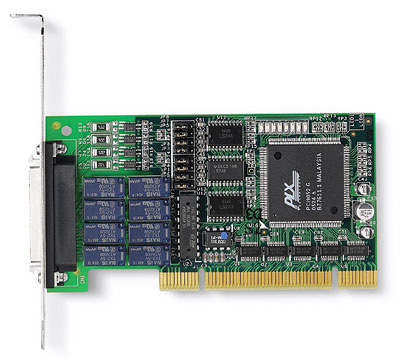
The ADLINK LPCI-7250 is a compact, low-profile PCI digital input/output (DIO) card designed for industrial automation and control applications. It provides eight single-pole double-throw (SPDT, Form C) relay outputs and eight optically isolated digital input channels. The card supports both 3.3 V and 5 V PCI bus signaling, ensuring compatibility with a wide range of modern and legacy systems. It is part of ADLINK’s 725X family, which also includes PCI-7250, PCI-7251, LPCIe-7250, and cPCI-7252 variants.
### 2. Key Features
- Bus Interface: 32-bit 3.3 V/5 V PCI bus, fully compliant with PCI specification.
- Low-Profile Design: Compact PCB (120 mm × 65 mm) suitable for space-constrained systems.
- Relay Outputs: 8 channels of SPDT (Form C) relays, non-latching type.
- Isolated Digital Inputs: 8 optically isolated, non-polarity input channels with optional RC filtering.
- High Isolation: 5000 VRMS isolation between input channels and system ground.
- LED Indicators: Onboard LEDs display the status of each relay output.
- Relay Readback: Output status can be read back through software.
- Onboard Driving Circuits: Integrated relay driver circuitry for reliable switching.
- Input Filtering: Jumper-selectable AC-filter or non-filter mode for each input channel.
- Software Support: Compatible with Windows and Linux drivers, including DAQPilot, PCIS-DASK, and DAQ-MTLB for MATLAB®.
- Industrial Reliability: Designed for noisy environments and continuous operation.
- Extended Product Family: Compatible with PCI-7251 expansion modules for scalable I/O configurations.
### 3. Technical Specifications
Physical Dimensions:
- 120 mm (L) × 65 mm (W) (excluding connectors)
Weight: Approx. 150 g (typical)
Form Factor: Low-profile PCI (MD1)
Bus Type: 32-bit PCI, 3.3 V/5 V signaling
Connector Type: 50-pin SCSI-II female connector
Relay Output Specifications:
- Number of Channels: 8
- Relay Type: SPDT (Form C), non-latching
- Contact Rating:
- DC: 30 V @ 2 A (resistive load)
- Breakdown Voltage: 1000 VRMS
- Contact Resistance: 100 mΩ (max)
- Operate Time: 8 ms (typical)
- Release Time: 8 ms (typical)
- Expected Life:
- >10⁵ operations @ 2 A, 30 VDC
- >5×10⁵ operations @ 1 A, 30 VDC
- LED Indicators: One per relay channel
- Data Transfer Mode: Programmed I/O
Isolated Digital Input Specifications:
- Number of Channels: 8
- Input Voltage Range: 0–24 VDC, non-polarity
- Logic Levels:
- Logic High: 5–24 V
- Logic Low: 0–1.5 V
- Input Resistance: 2.2 kΩ @ 0.33 W
- Isolation Voltage: 5000 VRMS channel-to-system
- Input Type: Optically isolated (PC3H4 photo-coupler)
- Filter Option: Jumper-selectable RC filter (~5 ms time constant)
Environmental Conditions:
- Operating Temperature: 0 °C to 60 °C
- Storage Temperature: -20 °C to 80 °C
- Relative Humidity: 5%–95%, non-condensing
Power Requirements:
- +5 V @ 200 mA (typical)
### 4. Functionality
The LPCI-7250 functions as a digital I/O interface card for industrial control systems. It provides eight relay outputs for switching external devices and eight optically isolated inputs for monitoring external signals. The relays can control external loads such as solenoids, contactors, or indicator lamps, while the isolated inputs can detect contact closures, limit switches, or logic-level signals.
Operation Principle:
- Each relay output is controlled by a single bit in the output register. A logic “1” energizes the relay (closing the NO contact), while a logic “0” de-energizes it.
- Input channels are read through the input register. A logic “1” indicates a high input voltage, and “0” indicates low.
- The card supports readback of relay states, allowing software verification of output conditions.
- Input channels can be configured for AC or DC signal detection using onboard jumpers (JP1–JP8).
Applications:
- Industrial ON/OFF control
- External relay driving and signal switching
- Laboratory automation and test systems
- Machine status monitoring and limit switch detection
- Integration with analog I/O cards for complete DAQ systems
Compatibility:
- Fully compatible with ADLINK’s PCI and PCIe DAQ product lines.
- Supported by ADLINK’s software ecosystem for Windows and Linux.
### 5. Components & Accessories
Included Items:
- LPCI-7250 Low-Profile PCI Card
- ADLINK Software CD (drivers and utilities)
- User’s Manual and Installation Guide
Optional Accessories:
- DIN-50S-01: Terminal board with one 50-pin SCSI-II connector and DIN-rail mounting.
- ACL-10250-1M: 50-pin SCSI-II cable (1 meter, AMP-787082-5 compatible).
Connectors:
- 50-pin SCSI-II female connector for I/O interface.
- Pin assignments include NO, NC, COM for each relay and differential pairs for each isolated input (IDI_nH/IDI_nL).
### 6. Installation & Setup
System Requirements:
- Available 32-bit PCI slot (3.3 V or 5 V signaling)
- Compatible operating system (Windows 2000/XP/Vista/7 or Linux)
Installation Procedure:
1. Power off the host system and disconnect peripherals.
2. Insert the LPCI-7250 into an available PCI slot.
3. Secure the card to the chassis bracket.
4. Connect external wiring via the 50-pin SCSI-II connector.
5. Power on the system; the OS will detect the card automatically.
6. Install ADLINK’s PCIS-DASK or DAQPilot driver package.
Input Configuration:
- Each input channel (DI0–DI7) can be configured for AC-filtered or non-filtered operation using jumpers JP1–JP8.
- Pins 1–2: AC-filtered mode
- Pins 2–3: Non-filtered (default)
Mounting Options:
- Low-profile PCI bracket for compact enclosures.
- Compatible with DIN-rail terminal boards for industrial wiring.
### 7. Performance & Capabilities
Relay Performance:
- Fast switching with 8 ms operate/release times.
- High endurance for mechanical and electrical operations.
- Reliable isolation and low contact resistance ensure consistent performance.
Input Performance:
- High isolation (5000 VRMS) for noise immunity.
- Non-polarity input design simplifies wiring.
- Optional RC filtering enhances stability in AC or noisy environments.
Data Transfer:
- Programmed I/O mode for direct register access.
- Supports readback of relay states and input monitoring.
Limitations:
- Not suitable for high-speed digital I/O applications (limited to relay switching speeds).
- Relay contacts rated for low to moderate current loads (≤2 A).
### 8. Standards & Compliance
- Bus Compliance: PCI Local Bus Specification, Revision 2.2
- Form Factor: Low-profile PCI (MD1)
- Isolation: 5000 VRMS channel-to-system isolation
- Safety & EMC: Designed for industrial environments with high noise immunity
- Environmental Compliance: RoHS compliant
- Operating System Support:
- Windows 2000/XP/Vista/7/2003 Server
- Linux (via PCIS-DASK/X drivers)
Software & Driver Support:
- DAQPilot: Task-oriented driver and SDK for Windows
- PCIS-DASK: Legacy driver for PCI/cPCI DAQ cards
- DAQ-MTLB: MATLAB® Data Acquisition Toolbox adapter
- DAQ-LVIEW PnP: LabVIEW™ VI set for ADLINK DAQ cards
- DAQBench: ActiveX controls for SCADA/HMI applications
- DAQMaster: Configuration-based device manager
### 9. Additional Information
Warranty:
- Standard ADLINK limited warranty (typically 2 years; refer to manufacturer terms).
Maintenance:
- No periodic calibration required.
- Keep connectors clean and free of dust.
- Avoid exceeding rated voltage/current on relay contacts.
Support & Service:
- Manufacturer: ADLINK Technology Inc.
- Website: [www.adlinktech.com](http://www.adlinktech.com)
- Email: service@adlinktech.com
- Phone: +886-2-82265877
- Address: 9F, No. 166, Jian Yi Road, Chungho City, Taipei 235, Taiwan
Documentation:
- User’s Manual (Rev. 2.03, June 24, 2008, Part No. 50-11038-1000)
- Updated specifications available on ADLINK’s website.
Product Family Overview:
- PCI-7250: 8 relay outputs, 8 isolated DI (standard PCI)
- PCI-7251: Expansion module for PCI-7250 (adds 8 relays + 8 DI)
- LPCI-7250: Low-profile PCI version (this model)
- LPCIe-7250: PCI Express x1 version
- cPCI-7252: CompactPCI version with 8 relays and 16 DI
Typical Applications:
- Industrial automation and process control
- Machine tool monitoring
- Laboratory instrumentation
- Building automation systems
- Test and measurement setups requiring isolated control
### Summary
The ADLINK LPCI-7250 is a robust, low-profile PCI digital I/O card engineered for industrial control and automation environments. It combines eight SPDT relay outputs with eight optically isolated digital inputs, offering reliable switching and signal monitoring in electrically noisy conditions. With its 3.3 V/5 V PCI compatibility, onboard LED indicators, and jumper-selectable input filtering, the LPCI-7250 provides flexibility and durability for a wide range of applications. Supported by ADLINK’s comprehensive software ecosystem, it integrates seamlessly into Windows and Linux systems for data acquisition, control, and automation tasks.
Its compact design, high isolation, and proven reliability make the LPCI-7250 an ideal choice for engineers and system integrators seeking a dependable digital I/O solution for industrial and laboratory environments.

### 1. Product Overview
Product Name: LPCI-7250
Model: LPCI-7250
Series: PCI-/cPCI-/LPCI-/LPCIe-725X Series
Article Number: LPCI-7250
Manufacturer: ADLINK Technology Inc.
Product Type: Low-profile PCI Digital I/O Card with 8 Relay Outputs and 8 Isolated Digital Inputs
The ADLINK LPCI-7250 is a compact, low-profile PCI digital input/output (DIO) card designed for industrial automation and control applications. It provides eight single-pole double-throw (SPDT, Form C) relay outputs and eight optically isolated digital input channels. The card supports both 3.3 V and 5 V PCI bus signaling, ensuring compatibility with a wide range of modern and legacy systems. It is part of ADLINK’s 725X family, which also includes PCI-7250, PCI-7251, LPCIe-7250, and cPCI-7252 variants.
### 2. Key Features
- Bus Interface: 32-bit 3.3 V/5 V PCI bus, fully compliant with PCI specification.
- Low-Profile Design: Compact PCB (120 mm × 65 mm) suitable for space-constrained systems.
- Relay Outputs: 8 channels of SPDT (Form C) relays, non-latching type.
- Isolated Digital Inputs: 8 optically isolated, non-polarity input channels with optional RC filtering.
- High Isolation: 5000 VRMS isolation between input channels and system ground.
- LED Indicators: Onboard LEDs display the status of each relay output.
- Relay Readback: Output status can be read back through software.
- Onboard Driving Circuits: Integrated relay driver circuitry for reliable switching.
- Input Filtering: Jumper-selectable AC-filter or non-filter mode for each input channel.
- Software Support: Compatible with Windows and Linux drivers, including DAQPilot, PCIS-DASK, and DAQ-MTLB for MATLAB®.
- Industrial Reliability: Designed for noisy environments and continuous operation.
- Extended Product Family: Compatible with PCI-7251 expansion modules for scalable I/O configurations.
### 3. Technical Specifications
Physical Dimensions:
- 120 mm (L) × 65 mm (W) (excluding connectors)
Weight: Approx. 150 g (typical)
Form Factor: Low-profile PCI (MD1)
Bus Type: 32-bit PCI, 3.3 V/5 V signaling
Connector Type: 50-pin SCSI-II female connector
Relay Output Specifications:
- Number of Channels: 8
- Relay Type: SPDT (Form C), non-latching
- Contact Rating:
- DC: 30 V @ 2 A (resistive load)
- Breakdown Voltage: 1000 VRMS
- Contact Resistance: 100 mΩ (max)
- Operate Time: 8 ms (typical)
- Release Time: 8 ms (typical)
- Expected Life:
- >10⁵ operations @ 2 A, 30 VDC
- >5×10⁵ operations @ 1 A, 30 VDC
- LED Indicators: One per relay channel
- Data Transfer Mode: Programmed I/O
Isolated Digital Input Specifications:
- Number of Channels: 8
- Input Voltage Range: 0–24 VDC, non-polarity
- Logic Levels:
- Logic High: 5–24 V
- Logic Low: 0–1.5 V
- Input Resistance: 2.2 kΩ @ 0.33 W
- Isolation Voltage: 5000 VRMS channel-to-system
- Input Type: Optically isolated (PC3H4 photo-coupler)
- Filter Option: Jumper-selectable RC filter (~5 ms time constant)
Environmental Conditions:
- Operating Temperature: 0 °C to 60 °C
- Storage Temperature: -20 °C to 80 °C
- Relative Humidity: 5%–95%, non-condensing
Power Requirements:
- +5 V @ 200 mA (typical)
### 4. Functionality
The LPCI-7250 functions as a digital I/O interface card for industrial control systems. It provides eight relay outputs for switching external devices and eight optically isolated inputs for monitoring external signals. The relays can control external loads such as solenoids, contactors, or indicator lamps, while the isolated inputs can detect contact closures, limit switches, or logic-level signals.
Operation Principle:
- Each relay output is controlled by a single bit in the output register. A logic “1” energizes the relay (closing the NO contact), while a logic “0” de-energizes it.
- Input channels are read through the input register. A logic “1” indicates a high input voltage, and “0” indicates low.
- The card supports readback of relay states, allowing software verification of output conditions.
- Input channels can be configured for AC or DC signal detection using onboard jumpers (JP1–JP8).
Applications:
- Industrial ON/OFF control
- External relay driving and signal switching
- Laboratory automation and test systems
- Machine status monitoring and limit switch detection
- Integration with analog I/O cards for complete DAQ systems
Compatibility:
- Fully compatible with ADLINK’s PCI and PCIe DAQ product lines.
- Supported by ADLINK’s software ecosystem for Windows and Linux.
### 5. Components & Accessories
Included Items:
- LPCI-7250 Low-Profile PCI Card
- ADLINK Software CD (drivers and utilities)
- User’s Manual and Installation Guide
Optional Accessories:
- DIN-50S-01: Terminal board with one 50-pin SCSI-II connector and DIN-rail mounting.
- ACL-10250-1M: 50-pin SCSI-II cable (1 meter, AMP-787082-5 compatible).
Connectors:
- 50-pin SCSI-II female connector for I/O interface.
- Pin assignments include NO, NC, COM for each relay and differential pairs for each isolated input (IDI_nH/IDI_nL).
### 6. Installation & Setup
System Requirements:
- Available 32-bit PCI slot (3.3 V or 5 V signaling)
- Compatible operating system (Windows 2000/XP/Vista/7 or Linux)
Installation Procedure:
1. Power off the host system and disconnect peripherals.
2. Insert the LPCI-7250 into an available PCI slot.
3. Secure the card to the chassis bracket.
4. Connect external wiring via the 50-pin SCSI-II connector.
5. Power on the system; the OS will detect the card automatically.
6. Install ADLINK’s PCIS-DASK or DAQPilot driver package.
Input Configuration:
- Each input channel (DI0–DI7) can be configured for AC-filtered or non-filtered operation using jumpers JP1–JP8.
- Pins 1–2: AC-filtered mode
- Pins 2–3: Non-filtered (default)
Mounting Options:
- Low-profile PCI bracket for compact enclosures.
- Compatible with DIN-rail terminal boards for industrial wiring.
### 7. Performance & Capabilities
Relay Performance:
- Fast switching with 8 ms operate/release times.
- High endurance for mechanical and electrical operations.
- Reliable isolation and low contact resistance ensure consistent performance.
Input Performance:
- High isolation (5000 VRMS) for noise immunity.
- Non-polarity input design simplifies wiring.
- Optional RC filtering enhances stability in AC or noisy environments.
Data Transfer:
- Programmed I/O mode for direct register access.
- Supports readback of relay states and input monitoring.
Limitations:
- Not suitable for high-speed digital I/O applications (limited to relay switching speeds).
- Relay contacts rated for low to moderate current loads (≤2 A).
### 8. Standards & Compliance
- Bus Compliance: PCI Local Bus Specification, Revision 2.2
- Form Factor: Low-profile PCI (MD1)
- Isolation: 5000 VRMS channel-to-system isolation
- Safety & EMC: Designed for industrial environments with high noise immunity
- Environmental Compliance: RoHS compliant
- Operating System Support:
- Windows 2000/XP/Vista/7/2003 Server
- Linux (via PCIS-DASK/X drivers)
Software & Driver Support:
- DAQPilot: Task-oriented driver and SDK for Windows
- PCIS-DASK: Legacy driver for PCI/cPCI DAQ cards
- DAQ-MTLB: MATLAB® Data Acquisition Toolbox adapter
- DAQ-LVIEW PnP: LabVIEW™ VI set for ADLINK DAQ cards
- DAQBench: ActiveX controls for SCADA/HMI applications
- DAQMaster: Configuration-based device manager
### 9. Additional Information
Warranty:
- Standard ADLINK limited warranty (typically 2 years; refer to manufacturer terms).
Maintenance:
- No periodic calibration required.
- Keep connectors clean and free of dust.
- Avoid exceeding rated voltage/current on relay contacts.
Support & Service:
- Manufacturer: ADLINK Technology Inc.
- Website: [www.adlinktech.com](http://www.adlinktech.com)
- Email: service@adlinktech.com
- Phone: +886-2-82265877
- Address: 9F, No. 166, Jian Yi Road, Chungho City, Taipei 235, Taiwan
Documentation:
- User’s Manual (Rev. 2.03, June 24, 2008, Part No. 50-11038-1000)
- Updated specifications available on ADLINK’s website.
Product Family Overview:
- PCI-7250: 8 relay outputs, 8 isolated DI (standard PCI)
- PCI-7251: Expansion module for PCI-7250 (adds 8 relays + 8 DI)
- LPCI-7250: Low-profile PCI version (this model)
- LPCIe-7250: PCI Express x1 version
- cPCI-7252: CompactPCI version with 8 relays and 16 DI
Typical Applications:
- Industrial automation and process control
- Machine tool monitoring
- Laboratory instrumentation
- Building automation systems
- Test and measurement setups requiring isolated control
### Summary
The ADLINK LPCI-7250 is a robust, low-profile PCI digital I/O card engineered for industrial control and automation environments. It combines eight SPDT relay outputs with eight optically isolated digital inputs, offering reliable switching and signal monitoring in electrically noisy conditions. With its 3.3 V/5 V PCI compatibility, onboard LED indicators, and jumper-selectable input filtering, the LPCI-7250 provides flexibility and durability for a wide range of applications. Supported by ADLINK’s comprehensive software ecosystem, it integrates seamlessly into Windows and Linux systems for data acquisition, control, and automation tasks.
Its compact design, high isolation, and proven reliability make the LPCI-7250 an ideal choice for engineers and system integrators seeking a dependable digital I/O solution for industrial and laboratory environments.
-
PCI-7250_7251_datasheet_20181121.pdf
PDF Catalog
-
06-07.pdf
PDF Catalog
-
06-00.pdf
PDF Catalog
-
Digital_IO_Selection_Guide_20151230.pdf
PDF Catalog
-
PCI-725X_manual.pdf
Manual
- DIN-50S-01 - 50pin SCSI-II termination board w/o cable DIN rail
- ACL-10250-1 - 50pin SCSI-II cable 1m
- ACL-10250-2 - 50pin SCSI-II cable 2m
- ACL-10250-4 - 50pin SCSI-II cable 4m