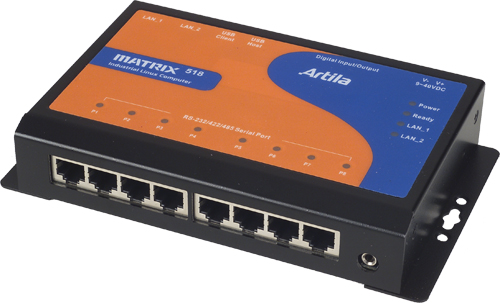
Comprehensive Product Summary – Matrix-504-SD Industrial Embedded Computer
### 1. Product Overview
Product Name: Matrix-504-SD
Model / Series: Matrix-500 Series (Upward Compatible)
Article Number: Matrix-504-SD
Manufacturer: Artila Electronics Co., Ltd.
Product Type: Linux-ready ARM9 Industrial Box Computer
The Artila Matrix-504-SD is a compact, fanless, ARM9-based embedded industrial computer designed for automation, networking, and control applications. It integrates a 400 MHz Atmel AT91SAM9G20 processor, pre-installed Linux operating system, and a rich set of communication interfaces including Ethernet, serial, USB, and GPIO. The system is engineered for reliability in harsh industrial environments, supporting wide input voltage (9–48 V DC), low power consumption (< 3 W), and extended operating temperature ranges.
### 2. Key Features
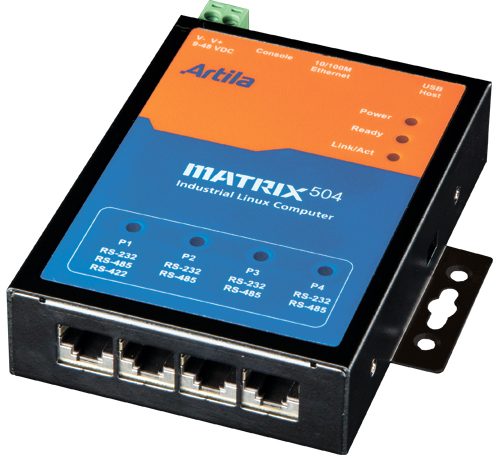
- Processor: ARM926EJ-S (Atmel AT91SAM9G20) running at 400 MHz with integrated MMU.
- Memory: 64 MB SDRAM and 256 MB NAND Flash; 2 MB DataFlash for system backup.
- Storage Expansion: Internal microSD socket supporting up to 32 GB.
- Operating System: Pre-installed Linux kernel 2.6.29 with U-Boot 1.1.2 bootloader.
- Networking: 1 × 10/100 Mbps Ethernet port (RJ45) with 1.5 kV magnetic isolation.
- Serial Communication:
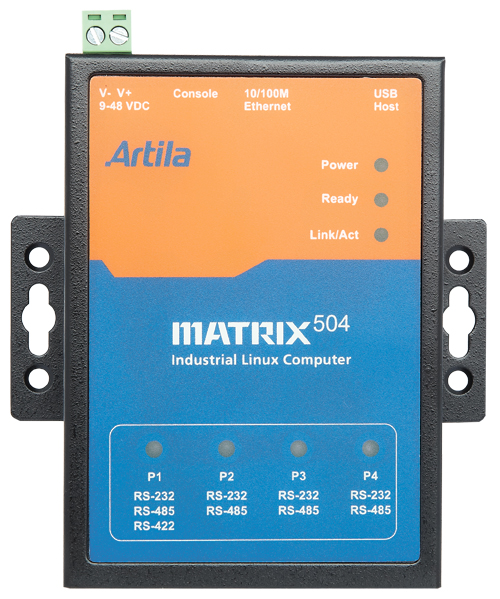
- 1 × software-configurable RS‑232/422/485 port.
- 3 × RS‑232/485 ports.
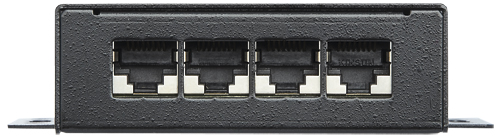
- All ports via RJ45 connectors, up to 921.6 kbps.
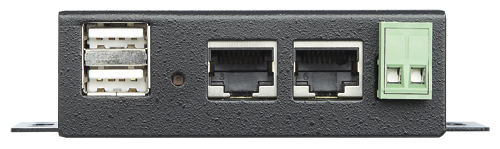
- USB Connectivity: 2 × USB 2.0 full-speed (12 Mbps) host ports; 1 × reserved client port.
- GPIO: 5 × programmable digital I/O lines (CMOS level, 100 kΩ pull-up).
- Power Input: 9–48 V DC, 250 mA @ 12 V DC (≈ 3 W).
- Form Factor: Ultra-compact metal enclosure, 78 × 108 × 24 mm.
- Mounting: DIN rail mountable (optional DK‑35A kit).
- Environmental: Operating temperature 0–70 °C (standard) or –20–80 °C (Matrix‑504T).
- Certifications: CE Class A, FCC Class A.
- Software Tools: GNU C/C++ cross-compilation toolchain for Linux and Windows (Cygwin).
- Security: Supports SSH 1.0/2.0, SSL, and secure remote management.
- Web Services: Built-in web server (lighttpd) and FTP server (vsftpd).
- Low Power Design: Fanless, flash-based architecture with < 3 W consumption.
### 3. Technical Specifications
CPU / Memory
- Processor: Atmel AT91SAM9G20 (ARM926EJ‑S core, 400 MHz, with MMU)
- SDRAM: 64 MB
- NAND Flash: 256 MB
- DataFlash: 2 MB (system backup)
- Cache: 32 KB instruction + 32 KB data
Networking
- Interface: 1 × 10/100 Base‑T Ethernet (RJ45)
- Isolation: 1.5 kV magnetic isolation
Serial Interfaces (TTY Ports)
- Port 1: RS‑232/422/485 selectable
- Ports 2–4: RS‑232/485 selectable
- Connector: RJ45
- Baud Rate: Up to 921.6 kbps
- Parity: None, Even, Odd, Mark, Space
- Data Bits: 5, 6, 7, 8
- Stop Bits: 1, 1.5, 2
- Flow Control: RTS/CTS, XON/XOFF, or None
- RS‑485 Direction Control: Automatic (hardware)
USB Ports
- Host Ports: 2 × USB 2.0 (full‑speed 12 Mbps, low‑speed 1.5 Mbps)
- Client Port: 1 × reserved (for production use)
General Hardware
- Watchdog Timer: Yes (kernel-level)
- Real-Time Clock: Yes
- Buzzer: Yes
- microSD Socket: Yes (internal)
- Power Input: 9–48 V DC
- Power Consumption: 250 mA @ 12 V DC (≈ 3 W)
- Dimensions (W × H × D): 78 × 108 × 24 mm
- Operating Temperature: 0–70 °C (standard), –20–80 °C (Matrix‑504T)
- Regulatory: CE Class A, FCC Class A
Physical Construction
- Enclosure: Fanless, metal housing
- Mounting: DIN rail (optional DK‑35A kit)
- Weight: Approx. < 300 g
### 4. Functionality
The Matrix‑504‑SD operates as a compact embedded Linux computer for industrial automation, data acquisition, and networked control. It boots from on‑board NAND Flash using the U‑Boot loader, loads the Linux 2.6.29 kernel, and mounts its root file system automatically.
Use Cases & Applications:
- Industrial automation controllers and gateways
- Serial‑to‑Ethernet communication bridges
- Remote data logging and monitoring systems
- Embedded web servers for equipment management
- IoT edge computing nodes
- Protocol converters (Modbus RTU/TCP, custom serial protocols)
Compatibility:
- Upward compatible with Matrix‑500 series hardware and software.
- Supports USB peripherals such as flash drives, Wi‑Fi dongles (Ralink RT73), USB‑to‑Serial adapters (Prolific PL‑2303, FTDI), and USB modems (CDC compliant).
- Works with GNU C/C++ toolchains for both Linux and Windows (Cygwin).
### 5. Components & Accessories
Included Items:
- Matrix‑504‑SD main unit (Linux pre‑installed)
- Quick start documentation
Optional Accessories:
- Matrix‑504T: Wide‑temperature version (–20 °C to 80 °C).
- CB‑RJ45F9‑150 (91‑R45F9‑150): Serial cable (RJ45 to DB9 female, 150 cm).
- CB‑RJ2CON‑100 (91‑RJCON‑100): Console cable (RJ45 to DB9 female, 100 cm).
- DK‑35A (36‑DK35A‑000): DIN rail mounting kit.
- PWR‑12V‑1A (31‑62100‑000): 110–240 V AC to 12 V DC 1 A power adapter.
Connectors:
- RJ45 for Ethernet and serial ports.
- 2 × USB Type‑A host connectors.
- 2‑pin terminal block for DC power input.
- microSD slot (internal).
### 6. Installation & Setup
Power Requirements:
- Input voltage: 9–48 V DC (typical 12 V DC).
- Power LED indicates proper supply (solid green).
Mounting Options:
- DIN rail mounting via optional DK‑35A kit.
- Compact form factor allows panel or enclosure integration.
Configuration & Access:
- Default IP: 192.168.2.127
- Default login: root / guest (guest for telnet only)
- Serial console: 115200 bps, 8N1, no flow control, VT100 terminal.
- SSH and web interfaces available for remote management.
System Boot:
- On power‑up, the system loads Linux kernel and mounts the root file system.
- Initialization scripts located in `/etc/inittab` and `/etc/rcS.d`.
- Default run level: 5 (multi‑user).
Network Configuration:
- Static IP or DHCP supported.
- Wireless LAN supported via USB WLAN adapter (Ralink RT2571/RT73).
- Configuration files: `/etc/network/interfaces` and `/etc/modules`.
Serial Console Setup:
- Console port (JP1) uses RJ45 connector next to Ethernet port.
- Requires console cable (91‑RJCON‑100).
- Terminal settings: 115200 bps, 8 data bits, no parity, 1 stop bit.
### 7. Performance & Capabilities
Processing & Throughput:
- 400 MHz ARM9 CPU with hardware MMU ensures stable multitasking.
- Serial ports support up to 921.6 kbps for high‑speed communication.
- Ethernet throughput up to 100 Mbps.
Storage & File System:
- 256 MB NAND Flash divided into bootloader, kernel, root file system, and user disk.
- File systems supported: UBI, JFFS2, EXT2/EXT3, VFAT/FAT, NFS.
- microSD expansion up to 32 GB for data logging or application storage.
Power Efficiency:
- Typical consumption < 3 W, ideal for continuous operation in remote or energy‑limited environments.
Reliability:
- Watchdog timer for system recovery.
- Real‑time clock with battery backup.
- Fanless design reduces mechanical failure points.
Limitations:
- USB host limited to full‑speed (12 Mbps).
- Single Ethernet interface.
- No built‑in display or GPU (headless operation).
### 8. Standards & Compliance
- Electrical Safety: CE Class A, FCC Class A.
- Environmental: RoHS‑compliant design.
- Software Standards: POSIX‑compliant GLIBC library.
- Networking: IEEE 802.3 10/100 Base‑T Ethernet.
- USB: USB 2.0 Full‑Speed compliant.
- Serial Communication: EIA/TIA‑232, 422, 485 standards.
### 9. Additional Information
Operating System & Software Environment:
- Linux 2.6.29 kernel with U‑Boot 1.1.2 bootloader.
- Pre‑installed utilities: bash, busybox, sysvinit, wget, ipkg, procps, apache2, vsftpd, iptables, ppp, ssh, wireless_tools, util‑linux, usbutils, and Artila utilities.
- Default daemons: ssh (sftp), syslog/klogd, telnet (disabled root), ftp (vsftpd), web (lighttpd), amgrd (Artila broadcast search).
- Package management via ipkg for installation, upgrade, and removal.
- Webmin available for web‑based administration (`ipkg install webmin`).
Development Environment:
- GNU C/C++ cross‑compiler (GCC 4.3.3, GLIBC 2.8–2.9, binutils 2.18–2.19).
- Toolchains for Linux and Windows (Cygwin).
- Supports remote debugging via gdbserver and DDD.
- Example programs and Makefiles available from Artila FTP.
Maintenance & Recovery:
- Built‑in loader menu for system recovery and firmware updates.
- Recovery options: update loader, kernel, and file system via USB or TFTP.
- Automatic fallback to DataFlash file system if NAND fails.
- Console‑based recovery menu includes options for formatting, environment restoration, and reboot.
Warranty & Support:
- Manufacturer warranty provided by Artila Electronics (duration per region).
- Technical resources, firmware images, and software packages available at [www.artila.com](http://www.artila.com).
- Support for ipkg‑based updates ensures long‑term maintainability.
Maintenance Recommendations:
- Use `reboot` command for software restarts; hardware reset only if necessary.
- Regularly back up configuration and user data to microSD or USB storage.
- Keep firmware and kernel modules updated via Artila FTP.
### Summary
The Artila Matrix‑504‑SD is a robust, Linux‑ready ARM9 embedded computer optimized for industrial automation and networking applications. Its combination of a 400 MHz ARM9 processor, multiple serial interfaces, Ethernet connectivity, and flexible I/O makes it suitable for protocol conversion, remote monitoring, and control tasks. The pre‑installed Linux environment, comprehensive toolchain support, and low‑power fanless design enable developers to deploy reliable, long‑life embedded solutions with minimal maintenance.
With its compact 78 × 108 × 24 mm footprint, wide 9–48 V DC input range, and extended temperature tolerance, the Matrix‑504‑SD delivers industrial‑grade performance in a small, energy‑efficient package. It adheres to CE and FCC standards, supports secure network protocols (SSH/SSL), and provides a full suite of utilities for system management and software development.
In essence, the Matrix‑504‑SD serves as a versatile, open, and durable embedded computing platform for industrial and IoT applications requiring dependable Linux performance, flexible connectivity, and long‑term support.




 LOOKING FOR THE RIGHT
 Warranty Declaration.pdf
PDF Catalog
Warranty Declaration.pdf
PDF Catalog
 Matrix-504_Datasheet_en.pdf
PDF Catalog
Matrix-504_Datasheet_en.pdf
PDF Catalog
 Enable Serial Console3.pdf
Manual
Enable Serial Console3.pdf
Manual
 LoaderHowTo.pdf
Manual
LoaderHowTo.pdf
Manual
 gdbserver_HOW_TO.pdf
Manual
gdbserver_HOW_TO.pdf
Manual
 Matrix-504_User_Guide.pdf
Manual
Matrix-504_User_Guide.pdf
Manual