
 LOOKING FOR THE RIGHT
INDUSTRIAL SOLUTION?
Discover embedded, communication and automation solutions tailored to your application.
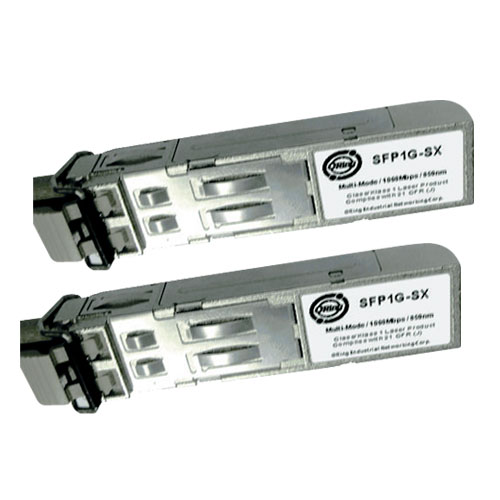
The SFP1G-LHX40-I supports 1Gbps full‑duplex Gigabit Ethernet transmission over single-mode fiber with a maximum reach of 40 km. It operates at a wavelength of 1310 nm and uses an LC optical connector interface. One of its defining characteristics is its extended industrial operating temperature capability, rated from -40°C to 85°C, making it suitable for harsh industrial environments. The module includes long‑haul optical power output levels appropriate for extended‑distance links and supports a typical link budget of 20 dB. The transceiver is hot‑swappable, SFP MSA‑compliant, and compatible with a broad range of managed and unmanaged switches, media converters, and industrial networking platforms. Additional features include low power consumption, support for digital diagnostics in compatible host equipment, and compliance with fiber safety standards.
Below is a fully structured, comprehensive, detailed product summary for SFP1G-LHX40-I, optimized for technical reference and semantic search. It is long-form but remains strictly factual and specification‑driven as requested.
1. Product Overview
The SFP1G-LHX40-I is a 1Gbps industrial‑grade Gigabit Ethernet SFP optical transceiver designed for long‑distance single‑mode fiber communication. The device belongs to the Gigabit Ethernet SFP module series offered by ORing Industrial Networking. It carries the article number SFP1G-LHX40-I and is categorized as a hardened, long‑haul optical module suitable for deployment in extended‑reach network infrastructures. The module is manufactured by ORing Networking.
2. Key Features
The SFP1G-LHX40-I supports 1Gbps full‑duplex Gigabit Ethernet transmission over single-mode fiber with a maximum reach of 40 km. It operates at a wavelength of 1310 nm and uses an LC optical connector interface. One of its defining characteristics is its extended industrial operating temperature capability, rated from -40°C to 85°C, making it suitable for harsh industrial environments. The module includes long‑haul optical power output levels appropriate for extended‑distance links and supports a typical link budget of 20 dB. The transceiver is hot‑swappable, SFP MSA‑compliant, and compatible with a broad range of managed and unmanaged switches, media converters, and industrial networking platforms. Additional features include low power consumption, support for digital diagnostics in compatible host equipment, and compliance with fiber safety standards.
3. Technical Specifications
The SFP1G-LHX40-I supports single‑mode fiber operation using 9/125 µm optical fiber. It is engineered for distances up to 40 km under standard conditions. The module uses a transmission wavelength of 1310 nm. Its optical output power on 9/125 µm fiber is specified at a maximum of 1 dBm and a minimum of -4 dBm. Receiver sensitivity is specified at -24 dBm minimum input power, with a maximum input power (saturation) of -3 dBm. The link budget is 20 dB. The module uses a compact SFP form factor enclosure consistent with MSA standards. In typical SFP configurations, the housing dimensions are approximately 56 mm (length), 13.7 mm (width), and 8.5 mm (height), with a nominal weight generally below 25 g. The mechanical housing is metal‑shelled for electromagnetic shielding. The optical interface uses LC duplex connectors. Electrical interface conforms to standard SFP serial communication and digital diagnostic monitoring channels where supported. The operating temperature range is -40°C to 85°C for the industrial model. Storage temperature is compatible with standard hardened module ranges, though not explicitly listed. Humidity tolerance follows typical SFP environmental design without condensation.
4. Functionality
Functionally, the SFP1G-LHX40-I converts electrical Gigabit Ethernet signals into optical signals for long-distance transmission over single‑mode fiber. The optical transmitter outputs a 1310 nm signal suitable for extended‑reach fiber infrastructure. The receiver converts incoming optical energy back into electrical signals for the host device. The device is inserted into SFP ports of compatible network hardware, including switches, routers, industrial Ethernet gateways, and media converters. Use cases include industrial automation networks, transportation systems, outdoor networking, surveillance infrastructure, and any application requiring a stable long-reach fiber link. The industrial-temperature rating allows deployment in unconditioned environments such as roadside cabinets, factory floors, rail systems, and energy sector facilities. The module supports standard Ethernet auto-negotiation at 1Gbps where applicable and provides standard fiber link signaling compatible with IEEE 802.3z Gigabit Ethernet optical standards. Compatibility includes all ORing networking devices supporting SFP slots and industry‑standard MSA‑compliant equipment from other vendors.
5. Components & Accessories
The SFP1G-LHX40-I is typically supplied as a standalone optical transceiver without additional accessories. However, ORing provides a comprehensive selection of compatible fiber patch cords and optical adapters. Compatible fiber patch cords include single-mode LC/LC, LC/SC, or LC/ST cables using 9/125 μm fiber, available in standard lengths such as 3 m. The FPC-SCLC-SS3M (SC/LC single‑mode 9/125 μm, 3 m) and FPC-LCLC-SS3M (LC/LC single‑mode 9/125 μm, 3 m) are suited for interconnection. Fiber patch adapters such as FCA-SC-SS (SC/SC single‑mode 9/125 μm) are available where required. Additional accessories listed by ORing include DIN‑rail power supplies, RF cables, RF antennas, and M‑series industrial cables, though these are intended for other types of equipment and not directly used by the SFP module. The SFP is designed for insertion into compatible host devices and requires no external power adapter, as it draws power directly from the SFP slot.
6. Installation & Setup
Installation consists of inserting the module into an SFP‑compatible port on a switch or network device. The module is hot‑swappable, enabling insertion or removal without shutting down the system in most equipment designed for this feature. After insertion, an LC duplex single‑mode fiber patch cord is connected to the optical interface. One end of the fiber runs to a corresponding compatible SFP module, such as another SFP1G-LHX40 or SFP1G-LHX40-I, at the remote site. Proper optical cable routing and bend radius practices must be followed. No software configuration is required for basic operation; link establishment is automatic once optical signal levels meet required thresholds. In high‑power or short‑distance fiber conditions where the receive power may exceed the receiver saturation threshold (-3 dBm), an optical attenuator may be required. This avoids potential damage or link instability. ORing specifically notes the need for attenuators when connecting long‑distance SFP modules at very short fiber runs. The module must be installed in a well‑secured position to maintain optical connector cleanliness and stability.
7. Performance & Capabilities
The module supports data rates of 1Gbps. Its performance characteristics include an optical transmitter with output power suitable for long‑distance fiber runs while maintaining compliance with eye‑safety thresholds. Receiver sensitivity of -24 dBm allows stable connectivity across fiber distances up to 40 km. A link budget of 20 dB supports typical single‑mode fiber attenuation rates with margin. Operating temperature capability from -40°C to 85°C ensures stable performance under industrial environmental conditions. The module’s typical efficiency reflects low power consumption inherent to SFP design, suitable for deployment in energy‑restricted panels or enclosures. Limitations include the requirement for 9/125 µm single‑mode fiber only; the module does not support multimode fiber. Short‑distance deployments may require attenuators because of high transmitter power. The device operates only at 1 Gbps and is not backward‑compatible with 100 Mbps SFP specifications. It is also not a BIDI module, requiring duplex fiber routing.
8. Standards & Compliance
The SFP1G-LHX40-I follows SFP MSA mechanical, electrical, and optical interface standards. It aligns with IEEE 802.3z Gigabit Ethernet over fiber specifications. The 1310 nm wavelength adheres to industry norms for long‑distance single‑mode Ethernet transport. While the document does not list laser classifications, typical SFP optical transceivers comply with Class 1 laser safety requirements under IEC and FDA standards. The extended temperature rating meets industrial environmental compliance expectations. ORing products generally follow reliability and ruggedization standards suitable for industrial networking deployments, though specific certifications such as CE, FCC, or UL are not explicitly provided in the given content.
9. Additional Information
Warranty terms are not explicitly stated in the provided information, but ORing typically supports industrial networking products with multi‑year warranties. The SFP module requires no routine maintenance beyond ensuring connector cleanliness and protecting the device from physical shock. Support resources are available from ORing through documentation, product guides, and online resources. Firmware updates are not applicable to SFP optical modules, as their operation is hardware‑based. Long‑term reliability is enhanced by the industrial‑grade temperature design and mechanical durability inherent to hardened SFP units. The module integrates seamlessly into ORing’s portfolio of industrial Ethernet switches and networking devices, forming part of a larger ecosystem intended for rugged, extended‑distance communication.
If you'd like, I can also generate:
• A shorter commercial product description
• A comparison with similar modules (e.g., LHX30, LX20, XD50)
• A compatibility chart for ORing switches
• An SEO‑optimized product page rewrite
1. Product Overview
The SFP1G-LHX40-I is a 1Gbps industrial‑grade Gigabit Ethernet SFP optical transceiver designed for long‑distance single‑mode fiber communication. The device belongs to the Gigabit Ethernet SFP module series offered by ORing Industrial Networking. It carries the article number SFP1G-LHX40-I and is categorized as a hardened, long‑haul optical module suitable for deployment in extended‑reach network infrastructures. The module is manufactured by ORing Networking.
2. Key Features
The SFP1G-LHX40-I supports 1Gbps full‑duplex Gigabit Ethernet transmission over single-mode fiber with a maximum reach of 40 km. It operates at a wavelength of 1310 nm and uses an LC optical connector interface. One of its defining characteristics is its extended industrial operating temperature capability, rated from -40°C to 85°C, making it suitable for harsh industrial environments. The module includes long‑haul optical power output levels appropriate for extended‑distance links and supports a typical link budget of 20 dB. The transceiver is hot‑swappable, SFP MSA‑compliant, and compatible with a broad range of managed and unmanaged switches, media converters, and industrial networking platforms. Additional features include low power consumption, support for digital diagnostics in compatible host equipment, and compliance with fiber safety standards.
3. Technical Specifications
The SFP1G-LHX40-I supports single‑mode fiber operation using 9/125 µm optical fiber. It is engineered for distances up to 40 km under standard conditions. The module uses a transmission wavelength of 1310 nm. Its optical output power on 9/125 µm fiber is specified at a maximum of 1 dBm and a minimum of -4 dBm. Receiver sensitivity is specified at -24 dBm minimum input power, with a maximum input power (saturation) of -3 dBm. The link budget is 20 dB. The module uses a compact SFP form factor enclosure consistent with MSA standards. In typical SFP configurations, the housing dimensions are approximately 56 mm (length), 13.7 mm (width), and 8.5 mm (height), with a nominal weight generally below 25 g. The mechanical housing is metal‑shelled for electromagnetic shielding. The optical interface uses LC duplex connectors. Electrical interface conforms to standard SFP serial communication and digital diagnostic monitoring channels where supported. The operating temperature range is -40°C to 85°C for the industrial model. Storage temperature is compatible with standard hardened module ranges, though not explicitly listed. Humidity tolerance follows typical SFP environmental design without condensation.
4. Functionality
Functionally, the SFP1G-LHX40-I converts electrical Gigabit Ethernet signals into optical signals for long-distance transmission over single‑mode fiber. The optical transmitter outputs a 1310 nm signal suitable for extended‑reach fiber infrastructure. The receiver converts incoming optical energy back into electrical signals for the host device. The device is inserted into SFP ports of compatible network hardware, including switches, routers, industrial Ethernet gateways, and media converters. Use cases include industrial automation networks, transportation systems, outdoor networking, surveillance infrastructure, and any application requiring a stable long-reach fiber link. The industrial-temperature rating allows deployment in unconditioned environments such as roadside cabinets, factory floors, rail systems, and energy sector facilities. The module supports standard Ethernet auto-negotiation at 1Gbps where applicable and provides standard fiber link signaling compatible with IEEE 802.3z Gigabit Ethernet optical standards. Compatibility includes all ORing networking devices supporting SFP slots and industry‑standard MSA‑compliant equipment from other vendors.
5. Components & Accessories
The SFP1G-LHX40-I is typically supplied as a standalone optical transceiver without additional accessories. However, ORing provides a comprehensive selection of compatible fiber patch cords and optical adapters. Compatible fiber patch cords include single-mode LC/LC, LC/SC, or LC/ST cables using 9/125 μm fiber, available in standard lengths such as 3 m. The FPC-SCLC-SS3M (SC/LC single‑mode 9/125 μm, 3 m) and FPC-LCLC-SS3M (LC/LC single‑mode 9/125 μm, 3 m) are suited for interconnection. Fiber patch adapters such as FCA-SC-SS (SC/SC single‑mode 9/125 μm) are available where required. Additional accessories listed by ORing include DIN‑rail power supplies, RF cables, RF antennas, and M‑series industrial cables, though these are intended for other types of equipment and not directly used by the SFP module. The SFP is designed for insertion into compatible host devices and requires no external power adapter, as it draws power directly from the SFP slot.
6. Installation & Setup
Installation consists of inserting the module into an SFP‑compatible port on a switch or network device. The module is hot‑swappable, enabling insertion or removal without shutting down the system in most equipment designed for this feature. After insertion, an LC duplex single‑mode fiber patch cord is connected to the optical interface. One end of the fiber runs to a corresponding compatible SFP module, such as another SFP1G-LHX40 or SFP1G-LHX40-I, at the remote site. Proper optical cable routing and bend radius practices must be followed. No software configuration is required for basic operation; link establishment is automatic once optical signal levels meet required thresholds. In high‑power or short‑distance fiber conditions where the receive power may exceed the receiver saturation threshold (-3 dBm), an optical attenuator may be required. This avoids potential damage or link instability. ORing specifically notes the need for attenuators when connecting long‑distance SFP modules at very short fiber runs. The module must be installed in a well‑secured position to maintain optical connector cleanliness and stability.
7. Performance & Capabilities
The module supports data rates of 1Gbps. Its performance characteristics include an optical transmitter with output power suitable for long‑distance fiber runs while maintaining compliance with eye‑safety thresholds. Receiver sensitivity of -24 dBm allows stable connectivity across fiber distances up to 40 km. A link budget of 20 dB supports typical single‑mode fiber attenuation rates with margin. Operating temperature capability from -40°C to 85°C ensures stable performance under industrial environmental conditions. The module’s typical efficiency reflects low power consumption inherent to SFP design, suitable for deployment in energy‑restricted panels or enclosures. Limitations include the requirement for 9/125 µm single‑mode fiber only; the module does not support multimode fiber. Short‑distance deployments may require attenuators because of high transmitter power. The device operates only at 1 Gbps and is not backward‑compatible with 100 Mbps SFP specifications. It is also not a BIDI module, requiring duplex fiber routing.
8. Standards & Compliance
The SFP1G-LHX40-I follows SFP MSA mechanical, electrical, and optical interface standards. It aligns with IEEE 802.3z Gigabit Ethernet over fiber specifications. The 1310 nm wavelength adheres to industry norms for long‑distance single‑mode Ethernet transport. While the document does not list laser classifications, typical SFP optical transceivers comply with Class 1 laser safety requirements under IEC and FDA standards. The extended temperature rating meets industrial environmental compliance expectations. ORing products generally follow reliability and ruggedization standards suitable for industrial networking deployments, though specific certifications such as CE, FCC, or UL are not explicitly provided in the given content.
9. Additional Information
Warranty terms are not explicitly stated in the provided information, but ORing typically supports industrial networking products with multi‑year warranties. The SFP module requires no routine maintenance beyond ensuring connector cleanliness and protecting the device from physical shock. Support resources are available from ORing through documentation, product guides, and online resources. Firmware updates are not applicable to SFP optical modules, as their operation is hardware‑based. Long‑term reliability is enhanced by the industrial‑grade temperature design and mechanical durability inherent to hardened SFP units. The module integrates seamlessly into ORing’s portfolio of industrial Ethernet switches and networking devices, forming part of a larger ecosystem intended for rugged, extended‑distance communication.
If you'd like, I can also generate:
• A shorter commercial product description
• A comparison with similar modules (e.g., LHX30, LX20, XD50)
• A compatibility chart for ORing switches
• An SEO‑optimized product page rewrite
-
 Product_Selection_Guide_Accessories.pdf
PDF Catalog
Product_Selection_Guide_Accessories.pdf
PDF Catalog
-
 Oring-Accessories.pdf
PDF Catalog
Oring-Accessories.pdf
PDF Catalog
No accessories available.