CB-RJ45F9-150
SUCHEN SIE DIE PASSENDE
INDUSTRIELLE LÖSUNG?
Entdecken Sie Embedded-, Kommunikations- und Automatisierungslösungen für Ihre Anwendung.
- ARM9-based System-on-Module: Powered by the Atmel AT91SAM9G45 CPU running at 400 MHz with integrated Memory Management Unit (MMU).
- Pre-installed Linux OS: Linux kernel 2.6.38 with U-Boot bootloader and full file system support (UBI, JFFS2, EXT2/3, VFAT, NFS, NTFS).
- Comprehensive Development Environment: Includes GNU C/C++ cross-compilation toolchain for Linux and Windows, GLIBC POSIX libraries, and IPKG package management.
- High Connectivity:
- 1 × 10/100 Mbps Ethernet port with onboard PHY and transformer (DAVICOM DM9161).
- 4 × UARTs (RS-232/422/485 selectable) supporting up to 921.6 Kbps.
- 1 × USB 2.0 high-speed host (480 Mbps) and 1 × USB 2.0 device port.
- 1 × SD card interface (up to 32 GB, SD 2.0 compliant).
- I²C, I²S, and SPI interfaces for peripheral expansion.
- Extensive I/O: 32 programmable 3.3 V GPIO channels with interrupt support on PIO32.
- Integrated Real-Time Clock: ST M41T81 RTC with onboard lithium backup battery (48 mAh).
- Compact and Efficient: 80 × 50 mm SoM, 3.3 VDC input, typical power consumption 2 W.
- Carrier Board Integration: Provides additional RS-232/422/485 ports, dual USB hosts, Ethernet, SD socket, GPIO connectors, EEPROM, and local bus interface.
- Fanless, DIN-rail mountable enclosure: Suitable for industrial and embedded environments.
- Wide Operating Temperature Range: 0 °C to +70 °C.
- Pre-installed Linux OS: Linux kernel 2.6.38 with U-Boot bootloader and full file system support (UBI, JFFS2, EXT2/3, VFAT, NFS, NTFS).
- Comprehensive Development Environment: Includes GNU C/C++ cross-compilation toolchain for Linux and Windows, GLIBC POSIX libraries, and IPKG package management.
- High Connectivity:
- 1 × 10/100 Mbps Ethernet port with onboard PHY and transformer (DAVICOM DM9161).
- 4 × UARTs (RS-232/422/485 selectable) supporting up to 921.6 Kbps.
- 1 × USB 2.0 high-speed host (480 Mbps) and 1 × USB 2.0 device port.
- 1 × SD card interface (up to 32 GB, SD 2.0 compliant).
- I²C, I²S, and SPI interfaces for peripheral expansion.
- Extensive I/O: 32 programmable 3.3 V GPIO channels with interrupt support on PIO32.
- Integrated Real-Time Clock: ST M41T81 RTC with onboard lithium backup battery (48 mAh).
- Compact and Efficient: 80 × 50 mm SoM, 3.3 VDC input, typical power consumption 2 W.
- Carrier Board Integration: Provides additional RS-232/422/485 ports, dual USB hosts, Ethernet, SD socket, GPIO connectors, EEPROM, and local bus interface.
- Fanless, DIN-rail mountable enclosure: Suitable for industrial and embedded environments.
- Wide Operating Temperature Range: 0 °C to +70 °C.
1. Product Overview
Product Name: M-503 Starter Kit
Model: M-503
Series: M-500 Series Embedded System-on-Module (SoM)
Article Number: M-503-Starter-Kit
Manufacturer: Artila Electronics Co., Ltd.
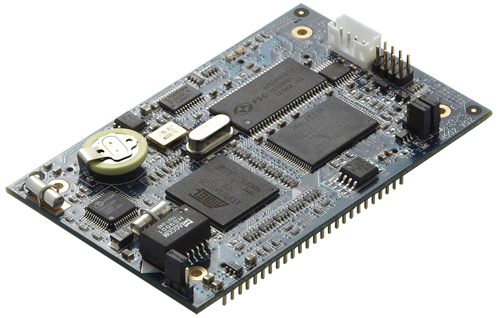
The M-503 Starter Kit is a complete embedded development platform designed for rapid prototyping and deployment of ARM9-based Linux systems. It integrates the M-503 System-on-Module (SoM)—a Linux-ready ARM9 module based on the Atmel AT91SAM9G45 processor—with a fully featured carrier board, power circuitry, and a comprehensive Linux toolchain. The kit provides developers with a ready-to-use environment for embedded applications requiring Ethernet connectivity, multiple serial interfaces, USB host/device support, and extensive GPIO capabilities.
2. Key Features
- ARM9-based System-on-Module: Powered by the Atmel AT91SAM9G45 CPU running at 400 MHz with integrated Memory Management Unit (MMU).
- Pre-installed Linux OS: Linux kernel 2.6.38 with U-Boot bootloader and full file system support (UBI, JFFS2, EXT2/3, VFAT, NFS, NTFS).
- Comprehensive Development Environment: Includes GNU C/C++ cross-compilation toolchain for Linux and Windows, GLIBC POSIX libraries, and IPKG package management.
- High Connectivity:
- 1 × 10/100 Mbps Ethernet port with onboard PHY and transformer (DAVICOM DM9161).
- 4 × UARTs (RS-232/422/485 selectable) supporting up to 921.6 Kbps.
- 1 × USB 2.0 high-speed host (480 Mbps) and 1 × USB 2.0 device port.
- 1 × SD card interface (up to 32 GB, SD 2.0 compliant).
- I²C, I²S, and SPI interfaces for peripheral expansion.
- Extensive I/O: 32 programmable 3.3 V GPIO channels with interrupt support on PIO32.
- Integrated Real-Time Clock: ST M41T81 RTC with onboard lithium backup battery (48 mAh).
- Compact and Efficient: 80 × 50 mm SoM, 3.3 VDC input, typical power consumption 2 W.
- Carrier Board Integration: Provides additional RS-232/422/485 ports, dual USB hosts, Ethernet, SD socket, GPIO connectors, EEPROM, and local bus interface.
- Fanless, DIN-rail mountable enclosure: Suitable for industrial and embedded environments.
- Wide Operating Temperature Range: 0 °C to +70 °C.
3. Technical Specifications
Processor and Memory
- CPU: Atmel AT91SAM9G45, ARM926EJ-S core, 400 MHz, with MMU.
- Cache: 32 KB instruction cache, 32 KB data cache.
- System Memory: 128 MB DDR2 SDRAM.
- Flash Storage: 256 MB NAND Flash.
- DataFlash: 2 MB for system backup and bootloader.
Networking
- Ethernet: 1 × 10/100 Mbps interface with onboard PHY (DAVICOM DM9161).
- Isolation: 1.5 kV magnetic isolation.
- Signals: ETX+, ETX−, ERX+, ERX−.
Serial Communication
- UARTs: 4 × UARTs (TX, RX, RTS, CTS, optional DCD, DTR, DSR).
- Baud Rate: Up to 921.6 Kbps.
- Signal Level: CMOS 3.3 V compatible.
- Flow Control: RTS/CTS, XON/XOFF, or none.
- Parity: None, Even, Odd, Mark, Space.
- Stop Bits: 1, 1.5, or 2.
USB Interfaces
- Host Port: 1 × USB 2.0 high-speed (480 Mbps).
- Device Port: 1 × USB 2.0 full-speed (12 Mbps).
- Signals: USBA+, USBA− (host); Uddata+, Uddata−, Udio (device).
Peripheral Interfaces
- I²C: TWD, TWCK; supports EEPROM and RTC.
- I²S: TSCK, TWS, TSD (transmit); RSCK, RWS, RSD (receive).
- SPI: MISO, MOSI, SPCK, CS1, CS2; supports external flash and peripherals.
- SD Interface: MCCDA, MCCK, MCDA0–MCDA3, CD, WP; SD 2.0 compliant, up to 32 GB.
GPIO
- Count: 32 programmable I/O pins (PIO0–PIO31).
- Voltage: 3.3 V CMOS compatible.
- Interrupt Support: PIO32.
- Predefined Pins:
- Reset Button (CN2 pin 35)
- System Reset (CN2 pin 34)
- Buzzer (CN2 pin 37)
- System Ready LED (CN2 pin 38)
- LAN Activity LED (CN3 pin 11)
Real-Time Clock
- Chip: ST M41T81.
- Backup Battery: 48 mAh lithium cell (onboard).
- External Battery Input: CN1 pin 5.
Debug and Programming Interfaces
- Serial Console: RS-232 (Tx, Rx, GND).
- JTAG Interface: NTRST, TDI, TMS, TCK, TDO.
Power
- Input Voltage: 3.0 – 3.6 VDC (nominal 3.3 V).
- Power Consumption: 2 W typical.
Physical Characteristics
- Dimensions: 80 mm × 50 mm (SoM).
- Pin Count: 128 pins, 2.0 mm pitch (CN1: 28 pins; CN2: 50 pins; CN3: 50 pins).
- Mounting Holes: 2 × M2 (2.0 mm diameter).
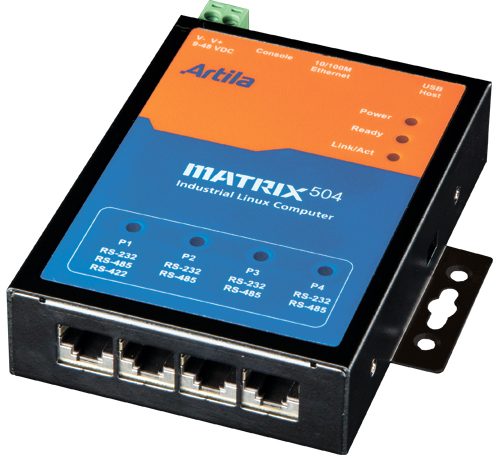
- Starter Kit Enclosure: 150 mm × 100 mm, fanless, DIN-rail mountable.
Environmental
- Operating Temperature: 0 °C – 70 °C.
4. Functionality
The M-503 Starter Kit provides a complete embedded computing platform for industrial control, automation, and networked device applications. The SoM runs a pre-installed Linux 2.6.38 kernel, booting from NAND Flash via U-Boot. Developers can access the system through serial console, SSH, or web-based administration (Webmin).
Typical Use Cases:
- Industrial automation controllers and gateways.
- Data acquisition and monitoring systems.
- Networked embedded devices and IoT gateways.
- Serial-to-Ethernet communication bridges.
- Embedded web servers and protocol converters.
Compatibility:
- Supports Linux and Windows development environments.
- Compatible with standard USB peripherals (Wi-Fi adapters, flash drives, webcams, keyboards, mice, 3G/ISDN modems, Bluetooth dongles).
- SD card and USB mass storage devices mountable via standard Linux commands.
5. Components & Accessories
Included in the Starter Kit:
- 1 × M-503 System-on-Module (SoM).
- 1 × Carrier Board with:
- Power circuitry.
- 3 × RS-232 ports.
- 1 × RS-232/422/485 configurable port.
- 1 × 10/100 Mbps Ethernet port.
- 2 × USB 2.0 host ports.
- 1 × SD card socket (rear side).
- 2 × GPIO connectors.
- Real-Time Clock and EEPROM.
- Local bus connector for expansion.
- Power supply interface and DIN-rail mountable enclosure.
- Pre-installed Linux OS and toolchain CD (GNU C/C++).
Optional Accessories:
- External JTAG debugger.
- Additional GPIO expansion modules.
- External RTC battery.
- USB Wi-Fi or Bluetooth adapters.
6. Installation & Setup
Hardware Setup:
1. Mount the M-503 SoM onto the carrier board via the 2.0 mm pitch connectors (CN1–CN3).
2. Connect power (3.3 VDC nominal).
3. Attach Ethernet, serial, and USB peripherals as required.
4. Insert SD card if external storage is needed.
5. Connect to the serial console (RS-232) for initial configuration.
Software Setup:
- The system boots via U-Boot from NAND Flash.
- Default OS: Linux kernel 2.6.38.
- Default IP: 192.168.2.127 / 255.255.255.0.
- Default logins:
- SSH: root / root
- Telnet: guest / guest
- Webmin available for browser-based administration.
- IPKG package manager for software installation and updates.
Mounting Options:
- DIN-rail mounting for industrial cabinets.
- Bench-top or panel installation via mounting holes.
7. Performance & Capabilities
- Processing Speed: 400 MHz ARM9 core with MMU ensures efficient multitasking and Linux compatibility.
- Memory Performance: 128 MB DDR2 SDRAM provides sufficient capacity for embedded applications and GUI-based environments.
- Storage: 256 MB NAND Flash with UBI/JFFS2 file system ensures reliable, wear-leveled storage; supports external SD cards up to 32 GB.
- Networking: 10/100 Mbps Ethernet with hardware isolation for robust industrial communication.
- Serial Communication: Four UARTs configurable for RS-232/422/485 enable flexible integration with legacy and modern serial devices.
- USB Throughput: High-speed USB 2.0 host (480 Mbps) supports mass storage and communication peripherals.
- Power Efficiency: Typical consumption of 2 W allows fanless operation and low thermal footprint.
- Reliability: Onboard watchdog timers (CPU and user-configurable) ensure system stability.
- Limitations:
- Single Ethernet interface.
- Limited to 3.3 V I/O levels.
- Operating temperature limited to 0–70 °C (non-extended range).
8. Standards & Compliance
- Operating System: Linux kernel 2.6.38 (open-source, POSIX compliant).
- USB Compliance: USB 2.0 specification (host and device).
- Ethernet Compliance: IEEE 802.3 10/100 Base-T.
- SD Card Compliance: SD 2.0 standard.
- Electrical Safety: 1.5 kV isolation on Ethernet interface.
- Software Standards:
- POSIX-compliant GLIBC libraries.
- IPKG package management system.
- Secure communication protocols (SSH 1/2, SSL).
- Regulatory Compliance: Designed for CE and FCC Class A industrial environments (manufacturer standard).
9. Additional Information
Warranty & Support:
- Standard manufacturer warranty (typically 1 year, extendable).
- Technical support via Artila’s online portal and documentation resources.
- Firmware and software updates available through Artila’s website.
Maintenance:
- Fanless design minimizes mechanical wear.
- NAND Flash with wear-leveling ensures long-term reliability.
- RTC battery (48 mAh lithium) replaceable when depleted.
Software Updates & Customization:
- Supports kernel and root filesystem updates via USB or network.
- Customizable bootloader (U-Boot) and startup scripts.
- User applications can be developed using the provided GNU toolchain.
Pre-installed Software Components:
- Utilities: bash, busybox, gtk+, x11, gpe, alsa, madplayer, sysvinit, wget, ipkg, lighttpd, vsftpd, iptables, ppp, openssh, wireless_tools, python, php, mysql, perl, qt4-embedded, sqlite3, snmp, and Artila utilities.
- Daemons: ssh (with sftp), syslog/klogd, telnetd, vsftpd, lighttpd, amgrd (Artila broadcast search daemon).
- Device Drivers: RTC, SD/MMC, UART, Ethernet, GPIO, Buzzer, EEPROM, Audio, USB mass storage, Wi-Fi, RS-232 adapters, webcams, modems, Bluetooth.
Development Environment:
- Toolchain: GCC C/C++ cross-compiler for ARM9.
- Libraries: GLIBC POSIX.
- Supported OS for Development: Linux and Windows.
- Web-based Administration: Webmin interface for configuration and monitoring.
Ordering Information:
- M-503 SoM: AT91SAM9G45 + Linux 2.6.38, 256 MB NAND Flash, 128 MB DDR2 SDRAM.
- M-503 Starter Kit: Includes M-503 SoM, carrier board, power circuitry, serial and USB interfaces, Ethernet, SD socket, GPIO connectors, RTC, EEPROM, and local bus connector.
Summary
The Artila M-503 Starter Kit is a robust, Linux-ready embedded development platform built around the Atmel AT91SAM9G45 ARM9 processor. It combines high connectivity, flexible I/O, and industrial-grade reliability in a compact, fanless design. With its pre-installed Linux environment, comprehensive toolchain, and versatile carrier board, the M-503 Starter Kit enables developers to accelerate embedded system design, prototyping, and deployment across a wide range of industrial and IoT applications.
Its combination of 400 MHz processing power, 128 MB DDR2 memory, 256 MB NAND Flash, and extensive peripheral support makes it ideal for networked embedded systems requiring stable Linux operation, multiple serial interfaces, and efficient power consumption. The inclusion of a full GNU development environment and Webmin-based administration further enhances usability, making the M-503 Starter Kit a complete, ready-to-deploy embedded computing solution.

Product Name: M-503 Starter Kit
Model: M-503
Series: M-500 Series Embedded System-on-Module (SoM)
Article Number: M-503-Starter-Kit
Manufacturer: Artila Electronics Co., Ltd.
The M-503 Starter Kit is a complete embedded development platform designed for rapid prototyping and deployment of ARM9-based Linux systems. It integrates the M-503 System-on-Module (SoM)—a Linux-ready ARM9 module based on the Atmel AT91SAM9G45 processor—with a fully featured carrier board, power circuitry, and a comprehensive Linux toolchain. The kit provides developers with a ready-to-use environment for embedded applications requiring Ethernet connectivity, multiple serial interfaces, USB host/device support, and extensive GPIO capabilities.
2. Key Features
- ARM9-based System-on-Module: Powered by the Atmel AT91SAM9G45 CPU running at 400 MHz with integrated Memory Management Unit (MMU).
- Pre-installed Linux OS: Linux kernel 2.6.38 with U-Boot bootloader and full file system support (UBI, JFFS2, EXT2/3, VFAT, NFS, NTFS).
- Comprehensive Development Environment: Includes GNU C/C++ cross-compilation toolchain for Linux and Windows, GLIBC POSIX libraries, and IPKG package management.
- High Connectivity:
- 1 × 10/100 Mbps Ethernet port with onboard PHY and transformer (DAVICOM DM9161).
- 4 × UARTs (RS-232/422/485 selectable) supporting up to 921.6 Kbps.
- 1 × USB 2.0 high-speed host (480 Mbps) and 1 × USB 2.0 device port.
- 1 × SD card interface (up to 32 GB, SD 2.0 compliant).
- I²C, I²S, and SPI interfaces for peripheral expansion.
- Extensive I/O: 32 programmable 3.3 V GPIO channels with interrupt support on PIO32.
- Integrated Real-Time Clock: ST M41T81 RTC with onboard lithium backup battery (48 mAh).
- Compact and Efficient: 80 × 50 mm SoM, 3.3 VDC input, typical power consumption 2 W.
- Carrier Board Integration: Provides additional RS-232/422/485 ports, dual USB hosts, Ethernet, SD socket, GPIO connectors, EEPROM, and local bus interface.
- Fanless, DIN-rail mountable enclosure: Suitable for industrial and embedded environments.
- Wide Operating Temperature Range: 0 °C to +70 °C.
3. Technical Specifications
Processor and Memory
- CPU: Atmel AT91SAM9G45, ARM926EJ-S core, 400 MHz, with MMU.
- Cache: 32 KB instruction cache, 32 KB data cache.
- System Memory: 128 MB DDR2 SDRAM.
- Flash Storage: 256 MB NAND Flash.
- DataFlash: 2 MB for system backup and bootloader.
Networking
- Ethernet: 1 × 10/100 Mbps interface with onboard PHY (DAVICOM DM9161).
- Isolation: 1.5 kV magnetic isolation.
- Signals: ETX+, ETX−, ERX+, ERX−.
Serial Communication
- UARTs: 4 × UARTs (TX, RX, RTS, CTS, optional DCD, DTR, DSR).
- Baud Rate: Up to 921.6 Kbps.
- Signal Level: CMOS 3.3 V compatible.
- Flow Control: RTS/CTS, XON/XOFF, or none.
- Parity: None, Even, Odd, Mark, Space.
- Stop Bits: 1, 1.5, or 2.
USB Interfaces
- Host Port: 1 × USB 2.0 high-speed (480 Mbps).
- Device Port: 1 × USB 2.0 full-speed (12 Mbps).
- Signals: USBA+, USBA− (host); Uddata+, Uddata−, Udio (device).
Peripheral Interfaces
- I²C: TWD, TWCK; supports EEPROM and RTC.
- I²S: TSCK, TWS, TSD (transmit); RSCK, RWS, RSD (receive).
- SPI: MISO, MOSI, SPCK, CS1, CS2; supports external flash and peripherals.
- SD Interface: MCCDA, MCCK, MCDA0–MCDA3, CD, WP; SD 2.0 compliant, up to 32 GB.
GPIO
- Count: 32 programmable I/O pins (PIO0–PIO31).
- Voltage: 3.3 V CMOS compatible.
- Interrupt Support: PIO32.
- Predefined Pins:
- Reset Button (CN2 pin 35)
- System Reset (CN2 pin 34)
- Buzzer (CN2 pin 37)
- System Ready LED (CN2 pin 38)
- LAN Activity LED (CN3 pin 11)
Real-Time Clock
- Chip: ST M41T81.
- Backup Battery: 48 mAh lithium cell (onboard).
- External Battery Input: CN1 pin 5.
Debug and Programming Interfaces
- Serial Console: RS-232 (Tx, Rx, GND).
- JTAG Interface: NTRST, TDI, TMS, TCK, TDO.
Power
- Input Voltage: 3.0 – 3.6 VDC (nominal 3.3 V).
- Power Consumption: 2 W typical.
Physical Characteristics
- Dimensions: 80 mm × 50 mm (SoM).
- Pin Count: 128 pins, 2.0 mm pitch (CN1: 28 pins; CN2: 50 pins; CN3: 50 pins).
- Mounting Holes: 2 × M2 (2.0 mm diameter).
- Starter Kit Enclosure: 150 mm × 100 mm, fanless, DIN-rail mountable.
Environmental
- Operating Temperature: 0 °C – 70 °C.
4. Functionality
The M-503 Starter Kit provides a complete embedded computing platform for industrial control, automation, and networked device applications. The SoM runs a pre-installed Linux 2.6.38 kernel, booting from NAND Flash via U-Boot. Developers can access the system through serial console, SSH, or web-based administration (Webmin).
Typical Use Cases:
- Industrial automation controllers and gateways.
- Data acquisition and monitoring systems.
- Networked embedded devices and IoT gateways.
- Serial-to-Ethernet communication bridges.
- Embedded web servers and protocol converters.
Compatibility:
- Supports Linux and Windows development environments.
- Compatible with standard USB peripherals (Wi-Fi adapters, flash drives, webcams, keyboards, mice, 3G/ISDN modems, Bluetooth dongles).
- SD card and USB mass storage devices mountable via standard Linux commands.
5. Components & Accessories
Included in the Starter Kit:
- 1 × M-503 System-on-Module (SoM).
- 1 × Carrier Board with:
- Power circuitry.
- 3 × RS-232 ports.
- 1 × RS-232/422/485 configurable port.
- 1 × 10/100 Mbps Ethernet port.
- 2 × USB 2.0 host ports.
- 1 × SD card socket (rear side).
- 2 × GPIO connectors.
- Real-Time Clock and EEPROM.
- Local bus connector for expansion.
- Power supply interface and DIN-rail mountable enclosure.
- Pre-installed Linux OS and toolchain CD (GNU C/C++).
Optional Accessories:
- External JTAG debugger.
- Additional GPIO expansion modules.
- External RTC battery.
- USB Wi-Fi or Bluetooth adapters.
6. Installation & Setup
Hardware Setup:
1. Mount the M-503 SoM onto the carrier board via the 2.0 mm pitch connectors (CN1–CN3).
2. Connect power (3.3 VDC nominal).
3. Attach Ethernet, serial, and USB peripherals as required.
4. Insert SD card if external storage is needed.
5. Connect to the serial console (RS-232) for initial configuration.
Software Setup:
- The system boots via U-Boot from NAND Flash.
- Default OS: Linux kernel 2.6.38.
- Default IP: 192.168.2.127 / 255.255.255.0.
- Default logins:
- SSH: root / root
- Telnet: guest / guest
- Webmin available for browser-based administration.
- IPKG package manager for software installation and updates.
Mounting Options:
- DIN-rail mounting for industrial cabinets.
- Bench-top or panel installation via mounting holes.
7. Performance & Capabilities
- Processing Speed: 400 MHz ARM9 core with MMU ensures efficient multitasking and Linux compatibility.
- Memory Performance: 128 MB DDR2 SDRAM provides sufficient capacity for embedded applications and GUI-based environments.
- Storage: 256 MB NAND Flash with UBI/JFFS2 file system ensures reliable, wear-leveled storage; supports external SD cards up to 32 GB.
- Networking: 10/100 Mbps Ethernet with hardware isolation for robust industrial communication.
- Serial Communication: Four UARTs configurable for RS-232/422/485 enable flexible integration with legacy and modern serial devices.
- USB Throughput: High-speed USB 2.0 host (480 Mbps) supports mass storage and communication peripherals.
- Power Efficiency: Typical consumption of 2 W allows fanless operation and low thermal footprint.
- Reliability: Onboard watchdog timers (CPU and user-configurable) ensure system stability.
- Limitations:
- Single Ethernet interface.
- Limited to 3.3 V I/O levels.
- Operating temperature limited to 0–70 °C (non-extended range).
8. Standards & Compliance
- Operating System: Linux kernel 2.6.38 (open-source, POSIX compliant).
- USB Compliance: USB 2.0 specification (host and device).
- Ethernet Compliance: IEEE 802.3 10/100 Base-T.
- SD Card Compliance: SD 2.0 standard.
- Electrical Safety: 1.5 kV isolation on Ethernet interface.
- Software Standards:
- POSIX-compliant GLIBC libraries.
- IPKG package management system.
- Secure communication protocols (SSH 1/2, SSL).
- Regulatory Compliance: Designed for CE and FCC Class A industrial environments (manufacturer standard).
9. Additional Information
Warranty & Support:
- Standard manufacturer warranty (typically 1 year, extendable).
- Technical support via Artila’s online portal and documentation resources.
- Firmware and software updates available through Artila’s website.
Maintenance:
- Fanless design minimizes mechanical wear.
- NAND Flash with wear-leveling ensures long-term reliability.
- RTC battery (48 mAh lithium) replaceable when depleted.
Software Updates & Customization:
- Supports kernel and root filesystem updates via USB or network.
- Customizable bootloader (U-Boot) and startup scripts.
- User applications can be developed using the provided GNU toolchain.
Pre-installed Software Components:
- Utilities: bash, busybox, gtk+, x11, gpe, alsa, madplayer, sysvinit, wget, ipkg, lighttpd, vsftpd, iptables, ppp, openssh, wireless_tools, python, php, mysql, perl, qt4-embedded, sqlite3, snmp, and Artila utilities.
- Daemons: ssh (with sftp), syslog/klogd, telnetd, vsftpd, lighttpd, amgrd (Artila broadcast search daemon).
- Device Drivers: RTC, SD/MMC, UART, Ethernet, GPIO, Buzzer, EEPROM, Audio, USB mass storage, Wi-Fi, RS-232 adapters, webcams, modems, Bluetooth.
Development Environment:
- Toolchain: GCC C/C++ cross-compiler for ARM9.
- Libraries: GLIBC POSIX.
- Supported OS for Development: Linux and Windows.
- Web-based Administration: Webmin interface for configuration and monitoring.
Ordering Information:
- M-503 SoM: AT91SAM9G45 + Linux 2.6.38, 256 MB NAND Flash, 128 MB DDR2 SDRAM.
- M-503 Starter Kit: Includes M-503 SoM, carrier board, power circuitry, serial and USB interfaces, Ethernet, SD socket, GPIO connectors, RTC, EEPROM, and local bus connector.
Summary
The Artila M-503 Starter Kit is a robust, Linux-ready embedded development platform built around the Atmel AT91SAM9G45 ARM9 processor. It combines high connectivity, flexible I/O, and industrial-grade reliability in a compact, fanless design. With its pre-installed Linux environment, comprehensive toolchain, and versatile carrier board, the M-503 Starter Kit enables developers to accelerate embedded system design, prototyping, and deployment across a wide range of industrial and IoT applications.
Its combination of 400 MHz processing power, 128 MB DDR2 memory, 256 MB NAND Flash, and extensive peripheral support makes it ideal for networked embedded systems requiring stable Linux operation, multiple serial interfaces, and efficient power consumption. The inclusion of a full GNU development environment and Webmin-based administration further enhances usability, making the M-503 Starter Kit a complete, ready-to-deploy embedded computing solution.

-
M-503_Datasheet.pdf
PDF Catalog
-
Warranty Declaration.pdf
PDF Catalog
-
M-502 User Guide.pdf
Manual
- CB-RJ45F9-150 - Data Cable DB9f Matrix-5xx series
- CB-RJ2Con-100 - Console Cable Matrix-5xx series