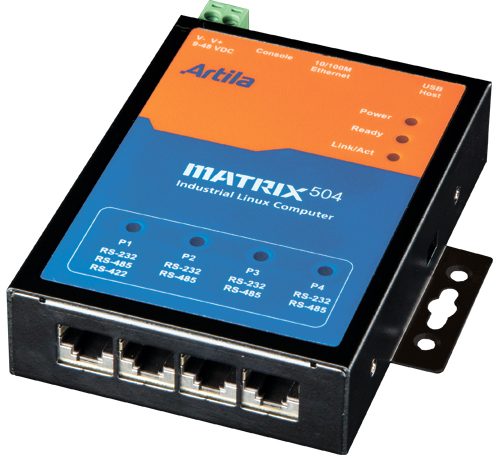
 SUCHEN SIE DIE PASSENDE
INDUSTRIELLE LÖSUNG?
Entdecken Sie Embedded-, Kommunikations- und Automatisierungslösungen für Ihre Anwendung.
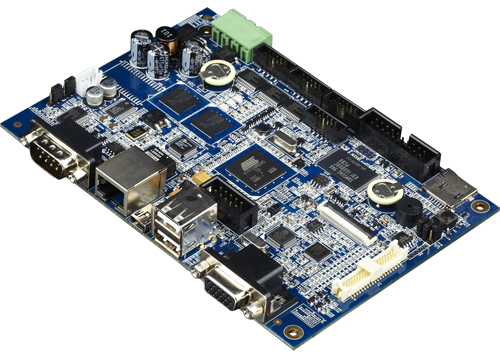
M-506
ARM-9 400MHz module 1*LAN 4*USB 4*GP DIO LCD Interface
200,00 EUR
inkl. Umsatzsteuer 238,00 EUR
- High-Performance ARM9 Processor: Powered by the Atmel AT91SAM9G45 400 MHz ARM926EJ-S core with integrated memory management unit (MMU), optimized for embedded Linux applications.
- Industrial Linux Platform: Pre-installed Linux 2.6.29 kernel with BusyBox utilities, lighttpd web server, and SSH/SSL support for secure remote management.
- Comprehensive Connectivity:
- 1 × 10/100 Mbps Ethernet port (DAVICOM DM9161 PHY with 1.5 kV isolation)
- 4 × USB 2.0 host ports (480 Mbps)
- 3 × RS-232 and 1 × RS-422/485 high-speed serial ports
- 4 × programmable GPIO channels
- LCD interface supporting LVDS/TTL displays up to 1280 × 860 resolution
- Integrated Storage: 128 MB SDRAM and 256 MB NAND Flash memory, with microSD expansion slot.
- Robust Industrial Design: Operates from 12 – 40 V DC input, with low power consumption (200 mA @ 12 V DC) and an operating temperature range of 0 °C – 70 °C.
- Software Development Support: Includes GNU C/C++ toolchain for Linux and Windows, Java accelerator, and full driver support for peripherals.
- Reliability Features: Hardware watchdog timer, real-time clock (RTC) with backup battery, and flash-based architecture for non-volatile operation.
- Compact Form Factor: 146 × 102 mm (3.5″ form factor), suitable for embedded integration.
- Industrial Linux Platform: Pre-installed Linux 2.6.29 kernel with BusyBox utilities, lighttpd web server, and SSH/SSL support for secure remote management.
- Comprehensive Connectivity:
- 1 × 10/100 Mbps Ethernet port (DAVICOM DM9161 PHY with 1.5 kV isolation)
- 4 × USB 2.0 host ports (480 Mbps)
- 3 × RS-232 and 1 × RS-422/485 high-speed serial ports
- 4 × programmable GPIO channels
- LCD interface supporting LVDS/TTL displays up to 1280 × 860 resolution
- Integrated Storage: 128 MB SDRAM and 256 MB NAND Flash memory, with microSD expansion slot.
- Robust Industrial Design: Operates from 12 – 40 V DC input, with low power consumption (200 mA @ 12 V DC) and an operating temperature range of 0 °C – 70 °C.
- Software Development Support: Includes GNU C/C++ toolchain for Linux and Windows, Java accelerator, and full driver support for peripherals.
- Reliability Features: Hardware watchdog timer, real-time clock (RTC) with backup battery, and flash-based architecture for non-volatile operation.
- Compact Form Factor: 146 × 102 mm (3.5″ form factor), suitable for embedded integration.
1. Product Overview
Product Name: M-506
Model: M-506
Series: ARM-9 Industrial Embedded Linux Module Series
Article Number: M-506
Manufacturer: Artila Electronics Co., Ltd.
The Artila M-506 is an industrial-grade embedded Linux computer module built around the ARM9 architecture, specifically the Atmel AT91SAM9G45 processor running at 400 MHz. Designed for robust industrial and embedded applications, the M-506 integrates a comprehensive set of communication interfaces, including Ethernet, USB, serial ports, GPIO, and LCD connectivity. It supports both LVDS and TTL LCD panels up to 1280 × 860 resolution and includes a 4-wire resistive touch screen interface. The module is preloaded with Linux kernel 2.6.29 and a web server environment, making it a ready-to-deploy platform for industrial automation, control, and monitoring systems.
2. Key Features
- High-Performance ARM9 Processor: Powered by the Atmel AT91SAM9G45 400 MHz ARM926EJ-S core with integrated memory management unit (MMU), optimized for embedded Linux applications.
- Industrial Linux Platform: Pre-installed Linux 2.6.29 kernel with BusyBox utilities, lighttpd web server, and SSH/SSL support for secure remote management.
- Comprehensive Connectivity:
- 1 × 10/100 Mbps Ethernet port (DAVICOM DM9161 PHY with 1.5 kV isolation)
- 4 × USB 2.0 host ports (480 Mbps)
- 3 × RS-232 and 1 × RS-422/485 high-speed serial ports
- 4 × programmable GPIO channels
- LCD interface supporting LVDS/TTL displays up to 1280 × 860 resolution
- Integrated Storage: 128 MB SDRAM and 256 MB NAND Flash memory, with microSD expansion slot.
- Robust Industrial Design: Operates from 12 – 40 V DC input, with low power consumption (200 mA @ 12 V DC) and an operating temperature range of 0 °C – 70 °C.
- Software Development Support: Includes GNU C/C++ toolchain for Linux and Windows, Java accelerator, and full driver support for peripherals.
- Reliability Features: Hardware watchdog timer, real-time clock (RTC) with backup battery, and flash-based architecture for non-volatile operation.
- Compact Form Factor: 146 × 102 mm (3.5″ form factor), suitable for embedded integration.
3. Technical Specifications
Processor and Memory
- CPU: Atmel AT91SAM9G45 ARM926EJ-S, 400 MHz
- RAM: 128 MB SDRAM
- Flash Memory: 256 MB NAND Flash
- Additional Storage: microSD card slot (SD 1.0 compatible)
- DataFlash: 2 MB (for system backup and bootloader)
Display and Input
- LCD Interface: LVDS/TTL, supports up to 1280 × 860 resolution
- Touch Screen: 4-wire resistive touch interface
Networking
- Ethernet: 1 × 10/100 Mbps (DAVICOM DM9161 PHY)
- Isolation: 1.5 kV magnetic isolation
Serial Communication
- RS-232 Ports: 3 × ports (TXD, RXD, RTS, CTS, DCD, DTR, DSR, GND)
- RS-422/485 Port: 1 × port with hardware auto-direction control and 9-bit multi-drop mode
- Baud Rate: Up to 921.6 kbps
- Parity: None, Even, Odd, Mark, Space
- Data Bits: 5, 6, 7, 8
- Stop Bits: 1, 1.5, 2
- Flow Control: RTS/CTS, XON/XOFF, None
USB Interfaces
- USB Host: 4 × USB 2.0 (480 Mbps)
- USB Device (Client): 1 × USB 2.0
Digital I/O
- GPIO: 4 × programmable channels (CMOS 3.3 V compatible)
Additional Interfaces
- I²C Bus: TWD, TWCK signals
- SPI Bus: MISO, MOSI, SPCK, CS1, CS2
- I²S Bus: TSCK, TWS, TSD (TX); RSCK, RWS, RSD (RX)
- Local Bus: 8-bit data and address bus with 4 chip selects
Power and Environmental
- Input Voltage: 12 – 40 V DC
- Power Consumption: 200 mA @ 12 V DC (approx. 2 W)
- Operating Temperature: 0 °C – 70 °C
- Dimensions: 146 × 102 mm (3.5″ form factor)
- Weight: Approx. 100 g (typical)
Mechanical
- Mounting: 4 × M2 mounting holes
- Connectors: 2.0 mm pitch, CN1 (28 pins), CN2 (50 pins), CN3 (50 pins)
4. Functionality
The M-506 functions as a compact, embedded Linux computer designed for industrial automation, control, and monitoring. It operates as a standalone system or as part of a larger networked environment. The ARM9 processor executes Linux-based applications, while the integrated peripherals handle communication, data acquisition, and control tasks.
Typical Use Cases:
- Industrial control panels and HMIs with LCD and touch input
- Intelligent transportation systems (ITS)
- Building automation and energy management
- Remote data logging and monitoring
- Embedded web servers for equipment management
- Protocol gateways and communication controllers
Compatibility:
- Compatible with standard Linux 2.6.x kernel drivers
- Supports GNU C/C++ toolchain for cross-platform development
- Works with standard Ethernet, USB, and serial peripherals
- Supports SD memory cards, USB flash drives, Wi-Fi adapters, and serial converters
5. Components & Accessories
Included Components:
- M-506 main module
- Pre-installed Linux 2.6.29 OS with web server and utilities
- RTC with lithium backup battery (48 mAh)
- Watchdog timer and buzzer
- System-ready and LAN activity LEDs
Optional Accessories:
- LCD display panels (LVDS/TTL compatible)
- 4-wire resistive touch screen
- microSD memory card
- USB Wi-Fi adapters (Ralink RT73USB, RT2500USB, Realtek RTL8187, ZyDAS ZD1211RW)
- USB-to-RS232 adapters (Prolific PL-2303)
- USB Ethernet adapters (Realtek RT8150)
- ADSL or ISDN modems (CDC/ACM compatible)
Connectors:
- CN1: 28-pin I/O connector
- CN2: 50-pin system connector (GPIO, control signals)
- CN3: 50-pin peripheral connector (LAN, USB, SPI, I²C, etc.)
6. Installation & Setup
Power Requirements:
The M-506 operates from a 12 – 40 V DC power source. The typical consumption is 200 mA @ 12 V DC. Ensure a regulated power supply with adequate current capacity.
Mounting Options:
The module features four M2 mounting holes for secure installation on a carrier board or enclosure. The 3.5″ form factor allows integration into standard embedded housings.
Configuration:
- Bootloader: U-Boot 1.3.4 pre-installed for system initialization and firmware updates.
- OS Setup: Linux 2.6.29 with BusyBox and lighttpd web server preconfigured.
- Network Configuration: Default Ethernet interface supports DHCP or static IP assignment.
- Serial Console: Accessible via RS-232 console port for low-level configuration.
- Software Development: Cross-compilation supported via GNU GCC toolchain for Linux/Windows.
Startup Procedure:
1. Connect power supply (12 – 40 V DC).
2. Connect Ethernet or serial console for configuration.
3. Boot Linux kernel (U-Boot handles boot sequence).
4. Access system via SSH, Telnet, or web interface.
7. Performance & Capabilities
Processing Performance:
The 400 MHz ARM926EJ-S core provides efficient performance for embedded control, networking, and web-based applications. The integrated MMU enables full Linux operation with multitasking and memory protection.
Memory and Storage:
128 MB SDRAM and 256 MB NAND Flash provide sufficient capacity for embedded applications, with additional microSD expansion for data logging or firmware updates.
Networking:
10/100 Mbps Ethernet with 1.5 kV isolation ensures reliable industrial communication. The module supports TCP/IP, SSH, FTP, HTTP, and other standard protocols.
USB Performance:
Four USB 2.0 host ports (480 Mbps) support a wide range of peripherals, including storage devices, Wi-Fi adapters, and serial converters.
Serial Communication:
High-speed UARTs (up to 921.6 kbps) with RS-232 and RS-485 support enable integration with industrial sensors, PLCs, and controllers.
Power Efficiency:
Low power consumption (~2 W) allows deployment in energy-sensitive environments.
Limitations:
- Operating temperature limited to 0 °C – 70 °C (not suitable for extreme outdoor environments without additional protection).
- Single Ethernet interface (no built-in redundancy).
- Limited onboard RAM (128 MB) may constrain memory-intensive applications.
8. Standards & Compliance
Electrical and Safety:
- 1.5 kV magnetic isolation on Ethernet port
- CMOS/3.3 V logic levels for all digital I/O
- Compliant with industrial EMC design practices
Software and Protocol Standards:
- Linux 2.6.29 kernel compliant with POSIX standards
- Supports TCP/IP, SSH 1.0/2.0, SSL, FTP, HTTP, and NFS protocols
- File systems: UBI, JFFS2, EXT2/EXT3, VFAT/FAT, NFS
Regulatory Compliance:
- Designed for industrial embedded applications following CE and FCC Class A guidelines (manufacturer standard)
- RoHS-compliant components
Industry Standards:
- ARM9 architecture (ARM926EJ-S)
- USB 2.0, Ethernet 10/100 Base-T, RS-232/422/485 serial communication standards
- SD 1.0 memory card specification
9. Additional Information
Warranty:
Standard manufacturer warranty (typically 1 year) covering defects in materials and workmanship.
Technical Support:
Artila provides technical documentation, software updates, and developer support via sales@artila.com and the official website www.artila.com.
Maintenance:
- Linux OS and utilities can be updated via network or USB.
- Flash memory supports firmware reprogramming through U-Boot or SSH.
- RTC battery (48 mAh lithium) should be replaced periodically for timekeeping accuracy.
Software Updates and Development Tools:
- Pre-installed utilities: bash, BusyBox, sysvinit, wget, ipkg, procps, psmisc, lighttpd, vsftpd, iptables, ppp, ssh, wireless_tools, util-linux, usbutils, and Artila utilities.
- Package management via ipkg for installation, upgrade, and removal of software packages.
- Web-based system administration supported through webmin (installable via ipkg).
- Default daemons: SSH (with SFTP), syslog/klogd, Telnet (root disabled), FTP (vsftpd), lighttpd web server, and Artila broadcast search daemon (amgrd).
Development Environment:
- GNU GCC C/C++ cross-compiler
- GLIBC POSIX library
- Full driver support for RTC, SD/MMC, UART, Ethernet, GPIO, and EEPROM (AT24C16 compatible)
Reliability Features:
- Dual watchdog timers (CPU internal and user-available)
- Flash-based architecture for non-volatile operation
- System-ready and LAN activity LEDs for status indication
- Hardware buzzer and reset button for diagnostics
Ordering Information:
- Model: M-506
- Processor: Atmel AT91SAM9G45, 400 MHz
- Memory: 128 MB SDRAM, 256 MB NAND Flash
- Operating System: Linux 2.6.29 pre-installed
- Form Factor: 3.5″ (146 × 102 mm)
Summary
The Artila M-506 is a compact, industrial-grade ARM9-based embedded Linux computer designed for demanding automation and control applications. With its 400 MHz processor, comprehensive I/O interfaces, and preloaded Linux environment, it provides a robust and flexible platform for system integrators and developers. The module’s combination of Ethernet, USB, serial, and GPIO connectivity, along with LCD and touch screen support, makes it ideal for human-machine interfaces, data acquisition systems, and networked controllers. Its low power consumption, wide input voltage range, and industrial temperature tolerance ensure reliable operation in diverse environments.
The M-506 exemplifies Artila’s commitment to providing open, Linux-based embedded solutions that simplify development, reduce time-to-market, and deliver long-term reliability for industrial and embedded applications.
Product Name: M-506
Model: M-506
Series: ARM-9 Industrial Embedded Linux Module Series
Article Number: M-506
Manufacturer: Artila Electronics Co., Ltd.
The Artila M-506 is an industrial-grade embedded Linux computer module built around the ARM9 architecture, specifically the Atmel AT91SAM9G45 processor running at 400 MHz. Designed for robust industrial and embedded applications, the M-506 integrates a comprehensive set of communication interfaces, including Ethernet, USB, serial ports, GPIO, and LCD connectivity. It supports both LVDS and TTL LCD panels up to 1280 × 860 resolution and includes a 4-wire resistive touch screen interface. The module is preloaded with Linux kernel 2.6.29 and a web server environment, making it a ready-to-deploy platform for industrial automation, control, and monitoring systems.
2. Key Features
- High-Performance ARM9 Processor: Powered by the Atmel AT91SAM9G45 400 MHz ARM926EJ-S core with integrated memory management unit (MMU), optimized for embedded Linux applications.
- Industrial Linux Platform: Pre-installed Linux 2.6.29 kernel with BusyBox utilities, lighttpd web server, and SSH/SSL support for secure remote management.
- Comprehensive Connectivity:
- 1 × 10/100 Mbps Ethernet port (DAVICOM DM9161 PHY with 1.5 kV isolation)
- 4 × USB 2.0 host ports (480 Mbps)
- 3 × RS-232 and 1 × RS-422/485 high-speed serial ports
- 4 × programmable GPIO channels
- LCD interface supporting LVDS/TTL displays up to 1280 × 860 resolution
- Integrated Storage: 128 MB SDRAM and 256 MB NAND Flash memory, with microSD expansion slot.
- Robust Industrial Design: Operates from 12 – 40 V DC input, with low power consumption (200 mA @ 12 V DC) and an operating temperature range of 0 °C – 70 °C.
- Software Development Support: Includes GNU C/C++ toolchain for Linux and Windows, Java accelerator, and full driver support for peripherals.
- Reliability Features: Hardware watchdog timer, real-time clock (RTC) with backup battery, and flash-based architecture for non-volatile operation.
- Compact Form Factor: 146 × 102 mm (3.5″ form factor), suitable for embedded integration.
3. Technical Specifications
Processor and Memory
- CPU: Atmel AT91SAM9G45 ARM926EJ-S, 400 MHz
- RAM: 128 MB SDRAM
- Flash Memory: 256 MB NAND Flash
- Additional Storage: microSD card slot (SD 1.0 compatible)
- DataFlash: 2 MB (for system backup and bootloader)
Display and Input
- LCD Interface: LVDS/TTL, supports up to 1280 × 860 resolution
- Touch Screen: 4-wire resistive touch interface
Networking
- Ethernet: 1 × 10/100 Mbps (DAVICOM DM9161 PHY)
- Isolation: 1.5 kV magnetic isolation
Serial Communication
- RS-232 Ports: 3 × ports (TXD, RXD, RTS, CTS, DCD, DTR, DSR, GND)
- RS-422/485 Port: 1 × port with hardware auto-direction control and 9-bit multi-drop mode
- Baud Rate: Up to 921.6 kbps
- Parity: None, Even, Odd, Mark, Space
- Data Bits: 5, 6, 7, 8
- Stop Bits: 1, 1.5, 2
- Flow Control: RTS/CTS, XON/XOFF, None
USB Interfaces
- USB Host: 4 × USB 2.0 (480 Mbps)
- USB Device (Client): 1 × USB 2.0
Digital I/O
- GPIO: 4 × programmable channels (CMOS 3.3 V compatible)
Additional Interfaces
- I²C Bus: TWD, TWCK signals
- SPI Bus: MISO, MOSI, SPCK, CS1, CS2
- I²S Bus: TSCK, TWS, TSD (TX); RSCK, RWS, RSD (RX)
- Local Bus: 8-bit data and address bus with 4 chip selects
Power and Environmental
- Input Voltage: 12 – 40 V DC
- Power Consumption: 200 mA @ 12 V DC (approx. 2 W)
- Operating Temperature: 0 °C – 70 °C
- Dimensions: 146 × 102 mm (3.5″ form factor)
- Weight: Approx. 100 g (typical)
Mechanical
- Mounting: 4 × M2 mounting holes
- Connectors: 2.0 mm pitch, CN1 (28 pins), CN2 (50 pins), CN3 (50 pins)
4. Functionality
The M-506 functions as a compact, embedded Linux computer designed for industrial automation, control, and monitoring. It operates as a standalone system or as part of a larger networked environment. The ARM9 processor executes Linux-based applications, while the integrated peripherals handle communication, data acquisition, and control tasks.
Typical Use Cases:
- Industrial control panels and HMIs with LCD and touch input
- Intelligent transportation systems (ITS)
- Building automation and energy management
- Remote data logging and monitoring
- Embedded web servers for equipment management
- Protocol gateways and communication controllers
Compatibility:
- Compatible with standard Linux 2.6.x kernel drivers
- Supports GNU C/C++ toolchain for cross-platform development
- Works with standard Ethernet, USB, and serial peripherals
- Supports SD memory cards, USB flash drives, Wi-Fi adapters, and serial converters
5. Components & Accessories
Included Components:
- M-506 main module
- Pre-installed Linux 2.6.29 OS with web server and utilities
- RTC with lithium backup battery (48 mAh)
- Watchdog timer and buzzer
- System-ready and LAN activity LEDs
Optional Accessories:
- LCD display panels (LVDS/TTL compatible)
- 4-wire resistive touch screen
- microSD memory card
- USB Wi-Fi adapters (Ralink RT73USB, RT2500USB, Realtek RTL8187, ZyDAS ZD1211RW)
- USB-to-RS232 adapters (Prolific PL-2303)
- USB Ethernet adapters (Realtek RT8150)
- ADSL or ISDN modems (CDC/ACM compatible)
Connectors:
- CN1: 28-pin I/O connector
- CN2: 50-pin system connector (GPIO, control signals)
- CN3: 50-pin peripheral connector (LAN, USB, SPI, I²C, etc.)
6. Installation & Setup
Power Requirements:
The M-506 operates from a 12 – 40 V DC power source. The typical consumption is 200 mA @ 12 V DC. Ensure a regulated power supply with adequate current capacity.
Mounting Options:
The module features four M2 mounting holes for secure installation on a carrier board or enclosure. The 3.5″ form factor allows integration into standard embedded housings.
Configuration:
- Bootloader: U-Boot 1.3.4 pre-installed for system initialization and firmware updates.
- OS Setup: Linux 2.6.29 with BusyBox and lighttpd web server preconfigured.
- Network Configuration: Default Ethernet interface supports DHCP or static IP assignment.
- Serial Console: Accessible via RS-232 console port for low-level configuration.
- Software Development: Cross-compilation supported via GNU GCC toolchain for Linux/Windows.
Startup Procedure:
1. Connect power supply (12 – 40 V DC).
2. Connect Ethernet or serial console for configuration.
3. Boot Linux kernel (U-Boot handles boot sequence).
4. Access system via SSH, Telnet, or web interface.
7. Performance & Capabilities
Processing Performance:
The 400 MHz ARM926EJ-S core provides efficient performance for embedded control, networking, and web-based applications. The integrated MMU enables full Linux operation with multitasking and memory protection.
Memory and Storage:
128 MB SDRAM and 256 MB NAND Flash provide sufficient capacity for embedded applications, with additional microSD expansion for data logging or firmware updates.
Networking:
10/100 Mbps Ethernet with 1.5 kV isolation ensures reliable industrial communication. The module supports TCP/IP, SSH, FTP, HTTP, and other standard protocols.
USB Performance:
Four USB 2.0 host ports (480 Mbps) support a wide range of peripherals, including storage devices, Wi-Fi adapters, and serial converters.
Serial Communication:
High-speed UARTs (up to 921.6 kbps) with RS-232 and RS-485 support enable integration with industrial sensors, PLCs, and controllers.
Power Efficiency:
Low power consumption (~2 W) allows deployment in energy-sensitive environments.
Limitations:
- Operating temperature limited to 0 °C – 70 °C (not suitable for extreme outdoor environments without additional protection).
- Single Ethernet interface (no built-in redundancy).
- Limited onboard RAM (128 MB) may constrain memory-intensive applications.
8. Standards & Compliance
Electrical and Safety:
- 1.5 kV magnetic isolation on Ethernet port
- CMOS/3.3 V logic levels for all digital I/O
- Compliant with industrial EMC design practices
Software and Protocol Standards:
- Linux 2.6.29 kernel compliant with POSIX standards
- Supports TCP/IP, SSH 1.0/2.0, SSL, FTP, HTTP, and NFS protocols
- File systems: UBI, JFFS2, EXT2/EXT3, VFAT/FAT, NFS
Regulatory Compliance:
- Designed for industrial embedded applications following CE and FCC Class A guidelines (manufacturer standard)
- RoHS-compliant components
Industry Standards:
- ARM9 architecture (ARM926EJ-S)
- USB 2.0, Ethernet 10/100 Base-T, RS-232/422/485 serial communication standards
- SD 1.0 memory card specification
9. Additional Information
Warranty:
Standard manufacturer warranty (typically 1 year) covering defects in materials and workmanship.
Technical Support:
Artila provides technical documentation, software updates, and developer support via sales@artila.com and the official website www.artila.com.
Maintenance:
- Linux OS and utilities can be updated via network or USB.
- Flash memory supports firmware reprogramming through U-Boot or SSH.
- RTC battery (48 mAh lithium) should be replaced periodically for timekeeping accuracy.
Software Updates and Development Tools:
- Pre-installed utilities: bash, BusyBox, sysvinit, wget, ipkg, procps, psmisc, lighttpd, vsftpd, iptables, ppp, ssh, wireless_tools, util-linux, usbutils, and Artila utilities.
- Package management via ipkg for installation, upgrade, and removal of software packages.
- Web-based system administration supported through webmin (installable via ipkg).
- Default daemons: SSH (with SFTP), syslog/klogd, Telnet (root disabled), FTP (vsftpd), lighttpd web server, and Artila broadcast search daemon (amgrd).
Development Environment:
- GNU GCC C/C++ cross-compiler
- GLIBC POSIX library
- Full driver support for RTC, SD/MMC, UART, Ethernet, GPIO, and EEPROM (AT24C16 compatible)
Reliability Features:
- Dual watchdog timers (CPU internal and user-available)
- Flash-based architecture for non-volatile operation
- System-ready and LAN activity LEDs for status indication
- Hardware buzzer and reset button for diagnostics
Ordering Information:
- Model: M-506
- Processor: Atmel AT91SAM9G45, 400 MHz
- Memory: 128 MB SDRAM, 256 MB NAND Flash
- Operating System: Linux 2.6.29 pre-installed
- Form Factor: 3.5″ (146 × 102 mm)
Summary
The Artila M-506 is a compact, industrial-grade ARM9-based embedded Linux computer designed for demanding automation and control applications. With its 400 MHz processor, comprehensive I/O interfaces, and preloaded Linux environment, it provides a robust and flexible platform for system integrators and developers. The module’s combination of Ethernet, USB, serial, and GPIO connectivity, along with LCD and touch screen support, makes it ideal for human-machine interfaces, data acquisition systems, and networked controllers. Its low power consumption, wide input voltage range, and industrial temperature tolerance ensure reliable operation in diverse environments.
The M-506 exemplifies Artila’s commitment to providing open, Linux-based embedded solutions that simplify development, reduce time-to-market, and deliver long-term reliability for industrial and embedded applications.
-
 M-502_Data-Sheet.pdf
PDF Catalog
M-502_Data-Sheet.pdf
PDF Catalog
-
 Warranty Declaration.pdf
PDF Catalog
Warranty Declaration.pdf
PDF Catalog
Kein Zubehör vorhanden.