DK-35A
SUCHEN SIE DIE PASSENDE
INDUSTRIELLE LÖSUNG?
Entdecken Sie Embedded-, Kommunikations- und Automatisierungslösungen für Ihre Anwendung.
- ARM9 Processor Platform: Based on the Atmel AT91RM9200 (ARM920T core) with integrated MMU, delivering up to 200 MIPS at 180 MHz.
- Pre-installed Linux OS: Fully compatible with Linux kernel 2.6.x, supporting standard file systems (JFFS2, EXT2/3, VFAT, NFS).
- Integrated Web Server: Includes Boa HTTP server, SSH, SSL, and SNMP v1/v2 for secure remote management.
- Multiple Serial Interfaces: Four high-speed serial ports (up to 921.6 Kbps) with flexible configuration:
- Port 1: RS-232/422/485 selectable
- Ports 2–4: RS-232 (Port 2 supports full modem signals)
- Networking: One 10/100 Mbps Ethernet port with 1.5 kV magnetic isolation.
- USB Expansion: Two USB 2.0 host ports supporting flash drives, Wi-Fi dongles (IEEE 802.11b/g), USB-to-Serial, and CDC modems.
- Digital I/O: 16 programmable GPIO channels (TTL compatible).
- Storage Expansion: Internal SD card slot (SD 1.0 compliant, up to 2 GB non-SDHC).
- Compact and Fanless Design: Dimensions 78 × 108 × 24 mm, metal enclosure, DIN-rail mountable.
- Low Power Consumption: Less than 3 W, operating from 9–48 VDC input.
- Wide Temperature Range: Operational from -20°C to +80°C (industrial version).
- Development Ready: Includes GNU C/C++ cross-compiler, GLIBC POSIX library, and U-Boot 1.1.2 bootloader.
- Security and Protocol Support: SSH 1.0/2.0, SSL, TCP/IP stack, DHCP, FTP, Telnet, PPP, SNMP, SMTP, and firewall (iptables).
- Pre-installed Linux OS: Fully compatible with Linux kernel 2.6.x, supporting standard file systems (JFFS2, EXT2/3, VFAT, NFS).
- Integrated Web Server: Includes Boa HTTP server, SSH, SSL, and SNMP v1/v2 for secure remote management.
- Multiple Serial Interfaces: Four high-speed serial ports (up to 921.6 Kbps) with flexible configuration:
- Port 1: RS-232/422/485 selectable
- Ports 2–4: RS-232 (Port 2 supports full modem signals)
- Networking: One 10/100 Mbps Ethernet port with 1.5 kV magnetic isolation.
- USB Expansion: Two USB 2.0 host ports supporting flash drives, Wi-Fi dongles (IEEE 802.11b/g), USB-to-Serial, and CDC modems.
- Digital I/O: 16 programmable GPIO channels (TTL compatible).
- Storage Expansion: Internal SD card slot (SD 1.0 compliant, up to 2 GB non-SDHC).
- Compact and Fanless Design: Dimensions 78 × 108 × 24 mm, metal enclosure, DIN-rail mountable.
- Low Power Consumption: Less than 3 W, operating from 9–48 VDC input.
- Wide Temperature Range: Operational from -20°C to +80°C (industrial version).
- Development Ready: Includes GNU C/C++ cross-compiler, GLIBC POSIX library, and U-Boot 1.1.2 bootloader.
- Security and Protocol Support: SSH 1.0/2.0, SSL, TCP/IP stack, DHCP, FTP, Telnet, PPP, SNMP, SMTP, and firewall (iptables).
1. Product Overview
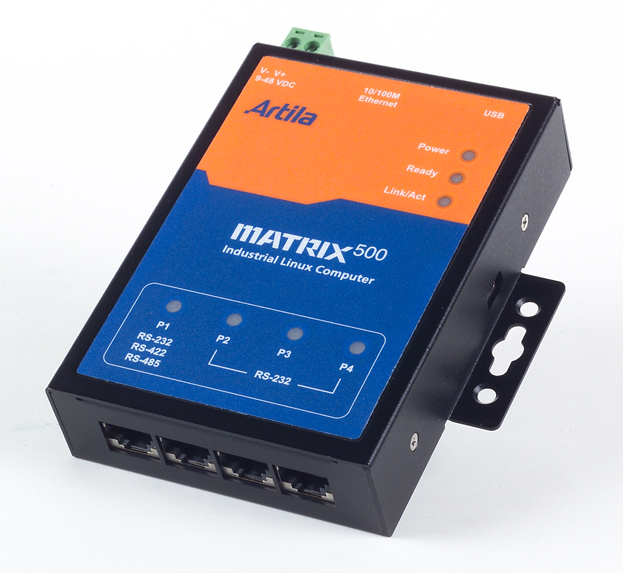
Product Name: Matrix-500T
Model / Series: Matrix-500 Series
Article Number: Matrix-500T
Manufacturer: Artila Electronics Co., Ltd.
Product Type: ARM9-based Industrial Embedded Linux Computer / Web Server
The Artila Matrix-500T is a compact, fanless, industrial-grade embedded computer built around the Atmel AT91RM9200 ARM9 processor running at 180 MHz. Designed for headless, run-only embedded applications, it integrates multiple serial interfaces, Ethernet, USB, and digital I/O in a rugged metal enclosure suitable for DIN-rail mounting. The device is preloaded with Linux kernel 2.6.x and includes a GNU C/C++ toolchain for both Linux and Windows development environments. With its low power consumption, wide operating temperature range, and versatile connectivity, the Matrix-500T serves as a reliable platform for industrial automation, remote monitoring, and networked control systems.
2. Key Features
- ARM9 Processor Platform: Based on the Atmel AT91RM9200 (ARM920T core) with integrated MMU, delivering up to 200 MIPS at 180 MHz.
- Pre-installed Linux OS: Fully compatible with Linux kernel 2.6.x, supporting standard file systems (JFFS2, EXT2/3, VFAT, NFS).
- Integrated Web Server: Includes Boa HTTP server, SSH, SSL, and SNMP v1/v2 for secure remote management.
- Multiple Serial Interfaces: Four high-speed serial ports (up to 921.6 Kbps) with flexible configuration:
- Port 1: RS-232/422/485 selectable
- Ports 2–4: RS-232 (Port 2 supports full modem signals)
- Networking: One 10/100 Mbps Ethernet port with 1.5 kV magnetic isolation.
- USB Expansion: Two USB 2.0 host ports supporting flash drives, Wi-Fi dongles (IEEE 802.11b/g), USB-to-Serial, and CDC modems.
- Digital I/O: 16 programmable GPIO channels (TTL compatible).
- Storage Expansion: Internal SD card slot (SD 1.0 compliant, up to 2 GB non-SDHC).
- Compact and Fanless Design: Dimensions 78 × 108 × 24 mm, metal enclosure, DIN-rail mountable.
- Low Power Consumption: Less than 3 W, operating from 9–48 VDC input.
- Wide Temperature Range: Operational from -20°C to +80°C (industrial version).
- Development Ready: Includes GNU C/C++ cross-compiler, GLIBC POSIX library, and U-Boot 1.1.2 bootloader.
- Security and Protocol Support: SSH 1.0/2.0, SSL, TCP/IP stack, DHCP, FTP, Telnet, PPP, SNMP, SMTP, and firewall (iptables).
3. Technical Specifications
Processor & Memory
- CPU: Atmel AT91RM9200 (ARM9, 180 MHz, with MMU)
- Performance: 200 MIPS
- Cache: 16 KB instruction + 16 KB data cache
- SDRAM: 64 MB
- Flash Memory: 16 MB NOR type
Networking
- Interface: 10/100Base-T Ethernet (RJ45)
- Isolation: 1.5 kV magnetic isolation
- Protocols: IPv4, TCP/IP, UDP, DHCP, NTP, SNMP, SSL, SSH
Serial Communication
- Ports: 4 × TTY (RJ45 connectors)
- Port 1: RS-232/422/485 selectable
- Port 2: RS-232 (full modem control)
- Ports 3–4: RS-232
- Baud Rate: Up to 921.6 Kbps
- Data Bits: 5, 6, 7, 8
- Stop Bits: 1, 1.5, 2
- Parity: None, Even, Odd, Mark, Space
- Flow Control: RTS/CTS, XON/XOFF, None
USB Interface
- Ports: 2 × USB 2.0 Host
- Data Rate: Low-speed (1.5 Mbps) and full-speed (12 Mbps)
- Supported Devices: Flash drives, Wi-Fi dongles (Ralink RT2571), USB-to-Serial (FTDI), CDC modems, USB cameras
Digital I/O (GPIO)
- Channels: 16 programmable I/O lines
- Logic Level: TTL compatible
- Connector: 20-pin header, 2.54 mm pitch
- Device Node: /dev/gpio
Storage
- Internal SD slot (SD 1.0 compliant, up to 2 GB)
- File Systems: JFFS2, EXT2/3, VFAT/FAT, NFS
Power & Environmental
- Input Voltage: 9–48 VDC
- Power Consumption: 220–300 mA @ 12 VDC (≈3 W)
- Operating Temperature: 0–70°C (standard), -20–80°C (industrial)
- Humidity: 5–95% non-condensing
- Watchdog Timer: Yes
- Real-Time Clock: Yes
- Buzzer: Yes
Physical Characteristics
- Dimensions: 78 × 108 × 24 mm
- Weight: Approx. 250 g
- Enclosure: Metal, fanless
- Mounting: DIN-rail or panel mount (optional DK-35A kit)
Regulatory Compliance
- CE Class A
- FCC Class A
4. Functionality
The Matrix-500T functions as a standalone embedded Linux computer capable of hosting web-based applications, data acquisition, and industrial control tasks. It operates without a display (headless mode) and can be accessed via Ethernet, SSH, or serial console.
Typical Use Cases:
- Industrial automation controllers
- Remote data logging and monitoring
- Web-based HMI or SCADA gateways
- Serial-to-Ethernet communication bridges
- IoT edge computing nodes
- Secure remote device management
Operation:
Upon power-up, the system loads the Linux kernel and root filesystem from flash into RAMDISK. The Ready LED indicates system status. Users can interact via SSH, Telnet, or web interface. The device supports both wired and wireless networking (via USB Wi-Fi adapter).
Compatibility:
- Compatible with Linux and Windows development environments
- Supports standard TCP/IP networking and POSIX-compliant applications
- Works with USB peripherals and SD storage
5. Components & Accessories
Included Items:
1. Matrix-500T main unit
2. Artila CD-ROM containing:
- GNU toolchain (Linux and Cygwin versions)
- User guide and installation manuals
- Example programs and utilities
Optional Accessories:
- CB-RJ45F9-150: RJ45 to DB9 female serial cable
- CB-RJ2CON-100: Serial console cable
- DK-35A: DIN-rail mounting kit
- PWR-12V-1A: 110–240 VAC to 12 VDC power adapter
Internal Connectors (for advanced users):
- CN7: 16-channel GPIO header (20-pin, 2.54 mm)
- CN6: SPI header (5-pin, 20 mm pitch)
- CN1: JTAG connector
- JP2: Serial debug port (TTL level, 4-pin)
- JP1: Boot manager selection jumper (factory default 2–3 position)
6. Installation & Setup
Power Connection:
Connect a regulated 9–48 VDC power source to the terminal block. The Power LED will illuminate solid green when power is applied.
Network Configuration:
Default IP: 192.168.2.127
Default login:
- User: guest / Password: guest
- Supervisor: root / Password: root
To change network settings, edit `/disk/etc/rc` or use commands:
```
ifconfig eth0 192.168.2.xxx netmask 255.255.255.0
dhcpcd eth0 &
```
Wireless Setup:
Insert a supported USB Wi-Fi dongle (Ralink RT2571). Configure using:
```
modprobe rt73
ifconfig wlan0 up
iwconfig wlan0 essid <SSID> key <KEY> mode managed
dhcpcd wlan0 &
```
Serial Console Access:
The serial console (ttyS0) shares pins with Port 3 (P3). Use the CB-RJ2CON-100 cable and terminal settings:
- Baud rate: 115200
- Data bits: 8
- Parity: None
- Stop bits: 1
- Flow control: None
- Terminal type: VT100
Mounting:
Use the optional DK-35A DIN-rail kit for industrial cabinet installation.
Software Setup:
The system boots automatically into Linux. The Ready LED indicates successful boot. Configuration files reside in `/disk/etc` and `/home`.
7. Performance & Capabilities
- Processing Power: 180 MHz ARM9 CPU, 200 MIPS performance
- Memory Utilization: 64 MB SDRAM (8 MB for RAMDISK, 16 MB for user applications)
- Storage: 16 MB onboard flash (approx. 12 MB user space), expandable via SD card (up to 2 GB)
- Networking: 10/100 Mbps Ethernet throughput; optional Wi-Fi via USB
- Serial Communication: Four ports up to 921.6 Kbps; supports RS-232/422/485
- Power Efficiency: <3 W typical consumption
- Reliability: Watchdog timer, RTC, and solid-state storage ensure robust operation
- Limitations: SD slot supports only SD 1.0 (non-SDHC); limited flash storage for large applications
8. Standards & Compliance
- Operating System: Linux kernel 2.6.x
- Bootloader: U-Boot 1.1.2
- File Systems: JFFS2, EXT2/3, VFAT, NFS
- Network Protocols: IPv4, TCP, UDP, FTP, Telnet, HTTP, PPP, PPPoE, DHCP, NTP, SMTP, SNMP v1/v2, SSL, SSH
- Regulatory Certifications: CE Class A, FCC Class A
- Electrical Safety: 1.5 kV Ethernet isolation
- Environmental Compliance: RoHS (implied by industrial design standards)
9. Additional Information
Warranty & Support:
Artila Electronics provides standard warranty coverage for manufacturing defects. Technical support, firmware updates, and documentation are available through the official website (www.artila.com).
Maintenance:
- Use the `update` utility to upgrade loader, kernel, or filesystem images.
- Format user disk with `update --FORMAT` if necessary.
- Backup user data before formatting.
- Use `setuart` utility to configure serial port modes and baud rates.
Software Development:
- GNU Toolchain: Includes GCC cross-compiler and GLIBC POSIX library.
- Development Environments:
- Linux host (native toolchain)
- Windows host via Cygwin environment (arm-linux-cygwin.zip)
- Example Programs: Provided on Artila CD under `/home/matrix500/examples`.
- Debugging: Supports remote debugging via `gdbserver` and DDD GUI.
System Utilities:
- BusyBox command suite
- Tinylogin for user management
- FTP/Telnet clients and servers
- SNMP daemon, SSH daemon, and firewall (iptables)
- Artila-specific utilities: `update`, `setuart`, `armd`
File System Layout:
- Root filesystem: RAMDISK (volatile)
- User disk: Flash-based `/disk` partition (persistent)
- Web server root: `/home/httpd`
- Configuration files: `/disk/etc`
Factory Defaults:
- IP: 192.168.2.127
- Login: guest / guest
- Root: root / root
- Serial console: disabled (enable via loader menu)
LED Indicators:
- Power LED: Solid green when powered
- Ready LED: Solid green when system booted
- Ethernet LED: Link/Activity indication
- Serial Port LEDs: Dual-color (RXD = green, TXD = yellow)
Recovery & Loader Operations:
- Loader version: 1.1.4
- Supports serial and TFTP upgrades for kernel and filesystem
- Ethernet configuration via loader commands (`set ipaddr`, `set serverip`, etc.)
- Recovery via serial console and Xmodem/Kermit protocols
Security:
- SSH and SSL for encrypted communication
- User-level and root-level access control
- Firewall configuration via iptables
Maintenance Tools:
- `ntpclient` for time synchronization
- `ssh_keygen` for secure key generation
- `scp` for secure file transfer
Documentation & Resources:
- Quick Installation Guide
- Serial Console Cable Guide
- Loader and Recovery Procedures
- Cygwin Installation Manual
- Example source code and Makefiles
Summary
The Artila Matrix-500T is a robust, Linux-ready ARM9 embedded computer engineered for industrial and automation environments requiring compactness, reliability, and network connectivity. With its combination of four serial ports, Ethernet, USB expansion, and GPIO, it serves as a versatile platform for embedded control, data acquisition, and remote management. Its pre-installed Linux OS, open-source toolchain, and comprehensive protocol support make it ideal for developers seeking a flexible, low-power, and cost-effective embedded solution. The Matrix-500T’s fanless metal enclosure, wide voltage input, and extended temperature range ensure dependable operation in demanding industrial applications.

Product Name: Matrix-500T
Model / Series: Matrix-500 Series
Article Number: Matrix-500T
Manufacturer: Artila Electronics Co., Ltd.
Product Type: ARM9-based Industrial Embedded Linux Computer / Web Server
The Artila Matrix-500T is a compact, fanless, industrial-grade embedded computer built around the Atmel AT91RM9200 ARM9 processor running at 180 MHz. Designed for headless, run-only embedded applications, it integrates multiple serial interfaces, Ethernet, USB, and digital I/O in a rugged metal enclosure suitable for DIN-rail mounting. The device is preloaded with Linux kernel 2.6.x and includes a GNU C/C++ toolchain for both Linux and Windows development environments. With its low power consumption, wide operating temperature range, and versatile connectivity, the Matrix-500T serves as a reliable platform for industrial automation, remote monitoring, and networked control systems.
2. Key Features
- ARM9 Processor Platform: Based on the Atmel AT91RM9200 (ARM920T core) with integrated MMU, delivering up to 200 MIPS at 180 MHz.
- Pre-installed Linux OS: Fully compatible with Linux kernel 2.6.x, supporting standard file systems (JFFS2, EXT2/3, VFAT, NFS).
- Integrated Web Server: Includes Boa HTTP server, SSH, SSL, and SNMP v1/v2 for secure remote management.
- Multiple Serial Interfaces: Four high-speed serial ports (up to 921.6 Kbps) with flexible configuration:
- Port 1: RS-232/422/485 selectable
- Ports 2–4: RS-232 (Port 2 supports full modem signals)
- Networking: One 10/100 Mbps Ethernet port with 1.5 kV magnetic isolation.
- USB Expansion: Two USB 2.0 host ports supporting flash drives, Wi-Fi dongles (IEEE 802.11b/g), USB-to-Serial, and CDC modems.
- Digital I/O: 16 programmable GPIO channels (TTL compatible).
- Storage Expansion: Internal SD card slot (SD 1.0 compliant, up to 2 GB non-SDHC).
- Compact and Fanless Design: Dimensions 78 × 108 × 24 mm, metal enclosure, DIN-rail mountable.
- Low Power Consumption: Less than 3 W, operating from 9–48 VDC input.
- Wide Temperature Range: Operational from -20°C to +80°C (industrial version).
- Development Ready: Includes GNU C/C++ cross-compiler, GLIBC POSIX library, and U-Boot 1.1.2 bootloader.
- Security and Protocol Support: SSH 1.0/2.0, SSL, TCP/IP stack, DHCP, FTP, Telnet, PPP, SNMP, SMTP, and firewall (iptables).
3. Technical Specifications
Processor & Memory
- CPU: Atmel AT91RM9200 (ARM9, 180 MHz, with MMU)
- Performance: 200 MIPS
- Cache: 16 KB instruction + 16 KB data cache
- SDRAM: 64 MB
- Flash Memory: 16 MB NOR type
Networking
- Interface: 10/100Base-T Ethernet (RJ45)
- Isolation: 1.5 kV magnetic isolation
- Protocols: IPv4, TCP/IP, UDP, DHCP, NTP, SNMP, SSL, SSH
Serial Communication
- Ports: 4 × TTY (RJ45 connectors)
- Port 1: RS-232/422/485 selectable
- Port 2: RS-232 (full modem control)
- Ports 3–4: RS-232
- Baud Rate: Up to 921.6 Kbps
- Data Bits: 5, 6, 7, 8
- Stop Bits: 1, 1.5, 2
- Parity: None, Even, Odd, Mark, Space
- Flow Control: RTS/CTS, XON/XOFF, None
USB Interface
- Ports: 2 × USB 2.0 Host
- Data Rate: Low-speed (1.5 Mbps) and full-speed (12 Mbps)
- Supported Devices: Flash drives, Wi-Fi dongles (Ralink RT2571), USB-to-Serial (FTDI), CDC modems, USB cameras
Digital I/O (GPIO)
- Channels: 16 programmable I/O lines
- Logic Level: TTL compatible
- Connector: 20-pin header, 2.54 mm pitch
- Device Node: /dev/gpio
Storage
- Internal SD slot (SD 1.0 compliant, up to 2 GB)
- File Systems: JFFS2, EXT2/3, VFAT/FAT, NFS
Power & Environmental
- Input Voltage: 9–48 VDC
- Power Consumption: 220–300 mA @ 12 VDC (≈3 W)
- Operating Temperature: 0–70°C (standard), -20–80°C (industrial)
- Humidity: 5–95% non-condensing
- Watchdog Timer: Yes
- Real-Time Clock: Yes
- Buzzer: Yes
Physical Characteristics
- Dimensions: 78 × 108 × 24 mm
- Weight: Approx. 250 g
- Enclosure: Metal, fanless
- Mounting: DIN-rail or panel mount (optional DK-35A kit)
Regulatory Compliance
- CE Class A
- FCC Class A
4. Functionality
The Matrix-500T functions as a standalone embedded Linux computer capable of hosting web-based applications, data acquisition, and industrial control tasks. It operates without a display (headless mode) and can be accessed via Ethernet, SSH, or serial console.
Typical Use Cases:
- Industrial automation controllers
- Remote data logging and monitoring
- Web-based HMI or SCADA gateways
- Serial-to-Ethernet communication bridges
- IoT edge computing nodes
- Secure remote device management
Operation:
Upon power-up, the system loads the Linux kernel and root filesystem from flash into RAMDISK. The Ready LED indicates system status. Users can interact via SSH, Telnet, or web interface. The device supports both wired and wireless networking (via USB Wi-Fi adapter).
Compatibility:
- Compatible with Linux and Windows development environments
- Supports standard TCP/IP networking and POSIX-compliant applications
- Works with USB peripherals and SD storage
5. Components & Accessories
Included Items:
1. Matrix-500T main unit
2. Artila CD-ROM containing:
- GNU toolchain (Linux and Cygwin versions)
- User guide and installation manuals
- Example programs and utilities
Optional Accessories:
- CB-RJ45F9-150: RJ45 to DB9 female serial cable
- CB-RJ2CON-100: Serial console cable
- DK-35A: DIN-rail mounting kit
- PWR-12V-1A: 110–240 VAC to 12 VDC power adapter
Internal Connectors (for advanced users):
- CN7: 16-channel GPIO header (20-pin, 2.54 mm)
- CN6: SPI header (5-pin, 20 mm pitch)
- CN1: JTAG connector
- JP2: Serial debug port (TTL level, 4-pin)
- JP1: Boot manager selection jumper (factory default 2–3 position)
6. Installation & Setup
Power Connection:
Connect a regulated 9–48 VDC power source to the terminal block. The Power LED will illuminate solid green when power is applied.
Network Configuration:
Default IP: 192.168.2.127
Default login:
- User: guest / Password: guest
- Supervisor: root / Password: root
To change network settings, edit `/disk/etc/rc` or use commands:
```
ifconfig eth0 192.168.2.xxx netmask 255.255.255.0
dhcpcd eth0 &
```
Wireless Setup:
Insert a supported USB Wi-Fi dongle (Ralink RT2571). Configure using:
```
modprobe rt73
ifconfig wlan0 up
iwconfig wlan0 essid <SSID> key <KEY> mode managed
dhcpcd wlan0 &
```
Serial Console Access:
The serial console (ttyS0) shares pins with Port 3 (P3). Use the CB-RJ2CON-100 cable and terminal settings:
- Baud rate: 115200
- Data bits: 8
- Parity: None
- Stop bits: 1
- Flow control: None
- Terminal type: VT100
Mounting:
Use the optional DK-35A DIN-rail kit for industrial cabinet installation.
Software Setup:
The system boots automatically into Linux. The Ready LED indicates successful boot. Configuration files reside in `/disk/etc` and `/home`.
7. Performance & Capabilities
- Processing Power: 180 MHz ARM9 CPU, 200 MIPS performance
- Memory Utilization: 64 MB SDRAM (8 MB for RAMDISK, 16 MB for user applications)
- Storage: 16 MB onboard flash (approx. 12 MB user space), expandable via SD card (up to 2 GB)
- Networking: 10/100 Mbps Ethernet throughput; optional Wi-Fi via USB
- Serial Communication: Four ports up to 921.6 Kbps; supports RS-232/422/485
- Power Efficiency: <3 W typical consumption
- Reliability: Watchdog timer, RTC, and solid-state storage ensure robust operation
- Limitations: SD slot supports only SD 1.0 (non-SDHC); limited flash storage for large applications
8. Standards & Compliance
- Operating System: Linux kernel 2.6.x
- Bootloader: U-Boot 1.1.2
- File Systems: JFFS2, EXT2/3, VFAT, NFS
- Network Protocols: IPv4, TCP, UDP, FTP, Telnet, HTTP, PPP, PPPoE, DHCP, NTP, SMTP, SNMP v1/v2, SSL, SSH
- Regulatory Certifications: CE Class A, FCC Class A
- Electrical Safety: 1.5 kV Ethernet isolation
- Environmental Compliance: RoHS (implied by industrial design standards)
9. Additional Information
Warranty & Support:
Artila Electronics provides standard warranty coverage for manufacturing defects. Technical support, firmware updates, and documentation are available through the official website (www.artila.com).
Maintenance:
- Use the `update` utility to upgrade loader, kernel, or filesystem images.
- Format user disk with `update --FORMAT` if necessary.
- Backup user data before formatting.
- Use `setuart` utility to configure serial port modes and baud rates.
Software Development:
- GNU Toolchain: Includes GCC cross-compiler and GLIBC POSIX library.
- Development Environments:
- Linux host (native toolchain)
- Windows host via Cygwin environment (arm-linux-cygwin.zip)
- Example Programs: Provided on Artila CD under `/home/matrix500/examples`.
- Debugging: Supports remote debugging via `gdbserver` and DDD GUI.
System Utilities:
- BusyBox command suite
- Tinylogin for user management
- FTP/Telnet clients and servers
- SNMP daemon, SSH daemon, and firewall (iptables)
- Artila-specific utilities: `update`, `setuart`, `armd`
File System Layout:
- Root filesystem: RAMDISK (volatile)
- User disk: Flash-based `/disk` partition (persistent)
- Web server root: `/home/httpd`
- Configuration files: `/disk/etc`
Factory Defaults:
- IP: 192.168.2.127
- Login: guest / guest
- Root: root / root
- Serial console: disabled (enable via loader menu)
LED Indicators:
- Power LED: Solid green when powered
- Ready LED: Solid green when system booted
- Ethernet LED: Link/Activity indication
- Serial Port LEDs: Dual-color (RXD = green, TXD = yellow)
Recovery & Loader Operations:
- Loader version: 1.1.4
- Supports serial and TFTP upgrades for kernel and filesystem
- Ethernet configuration via loader commands (`set ipaddr`, `set serverip`, etc.)
- Recovery via serial console and Xmodem/Kermit protocols
Security:
- SSH and SSL for encrypted communication
- User-level and root-level access control
- Firewall configuration via iptables
Maintenance Tools:
- `ntpclient` for time synchronization
- `ssh_keygen` for secure key generation
- `scp` for secure file transfer
Documentation & Resources:
- Quick Installation Guide
- Serial Console Cable Guide
- Loader and Recovery Procedures
- Cygwin Installation Manual
- Example source code and Makefiles
Summary
The Artila Matrix-500T is a robust, Linux-ready ARM9 embedded computer engineered for industrial and automation environments requiring compactness, reliability, and network connectivity. With its combination of four serial ports, Ethernet, USB expansion, and GPIO, it serves as a versatile platform for embedded control, data acquisition, and remote management. Its pre-installed Linux OS, open-source toolchain, and comprehensive protocol support make it ideal for developers seeking a flexible, low-power, and cost-effective embedded solution. The Matrix-500T’s fanless metal enclosure, wide voltage input, and extended temperature range ensure dependable operation in demanding industrial applications.
-
ds_matrix500.pdf
PDF Catalog
-
Matrix 500 Data Sheet.pdf
PDF Catalog
-
Warranty Declaration.pdf
PDF Catalog
-
Enable Serial Console3.pdf
Manual
-
LoaderHowTo.pdf
Manual
-
gdbserver_HOW_TO.pdf
Manual
- DK-35A - DIN rail mounting kit (2pcs, 4 screws)
- CB-RJ45F9-150 - Data Cable DB9f Matrix-5xx series
- CB-RJ2Con-100 - Console Cable Matrix-5xx series