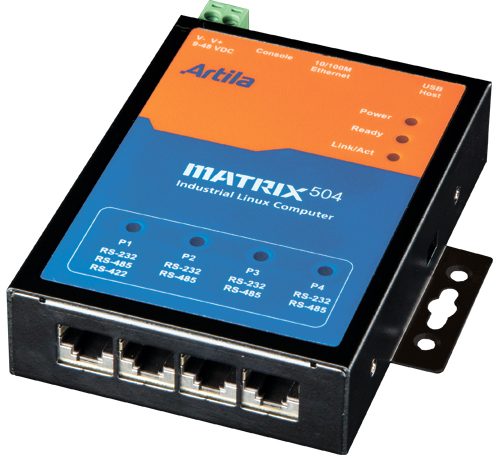
1. Product Overview
Product Name: Matrix-520
Model: Matrix-520
Series: Matrix 500/510/520 Industrial Embedded Computer Series
Article Number: Matrix-520
Manufacturer: Artila Electronics Co., Ltd.
The Matrix-520 is an ARM9-based, Linux-ready industrial embedded computer designed for headless or semi-headless applications requiring robust serial communication, Ethernet networking, and programmable digital I/O. It integrates an Atmel AT91RM9200 180 MHz ARM9 processor with a built-in Memory Management Unit (MMU), 64 MB SDRAM, and 16 MB NOR Flash memory. The device includes an 18×2 high-brightness LCM display, dual 10/100 Mbps Ethernet ports, eight high-speed serial ports, two USB 2.0 host ports, and 21 programmable digital I/O channels. It operates as a compact, fanless, flash-based industrial controller and web server, preloaded with Linux kernel 2.6.x and a full GNU C/C++ toolchain for both Linux and Windows development environments.
2. Key Features
- ARM9 Industrial Computing Platform: Powered by the Atmel AT91RM9200 (ARM920T core) running at 180 MHz, delivering approximately 200 MIPS performance with 16 KB instruction and 16 KB data cache.
- Linux-Ready Environment: Pre-installed Linux 2.6.x kernel with U-Boot 1.1.2 bootloader and full support for standard Linux file systems (JFFS2, EXT2/3, VFAT/FAT, NFS).
- Integrated Web Server: Includes Boa web server daemon for HTTP-based remote management and application hosting.
- High-Speed Serial Communication: Eight TTY ports supporting up to 921.6 Kbps. Ports 1, 5, 6, 7, 8 configurable as RS‑232/422/485; ports 2, 3, 4 as RS‑232. Ports 2, 5, 6, 7, 8 support full modem control.
- Dual Ethernet Networking: Two 10/100 Base‑T Ethernet ports with 1.5 kV magnetic isolation for redundant or segmented network configurations.
- USB Expansion: Two USB 2.0 host ports supporting low‑speed (1.5 Mbps) and full‑speed (12 Mbps) devices such as flash drives, Wi‑Fi dongles, serial adaptors, and modems.
- Programmable Digital I/O: 21 CMOS/TTL‑level GPIO channels, individually configurable as input or output, accessible via DB‑25 connector.
- LCM Display: 18×2 character (144×32 dot) high‑brightness LCD module with backlight for runtime status or user messages.
- Audio Output: Supports playback of MP3 and WAV formats for alert or multimedia applications.
- Storage Expansion: Internal SD 1.0‑compliant socket supporting up to 2 GB SD (non‑SDHC) cards.
- Fanless, Rugged Design: Compact metal enclosure, DIN‑rail or wall‑mountable, designed for industrial environments.
- Wide Power Input Range: 9 – 40 V DC input, 300 mA @ 12 V DC typical consumption.
- Operating Temperature: 0 °C – 70 °C (32 °F – 158 °F).
- Comprehensive Software Stack: Includes SSH, SSL, SNMP, FTP, Telnet, PPP, and firewall utilities.
- Development Support: Bundled GNU C/C++ cross‑compiler toolchain for Linux and Cygwin/Windows, with example programs and utilities on the included Artila CD.
3. Technical Specifications
Processor & Memory
- CPU: Atmel AT91RM9200 (ARM9, ARM920T core with MMU)
- Clock Speed: 180 MHz
- Performance: ~200 MIPS
- Cache: 16 KB instruction, 16 KB data
- SDRAM: 64 MB
- Flash Memory: 16 MB NOR type
Display
- Type: 144×32 dot‑matrix LCM with built‑in English font
- Text Mode: 18×2 characters
- Backlight: High‑brightness LED
Networking
- Ethernet Ports: 2 × 10/100 Base‑T (RJ‑45)
- Isolation: 1.5 kV magnetic isolation
- Protocols: IPv4, ICMP, ARP, DHCP, NTP, TCP, UDP, FTP, Telnet, HTTP, PPP, PPPoE, SMTP, SNMP v1/v2, SSL, SSH 1.0/2.0
Serial Communication (TTY Ports)
- Total Ports: 8
- Configurable Modes:
- Ports 1, 5, 6, 7, 8 – RS‑232/422/485 selectable
- Ports 2, 3, 4 – RS‑232
- Modem Control: Ports 2, 5, 6, 7, 8 support full modem signals
- Connector Type: RJ‑45
- Baud Rate: Up to 921.6 Kbps
- Data Bits: 5, 6, 7, 8
- Stop Bits: 1, 1.5, 2
- Parity: None, Even, Odd, Mark, Space
- Flow Control: RTS/CTS, XON/XOFF, None
USB Host Ports
- Quantity: 2
- Standard: USB 2.0 compliant
- Data Rates: 1.5 Mbps (low‑speed), 12 Mbps (full‑speed)
- Supported Devices: Flash disks, Wi‑Fi (IEEE 802.11 b/g), USB‑RS232 adaptors, modems
Digital I/O (GPIO)
- Channels: 21 × CMOS/TTL‑level
- Connector: DB‑25 female
- Voltage Levels: 3.3 V and 5 V outputs available (VCC3, VCC5)
- Ground: Digital GND pins provided
- Programmable Direction: Input or Output per channel
Audio Output
- Formats Supported: MP3, WAV
- Connector: Line‑out
Storage
- Internal SD Socket: SD 1.0 compliant, up to 2 GB (non‑SDHC)
- File Systems: JFFS2, EXT2/3, VFAT/FAT, NFS
Power & Environmental
- Input Voltage: 9 – 40 V DC
- Power Consumption: 300 mA @ 12 V DC
- Operating Temperature: 0 °C – 70 °C (32 °F – 158 °F)
- Enclosure: Fanless metal case, DIN‑rail mountable
- Dimensions: 160 × 104 × 38.5 mm
- Weight: Approx. 0.6 kg (typical)
Regulatory Compliance
- CE Class A
- FCC Class A
4. Functionality
The Matrix‑520 functions as a compact embedded Linux computer and web server for industrial automation, data acquisition, and communication gateway applications. It operates as a standalone controller capable of running user‑developed Linux applications, hosting web interfaces, and managing serial and network communications simultaneously.
Typical Use Cases:
- Industrial equipment monitoring and control
- Serial‑to‑Ethernet data gateways
- Remote terminal servers
- Embedded web‑based HMI systems
- Data logging and protocol conversion
- IoT edge computing nodes
Operation:
The system boots from on‑board Flash using U‑Boot, decompresses the Linux kernel and root filesystem into RAM, and mounts a persistent user disk partition (/disk) for application storage. The LCM display can show system status, IP address, or user‑defined messages via the `lcdctl` utility. GPIOs can be controlled programmatically or through the `gpioctl` command.
Compatibility:
- Supports USB Wi‑Fi dongles (Ralink RT2570/RT2571/RT73) for wireless networking.
- Compatible with standard USB storage and serial adaptors.
- Accessible via SSH, Telnet, FTP, or web browser.
- Development supported under Linux or Windows (Cygwin) environments.
5. Components & Accessories
Included Items:
1. Matrix‑520 Embedded Computer
2. Wall‑mount bracket
3. Artila CD containing:
- GNU C/C++ toolchain (Linux & Cygwin)
- User guide and installation manual
- Example programs and utilities
Optional Accessories:
- CB‑RJ45F9‑150: RJ‑45 to DB‑9 female serial cable
- CB‑RJ2CON‑100: Serial console cable
- DK‑35A: DIN‑rail mounting kit
- PWR‑12V‑1A: 110–240 VAC to 12 V DC 1 A power adapter
6. Installation & Setup
Mounting Options:
- DIN‑rail mounting (with DK‑35A kit)
- Wall mounting (bracket included)
Power Connection:
- Connect 9–40 V DC to the power terminal block.
- Power LED glows solid green when voltage is correctly applied.
Network Configuration:
- Default LAN 1 IP: 192.168.2.127
- Default LAN 2: DHCP enabled
- Default login: guest/guest
- Supervisor (root) login: root/root (via SSH)
Serial Console Access:
- Disabled by default; can be enabled via Port 3 using CB‑RJ2CON‑100 cable.
- Terminal settings: 115200 bps, 8 N 1, ANSI.
Wireless Setup:
- Insert supported USB Wi‑Fi dongle.
- Load driver: `modprobe rt73` or `modprobe rt2570`.
- Configure: `iwconfig wlan0 essid <SSID> key <KEY> mode managed`.
- Obtain IP: `dhcpcd wlan0 &` or manual `ifconfig`.
File System Layout:
- Root filesystem: RAMDISK (volatile).
- User disk (/disk): Flash‑based persistent storage (~11 MB).
- Applications and configuration files must be stored under /disk to survive reboot.
LED Indicators:
- Power LED: Solid green – power applied.
- Ready LED: Solid green – system boot complete.
- Link/Act LED: Solid – network link; flashing – activity.
- Serial Port LEDs: Green = RXD high; Yellow = TXD high.
7. Performance & Capabilities
- Processing Speed: 180 MHz ARM9 core (~200 MIPS).
- Serial Throughput: Up to 921.6 Kbps per port.
- Network Bandwidth: 10/100 Mbps per Ethernet interface.
- USB Data Rate: Up to 12 Mbps (full‑speed).
- Storage Capacity: 16 MB Flash + 2 GB SD card (max).
- Memory Utilization: 64 MB SDRAM (8 MB for RAMDISK, 16 MB for kernel/bootloader, ~40 MB available for user applications).
- Power Efficiency: Fanless design, < 4 W typical consumption.
- Reliability: Watchdog timer and real‑time clock integrated for autonomous operation.
Limitations:
- SD card limited to 2 GB (non‑SDHC).
- USB 2.0 supports only low/full‑speed devices (no high‑speed 480 Mbps).
- Operating temperature limited to 70 °C max.
8. Standards & Compliance
- Operating System: Linux 2.6.x kernel (open‑source, POSIX‑compliant).
- Networking Protocols: TCP/IP stack with SSL and SSH 1.0/2.0 security.
- Regulatory Certifications: CE Class A, FCC Class A for industrial environments.
- Electrical Safety: 1.5 kV magnetic isolation on Ethernet ports.
- Software Standards: GNU Toolchain (GCC, GLIBC) compliant with POSIX C/C++ libraries.
- Environmental Compliance: Fanless, low‑power, wide DC input range for industrial use.
9. Additional Information
Warranty & Support:
Artila Electronics provides standard manufacturer warranty covering hardware defects under normal industrial operating conditions. Technical support, firmware updates, and software utilities are available through Artila’s official website and support channels.
Maintenance:
- Periodically back up user data from /disk to external USB storage.
- Use the `update —FORMAT` command (supervisor mode) to restore factory defaults if required.
- Keep ventilation unobstructed for optimal thermal performance.
Software Updates:
- Firmware and kernel updates can be applied using the `update` utility.
- Additional utilities (e.g., ntpclient, ssh, scp, bluez, ssh_keygen) available on the Artila CD.
- User applications can be cross‑compiled using the provided GNU toolchain and transferred via FTP or USB.
Development Environment:
- Linux Host: Install arm‑linux‑3.3.2 toolchain; compile using `make`.
- Windows Host: Use Cygwin environment with arm‑linux‑cygwin compiler.
- Example source code and Makefiles included for rapid prototyping.
Debugging Support:
- Remote debugging via gdbserver and DDD (Data Display Debugger).
- Serial console or SSH access for runtime diagnostics.
Summary:
The Artila Matrix‑520 is a compact, fanless, ARM9‑based embedded Linux computer engineered for industrial automation, communication, and control applications. Combining robust serial connectivity, dual Ethernet networking, programmable I/O, and integrated display and audio capabilities, it delivers a flexible, open‑source platform for developers and system integrators. With its pre‑installed Linux OS, comprehensive protocol support, and included GNU toolchain, the Matrix‑520 enables rapid deployment of custom embedded solutions in demanding industrial environments.




 SUCHEN SIE DIE PASSENDE
 ds_matrix520.pdf
PDF Catalog
ds_matrix520.pdf
PDF Catalog
 Warranty Declaration.pdf
PDF Catalog
Warranty Declaration.pdf
PDF Catalog
 matrix520_QIG.pdf
Manual
matrix520_QIG.pdf
Manual
 Serial Console Cable.pdf
Manual
Serial Console Cable.pdf
Manual
 gdbserver_HOW_TO.pdf
Manual
gdbserver_HOW_TO.pdf
Manual