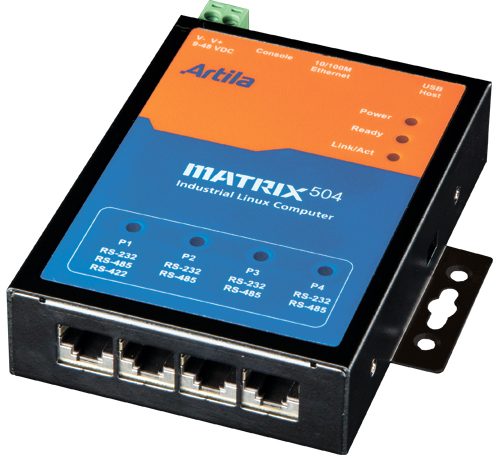
1. Product Overview
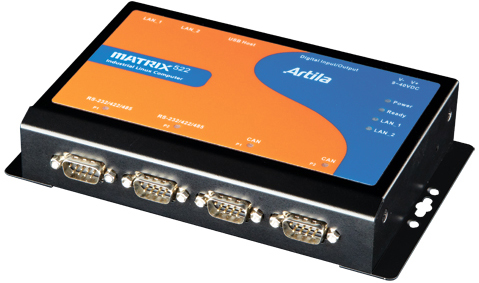
Product Name: Matrix-522T
Model: Matrix-522T
Series: Matrix-500/520 Industrial Embedded Computer Series
Article Number: Matrix-522T
Manufacturer: Artila Electronics Co., Ltd.
The Artila Matrix-522T is an ARM9-based industrial-grade embedded Linux computer designed for automation, control, and data communication applications. It integrates a 400 MHz ARM926EJ-S processor, dual Ethernet interfaces, dual CAN 2.0A/B ports, dual USB 2.0 host ports, and 21 programmable digital I/O channels. The system is engineered for fanless operation, wide temperature tolerance, and DIN-rail or wall mounting, making it suitable for harsh industrial environments. It comes preinstalled with Linux kernel 2.6.29 and supports a full GNU toolchain for both Linux and Windows (via Cygwin).
2. Key Features
- Processor: ARM926EJ-S (ARM9 core) running at 400 MHz with MMU, 32 KB instruction cache, and 32 KB data cache.
- Operating System: Pre-installed Linux 2.6.29; supports WinCE and Java acceleration.
- Memory: 64 MB SDRAM and 128 MB NAND Flash (Matrix-522T variant) or 256 MB NAND Flash (Matrix-522 base model). Includes 2 MB DataFlash for system backup.
- Networking: Two 10/100 Mbps Ethernet ports with independent MAC addresses.
- Serial Communication: Two software-configurable 3-in-1 RS-232/422/485 ports.
- CAN Bus: Two fully isolated CAN 2.0A/2.0B ports (2500 Vrms isolation).
- USB: Two USB 2.0 full-speed (12 Mbps) host ports and one USB device port.
- Digital I/O: 21 programmable GPIO channels accessible via DB25 connector.
- Storage: NAND Flash-based architecture; supports external USB and microSD (on Matrix-522).
- Power Supply: 9–40 V DC input, 190 mA @ 12 V DC (≈ 2.3 W).
- Temperature Range: –20 °C to +80 °C extended operating range.
- Form Factor: Compact fanless metal enclosure, DIN-rail or wall mountable.
- Security: Supports SSL, SSH 1.0/2.0, and secure remote access.
- Software Tools: GNU C/C++ toolchain, ipkg package manager, SocketCAN, CANopen, and Artila utilities (update, setuart, setconsole, gpioctl).
- Compatibility: Upward compatible with Matrix-500 series.
3. Technical Specifications
| Parameter | Specification |
|----------------|-------------------|
| CPU | ARM926EJ-S (ARM9) 400 MHz |
| Memory | 64 MB SDRAM, 128 MB NAND Flash, 2 MB DataFlash |
| Storage Expansion | USB flash disk, microSD (Matrix-522 only) |
| Ethernet | 2 × 10/100 Mbps RJ45 ports |
| Serial Ports | 2 × RS-232/422/485 (software selectable) |
| CAN Ports | 2 × CAN 2.0A/B, 2500 Vrms isolation |
| USB Ports | 2 × USB 2.0 host (12 Mbps), 1 × USB device |
| Digital I/O | 21 × programmable GPIO (DB25 female) |
| Power Input | 9–40 V DC |
| Power Consumption | 190 mA @ 12 V DC (≈ 2.3 W) |
| Operating Temperature | –20 °C ~ +80 °C |
| Dimensions | 160 × 104 × 32 mm |
| Weight | ~440 g |
| Enclosure | Fanless aluminum housing |
| Mounting | Wall mount (standard), DIN-rail (optional DK-35A kit) |
| Compliance | CE, FCC Class A (industrial) |
4. Functionality
The Matrix-522T functions as a compact embedded web server and communication controller. It boots Linux from NAND Flash, mounts its root file system, and provides network and serial communication services. The dual Ethernet ports allow separation of control and management networks, while the dual CAN interfaces enable integration with industrial CANopen or SocketCAN networks.
Use Cases:
- Industrial automation and control gateways
- Remote data acquisition and monitoring
- CAN bus protocol conversion and logging
- Embedded web server for equipment management
- Edge computing and protocol translation
Compatibility:
- Supports standard Linux networking and serial APIs.
- Works with Artila’s GNU toolchain for cross-compilation.
- Compatible with SocketCAN, libsocketcan, and CanFestival (CANopen).
- Supports SSH, FTP, Telnet, and HTTP (lighttpd) for remote management.
5. Components & Accessories
Included Items:
- Matrix-522T embedded computer
- Wall-mount bracket
- Pre-installed Linux OS and utilities
Optional Accessories:
- CBL-F10M9-20 (91-0P9M9-001): Console cable (10-pin header to DB9 male, 20 cm)
- DK-35A (36-DK35A-000): DIN-rail mounting kit
Connectors:
- Ethernet: 2 × RJ45 (10/100 Mbps)
- Serial Ports: 2 × DB9 male (RS-232/422/485)
- CAN Ports: 2 × DB9 male (isolated)
- Digital I/O: 1 × DB25 female (21 GPIO)
- Console Port: 10-pin internal header (RS-232)
- USB: 2 × Type A host, 1 × mini-B device
- Power Input: Terminal block (9–40 V DC)
6. Installation & Setup
Power Requirements:
Connect a regulated 9–40 V DC power source. The Power LED indicates correct input.
Mounting Options:
- Wall mount using included bracket.
- DIN-rail mount using optional DK-35A kit.
Network Configuration:
Default IP addresses:
- LAN 1: 192.168.2.127
- LAN 2: 192.168.3.127
Default login:
- Username: root / guest
- Password: root / guest
Serial Console Access:
- Baud rate: 115200 bps, 8 N 1, no flow control, VT100 terminal.
- Use CBL-F10M9-20 cable to connect CON1 header to PC.
- Console can be redirected to any serial port using `setconsole`.
Software Setup:
- Boot automatically loads Linux kernel and mounts root filesystem.
- Services started: SSH, Telnet, FTP, web server (lighttpd), syslog, amgrd.
- Modify `/etc/network/interfaces` for IP configuration.
- Use `ipkg` for package management and updates.
7. Performance & Capabilities
- Processing Speed: 400 MHz ARM9 core with hardware multiply and Java acceleration.
- Memory Throughput: 64 MB SDRAM optimized for embedded Linux multitasking.
- Storage Capacity: 128 MB NAND Flash (user disk ≈ 12 MB available for applications).
- Networking: Dual 10/100 Mbps Ethernet interfaces support routing, bridging, and redundancy.
- CAN Bus: Supports bit rates from 10 kbps to 1 Mbps; fully isolated; configurable via `/etc/can_config`.
- USB Performance: Full-speed 12 Mbps host ports for flash drives, WLAN adapters, or serial converters.
- Digital I/O: 21 GPIO lines configurable as input/output via `gpioctl`.
- System Efficiency: Fanless, low-power design (≈ 2.3 W typical).
- Limitations: No built-in SD slot (unlike Matrix-522); limited NAND Flash capacity for large applications.
8. Standards & Compliance
- CAN Bus: ISO 11898-1/2 compliant (CAN 2.0A/B).
- Ethernet: IEEE 802.3 10/100 Base-TX.
- USB: USB 2.0 full-speed compliant.
- Operating System: Linux 2.6.29 kernel, POSIX-compliant environment.
- Electrical Safety: 2500 Vrms isolation on CAN ports.
- Environmental: Extended temperature operation (–20 °C ~ +80 °C).
- Regulatory: CE and FCC Class A industrial compliance.
9. Additional Information
Warranty & Support:
Artila Electronics provides standard warranty coverage for manufacturing defects and offers firmware updates, technical documentation, and software packages via its FTP and website.
Maintenance:
- Periodically check power and network connections.
- Use `update` utility for firmware and loader upgrades.
- Backup configuration files before system updates.
Software Updates & Recovery:
- Loader menu accessible via serial console for system recovery.
- Recovery options include updating loader, kernel, and filesystem from USB disk.
- Default recovery image paths:
- Loader: `m522/m522.alf`
- Kernel: `m522/m522K`
- Filesystem: `m522/m522R`
Development Environment:
- Linux Toolchain: GCC 4.3.3, glibc 2.9, binutils 2.18.
- Windows Toolchain: Cygwin-based cross compiler (arm-linux-cygwin).
- Debugging: Supports `gdbserver` and DDD for remote debugging.
- Example Programs: Available on Artila FTP under `/examples`.
Software Utilities:
- update: Loader and kernel update utility.
- setuart: Configure serial port mode and baud rate.
- setconsole: Redirect console port.
- gpioctl: Manage digital I/O.
- version: Display OS version.
- ipkg: Lightweight package manager for installing additional modules.
Web & Network Services:
- Web Server: lighttpd v1.7 (default directory `/usr/www`).
- FTP Server: vsftpd v2.0.5.
- SSH Server: OpenSSH v4.6p1 with SFTP support.
- Telnet: Enabled for guest login.
- Webmin: Optional web-based administration (port 10000).
System Recovery & Diagnostics:
- Automatic fallback to DataFlash filesystem if NAND fails.
- Console recovery menu provides options for image update, filesystem creation, and environment restoration.
- Diagnostic LEDs:
- Power LED – Power status
- Ready LED – System boot complete
- Link/Act LED – Ethernet activity
- Serial/CAN LED – Data transmission indicators
GPIO Pinout (DB25 Female):
DIO0–DIO20 (pins 1–21), GND (pins 22–23), VCC3 (3.3 V, pin 24), VCC5 (5 V, pin 25).
CAN Port Pinout (DB9 Male):
Standard CAN_H, CAN_L, and shield ground; 120 Ω termination selectable via jumpers J7/J8.
Serial Port Pinout (DB9 Male):
Software-selectable RS-232/422/485; supports full-duplex and half-duplex modes.
Default Serial Settings:
115200 bps, 8 data bits, no parity, 1 stop bit, no flow control.
Software Package Management (ipkg):
- Update: `ipkg update`
- Install: `ipkg install [package]`
- Remove: `ipkg remove [package]`
- List: `ipkg list` / `ipkg list_installed`
- Sources configurable via `/etc/ipkg.conf` (supports Artila FTP or USB-based repositories).
Example CAN Configuration:
```
ip link set can0 down
ip link set can0 type can bitrate 250000
ip link set can0 up
ip –details link show can0
```
Default bit rates defined in `/etc/can_config`:
```
0:250000
1:250000
```
Time Synchronization:
- Manual: `date MMDDhhmmYYYY` followed by `hwclock –w`.
- Network: `ntpclient [time_server_ip]`.
Auto-start Applications:
Add commands to `/etc/rc.local` (e.g., `hello &` before `exit 0`).
Development Workflow:
1. Compile source using cross compiler (`arm-linux-gnueabi-gcc`).
2. Transfer executable via FTP to `/home/guest`.
3. Set execute permission (`chmod +x file`).
4. Run application (`./file`).
Summary
The Artila Matrix-522T is a robust, low-power, fanless embedded Linux computer optimized for industrial communication and control. With its ARM9 processor, dual Ethernet, dual CAN, and extensive I/O, it serves as a versatile platform for automation, data acquisition, and protocol gateway applications. Its open Linux environment, comprehensive toolchain support, and modular software architecture make it ideal for developers seeking a reliable and customizable embedded solution for harsh industrial environments.




 SUCHEN SIE DIE PASSENDE
 Matrix-522 Data Sheet.pdf
PDF Catalog
Matrix-522 Data Sheet.pdf
PDF Catalog
 Warranty Declaration.pdf
PDF Catalog
Warranty Declaration.pdf
PDF Catalog
 Matrix-522_User_Guide.pdf
Manual
Matrix-522_User_Guide.pdf
Manual
 Enable Serial Console3.pdf
Manual
Enable Serial Console3.pdf
Manual
 LoaderHowTo.pdf
Manual
LoaderHowTo.pdf
Manual
 gdbserver_HOW_TO.pdf
Manual
gdbserver_HOW_TO.pdf
Manual