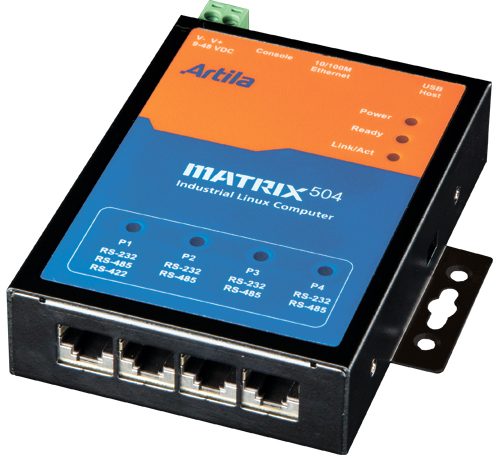
1. Product Overview
Product Name: Matrix-605
Model: Matrix-605
Series: Matrix Embedded Computer Series
Article Number: Matrix-605
Manufacturer: Artila Electronics Co., Ltd.
The Artila Matrix-605 is an industrial-grade, fanless embedded computer built around the Atmel AT91SAM9G45 ARM9 processor running at 400 MHz. It is designed for Windows CE 6.0 environments and optimized for industrial automation, remote monitoring, and control applications that require high reliability, low power consumption, and continuous 24/7 operation. The Matrix-605 extends the capabilities of Artila’s Matrix series by offering enhanced connectivity, including dual Ethernet ports, multiple serial interfaces, and USB 2.0 host ports, all within a compact, rugged metal enclosure suitable for DIN-rail mounting.
2. Key Features
- ARM9-based Industrial Embedded Platform: Powered by the Atmel AT91SAM9G45 400 MHz CPU, providing a balance of performance and energy efficiency for embedded control and communication tasks.
- Preinstalled Windows CE 6.0: Ready-to-use operating system with support for .NET Compact Framework 2.0, enabling rapid application development and deployment.
- Comprehensive Connectivity:
- 2 × 10/100 Mbps Ethernet ports for network redundancy or dual-network applications.
- 4 × RS-232/422/485 serial ports (3 configurable as RS-232/485, 1 configurable as RS-232/422/485 high-speed).
- 2 × USB 2.0 host ports supporting 480 Mbps data rate.
- Expandable Storage: 128 MB NAND Flash, 128 MB DDR2 RAM, and a microSD slot supporting up to 32 GB SDHC cards.
- Industrial Reliability: Fanless design, wide 9–48 VDC power input range, and 0–70°C operating temperature range.
- Security and Networking: Built-in support for SSL, SSH 1.0/2.0, and standard TCP/IP services (Web, Telnet, FTP).
- Developer-Friendly Environment: Includes GNU C/C++ toolchain for Linux/Windows, Java accelerator, and SDK support for C/C++ and .NET development.
- Compact and Durable: Rugged metal housing (78 × 108 × 24 mm) suitable for DIN-rail mounting in industrial cabinets.
- Low Power Consumption: Typical consumption of 3 W (300 mA @ 12 VDC), ideal for energy-efficient embedded systems.
3. Technical Specifications
Processor & Memory
- CPU: Atmel AT91SAM9G45 (ARM9 architecture with MMU), 400 MHz
- RAM: 128 MB DDR2 SDRAM
- Flash Storage: 128 MB NAND Flash
- Expansion: microSD slot (supports up to 32 GB SDHC)
- DataFlash: 2 MB (for system recovery and failover boot)
Networking
- Ethernet: 2 × 10/100Base-T (RJ-45 connectors)
- Isolation: 1.5 kV magnetic isolation per port
Serial Communication
- Ports: 4 × RJ-45 connectors
- COM1: RS-232/422/485 (high-speed)
- COM2–COM4: RS-232/485
- Baud Rate: Up to 921.6 Kbps
- Parity: None, Even, Odd, Mark, Space
- Data Bits: 5, 6, 7, 8
- Stop Bits: 1, 1.5, 2
- Flow Control: RTS/CTS, XON/XOFF, None
- RS-485 Direction Control: Automatic (hardware-based)
USB Interfaces
- 2 × USB 2.0 Host Ports (480 Mbps)
- 1 × USB Client Port (for ActiveSync and maintenance)
GPIO & Console
- Console: Tx/Rx/GND (115200, N81)
- GPIO: 5 × CMOS-level digital I/O pins
Power & Environmental
- Input Voltage: 9–48 VDC
- Power Consumption: 300 mA @ 12 VDC (approx. 3 W)
- Operating Temperature: 0°C to 70°C (32°F to 158°F)
- Storage Temperature: -20°C to 85°C (typical)
- Humidity: 5–95% RH (non-condensing)
Physical Characteristics
- Dimensions: 78 × 108 × 24 mm
- Weight: Approx. 250 g (typical)
- Enclosure: Fanless, metal housing, DIN-rail mountable
Indicators & Controls
- Watchdog Timer: Hardware-based, kernel-controlled
- Real-Time Clock: Integrated
- Buzzer: System event notification
4. Functionality
The Matrix-605 functions as a compact, embedded industrial computer capable of running Windows CE 6.0 applications for automation, data acquisition, and remote device management. It is designed for network-centric applications, offering built-in Web, Telnet, and FTP servers for remote configuration and monitoring.
Typical Use Cases:
- Industrial automation controllers and gateways
- Remote monitoring and telemetry systems
- Data logging and protocol conversion
- Machine-to-machine (M2M) communication nodes
- Embedded HMI or control panels
- Edge computing for IoT and SCADA systems
Compatibility:
- Compatible with Microsoft Visual Studio 2005 for application development.
- Supports C/C++, VB.NET, and C# programming languages.
- Works with Microsoft’s Remote Display Control for WinCE, allowing remote GUI-based operation.
- Supports ActiveSync for file transfer and synchronization.
Operation:
The system boots from NAND Flash by default. In the event of NAND corruption, it automatically switches to the onboard DataFlash for recovery. The failover mechanism ensures system resilience and minimizes downtime.
5. Components & Accessories
Included Components:
- Matrix-605 Embedded Computer Unit
- Preinstalled Windows CE 6.0 Core OS
- SDK and development tools (C/C++ libraries, runtime files)
- User documentation and setup guide
Optional Accessories:
- CB-RJCON-100: Console cable (RJ45-to-DB9F, 100 cm)
- CB-RJ45F9-150: COM port connection cable (RJ45-to-DB9F, 150 cm)
- DIN-rail mounting kit (standard with unit or optional depending on configuration)
- Power adapter (9–48 VDC external supply, optional)
Connectors:
- RJ-45 for Ethernet and serial ports
- USB Type-A for host ports
- USB Mini-B for client port
- Terminal block or barrel connector for DC power input
6. Installation & Setup
Requirements:
- Power supply: 9–48 VDC regulated source
- Mounting: DIN-rail or panel mount (metal enclosure supports both)
- Development environment: Microsoft Visual Studio 2005 or later
Installation Steps:
1. Mount the Matrix-605 securely on a DIN rail or panel.
2. Connect power input (9–48 VDC) to the terminal block.
3. Connect Ethernet, serial, and USB peripherals as required.
4. Power on the device; the preinstalled Windows CE 6.0 OS will boot automatically.
5. Configure network settings via the built-in Web interface, Telnet, or console port.
6. Deploy applications via ActiveSync, USB drive, or FTP.
Configuration Tools:
- ifconfig: Modify network interface parameters.
- usrmgr: Manage user accounts and permissions.
- update: Update kernel image and file system.
- init: Configure auto-start applications.
- gpioctrl: Control and monitor GPIO pins.
7. Performance & Capabilities
Processing Performance:
The 400 MHz ARM9 CPU provides sufficient computational power for embedded control, data processing, and communication tasks while maintaining low power consumption.
Memory & Storage:
- 128 MB DDR2 RAM ensures smooth multitasking under Windows CE 6.0.
- 128 MB NAND Flash provides reliable storage with bad block management.
- microSD expansion allows up to 32 GB additional storage for data logging or application files.
Networking:
Dual Ethernet ports enable flexible network configurations such as redundancy, load balancing, or separation of control and data networks.
Serial Communication:
Four high-speed serial ports (up to 921.6 Kbps) support a wide range of industrial protocols (Modbus RTU, ASCII, custom serial communication).
USB Performance:
Two USB 2.0 host ports (480 Mbps) support external peripherals such as flash drives, Wi-Fi adapters, or serial converters.
Reliability:
- Fanless design eliminates mechanical failure points.
- Watchdog timer ensures automatic recovery from software hangs.
- Failover boot mechanism enhances system uptime.
Limitations:
- No built-in display interface (requires remote display or external HMI).
- Limited to Windows CE 6.0 environment (not compatible with Linux or Android).
- USB client port limited to maintenance and synchronization functions.
8. Standards & Compliance
Certifications:
- CE Class A (Electromagnetic Compatibility)
- FCC Class A (Electromagnetic Emission Compliance)
Industry Standards:
- Ethernet: IEEE 802.3 10/100Base-T
- USB: USB 2.0 compliant
- Serial Communication: EIA/TIA RS-232, RS-422, RS-485 standards
- Power: Industrial-grade 9–48 VDC input range
Environmental Compliance:
- RoHS-compliant materials and manufacturing processes
- Designed for industrial temperature range (0–70°C)
Software Standards:
- Microsoft Windows CE 6.0 Core OS
- Supports .NET Compact Framework 2.0
- Compatible with standard TCP/IP, HTTP, FTP, and Telnet protocols
9. Additional Information
Warranty:
- Standard manufacturer’s warranty (typically 1 year, extendable depending on region and distributor).
Technical Support:
- Provided by Artila Electronics, including firmware updates, SDKs, and developer documentation.
- Online resources and community support available through Artila’s developer portal.
Maintenance:
- Minimal maintenance required due to fanless design.
- Periodic firmware updates recommended for security and performance improvements.
- NAND Flash wear-leveling ensures long-term reliability.
Software Updates:
- Kernel and file system updates can be performed via the update utility.
- Remote updates supported through FTP or local USB transfer.
Longevity & Availability:
- Designed for long-term industrial deployment with stable component sourcing.
- Backward compatibility with previous Matrix series models (e.g., Matrix-604) for seamless migration.
### Summary
The Artila Matrix-605 is a robust, compact, and energy-efficient ARM9-based embedded computer tailored for industrial and automation environments requiring reliable, continuous operation. With its dual Ethernet ports, multiple serial interfaces, USB connectivity, and Windows CE 6.0 operating system, it provides a versatile platform for developing and deploying embedded control, monitoring, and communication applications.
Its failover boot mechanism, wide power input range, and fanless metal enclosure make it ideal for harsh industrial conditions. Developers benefit from comprehensive SDK support, standard development tools, and built-in network services, enabling rapid integration into existing systems.
Compact yet powerful, the Matrix-605 exemplifies Artila’s commitment to delivering high-performance, low-power embedded computing solutions for industrial automation, IoT gateways, and networked control systems.


 SUCHEN SIE DIE PASSENDE
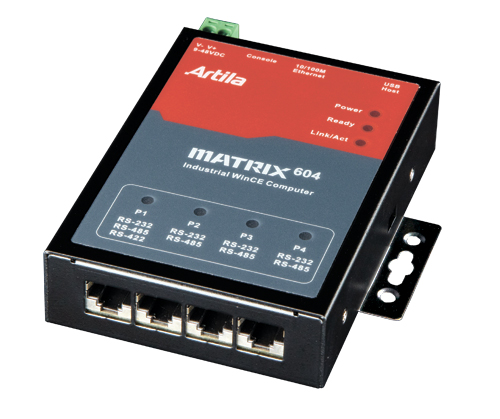
 ds_matrix604.pdf
PDF Catalog
ds_matrix604.pdf
PDF Catalog