CB-F10M9-20
SUCHEN SIE DIE PASSENDE
INDUSTRIELLE LÖSUNG?
Entdecken Sie Embedded-, Kommunikations- und Automatisierungslösungen für Ihre Anwendung.
- ARM9 Industrial Computing Platform:
Powered by an Atmel AT91RM9200 ARM920T processor running at 180 MHz (200 MIPS) with integrated MMU, 16 KB instruction cache, and 16 KB data cache.
- Pre-installed Linux OS:
Ships with Linux kernel 2.6.x, U-Boot 1.1.2 bootloader, and a full file system supporting JFFS2, EXT2/EXT3, VFAT/FAT, and NFS.
- Rich I/O Interfaces:
Includes 16 opto-isolated digital inputs (2.5 kV isolation) and 8 Darlington-pair digital outputs (500 mA max per channel, 5–50 VDC source voltage).
- Networking and Connectivity:
Dual 10/100 Mbps Ethernet ports (RJ-45), one RS-232 port with full modem control, one RS-485 port with hardware direction control, and two USB 2.0 host ports (12 Mbps).
- Expandable Storage:
One internal SD 1.0-compliant socket supporting up to 4 GB SD cards for data logging and application storage.
- Web and Network Services:
Integrated web server (Boa), FTP, Telnet, SSH, SNMP, and firewall (iptables) for remote monitoring and control.
- Open Development Environment:
Includes GNU C/C++ cross-compilation toolchain for Linux and Windows (CygWin), POSIX libraries, and BusyBox utilities.
- Industrial Design:
Fanless, DIN-rail mountable, wide 9–40 VDC power input, 0–70 °C operating temperature, CE/FCC Class A compliance.
- Security and Management:
Supports SSL, SSH 1.0/2.0, and user-level access control. Includes watchdog timer, real-time clock, and buzzer for system monitoring.
Powered by an Atmel AT91RM9200 ARM920T processor running at 180 MHz (200 MIPS) with integrated MMU, 16 KB instruction cache, and 16 KB data cache.
- Pre-installed Linux OS:
Ships with Linux kernel 2.6.x, U-Boot 1.1.2 bootloader, and a full file system supporting JFFS2, EXT2/EXT3, VFAT/FAT, and NFS.
- Rich I/O Interfaces:
Includes 16 opto-isolated digital inputs (2.5 kV isolation) and 8 Darlington-pair digital outputs (500 mA max per channel, 5–50 VDC source voltage).
- Networking and Connectivity:
Dual 10/100 Mbps Ethernet ports (RJ-45), one RS-232 port with full modem control, one RS-485 port with hardware direction control, and two USB 2.0 host ports (12 Mbps).
- Expandable Storage:
One internal SD 1.0-compliant socket supporting up to 4 GB SD cards for data logging and application storage.
- Web and Network Services:
Integrated web server (Boa), FTP, Telnet, SSH, SNMP, and firewall (iptables) for remote monitoring and control.
- Open Development Environment:
Includes GNU C/C++ cross-compilation toolchain for Linux and Windows (CygWin), POSIX libraries, and BusyBox utilities.
- Industrial Design:
Fanless, DIN-rail mountable, wide 9–40 VDC power input, 0–70 °C operating temperature, CE/FCC Class A compliance.
- Security and Management:
Supports SSL, SSH 1.0/2.0, and user-level access control. Includes watchdog timer, real-time clock, and buzzer for system monitoring.
1. Product Overview
Product Name: PAC-5010
Model: PAC-5010
Series: ARM9-based Linux Programmable Automation Controller Series
Article Number: PAC-5010
Manufacturer: Artila Electronics Co., Ltd.
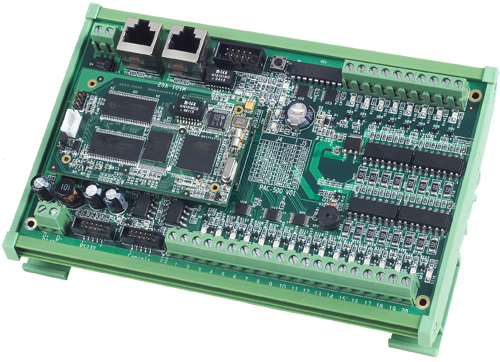
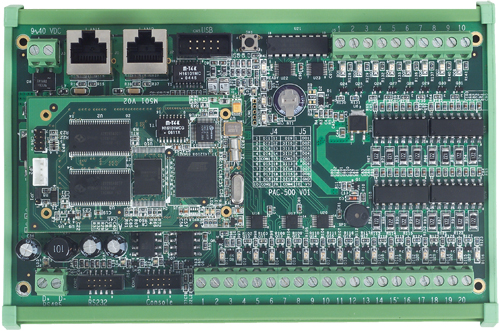
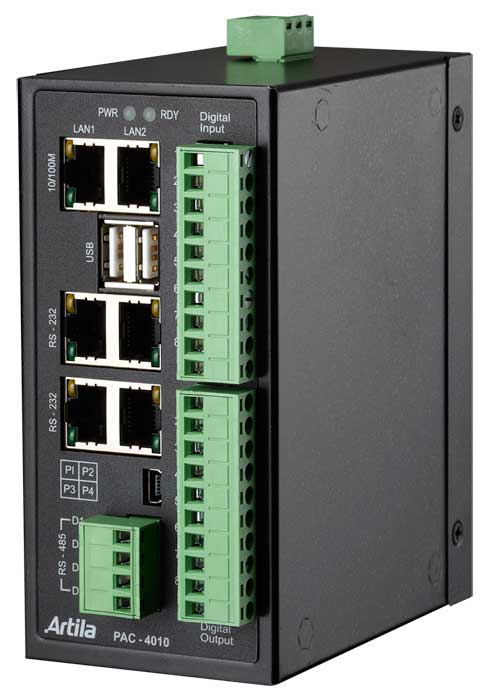
The Artila PAC-5010 is a compact, fanless, ARM9-based Linux automation controller designed for industrial control, monitoring, and data acquisition applications. It integrates a 180 MHz Atmel AT91RM9200 ARM9 processor, dual Ethernet interfaces, multiple serial ports, isolated digital I/O channels, and USB host ports in a DIN-rail mountable enclosure. The controller runs an embedded Linux 2.6.x operating system and provides a full GNU C/C++ development environment, enabling engineers to develop, deploy, and manage automation applications using open-source tools.
2. Key Features
- ARM9 Industrial Computing Platform:
Powered by an Atmel AT91RM9200 ARM920T processor running at 180 MHz (200 MIPS) with integrated MMU, 16 KB instruction cache, and 16 KB data cache.
- Pre-installed Linux OS:
Ships with Linux kernel 2.6.x, U-Boot 1.1.2 bootloader, and a full file system supporting JFFS2, EXT2/EXT3, VFAT/FAT, and NFS.
- Rich I/O Interfaces:
Includes 16 opto-isolated digital inputs (2.5 kV isolation) and 8 Darlington-pair digital outputs (500 mA max per channel, 5–50 VDC source voltage).
- Networking and Connectivity:
Dual 10/100 Mbps Ethernet ports (RJ-45), one RS-232 port with full modem control, one RS-485 port with hardware direction control, and two USB 2.0 host ports (12 Mbps).
- Expandable Storage:
One internal SD 1.0-compliant socket supporting up to 4 GB SD cards for data logging and application storage.
- Web and Network Services:
Integrated web server (Boa), FTP, Telnet, SSH, SNMP, and firewall (iptables) for remote monitoring and control.
- Open Development Environment:
Includes GNU C/C++ cross-compilation toolchain for Linux and Windows (CygWin), POSIX libraries, and BusyBox utilities.
- Industrial Design:
Fanless, DIN-rail mountable, wide 9–40 VDC power input, 0–70 °C operating temperature, CE/FCC Class A compliance.
- Security and Management:
Supports SSL, SSH 1.0/2.0, and user-level access control. Includes watchdog timer, real-time clock, and buzzer for system monitoring.
3. Technical Specifications
Processor & Memory
- CPU: Atmel AT91RM9200 ARM9 (ARM920T core)
- Clock Speed: 180 MHz (200 MIPS)
- Cache: 16 KB instruction, 16 KB data
- SDRAM: 64 MB
- Flash Memory: 16 MB
Networking
- Ethernet: 2 × 10/100 Base‑T (RJ‑45 connectors)
- Protocols: IPv4, ICMP, ARP, DHCP, NTP, TCP, UDP, FTP, Telnet, HTTP, PPP, PPPoE, CHAP, PAP, SMTP, SNMP v1/v2, SSL, SSH
Serial Interfaces
- RS‑232: 1 port (10‑pin header, full modem control)
- Signals: Tx, Rx, RTS, CTS, DSR, DTR, DCD, GND
- RS‑485: 1 port (screw terminal)
- Signals: Data+, Data‑, GND
- Console: 1 port (10‑pin header, Tx, Rx, GND)
- Baud Rate: up to 921.6 kbps
- Parity: None, Even, Odd, Mark, Space
- Data Bits: 5–8
- Stop Bits: 1, 1.5, 2
- Flow Control: RTS/CTS, XON/XOFF, None
USB Host Ports
- 2 × USB 2.0 Full‑Speed (12 Mbps)
- Connector: 10‑pin header
- Supported Devices: Flash disks, Wi‑Fi (IEEE 802.11b/g), RS‑232 adaptors
Digital I/O
- Inputs: 16 × opto‑isolated channels
- Logical High: 5–24 VDC
- Logical Low: 0–1.5 VDC
- Input Resistance: 1.2 kΩ @ 0.5 W
- Response Time: 20 µs
- Isolation: 2500 Vrms
- Outputs: 8 × Darlington‑pair channels (UDN2981A Allegro)
- Source Voltage: 5–50 VDC
- Max Output Current: 500 mA per channel
- Built‑in transient suppression diodes
Storage
- Internal SD 1.0 socket (supports up to 4 GB SD card)
Power
- Input Voltage: 9–40 VDC
- Power Consumption: 800 mA @ 12 VDC
- Protection: Auto‑polarity and surge protection
Environmental
- Operating Temperature: 0 – 70 °C (32 – 158 °F)
- Dimensions: 160 × 104 × 32 mm
- Mounting: DIN‑rail
- Compliance: CE Class A, FCC Class A
Indicators & Controls
- Power LED (green)
- Ready LED (system boot status)
- LAN1/LAN2 LEDs (link/activity)
- Serial Port LEDs (TX/RX status)
- User LEDs (LD1/LD2, dual‑color, programmable)
- Reset Button (hardware reset)
4. Functionality
The PAC‑5010 functions as a compact, embedded Linux automation controller capable of handling digital I/O operations, serial communications, and network‑based control tasks. It operates as a standalone industrial computer with built‑in web and network services, enabling remote configuration, monitoring, and data acquisition.
Use Cases & Applications:
- Industrial automation and process control
- Remote monitoring and data logging
- Building management systems (BMS)
- Machine control and relay actuation
- IoT gateway and edge computing node
- Networked sensor/actuator interface
Operation:
The controller boots from onboard flash using U‑Boot, loads the Linux 2.6.x kernel, and mounts its file system (RAMDISK + Flash Disk). Users can log in via Telnet, SSH, or serial console to configure network parameters, manage I/O, and deploy applications.
Compatibility:
- Supports standard Linux utilities and POSIX‑compliant applications.
- Compatible with USB Wi‑Fi adapters using Ralink RT2571 (rt73) chipset.
- Works with standard SD cards and USB mass storage devices.
- Accessible via any OS supporting SSH/Telnet/FTP.
5. Components & Accessories
Included Items:
1. PAC‑5010 Controller
2. CBL‑F10M9‑20 Cable (10‑pin header to DB9 male for RS‑232)
3. Artila CD (includes GNU tool chain, utilities, examples, and documentation)
4. User’s Guide
Optional Accessories:
- 4 GB SD Card (for data storage expansion)
- USB Wi‑Fi adapter (Ralink RT2571/rt73 chipset)
- USB RS‑232 adapters
- DIN‑rail mounting hardware (if not pre‑installed)
Connectors:
- Power Input (J3): +9 – 40 VDC with auto‑polarity protection
- Digital Input (J4): 16 channels grouped in 4 commons (COM1–COM4)
- Digital Output (J5): 8 channels (DO1–DO8) + VS (voltage source) + GND
- RS‑232/RS‑485/Console headers (10‑pin)
- USB header (10‑pin)
6. Installation & Setup
Power Requirements:
Supply 9–40 VDC to the J3 connector. The controller includes reverse polarity and surge protection.
Mounting:
DIN‑rail mountable enclosure (160 × 104 × 32 mm). Ensure adequate ventilation for fanless operation.
Initial Configuration:
- Default LAN1 IP: 192.168.2.127
- LAN2: DHCP enabled
- Login credentials: guest/guest (Telnet), root/root (SSH)
- Boot time: ~30 seconds
Network Setup:
Modify `/disk/etc/rc` to set static IP or enable DHCP:
- Static: `ifconfig eth0 192.168.2.127 netmask 255.255.255.0`
- DHCP: `dhcpcd eth1 &`
Wireless LAN Setup:
Insert USB Wi‑Fi adapter (Ralink RT2571). Use commands:
```
ifconfig wlan0 up
iwconfig wlan0 essid <SSID> key <KEY> mode managed
dhcpcd wlan0 &
```
Serial Console Access:
Use CBL‑F10M9‑20 to connect to PC RS‑232 port via null modem adapter.
Terminal settings: 115200 bps, 8N1, ANSI mode.
File System Structure:
- Root file system: RAMDISK (8 MB)
- User disk (/disk): Flash storage (~11 MB) for programs and configurations
- Files outside /disk are volatile and lost after power off.
Restoring Factory Defaults:
Copy files from `/default` to `/disk` to restore factory settings.
7. Performance & Capabilities
Processing Performance:
- 180 MHz ARM9 CPU delivering ~200 MIPS for real‑time control tasks.
- Efficient Linux kernel 2.6.x optimized for embedded applications.
I/O Performance:
- Digital input response time: 20 µs.
- Digital output current capacity: 500 mA per channel (5–50 VDC).
- Opto‑isolation ensures noise immunity in industrial environments.
Networking Performance:
- Dual 10/100 Mbps Ethernet interfaces support redundant or segmented networks.
- Supports TCP/IP stack with SSL and SSH for secure communication.
Storage Capacity:
- 16 MB onboard Flash for system and user disk.
- Expandable via SD card (up to 4 GB) and USB mass storage.
System Reliability:
- Watchdog timer for automatic recovery from system hangs.
- Real‑time clock for timestamping and scheduled operations.
- Fanless design reduces mechanical failure points.
Limitations:
- No analog I/O channels (natively digital only).
- USB ports limited to Full‑Speed (12 Mbps).
- Internal storage (16 MB Flash) may require external SD for large applications.
8. Standards & Compliance
- Electrical Safety: Opto‑isolation 2500 Vrms on digital inputs.
- EMC Compliance: CE Class A, FCC Class A.
- Environmental: 0 – 70 °C operating range for industrial environments.
- Software Standards: POSIX‑compliant libraries, GNU tool chain.
- Network Protocols: IPv4, TCP/IP, SNMP v1/v2, SSL, SSH 2.0.
9. Additional Information
Warranty & Support:
Artila provides standard manufacturer warranty and technical support for the PAC‑5010. Firmware updates, utilities, and documentation are available via the Artila support portal and included CD.
Maintenance:
- Periodically check power connections and DIN‑rail mount stability.
- Use the `update` utility to upgrade bootloader, kernel, or file system images.
- Use `update --FORMAT` to format user disk if necessary (supervisor mode only).
Software Utilities:
- update: Firmware and file system update tool.
- setuart: Configure serial port parameters and modes.
- gpioctl: Control digital I/O channels (DO1–DO8 and DI1–DI16).
- manager.jar: Java‑based network discovery and configuration utility.
- busybox, tinylogin, bash, ftp, telnet: Standard Linux utilities.
Development Environment:
- GNU C/C++ cross‑compiler (GCC) for Linux and CygWin.
- GLIBC POSIX library.
- Example programs and Makefiles included on Artila CD.
- Supports remote deployment via FTP and execution via SSH/Telnet.
Time Synchronization:
- Manual RTC adjustment via `date` and `hwclock –w`.
- NTP client utility available for automatic time synchronization.
Web Server Configuration:
- Web pages stored in `/home/httpd`.
- Configuration file: `boa.conf`.
- Default home page: `index.html`.
Device Drivers:
- SD/MMC, UART, RTC, Buzzer, Digital I/O, Ethernet, Watchdog.
- USB drivers for Flash disk, Wi‑Fi (IEEE 802.11b/g), RS‑232 adapters.
Device Nodes (/dev):
- ttyS0 (console), ttyS1 (RS‑485), ttyS2 (RS‑232)
- mmc0–mmc2 (SD card), sda–sde (USB storage)
- ttyUSB0–ttyUSB1 (USB serial adapters)
- rtc (Real Time Clock), gpio (Digital I/O)
System Recovery:
- Hardware reset button for manual reboot.
- Factory default files in `/default` directory.
Summary:
The Artila PAC‑5010 is a robust, Linux‑based programmable automation controller engineered for industrial applications requiring networked control, data acquisition, and remote management. Its ARM9 architecture, dual Ethernet interfaces, isolated digital I/O, and open‑source software environment make it a flexible solution for system integrators and automation engineers seeking a compact, reliable, and programmable platform for industrial automation and IoT deployments.

Product Name: PAC-5010
Model: PAC-5010
Series: ARM9-based Linux Programmable Automation Controller Series
Article Number: PAC-5010
Manufacturer: Artila Electronics Co., Ltd.
The Artila PAC-5010 is a compact, fanless, ARM9-based Linux automation controller designed for industrial control, monitoring, and data acquisition applications. It integrates a 180 MHz Atmel AT91RM9200 ARM9 processor, dual Ethernet interfaces, multiple serial ports, isolated digital I/O channels, and USB host ports in a DIN-rail mountable enclosure. The controller runs an embedded Linux 2.6.x operating system and provides a full GNU C/C++ development environment, enabling engineers to develop, deploy, and manage automation applications using open-source tools.
2. Key Features
- ARM9 Industrial Computing Platform:
Powered by an Atmel AT91RM9200 ARM920T processor running at 180 MHz (200 MIPS) with integrated MMU, 16 KB instruction cache, and 16 KB data cache.
- Pre-installed Linux OS:
Ships with Linux kernel 2.6.x, U-Boot 1.1.2 bootloader, and a full file system supporting JFFS2, EXT2/EXT3, VFAT/FAT, and NFS.
- Rich I/O Interfaces:
Includes 16 opto-isolated digital inputs (2.5 kV isolation) and 8 Darlington-pair digital outputs (500 mA max per channel, 5–50 VDC source voltage).
- Networking and Connectivity:
Dual 10/100 Mbps Ethernet ports (RJ-45), one RS-232 port with full modem control, one RS-485 port with hardware direction control, and two USB 2.0 host ports (12 Mbps).
- Expandable Storage:
One internal SD 1.0-compliant socket supporting up to 4 GB SD cards for data logging and application storage.
- Web and Network Services:
Integrated web server (Boa), FTP, Telnet, SSH, SNMP, and firewall (iptables) for remote monitoring and control.
- Open Development Environment:
Includes GNU C/C++ cross-compilation toolchain for Linux and Windows (CygWin), POSIX libraries, and BusyBox utilities.
- Industrial Design:
Fanless, DIN-rail mountable, wide 9–40 VDC power input, 0–70 °C operating temperature, CE/FCC Class A compliance.
- Security and Management:
Supports SSL, SSH 1.0/2.0, and user-level access control. Includes watchdog timer, real-time clock, and buzzer for system monitoring.
3. Technical Specifications
Processor & Memory
- CPU: Atmel AT91RM9200 ARM9 (ARM920T core)
- Clock Speed: 180 MHz (200 MIPS)
- Cache: 16 KB instruction, 16 KB data
- SDRAM: 64 MB
- Flash Memory: 16 MB
Networking
- Ethernet: 2 × 10/100 Base‑T (RJ‑45 connectors)
- Protocols: IPv4, ICMP, ARP, DHCP, NTP, TCP, UDP, FTP, Telnet, HTTP, PPP, PPPoE, CHAP, PAP, SMTP, SNMP v1/v2, SSL, SSH
Serial Interfaces
- RS‑232: 1 port (10‑pin header, full modem control)
- Signals: Tx, Rx, RTS, CTS, DSR, DTR, DCD, GND
- RS‑485: 1 port (screw terminal)
- Signals: Data+, Data‑, GND
- Console: 1 port (10‑pin header, Tx, Rx, GND)
- Baud Rate: up to 921.6 kbps
- Parity: None, Even, Odd, Mark, Space
- Data Bits: 5–8
- Stop Bits: 1, 1.5, 2
- Flow Control: RTS/CTS, XON/XOFF, None
USB Host Ports
- 2 × USB 2.0 Full‑Speed (12 Mbps)
- Connector: 10‑pin header
- Supported Devices: Flash disks, Wi‑Fi (IEEE 802.11b/g), RS‑232 adaptors
Digital I/O
- Inputs: 16 × opto‑isolated channels
- Logical High: 5–24 VDC
- Logical Low: 0–1.5 VDC
- Input Resistance: 1.2 kΩ @ 0.5 W
- Response Time: 20 µs
- Isolation: 2500 Vrms
- Outputs: 8 × Darlington‑pair channels (UDN2981A Allegro)
- Source Voltage: 5–50 VDC
- Max Output Current: 500 mA per channel
- Built‑in transient suppression diodes
Storage
- Internal SD 1.0 socket (supports up to 4 GB SD card)
Power
- Input Voltage: 9–40 VDC
- Power Consumption: 800 mA @ 12 VDC
- Protection: Auto‑polarity and surge protection
Environmental
- Operating Temperature: 0 – 70 °C (32 – 158 °F)
- Dimensions: 160 × 104 × 32 mm
- Mounting: DIN‑rail
- Compliance: CE Class A, FCC Class A
Indicators & Controls
- Power LED (green)
- Ready LED (system boot status)
- LAN1/LAN2 LEDs (link/activity)
- Serial Port LEDs (TX/RX status)
- User LEDs (LD1/LD2, dual‑color, programmable)
- Reset Button (hardware reset)
4. Functionality
The PAC‑5010 functions as a compact, embedded Linux automation controller capable of handling digital I/O operations, serial communications, and network‑based control tasks. It operates as a standalone industrial computer with built‑in web and network services, enabling remote configuration, monitoring, and data acquisition.
Use Cases & Applications:
- Industrial automation and process control
- Remote monitoring and data logging
- Building management systems (BMS)
- Machine control and relay actuation
- IoT gateway and edge computing node
- Networked sensor/actuator interface
Operation:
The controller boots from onboard flash using U‑Boot, loads the Linux 2.6.x kernel, and mounts its file system (RAMDISK + Flash Disk). Users can log in via Telnet, SSH, or serial console to configure network parameters, manage I/O, and deploy applications.
Compatibility:
- Supports standard Linux utilities and POSIX‑compliant applications.
- Compatible with USB Wi‑Fi adapters using Ralink RT2571 (rt73) chipset.
- Works with standard SD cards and USB mass storage devices.
- Accessible via any OS supporting SSH/Telnet/FTP.
5. Components & Accessories
Included Items:
1. PAC‑5010 Controller
2. CBL‑F10M9‑20 Cable (10‑pin header to DB9 male for RS‑232)
3. Artila CD (includes GNU tool chain, utilities, examples, and documentation)
4. User’s Guide
Optional Accessories:
- 4 GB SD Card (for data storage expansion)
- USB Wi‑Fi adapter (Ralink RT2571/rt73 chipset)
- USB RS‑232 adapters
- DIN‑rail mounting hardware (if not pre‑installed)
Connectors:
- Power Input (J3): +9 – 40 VDC with auto‑polarity protection
- Digital Input (J4): 16 channels grouped in 4 commons (COM1–COM4)
- Digital Output (J5): 8 channels (DO1–DO8) + VS (voltage source) + GND
- RS‑232/RS‑485/Console headers (10‑pin)
- USB header (10‑pin)
6. Installation & Setup
Power Requirements:
Supply 9–40 VDC to the J3 connector. The controller includes reverse polarity and surge protection.
Mounting:
DIN‑rail mountable enclosure (160 × 104 × 32 mm). Ensure adequate ventilation for fanless operation.
Initial Configuration:
- Default LAN1 IP: 192.168.2.127
- LAN2: DHCP enabled
- Login credentials: guest/guest (Telnet), root/root (SSH)
- Boot time: ~30 seconds
Network Setup:
Modify `/disk/etc/rc` to set static IP or enable DHCP:
- Static: `ifconfig eth0 192.168.2.127 netmask 255.255.255.0`
- DHCP: `dhcpcd eth1 &`
Wireless LAN Setup:
Insert USB Wi‑Fi adapter (Ralink RT2571). Use commands:
```
ifconfig wlan0 up
iwconfig wlan0 essid <SSID> key <KEY> mode managed
dhcpcd wlan0 &
```
Serial Console Access:
Use CBL‑F10M9‑20 to connect to PC RS‑232 port via null modem adapter.
Terminal settings: 115200 bps, 8N1, ANSI mode.
File System Structure:
- Root file system: RAMDISK (8 MB)
- User disk (/disk): Flash storage (~11 MB) for programs and configurations
- Files outside /disk are volatile and lost after power off.
Restoring Factory Defaults:
Copy files from `/default` to `/disk` to restore factory settings.
7. Performance & Capabilities
Processing Performance:
- 180 MHz ARM9 CPU delivering ~200 MIPS for real‑time control tasks.
- Efficient Linux kernel 2.6.x optimized for embedded applications.
I/O Performance:
- Digital input response time: 20 µs.
- Digital output current capacity: 500 mA per channel (5–50 VDC).
- Opto‑isolation ensures noise immunity in industrial environments.
Networking Performance:
- Dual 10/100 Mbps Ethernet interfaces support redundant or segmented networks.
- Supports TCP/IP stack with SSL and SSH for secure communication.
Storage Capacity:
- 16 MB onboard Flash for system and user disk.
- Expandable via SD card (up to 4 GB) and USB mass storage.
System Reliability:
- Watchdog timer for automatic recovery from system hangs.
- Real‑time clock for timestamping and scheduled operations.
- Fanless design reduces mechanical failure points.
Limitations:
- No analog I/O channels (natively digital only).
- USB ports limited to Full‑Speed (12 Mbps).
- Internal storage (16 MB Flash) may require external SD for large applications.
8. Standards & Compliance
- Electrical Safety: Opto‑isolation 2500 Vrms on digital inputs.
- EMC Compliance: CE Class A, FCC Class A.
- Environmental: 0 – 70 °C operating range for industrial environments.
- Software Standards: POSIX‑compliant libraries, GNU tool chain.
- Network Protocols: IPv4, TCP/IP, SNMP v1/v2, SSL, SSH 2.0.
9. Additional Information
Warranty & Support:
Artila provides standard manufacturer warranty and technical support for the PAC‑5010. Firmware updates, utilities, and documentation are available via the Artila support portal and included CD.
Maintenance:
- Periodically check power connections and DIN‑rail mount stability.
- Use the `update` utility to upgrade bootloader, kernel, or file system images.
- Use `update --FORMAT` to format user disk if necessary (supervisor mode only).
Software Utilities:
- update: Firmware and file system update tool.
- setuart: Configure serial port parameters and modes.
- gpioctl: Control digital I/O channels (DO1–DO8 and DI1–DI16).
- manager.jar: Java‑based network discovery and configuration utility.
- busybox, tinylogin, bash, ftp, telnet: Standard Linux utilities.
Development Environment:
- GNU C/C++ cross‑compiler (GCC) for Linux and CygWin.
- GLIBC POSIX library.
- Example programs and Makefiles included on Artila CD.
- Supports remote deployment via FTP and execution via SSH/Telnet.
Time Synchronization:
- Manual RTC adjustment via `date` and `hwclock –w`.
- NTP client utility available for automatic time synchronization.
Web Server Configuration:
- Web pages stored in `/home/httpd`.
- Configuration file: `boa.conf`.
- Default home page: `index.html`.
Device Drivers:
- SD/MMC, UART, RTC, Buzzer, Digital I/O, Ethernet, Watchdog.
- USB drivers for Flash disk, Wi‑Fi (IEEE 802.11b/g), RS‑232 adapters.
Device Nodes (/dev):
- ttyS0 (console), ttyS1 (RS‑485), ttyS2 (RS‑232)
- mmc0–mmc2 (SD card), sda–sde (USB storage)
- ttyUSB0–ttyUSB1 (USB serial adapters)
- rtc (Real Time Clock), gpio (Digital I/O)
System Recovery:
- Hardware reset button for manual reboot.
- Factory default files in `/default` directory.
Summary:
The Artila PAC‑5010 is a robust, Linux‑based programmable automation controller engineered for industrial applications requiring networked control, data acquisition, and remote management. Its ARM9 architecture, dual Ethernet interfaces, isolated digital I/O, and open‑source software environment make it a flexible solution for system integrators and automation engineers seeking a compact, reliable, and programmable platform for industrial automation and IoT deployments.

-
ds_ipac5010.pdf
PDF Catalog
-
Warranty Declaration.pdf
PDF Catalog
-
PAC_5010_user_guide.pdf
Manual
- CB-F10M9-20 - DB9m adapter cable iPAC-50XX